Lattice-Trapped Atom Interferometry with a Bose-Einstein condensate: Observation and Control of Interactions
Pith reviewed 2026-06-29 14:13 UTC · model grok-4.3
The pith
A ytterbium Bose-Einstein condensate provides the source for a lattice-trapped atom interferometer in which atomic interactions produce measurable contrast loss and phase shifts that can be tuned by density.
A machine-rendered reading of the paper's core claim, the machinery that carries it, and where it could break.
Core claim
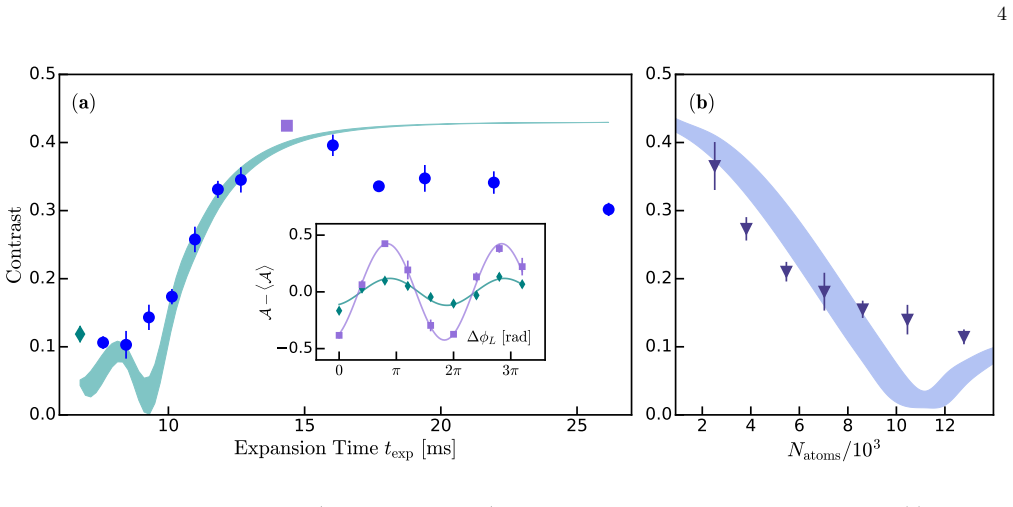
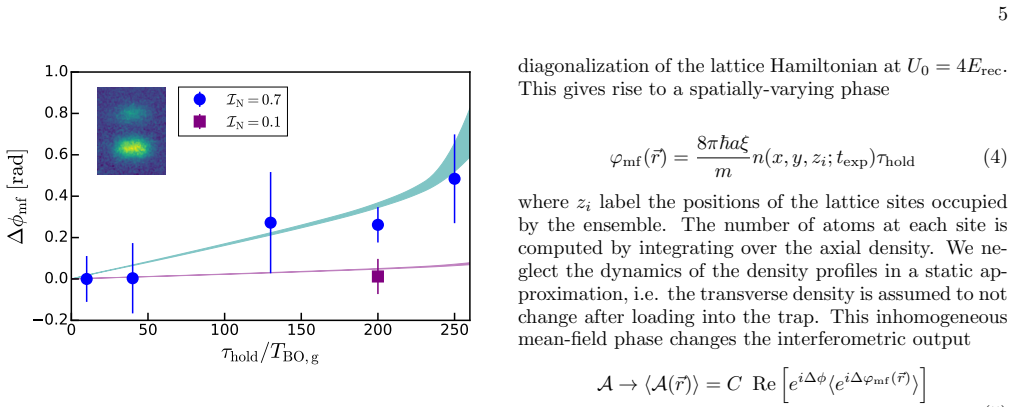
We realize a lattice-trapped interferometer whose two arms originate from a weakly-interacting ytterbium Bose-Einstein condensate that is coherently split and trapped by pulsed optical standing waves. Direct signatures of atomic interactions appear as density-dependent reductions in fringe contrast and as phase shifts; both effects are controlled by changing atom number or sample volume and are captured quantitatively by a mean-field model.
What carries the argument
Lattice-trapped interferometer arms sourced from a ytterbium BEC, with interactions read out through contrast and phase and modeled by mean-field theory.
If this is right
- Atom number can be increased to improve signal-to-noise without immediate loss of fringe visibility provided density is kept below the interaction-dominated threshold.
- Interaction-induced phase shifts become a tunable resource rather than an uncontrolled systematic.
- Lattice interferometers can operate with bright, high-phase-space-density sources while still remaining describable by single-particle plus mean-field physics.
- Performance optimization by density control extends the practical range of lattice-trapped sensors before many-body corrections dominate.
Where Pith is reading between the lines
- The same density-tuning method could be used to null interaction phase shifts in future precision measurements of gravity or accelerations.
- Extending the platform to two-dimensional lattices or to other bosonic species would test whether the mean-field control remains equally effective.
- If interaction control proves robust, lattice interferometers could incorporate engineered many-body states for enhanced sensitivity beyond the standard quantum limit.
Load-bearing premise
The mean-field description remains accurate over the explored density range and no higher-order correlations or hidden systematics produce the observed contrast and phase changes.
What would settle it
A set of contrast and phase measurements at several densities that deviate systematically from the mean-field curves while all known experimental imperfections are held fixed.
Figures
read the original abstract
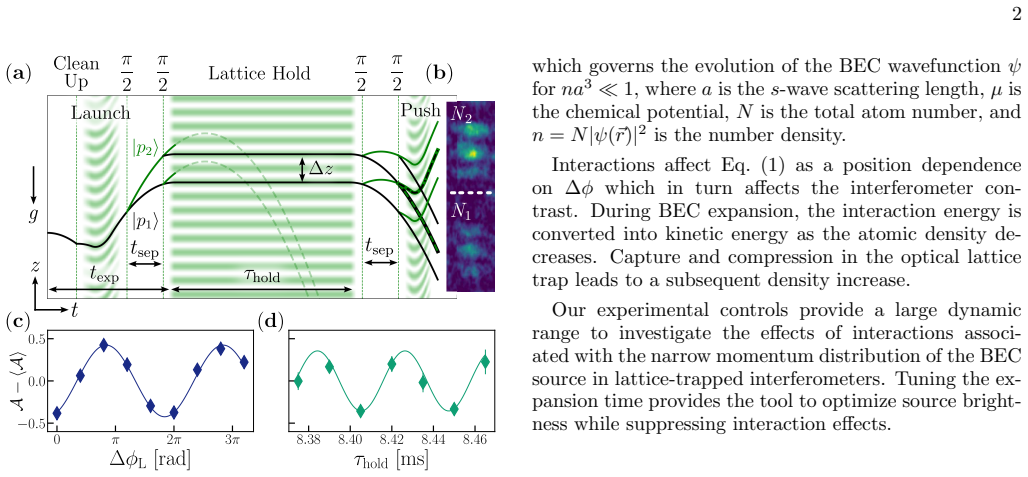
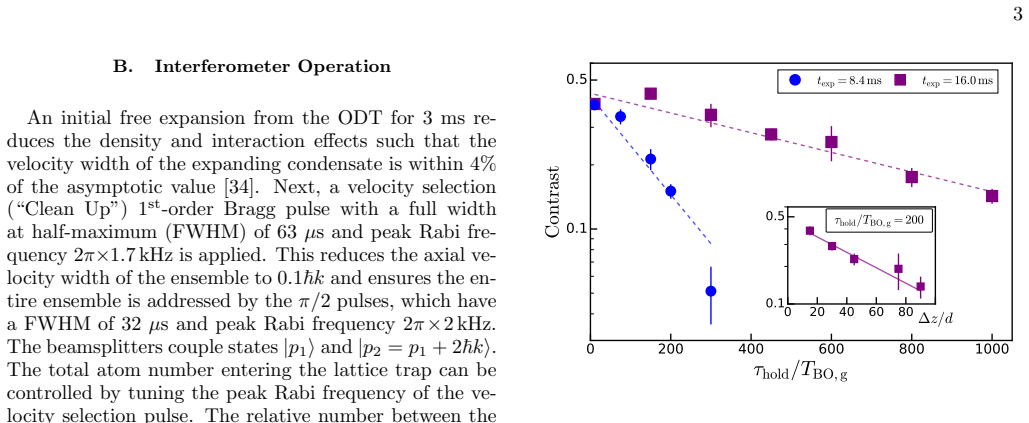
Precision interferometry with atomic wavepackets confined in a one-dimensional optical lattice is an emergent paradigm in quantum sensing of forces and fields, with applications in gravimetry, accelerometry, geophysics, and fundamental physics tests. We report on the realization of a lattice-trapped interferometer where the two arms are sourced from a weakly-interacting ytterbium Bose-Einstein condensate, coherently split and trapped by pulsed optical standing waves before recombination. We directly observe atomic interactions through contrast changes and phase shifts of the interferometer. By changing either the atom number or the sample volume to vary the density, we demonstrate control over interactions and optimize interferometer performance. Our observations are effectively captured by a mean-field theoretical model of the system. This work experimentally probes the boundary where improved performance from source brightening through higher phase space density transitions into a regime beyond single-atom physics in lattice-trapped atom interferometry, and opens a door to incorporating many-body effects for metrological advances in such platforms.
Editorial analysis
A structured set of objections, weighed in public.
Referee Report
Summary. The paper reports the experimental realization of a lattice-trapped atom interferometer sourced from a weakly interacting ytterbium BEC. The arms are coherently split and trapped using pulsed optical standing waves, with recombination yielding direct observations of atomic interactions via contrast reduction and phase shifts. Density is varied by changing atom number or sample volume, demonstrating control over interaction effects and optimization of interferometer performance. The observations are stated to be captured by a mean-field theoretical model.
Significance. If the mean-field description is quantitatively validated across the density range, the work establishes a controlled experimental platform for probing the crossover from single-particle to many-body regimes in lattice interferometry. This could enable density-tuned optimization of contrast and phase stability, with implications for precision sensing applications that incorporate controlled many-body effects.
major comments (2)
- [Results and model comparison sections] The central claim that observations are 'effectively captured' by the mean-field model requires explicit quantitative support. The manuscript should present fit residuals, reduced chi-squared values, and independent calibration of the interaction parameter (e.g., via scattering length or density measurements) for the contrast and phase data at multiple densities; without these, it is not possible to confirm that higher-order correlations or unaccounted systematics are negligible.
- [Experimental methods and data analysis] Control experiments isolating interaction signatures from potential density-dependent systematics (lattice pulse imperfections, detection nonlinearities, or trap anharmonicities) are not described. Such controls are load-bearing for attributing contrast/phase changes specifically to the mean-field interaction term when density is varied via atom number versus volume.
minor comments (2)
- [Theoretical model] Clarify the precise definition and units of the mean-field interaction parameter used in the model fits.
- [Figures] Ensure all figures include error bars on contrast and phase data points and state the number of experimental repetitions per point.
Simulated Author's Rebuttal
We thank the referee for their constructive comments, which help strengthen the quantitative rigor of our work. We address each major comment below and will revise the manuscript to incorporate the requested elements.
read point-by-point responses
-
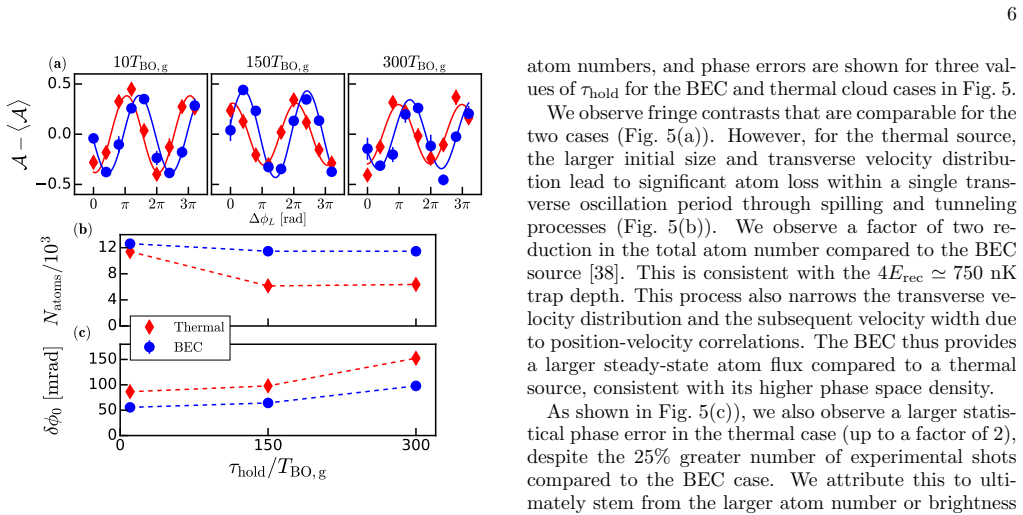
Referee: [Results and model comparison sections] The central claim that observations are 'effectively captured' by the mean-field model requires explicit quantitative support. The manuscript should present fit residuals, reduced chi-squared values, and independent calibration of the interaction parameter (e.g., via scattering length or density measurements) for the contrast and phase data at multiple densities; without these, it is not possible to confirm that higher-order correlations or unaccounted systematics are negligible.
Authors: We agree that explicit quantitative metrics are needed to support the mean-field description. In the revised manuscript we will add a new subsection presenting fit residuals and reduced chi-squared values for the contrast and phase data at each density. We will also include the independent calibration procedure, using the known ytterbium scattering length together with absorption-imaging density measurements, to demonstrate that the interaction parameter is not a free fit but is fixed by separate calibration. revision: yes
-
Referee: [Experimental methods and data analysis] Control experiments isolating interaction signatures from potential density-dependent systematics (lattice pulse imperfections, detection nonlinearities, or trap anharmonicities) are not described. Such controls are load-bearing for attributing contrast/phase changes specifically to the mean-field interaction term when density is varied via atom number versus volume.
Authors: We acknowledge that the original manuscript did not describe the control experiments in sufficient detail. In the revision we will expand the methods and data-analysis sections to document the controls performed: (i) lattice-pulse amplitude and duration scans at fixed density, (ii) linearity checks of the absorption imaging system across the relevant optical depths, and (iii) trap-frequency measurements confirming anharmonicity remains negligible. We will explicitly compare the two density-variation methods (atom number vs. volume) to show that the observed contrast and phase shifts track the mean-field prediction rather than these systematics. revision: yes
Circularity Check
No significant circularity; experimental data compared to independent mean-field model
full rationale
The paper reports experimental realization of a lattice-trapped BEC interferometer, direct observation of density-dependent contrast and phase shifts, and comparison to a standard mean-field (Gross-Pitaevskii) model. No load-bearing step reduces by construction to fitted inputs from the same dataset, self-citation chains, or ansatz smuggling. The model is an external theoretical framework whose validity is tested against independent measurements (varying atom number or volume); no equations or claims in the provided text show a prediction equivalent to its own inputs. This is the common case of an experimental paper whose central claims rest on falsifiable data rather than definitional equivalence.
Axiom & Free-Parameter Ledger
free parameters (1)
- mean-field interaction parameter
axioms (1)
- domain assumption Mean-field approximation suffices for the weakly interacting regime explored
Reference graph
Works this paper leans on
-
[1]
Af- ter release from the ODT, the BEC wavefunction under- goes a self-similar dilation [37] with TF radii growing as Ri(t) =λ i(t)R0,i
of interacting BECs in the Thomas-Fermi regime during the expansion timet exp until lattice trapping. Af- ter release from the ODT, the BEC wavefunction under- goes a self-similar dilation [37] with TF radii growing as Ri(t) =λ i(t)R0,i. We determine the scale factorsλ i(t) by numerical integration [34] and obtain the condensate den- sity during expansion...
-
[2]
= 2π×3.4 Hz, and the corresponding breathing mode period is 150 ms. Our observations atτ hold = 200T BO,g = 170 ms (Fig.3) are still well-captured by our static model, suggesting that any transverse oscillations in cloud size effectively averages away with minimal effect on the interferometer signal. The model underestimates the contrast in regimes of hig...
-
[3]
Morel, Y
L. Morel, Y. Zhao, P. Clade, and S. Guellati-Khelifa, Determination of the fine-structure constant with an ac- curacy of 81 parts per trillion, Nature588, 61 (2020)
2020
-
[4]
M. Abe, P. Adamson, M. Borcean, D. Bortoletto, K. Bridges, S. P. Carman, S. Chattopadhyay, J. Coleman, N. M. Curfman, and K. D. et al, Matter-wave atomic gra- diometer interferometric sensor (MAGIS-100), Quantum Science and Technology6, 044003 (2021). 8
2021
-
[5]
Asenbaum, C
P. Asenbaum, C. Overstreet, M. Kim, J. Curti, and M. A. Kasevich, Atom-interferometric test of the equivalence principle at the 10−12 level, Phys. Rev. Lett.125, 191101 (2020)
2020
-
[6]
O. Dobkowski, B. Trok, P. Skakunenko, Y. Japha, D. Groswasser, M. Efremov, C. Marletto, I. Fuentes, R. Penrose, V. Vedral, W. P. Schleich, and R. Folman, Observation of quantum free fall and the consistency with the equivalence principle (2025), arXiv:2502.14535 [quant-ph]
-
[7]
D.-F. Zhang, J.-T. Li, W.-Z. Wang, W.-H. Xu, J.-Y. Wei, X. Li, Y.-B. Wang, D.-F. Gao, J.-Q. Zhong, B. Tang, L. Zhou, R.-B. Li, H.-Y. Sun, Q.-F. Chen, L. Qin, M. zhen An, Z.-F. Li, S.-Q. Wang, X.-X. Guo, Y. Tian, X.-H. Yu, H.-E. Zhong, X. Chen, J. Wang, and M.- S. Zhan, In-orbit test of the weak equivalence princi- ple with atom interferometry (2026), arXi...
-
[8]
Panda, M
C. Panda, M. Tao, J. Egelhoff, M. Ceja, V. Xu, and H. Muller, Coherence limits in lattice atom interferom- etry at the one-minute scale, Nature Physics20, 1234 (2024)
2024
-
[9]
Ben-A¨ ıcha, Z
Y. Ben-A¨ ıcha, Z. Mehdi, C. Freier, S. S. Szigeti, P. B. Wigley, L. O. Conlon, R. Husband, S. Legge, R. H. Ea- gle, J. J. Hope, N. P. Robins, J. D. Close, K. S. Hardman, S. A. Haine, and R. J. Thomas, Dual open atom interfer- ometry for compact and mobile quantum sensing, Phys. Rev. Lett.133, 263403 (2024)
2024
-
[10]
J. M. McGuirk, G. T. Foster, J. B. Fixler, M. J. Snadden, and M. A. Kasevich, Sensitive absolute-gravity gradiom- etry using atom interferometry, Phys. Rev. A65, 033608 (2002)
2002
-
[11]
Zhang, L.-L
T. Zhang, L.-L. Chen, Y.-B. Shu, W.-J. Xu, Y. Cheng, Q. Luo, Z.-K. Hu, and M.-K. Zhou, Ultrahigh-sensitivity bragg atom gravimeter and its application in testing Lorentz violation, Phys. Rev. Appl.20, 014067 (2023)
2023
-
[12]
S. M. Dickerson, J. M. Hogan, A. Sugarbaker, D. M. S. Johnson, and M. A. Kasevich, Multiaxis inertial sensing with long-time point source atom interferometry, Phys. Rev. Lett.111, 083001 (2013)
2013
-
[13]
Stolzenberg, C
K. Stolzenberg, C. Struckmann, S. Bode, R. Li, A. Herbst, V. Vollenkemper, D. Thomas, A. Ra- jagopalan, E. M. Rasel, N. Gaaloul, and D. Schlippert, Multi-axis inertial sensing with 2d matter-wave arrays, Phys. Rev. Lett.134, 143601 (2025)
2025
-
[14]
Gersemann, A
M. Gersemann, A. Rajagopalan, M. Abidi, P. Bar- bey, A. Sabu, X. Chen, N. B. Weddig, B. Tennstedt, J. Petring, N. Droese, A. Kassner, C. K¨ unzler, L. Kein- ert, X. Xiao, F. Dencker, M. C. Wurz, A. L¨ ower, E. von Hin¨ uber, D. Schlippert, E. M. Rasel, S. Sch¨ on, and S. Abend, Developments for quantum inertial navigation systems employing Bose–Einstein c...
2025
-
[15]
Bidel, N
Y. Bidel, N. Zahzam, C. Blanchard, A. Bonnin, M. Cadoret, A. Bresson, D. Rouxel, and M. F. Lequentrec-Lalancette, Absolute marine gravimetry with matter-wave interferometry, Nature Communications9, 627 (2018)
2018
-
[16]
X. Wu, Z. Pagel, B. S. Malek, T. H. Nguyen, F. Zi, D. S. Scheirer, and H. M¨ uller, Gravity surveys using a mobile atom interferometer, Science Advances5(2019)
2019
-
[17]
Asenbaum, C
P. Asenbaum, C. Overstreet, T. Kovachy, D. Brown, J. Hogan, and M. Kasevich, Phase shift in an atom in- terferometer due to spacetime curvature across its wave function, Phys. Rev. Lett.118, 183602 (2017)
2017
-
[18]
Abdalla and et al., Terrestrial very-long-baseline atom interferometry: Summary of the second workshop, EPJ Quantum Technology12, 42 (2025)
A. Abdalla and et al., Terrestrial very-long-baseline atom interferometry: Summary of the second workshop, EPJ Quantum Technology12, 42 (2025)
2025
-
[19]
McDonald, C
G. McDonald, C. Kuhn, S. Bennetts, J. Debs, K. Hard- man, M. Johnsson, J. Close, and N. Robins, 80ℏkmo- mentum separation with Bloch oscillations in an optically guided atom interferometer, Phys. Rev. A88, 053620 (2013)
2013
-
[20]
K. A. Krzyzanowska, J. Ferreras, C. Ryu, E. C. Samson, and M. G. Boshier, Matter-wave analog of a fiber-optic gyroscope, Phys. Rev. A108, 043305 (2023)
2023
-
[21]
X. Chai, E. Nolasco-Martinez, X. Liang, J. L. Tanlimco, E. Q. Simmons, E. Zhu, R. Sajjad, H. Mas, S. N. Ha- lawani, A. Cao, and D. M. Weld, Continuously trapped matter-wave interferometry in magic Floquet-Bloch band structures, Nature Communications17, 2530 (2026)
2026
-
[22]
LeDesma, K
C. LeDesma, K. Mehling, and M. Holland, Vector atom accelerometry in an optical lattice, Science Advances11, eadt7480 (2025)
2025
-
[23]
Balland, L
Y. Balland, L. Absil, and F. Pereira Dos Santos, Quec- tonewton local force sensor, Phys. Rev. Lett.133, 113403 (2024)
2024
-
[24]
Charri` ere, M
R. Charri` ere, M. Cadoret, N. Zahzam, Y. Bidel, and A. Bresson, Local gravity measurement with the com- bination of atom interferometry and Bloch oscillations, Phys. Rev. A85, 013639 (2012)
2012
-
[25]
Zhang, R
X. Zhang, R. P. del Aguila, T. Mazzoni, N. Poli, and G. M. Tino, Trapped-atom interferometer with ultracold sr atoms, Phys. Rev. A94, 043608 (2016)
2016
-
[26]
V. Xu, M. Jaffe, C. Panda, S. Kristensen, L. Clark, and H. Muller, Probing gravity by holding atoms for 20 sec- onds, Science366, 745 (2019)
2019
-
[27]
Panda, M
C. Panda, M. Tao, M. Ceja, , J. Khoury, G. Tino, and H. Muller, Measuring gravitational attraction with a lat- tice atom interferometer, Nature631, 515 (2024)
2024
-
[28]
Horikoshi and K
M. Horikoshi and K. Nakagawa, Dephasing due to atom- atom interaction in a waveguide interferometer using a Bose-Einstein condensate, Phys. Rev. A74, 031602(R) (2006)
2006
-
[29]
Burchianti, C
A. Burchianti, C. D’Errico, L. Marconi, F. Minardi, C. Fort, and M. Modugno, Effect of interactions in the interference pattern of Bose-Einstein condensates, Phys. Rev. A102, 043314 (2020)
2020
-
[30]
Plotkin-Swing, D
B. Plotkin-Swing, D. Gochnauer, K. McAlpine, E. Cooper, A. Jamison, and S. Gupta, Three-path atom interferometry with large momentum separation, Phys. Rev. Lett.121, 133201 (2018)
2018
-
[31]
Plotkin-Swing, Large momentum separation matter wave interferometry, University of Washington PhD The- sis (2018)
B. Plotkin-Swing, Large momentum separation matter wave interferometry, University of Washington PhD The- sis (2018)
2018
-
[32]
Gochnauer, K
D. Gochnauer, K. McAlpine, B. Plotkin-Swing, A. Jami- son, and S. Gupta, Bloch-band picture for light-pulse atom diffraction and interferometry, Phys. Rev. A.100, 043611 (2019)
2019
-
[33]
McAlpine, D
K. McAlpine, D. Gochnauer, and S. Gupta, Excited- band Bloch oscillations for precision atom interferometry, Phys. Rev. A.101, 023614 (2020)
2020
-
[34]
Gochnauer, T
D. Gochnauer, T. Rahman, A. Wirth, and S. Gupta, In- terferometry in an atomic fountain with ytterbium Bose- Einstein condensates, Atoms9, 58 (2021)
2021
-
[35]
Rahman, A
T. Rahman, A. Wirth-Singh, A. Ivanov, D. Gochnauer, E. Hough, and S. Gupta, Bloch oscillation phases inves- tigated by multipath St¨ uckelberg atom interferometry, 9 Phys. Rev. Res.6, L022012 (2024)
2024
-
[36]
Hough, T
E. Hough, T. Rahman, F. Tschirhart, and S. Gupta, Sup- plementary material for lattice trapped atom interferom- etry with a bose-einstein condensate: Observation and control of interactions (2026)
2026
-
[37]
Piccon, S
R. Piccon, S. Sarkar, J. Gomes Baptista, S. Merlet, and F. Pereira Dos Santos, Separating the output ports of a Bragg interferometer via velocity selective transport, Phys. Rev. A106, 013303 (2022)
2022
-
[38]
Castin and R
Y. Castin and R. Dum, Bose-Einstein condensates in time dependent traps, Phys. Rev. Lett.77, 5315 (1996)
1996
-
[39]
A. O. Jamison, J. N. Kutz, and S. Gupta, Atomic inter- actions in precision interferometry Using Bose-Einstein condensates, Phys. Rev. A.84, 043643 (2011)
2011
-
[40]
The interferometer geometry (Fig
When decreasing the velocity distribution from thermal to BEC, the two competing effects of narrowing ve- locity distribution and decreasing initial atom number roughly cancel after our velocity selection and approxi- mately 25,000 atoms enter the interferometer sequence for both sources. The interferometer geometry (Fig. 1) implies that only half of thes...
-
[41]
J. M. Hensley, A. Peters, and S. Chu, Active low fre- quency vertical vibration isolation, Review of Scientific Instruments70, 2735 (1999)
1999
-
[42]
Fitzek, J.-N
F. Fitzek, J.-N. Kirsten-Siemß, E. M. Rasel, N. Gaaloul, and K. Hammerer, Accurate and efficient Bloch- oscillation-enhanced atom interferometry, Phys. Rev. Res.6, L032028 (2024)
2024
-
[43]
A. M. Rey, B. L. Hu, E. Calzetta, A. Roura, and C. W. Clark, Nonequilibrium dynamics of optical-lattice- loaded Bose-Einstein-condensate atoms: Beyond the Hartree-Fock-Bogoliubov approximation, Phys. Rev. A 69, 033610 (2004)
2004
-
[44]
Polkovnikov and D.-W
A. Polkovnikov and D.-W. Wang, Effect of quantum fluc- tuations on the dipolar motion of Bose-Einstein conden- sates in optical lattices, Phys. Rev. Lett.93, 070401 (2004)
2004
-
[45]
Sørensen, L
A. Sørensen, L. M. Duan, J. I. Cirac, and P. Zoller, Many-particle entanglement with Bose-Einstein conden- sates, Nature409, 63 (2001)
2001
-
[46]
Corgier, L
R. Corgier, L. Pezz` e, and A. Smerzi, Nonlinear bragg interferometer with a trapped Bose-Einstein condensate, Phys. Rev. A103, L061301 (2021)
2021
-
[47]
Clean Up
R. Corgier, N. Gaaloul, A. Smerzi, and L. Pezz` e, Delta- kick squeezing, Phys. Rev. Lett.127, 183401 (2021). 10 Supplementary Material for: Lattice-Trapped Atom Interferometry with a Bose-Einstein condensate: Observation and Control of Interactions SI. EXPERIMENT AL DET AILS The Bloch oscillation (BO) “push” phase acts as a momentum-state-selective contr...
2021
discussion (0)
Sign in with ORCID, Apple, or X to comment. Anyone can read and Pith papers without signing in.