SYNAPSE: Neuro-Symbolic Visual Thought-to-Text Decoding via Topological Semantic Denoising
Pith reviewed 2026-06-29 13:43 UTC · model grok-4.3
The pith
SYNAPSE stabilizes EEG-to-text decoding in frozen LLMs by purifying semantic candidates with commonsense graphs.
A machine-rendered reading of the paper's core claim, the machinery that carries it, and where it could break.
Core claim
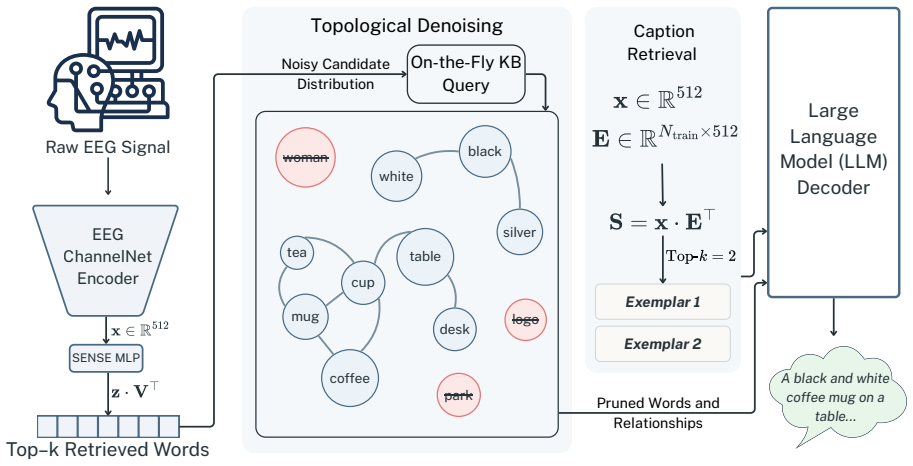
SYNAPSE (Symbolic Neural Alignment for Precise Semantic Extraction) is a lightweight framework that applies topological semantic denoising at inference time: EEG-derived semantic candidates are purified using commonsense graph structure and latent exemplars, thereby stabilizing generation in unmodified language models against biological noise.
What carries the argument
The inference-time symbolic regularization step that purifies EEG-derived semantic candidates via commonsense graph structure and latent exemplars.
If this is right
- Consistent gains over unconstrained prompting baselines on popular EEG decoding benchmarks.
- Robust performance when object labels are ablated from the input.
- Results comparable to fine-tuned systems while avoiding their computational cost.
- Biometric privacy is maintained because raw EEG processing stays inside the encoder stack.
Where Pith is reading between the lines
- The same purification mechanism could be tested on other noisy neural signals such as fMRI or MEG without model retraining.
- Symbolic graph regularization may offer a general way to stabilize LLM outputs from any high-variance sensor input.
- Localizing the denoising step could support on-device brain-computer interfaces that avoid sending raw data to remote servers.
Load-bearing premise
Purifying EEG-derived semantic candidates with commonsense graph structure and latent exemplars will effectively reduce the effects of biological noise on frozen language model outputs.
What would settle it
A controlled test on the same EEG benchmarks showing no measurable gain in semantic stability metrics when the symbolic purification step is removed or replaced by random filtering.
Figures
read the original abstract
Recent advances in large language models have accelerated open-vocabulary EEG-to-imagined-text decoding, where non-invasive neural activity recorded during visual perception is translated into coherent natural language descriptions of viewed stimuli. However, existing systems remain highly vulnerable to biological noise, where corrupted neural projections induce hallucinated or semantically unstable generation in frozen language models. We introduce SYNAPSE (Symbolic Neural Alignment for Precise Semantic Extraction), a lightweight neuro-symbolic framework that stabilizes neural text generation through inference-time symbolic regularization. By purifying EEG-derived semantic candidates using commonsense graph structure and latent exemplars, SYNAPSE improves semantic stability without end-to-end LLM fine-tuning. Experiments across popular EEG decoding benchmarks and multiple frozen LLM backends demonstrate consistent gains over unconstrained prompting baselines, robustness under object-label ablation, and performance commensurate with substantially more resource-intensive fine-tuned systems, while preserving biometric privacy by localizing raw EEG processing entirely within the encoder stack.
Editorial analysis
A structured set of objections, weighed in public.
Referee Report
Summary. The manuscript introduces SYNAPSE, a neuro-symbolic framework for open-vocabulary EEG-to-imagined-text decoding. It stabilizes generation in frozen LLMs via inference-time topological semantic denoising that purifies EEG-derived semantic candidates using commonsense graph structure and latent exemplars, without end-to-end fine-tuning. Experiments on popular EEG benchmarks across multiple frozen LLM backends are claimed to show consistent gains over unconstrained prompting, robustness under object-label ablation, and performance comparable to resource-intensive fine-tuned systems while keeping raw EEG processing local for biometric privacy.
Significance. If the experimental claims hold, the work would demonstrate a lightweight inference-time symbolic regularization technique that improves semantic stability against biological noise in EEG decoding. This could reduce reliance on fine-tuning for neuro-symbolic BCI systems and support privacy-preserving deployments; the combination of graph-based purification with frozen LLMs is a potentially useful direction for stabilizing noisy neural projections.
major comments (1)
- [Abstract] Abstract: the central claim of 'consistent gains over unconstrained prompting baselines' and 'performance commensurate with substantially more resource-intensive fine-tuned systems' is presented without any quantitative metrics, error bars, dataset names, or statistical details. This absence is load-bearing because the soundness of the semantic-stability improvement rests entirely on these unreported experimental results.
minor comments (2)
- The title refers to 'Topological Semantic Denoising' while the abstract defines the acronym as 'Symbolic Neural Alignment for Precise Semantic Extraction'; the relationship between these framings should be clarified in the introduction or methods.
- The weakest assumption (purifying EEG candidates via commonsense graphs will stabilize frozen-LLM generation) is stated at a high level; a concrete description of the graph construction, denoising operator, or exemplar selection procedure would aid reproducibility.
Simulated Author's Rebuttal
We thank the referee for their thoughtful review and for highlighting the need for greater specificity in the abstract. We address the single major comment below.
read point-by-point responses
-
Referee: [Abstract] Abstract: the central claim of 'consistent gains over unconstrained prompting baselines' and 'performance commensurate with substantially more resource-intensive fine-tuned systems' is presented without any quantitative metrics, error bars, dataset names, or statistical details. This absence is load-bearing because the soundness of the semantic-stability improvement rests entirely on these unreported experimental results.
Authors: We agree that the abstract would benefit from explicit quantitative support for its central claims. The full manuscript reports results on standard EEG benchmarks (e.g., EEG-ImageNet and related visual decoding datasets) across multiple frozen LLM backends, including average accuracy or semantic similarity gains with standard deviations. In the revised version we will condense the key numerical findings—such as relative improvements over unconstrained prompting and comparison to fine-tuned baselines—directly into the abstract, along with dataset names and any reported statistical details, while preserving the abstract’s length constraints. revision: yes
Circularity Check
No significant circularity detected
full rationale
The abstract and context describe a neuro-symbolic framework for EEG-to-text decoding that relies on commonsense graph structure and latent exemplars for semantic purification at inference time. No equations, derivations, fitted parameters, or self-referential predictions are present. The central claim of improved semantic stability is supported by external benchmark experiments rather than reducing to self-definition or self-citation chains. The derivation chain is self-contained against external benchmarks with no load-bearing steps that collapse to inputs by construction.
Axiom & Free-Parameter Ledger
Reference graph
Works this paper leans on
-
[1]
Abhijit Mishra, Shreya Shukla, Jose Torres, Jacek Gwizdka, and Shounak Roychowdhury
Generalizable spelling using a speech neuro- prosthesis in an individual with severe limb and vocal paralysis.Nature communications, 13(1):6510. Abhijit Mishra, Shreya Shukla, Jose Torres, Jacek Gwizdka, and Shounak Roychowdhury. 2025. Thought2Text: Text generation from EEG signal using large language models (LLMs). InFindings of the Association for Compu...
-
[2]
LLaMA: Open and Efficient Foundation Language Models
Deep learning human mind for automated visual classification. InProceedings of the IEEE con- ference on computer vision and pattern recognition, pages 6809–6817. Robyn Speer, Joshua Chin, and Catherine Havasi. 2017. Conceptnet 5.5: an open multilingual graph of gen- eral knowledge. InProceedings of the Thirty-First AAAI Conference on Artificial Intelligen...
work page internal anchor Pith review Pith/arXiv arXiv 2017
-
[5]
Output ONLY the raw caption string text
Do NOT include annotations, prefix strings, quotes, or conversational meta-commentary. Output ONLY the raw caption string text. Output: B.1.2 Graph Cleaned Bag-of-Words Minimal Baseline (A 6) This configuration isolates the base limits of our network-filtering mechanism, conditioning the decoder exclusively on the degree centrality filtered keywords along...
-
[7]
Prioritize concepts verified by the brain-signal keywords
-
[8]
Output ONLY the raw caption string text
Do NOT include annotations, prefix strings, quotes, or conversational meta-commentary. Output ONLY the raw caption string text. Output: B.1.3 Context Resilience Prompt Track (A 3) Designed to measure framework vulnerability to isolated connectionist failures, this configuration decou- ples the generation sequence from primary perceptual tracking classes, ...
-
[11]
Output ONLY the raw caption string text
Do NOT include annotations, prefix strings, quotes, or conversational meta-commentary. Output ONLY the raw caption string text. Output: B.1.4 Relational Fact Ablation Configuration (A 5) This template deactivates the relational background constraints cache F. It forces the autoregressive layers to process structural layout guides and keyword vectors witho...
-
[14]
Output ONLY the raw caption string text
Do NOT include annotations, prefix strings, quotes, or conversational meta-commentary. Output ONLY the raw caption string text. Output: B.1.5 In-Context Exemplar Blueprint Ablation Configuration (A 4) This setting isolates model reactions to a strict zero-shot operational setting by dropping the grammatical blueprint matrixE exemplars while preserving con...
-
[17]
Output ONLY the raw caption string text
Do NOT include annotations, prefix strings, quotes, or conversational meta-commentary. Output ONLY the raw caption string text. Output: B.2 THINGS EEG2 Scaling Profiles To trace the scaling dynamics within the experimental scope, we document the prompting profiles configured for the multi-subject THINGS EEG2 matrix. B.2.1 THINGS EEG2 Full Scaling Model Ar...
-
[20]
Output ONLY the raw caption string text
Do NOT include annotations, prefix strings, quotes, or conversational meta-commentary. Output ONLY the raw caption string text. Output: B.2.2 THINGS EEG2 Syntactic Blueprint Matrix Ablation (B 2) This template strips away cross-modal target coordinates (Eexemplars), forcing the autoregressive decoder to structure descriptions under high crowding metrics w...
-
[21]
Synthesize these primitives into exactly ONE clear, fluent English description (8-20 words)
-
[22]
Prioritize concepts verified by both the brain-signal keywords and the common-sense relational constraints
-
[23]
Output ONLY the raw caption string text
Do NOT include annotations, prefix strings, quotes, or conversational meta-commentary. Output ONLY the raw caption string text. Output: 16
discussion (0)
Sign in with ORCID, Apple, or X to comment. Anyone can read and Pith papers without signing in.