Elliptic Flow of Multi-strange Hadrons in Au+Au Collisions at sqrt{s_(NN)} = 7.7-19.6 GeV
Pith reviewed 2026-06-29 09:25 UTC · model grok-4.3
The pith
Multi-strange hadrons maintain NCQ scaling in elliptic flow down to 7.7 GeV, pointing to partonic origin of collectivity.
A machine-rendered reading of the paper's core claim, the machinery that carries it, and where it could break.
Core claim
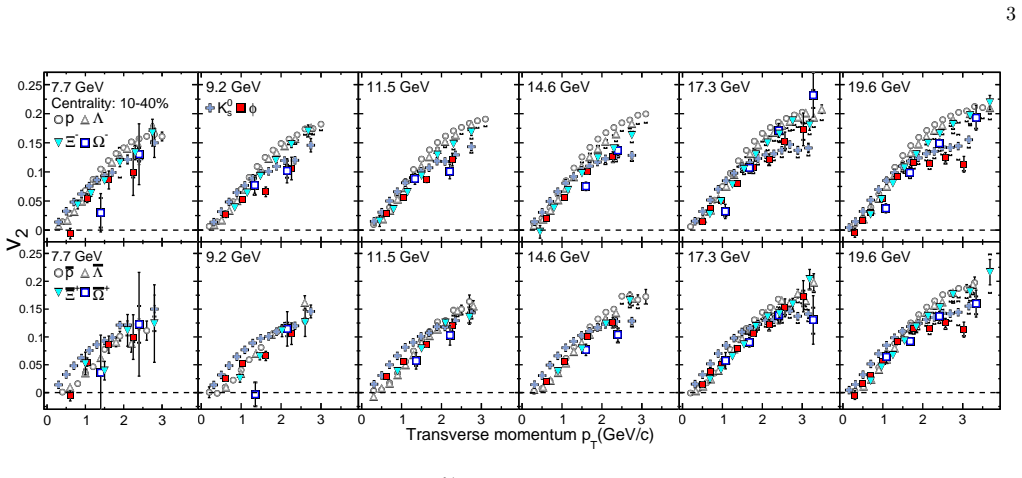
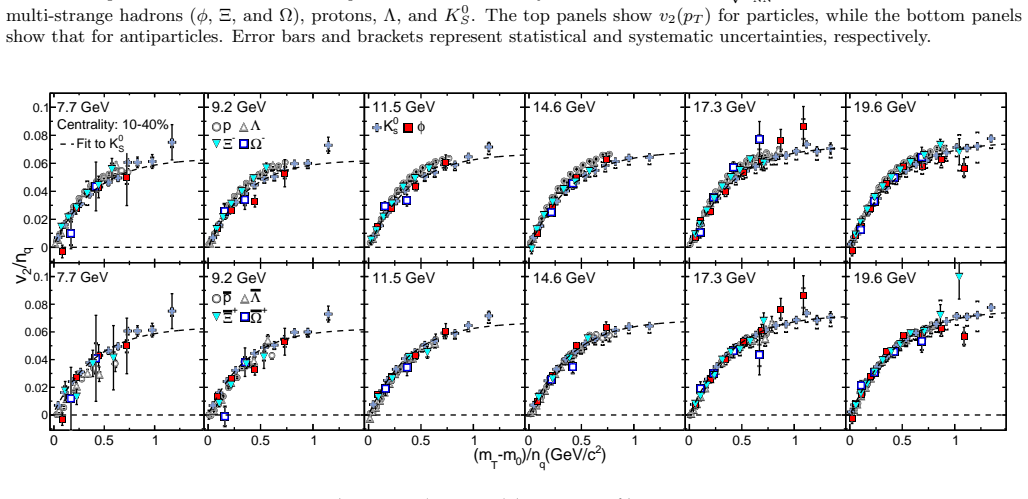
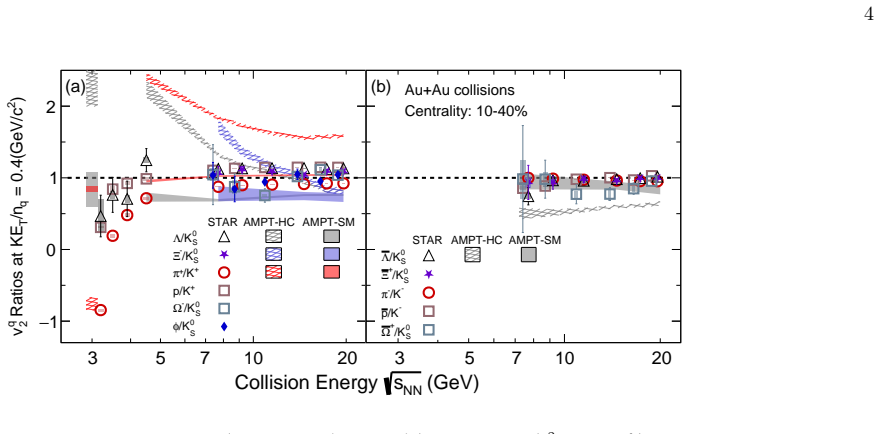
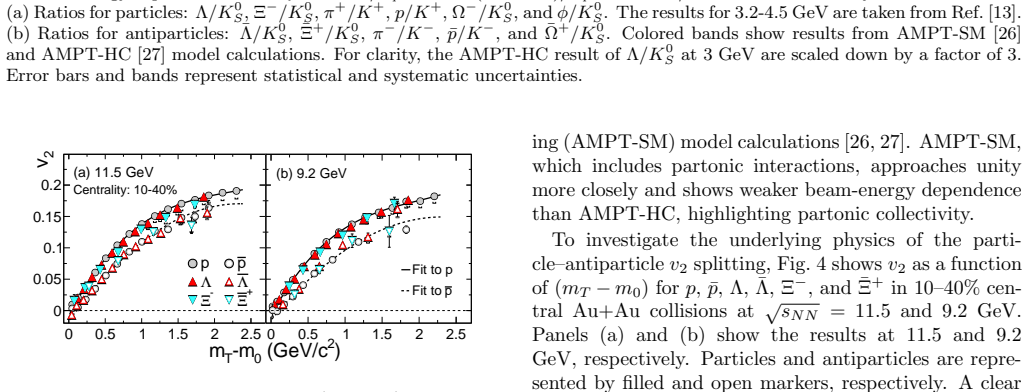
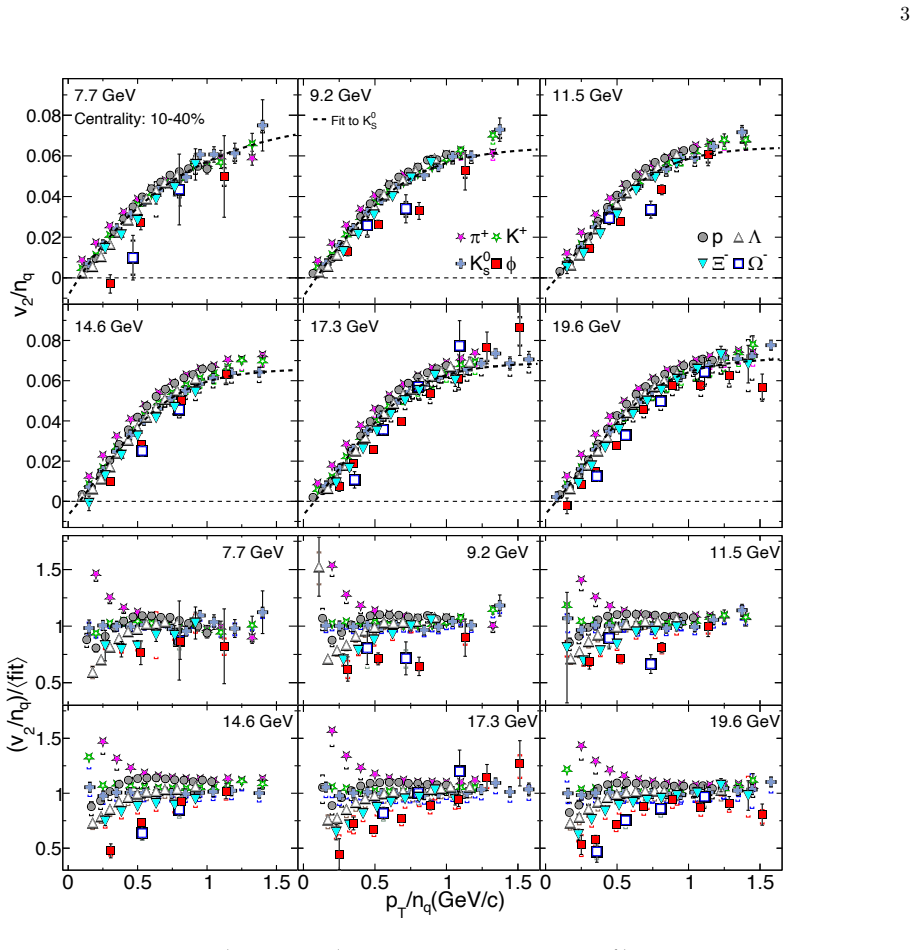
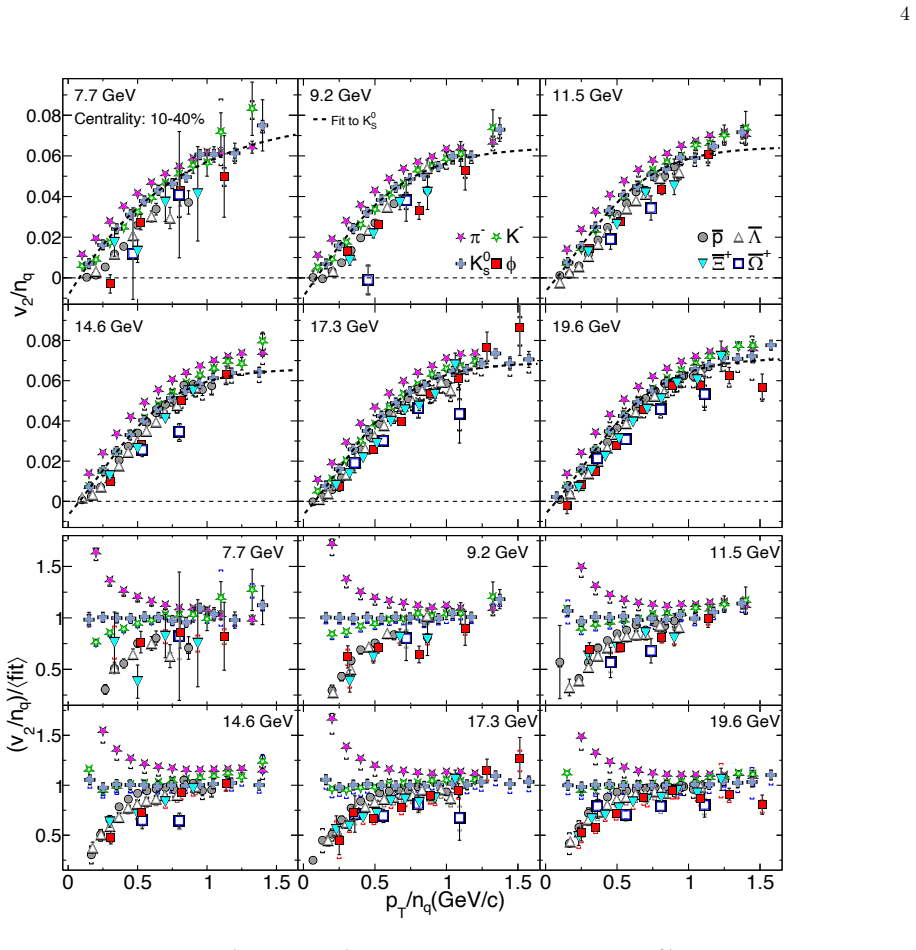
The NCQ-scaled v2 of multi-strange hadrons follows the scaling seen for other identified species, with ratios to Ks0 near unity and weak beam-energy dependence; similar particle-antiparticle v2 splittings for p, Lambda, and Xi indicate the splitting depends weakly on hadronic interaction strength, implying late-stage hadronic interactions are subdominant and the splitting reflects early partonic dynamics.
What carries the argument
Number-of-constituent-quark (NCQ) scaling applied to elliptic flow v2 of multi-strange hadrons, used to test whether flow develops before hadronization.
If this is right
- Collective flow is established predominantly before hadronization even at the lowest beam energies studied.
- Late hadronic rescattering contributes little to the observed elliptic flow.
- The particle-antiparticle v2 difference is fixed in the partonic stage rather than by hadronic interactions.
- NCQ scaling remains valid with only weak dependence on collision energy for these probes.
Where Pith is reading between the lines
- The findings would support the presence of partonic degrees of freedom and collective behavior at energies where the system may be closer to a hadronic regime.
- Measurements at still lower energies could map the energy where NCQ scaling first appears or breaks.
- The results constrain hydrodynamic and transport models on the relative timing of flow development and hadronization.
Load-bearing premise
The small hadronic interaction cross sections of multi-strange hadrons ensure their v2 is set in the partonic stage with negligible distortion from later hadronic rescattering.
What would settle it
A clear breakdown in NCQ scaling specifically for multi-strange hadrons at 7.7 GeV, or a strong correlation between the size of particle-antiparticle v2 splitting and hadronic cross section.
Figures
read the original abstract
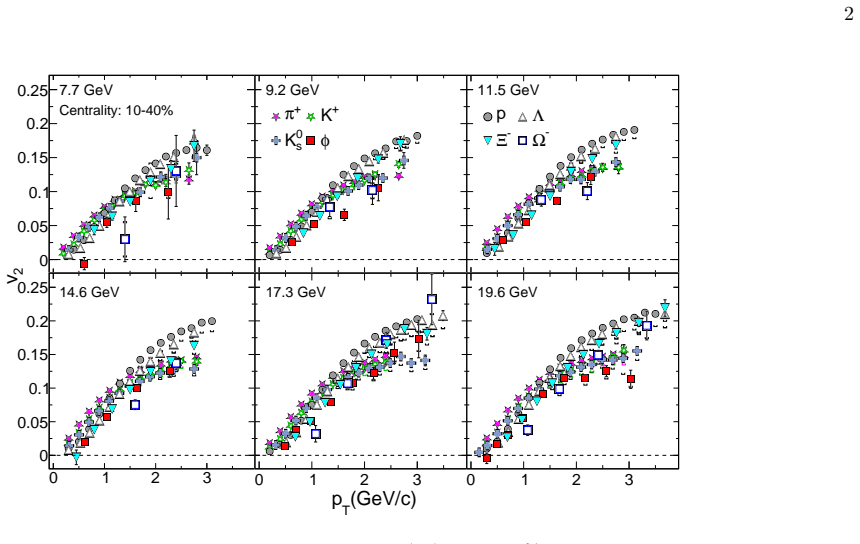
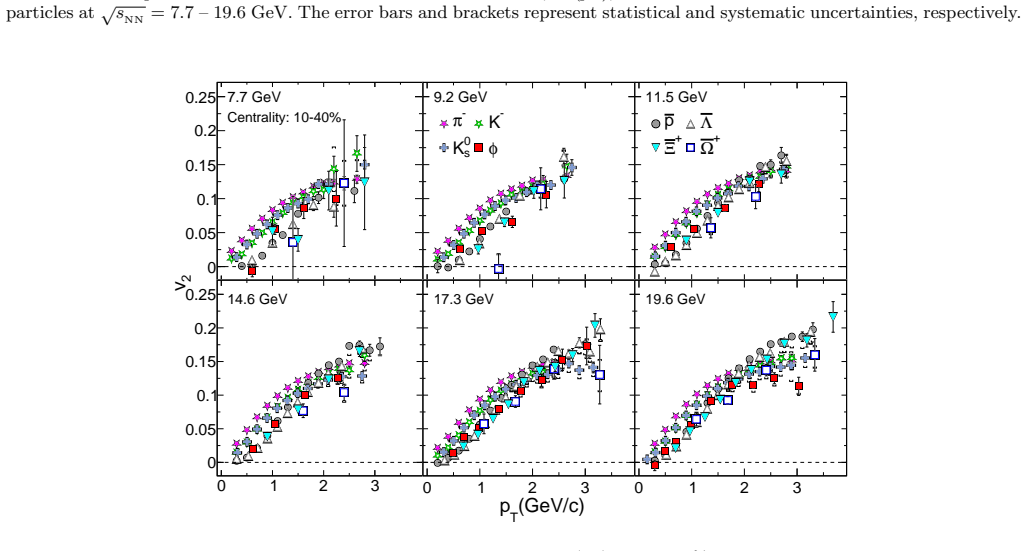
Multi-strange hadrons ($\phi$, $\Xi$, and $\Omega$), owing to their small hadronic interaction cross sections, provide a sensitive probe of partonic collectivity with minimal distortion from late-stage hadronic rescattering. Using high-statistics data from the second phase of the STAR Beam Energy Scan program, we present precision measurements of elliptic flow ($v_2$) for multi-strange hadrons, together with other identified hadrons ($\pi^{\pm}, K^{\pm}$, $K_{S}^{0}$, $p$, and $\Lambda$) for comparison, in Au+Au collisions at $\sqrt{s_{NN}}$ = 7.7--19.6 GeV. Number-of-constituent-quark (NCQ) scaling is examined separately for particles and antiparticles. The NCQ-scaled $v_2$ of multi-strange hadrons follows the scaling observed for other identified species, with ratios relative to $K_{S}^{0}$ close to unity and exhibiting weak beam-energy dependence. The persistence of NCQ scaling for these weakly interacting probes provides strong evidence that collective flow is predominantly developed in the partonic phase, persisting down to $\sqrt{s_{NN}}$ = 7.7 GeV. The similar particle-antiparticle $v_2$ splittings observed for $p$, $\Lambda$, and $\Xi$, despite their markedly different hadronic cross sections, indicate that the splitting depends weakly on hadronic interaction strength. This suggests that late-stage hadronic interactions are subdominant and that the observed splitting primarily reflects dynamics established in the early, partonic stage.
Editorial analysis
A structured set of objections, weighed in public.
Referee Report
Summary. The paper reports precision v2 measurements for multi-strange hadrons (φ, Ξ, Ω) and lighter species (π, K, p, Λ) in Au+Au collisions at √s_NN = 7.7–19.6 GeV from the STAR Beam Energy Scan. NCQ scaling is tested separately for particles and antiparticles; the NCQ-scaled v2 of multi-strange hadrons tracks that of other species with ratios near unity and weak energy dependence. Particle-antiparticle v2 splittings are found to be similar across p, Λ, and Ξ despite differing hadronic cross sections. The authors interpret these results as evidence that collective flow develops predominantly in the partonic phase down to 7.7 GeV, with late-stage hadronic effects subdominant.
Significance. If the measurements and scaling hold after full systematic evaluation, the work supplies direct experimental support for partonic collectivity at the lowest BES energies using probes with minimal hadronic rescattering. The species-independent splitting observation is a concrete constraint on models separating partonic and hadronic contributions to flow.
major comments (2)
- [Methods / Data Analysis] The provided manuscript text (abstract) does not detail the event-plane resolution correction, centrality determination, or track-quality cuts used for the multi-strange reconstruction; these are load-bearing for the claimed precision of the NCQ ratios and must be quantified in the methods section to support the central claim of scaling persistence.
- [Discussion] The interpretation that similar p–Λ–Ξ splittings imply hadronic interactions are subdominant rests on the assumption that the hadronic cross-section differences are large enough to produce observable distortions if rescattering dominated; a quantitative estimate of expected distortion (e.g., via transport-model comparison) is needed to make this step rigorous.
minor comments (2)
- [Figures] Figure captions should explicitly state the pT range and centrality binning used for each NCQ-scaled ratio panel.
- [Introduction / Results] Notation for NCQ scaling (v2/nq vs. (mT–m0)/nq) should be defined once in the text before the first ratio plot.
Simulated Author's Rebuttal
We thank the referee for the positive assessment and recommendation of minor revision. The comments identify opportunities to strengthen the presentation of methods and the rigor of the discussion. We address each major comment below.
read point-by-point responses
-
Referee: [Methods / Data Analysis] The provided manuscript text (abstract) does not detail the event-plane resolution correction, centrality determination, or track-quality cuts used for the multi-strange reconstruction; these are load-bearing for the claimed precision of the NCQ ratios and must be quantified in the methods section to support the central claim of scaling persistence.
Authors: The full manuscript contains a dedicated Analysis section that specifies the event-plane resolution correction (sub-event method with tabulated resolution values per energy), centrality selection via charged-particle multiplicity in |η|<0.5, and the track-quality and topological cuts applied to multi-strange reconstruction. To address the concern directly and ensure these details are unambiguous, we will expand the section in the revised version with explicit numerical values, a summary table of cuts, and resolution factors to further support the precision of the NCQ ratios. revision: yes
-
Referee: [Discussion] The interpretation that similar p–Λ–Ξ splittings imply hadronic interactions are subdominant rests on the assumption that the hadronic cross-section differences are large enough to produce observable distortions if rescattering dominated; a quantitative estimate of expected distortion (e.g., via transport-model comparison) is needed to make this step rigorous.
Authors: We agree that an explicit quantitative estimate would make the argument more rigorous. In the revised manuscript we will add a brief comparison with published transport-model results (AMPT and UrQMD) that quantify the expected v2 splitting arising from hadronic rescattering for species with the measured cross-section differences. This will demonstrate that the observed particle-antiparticle similarity is inconsistent with dominant late-stage hadronic contributions. revision: yes
Circularity Check
No significant circularity; direct experimental measurements
full rationale
The paper reports precision v2 measurements for identified hadrons including multi-strange species in Au+Au collisions at several beam energies. NCQ scaling is examined by plotting the measured v2 divided by number of constituent quarks versus transverse kinetic energy per quark; the observed adherence for multi-strange hadrons is an empirical result from the data, not a quantity derived or fitted within the paper. Particle-antiparticle splitting comparisons are likewise direct data comparisons across species. No equations, ansatze, uniqueness theorems, or self-citations are invoked to derive or predict the reported quantities from other quantities inside the same work. The central claims follow from the reported observables without reduction to fitted inputs or self-referential definitions.
Axiom & Free-Parameter Ledger
axioms (2)
- domain assumption Number-of-constituent-quark scaling is a signature of partonic collectivity
- domain assumption Multi-strange hadrons have small hadronic cross sections leading to minimal late-stage rescattering
Reference graph
Works this paper leans on
-
[1]
M. M. Aggarwalet al.(STAR Collaboration), arXiv:1007.2613 [nucl-ex]
work page internal anchor Pith review Pith/arXiv arXiv
-
[2]
A. M. Poskanzer and S. A. Voloshin, Phys. Rev. C58, 1671 (1998), arXiv:nucl-ex/9805001
work page internal anchor Pith review Pith/arXiv arXiv 1998
-
[3]
S. A. Voloshin, A. M. Poskanzer, and R. Snellings, Landolt-Bornstein23, 293 (2010), arXiv:0809.2949 [nucl- ex]
work page internal anchor Pith review Pith/arXiv arXiv 2010
-
[4]
Multi-strange baryon elliptic flow in Au+Au collisions at sqrt(s_NN)= 200 GeV
J. Adamset al.(STAR Collaboration), Phys. Rev. Lett. 95, 122301 (2005), arXiv:nucl-ex/0504022
work page internal anchor Pith review Pith/arXiv arXiv 2005
-
[6]
B. I. Abelevet al.(STAR Collaboration), Phys. Rev. C 75, 054906 (2007), arXiv:nucl-ex/0701010
work page internal anchor Pith review Pith/arXiv arXiv 2007
-
[7]
B. I. Abelevet al.(STAR Collaboration), Phys. Rev. C 77, 054901 (2008), arXiv:0801.3466 [nucl-ex]
work page internal anchor Pith review Pith/arXiv arXiv 2008
-
[8]
L. Adamczyket al.(STAR Collaboration), Phys. Rev. Lett.116, 062301 (2016), arXiv:1507.05247 [nucl-ex]
work page internal anchor Pith review Pith/arXiv arXiv 2016
-
[9]
Measurement of $D^0$ azimuthal anisotropy at mid-rapidity in Au+Au collisions at \sNN = 200\,GeV
L. Adamczyket al.(STAR Collaboration), Phys. Rev. Lett.118, 212301 (2017), arXiv:1701.06060 [nucl-ex]
work page internal anchor Pith review Pith/arXiv arXiv 2017
-
[10]
B. B. Abelevet al.(ALICE), JHEP06, 190 (2015), arXiv:1405.4632 [nucl-ex]
work page internal anchor Pith review Pith/arXiv arXiv 2015
-
[11]
A. M. Sirunyanet al.(CMS Collaboration), Phys. Rev. Lett.121, 082301 (2018), arXiv:1804.09767 [hep-ex]
work page internal anchor Pith review Pith/arXiv arXiv 2018
-
[12]
J. Chenet al., Chin. Phys. Lett.43, 030102 (2026), arXiv:2601.12977 [nucl-ex]
- [13]
-
[14]
Collision Broadening of the Phi Meson in Baryon Rich Hadronic Matter
W. Smith and K. L. Haglin, Phys. Rev. C57, 1449 (1998), arXiv:nucl-th/9710026
work page internal anchor Pith review Pith/arXiv arXiv 1998
-
[15]
W. S. Chung, G.-Q. Li, and C. M. Ko, Nucl. Phys. A 625, 347 (1997), arXiv:nucl-th/9704002
work page internal anchor Pith review Pith/arXiv arXiv 1997
-
[16]
Ferrari and L
F. Ferrari and L. Fonda, Phys. Rev.114, 874 (1959)
1959
-
[17]
A. Gal, E. V. Hungerford, and D. J. Millener, Rev. Mod. Phys.88, 035004 (2016), arXiv:1605.00557 [nucl-th]
work page internal anchor Pith review Pith/arXiv arXiv 2016
-
[18]
V. Crede and J. Yelton, Rept. Prog. Phys.87, 106301 (2024), arXiv:2502.08815 [hep-ex]
-
[19]
Navaset al.(Particle Data Group), Phys
S. Navaset al.(Particle Data Group), Phys. Rev. D110, 030001 (2024)
2024
-
[20]
Hydrodynamics at large baryon densities: Understanding proton vs. anti-proton v_2 and other puzzles
J. Steinheimer, V. Koch, and M. Bleicher, Phys. Rev. C 86, 044903 (2012), arXiv:1207.2791 [nucl-th]
work page internal anchor Pith review Pith/arXiv arXiv 2012
-
[21]
Effects of hadronic potentials on elliptic flows in relativistic heavy ion collisions
J. Xu, L.-W. Chen, C. M. Ko, and Z.-W. Lin, Phys. Rev. C85, 041901 (2012), arXiv:1201.3391 [nucl-th]
work page internal anchor Pith review Pith/arXiv arXiv 2012
-
[22]
J. Xu, T. Song, C. M. Ko, and F. Li, Phys. Rev. Lett. 112, 012301 (2014), arXiv:1308.1753 [nucl-th]
work page internal anchor Pith review Pith/arXiv arXiv 2014
- [23]
-
[24]
J. C. Dunlop, M. A. Lisa, and P. Sorensen, Phys. Rev. C84, 044914 (2011), arXiv:1107.3078 [hep-ph]
work page internal anchor Pith review Pith/arXiv arXiv 2011
- [25]
-
[26]
Improved Quark Coalescence for a Multi-Phase Transport Model
Y. He and Z.-W. Lin, Phys. Rev. C96, 014910 (2017), arXiv:1703.02673 [nucl-th]
work page internal anchor Pith review Pith/arXiv arXiv 2017
-
[27]
G.-C. Yong, Z.-G. Xiao, Y. Gao, and Z.-W. Lin, Physics Letters B820, 136521 (2021), arXiv:2105.10284 [nucl-th]
-
[28]
The RHIC Beam Energy Scan Phase II: Physics and Upgrades
C. Yang (STAR Collaboration), Nuclear Physics A967, 800 (2017), arXiv:1810.04767 [nucl-ex]
work page internal anchor Pith review Pith/arXiv arXiv 2017
- [29]
-
[30]
J. Adamset al., Nucl. Instrum. Meth. A968, 163970 (2020), arXiv:1912.05243 [physics.ins-det]
- [31]
- [32]
-
[33]
Elliptic flow of identified hadrons in Au+Au collisions at $\sqrt{s_{NN}}=$ 7.7--62.4 GeV
L. Adamczyket al.(STAR Collaboration), Phys. Rev. C 88, 014902 (2013), arXiv:1301.2348 [nucl-ex]
work page internal anchor Pith review Pith/arXiv arXiv 2013
-
[34]
Kisel (CBM Collaboration), J
I. Kisel (CBM Collaboration), J. Phys. Conf. Ser.1070, 012015 (2018)
2018
-
[35]
Banerjee, I
A. Banerjee, I. Kisel, and M. Zyzak, Int. J. Mod. Phys. 6 A35, 2043003 (2020)
2020
-
[36]
B. I. Abelevet al.(STAR Collaboration), Phys. Rev. C 79, 064903 (2009), arXiv:0809.4737 [nucl-ex]
work page internal anchor Pith review Pith/arXiv arXiv 2009
-
[37]
See Supplemental Material athttp://......for details
-
[38]
Event plane resolution correction for azimuthal anisotropy in wide centrality bins
H. Masui, A. Schmah, and A. M. Poskanzer, Nucl. Instrum. Meth. A833, 181 (2016), arXiv:1212.3650 [physics.data-an]
work page internal anchor Pith review Pith/arXiv arXiv 2016
-
[39]
Shenet al., Nucl
F. Shenet al., Nucl. Instrum. Meth. A896, 90 (2018)
2018
-
[40]
Systematic Errors: facts and fictions
R. Barlow, arXiv:hep-ex/0207026
work page internal anchor Pith review Pith/arXiv arXiv
-
[41]
Flow analysis with cumulants: direct calculations
A. Bilandzic, R. Snellings, and S. Voloshin, Phys. Rev. C83, 044913 (2011), arXiv:1010.0233 [nucl-ex]
work page internal anchor Pith review Pith/arXiv arXiv 2011
-
[42]
L. Adamczyket al.(STAR Collaboration), Phys. Rev. Lett.110, 142301 (2013), arXiv:1301.2347 [nucl-ex]
work page internal anchor Pith review Pith/arXiv arXiv 2013
-
[43]
Radial and elliptic flow at RHIC: further predictions
P. Huovinen, P. F. Kolb, U. W. Heinz, P. V. Ruuska- nen, and S. A. Voloshin, Phys. Lett. B503, 58 (2001), arXiv:hep-ph/0101136
work page internal anchor Pith review Pith/arXiv arXiv 2001
-
[47]
L. Adamczyket al.(STAR Collaboration), Phys. Rev. C 93, 014907 (2016), arXiv:1509.08397 [nucl-ex]
work page internal anchor Pith review Pith/arXiv arXiv 2016
-
[48]
Inclusive charged hadron elliptic flow in Au + Au collisions at $\sqrt{s_{NN}}$ = 7.7 - 39 GeV
L. Adamczyket al.(STAR), Phys. Rev. C86, 054908 (2012), arXiv:1206.5528 [nucl-ex]
work page internal anchor Pith review Pith/arXiv arXiv 2012
-
[49]
S. A. Voloshin, J. Phys. Conf. Ser.9, 276 (2005)
2005
-
[50]
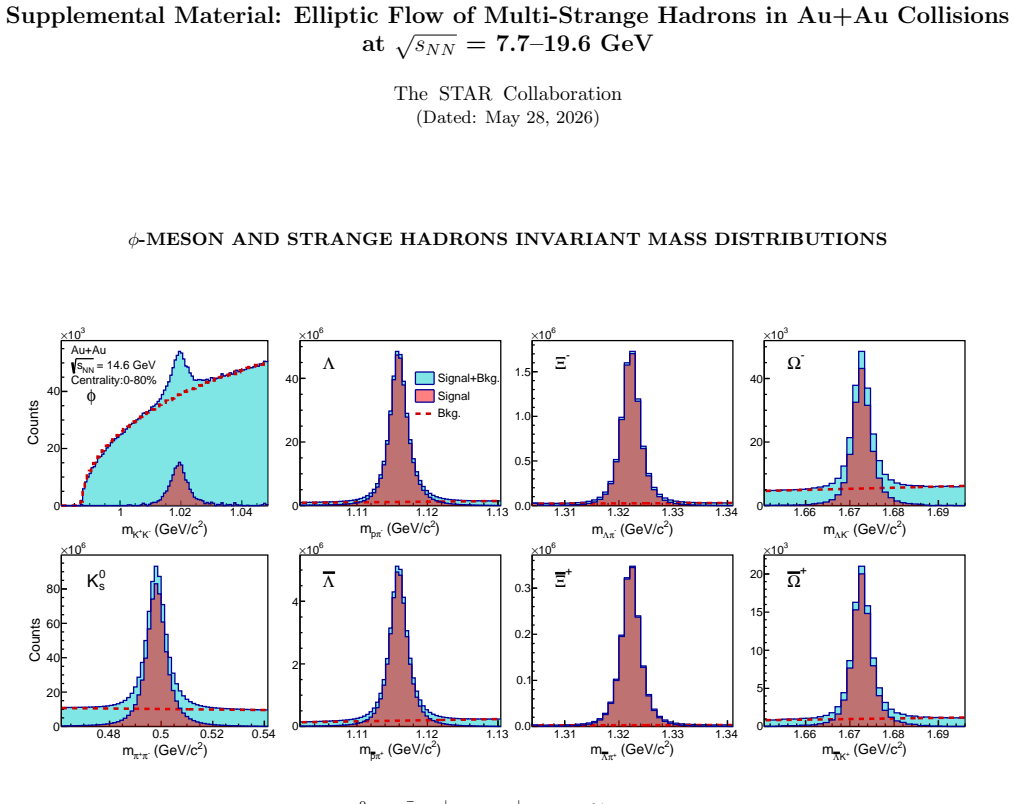
G. S. Denicol, C. Gale, S. Jeon, A. Monnai, B. Schenke, and C. Shen, Phys. Rev. C98, 034916 (2018), arXiv:1804.10557 [nucl-th]. Supplemental Material: Elliptic Flow of Multi-Strange Hadrons in Au+Au Collisions at √sN N = 7.7–19.6 GeV The STAR Collaboration (Dated: May 28, 2026) ϕ-MESON AND STRANGE HADRONS INV ARIANT MASS DISTRIBUTIONS 1 1.02 1.04 ) 2 (GeV...
work page internal anchor Pith review Pith/arXiv arXiv 2018
-
[51]
P. Huovinen, P. F. Kolb, U. W. Heinz, P. V. Ruuskanen, and S. A. Voloshin, Phys. Lett. B503, 58 (2001), arXiv:hep- ph/0101136
-
[52]
Elliptic flow at large transverse momenta from quark coalescence
D. Moln´ ar and S. A. Voloshin, Phys. Rev. Lett.91(2003), arXiv:nucl-th/0302014
work page internal anchor Pith review Pith/arXiv arXiv 2003
-
[53]
J. Adams et al. (STAR Collaboration), Phys. Rev. Lett.92, 052302 (2004), arXiv:nucl-ex/0306007
work page internal anchor Pith review Pith/arXiv arXiv 2004
-
[54]
B. I. Abelev et al. (STAR Collaboration), Phys. Rev. Lett.99, 112301 (2007), arXiv:nucl-ex/0703033. 4 0 0.02 0.04 0.06 0.08Centrality: 10-40% 7.7 GeV 0 0.02 0.04 0.06 0.0814.6 GeV 0 0.02 0.04 0.06 0.08 S 0Fit to K -π -K s 0Kφ 9.2 GeV 0 0.02 0.04 0.06 0.0817.3 GeV 0 0.02 0.04 0.06 0.08 pΛ+Ξ + Ω 11.5 GeV 0 0.02 0.04 0.06 0.0819.6 GeV q/n2v 0 0.5 1 1.5 0.5 1...
work page internal anchor Pith review Pith/arXiv arXiv 2007
-
[55]
X. Dong, S. Esumi, P. Sorensen, N. Xu, and Z. Xu, Physics Letters B597, 328–332 (2004), arXiv:nucl-th/0403030
work page internal anchor Pith review Pith/arXiv arXiv 2004
-
[56]
Scaling properties of azimuthal anisotropy in Au+Au and Cu+Cu collisions at sqrt(s_NN) = 200 GeV
A. Adare et al. (PHENIX Collaboration), Phys. Rev. Lett.98, 162301 (2007), arXiv:nucl-ex/0608033
work page internal anchor Pith review Pith/arXiv arXiv 2007
discussion (0)
Sign in with ORCID, Apple, or X to comment. Anyone can read and Pith papers without signing in.