Pattern Recognition Tasks with Personalized Federated Learning
Pith reviewed 2026-06-29 14:04 UTC · model grok-4.3
The pith
APPLE, FedGC, and FedProto outperform other personalized federated learning methods on pattern recognition tasks with heterogeneous client data.
A machine-rendered reading of the paper's core claim, the machinery that carries it, and where it could break.
Core claim
Through empirical investigation on MNIST, SignMNIST, and Digit5, the evaluation anchored in Accuracy, Precision, Recall, and F1 Score shows that APPLE, FedGC, and FedProto consistently deliver superior performance in personalized federated learning for pattern recognition tasks, with other algorithms showing advantages only in specific contexts and with potential for further refinement.
What carries the argument
Comparative evaluation of seven PFL algorithms on heterogeneous client data distributions using four standard classification metrics.
If this is right
- APPLE, FedGC, and FedProto can be prioritized for pattern recognition applications that involve client-specific data distributions.
- Algorithm selection in PFL requires attention to the particular dataset and data heterogeneity patterns.
- Context-specific alternatives among the seven algorithms remain viable when datasets differ from those tested.
- Iterative refinement of the top methods can further improve outcomes in privacy-preserving settings.
Where Pith is reading between the lines
- The superiority of these three algorithms may extend to other image-based tasks with similar privacy needs, though this requires direct testing.
- Limiting the study to three datasets leaves open whether the ranking holds for non-image pattern recognition problems.
- The results point toward using these methods as baselines when designing new PFL systems for heterogeneous client environments.
Load-bearing premise
The three chosen datasets and four metrics are representative and sufficient to identify the best PFL algorithms for pattern recognition tasks with heterogeneous client data.
What would settle it
An experiment on a new heterogeneous image dataset for pattern recognition where one of the other four PFL algorithms records higher average scores across accuracy, precision, recall, and F1 than APPLE, FedGC, and FedProto.
Figures
read the original abstract
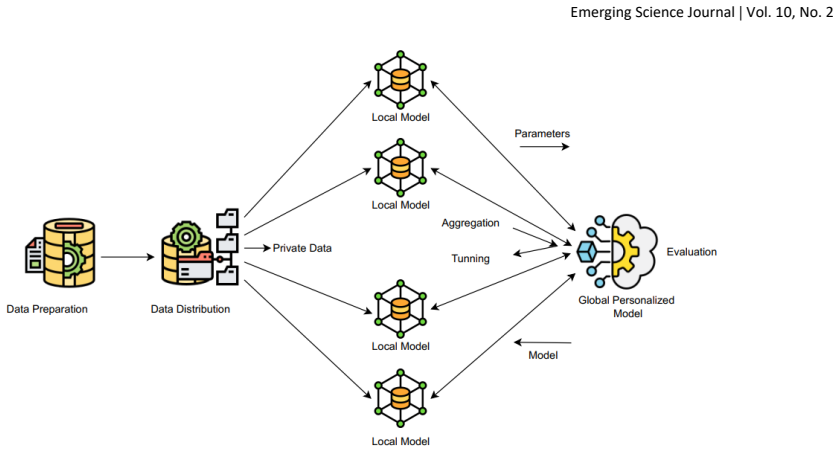
Personalized Federated Learning (PFL) constitutes a novel paradigm that tailors Machine Learning (ML) models to individual clients, thereby furnishing personalized model updates whilst upholding stringent data privacy principles. Diverging from conventional standard Federated Learning (FL) approaches, PFL adapts models to distinct client data distributions, engendering heightened levels of accuracy, customization, and data security, all while minimizing communication overhead. This methodology proves particularly salient in contexts marked by pattern recognition tasks reliant upon heterogeneous data sources and underpinned by paramount privacy apprehensions. In the present research endeavor, this article undertake a comprehensive comparative analysis of seven distinct PFL algorithms deployed across three diverse datasets, namely MNIST, SignMNIST, and Digit5. The overarching objective entails ascertaining the preeminent PFL algorithm, within the framework of pattern recognition tasks, through a rigorous evaluation anchored in metrics encompassing Accuracy, Precision, Recall, and F1 Score. Concurrently, an in-depth scrutiny of these PFL algorithms is conducted, elucidating their operative workflows, advantages, and limitations. Through empirical investigation, the findings evince that APPLE, FedGC, and FedProto emerge as stalwart contenders, consistently furnishing superior performance across the spectrum of assessed datasets, while acknowledging the contextual specificity of alternative algorithms and the potential for iterative refinement to realize optimal outcomes.
Editorial analysis
A structured set of objections, weighed in public.
Referee Report
Summary. The paper performs an empirical comparison of seven Personalized Federated Learning (PFL) algorithms on three image classification datasets (MNIST, SignMNIST, Digit5). It evaluates them using Accuracy, Precision, Recall, and F1 Score, analyzes their workflows/advantages/limitations, and concludes that APPLE, FedGC, and FedProto consistently deliver superior performance across the assessed datasets for pattern recognition tasks under heterogeneous client data.
Significance. If the empirical comparisons are made reproducible with full protocol details and statistical rigor, the work supplies a useful reference benchmark for PFL algorithm selection in privacy-sensitive image classification with non-IID data. The side-by-side discussion of each method's mechanics adds practical value. The narrow dataset scope, however, limits the strength of any claim to identify preeminent methods for the broader class of pattern recognition tasks.
major comments (2)
- [Experimental Setup / Results] Experimental Setup / Results sections: The manuscript asserts empirical superiority of APPLE, FedGC, and FedProto but supplies no details on data partitioning for heterogeneity, number of clients, communication rounds, hyperparameter selection, baseline implementations, or statistical tests. This information is required to verify the central performance claims.
- [Abstract and Conclusion] Abstract and Conclusion: The claim that the three algorithms are preeminent 'within the framework of pattern recognition tasks' rests on results from only MNIST, SignMNIST, and Digit5 (all digit/sign variants with similar input statistics). No justification or additional domains are provided to support extrapolation beyond these specific datasets.
minor comments (2)
- [Abstract] Abstract contains grammatical errors (e.g., 'this article undertake' should be 'undertakes'; 'engendering heightened levels of accuracy' is awkward).
- No mention of code or data availability, which would strengthen reproducibility of the reported comparisons.
Simulated Author's Rebuttal
We thank the referee for the constructive comments. We address each major comment point by point below and will revise the manuscript to improve reproducibility and appropriately scope the claims.
read point-by-point responses
-
Referee: Experimental Setup / Results sections: The manuscript asserts empirical superiority of APPLE, FedGC, and FedProto but supplies no details on data partitioning for heterogeneity, number of clients, communication rounds, hyperparameter selection, baseline implementations, or statistical tests. This information is required to verify the central performance claims.
Authors: We agree that the current version lacks these protocol details, which are necessary for reproducibility. In the revised manuscript we will add a dedicated subsection in Experimental Setup describing: the non-IID partitioning method (Dirichlet distribution with chosen alpha), number of clients and per-client sample counts, total communication rounds, hyperparameter selection procedure (including values used or tuning method), baseline implementation sources or re-implementation details, and statistical significance tests (e.g., paired t-tests or Wilcoxon signed-rank with p-values) supporting the reported superiority. These additions will be included in the next version. revision: yes
-
Referee: Abstract and Conclusion: The claim that the three algorithms are preeminent 'within the framework of pattern recognition tasks' rests on results from only MNIST, SignMNIST, and Digit5 (all digit/sign variants with similar input statistics). No justification or additional domains are provided to support extrapolation beyond these specific datasets.
Authors: We accept that the three datasets share similar input statistics and that broad extrapolation is not justified. We will revise the abstract and conclusion to state that APPLE, FedGC, and FedProto demonstrate superior performance on the evaluated image-classification datasets for pattern recognition tasks, without claiming preeminence across all pattern recognition tasks. A new limitations paragraph will explicitly note the narrow dataset scope and recommend future validation on more diverse domains. revision: yes
Circularity Check
No circularity: purely empirical comparison of PFL algorithms
full rationale
The paper performs an empirical comparison of seven PFL algorithms on MNIST, SignMNIST, and Digit5 using Accuracy, Precision, Recall, and F1 Score. It reports observed performance rankings without any derivation chain, first-principles predictions, fitted parameters renamed as predictions, or load-bearing self-citations. The central claim is that APPLE, FedGC, and FedProto perform best on the tested datasets; this is a direct reporting of experimental outcomes rather than a reduction to inputs by construction. No equations or uniqueness theorems are invoked that could create circularity. The analysis is self-contained against external benchmarks (the three datasets and four metrics).
Axiom & Free-Parameter Ledger
Reference graph
Works this paper leans on
-
[1]
DP-SVM MNIST Linear SVM = 97.2, RBF SVM = 98.3 The core contribution of the scientific paper is the development of a privacy -preserving image pattern recognition scheme using Support Vector Machine (SVM) and Differential Privacy (DP) framework
-
[2]
CNN Sign- MNIST Accuracy = 93 The core contribution of the scientific paper is the development of a DL based application that uses a custom Convolutional Neural Network (CNN) to recognize sign language gestures from video frames
-
[3]
The paper compares the performance of ML and DL algorithms, specifically the CNN classifier, for accurately extracting and classifying handwritten letters and numbers from images
KNN MNIST Sensitivity = 97.18, Precision = 97.92, Specificity = 98.58 The core contribution of the scientific paper is the development and evaluation of a system for Optical Character Recognition (OCR) focused on handwritten digits. The paper compares the performance of ML and DL algorithms, specifically the CNN classifier, for accurately extracting and c...
-
[4]
Decision Tree MNIST True-Classified Scenario = 90.37, False-Classified Scenario = 9.63 The core contribution of the scientific paper is the proposal of a method for offline handwritten digit recognition using ML algorithms. Various ML methods, such as Support Vector Machine, Multilayer Perceptron, Decision Tree, Naïve Bayes, K-Nearest Neighbor, and Random...
-
[5]
GPFL uses multiple GP runs to generate models that focus on specific high -level features of tr aining images
GPFL MNIST Accuracy = 91.66 The core contribution of the scientific paper is the introduction of Genetic Program Feature Learner (GPFL), a novel generative GP feature learner for 2D images. GPFL uses multiple GP runs to generate models that focus on specific high -level features of tr aining images. These models are then combined into a function that reco...
-
[6]
Instead of using the gradient algorithm to adjust CNN parameters, the model inputs CNN-extracted features into RF for classification
Hybrid-RF MNIST Error = 1.97 The core contribution of the scientific paper is the proposal of a hybrid model that combines a Convolutional Neural Network (CNN) and a Random Forest (RF) for image pattern recognition. Instead of using the gradient algorithm to adjust CNN parameters, the model inputs CNN-extracted features into RF for classification. Emergin...
-
[7]
FedAvg MNIST, Shakespeare, CIFAR-10 Accuracy: MNIST=99, Shakespeare=54, CIFAR- 10=85 The core contribution of this paper is the introduction of FL, a decentralized method for training deep networks on distributed mobile data, minimizing communication costs while ensuring strong performance across diverse data distributions
-
[8]
SCAFFOLDE MNIST Similarity=84.2 The core contribution of this paper is the SCAFFOLD algorithm, which addresses the ’client -drift’ issue in FL by using control variates for variance reduction, resulting in faster and more stable convergence, particularly in the presence of data heterogeneity and client sampling
-
[9]
FedProx MNIST, FEMNIST, Shakespeare, Sent140 Average accuracy is more than 22% than FedAvg The core contribution of this paper is the introduction of FedProx, a novel FL framework that handles statistical and systemic heterogeneity, ensures convergence for non- identical data distributions, and outperforms state-of-the- art FedAvg in robustness and accuracy
-
[10]
FedDyn MNIST, EMNIST, CIFAR-10, CIFAR-100 and Shakespeare Accuracy: MNIST=98.4, EMNIST=95.0, CIFAR-10=85.2, CIFAR-100=55.3, Shakespeare=51.2 The core contribution of this study is a new FL approach that dynamically regulates the interoperation between a subset of devices, coordinating local and global solutions while minimizing transmission costs and taki...
-
[11]
MOON CIFAR-10, CIFAR-100, and Tiny- Imagenet True-Classified Scenario = 90.37, False-Classified Scenario = 9.63 The core contribution of this paper is the introduction of MOON, a model - contrastive FL approach that leverages model representation similarity to enhance federated training, achieving superior performance on image pattern recognition tasks co...
-
[12]
3- Research Methodology FL algorithms were implemented by first defining the problem intended to be solved through this distributed approach
FedGen MNIST, EMNIST, Celeba Accuracy: MNIST=95.52, EMNIST=78.92, Celeba=90.29 The core contribution of this paper is a data-free knowledge distillation approach that enhances heterogeneous FL by utilizing a lightweight generator to ensemble user information, leading to improved generalization performance and reduced communication rounds compared to state...
2023
-
[13]
Niknam, S., Dhillon, H. S., & Reed, J. H. (2020). Federated Learning for Wireless Communications: Motivation, Opportunities, and Challenges. IEEE Communications Magazine, 58(6), 46–51. doi:10.1109/MCOM.001.1900461
-
[14]
Hosain, M. T., & Morol, M. K. (2025). Can Multi -turn Self -refined Single Agent LMs with Retrieval Solve Hard Coding Problems? Proceedings of the Annual Meeting of the Association for Computational Linguistics, 4, 129 –142. doi:10.18653/v1/2025.acl-srw.8
-
[15]
Voigt, P., & Von dem Bussche, A. (2017). The EU General Data Protection Regulation (GDPR): A Practical Guide. In The EU General Data Protection Regulation (GDPR): a Practical Guide. Springer International Publishing , Berlin, Germany . doi:10.1007/978-3-319-57959-7
-
[16]
Abir, M. R., Mridha, M. F., & Shin, J. Federated Smart Mirrored Personalized Fashion in IoT . ResearchGate, 1 -5. doi:10.13140/RG.2.2.35779.52008
-
[17]
Brendan McMahan, H., Moore, E., Ramage, D., Hampson, S., & Agüera y Arcas, B. (2017). Communication -efficient learning of deep networks from decentralized data. Proceedings of the 20th International Conference on Artificial Intelligence and Statistics, AISTATS 2017, 54
2017
-
[18]
Hosain, M. T., Morol, M. K., & Hossen, M. J. (2025). A hybrid self-attentive linearized phrase structured transformer based RNN for financial sentence analysis with sentence level explainability. Scientific Reports, 15(1), 23893. doi:10.1038/s41598-025-09265-8
-
[19]
Kairouz, P., & McMahan, H. B. (2021). Advances and open problems in federated learning. Foundations and trends in machine learning, 14(1-2), 1-210. doi:10.1561/2200000083
-
[20]
Federated Learning with Personalization Layers
Arivazhagan, M. G., Aggarwal, V., Singh, A. K., & Choudhary, S. (2019). Federated learning with personalization layers. arXiv Preprint, arXiv:1912.00818. doi:10.48550/arXiv.1912.00818
work page internal anchor Pith review Pith/arXiv arXiv doi:10.48550/arxiv.1912.00818 2019
-
[21]
Mushfiqur Rahman Abir, Asif Zaman, & Sawon Mursalin. (2024). Efficiency measurement of FL algorithms for image classification. GSC Advanced Research and Reviews, 18(3), 356–366. doi:10.30574/gscarr.2024.18.3.0110
-
[22]
P., Kale, S., Mohri, M., Reddi, S
Karimireddy, S. P., Kale, S., Mohri, M., Reddi, S. J., Stich, S. U., & Suresh, A. T. (2020). SCAFFOLD: Stochastic Controlled Averaging for Federated Learning. 37th International Conference on Machine Learning, ICML 2020, PartF168147 -7, 5088– 5099
2020
-
[23]
K., Zaheer, M., Sanjabi, M., Talwalkar, A., & Smith, V
Li, T., Sahu, A. K., Zaheer, M., Sanjabi, M., Talwalkar, A., & Smith, V. (2020). Federated Optimization in Heterogeneous Networks. Proceedings of Machine Learning and Systems, 2, 429–450. Emerging Science Journal | Vol. 10, No. 2 Page | 989
2020
-
[24]
Gupta, R. Das, Hosain, M. T., Mridha, M. F., & Ahmed, S. U. (2025). Multimodal Programming in Computer Science with Interactive Assistance Powered by Large Language Model. Lecture Notes in Computer Science, 15770 LNCS, 59 –69. doi:10.1007/978-3-031-93864-1_5
-
[25]
Hosain, M. T., Rahman, S., Morol, M. K., & Parvez, M. R. (2025). Xolver: Multi -agent reasoning with holistic experience learning just like an olympiad team. arXiv Preprint, arXiv:2506.14234. doi:10.48550/arXiv.2506.14234
-
[26]
Theodoridis, S., & Koutroumbas, K. (2006). Pattern recognition. Elsevier, Amsterdam, Netherlands
2006
-
[27]
Saini, P., Kaur, J., & Lamba, S. (2021). A Review on Pattern Recognition Using Machine Learning. Lecture Notes in Mechanical Engineering, 619–627. doi:10.1007/978-981-16-0942-8_58
-
[28]
Hosain, M. T., Gupta, R. D., & Morol, M. K. (2025). Multilingual question answering in low -resource settings: A dzongkha - english benchmark for foundation models. arXiv Preprint, arXiv:2505.18638. doi:10.48550/arXiv.2505.18638
-
[29]
Woubie, A., Solomon, E., & Attieh, J. (2024). Maintaining privacy in face recognition using federated learning method. IEEE Access, 12, 39603-39613. doi:10.1109/ACCESS.2024.3373691
-
[30]
T., Abir, M
Hosain, M. T., Abir, M. R., Rahat, M. Y., Mridha, M. F., & Mukta, S. H. (2024). Privacy Preserving Machine Learning with Federated Personalized Learning in Artificially Generated Environment. IEEE Open Journal of the Computer Society, 5, 694 –
2024
-
[31]
doi:10.1109/OJCS.2024.3466859
-
[32]
Hosain, M. T., Zaman, A., Sajid, M. S., Khan, S. S., & Akter, S. (2023). Privacy Preserving Machine Learning Model Personalization through Federated Personalized Learning. 2023 4th International Conference on Data Analytics for Business and Industry, ICDABI 2023, 536–545. doi:10.1109/ICDABI60145.2023.10629638
-
[33]
Luo, J., & Wu, S. (2022). Adapt to Adaptation: Learning Personalization for Cross-Silo Federated Learning. IJCAI International Joint Conference on Artificial Intelligence, 2166–2173. doi:10.24963/ijcai.2022/301
-
[34]
Zhang, J., Hua, Y., Wang, H., Song, T., Xue, Z., Ma, R., & Guan, H. (2023). FedALA: Adaptive Local Aggregation for Personalized Federated Learning. Proceedings of the 37th AAAI Conference on Artificial Intelligence, AAAI 2023, 37, 11237– 11244. doi:10.1609/aaai.v37i9.26330
-
[35]
Oh, J., Kim, S., & Yun, S. Y. (2021). Fedbabu: Towards enhanced representation for federated image classification. arXiv Preprint, arXiv:2106.06042. doi:10.48550/arXiv.2106.06042
-
[36]
Niu, Y., & Deng, W. (2022). Federated Learning for Face Recognition with Gradient Correction. Proceedings of the 36th AAAI Conference on Artificial Intelligence, AAAI 2022, 36, 1999–2007. doi:10.1609/aaai.v36i2.20095
-
[37]
Xu, J., Tong, X., & Huang, S. L. (2023). Personalized federated learning with feature alignment and classifier collaboration. arXiv preprint arXiv:2306.11867. doi:10.48550/arXiv.2306.11867
-
[38]
Tan, Y., Long, G., Ma, J., Liu, L., Zhou, T., & Jiang, J. (2022). Federated Learning from Pre -Trained Models: A Contrastive Learning Approach. Advances in Neural Information Processing Systems, 35, 19332–19344
2022
-
[39]
Tan, Y., Long, G., Liu, L., Zhou, T., Lu, Q., Jiang, J., & Zhang, C. (2022). FedProto: Federated Prototype Learning across Heterogeneous Clients. Proceedings of the 36th AAAI Conference on Artificial Intelligence, AAAI 2022, 36, 8432 –8440. doi:10.1609/aaai.v36i8.20819
-
[40]
Deng, L. (2012). The MNIST database of handwritten digit images for machine learning research. IEEE Signal Processing Magazine, 29(6), 141–142. doi:10.1109/MSP.2012.2211477
-
[41]
El-Marzouki, N., Lasri, I., Riadsolh, A., & Elbelkacemi, M. (2024). American Sign Language Recognition with Convolutional Neural Networks: A Gateway to Enhanced Inclusivity. Lecture Notes in Networks and Systems, 1100 LNNS, 24 –33. doi:10.1007/978-3-031-68660-3_3
-
[42]
Zhou, K., Yang, Y., Hospedales, T., & Xiang, T. (2020). Learning to Generate Novel Domains for Domain Generalization. Lecture Notes in Computer Science (Including Subseries Lecture Notes in Artificial Intelligence and Lecture Notes in Bioinformatics), 12361 LNCS, 561–578. doi:10.1007/978-3-030-58517-4_33
-
[43]
Abir, M., Hosain, M. T., Jubair, M. A. A., & Mridha, M. F. (2024). Imvb7t: A multi-modal model for food preferences based on artificially produced traits. Proceedings of the 3rd International Conference on Computing Advancements , 882-888. doi:10.1145/3723178.3723295
-
[44]
Senekane, M. (2019). Differentially Private Image Classification Using Support Vector Machine and Differential Privacy. Machine Learning and Knowledge Extraction, 1(1), 483–491. doi:10.3390/make1010029
-
[45]
Nirmala, M. (2022). Sign Language Recognition Using Deep Learning. 2022 4th International Conference on Cognitive Computing and Information Processing, CCIP 2022, 12(5), 964–968. doi:10.1109/CCIP57447.2022.10058655. Emerging Science Journal | Vol. 10, No. 2 Page | 990
-
[46]
Sharma, A., Bhardwaj, H., Bhardwaj, A., Sakalle, A., Acharya, D., & Ibrahim, W. (2022). A Machine Learning and Deep Learning Approach for Recognizing Handwritten Digits. Computational Intelligence and Neuroscience, 2022. doi:10.1155/2022/9869948
-
[47]
K., Rajpurohit, J., & Abugabah, A
Bhushan, S., Alshehri, M., Keshta, I., Chakraverti, A. K., Rajpurohit, J., & Abugabah, A. (2022). An Experimental Analysis of Various Machine Learning Algorithms for Hand Gesture Recognition. Electronics (Switzerland), 11(6) , 968 . doi:10.3390/electronics11060968
-
[48]
Gope, B., Pande, S., Karale, N., Dharmale, S., & Umekar, P. (2021). Handwritten digits identification using mnist database via machine learning models. IOP Conference Series: Materials Science and Engineering , 1022(1), 012108. doi:10.1088/1757 - 899X/1022/1/012108
-
[49]
Ruberto, S., Terragni, V., & Moore, J. H. (2020). Image feature learning with genetic programming. Lecture Notes in Computer Science (Including Subseries Lecture Notes in Artificial Intelligence and Lecture Notes in Bioinformatics), 12270 LNCS, 63 –
2020
-
[50]
doi:10.1007/978-3-030-58115-2_5
-
[51]
Xi, E. (2022). Image Classification and Recognition Based on Deep Learning and Random Forest Algorithm. Wireless Communications and Mobile Computing, 2022. doi:10.1155/2022/2013181
-
[52]
E., Yue, Z., Ramon, M., Matthew, M., Paul, W., & Venkatesh, S
Durmus, A. E., Yue, Z., Ramon, M., Matthew, M., Paul, W., & Venkatesh, S. (2021). Federated learning based on dynamic regularization. International Conference on Learning Representations, 10280833
2021
-
[53]
Li, Q., He, B., & Song, D. (2021). Model-contrastive federated learning. Proceedings of the IEEE/CVF Conference on Computer Vision and Pattern Recognition, 10713–10722
2021
-
[54]
Zhu, Z., Hong, J., & Zhou, J. (2021). Data-Free Knowledge Distillation for Heterogeneous Federated Learning. Proceedings of Machine Learning Research, 139, 12878–12889
2021
discussion (0)
Sign in with ORCID, Apple, or X to comment. Anyone can read and Pith papers without signing in.