Spin-Hall-Like Magnon Transport in a Synthetic Antiferromagnetic Skyrmion Lattice
Pith reviewed 2026-06-29 11:06 UTC · model grok-4.3
The pith
Edge magnons in a synthetic antiferromagnetic skyrmion lattice are layer-polarized spin-Hall-like modes rather than Z2-protected states.
A machine-rendered reading of the paper's core claim, the machinery that carries it, and where it could break.
Core claim
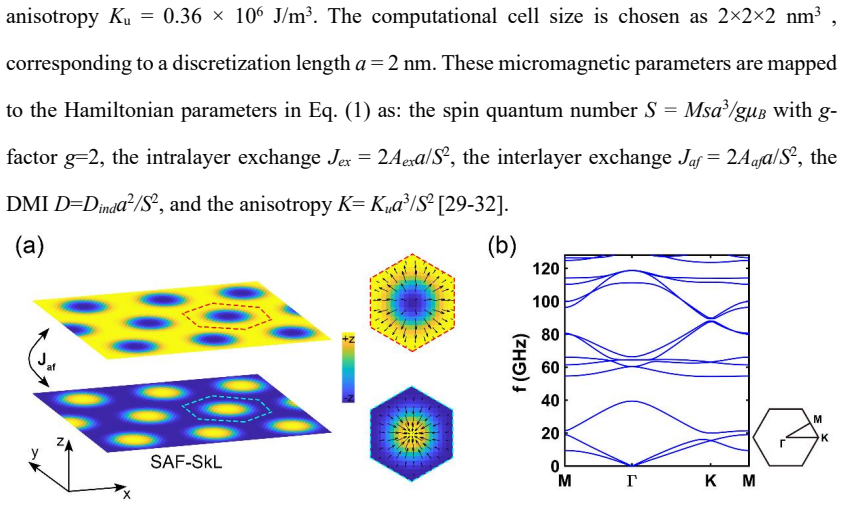
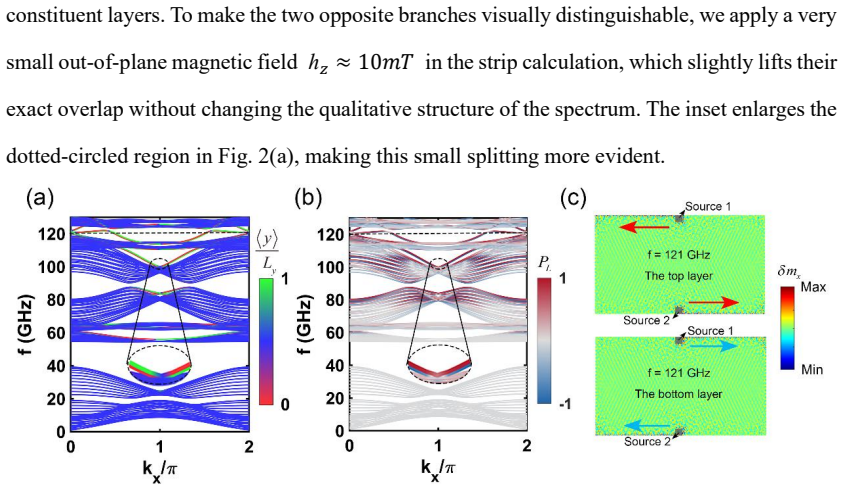
Based on a relaxed bilayer texture from micromagnetic simulations, the bosonic Bogoliubov-de Gennes Hamiltonian within linear spin-wave theory yields counterpropagating in-gap edge modes with opposite layer polarization. A symmetry analysis shows that the fully coupled system lacks the pseudo-time-reversal symmetry required for a genuine bosonic Z2 topological phase. Thus, the observed edge modes are not Z2-protected helical magnon edge states, but layer-polarized, spin-Hall-like modes originating from the opposite Hall tendencies of the two skyrmion lattice layers.
What carries the argument
Layer-polarized counterpropagating in-gap edge modes that arise because the two antiferromagnetically coupled skyrmion lattice layers possess opposite magnon Hall tendencies.
If this is right
- The edge modes propagate with opposite layer polarization, as confirmed by dynamical micromagnetic simulations.
- The transport qualifies as spin-Hall-like because it stems from the opposite Hall tendencies of the two layers.
- The fully coupled system does not realize a genuine bosonic Z2 topological phase.
- Synthetic antiferromagnetic skyrmion lattices therefore function as a platform for spin-Hall-like magnon transport beyond strict Z2 classification.
Where Pith is reading between the lines
- The same distinction between layer-polarized Hall-like modes and true Z2 protection may appear in other bilayer magnonic textures.
- Layer selectivity of the edge modes could be exploited to route magnon signals between layers in a device.
- Varying the strength or form of the interlayer coupling offers a tunable knob for the polarization and velocity of these modes.
Load-bearing premise
The relaxed bilayer texture obtained from micromagnetic simulations accurately represents the magnon spectrum and edge mode properties of the physical system.
What would settle it
A calculation or measurement that finds the coupled system possesses pseudo-time-reversal symmetry or that the edge modes lack opposite layer polarization would falsify the claim.
Figures

read the original abstract
We investigate spin-Hall-like magnon edge transport in a synthetic antiferromagnetic skyrmion lattice composed of two antiferromagnetically coupled skyrmion lattice layers with opposite magnetic textures. Based on a relaxed bilayer texture from micromagnetic simulations, we construct the bosonic Bogoliubov-de Gennes Hamiltonian within linear spin-wave theory and calculate the bulk and strip magnon spectrum. We find counterpropagating in-gap edge modes with opposite layer polarization, whose layer-resolved propagation is further confirmed by dynamical micromagnetic simulations. A symmetry analysis shows that the fully coupled system lacks the pseudo-time-reversal symmetry required for a genuine bosonic Z2 topological phase. Thus, the observed edge modes are not Z2-protected helical magnon edge states, but layer-polarized, spin-Hall-like modes originating from the opposite Hall tendencies of the two skyrmion lattice layers. These results establish synthetic antiferromagnetic skyrmion lattices as a platform for spin-Hall-like magnon transport beyond a strict bosonic Z2 classification.
Editorial analysis
A structured set of objections, weighed in public.
Referee Report
Summary. The manuscript claims that magnon edge modes in a synthetic antiferromagnetic skyrmion lattice (two antiferromagnetically coupled layers with opposite textures) are counterpropagating in-gap states with opposite layer polarization. These are interpreted as spin-Hall-like modes (arising from the layers' opposite Hall tendencies) rather than Z2-protected helical states, because symmetry analysis shows the fully coupled system lacks pseudo-time-reversal symmetry. The pipeline consists of micromagnetic relaxation of the bilayer texture, construction of the bosonic Bogoliubov-de Gennes Hamiltonian in linear spin-wave theory to obtain bulk and strip spectra, and dynamical micromagnetic simulations to confirm layer-resolved propagation.
Significance. If the relaxed texture and linear spin-wave BdG construction faithfully capture the spectrum and symmetry properties, the result would be significant for identifying a platform for spin-Hall-like magnon transport that operates outside a strict bosonic Z2 classification. The combination of micromagnetic relaxation, LSWT, and dynamical confirmation is a methodological strength that could be useful for related magnonic systems.
major comments (2)
- [Abstract (micromagnetic relaxation and BdG construction)] The central claim that the edge modes are layer-polarized spin-Hall-like modes (not Z2-protected) rests on the micromagnetic-relaxed bilayer texture correctly encoding opposite Hall tendencies when fed into the bosonic BdG Hamiltonian (as described in the abstract). Linear spin-wave theory on this static ground state may miss anharmonic magnon-magnon interactions or small texture deviations that could alter layer polarization or restore effective pseudo-TR symmetry; the dynamical micromagnetic confirmation of propagation does not directly test whether the linear BdG reproduces the same in-gap modes or symmetry classification.
- [Symmetry analysis] The symmetry analysis concluding that the fully coupled system lacks the pseudo-time-reversal symmetry required for a genuine bosonic Z2 phase is load-bearing for reclassifying the modes. Without explicit details on the symmetry operations applied to the coupled layers or how the antiferromagnetic interlayer coupling breaks the relevant symmetry, it is difficult to assess robustness of this conclusion.
minor comments (1)
- [Abstract] The abstract outlines the computational pipeline but provides no numerical data, error estimates, or specific spectral features (e.g., gap sizes, polarization values), which would aid evaluation of the quantitative claims.
Simulated Author's Rebuttal
We thank the referee for the constructive comments. We address each major point below and indicate where revisions will be made to improve clarity and transparency.
read point-by-point responses
-
Referee: [Abstract (micromagnetic relaxation and BdG construction)] The central claim that the edge modes are layer-polarized spin-Hall-like modes (not Z2-protected) rests on the micromagnetic-relaxed bilayer texture correctly encoding opposite Hall tendencies when fed into the bosonic BdG Hamiltonian (as described in the abstract). Linear spin-wave theory on this static ground state may miss anharmonic magnon-magnon interactions or small texture deviations that could alter layer polarization or restore effective pseudo-TR symmetry; the dynamical micromagnetic confirmation of propagation does not directly test whether the linear BdG reproduces the same in-gap modes or symmetry classification.
Authors: Linear spin-wave theory is the standard harmonic approximation for computing magnon spectra from a relaxed micromagnetic ground state, as employed in the majority of magnonic topology studies. The opposite skyrmion textures are imposed by construction in the synthetic antiferromagnet and are preserved under relaxation, directly encoding the opposing Hall responses. While anharmonic effects are neglected, they are not expected to restore pseudo-TR symmetry or invert layer polarization in this regime. The dynamical micromagnetic simulations provide independent confirmation of the layer-resolved counterpropagation, consistent with the BdG edge modes. We will add a brief discussion of LSWT limitations and its appropriateness here. revision: partial
-
Referee: [Symmetry analysis] The symmetry analysis concluding that the fully coupled system lacks the pseudo-time-reversal symmetry required for a genuine bosonic Z2 phase is load-bearing for reclassifying the modes. Without explicit details on the symmetry operations applied to the coupled layers or how the antiferromagnetic interlayer coupling breaks the relevant symmetry, it is difficult to assess robustness of this conclusion.
Authors: We agree that explicit details will strengthen the presentation. In the revised manuscript we will specify the pseudo-time-reversal operator (layer exchange combined with time reversal) and demonstrate how the antiferromagnetic interlayer exchange term explicitly violates it, while the decoupled layers would preserve it. This addition will make the symmetry-breaking argument fully transparent. revision: yes
Circularity Check
No circularity; derivation is self-contained computation from micromagnetic input
full rationale
The paper obtains a relaxed bilayer texture via micromagnetic simulations, constructs the bosonic BdG Hamiltonian in linear spin-wave theory, computes the spectrum, and performs a symmetry analysis on that Hamiltonian to establish absence of pseudo-time-reversal symmetry. The conclusion that edge modes are layer-polarized spin-Hall-like (not Z2-protected) follows directly from these steps rather than from any fitted parameter renamed as prediction, self-definitional loop, or load-bearing self-citation. No equations or claims reduce to their inputs by construction; the symmetry classification is an output of the constructed model.
Axiom & Free-Parameter Ledger
Reference graph
Works this paper leans on
-
[1]
P. A. McClarty, Topological Magnons: A Review, Annu. Rev. Condens. Matter Phys. 13, 171 (2022)
2022
-
[2]
Katsura, N
H. Katsura, N. Nagaosa, and P. A. Lee, Theory of the Thermal Hall Effect in Quantum Magnets, Phys. Rev. Lett. 104, 066403 (2010)
2010
-
[3]
Matsumoto and S
R. Matsumoto and S. Murakami, Theoretical Prediction of a Rotating Magnon Wave Packet in Ferromagnets, Phys. Rev. Lett. 106, 197202 (2011)
2011
-
[4]
Matsumoto and S
R. Matsumoto and S. Murakami, Rotational motion of magnons and the thermal Hall effect, Phys. Rev. B 84, 184406 (2011)
2011
-
[5]
Zhang, J
L. Zhang, J. Ren, J. -S. Wang, and B. Li, Topological magnon insulator in insulating ferromagnet, Phys. Rev. B 87, 144101 (2013)
2013
-
[6]
Shindou, R
R. Shindou, R. Matsumoto, S. Murakami, and J.-i. Ohe, Topological chiral magnonic edge mode in a magnonic crystal, Phys. Rev. B 87, 174427 (2013)
2013
-
[7]
A. Mook, J. Henk, and I. Mertig, Magnon Hall effect and topology in kagome lattices: A theoretical investigation, Phys. Rev. B 89, 134409 (2014)
2014
-
[8]
A. Mook, J. Henk, and I. Mertig, Edge states in topological magnon insulators, Phys. Rev. B 90, 024412 (2014)
2014
-
[9]
X. S. Wang, H. W. Zhang, and X. R. Wang, Topological Magnonics: A Paradigm for Spin- Wave Manipulation and Device Design, Phys. Rev. Applied 9, 024029 (2018)
2018
-
[10]
Malki and G
M. Malki and G. S. Uhrig, Topological magnon bands for magnonics, Phys. Rev. B 99, 174412 (2019)
2019
-
[11]
Habel, A
J. Habel, A. Mook, J. Willsher, and J. Knolle, Breakdown of chiral edge modes in topological magnon insulators, Phys. Rev. B 109, 024441 (2024)
2024
-
[12]
Weber, D
T. Weber, D. M. Fobes, J. Waizner, P. Steffens, G. S. Tucker, M. Böhm, L. Beddrich, C. Franz, H. Gabold, and R. Bewley, Topological magnon band structure of emergent Landau levels in a skyrmion lattice, Science 375, 1025 (2022)
2022
-
[13]
K. A. van Hoogdalem, Y . Tserkovnyak, and D. Loss, Magnetic texture -induced thermal Hall effects, Phys. Rev. B 87, 024402 (2013)
2013
-
[14]
Roldán-Molina, A
A. Roldán-Molina, A. S. Núñez, and J. Fernández-Rossier, Topological spin waves in the atomic-scale magnetic skyrmion crystal, New J. Phys. 18, 045015 (2016)
2016
-
[15]
S. A. Díaz, J. Klinovaja, and D. Loss, Topological Magnons and Edge States in Antiferromagnetic Skyrmion Crystals, Phys. Rev. Lett. 122, 187203 (2019)
2019
-
[16]
S. A. Díaz, T. Hirosawa, J. Klinovaja, and D. Loss, Chiral magnonic edge states in ferromagnetic skyrmion crystals controlled by magnetic fields, Phys. Rev. Research 2, 013231 (2020)
2020
-
[17]
Akazawa, H.-Y
M. Akazawa, H.-Y . Lee, H. Takeda, Y . Fujima, Y . Tokunaga, T. Arima, J. H. Han, and M. Yamashita, Topological thermal Hall effect of magnons in magnetic skyrmion lattice, Phys. Rev. Research 4, 043085 (2022)
2022
-
[18]
Takeda, M
H. Takeda, M. Kawano, K. Tamura, M. Akazawa, J. Yan, T. Waki, H. Nakamura, K. Sato, Y . Narumi, M. Hagiwara, M. Yamashita, and C. Hotta, Magnon thermal Hall effect via emergent SU(3) flux on the antiferromagnetic skyrmion lattice, Nat. Commun. 15, 566 (2024)
2024
-
[19]
X. Zheng, P. Tang, X. Liu, Z. Li, P . Yan, and H. Wu, Emergence of Nontrivial Topological Magnon States in Skyrmionium Lattices with Zero Topological Charge, arXiv :2604.13451 (2026)
work page internal anchor Pith review Pith/arXiv arXiv 2026
-
[20]
Lein and K
M. Lein and K. Sato, Krein-Schrödinger formalism of bosonic Bogoliubov-de Gennes and certain classical systems and their topological classification, Phys. Rev. B 100, 075414 (2019)
2019
-
[21]
Lieu, Topological symmetry classes for non-Hermitian models and connections to the bosonic Bogoliubov-de Gennes equation, Phys
S. Lieu, Topological symmetry classes for non-Hermitian models and connections to the bosonic Bogoliubov-de Gennes equation, Phys. Rev. B 98, 115135 (2018)
2018
-
[22]
Kawabata, K
K. Kawabata, K. Shiozaki, M. Ueda, and M. Sato, Symmetry and Topology in Non - Hermitian Physics, Phys. Rev. X 9, 041015 (2019)
2019
-
[23]
Kondo, Y
H. Kondo, Y . Akagi, and H. Katsura, Z2 topological invariant for magnon spin Hall systems, Phys. Rev. B 99, 041110 (2019)
2019
-
[24]
A. P. Schnyder, S. Ryu, A. Furusaki, and A. W. W. Ludwig, Classification of topological insulators and superconductors in three spatial dimensions, Phys. Rev. B 78, 195125 (2008)
2008
-
[25]
S. Ryu, A. P. Schnyder, A. Furusaki, and A. W. W. Ludwig, Topological insulators and superconductors: Tenfold way and dimensional hierarchy, New J. Phys. 12, 065010 (2010)
2010
-
[26]
Kondo, Y
H. Kondo, Y . Akagi, and H. Katsura, Non -Hermiticity and topological invariants of magnon Bogoliubov-de Gennes systems, Prog. Theor. Exp. Phys. 2020, 12A104 (2020)
2020
-
[27]
Corticelli, R
A. Corticelli, R. Moessner, and P . A. McClarty, Spin -space groups and magnon band topology, Phys. Rev. B 105, 064430 (2022)
2022
-
[28]
Q.-R. Xu, V . P . Flynn, A. Alase, E. Cobanera, L. Viola, and G. Ortiz, Squaring the fermion: The threefold way and the fate of zero modes, Phys. Rev. B 102, 125127 (2020)
2020
-
[29]
Vansteenkiste, J
A. Vansteenkiste, J. Leliaert, M. Dvornik, M. Helsen, F. Garcia -Sanchez, and B. Van Waeyenberge, The design and verification of MuMax3, AIP Adv. 4, 107133 (2014)
2014
-
[30]
S. M. Rezende, Fundamentals of Magnonics (Springer, Cham, Switzerland, 2020)
2020
- [31]
-
[32]
Z. Wang, X. Zheng, Z. Li, Z. Zhang, and X. Wang, Domain wall skyrmion-based magnonic crystal, Phys. Rev. B 113, 014402 (2026)
2026
-
[33]
Roldán-Molina, M
A. Roldán-Molina, M. J. Santander, Á. S. Núñez, and J. Fernández -Rossier, Quantum theory of spin waves in finite chiral spin chains, Phys. Rev. B 89, 054403 (2014)
2014
-
[34]
Holstein and H
T. Holstein and H. Primakoff, Field Dependence of the Intrinsic Domain Magnetization of a Ferromagnet, Phys. Rev. 58, 1098 (1940)
1940
-
[35]
J. H. P. Colpa, Diagonalization of the quadratic boson hamiltonian, Physica A 93, 327 (1978)
1978
-
[36]
J. L. van Hemmen, A note on the diagonalization of quadratic boson and fermion hamiltonians, Z. Phys. B 38, 271 (1980)
1980
-
[37]
Theory of transformation for the diagonalization of quadratic Hamiltonians
M.-w. Xiao, Theory of transformation for the diagonalization of quadratic Hamiltonians, arXiv:0908.0787 (2009)
work page internal anchor Pith review Pith/arXiv arXiv 2009
-
[38]
D. N. Sheng, Z. Y . Weng, L. Sheng, and F. D. M. Haldane, Quantum Spin-Hall Effect and Topologically Invariant Chern Numbers, Phys. Rev. Lett. 97, 036808 (2006)
2006
-
[39]
Sundaram and Q
G. Sundaram and Q. Niu, Wave -packet dynamics in slowly perturbed crystals: Gradient corrections and Berry-phase effects, Phys. Rev. B 59, 14915 (1999)
1999
-
[40]
Xiao, M.-C
D. Xiao, M.-C. Chang, and Q. Niu, Berry phase effects on electronic properties, Rev. Mod. Phys. 82, 1959 (2010)
1959
-
[41]
T. Qin, Q. Niu, and J. Shi, Energy Magnetization and the Thermal Hall Effect, Phys. Rev. Lett. 107, 236601 (2011)
2011
-
[42]
Nagaosa, J
N. Nagaosa, J. Sinova, S. Onoda, A. H. MacDonald, and N. P. Ong, Anomalous Hall effect, Rev. Mod. Phys. 82, 1539 (2010)
2010
-
[43]
C. L. Kane and E. J. Mele, Quantum Spin Hall Effect in Graphene, Phys. Rev. Lett. 95, 226801 (2005)
2005
-
[44]
Sinova, S
J. Sinova, S. O. Valenzuela, J. Wunderlich, C. H. Back, and T. Jungwirth, Spin Hall effects, Rev. Mod. Phys. 87, 1213 (2015)
2015
discussion (0)
Sign in with ORCID, Apple, or X to comment. Anyone can read and Pith papers without signing in.