A Road-Conditioned Traffic Movie Prediction Network with Spatiotemporal and Structure-Consistent Learning
Reviewed by Pith T0 review T1 audit T2 compute T3 formal T4 kernel 2026-06-29 13:51 UTCgrok-4.3pith:XRYWKAPIrecord.jsonopen to challenge →
The pith
RCSNet uses static road maps and structure-consistent learning to improve traffic movie predictions in both same-city and cross-city settings.
A machine-rendered reading of the paper's core claim, the machinery that carries it, and where it could break.
Core claim
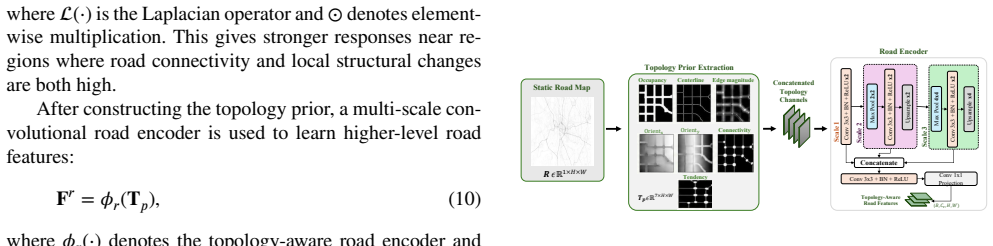
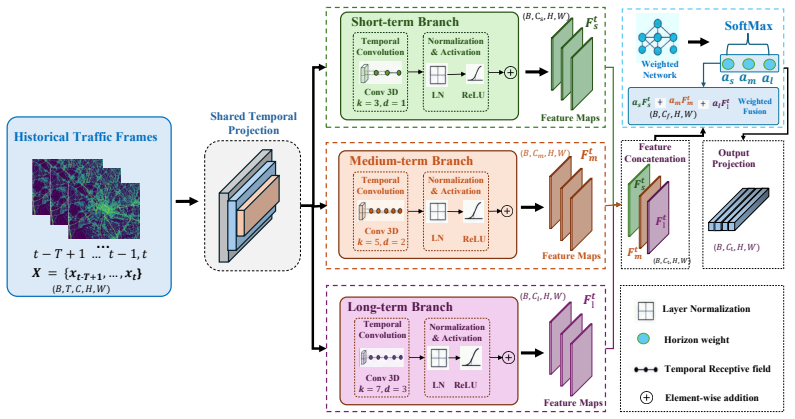
RCSNet reformulates traffic movie prediction as topology-guided future-state generation. It extracts road-aware representations from static road maps, models multi-horizon traffic dynamics from historical observations, aligns directional traffic features with local road structure, and progressively generates future traffic maps. A structure-consistent learning objective encourages predictions to remain accurate, road-aligned, and spatially stable. Experiments show improvements in forecasting accuracy and structural consistency across cities.
What carries the argument
The RCSNet architecture, which conditions spatiotemporal predictions on static road maps and uses a structure-consistent objective to enforce road alignment in generated traffic maps.
If this is right
- Reduces average MAE by 11.5%, MSE by 10.0%, and RMSE by 5.1% in same-city forecasting on Berlin, Antwerp, and Moscow.
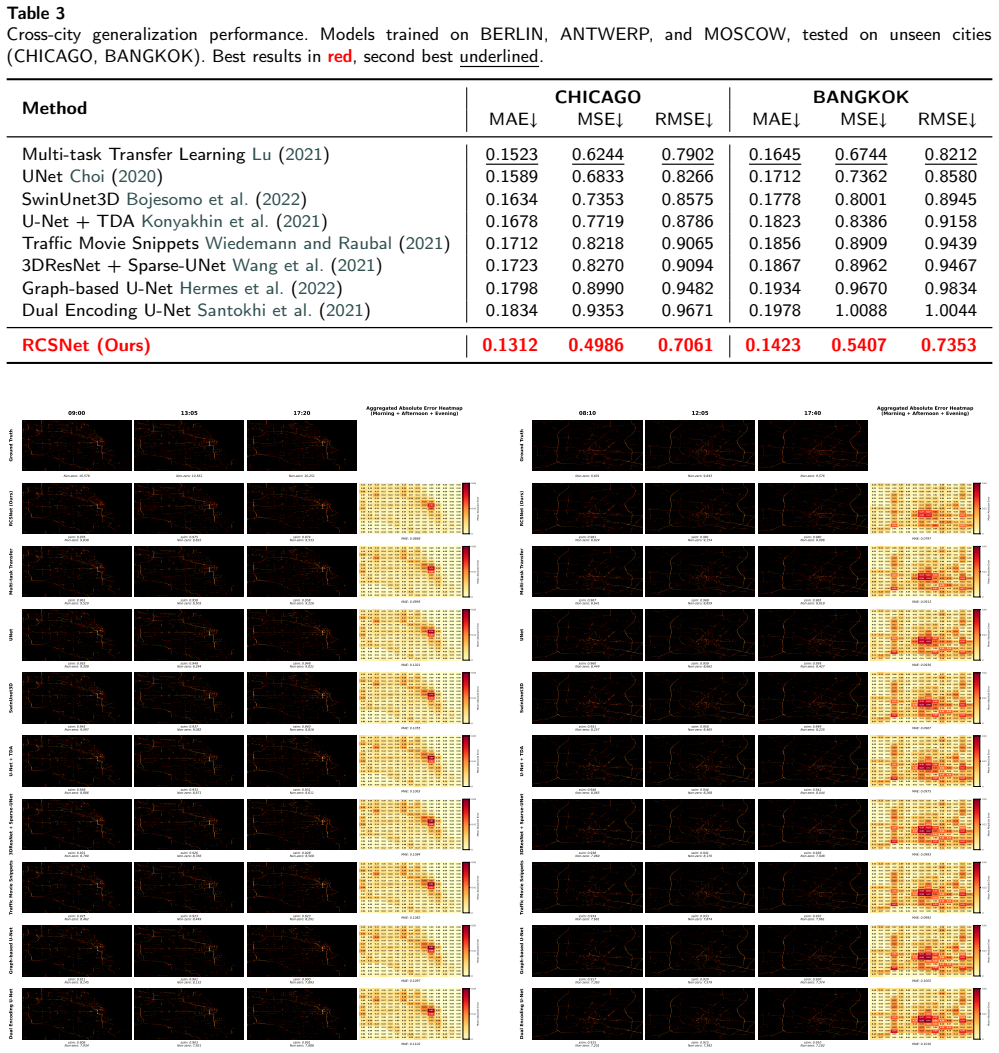
- Reduces RMSE by 10.6% and 10.5% in cross-city testing on Chicago and Bangkok without fine-tuning.
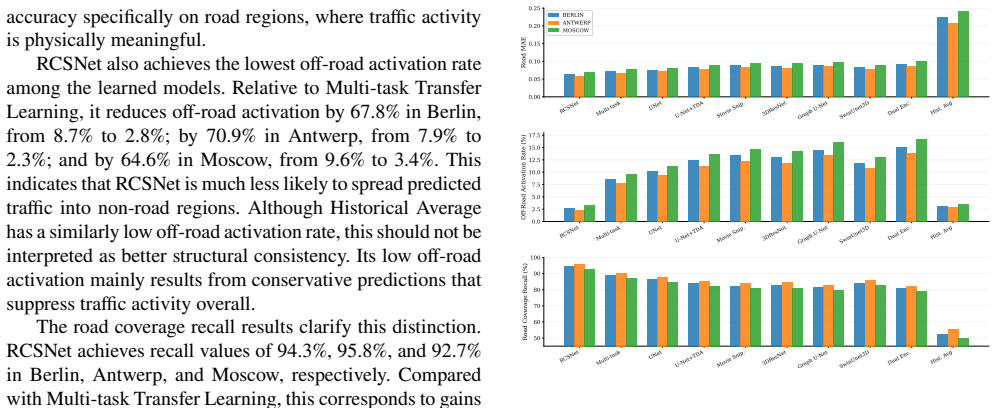
- Produces predictions with improved structural consistency and temporal stability.
- Offers computational efficiency advantages in addition to accuracy gains.
Where Pith is reading between the lines
- The method may enable better integration with route guidance systems by ensuring predictions respect travel directions.
- Extending the approach to dynamic road conditions like construction or accidents could further enhance real-world applicability.
- Similar conditioning techniques might apply to other spatiotemporal prediction tasks such as crowd flow or weather patterns over networks.
- Longer prediction horizons might benefit more from the topology guidance if the structure consistency holds over time.
Load-bearing premise
Static road maps supply sufficient topology and directional information to guide multi-horizon traffic dynamics, and the structure-consistent objective enforces road alignment without introducing new biases or reducing accuracy on non-road features.
What would settle it
A test where RCSNet is applied to a city with significantly different road structures or traffic patterns and shows no reduction in errors or even increased structural misalignment compared to baselines would falsify the central claim.
Figures




read the original abstract
City-wide traffic forecasting is important for congestion management, route guidance, and intelligent transportation systems, but accurate prediction remains challenging when future traffic must be generated as spatial maps over an entire urban network. Existing traffic movie prediction methods have improved frame-level accuracy, yet many still treat forecasting mainly as image reconstruction. This can produce traffic maps that are numerically close to the ground truth but weakly constrained by road layout, connectivity, travel direction, and congestion propagation, especially in cross-city settings where both traffic behavior and road structure change. To address this limitation, this study proposes RCSNet, a road-conditioned spatiotemporal network that reformulates traffic movie prediction as topology-guided future-state generation. RCSNet extracts road-aware representations from static road maps, models multi-horizon traffic dynamics from historical observations, aligns directional traffic features with local road structure, and progressively generates future traffic maps for improved temporal consistency. A structure-consistent learning objective further encourages predictions to remain accurate, road-aligned, and spatially stable. Experiments across multiple cities show that RCSNet improves both forecasting accuracy and structural consistency. In same-city forecasting on Berlin, Antwerp, and Moscow, RCSNet reduces average MAE, MSE, and RMSE by 11.5%, 10.0%, and 5.1%, respectively, compared with the closest baseline. In cross-city testing on unseen Chicago and Bangkok, it reduces RMSE by 10.6% and 10.5% without target-city fine-tuning. Additional horizon-wise, road-structure, explainability, statistical, and efficiency analyses show that RCSNet produces more accurate, transferable, road-aligned, and computationally efficient traffic forecasts.
Editorial analysis
A structured set of objections, weighed in public.
Referee Report
Summary. The paper proposes RCSNet, a road-conditioned spatiotemporal network for city-wide traffic movie prediction. It reformulates the task as topology-guided future-state generation by extracting road-aware representations from static road maps, modeling multi-horizon dynamics, aligning directional features with road structure, and applying a structure-consistent learning objective for accuracy, alignment, and spatial stability. Experiments on Berlin, Antwerp, Moscow, Chicago, and Bangkok report average reductions of 11.5% MAE, 10.0% MSE, and 5.1% RMSE in same-city forecasting versus the closest baseline, plus 10.6% and 10.5% RMSE reductions in cross-city transfer without fine-tuning, along with horizon-wise, structural, explainability, statistical, and efficiency analyses.
Significance. If the empirical gains hold under rigorous controls, the work could advance traffic forecasting by demonstrating that static topology and directional constraints improve both accuracy and cross-city transferability over pure image-reconstruction approaches. The structure-consistent objective and road-aware representations address a recognized limitation in existing spatiotemporal models.
major comments (2)
- [Experiments and Ablation Studies] The central claim that road conditioning from static maps drives the reported MAE/MSE/RMSE reductions (both same-city and cross-city) requires evidence that topology and directionality are primary constraints on multi-horizon dynamics rather than time-varying signals. The manuscript should include ablations that isolate the road-map input and structure-consistent objective (e.g., comparing against a non-road-conditioned spatiotemporal baseline) to rule out that gains arise from other unstated factors.
- [Cross-City Evaluation] Cross-city results on unseen Chicago and Bangkok are presented as evidence of transferability without target-city fine-tuning, yet the paper must demonstrate that the static road maps of the source cities (Berlin/Antwerp/Moscow) generalize to the target topologies; otherwise the 10.6%/10.5% RMSE reductions cannot be attributed to the proposed mechanism.
minor comments (2)
- [Abstract and §4] The abstract and results sections should explicitly list the baselines, data splits, and statistical significance tests used to compute the percentage improvements.
- [Method] Notation for the structure-consistent loss and road-aware feature extraction should be defined with equations before the experimental claims.
Simulated Author's Rebuttal
We thank the referee for the constructive comments and the recommendation for major revision. We address each major comment below and outline the changes we will make to the manuscript.
read point-by-point responses
-
Referee: [Experiments and Ablation Studies] The central claim that road conditioning from static maps drives the reported MAE/MSE/RMSE reductions (both same-city and cross-city) requires evidence that topology and directionality are primary constraints on multi-horizon dynamics rather than time-varying signals. The manuscript should include ablations that isolate the road-map input and structure-consistent objective (e.g., comparing against a non-road-conditioned spatiotemporal baseline) to rule out that gains arise from other unstated factors.
Authors: We agree that explicit ablations isolating the road-map input and the structure-consistent objective would provide stronger evidence for our claims. Although the current experiments compare RCSNet against several spatiotemporal baselines that lack road conditioning, we will add dedicated ablation studies in the revised manuscript. These will include variants of RCSNet without the road-map encoder and without the structure-consistent loss term, allowing direct quantification of their contributions to the observed performance improvements. revision: yes
-
Referee: [Cross-City Evaluation] Cross-city results on unseen Chicago and Bangkok are presented as evidence of transferability without target-city fine-tuning, yet the paper must demonstrate that the static road maps of the source cities (Berlin/Antwerp/Moscow) generalize to the target topologies; otherwise the 10.6%/10.5% RMSE reductions cannot be attributed to the proposed mechanism.
Authors: We believe there may be a misunderstanding regarding the cross-city setup. In our experiments, the model is trained exclusively on traffic data from the source cities but, during inference on the target cities, we provide the target cities' static road maps as input to the road-conditioning module. This allows us to test whether the spatiotemporal dynamics learned from source cities can be applied to novel road topologies without retraining. We will revise the manuscript to explicitly describe this procedure and add a discussion on how the road-aware representations enable generalization across different topologies. If additional experiments are required, we can explore training without any road map input for cross-city as well. revision: partial
Circularity Check
No circularity: empirical ML model with experimental validation
full rationale
The paper introduces RCSNet as a neural architecture for road-conditioned traffic movie prediction and reports empirical MAE/MSE/RMSE reductions on held-out city data (Berlin, Antwerp, Moscow, Chicago, Bangkok). No equations, derivations, or self-citations appear that reduce any claimed prediction or uniqueness result to fitted inputs by construction. The structure-consistent objective and road-map conditioning are design choices whose performance is measured experimentally rather than asserted by definition or prior self-work. This matches the most common honest finding for applied CV papers: self-contained empirical results with no load-bearing circular steps.
Axiom & Free-Parameter Ledger
free parameters (1)
- network weights and hyperparameters
axioms (1)
- domain assumption Standard assumptions of supervised deep learning on spatiotemporal image sequences hold for traffic maps.
Reference graph
Works this paper leans on
-
[1]
Journal of Transportation Engineering, Part B: Pavements 152, 04026010
Pavecap: A multimodal framework for comprehensive pavement condition assessment withdense captioning and pci estimation. Journal of Transportation Engineering, Part B: Pavements 152, 04026010. Ahn, J., Ko, E., Kim, E.Y., 2016. Highway traffic flow prediction using support vector regression and bayesian classifier, in: 2016 International conferenceonbigdat...
-
[2]
arXiv preprint arXiv:2503.21158
Integrating travel behavior forecasting and generative modeling for predicting future urban mobility and spatial transformations. arXiv preprint arXiv:2503.21158 . Diao, Z., Wang, X., Zhang, D., Liu, Y., Xie, K., He, S., 2019. Dynamic spatial-temporalgraphconvolutionalneuralnetworksfortrafficforecast- ing, in: Proceedings of the AAAI conference on artific...
-
[3]
A graph-based u-net model for predicting traffic in unseen cities, in: 2022 International Joint Conference on Neural Networks (IJCNN), IEEE. pp. 1–8. Ho,S.L.,Xie,M.,1998. Theuseofarimamodelsforreliabilityforecasting and analysis. Computers & industrial engineering 35, 213–216. Hong, W.C., Pai, P.F., Yang, S.L., Theng, R., 2006. Highway traffic fore- casti...
-
[4]
Decoupled dynamic spatial-temporal graph neural network for traffic forecasting,
Decoupled dynamic spatial-temporal graph neural network for traffic forecasting. arXiv preprint arXiv:2206.09112 . Sharma,S.,Majumdar,A.,Elvira,V.,Chouzenoux,E.,2020. Blindkalman filtering for short-term load forecasting. IEEE Transactions on Power Systems 35, 4916–4919. Shoman, M., Aboah, A., Daud, A., Adu-Gyamfi, Y., 2024. Graph con- volutional gated re...
discussion (0)
Sign in with ORCID, Apple, or X to comment. Anyone can read and Pith papers without signing in.