Squeezed-slit Bohr-Einstein Interferometer
Pith reviewed 2026-06-29 11:47 UTC · model grok-4.3
The pith
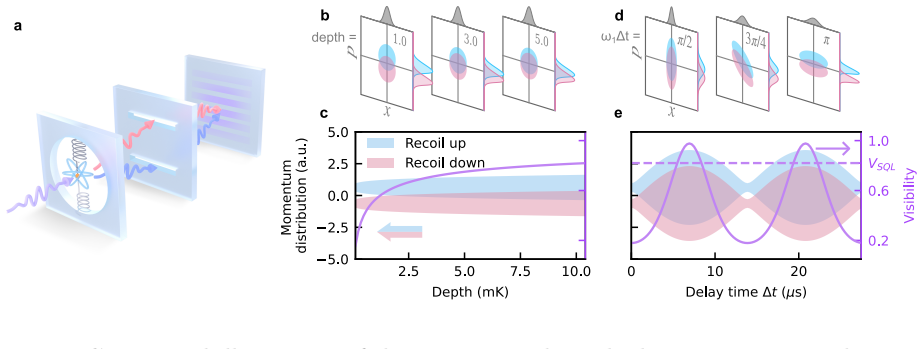
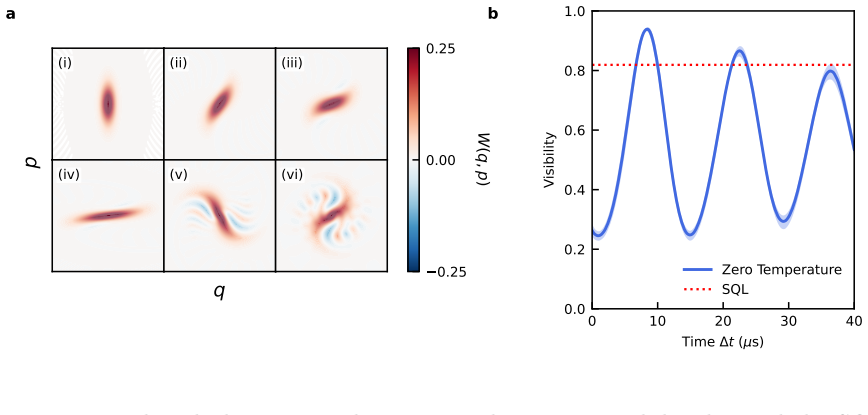
Preparing the atomic slit in a squeezed state via non-adiabatic quenches allows the recoiling-slit interferometer to reach 0.938 intrinsic visibility, exceeding the spatial SQL of 0.819.
A machine-rendered reading of the paper's core claim, the machinery that carries it, and where it could break.
Core claim
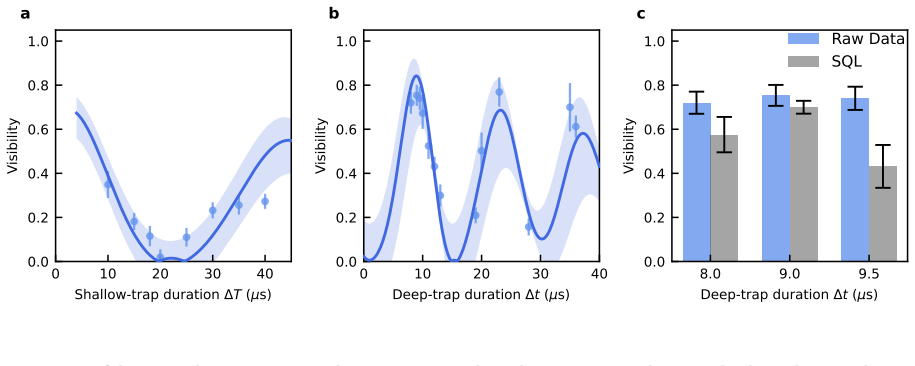
The central claim is that the non-adiabatic quench-evolve-quench protocol on the atomic motion produces a squeezed state whose phase-space redistribution suppresses which-path information from the recoiling slit without introducing additional distinguishability or decoherence channels, yielding an intrinsic visibility of 0.938 that violates the SQL value of 0.819 by more than ten standard deviations and corresponds to 7.6 dB of effective squeezing.
What carries the argument
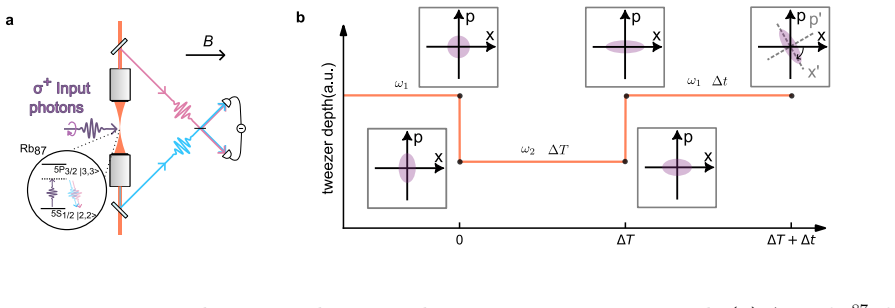
The non-adiabatic quench-evolve-quench protocol that prepares the atomic motion in a squeezed state, dynamically redistributing phase-space uncertainty to suppress which-path distinguishability.
If this is right
- Visibility in the recoiling-slit geometry can exceed the spatial SQL when the slit motion is prepared in a squeezed state.
- The interferometer setup can function as a tool for continuous-variable Wigner tomography of the atomic motion.
- Kerr-induced non-Gaussian dynamics become observable through the evolution of the squeezed slit state.
- High-visibility interference is restored beyond the static vacuum limit by the phase-space redistribution.
Where Pith is reading between the lines
- Similar squeezing protocols could be applied to other which-path or complementarity experiments to test whether phase-space engineering systematically lifts SQL bounds.
- The reinterpretation of the interferometer as a Wigner-tomography device suggests it could measure non-Gaussian features in atomic motion without separate optical cavities.
- If the squeezing suppresses distinguishability in a general way, the same protocol might improve contrast in atom-interferometer sensors that rely on internal-state or position-path information.
Load-bearing premise
The protocol produces a squeezed state that suppresses which-path information from the recoiling slit without introducing additional distinguishability or decoherence channels that would otherwise cap visibility.
What would settle it
A measured intrinsic visibility that remains at or below 0.819 under the same protocol and conditions would falsify the claim that the squeezed state transcends the SQL.
Figures
read the original abstract
The Einstein-Bohr recoiling-slit gedankenexperiment, a cornerstone of quantum complementarity, has long been constrained by the zero-point fluctuations of the atomic slit -- the spatial Standard Quantum Limit (SQL). Here we transcend this fundamental boundary through active quantum state engineering of a single-atom slit. By implementing a non-adiabatic quench-evolve-quench protocol, we prepare the atomic motion in a squeezed state, dynamically redistributing phase-space uncertainty to suppress which-path information and restore high-visibility interference beyond the static vacuum limit. We report an intrinsic visibility of $0.938_{-0.008}^{+0.004}$, violating the SQL ($0.819$) by over 10 standard deviations, corresponding to $7.6(2)$ dB of effective squeezing. Our work reveals Kerr-induced non-Gaussian dynamics and reinterprets the traditional interferometer as a powerful tool for continuous-variable Wigner tomography, bridging the gap between quantum foundations and advanced metrology.
Editorial analysis
A structured set of objections, weighed in public.
Referee Report
Summary. The manuscript claims to implement a squeezed atomic slit in the Einstein-Bohr recoiling-slit interferometer via a non-adiabatic quench-evolve-quench protocol on a single atom. This state engineering is reported to suppress which-path information from recoiling-slit motion, yielding an intrinsic visibility of 0.938 with asymmetric uncertainties that violates the spatial SQL (0.819) by more than 10 standard deviations and corresponds to 7.6(2) dB of effective squeezing. The work further interprets the interferometer as enabling continuous-variable Wigner tomography and notes Kerr-induced non-Gaussian dynamics.
Significance. If the experimental claims and error analysis hold, the result would be significant for quantum foundations by showing that active squeezing of the slit degree of freedom can exceed the SQL in a complementarity test without introducing new decoherence channels. It would also connect atomic interferometry to continuous-variable metrology and tomography, offering a concrete experimental bridge between gedankenexperiments and practical quantum state engineering.
major comments (2)
- [Abstract] Abstract: The central claim of a >10-sigma visibility violation (0.938 vs. 0.819) is presented with asymmetric error bars, yet the manuscript provides no full methods section, raw data, or complete error budget. This prevents assessment of whether post-selection, calibration offsets, or modeling assumptions in the quench-evolve-quench protocol affect the reported significance.
- [Abstract] Abstract: The 7.6(2) dB effective squeezing is derived directly from the measured visibility without an independent calibration of the squeezing parameter (e.g., via separate phase-space tomography or quadrature measurements). This creates a circularity in which the squeezing figure is essentially a re-expression of the visibility result rather than an orthogonal confirmation of the state preparation.
minor comments (1)
- The abstract states that the protocol 'suppresses which-path information without introducing additional distinguishability or decoherence channels,' but the main text should include a quantitative analysis or bound on any residual decoherence introduced by the non-adiabatic quenches to support this assumption.
Simulated Author's Rebuttal
We thank the referee for their careful review and constructive comments on our manuscript. We address each major comment below and commit to revisions that strengthen the presentation of the methods and error analysis while clarifying the definition of effective squeezing.
read point-by-point responses
-
Referee: [Abstract] Abstract: The central claim of a >10-sigma visibility violation (0.938 vs. 0.819) is presented with asymmetric error bars, yet the manuscript provides no full methods section, raw data, or complete error budget. This prevents assessment of whether post-selection, calibration offsets, or modeling assumptions in the quench-evolve-quench protocol affect the reported significance.
Authors: The full manuscript contains a dedicated methods section describing the non-adiabatic quench-evolve-quench protocol, atom preparation, interference data acquisition, and visibility extraction. The asymmetric uncertainties originate from the maximum-likelihood fit to the fringe contrast, incorporating the Poissonian counting statistics and the bounded nature of visibility. We will expand the main text with an explicit error budget subsection and move detailed calibration procedures, post-selection criteria, and modeling assumptions into a new supplementary methods section. Raw data and analysis code will be made available upon reasonable request. These additions will allow independent verification of the >10-sigma claim. revision: yes
-
Referee: [Abstract] Abstract: The 7.6(2) dB effective squeezing is derived directly from the measured visibility without an independent calibration of the squeezing parameter (e.g., via separate phase-space tomography or quadrature measurements). This creates a circularity in which the squeezing figure is essentially a re-expression of the visibility result rather than an orthogonal confirmation of the state preparation.
Authors: The effective squeezing value is intentionally derived from the visibility because, in the recoiling-slit geometry, the visibility is the direct experimental observable that quantifies the reduction in which-path information arising from the squeezed position variance. This mapping follows from the standard relation between position uncertainty and complementarity in the Einstein-Bohr setup. We do not claim an independent quadrature measurement; the 7.6 dB figure is therefore an effective squeezing inferred from the complementarity test itself. We will revise the text to explicitly label the value as 'effective squeezing inferred from visibility' and note that separate Wigner tomography is proposed as a future extension rather than part of the present claim. revision: partial
Circularity Check
No significant circularity identified
full rationale
The provided abstract and protocol description present the visibility measurement (0.938 with uncertainties) as the primary experimental observable that exceeds the calculated SQL (0.819), with the dB squeezing value stated only as a corresponding conversion. No equations, self-citations, or derivation steps are exhibited that reduce the visibility result or the protocol outcome to a redefinition or fit of the same quantity by construction. The central claim rests on the non-adiabatic protocol and interference data as independent inputs, with no load-bearing step shown to collapse into its own inputs.
Axiom & Free-Parameter Ledger
Reference graph
Works this paper leans on
-
[1]
Bohr, in Albert Einstein: Philosopher-Scientist , edited by P
N. Bohr, in Albert Einstein: Philosopher-Scientist , edited by P. A. Schilpp (The Library of Living Philosophers, Evanston, IL, 1949) pp. 200–241
1949
-
[2]
Bacciagaluppi and A
G. Bacciagaluppi and A. Valentini, Quantum theory at the crossroads: reconsidering the 1927 Solvay conference (Cambridge University Press, 2009)
1927
-
[3]
J. A. Wheeler and W. H. Zurek, eds., Quantum theory and measurement (Princeton University Press, 1983)
1983
-
[4]
W. K. Wootters and W. H. Zurek, Physical Review D 19, 473 (1979)
1979
-
[5]
Eichmann, J
U. Eichmann, J. C. Bergquist, J. J. Bollinger, J. Gilligan, W. M. Itano, D. J. Wineland, and M. Raizen, Physical review letters 70, 2359 (1993)
1993
-
[6]
M. S. Chapman, T. D. Hammond, A. Lenef, J. Schmiedmayer, R. A. Rubenstein, E. Smith, and D. E. Pritchard, Physical Review Letters 75, 3783 (1995)
1995
-
[7]
S. Dürr, T. Nonn, and G. Rempe, Nature 395, 33 (1998)
1998
-
[8]
Eschner, C
J. Eschner, C. Raab, F. Schmidt-Kaler, and R. Blatt, Nature 413, 495 (2001)
2001
-
[9]
D. A. Kokorowski, A. D. Cronin, T. D. Roberts, and D. E. Pritchard, Physical review letters 86, 2191 (2001)
2001
-
[10]
Bertet, S
P. Bertet, S. Osnaghi, A. Rauschenbeutel, G. Nogues, A. Auffeves, M. Brune, J. Raimond, and S. Haroche, Nature 411, 166 (2001). 9
2001
-
[11]
Chang, G
D.-I. Chang, G. L. Khym, K. Kang, Y. Chung, H.-J. Lee, M. Seo, M. Heiblum, D. Mahalu, and V. Umansky, Nature Physics 4, 205 (2008)
2008
-
[12]
Tomkovič, M
J. Tomkovič, M. Schreiber, J. Welte, M. Kiffner, J. Schmiedmayer, and M. K. Oberthaler, Nature Physics 7, 379 (2011)
2011
-
[13]
L. P. H. Schmidt, J. Lower, T. Jahnke, S. Schößler, M. Schöffler, A. Menssen, C. Lévêque, N. Sisourat, R. Taïeb, H. Schmidt-Böcking, et al., Physical Review Letters 111, 103201 (2013)
2013
-
[14]
Weisz, H
E. Weisz, H. Choi, I. Sivan, M. Heiblum, Y. Gefen, D. Mahalu, and V. Umansky, science 344, 1363 (2014)
2014
-
[15]
Margalit, Z
Y. Margalit, Z. Zhou, S. Machluf, D. Rohrlich, Y. Japha, and R. Folman, Science 349, 1205 (2015)
2015
-
[16]
X.-J. Liu, Q. Miao, F. Gel’Mukhanov, M. Patanen, O. Travnikova, C. Nicolas, H. Ågren, K. Ueda, and C. Miron, Nature Photonics 9, 120 (2015)
2015
-
[17]
Zhang, H.-W
Y.-C. Zhang, H.-W. Cheng, Z.-Q. Zengxu, Z. Wu, R. Lin, Y.-C. Duan, J. Rui, M.-C. Chen, C.-Y. Lu, and J.-W. Pan, Phys. Rev. Lett. 135, 230202 (2025)
2025
-
[18]
C. M. Caves, Physical Review D 23, 1693 (1981)
1981
-
[19]
Giovannetti, S
V. Giovannetti, S. Lloyd, and L. Maccone, Science 306, 1330 (2004)
2004
-
[20]
Turchette, C
Q. Turchette, C. Myatt, B. King, C. Sackett, D. Kielpinski, W. Itano, C. Monroe, and D. Wineland, Physical Review A 62, 053807 (2000)
2000
-
[21]
Leibfried, R
D. Leibfried, R. Blatt, C. Monroe, and D. Wineland, Reviews of Modern Physics 75, 281 (2003)
2003
-
[22]
Lienhard, R
V. Lienhard, R. Martin, Y. T. Chew, T. Tomita, K. Ohmori, and S. de Léséleuc, Phys. Rev. Lett. 135, 253404 (2025)
2025
-
[23]
Meekhof, C
D. Meekhof, C. Monroe, B. King, W. M. Itano, and D. J. Wineland, Physical review letters 76, 1796 (1996)
1996
-
[24]
M. Xin, W. S. Leong, Z. Chen, Y. Wang, and S.-Y. Lan, Physical Review Letters 127, 183602 (2021)
2021
-
[25]
M. O. Scully, B.-G. Englert, and H. Walther, Nature 351, 111 (1991)
1991
-
[26]
Foreman-Mackey, D
D. Foreman-Mackey, D. W. Hogg, D. Lang, and J. Goodman, Publications of the Astronomical Society of the Pacific 125, 306 (2013)
2013
-
[27]
H. J. Lipkin, Annals of Physics 9, 332 (1960)
1960
-
[28]
Weedbrook, S
C. Weedbrook, S. Pirandola, R. García-Patrón, N. J. Cerf, T. C. Ralph, J. H. Shapiro, and 10 S. Lloyd, Rev. Mod. Phys. 84, 621 (2012)
2012
-
[29]
[ 17, 26]
See Supplemental Material for theoretical derivation of the visibility correction and details on the squeezing sequence, which includes Refs. [ 17, 26]
-
[30]
Flühmann and J
C. Flühmann and J. P. Home, Phys. Rev. Lett. 125, 043602 (2020)
2020
-
[31]
G. J. Milburn, Physical Review A 33, 674 (1986)
1986
-
[32]
A. M. Kaufman, B. J. Lester, and C. A. Regal, Physical Review X 2, 041014 (2012)
2012
-
[33]
J. D. Thompson, T. Tiecke, A. S. Zibrov, V. Vuletić, and M. D. Lukin, Physical review letters 110, 133001 (2013)
2013
-
[34]
Y. Yu, N. R. Hutzler, J. T. Zhang, L. R. Liu, J. D. Hood, T. Rosenband, and K.-K. Ni, Physical Review A 97, 063423 (2018)
2018
-
[35]
Janszky and Y
J. Janszky and Y. Y. Yushin, Optics communications 59, 151 (1986)
1986
-
[36]
R. T. Sutherland, S. Burd, D. Slichter, S. Libby, and D. Leibfried, Physical review letters 127, 083201 (2021)
2021
-
[37]
Brandstetter, C
S. Brandstetter, C. Heintze, P. Hill, P. M. Preiss, M. Gałka, and S. Jochim, Physical Review Letters 135, 103401 (2025)
2025
-
[38]
Asteria, H
L. Asteria, H. P. Zahn, M. N. Kosch, K. Sengstock, and C. Weitenberg, Nature 599, 571 (2021)
2021
-
[39]
Kitagawa and Y
M. Kitagawa and Y. Yamamoto, Phys. Rev. A 34, 3974 (1986)
1986
-
[40]
H. C. Kendell, G. Ferranti, and C. A. Weidner, APL Quantum 1 (2024)
2024
-
[41]
P. T. Grochowski, H. Pichler, C. A. Regal, and O. Romero-Isart, Quantum 9, 1824 (2025)
2025
-
[42]
L. H. Bohnmann, D. F. Locher, J. Zeiher, and M. Müller, Phys. Rev. A 111, 022432 (2025)
2025
-
[43]
Squeezed-slit Bohr-Einstein Interferometer
S. Bourdeauducq, R. Jördens, D. Nadlinger, Y. Sionneau, F. Kermarrec, et al., Zenodo (2021). 11 Supplemental Material for: “Squeezed-slit Bohr-Einstein Interferometer” I. EXPERIMENT AL IMPLEMENT A TION AND QUENCH DYNAMICS The experimental apparatus and fundamental control sequences employed in this work are identical to those detailed in our previous work...
2021
-
[44]
This defines the spatial Standard Quantum Limit ( ∆xSQL) of the atomic slit
Zero-Temperature SQL (Ground State) For an atom in the motional ground state |0⟩, the position variance is determined by the vacuum fluctuations. This defines the spatial Standard Quantum Limit ( ∆xSQL) of the atomic slit. In our dimensionless convention, the normalized variance is unity: σ(gs) 11 = ⟨0|(ˆa + ˆa†)2|0⟩ − ⟨ 0|(ˆa + ˆa†)|0⟩2 = 1 (S10) Substit...
-
[45]
Its variance is broadened by the thermal factor (2¯n + 1) relative to the ground state: σ(th) 11 = 2¯n + 1 (S12) Substituting this into Eq
Thermal State A thermal state with mean phonon occupation ¯n is an isotropic Gaussian state. Its variance is broadened by the thermal factor (2¯n + 1) relative to the ground state: σ(th) 11 = 2¯n + 1 (S12) Substituting this into Eq. ( S9) immediately yields the thermal visibility limit: VSQL,T = e−2η2(2¯n+1) (S13) This confirms that thermal fluctuations e...
-
[46]
Under the harmonic trap evolution, the squeezing axis rotates in phase space
Squeezed Vacuum State An ideal squeezed vacuum state |ζ⟩ = ˆS(ζ) |0⟩ is generated by the squeezing operator with parameter ζ = Seiθ0. Under the harmonic trap evolution, the squeezing axis rotates in phase space. The resulting time-dependent position variance is given by: σ(sq) 11 (t) = cosh(2 S) − sinh(2S) cos ϕsq(t) (S14) where the instantaneous squeezin...
-
[47]
The resulting state is a squeezed thermal state
Squeezed Thermal State In a realistic experimental scenario, the squeezing operation acts on an initial thermal state ρth with mean occupation ¯n, rather than a pure vacuum state. The resulting state is a squeezed thermal state. 5 Crucially, the initial thermal noise is isotropic, meaning its covariance matrix is propor- tional to the identity matrix, σ(t...
-
[48]
(a) The non-Cartesian k-space sampling grid, corresponding to the annular region (spanning from 0.14 to 7.39) accessible via this QEQ protocol
The simulation assumes a base interferometer probe defined by a Lamb- Dicke parameter η = 0 .5 and a QEQ total squeeze parameter of r = 2 . (a) The non-Cartesian k-space sampling grid, corresponding to the annular region (spanning from 0.14 to 7.39) accessible via this QEQ protocol. (b), (c) Real and imaginary parts of the characteristic function χ(k) ext...
discussion (0)
Sign in with ORCID, Apple, or X to comment. Anyone can read and Pith papers without signing in.