ConRAG: Consensus-Driven Multi-View Retrieval for Multi-Hop Question Answering
Pith reviewed 2026-06-29 13:19 UTC · model grok-4.3
The pith
ConRAG retrieves better evidence for multi-hop questions by building consensus across relation, entity, and text signals.
A machine-rendered reading of the paper's core claim, the machinery that carries it, and where it could break.
Core claim
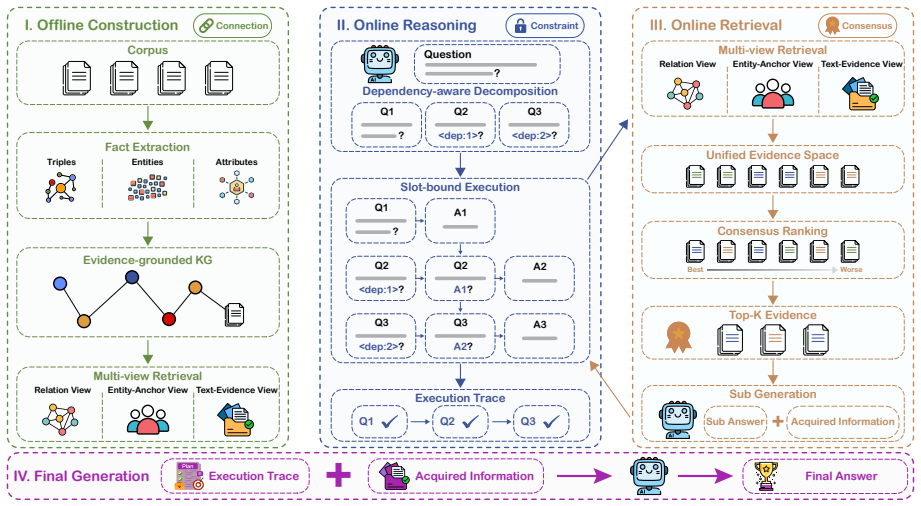
The paper presents ConRAG as a framework that systematically optimizes both the query and corpus sides of retrieval-augmented generation and uses consensus over relation, entity, and text signals to achieve more accurate retrieval for multi-hop question answering.
What carries the argument
Consensus-driven integration of multi-view evidence (relation, entity, and text signals) that refines retrieval on both query and corpus sides.
If this is right
- ConRAG outperforms all tested baselines on three multi-hop QA benchmarks.
- It delivers up to 26.9 percent average gains compared with vanilla RAG.
- Gemma-4-31B equipped with ConRAG sets a new state-of-the-art result on the MuSiQue benchmark.
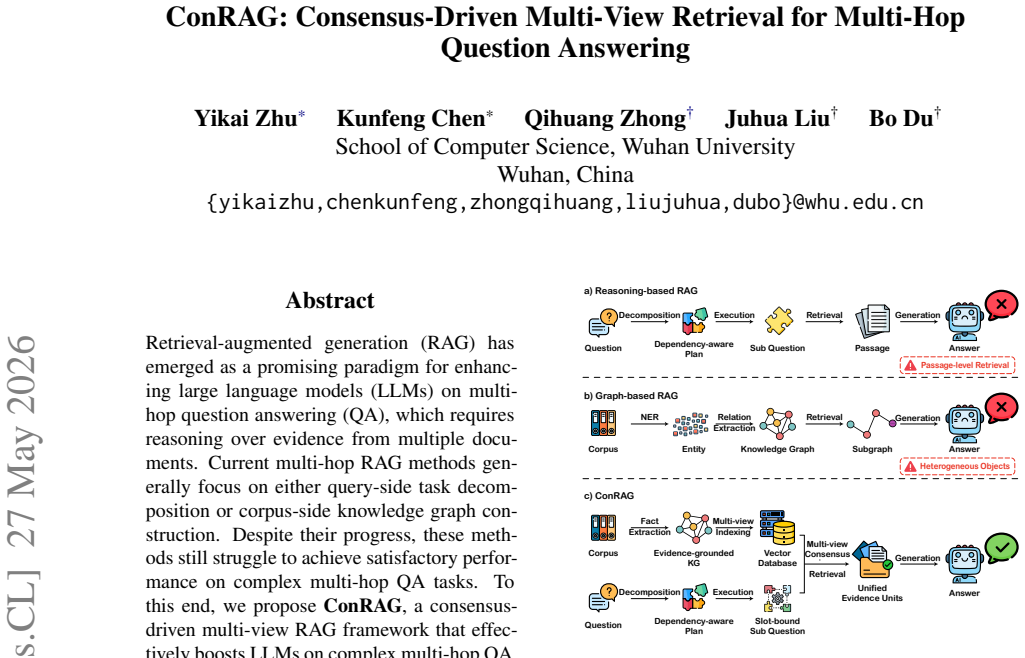
- Multi-view consensus addresses shortcomings of query decomposition and knowledge graph methods.
Where Pith is reading between the lines
- Models using this retrieval method may generate answers with fewer unsupported claims because the evidence has higher consensus.
- The framework could be adapted to improve retrieval in domains like legal or medical document search where multiple evidence types matter.
- Future work might test whether adding more views, such as temporal signals, further improves results on long-context tasks.
Load-bearing premise
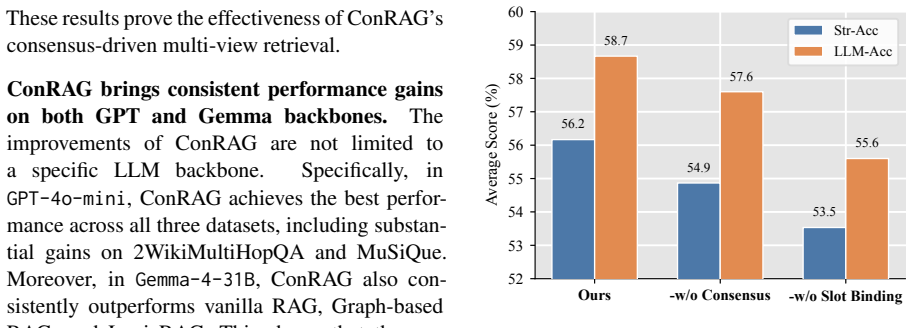
The claim depends on the assumption that agreement among relation, entity, and text signals yields retrieval results superior to those from query decomposition or knowledge-graph construction.
What would settle it
Running the system on MuSiQue without the consensus step and observing whether performance falls back to the level of standard RAG methods.
Figures
read the original abstract
Retrieval-augmented generation (RAG) has emerged as a promising paradigm for enhancing large language models (LLMs) on multi-hop question answering (QA), which requires reasoning over evidence from multiple documents. Current multi-hop RAG methods generally focus on either query-side task decomposition or corpus-side knowledge graph construction. Despite their progress, these methods still struggle to achieve satisfactory performance on complex multi-hop QA tasks. To this end, we propose ConRAG, a consensus-driven multi-view RAG framework that effectively boosts LLMs on complex multi-hop QA. The core of ConRAG is to systematically optimize both the query and corpus sides and to leverage multi-view evidence (relation, entity, and text signals) for more accurate retrieval. Extensive experiments on three multi-hop QA benchmarks show that ConRAG consistently outperforms all baselines by a clear margin, e.g., up to +26.9% average performance gains over vanilla RAG, and enables Gemma-4-31B to achieve a new state-of-the-art record on the challenging MuSiQue benchmark.
Editorial analysis
A structured set of objections, weighed in public.
Referee Report
Summary. The manuscript proposes ConRAG, a consensus-driven multi-view RAG framework for multi-hop question answering. It systematically optimizes both the query and corpus sides and leverages multi-view evidence (relation, entity, and text signals) for more accurate retrieval. The authors claim that extensive experiments on three multi-hop QA benchmarks demonstrate consistent outperformance over all baselines, with up to +26.9% average gains over vanilla RAG, and that the method enables Gemma-4-31B to set a new state-of-the-art on the MuSiQue benchmark.
Significance. If the reported results are substantiated by detailed experiments, the work would offer a practical advance in multi-hop RAG by showing that consensus across relation, entity, and text views can outperform prior query-decomposition and knowledge-graph approaches. The quantitative margins and SOTA claim on a challenging benchmark would indicate meaningful impact for LLM-based reasoning systems.
major comments (2)
- [Abstract] Abstract: The central empirical claims (consistent outperformance, +26.9% gains over vanilla RAG, new SOTA on MuSiQue) are stated without any description of the three benchmarks, baseline implementations, evaluation metrics, statistical significance tests, or ablation studies. This information is load-bearing for assessing whether the multi-view consensus premise actually produces the claimed improvements.
- [Abstract] Abstract: The description of the core mechanism—how consensus is computed across the three views and how the query-side and corpus-side optimizations are performed—remains at a high level with no algorithmic details, pseudocode, or equations. Without these, it is not possible to verify that the framework differs substantively from prior multi-view or ensemble retrieval methods.
Simulated Author's Rebuttal
We thank the referee for the constructive feedback. We address the two major comments on the abstract below and will revise the abstract to improve clarity while preserving its length constraints.
read point-by-point responses
-
Referee: [Abstract] Abstract: The central empirical claims (consistent outperformance, +26.9% gains over vanilla RAG, new SOTA on MuSiQue) are stated without any description of the three benchmarks, baseline implementations, evaluation metrics, statistical significance tests, or ablation studies. This information is load-bearing for assessing whether the multi-view consensus premise actually produces the claimed improvements.
Authors: We agree the abstract is concise and omits explicit references to these elements. The full paper describes the benchmarks (HotpotQA, 2WikiMultiHopQA, MuSiQue) in Section 4.1, baselines and metrics (EM/F1) in Section 4.2, ablations in Section 5.3, and reports significance via paired t-tests in Tables 2-4. We will revise the abstract to briefly name the benchmarks and note the evaluation protocol to better ground the claims. revision: yes
-
Referee: [Abstract] Abstract: The description of the core mechanism—how consensus is computed across the three views and how the query-side and corpus-side optimizations are performed—remains at a high level with no algorithmic details, pseudocode, or equations. Without these, it is not possible to verify that the framework differs substantively from prior multi-view or ensemble retrieval methods.
Authors: The abstract follows standard practice by summarizing at a high level. Section 3 details the consensus computation (Equations 3–5 for relation/entity/text view agreement), query-side multi-view rewriting, corpus-side multi-view indexing, and includes pseudocode in Algorithm 1. We will add one sentence to the abstract briefly describing the consensus step to emphasize its distinction from prior work. revision: yes
Circularity Check
No significant circularity; empirical engineering contribution
full rationale
The paper is an empirical ML systems contribution proposing the ConRAG framework for multi-hop QA. It optimizes query and corpus sides via multi-view evidence (relation/entity/text) and reports benchmark gains (+26.9% over vanilla RAG, new SOTA on MuSiQue). No equations, derivations, or parameter-fitting steps appear in the provided abstract or description. The central claim is a performance comparison on external benchmarks, which is directly falsifiable and does not reduce to self-definition, fitted-input renaming, or self-citation chains. No load-bearing step matches any enumerated circularity pattern.
Axiom & Free-Parameter Ledger
Reference graph
Works this paper leans on
-
[1]
Muhammad Arslan, Hussam Ghanem, Saba Munawar, and Christophe Cruz. 2024. A survey on RAG with LLMs . Procedia Computer Science, 246:3781--3790
2024
-
[2]
Shengyuan Chen, Chuang Zhou, Zheng Yuan, Qinggang Zhang, Zeyang Cui, Hao Chen, Yilin Xiao, Jiannong Cao, and Xiao Huang. 2026. You don't need pre-built graphs for RAG : Retrieval augmented generation with adaptive reasoning structures. In Proceedings of the AAAI Conference on Artificial Intelligence, volume 40, pages 30270--30278
2026
-
[3]
Junnan Dong, Siyu An, Yifei Yu, Qian-Wen Zhang, Linhao Luo, Xiao Huang, di yin, Yunsheng Wu, and Xing Sun. 2026. Youtu- G raph RAG : Vertically unified agents for graph retrieval-augmented complex reasoning. In The Fourteenth International Conference on Learning Representations
2026
-
[4]
Darren Edge, Ha Trinh, Newman Cheng, Joshua Bradley, Alex Chao, Apurva Mody, Steven Truitt, Dasha Metropolitansky, Robert Osazuwa Ness, and Jonathan Larson. 2024. From local to global: A graph RAG approach to query-focused summarization. arXiv preprint arXiv:2404.16130
work page internal anchor Pith review Pith/arXiv arXiv 2024
-
[5]
Wenqi Fan, Yujuan Ding, Liangbo Ning, Shijie Wang, Hengyun Li, Dawei Yin, Tat-Seng Chua, and Qing Li. 2024. A survey on RAG meeting LLMs : Towards retrieval-augmented large language models. In Proceedings of the 30th ACM SIGKDD Conference on Knowledge Discovery and Data Mining, pages 6491--6501
2024
-
[6]
Zirui Guo, Lianghao Xia, Yanhua Yu, Tu Ao, and Chao Huang. 2025. L ight RAG : Simple and fast retrieval-augmented generation. In Findings of the Association for Computational Linguistics: EMNLP 2025, pages 10746--10761
2025
-
[7]
Bernal Jim\' e nez Guti\' e rrez, Yiheng Shu, Yu Gu, Michihiro Yasunaga, and Yu Su. 2024. Hippo RAG : Neurobiologically inspired long-term memory for large language models. In Advances in Neural Information Processing Systems, volume 37, pages 59532--59569
2024
-
[8]
Bernal Jim\' e nez Guti\' e rrez, Yiheng Shu, Weijian Qi, Sizhe Zhou, and Yu Su. 2025. From RAG to memory: Non-parametric continual learning for large language models. In Proceedings of the 42nd International Conference on Machine Learning, volume 267, pages 21497--21515
2025
-
[9]
Chawla, Thomas Laurent, Yann LeCun, Xavier Bresson, and Bryan Hooi
Xiaoxin He, Yijun Tian, Yifei Sun, Nitesh V. Chawla, Thomas Laurent, Yann LeCun, Xavier Bresson, and Bryan Hooi. 2024. G- R etriever: Retrieval-augmented generation for textual graph understanding and question answering. In Advances in Neural Information Processing Systems, volume 37, pages 132876--132907
2024
-
[10]
Xanh Ho, Anh-Khoa Duong Nguyen, Saku Sugawara, and Akiko Aizawa. 2020. Constructing a multi-hop QA dataset for comprehensive evaluation of reasoning steps. In Proceedings of the 28th International Conference on Computational Linguistics, pages 6609--6625
2020
-
[11]
Aaron Hurst, Adam Lerer, Adam P Goucher, Adam Perelman, Aditya Ramesh, Aidan Clark, AJ Ostrow, Akila Welihinda, Alan Hayes, Alec Radford, and 1 others. 2024. GPT -4o system card. arXiv preprint arXiv:2410.21276
work page internal anchor Pith review Pith/arXiv arXiv 2024
-
[12]
Vladimir Karpukhin, Barlas Oguz, Sewon Min, Patrick Lewis, Ledell Wu, Sergey Edunov, Danqi Chen, and Wen-tau Yih. 2020. Dense passage retrieval for open-domain question answering. In Proceedings of the 2020 Conference on Empirical Methods in Natural Language Processing (EMNLP), pages 6769--6781
2020
-
[13]
u ttler, Mike Lewis, Wen-tau Yih, Tim Rockt\
Patrick Lewis, Ethan Perez, Aleksandra Piktus, Fabio Petroni, Vladimir Karpukhin, Naman Goyal, Heinrich K\" u ttler, Mike Lewis, Wen-tau Yih, Tim Rockt\" a schel, Sebastian Riedel, and Douwe Kiela. 2020. Retrieval-augmented generation for knowledge-intensive NLP tasks. In Advances in Neural Information Processing Systems, volume 33, pages 9459--9474
2020
-
[14]
Vaibhav Mavi, Anubhav Jangra, and Adam Jatowt. 2024. Multi-hop question answering. Foundations and Trends in Information Retrieval, 17(5):457--586
2024
-
[15]
Ofir Press, Muru Zhang, Sewon Min, Ludwig Schmidt, Noah Smith, and Mike Lewis. 2023. Measuring and narrowing the compositionality gap in language models. In Findings of the Association for Computational Linguistics: EMNLP 2023, pages 5687--5711, Singapore
2023
-
[16]
Parth Sarthi, Salman Abdullah, Aditi Tuli, Shubh Khanna, Anna Goldie, and Christopher D Manning. 2024. RAPTOR : Recursive abstractive processing for tree-organized retrieval. In The Twelfth International Conference on Learning Representations
2024
-
[17]
Harsh Trivedi, Niranjan Balasubramanian, Tushar Khot, and Ashish Sabharwal. 2022. ♫ M u S i Q ue: Multihop questions via single-hop question composition. Transactions of the Association for Computational Linguistics, 10:539--554
2022
-
[18]
Harsh Trivedi, Niranjan Balasubramanian, Tushar Khot, and Ashish Sabharwal. 2023. Interleaving retrieval with chain-of-thought reasoning for knowledge-intensive multi-step questions. In Proceedings of the 61st Annual Meeting of the Association for Computational Linguistics (volume 1: long papers), pages 10014--10037
2023
-
[19]
Yu Wang, Nedim Lipka, Ryan A Rossi, Alexa Siu, Ruiyi Zhang, and Tyler Derr. 2024. Knowledge graph prompting for multi-document question answering. In Proceedings of the AAAI conference on artificial intelligence, volume 38, pages 19206--19214
2024
-
[20]
Zhilin Yang, Peng Qi, Saizheng Zhang, Yoshua Bengio, William Cohen, Ruslan Salakhutdinov, and Christopher D Manning. 2018. Hotpot QA : A dataset for diverse, explainable multi-hop question answering. In Proceedings of the 2018 Conference on Empirical Methods in Natural Language Processing, pages 2369--2380
2018
-
[21]
Shunyu Yao, Jeffrey Zhao, Dian Yu, Nan Du, Izhak Shafran, Karthik R Narasimhan, and Yuan Cao. 2023. Re A ct: Synergizing reasoning and acting in language models. In The Eleventh International Conference on Learning Representations
2023
-
[22]
Lianmin Zheng, Wei-Lin Chiang, Ying Sheng, Siyuan Zhuang, Zhanghao Wu, Yonghao Zhuang, Zi Lin, Zhuohan Li, Dacheng Li, Eric Xing, Hao Zhang, Joseph Gonzalez, and Ion Stoica. 2023. Judging llm-as-a-judge with mt-bench and chatbot arena. In Advances in Neural Information Processing Systems, volume 36, pages 46595--46623
2023
-
[23]
Denny Zhou, Nathanael Sch \"a rli, Le Hou, Jason Wei, Nathan Scales, Xuezhi Wang, Dale Schuurmans, Claire Cui, Olivier Bousquet, Quoc V Le, and Ed H. Chi. 2023. Least-to-most prompting enables complex reasoning in large language models. In The Eleventh International Conference on Learning Representations
2023
-
[24]
Luyao Zhuang, Shengyuan Chen, Yilin Xiao, Huachi Zhou, Yujing Zhang, Hao Chen, Qinggang Zhang, and Xiao Huang. 2026. Linear RAG : Linear graph retrieval augmented generation on large-scale corpora. In The Fourteenth International Conference on Learning Representations
2026
-
[25]
Ziyuan Zhuang, Zhiyang Zhang, Sitao Cheng, Fangkai Yang, Jia Liu, Shujian Huang, Qingwei Lin, Saravan Rajmohan, Dongmei Zhang, and Qi Zhang. 2024. Efficient RAG : Efficient retriever for multi-hop question answering. In Proceedings of the 2024 Conference on Empirical Methods in Natural Language Processing, pages 3392--3411
2024
-
[26]
online" 'onlinestring :=
ENTRY address archivePrefix author booktitle chapter edition editor eid eprint eprinttype howpublished institution journal key month note number organization pages publisher school series title type volume year doi pubmed url lastchecked label extra.label sort.label short.list INTEGERS output.state before.all mid.sentence after.sentence after.block STRING...
-
[27]
write newline
" write newline "" before.all 'output.state := FUNCTION n.dashify 't := "" t empty not t #1 #1 substring "-" = t #1 #2 substring "--" = not "--" * t #2 global.max substring 't := t #1 #1 substring "-" = "-" * t #2 global.max substring 't := while if t #1 #1 substring * t #2 global.max substring 't := if while FUNCTION word.in bbl.in capitalize " " * FUNCT...
discussion (0)
Sign in with ORCID, Apple, or X to comment. Anyone can read and Pith papers without signing in.