Better heads do not guarantee better binarized constituency parsing
Pith reviewed 2026-06-29 13:02 UTC · model grok-4.3
The pith
Learned dependency heads improve head prediction but do not deliver consistent gains in binarized constituency parsing.
A machine-rendered reading of the paper's core claim, the machinery that carries it, and where it could break.
Core claim
Although learned heads substantially outperform rule-based heads in intrinsic head prediction, they do not yield consistent parsing gains after debinarization. In particular, punctuation-conditioned evaluation shows that learned headedness underperforms rule-based binarization in macro-average punctuation-sensitive F1, despite a small overall gain on CTB. Similar instability appears under cross-treebank transfer. These results suggest that linguistically grounded headedness is not necessarily parser-optimal when used as a binarization control signal.
What carries the argument
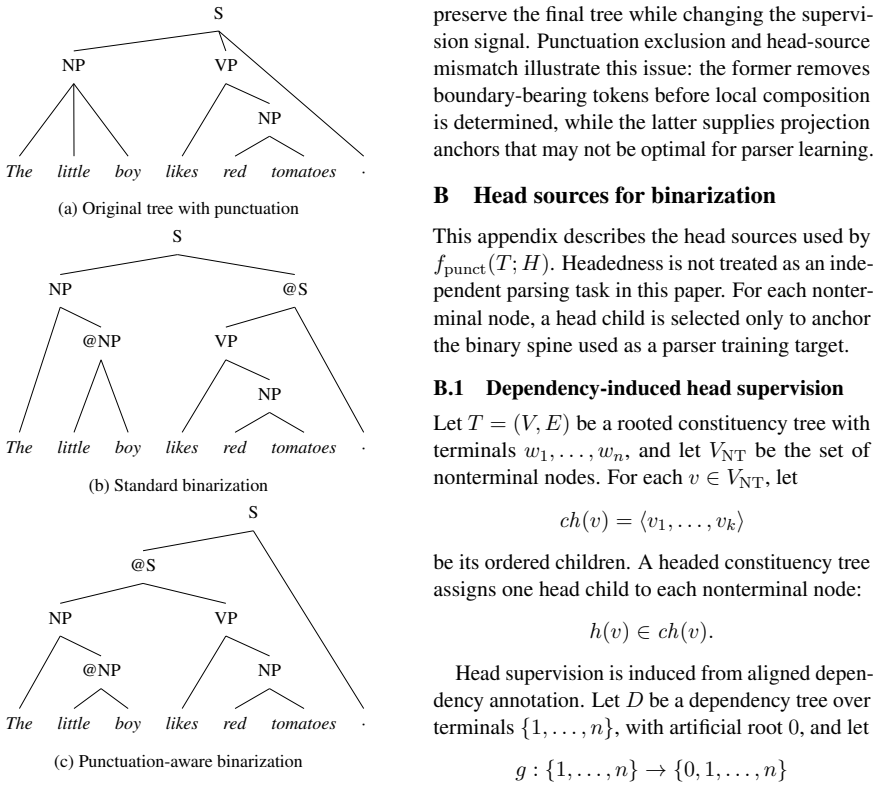
Punctuation-aware tree binarization that uses headedness from a dependency parser as the control signal for ordering children in binary trees.
If this is right
- Superior accuracy on head prediction does not translate into higher constituency parsing F1 after debinarization.
- Rule-based binarization can outperform learned headedness on macro-average punctuation-sensitive metrics.
- Parsing performance gains from learned heads remain unstable when models are transferred across different treebanks.
- Linguistically motivated headedness need not be the optimal signal for controlling binarization in parser training.
Where Pith is reading between the lines
- Other modeling decisions inside the parser, such as how it handles the binary structure during training, may matter more than the source of the head labels.
- Direct optimization of binarization choices for end-task parsing metrics could be more effective than relying on separate head-prediction accuracy.
- Alternative signals for ordering children in binary trees, beyond either rule-based or learned dependency heads, merit direct comparison.
Load-bearing premise
The quality of the head signal used to control binarization will directly determine how well the parser performs after the binary trees are converted back to their original form.
What would settle it
A replication experiment in which learned heads produce higher punctuation-sensitive F1 scores than rule-based heads on every treebank and every punctuation-conditioned split would show the central negative result does not hold.
Figures
read the original abstract
We revisit punctuation-aware tree binarization for constituency parsing and ask whether dependency-induced headedness improves binary parser supervision. Although learned heads substantially outperform rule-based heads in intrinsic head prediction, they do not yield consistent parsing gains after debinarization. In particular, punctuation-conditioned evaluation shows that learned headedness underperforms rule-based binarization in macro-average punctuation-sensitive $F_1$, despite a small overall gain on CTB. Similar instability appears under cross-treebank transfer. These results suggest that \ycc{linguistically grounded} headedness is not necessarily parser-optimal when used as a binarization control signal. The paper presents a negative result: better head prediction does not imply better punctuation-sensitive constituency parsing.
Editorial analysis
A structured set of objections, weighed in public.
Referee Report
Summary. The manuscript reports an empirical study on punctuation-aware tree binarization for constituency parsing. It compares rule-based heads against learned heads as control signals for binarization. Although learned heads outperform rule-based heads on intrinsic head prediction accuracy, the paper finds no consistent parsing gains after debinarization. In particular, punctuation-conditioned evaluation reveals that learned heads underperform rule-based binarization on macro-average punctuation-sensitive F1 despite a small overall CTB gain, with similar instability under cross-treebank transfer. The central negative result is that linguistically grounded headedness is not necessarily parser-optimal when used as a binarization control signal.
Significance. If the empirical comparisons hold after controlling for confounds, the negative result is significant because it directly tests and challenges the assumption that higher-quality head signals will produce better binary trees for downstream constituency parsing. The work supplies falsifiable predictions via head-source swaps and punctuation-sensitive metrics, which are load-bearing for claims about the utility of dependency information in parsing pipelines.
major comments (1)
- [Abstract] Abstract and central claim: the reported reversal in macro-average punctuation-sensitive F1 (learned heads underperform rule-based) is presented as evidence that head quality does not determine post-debinarization performance. However, this interpretation requires that head choice is isolated from punctuation attachment patterns during binarization and evaluation; the manuscript provides no explicit description of the debinarization procedure, parser architecture, or punctuation handling that would confirm the isolation.
Simulated Author's Rebuttal
We thank the referee for the constructive feedback highlighting the need for clearer documentation of experimental procedures. We address the single major comment below and will revise the manuscript accordingly.
read point-by-point responses
-
Referee: [Abstract] Abstract and central claim: the reported reversal in macro-average punctuation-sensitive F1 (learned heads underperform rule-based) is presented as evidence that head quality does not determine post-debinarization performance. However, this interpretation requires that head choice is isolated from punctuation attachment patterns during binarization and evaluation; the manuscript provides no explicit description of the debinarization procedure, parser architecture, or punctuation handling that would confirm the isolation.
Authors: We agree that explicit descriptions strengthen the isolation claim. Head choice serves as the sole control signal for binarization decisions (determining which child becomes the head in each binary production), while punctuation attachment follows a fixed, source-independent rule applied after head selection. The parser is a standard neural span-based constituency parser trained directly on the resulting binary trees; debinarization is the deterministic inverse of the binarization steps and does not reintroduce head information. These elements are described in Sections 3 (binarization) and 4 (parser and evaluation), with punctuation-conditioned metrics computed identically for both head sources. To address the concern, the revision will add a dedicated paragraph in Section 3 explicitly stating that punctuation handling is decoupled from head source and confirming identical application across conditions. This documentation will make the isolation transparent without altering the reported results or central claim. revision: yes
Circularity Check
No circularity: direct empirical comparison of head sources
full rationale
The paper reports an experimental comparison of rule-based versus learned heads as binarization controls for constituency parsing, measuring effects on post-debinarization parser performance (including punctuation-conditioned F1). No equations, fitted parameters, derivations, or self-citation chains are described that reduce any result to its own inputs by construction. The central negative finding rests on observed experimental outcomes rather than any self-definitional or load-bearing self-citation step. This is a standard non-circular empirical study.
Axiom & Free-Parameter Ledger
Reference graph
Works this paper leans on
-
[1]
online" 'onlinestring :=
ENTRY address archivePrefix author booktitle chapter edition editor eid eprint eprinttype howpublished institution journal key month note number organization pages publisher school series title type volume year doi pubmed url lastchecked label extra.label sort.label short.list INTEGERS output.state before.all mid.sentence after.sentence after.block STRING...
-
[2]
write newline
" write newline "" before.all 'output.state := FUNCTION n.dashify 't := "" t empty not t #1 #1 substring "-" = t #1 #2 substring "--" = not "--" * t #2 global.max substring 't := t #1 #1 substring "-" = "-" * t #2 global.max substring 't := while if t #1 #1 substring * t #2 global.max substring 't := if while FUNCTION word.in bbl.in capitalize " " * FUNCT...
-
[3]
Anne Abeill \' e , Lionel Cl \' e ment, and François Toussenel. 2003. Building a Treebank for French . In Anne Abeill \' e , editor, Treebanks: Building and Using Parsed Corpora, pages 165--188. Kluwer
2003
-
[4]
Ezra Black, Steven P. Abney, Dan Flickinger, Claudia Gdaniec, Ralph Grishman, Phil Harrison, Don Hindle, Robert Ingria, Frederick Jelinek, Judith Klavans, Mark Liberman, Mitch Marcus, Salim Roukos, Beatrice Santorini, and Tomek Strzalkowski. 1991. https://aclanthology.org/H91-1060/ A Procedure for Quantitatively Comparing the Syntactic Coverage of English...
1991
-
[5]
Ted Briscoe and John Carroll. 1995. https://aclanthology.org/1995.iwpt-1.8 Developing and Evaluating a Probabilistic LR Parser of Part-of-Speech and Punctuation Labels . In Proceedings of the Fourth International Workshop on Parsing Technologies, pages 48--58, Prague and Karlovy Vary, Czech Republic. Association for Computational Linguistics
1995
-
[6]
John Cocke. 1969. Programming Languages and Their Compilers: Preliminary Notes . New York University, USA
1969
-
[7]
Michael Collins. 1999. http://www.cs.columbia.edu/ mcollins/papers/thesis.ps Head-Driven Statistical Models for Natural Language Parsing . Ph.D. thesis, University of Pennsylvania
1999
-
[8]
Jacob Devlin, Ming-Wei Chang, Kenton Lee, and Kristina Toutanova. 2019. https://doi.org/10.18653/v1/N19-1423 BERT: Pre-training of Deep Bidirectional Transformers for Language Understanding . In Proceedings of the 2019 Conference of the North American Chapter of the Association for Computational Linguistics: Human Language Technologies, Volume 1 (Long and...
-
[9]
Julia Hockenmaier and Mark Steedman. 2007. CCGbank: A Corpus of CCG Derivations and Dependency Structures Extracted from the Penn Treebank . Computational Linguistics, 33(3):355--396
2007
-
[10]
Yang Hou and Zhenghua Li. 2025. https://doi.org/10.18653/v1/2025.acl-long.786 Dynamic Head Selection for Neural Lexicalized Constituency Parsing . In Proceedings of the 63rd Annual Meeting of the Association for Computational Linguistics (Volume 1: Long Papers), pages 16141--16155, Vienna, Austria. Association for Computational Linguistics
-
[11]
Chu-Ren Huang, Feng-Yi Chen, Keh-Jiann Chen, Zhao-ming Gao, and Kuang-Yu Chen. 2000. https://doi.org/10.3115/1117769.1117775 Sinica Treebank: Design Criteria, Annotation Guidelines, and On-line Interface . In Second Chinese Language Processing Workshop, pages 29--37, Hong Kong, China. Association for Computational Linguistics
-
[12]
Eunkyul Leah Jo, Angela Yoonseo Park, and Jungyeul Park. 2024. https://aclanthology.org/2024.cl-3.10 A Novel Alignment-based Approach for PARSEVAL Measures . Computational Linguistics, 50(3):1181--1190
2024
-
[13]
Bernard Jones. 1996. https://doi.org/10.3115/981863.981916 Towards Testing the Syntax of Punctuation . In 34th Annual Meeting of the Association for Computational Linguistics, pages 363--365, Santa Cruz, California, USA. Association for Computational Linguistics
-
[14]
Bernard E. M. Jones. 1994. https://aclanthology.org/C94-1069 Exploring the Role of Punctuation in Parsing Natural Text . In COLING 1994 Volume 1: The 15th International Conference on Computational Linguistics, Kyoto, Japan
1994
-
[15]
Tadao Kasami. 1966. http://hdl.handle.net/2142/74304 An Efficient Recognition and Syntax-Analysis Algorithm for Context-Free Languages . Technical report, University of Illinois at Urbana-Champaign
1966
-
[16]
Nikita Kitaev, Steven Cao, and Dan Klein. 2019. https://www.aclweb.org/anthology/P19-1340 Multilingual Constituency Parsing with Self-Attention and Pre-Training . In Proceedings of the 57th Annual Meeting of the Association for Computational Linguistics, pages 3499--3505, Florence, Italy. Association for Computational Linguistics
2019
-
[17]
Nikita Kitaev and Dan Klein. 2018. http://aclweb.org/anthology/P18-1249 Constituency Parsing with a Self-Attentive Encoder . In Proceedings of the 56th Annual Meeting of the Association for Computational Linguistics (Volume 1: Long Papers), pages 2675--2685, Melbourne, Australia. Association for Computational Linguistics
2018
-
[18]
Marcus, Mary Ann Marcinkiewicz, and Beatrice Santorini
Mitchell P. Marcus, Mary Ann Marcinkiewicz, and Beatrice Santorini. 1993. https://aclanthology.org/J93-2004 Building a Large Annotated Corpus of English: The Penn Treebank . Computational linguistics, 19(2):313--330
1993
-
[19]
Geoffrey Nunberg. 1990. The Linguistics of Punctuation , csli edition. University of Chicago Press, Chicago, IL
1990
-
[20]
Kenji Sagae and Alon Lavie. 2005. http://www.aclweb.org/anthology/W/W05/W05-1513 A Classifier-Based Parser with Linear Run-Time Complexity . In Proceedings of the Ninth International Workshop on Parsing Technology (IWPT2005), pages 125--132, Vancouver, British Columbia. Association for Computational Linguistics
2005
-
[21]
Nianwen Xue, Fei Xia, Fu-dong Chiou, and Marta Palmer. 2005. https://doi.org/10.1017/S135132490400364X The Penn Chinese TreeBank: Phrase Structure Annotation of a Large Corpus . Natural Language Engineering, 11(2):207--238
-
[22]
Daniel H. Younger. 1967. https://doi.org/10.1016/S0019-9958(67)80007-X Recognition and parsing of context-free languages in time n3 . Information and Control, 10(2):189--208
-
[23]
Muhua Zhu, Yue Zhang, Wenliang Chen, Min Zhang, and Jingbo Zhu. 2013. https://aclanthology.org/P13-1043 Fast and Accurate Shift-Reduce Constituent Parsing . In Proceedings of the 51st Annual Meeting of the Association for Computational Linguistics (Volume 1: Long Papers), pages 434--443, Sofia, Bulgaria. Association for Computational Linguistics
2013
discussion (0)
Sign in with ORCID, Apple, or X to comment. Anyone can read and Pith papers without signing in.