A Demonstration of Quantum Circuit Implementation for Obstacle Flow Using Carleman-Linearized Lattice Boltzmann Method
Pith reviewed 2026-06-29 12:24 UTC · model grok-4.3
The pith
Quantum circuits for fluid flow around an obstacle achieve logarithmic scaling in qubits and gates with lattice size.
A machine-rendered reading of the paper's core claim, the machinery that carries it, and where it could break.
Core claim
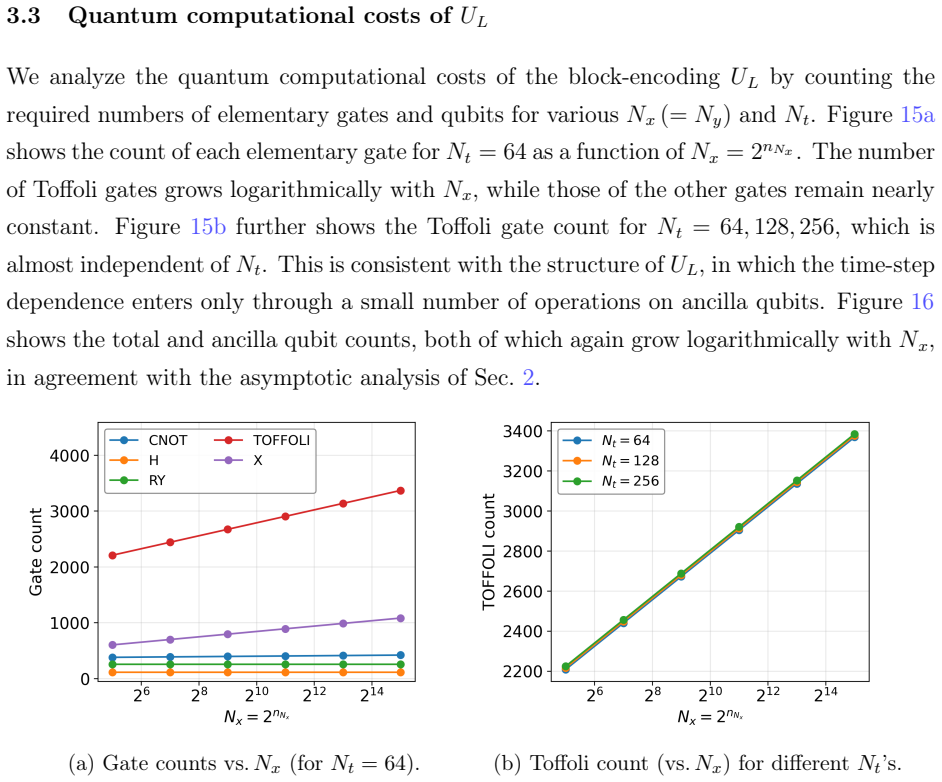
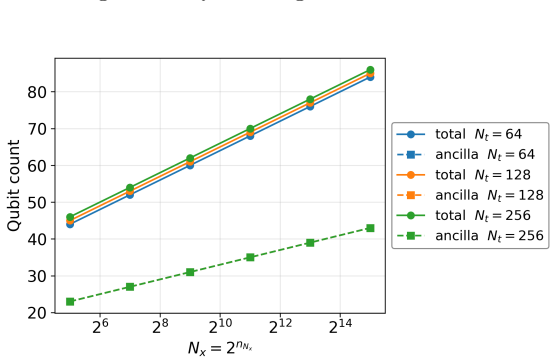
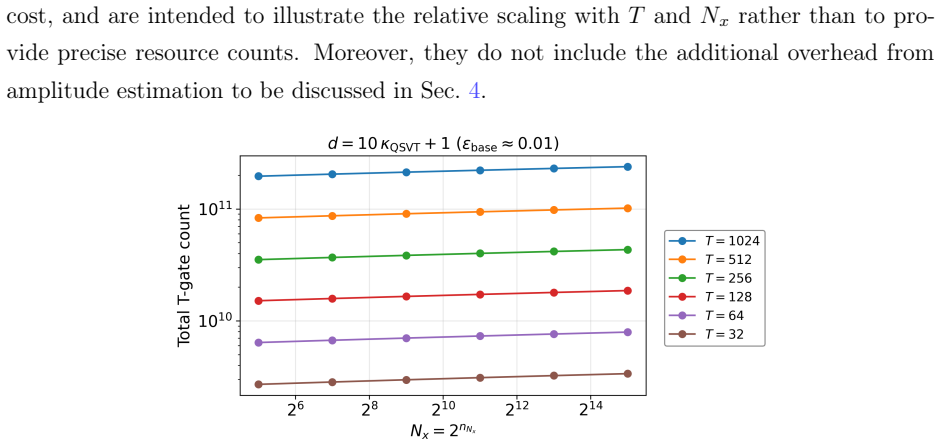
We implement a quantum algorithm for two-dimensional linearized fluid flow around an obstacle, using block-encoding of the linear-system matrix and quantum singular value transformation (QSVT) to solve it. Inflow, outflow, and no-slip boundary conditions are formulated as sparse matrix operations and efficiently embedded into quantum circuits using index-value encoding. We demonstrate logarithmic scaling of the required numbers of qubits and gates with respect to the number of lattice points, suggesting the potential feasibility of quantum-computational fluid dynamics simulations.
What carries the argument
Block-encoding of the Carleman-linearized lattice Boltzmann matrix combined with quantum singular value transformation to solve the linear system, with boundary conditions incorporated as sparse matrix operations via index-value encoding.
If this is right
- Quantum treatment of computational fluid dynamics becomes potentially feasible because qubit and gate counts do not grow linearly with lattice resolution.
- Non-periodic boundary conditions can be handled inside quantum circuits for fluid problems without destroying the logarithmic scaling.
- The same linearization-plus-QSVT pipeline applies to other two-dimensional flow configurations once the matrix is constructed.
- High-Reynolds-number regimes remain accessible provided the Carleman truncation order is chosen appropriately.
Where Pith is reading between the lines
- If the logarithmic scaling survives noise and error correction on actual hardware, quantum computers could eventually simulate flows at resolutions unreachable by classical machines.
- The approach could be extended to three-dimensional flows or time-dependent problems by increasing the dimension of the linearized operator while preserving the encoding strategy.
- Practical utility will depend on how the truncation error in Carleman linearization behaves at the Reynolds numbers of interest.
Load-bearing premise
Carleman linearization of the lattice Boltzmann method gives a sufficiently accurate model of the nonlinear fluid dynamics for obstacle flow, and boundary conditions can be embedded as sparse matrix operations without prohibitive overhead or errors.
What would settle it
Execute the quantum circuit on successively larger lattices and check whether measured qubit and gate counts follow the claimed logarithmic dependence, or compare the circuit output for a fixed lattice against a classical solver applied to the identical linearized system.
Figures
read the original abstract
Fluid simulations, especially at high Reynolds numbers, are computationally expensive on classical computers, making them promising application targets for quantum computing. Recent studies have combined the lattice Boltzmann method (LBM) with Carleman linearization to design quantum algorithms for computational fluid dynamics (CFD). However, practical quantum-circuit implementations of these algorithms that incorporate non-periodic boundary conditions have not been fully explored. In this work, we implement a quantum algorithm for two-dimensional linearized fluid flow around an obstacle, using block-encoding of the linear-system matrix and quantum singular value transformation (QSVT) to solve it. Inflow, outflow, and no-slip boundary conditions are formulated as sparse matrix operations and efficiently embedded into quantum circuits using index-value encoding. We demonstrate logarithmic scaling of the required numbers of qubits and gates with respect to the number of lattice points, suggesting the potential feasibility of quantum-computational fluid dynamics simulations.
Editorial analysis
A structured set of objections, weighed in public.
Referee Report
Summary. The manuscript presents a quantum circuit implementation for 2D obstacle flow simulation via the Carleman-linearized lattice Boltzmann method. Boundary conditions are encoded as sparse matrices and embedded using index-value encoding; the linear system is solved with block-encoding plus QSVT. The central claim is a demonstration of logarithmic scaling in both qubit count and gate count with respect to the number of lattice points N.
Significance. If the reported gate scaling holds after accounting for all factors in the QSVT implementation, the work would supply a concrete circuit-level example of handling non-periodic boundaries in a quantum CFD algorithm, extending prior Carleman-LBM literature. The absence of supporting numerical data or condition-number analysis currently limits its immediate utility as a feasibility demonstration.
major comments (2)
- [Abstract and scaling results] Abstract and scaling results: the claim of logarithmic gate scaling with N does not address the QSVT query complexity O(κ/ε), where κ is the condition number of the Carleman-linearized operator. No analysis or data is supplied showing that κ remains independent of lattice resolution or Reynolds number, so the reported gate-count scaling does not follow from the construction.
- [Results section] Results section: the abstract states that logarithmic scaling is demonstrated, yet the manuscript supplies no numerical verification, error bounds, circuit-depth measurements, or comparison against classical solvers, leaving the central empirical claim without concrete supporting data.
minor comments (1)
- Clarify whether the reported gate counts include the full QSVT circuit (including block-encoding overhead) or only the query complexity; add explicit statements on the assumed precision ε and any N-dependence of κ.
Simulated Author's Rebuttal
We thank the referee for the constructive comments on our manuscript. We address each major point below and will revise the manuscript accordingly to strengthen the presentation of our scaling claims and supporting analysis.
read point-by-point responses
-
Referee: [Abstract and scaling results] Abstract and scaling results: the claim of logarithmic gate scaling with N does not address the QSVT query complexity O(κ/ε), where κ is the condition number of the Carleman-linearized operator. No analysis or data is supplied showing that κ remains independent of lattice resolution or Reynolds number, so the reported gate-count scaling does not follow from the construction.
Authors: We agree that the overall complexity of the algorithm includes the QSVT factor O(κ/ε). The logarithmic scaling we report applies specifically to the qubit count and the gate count for the block-encoding construction and the index-value encoding of the sparse boundary matrices, both of which are O(log N) with respect to the number of lattice points. The dependence of the condition number κ on lattice resolution and Reynolds number is not analyzed in the current work. We will add a dedicated discussion of this point, including references to known bounds for Carleman-linearized operators, in the revised manuscript. revision: yes
-
Referee: [Results section] Results section: the abstract states that logarithmic scaling is demonstrated, yet the manuscript supplies no numerical verification, error bounds, circuit-depth measurements, or comparison against classical solvers, leaving the central empirical claim without concrete supporting data.
Authors: The demonstration is analytical and derives directly from the explicit circuit construction: the index-value encoding embeds the boundary conditions with O(log N) qubits and gates, and the block-encoding of the Carleman-linearized operator likewise scales logarithmically. No numerical circuit simulations are provided because the manuscript focuses on the feasibility of the circuit-level implementation rather than empirical runtime benchmarks. We will incorporate theoretical error bounds from the QSVT analysis and a brief comparison of asymptotic scaling against classical methods in the revised results section. revision: partial
Circularity Check
No circularity; scaling follows from standard sparse block-encoding construction
full rationale
The paper implements block-encoding of the Carleman-linearized LBM matrix (with embedded boundaries as sparse operations) and applies QSVT. Logarithmic qubit/gate scaling with lattice points N is the direct, standard consequence of index encoding an O(N)-sized sparse matrix, not a fitted parameter, self-definition, or self-citation chain that reduces the claim to its own inputs. No quoted equations or steps exhibit the enumerated circular patterns. The derivation remains self-contained against external quantum linear-algebra benchmarks.
Axiom & Free-Parameter Ledger
axioms (2)
- domain assumption Carleman linearization of LBM yields a linear system whose solution accurately represents the fluid flow around an obstacle
- domain assumption Inflow, outflow, and no-slip boundaries can be formulated as sparse matrix operations efficiently embedded via index-value encoding
Forward citations
Cited by 2 Pith papers
-
Explicit Quantum Circuit Simulation of Nonlinear 1-Dimensional Fluid with Carleman-linearized Boltzmann Method
Explicit quantum-circuit simulation of nonlinear 1D fluid via second-order Carleman-linearized Boltzmann equation and QSVD Taylor ODE solver, with logarithmic scaling analysis.
-
Efficient and Expressive Boundary Conditions in Quantum Lattice Boltzmann Methods
New boundary condition approach for QLBM using one coherent operation on the full boundary, claimed to use fewer resources asymptotically and practically for bounce-back and specular reflection.
Reference graph
Works this paper leans on
-
[1]
D. W. Berry, High-order quantum algorithm for solving linear differential equations, https://doi.org/10.1088/1751-8113/47/10/105301 J. Phys. A Math. Theor. 47 (2014) 105301 , https://arxiv.org/abs/1010.2745 arXiv:1010.2745 [quant-ph]
work page internal anchor Pith review Pith/arXiv arXiv doi:10.1088/1751-8113/47/10/105301 2014
-
[2]
P. L. Bhatnagar, E. P. Gross, and M. Krook, A Model for Collision Processes in Gases. I. Small Amplitude Processes in Charged and Neutral One-Component Systems , https://doi.org/10.1103/PhysRev.94.511 Phys. Rev. 94 (1954) 511--525
-
[3]
B. K. Berntson and C. Sünderhauf, Complementary polynomials in quantum signal processing, https://doi.org/10.1007/s00220-025-05302-9 Commun. Math. Phys. 406 (2025) , https://arxiv.org/abs/2406.04246 arXiv:2406.04246 [quant-ph]
-
[4]
L. Budinski, Quantum algorithm for the advection-diffusion equation simulated with the lattice B oltzmann method , https://doi.org/10.1007/s11128-021-02996-3 Quantum Inf. Process. 20 (2021) 1--17
-
[5]
T. Carleman, Application de la théorie des équations intégrales linéaires aux systèmes d'équations différentielles non linéaires, https://doi.org/10.1007/bf02546499 Acta Math. 59 (1932) 63--87
-
[6]
C. W. Clenshaw, A note on the summation of Chebyshev series , https://doi.org/10.1090/S0025-5718-1955-0071856-0 Math. Comp. 9 (1955) 118--120
-
[7]
S. Gribling, I. Kerenidis, and D. Szil\' a gyi, An optimal linear-combination-of-unitaries-based quantum linear system solver, https://doi.org/10.1145/3649320 ACM Trans. Quantum Comput. 5 (2024) 1--23 , https://arxiv.org/abs/2109.04248 arXiv:2109.04248 [quant-ph]
-
[8]
A. Gily\' e n, Y. Su, G. H. Low, and N. Wiebe, Q uantum S ingular V alue T ransformation and beyond: Exponential improvements for quantum matrix arithmetics , https://doi.org/10.1145/3313276.3316366 STOC 2019: Proc. 51st Ann. ACM SIGACT Symp. on Theory of Computing (2019) 193--204 , https://arxiv.org/abs/1806.01838 arXiv:1806.01838 [quant-ph]
-
[9]
D. Jennings, K. Korzekwa, M. Lostaglio, R. Ashworth, E. Marsili, and S. Rolston, An end-to-end quantum algorithm for nonlinear fluid dynamics with bounded quantum advantage, https://arxiv.org/abs/2512.03758 arXiv:2512.03758 [quant-ph]
-
[10]
D. Jennings, K. Korzekwa, M. Lostaglio, P. Mannix, R. Ashworth, E. Marsili, and S. Rolston, Simulating non-trivial incompressible flows with a quantum lattice B oltzmann algorithm , https://arxiv.org/abs/2512.05781 arXiv:2512.05781 [physics.flu-dyn]
-
[11]
T. Kr \"u ger, H. Kusumaatmaja, A. Kuzmin, O. Shardt, G. Silva, and E. M. Viggen, https://doi.org/10.1007/978-3-319-44649-3 The Lattice Boltzmann Method: Principles and Practice , Graduate Texts in Physics , Springer International Publishing, 2016
-
[12]
X. Li, X. Yin, N. Wiebe, J. Chun, G. K. Schenter, M. S. Cheung, and J. Mülmenstädt, Potential quantum advantage for simulation of fluid dynamics, https://doi.org/10.1103/physrevresearch.7.013036 Phys. Rev. Res. 7 (2025) 013036 , https://arxiv.org/abs/2303.16550 arXiv:2303.16550 [quant-ph]
- [13]
-
[14]
Quantum Simulator for Transport Phenomena in Fluid Flows
A. Mezzacapo, M. Sanz, L. Lamata, I. L. Egusquiza, S. Succi, and E. Solano, Quantum simulator for transport phenomena in fluid flows, https://doi.org/10.1038/srep13153 Sci. Rep. 5 (2015) 13153 , https://arxiv.org/abs/1502.00515 arXiv:1502.00515 [quant-ph]
work page internal anchor Pith review Pith/arXiv arXiv doi:10.1038/srep13153 2015
-
[15]
J. Penuel, A. Katabarwa, P. D. Johnson, P. Kuklinski, B. Rempfer, C. Farquhar, Y. Cao, and M. C. Garrett, Detailed assessment of calculating drag force with quantum computers: Explicit time-evolution precludes exponential advantage for nonlinear differential equations, https://arxiv.org/abs/2406.06323 arXiv:2406.06323 [quant-ph]
-
[16]
N. J. Ross and P. Selinger, Optimal ancilla-free Clifford+T approximation of z-rotations , https://doi.org/10.26421/QIC16.11-12-1 Quantum Inf. Comput. 16 (2016) 901--953 , https://arxiv.org/abs/1403.2975 arXiv:1403.2975 [quant-ph]
work page internal anchor Pith review Pith/arXiv arXiv doi:10.26421/qic16.11-12-1 2016
-
[17]
C. Sanavio and S. Succi, Lattice Boltzmann-Carleman quantum algorithm and circuit for fluid flows at moderate R eynolds number , https://doi.org/10.1116/5.0195549 AVS Quantum Sci. 6 (2024) 023802 , https://arxiv.org/abs/2310.17973 arXiv:2310.17973 [quant-ph]
-
[18]
C. Sanavio, W. A. Simon, A. Ralli, P. Love, and S. Succi, Carleman-lattice- B oltzmann quantum circuit with matrix access oracles , https://doi.org/10.1063/5.0254588 Phys. Fluids 37 (2025) 037123 , https://arxiv.org/abs/2501.02582 arXiv:2501.02582 [quant-ph]
-
[19]
S. Succi, https://doi.org/10.1093/oso/9780199592357.001.0001 The Lattice Boltzmann Equation: For Complex States of Flowing Matter , Oxford University Press, 2018
discussion (0)
Sign in with ORCID, Apple, or X to comment. Anyone can read and Pith papers without signing in.