A novel ordinal multi-view aggregation scheme for oak defoliation
Pith reviewed 2026-06-29 13:34 UTC · model grok-4.3
The pith
A three-view ensemble of CNNs on north, south and crown images yields the most accurate ordinal estimates of oak defoliation.
A machine-rendered reading of the paper's core claim, the machinery that carries it, and where it could break.
Core claim
The central claim is that the proposed multi-view ensemble framework aggregates ordinal CNN predictions from north, south and crown perspectives of individual trees, achieving more robust and accurate defoliation estimates than single-view models, pairwise combinations or nominal classification methods, with the three-view ensemble performing best on all evaluation metrics.
What carries the argument
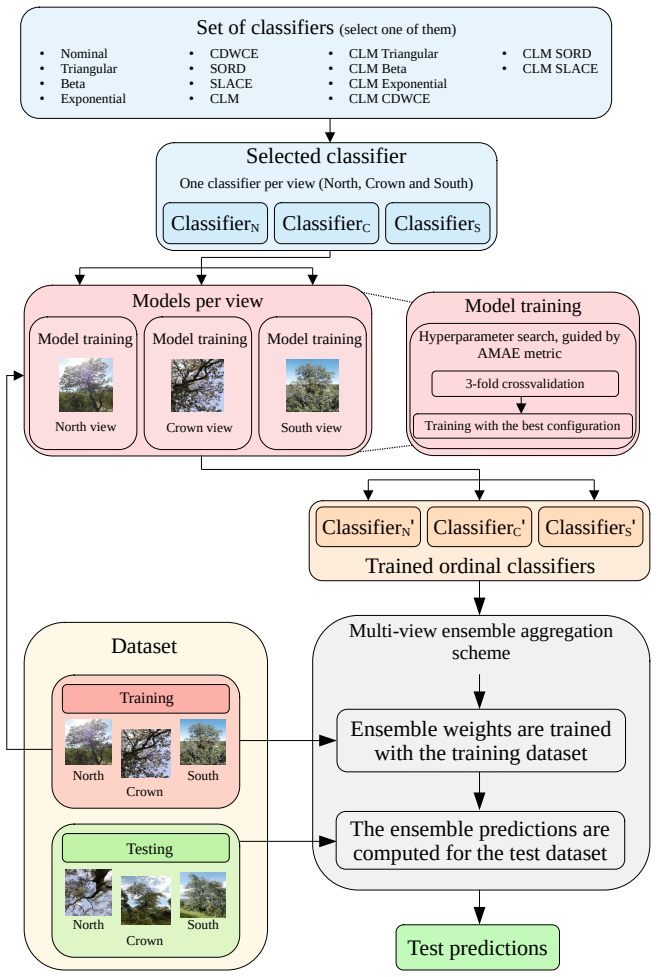
The homogeneous multi-view ensemble that aggregates ordinal predictions from CNNs trained separately on three complementary tree perspectives.
If this is right
- Ordinal classification improves results over treating defoliation levels as unrelated classes.
- The three-view ensemble outperforms both single-view and pairwise view combinations on every metric examined.
- The approach supports scalable and objective forest health assessment in Mediterranean dehesas.
- Combining deep learning, ordinal classification and multi-view aggregation produces consistent predictions across the tested configurations.
Where Pith is reading between the lines
- The same homogeneous aggregation pattern could be tested on other tree species or stressors to check whether the complementary-view benefit generalizes.
- Extending the three fixed ground perspectives to include seasonal repeats or drone angles would reveal whether temporal or aerial views add further gains.
- The design may transfer to other ordinal image tasks where multiple angles of the same object are available.
Load-bearing premise
Different visual perspectives of the same tree supply complementary information that aggregates without inconsistency under a homogeneous ensemble design.
What would settle it
A new collection of oak images in which the three-view ensemble shows no improvement over the strongest single-view model on accuracy or mean absolute error would falsify the central performance claim.
Figures
read the original abstract
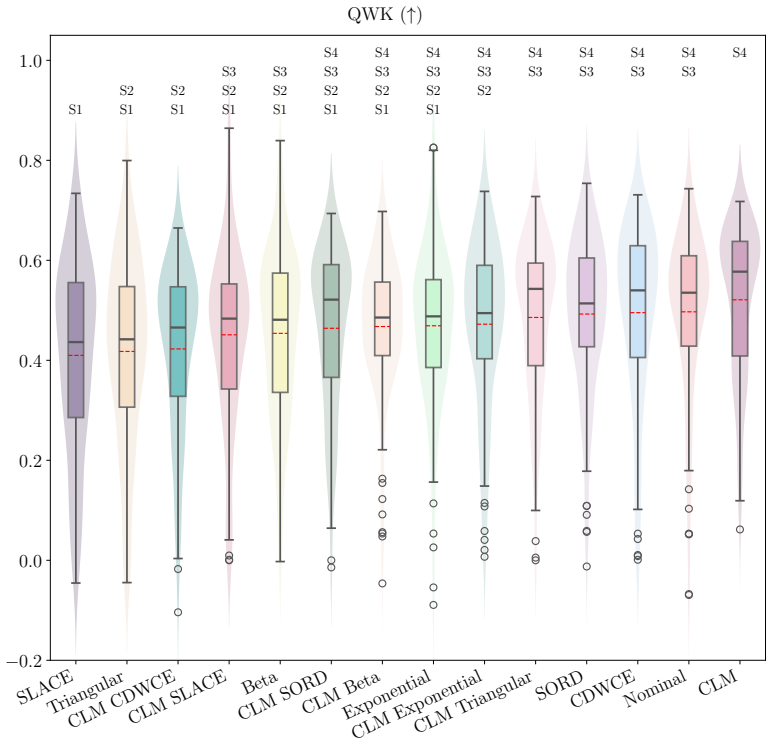
Forest decline driven by climate and biotic stressors threatens ecosystem functioning, making accurate monitoring of tree health essential. In this work, we address tree defoliation estimation as an ordinal classification problem using ground-level imagery. We propose a novel multi-view ensemble framework that aggregates predictions from Convolutional Neural Networks (CNNs) trained on different perspectives of individual trees (north, south, and crown). This approach leverages complementary visual information while preserving modelling consistency through a homogeneous ensemble design. A comprehensive evaluation is conducted by comparing multiple ordinal classification methods and analysing the contribution of each view and their combinations. Results show that modelling the ordinal structure of defoliation levels improves performance over nominal approaches, while the proposed multi-view ensemble consistently outperforms single-view and pairwise configurations. In particular, the three-view ensemble achieves the most robust and accurate predictions across all evaluation metrics. These findings highlight the potential of combining Deep Learning (DL), Ordinal Classification (OC), and multi-view aggregation for scalable, consistent, and objective forest health assessment in complex ecosystems such as Mediterranean dehesas.
Editorial analysis
A structured set of objections, weighed in public.
Referee Report
Summary. The paper addresses oak defoliation estimation as an ordinal classification task from ground-level imagery. It proposes a homogeneous multi-view ensemble of CNNs trained separately on north, south, and crown views of the same trees, with aggregation of their ordinal predictions. The central empirical claim is that ordinal modeling outperforms nominal baselines and that the three-view ensemble yields the most robust and accurate results across metrics compared with single-view and pairwise configurations.
Significance. If the quantitative results and experimental controls hold, the work demonstrates a practical way to exploit complementary multi-view information for ordinal forest-health monitoring without introducing modeling inconsistency. The combination of DL, ordinal classification, and homogeneous ensemble design is a modest but useful contribution for scalable, objective assessment in complex ecosystems.
major comments (3)
- [Abstract and §4] Abstract and §4 (Results): the claim that the three-view ensemble 'achieves the most robust and accurate predictions across all evaluation metrics' is stated without any numerical values, dataset size, number of trees/images, cross-validation scheme, or ablation tables. This absence makes the central performance claim unverifiable from the manuscript as presented.
- [§3.2] §3.2 (Multi-view aggregation): the description of how ordinal probability outputs from the three CNNs are combined (e.g., averaging, voting, or learned fusion) is not specified. Because the novelty rests on consistent aggregation of complementary views, the lack of an explicit aggregation equation or algorithm is load-bearing.
- [§4.3] §4.3 (View contribution analysis): the reported improvements for the three-view ensemble versus pairwise baselines are not accompanied by statistical significance tests or confidence intervals, which is required to support the claim that the full ensemble is reliably superior.
minor comments (2)
- [§2.1] Notation for the ordinal levels (e.g., how many defoliation classes and their ordering) should be defined explicitly in §2.1.
- [Figures 2-4] Figure captions for the example images and confusion matrices could include the exact number of samples per class to aid interpretation.
Simulated Author's Rebuttal
Thank you for the opportunity to respond to the referee's report. We appreciate the detailed feedback and will revise the manuscript accordingly to address the concerns raised regarding verifiability, methodological clarity, and statistical rigor.
read point-by-point responses
-
Referee: [Abstract and §4] Abstract and §4 (Results): the claim that the three-view ensemble 'achieves the most robust and accurate predictions across all evaluation metrics' is stated without any numerical values, dataset size, number of trees/images, cross-validation scheme, or ablation tables. This absence makes the central performance claim unverifiable from the manuscript as presented.
Authors: We agree that the abstract and the summary statements in §4 present the performance claim without embedding specific numerical values, dataset statistics, or explicit references to the evaluation protocol. While detailed results appear in the tables of §4, we will revise the abstract and the opening paragraphs of §4 to include key quantitative results (e.g., accuracy, MAE, and F1 scores for the three-view ensemble), the number of trees and images, the cross-validation scheme, and direct pointers to the ablation tables. This will make the central claims immediately verifiable. revision: yes
-
Referee: [§3.2] §3.2 (Multi-view aggregation): the description of how ordinal probability outputs from the three CNNs are combined (e.g., averaging, voting, or learned fusion) is not specified. Because the novelty rests on consistent aggregation of complementary views, the lack of an explicit aggregation equation or algorithm is load-bearing.
Authors: We acknowledge that §3.2 describes the homogeneous ensemble architecture but does not supply an explicit equation or algorithmic description of the aggregation step. We will revise §3.2 to include a clear mathematical formulation of the aggregation procedure used for combining the ordinal probability outputs from the three view-specific models, thereby fully specifying the novel multi-view component. revision: yes
-
Referee: [§4.3] §4.3 (View contribution analysis): the reported improvements for the three-view ensemble versus pairwise baselines are not accompanied by statistical significance tests or confidence intervals, which is required to support the claim that the full ensemble is reliably superior.
Authors: We concur that the absence of statistical significance tests and confidence intervals weakens the support for the superiority claims in §4.3. In the revised version we will add appropriate statistical comparisons (e.g., McNemar tests for accuracy and paired tests for MAE) between the three-view ensemble and the pairwise/single-view baselines, together with 95% confidence intervals obtained via bootstrapping. These results will be reported both in the text of §4.3 and in the associated tables. revision: yes
Circularity Check
No significant circularity
full rationale
The paper presents an empirical study comparing CNN-based ordinal classifiers on single-view, pairwise, and three-view image ensembles for defoliation estimation. No equations, derivations, fitted parameters renamed as predictions, or self-citation chains appear in the abstract or described methodology. The central claim (three-view ensemble superiority) rests on standard cross-validation metrics against baselines, with the multi-view aggregation described as a homogeneous design choice rather than a self-referential result. This is a normal empirical ML comparison with no load-bearing steps that reduce to their own inputs by construction.
Axiom & Free-Parameter Ledger
axioms (2)
- domain assumption CNNs trained on single-view tree images can extract features relevant to defoliation level
- domain assumption Defoliation levels form a natural ordinal scale that benefits from ordinal-specific loss functions
Reference graph
Works this paper leans on
-
[1]
URLhttps://openknowledge.fao.org/handle/20.500.14283/ cd6709en
FAO, Global Forest Resources Assessment 2025, FAO, 2025. URLhttps://openknowledge.fao.org/handle/20.500.14283/ cd6709en
2025
-
[2]
K. Verheyen, L. Gillerot, H. Blondeel, P. De Frenne, K. De Pauw, L. De- pauw, E. Lorer, P. Sanczuk, J. Schreel, T. Vanneste, L. Wei, D. Landuyt, Forest canopies as nature-based solutions to mitigate global change ef- fects on people and nature, Journal of Ecology 112 (11) (2024) 2451– 2461.doi:10.1111/1365-2745.14345
-
[3]
C. D. Allen, A. K. Macalady, H. Chenchouni, D. Bachelet, N. McDowell, M. Vennetier, T. Kitzberger, A. Rigling, D. D. Breshears, E. H. T. Hogg, P. Gonzalez, R. Fensham, Z. Zhang, J. Castro, N. Demidova, J.-H. Lim, G. Allard, S. W. Running, A. Semerci, N. Cobb, A global overview of drought and heat-induced tree mortality reveals emerging climate change risk...
-
[4]
W. R. L. Anderegg, A. T. Trugman, G. Badgley, C. M. Ander- son, A. Bartuska, P. Ciais, D. Cullenward, C. B. Field, J. Freeman, S. J. Goetz, J. A. Hicke, D. Huntzinger, R. B. Jackson, J. Nickerson, S. Pacala, J. T. Randerson, Climate-driven risks to the climate miti- gation potential of forests, Science 368 (6497) (2020-06-19) eaaz7005. doi:10.1126/science.aaz7005
-
[5]
Carnicer, M
J. Carnicer, M. Coll, M. Ninyerola, X. Pons, G. Sanchez, J. Penuelas, Widespread crown condition decline, food web disruption, and amplified 28 tree mortality with increased climate change-type drought, Proceedings of the National Academy of Sciences 108 (4) (2011) 1474–1478
2011
-
[6]
P. D. Manion, D. Lachance, Forest decline concepts., American Phy- topathological Society (APS), 1992
1992
-
[7]
Sangüesa-Barreda, A
G. Sangüesa-Barreda, A. Gazol, J. J. Camarero, Drops in needle production are early-warning signals of drought-triggered dieback in Scots pine, Trees 37 (4) (2023-08-01) 1137–1151.doi:10.1007/ s00468-023-02412-6
2023
-
[9]
H. Hartmann, A. Bastos, A. J. Das, A. Esquivel-Muelbert, W. M. Ham- mond, J. Martínez-Vilalta, N. G. McDowell, J. S. Powers, T. A. M. Pugh, K. X. Ruthrof, C. D. Allen, Climate Change Risks to Global For- est Health: Emergence of Unexpected Events of Elevated Tree Mortality Worldwide, Annual Review of Plant Biology 73 (2022-05-20) 673–702. doi:10.1146/annu...
-
[10]
N. G. McDowell, C. D. Allen, K. Anderson-Teixeira, B. H. Aukema, B. Bond-Lamberty, L. Chini, J. S. Clark, M. Dietze, C. Grossiord, A. Hanbury-Brown, G. C. Hurtt, R. B. Jackson, D. J. Johnson, L. Kuep- pers, J.W.Lichstein, K.Ogle, B.Poulter, T.A.M.Pugh, R.Seidl, M.G. Turner, M. Uriarte, A. P. Walker, C. Xu, Pervasive shifts in forest dy- namics in a changi...
-
[11]
Acosta-Muñoz, R
C. Acosta-Muñoz, R. M. Navarro-Cerrillo, F. J. Bonet-García, F. J. Ruiz-Gómez, P. González-Moreno, Evolution and Paradigm Shift in For- 29 est Health Research: A Review on of Global Trends and Knowledge Gaps, Forests 15 (8) (2024) 1279. URLhttps://www.mdpi.com/1999-4907/15/8/1279
2024
-
[12]
Eichhorn, P
J. Eichhorn, P. Roskams, N. Potocic, V. Timmermann, M. Ferretti, V. Mues, A. Szepesi, D. Durrant, I. Seletkovic, H.-W. Schroeck, S. Neu- vonen, F. Bussotti, P. García, W. Sören, Part IV Visual assessment of crown condition and damaging agents. Version 2020-3., in: U. I. F. P. C.-o. C. (Ed.), Manual on Methods and Criteria for Harmonized Sampling, Assessme...
2020
-
[13]
P. Torres, M. Rodes-Blanco, A. Viana-Soto, H. Nieto, M. García, The Role of Remote Sensing for the Assessment and Monitoring of Forest Health: A Systematic Evidence Synthesis, Forests 12 (8) (2021-08) 1134. doi:10.3390/f12081134
-
[14]
A. Ariza-Salamanca, R. Navarro-Cerrillo, F. Bonet-García, M. Pérez- Palazón, M. Polo, Integration of a Landsat Time-Series of NBR and Hydrological Modeling to Assess Pinus Pinaster Aiton. Forest Defo- liation in South-Eastern Spain, Remote Sensing 11 (19) (2019) 2291. doi:10.3390/rs11192291
-
[15]
A. Lausch, S. Erasmi, D. J. King, P. Magdon, M. Heurich, Under- standing Forest Health with Remote Sensing-Part II—A Review of Approaches and Data Models, Remote Sensing 9 (2) (2017-02) 129. doi:10.3390/rs9020129
-
[16]
R. M. Navarro-Cerrillo, M. Á. Varo-Martínez, C. Acosta, G. P. Ro- driguez, R. Sanchez-Cuesta, F. J. R. Gomez, Integration of WorldView-2 and airborne laser scanning data to classify defoliation levels in quer- cus ilex l.dehesas affected by root rot mortality: Management impli- 30 cations, Forest Ecology and Management 451 (2019-11) 117564.doi: 10.1016/j....
-
[17]
W. G. Canto-Sansores, J. O. López-Martínez, E. J. González, J. A. Meave, J. Luis Hernández-Stefanoni, P. A. Macario-Mendoza, The im- portance of spatial scale and vegetation complexity in woody species di- versity and its relationship with remotely sensed variables, ISPRS Jour- nal of Photogrammetry and Remote Sensing 216 (2024-10-01) 142–153. doi:10.1016...
-
[18]
M. S. R. Saimun, M. M. Rahman, A comprehensive review of tree cover mapping using satellite sensor data, Discover Geoscience 3 (1) (2025-08-
2025
-
[19]
90.doi:10.1007/s44288-025-00201-x
-
[20]
U. Kälin, N. Lang, C. Hug, A. Gessler, J. D. Wegner, Defoliation estima- tion of forest trees from ground-level images, Remote Sensing of Envi- ronment 223 (2019-03-15) 143–153.doi:10.1016/j.rse.2018.12.021
-
[21]
J. Schmidhuber, Deep learning in neural networks: An overview, Neural networks 61 (2015) 85–117.doi:10.1016/j.neunet.2014.09.003
-
[22]
A. Khan, A. Sohail, U. Zahoora, A. S. Qureshi, A survey of the recent ar- chitectures of deep convolutional neural networks, Artificial intelligence review 53 (8) (2020) 5455–5516.doi:10.1007/s10462-020-09825-6
-
[23]
M. Beloiu, L. Heinzmann, N. Rehush, A. Gessler, V. C. Griess, Individ- ual Tree-Crown Detection and Species Identification in Heterogeneous Forests Using Aerial RGB Imagery and Deep Learning, Remote Sensing 15 (5) (2023-01) 1463.doi:10.3390/rs15051463
-
[24]
L. A. Da Silva, P. O. Bressan, D. N. Gonçalves, D. M. Freitas, B. B. Machado, W. N. Gonçalves, Estimating soybean leaf defoliation using convolutional neural networks and synthetic images, Computers and 31 electronics in agriculture 156 (2019) 360–368.doi:10.1016/j.compag. 2018.11.040
-
[25]
Y. Toda, F. Okura, How convolutional neural networks diagnose plant disease, Plant phenomics (2019).doi:10.34133/2019/923713
-
[26]
Z. Zhang, S. Khanal, A. Raudenbush, K. Tilmon, C. Stewart, Assessing the efficacy of machine learning techniques to characterize soybean de- foliation from unmanned aerial vehicles, Computers and Electronics in Agriculture 193 (2022) 106682.doi:10.1016/j.compag.2021.106682
-
[27]
S. Ecke, F. Stehr, J. Frey, D. Tiede, J. Dempewolf, H.-J. Klemmt, E. En- dres, T.Seifert, Towardsoperationaluav-basedforesthealthmonitoring: Species identification and crown condition assessment by means of deep learning, Computers and Electronics in Agriculture 219 (2024) 108785. doi:10.1016/j.compag.2024.108785
-
[28]
D. Scutelnic, C. Daffara, R. Muradore, M. Weinmann, B. Jutzi, Multi- model ensembles for object detection in multispectral images: A case study for precision agriculture, Computers and Electronics in Agricul- ture 240 (2026) 111213.doi:10.1016/j.compag.2025.111213
-
[29]
P. A. Gutiérrez, M. Perez-Ortiz, J. Sanchez-Monedero, F. Fernandez- Navarro, C. Hervas-Martinez, Ordinal regression methods: survey and experimental study, IEEE Transactions on Knowledge and Data Engi- neering 28 (1) (2015) 127–146.doi:10.1109/TKDE.2015.2457911
-
[30]
C. Morales-Rodríguez, A. Vannini, B. Scanu, P. González-Moreno, S. Turco, M. I. Drais, A. Brandano, M. Á. Varo Martínez, A. Mazzaglia, A. Deidda, et al., Challenges to Mediterranean Fagaceae ecosystems af- fected by Phytophthora cinnamomi and Climate Change: Integrated Pest Management perspectives, Current Forestry Reports 11 (1) (2025- 01-14).doi:10.1007...
-
[31]
de Sampaio e Paiva Camilo-Alves, M
C. de Sampaio e Paiva Camilo-Alves, M. I. E. da Clara, N. M. C. de Almeida Ribeiro, Decline of mediterranean oak trees and its as- sociation with phytophthora cinnamomi: A review, European Jour- nal of Forest Research 132 (3) (2013-05-01) 411–432.doi:10.1007/ s10342-013-0688-z
2013
-
[32]
R. Sánchez-Cuesta, F. J. Ruiz-Gómez, J. Duque-Lazo, P. González- Moreno, R. M. Navarro-Cerrillo, The environmental drivers influencing spatio-temporal dynamics of oak defoliation and mortality in dehesas of Southern Spain, Forest Ecology and Management 485 (2021-04-01) 118946.doi:10.1016/j.foreco.2021.118946
-
[33]
K. Onoszko, F. J. R. Gómez, L. Lazzaro, Á. L. González, P. González- Moreno, Diversity patterns of herbaceous community in environmental gradients of dehesa ecosystems, Global Ecology and Conservation 54 (2024) e03162.doi:10.1016/j.gecco.2024.e03162
-
[34]
Ferreti, N
M. Ferreti, N. König, O. Granke, Part III: Quality Assurance within the ICP Forests monitoring programme, in: Manual on Methods and Cri- teria for Harmonized Sampling, Assessment, Monitoring and Analysis of the Effects of Air Pollution on Forests, Thünen Institute of Forest Ecosystems, Eberswalde, Germany, 2016, p. 10
2016
-
[35]
C. Hartung, A. Lerer, Y. Anokwa, C. Tseng, W. Brunette, G. Bor- riello, Open data kit: Tools to build information services for devel- oping regions, in: Proceedings of the 4th ACM/IEEE International Conference on Information and Communication Technologies and De- velopment, ICTD ’10, ACM, New York, NY, USA, 2010, pp. 1–12. doi:10.1145/2369220.2369236. URL...
-
[36]
V. M. Vargas, P. A. Gutierrez, C. Hervas-Martinez, Cumulative link 33 models for deep ordinal classification, Neurocomputing 401 (2020) 48– 58.doi:10.1016/j.neucom.2020.03.034
-
[37]
Polat, I
G. Polat, I. Ergenc, H. T. Kani, Y. O. Alahdab, O. Atug, A. Temizel, Class distance weighted cross-entropy loss for ulcerative colitis severity estimation, in: AnnualConference onMedical ImageUnderstandingand Analysis, Springer, 2022, pp. 157–171
2022
-
[38]
4738–4747
R.Diaz, A.Marathe, Softlabelsforordinalregression, in: Proceedingsof the IEEE/CVF conference on computer vision and pattern recognition, 2019, pp. 4738–4747
2019
-
[39]
Nachmani, B
I. Nachmani, B. Genossar, C. Scharf, R. Shraga, A. Gal, Slace: A mono- tone and balance-sensitive loss function for ordinal regression, in: Pro- ceedings of the AAAI Conference on Artificial Intelligence, Vol. 39, 2025, pp. 19598–19606
2025
-
[40]
V. M. Vargas, P. A. Gutiérrez, J. Barbero-Gómez, C. Hervás-Martínez, Soft labelling based on triangular distributions for ordinal classification, Information Fusion 93 (0) (2023) 258–267.doi:10.1016/j.inffus. 2023.01.003
-
[41]
V. M. Vargas, P. A. Gutiérrez, C. Hervás-Martínez, Unimodal regu- larisation based on beta distribution for deep ordinal regression, Pat- tern Recognition 122 (0) (2022) 1–10.doi:10.1016/j.patcog.2021. 108310
-
[42]
V. M. Vargas, P. A. Gutiérrez, R. Rosati, L. Romeo, E. Frontoni, C. Hervás-Martínez, Exponential loss regularisation for encouraging or- dinalconstrainttoshotgunstocksqualityassessment, AppliedSoftCom- puting 138 (0) (2023) 1–10.doi:10.1016/j.asoc.2023.110191
-
[43]
Z. Li, F. Liu, W. Yang, S. Peng, J. Zhou, A survey of convolutional neural networks: analysis, applications, and prospects, IEEE transac- 34 tions on neural networks and learning systems 33 (12) (2021) 6999–7019. doi:10.1109/TNNLS.2021.3084827
-
[44]
Opitz, R
D. Opitz, R. Maclin, Popular ensemble methods: An empirical study, Journal of artificial intelligence research 11 (1999) 169–198
1999
-
[45]
L.K.Hansen, P.Salamon, Neuralnetworkensembles, IEEEtransactions on pattern analysis and machine intelligence 12 (10) (1990) 993–1001
1990
-
[46]
F. Bérchez-Moreno, R. Ayllón-Gavilán, V. M. Vargas, D. Guijo-Rubio, C. Hervás-Martínez, J. C. Fernández, P. A. Gutiérrez, dlordinal: A python package for deep ordinal classification, Neurocomputing (2025) 129305doi:10.1016/j.neucom.2024.129305
-
[47]
K. He, X. Zhang, S. Ren, J. Sun, Deep residual learning for image recognition, in: Proceedings of the IEEE conference on computer vision and pattern recognition, 2016, pp. 770–778
2016
-
[48]
Baccianella, A
S. Baccianella, A. Esuli, F. Sebastiani, Evaluation measures for ordinal regression, in: 2009 Ninth international conference on intelligent systems design and applications, IEEE, 2009, pp. 283–287
2009
-
[49]
L. Ma, Y. Liu, X. Zhang, Y. Ye, G. Yin, B. A. Johnson, Deep learn- ing in remote sensing applications: A meta-analysis and review, ISPRS Journal of Photogrammetry and Remote Sensing 152 (2019) 166–177. doi:10.1016/j.isprsjprs.2019.04.015
-
[50]
Agresti, Analysis of ordinal categorical data, John Wiley & Sons, 2010
A. Agresti, Analysis of ordinal categorical data, John Wiley & Sons, 2010
2010
-
[51]
C. Ferri, J. Hernández-Orallo, R. Modroiu, An experimental comparison of performance measures for classification, Pattern Recognition Letters 30 (1) (2009) 27–38.doi:10.1016/j.patrec.2008.08.010. 35
-
[52]
E. R. da Cunha, C. A. G. Santos, R. M. da Silva, V. M. Bacani, P. E. Teodoro, E. Panachuki, N. de Souza Oliveira, Mapping LULC types in the Cerrado-Atlantic Forest ecotone region using a Landsat time se- ries and object-based image approach: A case study of the Prata River Basin, Mato Grosso do Sul, Brazil, Environmental Monitoring and As- sessment 192 (2...
-
[53]
B. G. Weinstein, S. Marconi, S. A. Bohlman, A. Zare, E. P. White, Cross-site learning in deep learning RGB tree crown detection, Eco- logical Informatics 56 (2020) 101061.doi:10.1016/j.ecoinf.2020. 101061
-
[54]
C. R. Qi, H. Su, M. Nießner, A. Dai, M. Yan, L. J. Guibas, Volu- metric and Multi-view CNNs for Object Classification on 3D Data, in: 2016 IEEE Conference on Computer Vision and Pattern Recognition (CVPR), 2016, pp. 5648–5656.doi:10.1109/CVPR.2016.609
-
[55]
H. Su, S. Maji, E. Kalogerakis, E. Learned-Miller, Multi-view Convo- lutional Neural Networks for 3D Shape Recognition, in: 2015 IEEE In- ternational Conference on Computer Vision (ICCV), 2015, pp. 945–953. doi:10.1109/ICCV.2015.114
-
[56]
L. Duchemin, C. Eloy, E. Badel, B. Moulia, Tree crowns grow into self- similar shapes controlled by gravity and light sensing, Journal of The RoyalSocietyInterface15(142)(2018).doi:10.1098/rsif.2017.0976
-
[57]
Szegedy, V
C. Szegedy, V. Vanhoucke, S. Ioffe, J. Shlens, Z. Wojna, Rethinking the inception architecture for computer vision, in: Proceedings of the IEEE conference on computer vision and pattern recognition, 2016, pp. 2818–2826
2016
-
[58]
V. M. Vargas, A. M. Gómez-Orellana, P. A. Gutiérrez, C. Hervás- Martínez, D. Guijo-Rubio, EBANO: A novel ensemble based on uni- modal ordinal classifiers for the prediction of significant wave height, 36 Knowledge-Based Systems 300 (0) (2024) 1–14.doi:10.1016/j. knosys.2024.112223
work page doi:10.1016/j 2024
-
[59]
R. Ayllón-Gavilán, F. J. Martínez-Estudillo, D. Guijo-Rubio, C. Hervás- Martínez, P. A. Gutiérrez, Splitting criteria for ordinal decision trees: An experimental study, Pattern Recognition 171 (2026) 112273.doi: 10.1016/j.patcog.2025.112273
-
[60]
R.Rosati, L.Romeo, V.M.Vargas, P.A.Gutiérrez, C.Hervás-Martínez, E. Frontoni, A novel deep ordinal classification approach for aesthetic qualitycontrolclassification, NeuralComputingandApplications(2022) 1–15doi:10.1007/s00521-022-07050-6. Appendix A. Components of deep ordinal classification This appendix provides additional details on the main component...
discussion (0)
Sign in with ORCID, Apple, or X to comment. Anyone can read and Pith papers without signing in.