Unification and Optimization of Robust Supervised Learning
Reviewed by Pith2026-06-29 14:01 UTCgrok-4.3pith:BZSRIMRMopen to challenge →
The pith
Robust learning methods for different failure modes unify into a design space where joint hyperparameter optimization matches the best single baseline across benchmarks.
A machine-rendered reading of the paper's core claim, the machinery that carries it, and where it could break.
Core claim
Existing robust methods can be decomposed into the stages of reference distribution enrichment, input-space perturbation, label-space perturbation, and sample-level aggregation, with each stage admitting pessimistic, neutral, or optimistic choices; joint hyperparameter optimization over this space yields performance competitive with the best single-method baseline on tabular, image, and reward modeling tasks.
What carries the argument
Decomposition of robust learning into sequential stages (reference distribution enrichment, input-space perturbation, label-space perturbation, sample-level aggregation) each with a stance (pessimistic, neutral, or optimistic) that turns the choices into jointly optimizable hyperparameters.
If this is right
- A single optimization run can serve as a default when the practitioner does not know which failure mode dominates.
- Robustness components can be mixed across stages rather than selected as an isolated technique.
- The design space makes systematic comparison of stance and perturbation choices feasible without developing new methods from scratch.
Where Pith is reading between the lines
- The staged view may make it easier to diagnose which stage contributes most to robustness on a given dataset.
- The same decomposition could be tested on settings beyond supervised learning to see whether the same stage-and-stance structure appears.
Load-bearing premise
That the decomposition into these four stages and three stances captures the essential properties of existing robust methods without significant loss.
What would settle it
A benchmark suite in which the jointly optimized procedure underperforms the strongest specialized robust method by a clear margin on multiple tasks when the dominant failure mode is known in advance.
Figures


read the original abstract
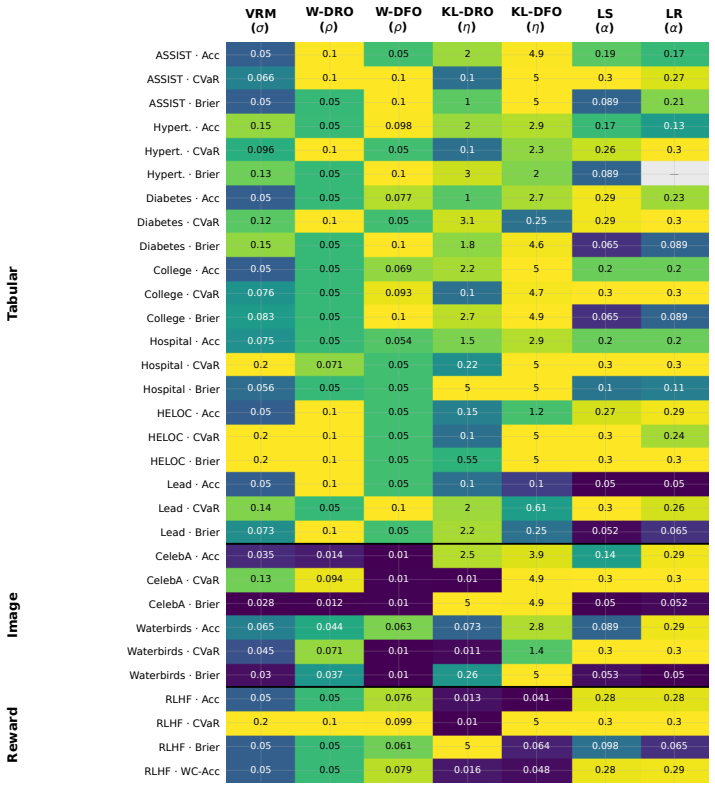
The literature has proposed various robust alternatives to empirical risk minimisation to address failure modes such as distribution shift, label noise and finite-sample degeneracies. Examples include distributionally robust optimization, label smoothing, vicinal risk minimization, and Mixup. However, such approaches are typically developed in isolation, forcing practitioners to commit a priori to a single failure mode even when the dominant mode for the task is unclear. To address this, we organize a broad class of existing methods along three common design axes and derive a tractable training procedure that decomposes robust learning into sequential stages (reference distribution enrichment, input-space perturbation, label-space perturbation, and sample-level aggregation), each with a choice of stance (pessimistic, neutral, or optimistic). This results in a unified design space in which joint hyperparameter optimization can compose and configure robustness strategies suited to the task at hand. Across tabular, image, and reward modeling benchmarks, joint hyperparameter optimization is competitive with the best single-method baseline in each setting, offering a reliable default for practitioners who do not know a priori which failure mode dominates their task.
Editorial analysis
A structured set of objections, weighed in public.
Referee Report
Summary. The paper claims to unify a broad class of robust supervised learning methods (DRO, label smoothing, vicinal risk minimization, Mixup, etc.) by organizing them along three common design axes and deriving a tractable procedure that decomposes robust learning into four sequential stages—reference distribution enrichment, input-space perturbation, label-space perturbation, and sample-level aggregation—each admitting a pessimistic, neutral, or optimistic stance. Joint hyperparameter optimization over the resulting design space is then shown to be competitive with the best single-method baseline on tabular, image, and reward-modeling benchmarks, providing a default strategy when the dominant failure mode is unknown a priori.
Significance. If the staged decomposition faithfully reproduces the essential properties of the original methods, the work supplies a practical, task-adaptive alternative to committing to one robust technique in advance. The multi-domain empirical evaluation is a concrete strength, as is the explicit construction of a composable space that permits joint optimization rather than isolated method selection.
major comments (1)
- [Methodology (decomposition into stages)] The strongest empirical claim (joint HPO competitive with best single-method baselines) depends on the decomposition into the four sequential stages preserving the properties of the source methods. The manuscript must demonstrate, for at least one non-trivial example such as DRO or Mixup, that the staged procedure is equivalent (or explicitly note the approximation) to the original formulation; otherwise the benchmark comparisons rest on an unverified assumption that the composed procedures match the baselines they are measured against.
minor comments (2)
- [Section 3] Clarify the precise definition of the three design axes and how each stance choice maps onto existing hyperparameters; a small table or diagram would aid reproducibility.
- [Experiments] Report the number of random seeds, standard deviations, and any statistical tests supporting the claim that joint HPO is “competitive” with the per-setting best baseline.
Simulated Author's Rebuttal
We thank the referee for the constructive feedback on the decomposition's fidelity. We address the major comment below and agree that additional clarification is warranted.
read point-by-point responses
-
Referee: [Methodology (decomposition into stages)] The strongest empirical claim (joint HPO competitive with best single-method baselines) depends on the decomposition into the four sequential stages preserving the properties of the source methods. The manuscript must demonstrate, for at least one non-trivial example such as DRO or Mixup, that the staged procedure is equivalent (or explicitly note the approximation) to the original formulation; otherwise the benchmark comparisons rest on an unverified assumption that the composed procedures match the baselines they are measured against.
Authors: We agree that the empirical claims rest on the staged decomposition preserving key properties of the source methods. The manuscript derives the four stages directly from the common design axes identified across the literature (reference distribution, input perturbation, label perturbation, aggregation), with each stance (pessimistic/neutral/optimistic) chosen to recover standard formulations. In the revision we will add an explicit subsection (likely Section 3.3) that (i) maps DRO to reference-distribution enrichment under the pessimistic stance and (ii) maps Mixup to input-space perturbation under the neutral stance, showing either exact recovery of the original objective or the precise approximation introduced by sequential decomposition. This will be accompanied by a short proof sketch or counter-example where equivalence does not hold, ensuring the joint-HPO baselines are not compared against an unverified surrogate. revision: yes
Circularity Check
No circularity: unification is reorganization of existing methods
full rationale
The paper organizes existing robust methods (DRO, Mixup, label smoothing, etc.) along three design axes and decomposes them into sequential stages (reference distribution enrichment, input-space perturbation, label-space perturbation, sample-level aggregation) with stance choices. This produces a design space for joint HPO, but the decomposition is an explicit modeling choice rather than a reduction of any quantity to itself by definition or fitted parameter. No equations or claims reduce by construction to the paper's own inputs, and no load-bearing self-citations are invoked to justify uniqueness or the central procedure. The empirical claim (joint HPO competitive with single-method baselines) rests on benchmark comparisons that are external to the framework definition itself.
Axiom & Free-Parameter Ledger
free parameters (1)
- stance choices per stage
axioms (1)
- domain assumption Existing robust methods can be organized along three common design axes and decomposed into the four sequential stages without loss of their core properties
Reference graph
Works this paper leans on
-
[1]
Akiba, T., Sano, S., Yanase, T., Ohta, T., and Koyama, M. (2019). Optuna: A next-generation hyperparameter optimization framework. InProceedings of the 25th ACM SIGKDD International Conference on Knowledge Discovery and Data Mining
2019
-
[2]
Training a Helpful and Harmless Assistant with Reinforcement Learning from Human Feedback
Bai, Y ., Jones, A., Ndousse, K., Askell, A., Chen, A., DasSarma, N., Drain, D., Fort, S., Ganguli, D., Henighan, T., Joseph, N., Kadavath, S., Kernion, J., Conerly, T., Showk, S. E., Elhage, N., Hatfield-Dodds, Z., Hernandez, D., Hume, T., Johnston, S., Kravec, S., Lovitt, L., Nanda, N., Olsson, C., Amodei, D., Brown, T. B., Clark, J., McCandlish, S., Ol...
work page internal anchor Pith review Pith/arXiv arXiv 2022
-
[3]
Ben-Tal, A., Den Hertog, D., De Waegenaere, A., Melenberg, B., and Rennen, G. (2013). Robust Solutions of Optimization Problems Affected by Uncertain Probabilities.Management Science, 59(2):341–357
2013
-
[4]
Blanchet, J., Li, J., Lin, S., and Zhang, X. (2025). Distributionally robust optimization and robust statistics.Statistical Science, 40(3):351–377
2025
-
[5]
Bradley, R. A. and Terry, M. E. (1952). Rank Analysis of Incomplete Block Designs: I. The Method of Paired Comparisons.Biometrika, 39(3/4):324
1952
-
[6]
Brier, G. W. (1950). Verification of forecasts expressed in terms of probability.Monthly Weather Review, 78(1):1–3
1950
-
[7]
Carratino, L., Cissé, M., Jenatton, R., and Vert, J. (2022). On mixup regularization.J. Mach. Learn. Res., 23:325:1–325:31
2022
-
[8]
Chapelle, O., Weston, J., Bottou, L., and Vapnik, V . (2000). Vicinal Risk Minimization. In Advances in Neural Information Processing Systems, volume 13. MIT Press
2000
-
[9]
Choquet, G. (1954). Theory of capacities.Annales de l’Institut Fourier, 5:131–295
1954
-
[10]
and Grote, T
Freiesleben, T. and Grote, T. (2023). Beyond generalization: a theory of robustness in machine learning.Synthese, 202(4):109
2023
-
[11]
Gao, R., Chen, X., and Kleywegt, A. J. (2024). Wasserstein distributionally robust optimization and variation regularization.Oper. Res
2024
-
[12]
Gardner, J., Popovic, Z., and Schmidt, L. (2023). Benchmarking distribution shift in tabular data with tableshift.Advances in Neural Information Processing Systems
2023
-
[13]
(2023).Bayesian Optimization
Garnett, R. (2023).Bayesian Optimization. Cambridge University Press. Available for free at https://bayesoptbook.com/
2023
-
[14]
J., Shlens, J., and Szegedy, C
Goodfellow, I. J., Shlens, J., and Szegedy, C. (2015). Explaining and harnessing adversarial examples. In3rd International Conference on Learning Representations, ICLR 2015, San Diego, CA, USA, May 7-9, 2015, Conference Track Proceedings
2015
-
[15]
and Lopez-Paz, D
Gulrajani, I. and Lopez-Paz, D. (2021). In search of lost domain generalization. In9th International Conference on Learning Representations, ICLR 2021, Virtual Event, Austria, May 3-7, 2021
2021
-
[16]
He, P., Gao, J., and Chen, W. (2023). Debertav3: Improving deberta using electra-style pre- training with gradient-disentangled embedding sharing. InThe Eleventh International Conference on Learning Representations, ICLR 2023, Kigali, Rwanda, May 1-5, 2023. OpenReview.net
2023
-
[17]
D., Zoph, B., Gilmer, J., and Lakshminarayanan, B
Hendrycks, D., Mu, N., Cubuk, E. D., Zoph, B., Gilmer, J., and Lakshminarayanan, B. (2020). Augmix: A simple method to improve robustness and uncertainty under data shift. InInternational Conference on Learning Representations
2020
- [18]
-
[19]
Hu, W., Niu, G., Sato, I., and Sugiyama, M. (2018). Does distributionally robust supervised learning give robust classifiers? InProceedings of the 35th International Conference on Machine Learning, pages 2029–2037
2018
-
[20]
and Hong, L
Hu, Z. and Hong, L. J. (2013). Kullback-Leibler divergence constrained distributionally robust optimization.Available at Optimization Online, 1(2):9
2013
-
[21]
Jeong, D., Aggarwal, S., Robinson, J., Kumar, N., Spearot, A., and Park, D. S. (2023). Ex- haustive or exhausting? evidence on respondent fatigue in long surveys.Journal of Development Economics, 161:102992
2023
-
[22]
and Xie, W
Jiang, N. and Xie, W. (2024). Distributionally Favorable Optimization: A Framework for Data- Driven Decision-Making with Endogenous Outliers.SIAM Journal on Optimization, 34(1):419– 458
2024
-
[23]
Kaufmann, T., Weng, P., Bengs, V ., and Hüllermeier, E. (2025). A survey of reinforcement learning from human feedback.Trans. Mach. Learn. Res
2025
-
[24]
Kingma, D. P. and Ba, J. (2015). Adam: A method for stochastic optimization. In Bengio, Y . and LeCun, Y ., editors,3rd International Conference on Learning Representations, ICLR 2015, San Diego, CA, USA, May 7-9, 2015, Conference Track Proceedings
2015
-
[25]
Krizhevsky, A., Sutskever, I., and Hinton, G. E. (2012). Imagenet classification with deep convolutional neural networks. InAdvances in Neural Information Processing Systems 25: 26th Annual Conference on Neural Information Processing Systems 2012. Proceedings of a meeting held December 3-6, 2012, Lake Tahoe, Nevada, United States, pages 1106–1114
2012
-
[26]
M., Nguyen, V
Kuhn, D., Esfahani, P. M., Nguyen, V . A., and Shafieezadeh-Abadeh, S. (2019). Wasserstein Distributionally Robust Optimization: Theory and Applications in Machine Learning. In Netessine, S., Shier, D., and Greenberg, H. J., editors,Operations Research & Management Science in the Age of Analytics, pages 130–166. INFORMS
2019
-
[27]
C., and Sidford, A
Levy, D., Carmon, Y ., Duchi, J. C., and Sidford, A. (2020). Large-scale methods for distribu- tionally robust optimization.Advances in neural information processing systems, 33:8847–8860
2020
-
[28]
Li, T., Beirami, A., Sanjabi, M., and Smith, V . (2021). Tilted empirical risk minimization. In 9th International Conference on Learning Representations, ICLR 2021, Virtual Event, Austria, May 3-7, 2021. OpenReview.net
2021
-
[29]
and Hüllermeier, E
Lienen, J. and Hüllermeier, E. (2021). From label smoothing to label relaxation. InThirty-Fifth AAAI Conference on Artificial Intelligence, AAAI 2021, Thirty-Third Conference on Innovative Applications of Artificial Intelligence, IAAI 2021, The Eleventh Symposium on Educational Advances in Artificial Intelligence, EAAI 2021, Virtual Event, February 2-9, 2...
2021
-
[30]
Liu, Z., Luo, P., Wang, X., and Tang, X. (2015). Deep learning face attributes in the wild. In 2015 IEEE International Conference on Computer Vision, ICCV 2015, Santiago, Chile, December 7-13, 2015, pages 3730–3738. IEEE Computer Society
2015
-
[31]
Madry, A., Makelov, A., Schmidt, L., Tsipras, D., and Vladu, A. (2018). Towards deep learning models resistant to adversarial attacks. InInternational Conference on Learning Representations
2018
-
[32]
Müller, R., Kornblith, S., and Hinton, G. E. (2019). When does label smoothing help? In Advances in Neural Information Processing Systems, volume 32
2019
-
[33]
Muschalik, M., Baniecki, H., Fumagalli, F., Kolpaczki, P., Hammer, B., and Hüllermeier, E. (2024). shapiq: Shapley interactions for machine learning. InAdvances in Neural Information Processing Systems 38: Annual Conference on Neural Information Processing Systems 2024, NeurIPS 2024, Vancouver, BC, Canada, December 10 - 15, 2024
2024
-
[34]
W., Hallacy, C., Ramesh, A., Goh, G., Agarwal, S., Sastry, G., Askell, A., Mishkin, P., Clark, J., Krueger, G., and Sutskever, I
Radford, A., Kim, J. W., Hallacy, C., Ramesh, A., Goh, G., Agarwal, S., Sastry, G., Askell, A., Mishkin, P., Clark, J., Krueger, G., and Sutskever, I. (2021). Learning transferable visual models from natural language supervision. InProceedings of the 38th International Conference on Machine Learning, ICML 2021, 18-24 July 2021, Virtual Event, Proceedings ...
2021
-
[35]
J., and Hassani, H
Robey, A., Chamon, L., Pappas, G. J., and Hassani, H. (2022). Probabilistically robust learning: Balancing average and worst-case performance. In Chaudhuri, K., Jegelka, S., Song, L., Szepesvari, C., Niu, G., and Sabato, S., editors,Proceedings of the 39th International Conference on Machine Learning, volume 162 ofProceedings of Machine Learning Research,...
2022
-
[36]
Robey, A., Chamon, L. F. O., Pappas, G. J., Hassani, H., and Ribeiro, A. (2021). Adversarial robustness with semi-infinite constrained learning. InAdvances in Neural Information Processing Systems 34: Annual Conference on Neural Information Processing Systems 2021, NeurIPS 2021, December 6-14, 2021, virtual, pages 6198–6215
2021
-
[37]
Rockafellar, R. T. and Uryasev, S. (2000). Optimization of conditional value-at-risk.The Journal of Risk, 2(3):21–41
2000
-
[38]
W., Hashimoto, T
Sagawa, S., Koh, P. W., Hashimoto, T. B., and Liang, P. (2020). Distributionally robust neural networks. InInternational Conference on Learning Representations
2020
-
[39]
L., Bouabid, S., and Muandet, K
Singh, A., Chau, S. L., Bouabid, S., and Muandet, K. (2024). Domain generalisation via imprecise learning. InProceedings of the 41st International Conference on Machine Learning, volume 235 ofICML’24, pages 45544–45570, Vienna, Austria. JMLR.org
2024
-
[40]
Sinha, A., Namkoong, H., and Duchi, J. (2018). Certifying some distributional robustness with principled adversarial training. InInternational Conference on Learning Representations
2018
-
[41]
and Bottou, L
Slowik, A. and Bottou, L. (2022). On distributionally robust optimization and data rebalancing. In Camps-Valls, G., Ruiz, F. J. R., and Valera, I., editors,International Conference on Artificial Intelligence and Statistics, AISTATS 2022, 28-30 March 2022, Virtual Event, Proceedings of Machine Learning Research, pages 1283–1297. PMLR
2022
-
[42]
Stiennon, N., Ouyang, L., Wu, J., Ziegler, D., Lowe, R., V oss, C., Radford, A., Amodei, D., and Christiano, P. F. (2020). Learning to summarize with human feedback. InAdvances in Neural Information Processing Systems, volume 33, pages 3008–3021. Curran Associates, Inc
2020
-
[43]
Szegedy, C., Vanhoucke, V ., Ioffe, S., Shlens, J., and Wojna, Z. (2016). Rethinking the inception architecture for computer vision. In2016 IEEE Conference on Computer Vision and Pattern Recognition, CVPR 2016, Las Vegas, NV, USA, June 27-30, 2016, pages 2818–2826. IEEE Computer Society
2016
-
[44]
Tsai, C., Yeh, C., and Ravikumar, P. (2023). Faith-shap: The faithful shapley interaction index. J. Mach. Learn. Res., 24:94:1–94:42
2023
-
[45]
Learning Credal Ensembles via Distributionally Robust Optimization
Wang, K., Faza, G. A., Cuzzolin, F., Chau, S. L., Moens, D., and Hallez, H. (2026). Learning Credal Ensembles via Distributionally Robust Optimization.arXiv:2602.08470 [cs.LG]
work page internal anchor Pith review Pith/arXiv arXiv 2026
-
[46]
Wang, Y ., Zou, D., Yi, J., Bailey, J., Ma, X., and Gu, Q. (2020). Improving adversarial robustness requires revisiting misclassified examples. In8th International Conference on Learning Representations, ICLR 2020, Addis Ababa, Ethiopia, April 26-30, 2020
2020
-
[47]
J., Yoo, Y ., and Choe, J
Yun, S., Han, D., Chun, S., Oh, S. J., Yoo, Y ., and Choe, J. (2019). Cutmix: Regularization strategy to train strong classifiers with localizable features. In2019 IEEE/CVF International Conference on Computer Vision, ICCV 2019, Seoul, Korea (South), October 27 - November 2, 2019, pages 6022–6031. IEEE
2019
-
[48]
N., and Lopez-Paz, D
Zhang, H., Cissé, M., Dauphin, Y . N., and Lopez-Paz, D. (2018). Mixup: Beyond empirical risk minimization. In6th International Conference on Learning Representations, ICLR 2018, Vancouver, BC, Canada, April 30 - May 3, 2018, Conference Track Proceedings. OpenReview.net
2018
-
[49]
P., Ghaoui, L
Zhang, H., Yu, Y ., Jiao, J., Xing, E. P., Ghaoui, L. E., and Jordan, M. I. (2019). Theoretically principled trade-off between robustness and accuracy. InProceedings of the 36th International Conference on Machine Learning, ICML 2019, 9-15 June 2019, Long Beach, California, USA, Proceedings of Machine Learning Research, pages 7472–7482. PMLR
2019
-
[50]
Fine-Tuning Language Models from Human Preferences
Ziegler, D. M., Stiennon, N., Wu, J., Brown, T. B., Radford, A., Amodei, D., Christiano, P. F., and Irving, G. (2019). Fine-tuning language models from human preferences.CoRR, abs/1909.08593. 13 A Extended Background In supervised learning, we consider an input space X , an output space Y and we assume there exists an unknown distribution P ⋆ ∈ P(X × Y) ,...
work page internal anchor Pith review Pith/arXiv arXiv 2019
discussion (0)
Sign in with ORCID, Apple, or X to comment. Anyone can read and Pith papers without signing in.