Parameter-Efficient Generative Modeling with Controlled Vector Fields
Pith reviewed 2026-06-29 14:40 UTC · model grok-4.3
The pith
Generative flows can transport distributions using scalar controls on a small set of fixed bracket-generating vector fields.
A machine-rendered reading of the paper's core claim, the machinery that carries it, and where it could break.
Core claim
We introduce a continuous-time generative modeling framework, motivated by the Chow-Rashevskii theorem, that builds expressive flows from a small set of fixed vector fields and learned scalar controls. Instead of learning an unconstrained high-dimensional vector field, our framework constructs the velocity by modulating fixed vector fields with learned scalar control functions. When the fixed fields are bracket-generating, their Lie algebra spans the ambient space, providing a mechanism for expressive transport with only a small number of learned control channels and offering a parameter-efficient geometric alternative to standard vector-field parameterizations. We formulate an expressivity
What carries the argument
The controlled vector field obtained by modulating fixed bracket-generating vector fields with learned scalar control functions, which uses the Lie algebra structure to span the ambient space and achieve full transport expressivity.
If this is right
- The number of learned scalar output channels can be chosen independently of the ambient dimension.
- The resulting model is structured and interpretable.
- The approach yields a geometric alternative to unconstrained vector-field learning in continuous normalizing flows.
- The model can be trained using a continuous-normalizing-flow likelihood objective.
Where Pith is reading between the lines
- This construction could reduce parameter counts in high-dimensional settings such as image or audio generation where full vector fields become costly.
- The controllability perspective may suggest new ways to incorporate geometric priors into other flow-based or diffusion models.
- One could test whether the same fixed-field basis works across multiple datasets or whether the basis itself needs to be adapted per problem.
Load-bearing premise
The fixed vector fields must be bracket-generating so that their Lie algebra spans the entire ambient space.
What would settle it
An experiment in which the model with bracket-generating fields successfully matches a target distribution while an otherwise identical model with non-bracket-generating fields fails to match the same distribution due to unreachable directions.
Figures
read the original abstract
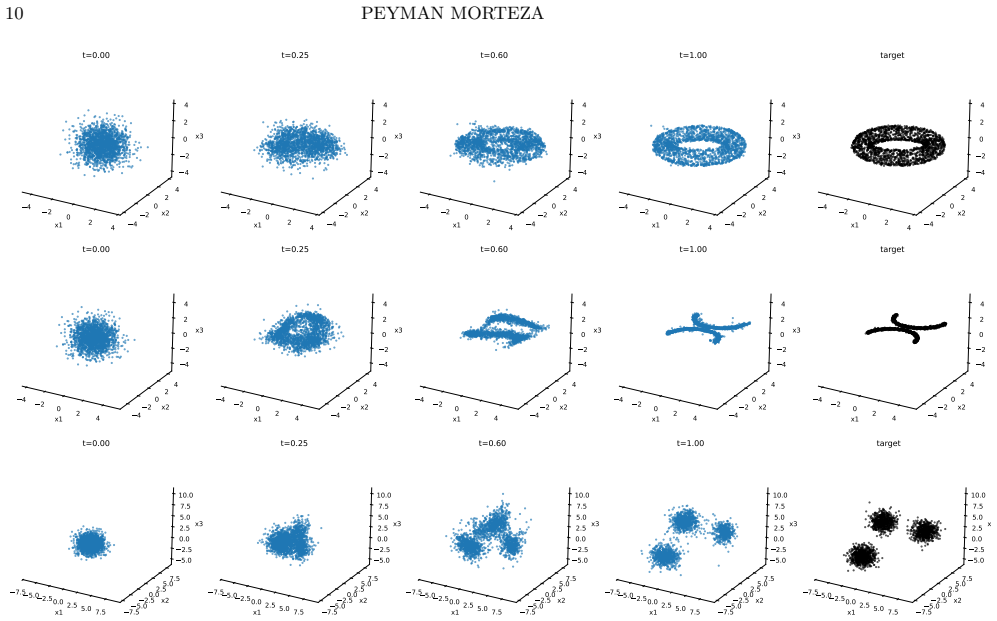
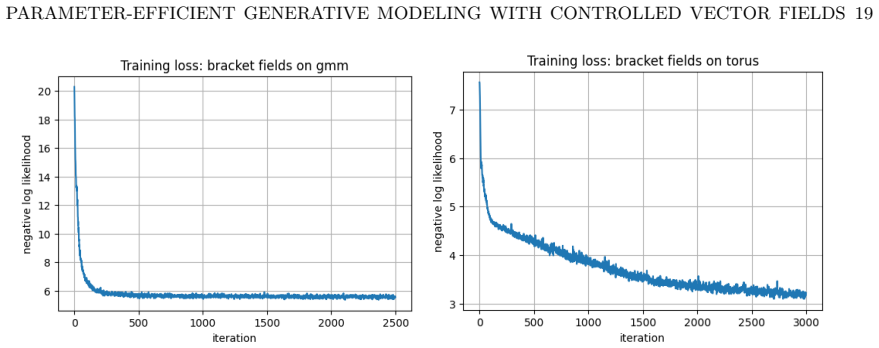
We introduce a continuous-time generative modeling framework, motivated by the Chow-Rashevskii theorem, that builds expressive flows from a small set of fixed vector fields and learned scalar controls. Instead of learning an unconstrained high-dimensional vector field, our framework constructs the velocity by modulating fixed vector fields with learned scalar control functions. When the fixed fields are bracket-generating, their Lie algebra spans the ambient space, providing a mechanism for expressive transport with only a small number of learned control channels and offering a parameter-efficient geometric alternative to standard vector-field parameterizations. This decoupled formulation yields a structured and interpretable generative model in which the number of learned scalar output channels can be chosen independently of the ambient dimension. We formulate an expressivity principle showing that, under suitable controllability and well-posedness assumptions, such controlled flows can transport a source distribution to a target distribution. We train the resulting model using a continuous-normalizing-flow likelihood objective and present proof-of-concept experiments on synthetic distributions.
Editorial analysis
A structured set of objections, weighed in public.
Referee Report
Summary. The manuscript introduces a continuous-time generative modeling framework that constructs the velocity field by modulating a small set of fixed vector fields with learned scalar control functions. Motivated by the Chow-Rashevskii theorem, it claims that when the fixed fields are bracket-generating their Lie algebra spans the space, enabling expressive transport from source to target distributions with the number of learned channels independent of ambient dimension. An expressivity principle is formulated under controllability and well-posedness assumptions; the model is trained via a continuous-normalizing-flow likelihood objective and evaluated in proof-of-concept experiments on synthetic distributions.
Significance. If the expressivity principle holds under the stated assumptions, the framework supplies a geometrically structured, parameter-efficient alternative to unconstrained vector-field parameterizations in generative modeling. The decoupling of learned scalar channels from dimension and the explicit invocation of an established controllability theorem constitute clear strengths; the use of a standard CNF likelihood objective further supports reproducibility.
minor comments (2)
- [Abstract] Abstract: the description of the proof-of-concept experiments does not specify ambient dimensions or the concrete synthetic distributions, which would allow readers to assess the claimed parameter efficiency.
- [Experiments] The manuscript should clarify in the experiments section how the fixed vector fields are selected or constructed to satisfy the bracket-generating condition in the reported runs.
Simulated Author's Rebuttal
We thank the referee for the positive summary, significance assessment, and recommendation of minor revision. The report raises no major comments.
Circularity Check
No significant circularity
full rationale
The paper's central expressivity principle is explicitly conditional on external controllability and well-posedness assumptions drawn from control theory (Chow-Rashevskii theorem for bracket-generating fields). No derivation step reduces a claimed result to a fitted parameter, self-referential definition, or load-bearing self-citation; the number of learned control channels is decoupled from ambient dimension by construction of the framework rather than by tautology, and the CNF training objective is standard. The argument structure treats the Lie-algebra spanning property as a prerequisite rather than deriving it from the learned scalars.
Axiom & Free-Parameter Ledger
axioms (2)
- domain assumption Fixed vector fields are bracket-generating so their Lie algebra spans the ambient space
- domain assumption Suitable controllability and well-posedness assumptions hold
Reference graph
Works this paper leans on
-
[1]
[Cho40] Wei-Liang Chow, ¨Uber systeme von linearen partiellen differentialgleichun- gen erster ordnung, Mathematische Annalen117(1940), no
[BMR+20] Tom Brown, Benjamin Mann, Nick Ryder, Melanie Subbiah, Jared D Ka- plan, Prafulla Dhariwal, Arvind Neelakantan, Pranav Shyam, Girish Sastry, Amanda Askell, et al.,Language models are few-shot learners, Advances in neural information processing systems33(2020), 1877–1901. [Cho40] Wei-Liang Chow, ¨Uber systeme von linearen partiellen differentialgl...
2020
-
[2]
Density estimation using Real NVP
[DSDB16] Laurent Dinh, Jascha Sohl-Dickstein, and Samy Bengio,Density estimation using real nvp, arXiv preprint arXiv:1605.08803 (2016). [Ela25] Karthik Elamvazhuthi,Flow matching for measure transport and feed- back stabilization of control-affine systems, arXiv preprint arXiv:2510.02706 (2025). [HJA20] Jonathan Ho, Ajay Jain, and Pieter Abbeel,Denoising...
work page internal anchor Pith review Pith/arXiv arXiv 2016
-
[3]
Flow Matching for Generative Modeling
[LCBH+22] Yaron Lipman, Ricky TQ Chen, Heli Ben-Hamu, Maximilian Nickel, and Matt Le,Flow matching for generative modeling, arXiv preprint arXiv:2210.02747 (2022). [Mon02] Richard Montgomery,A tour of subriemannian geometries, their geodesics and applications, no. 91, American Mathematical Soc.,
work page internal anchor Pith review Pith/arXiv arXiv 2022
-
[4]
Score-Based Generative Modeling through Stochastic Differential Equations
[PNR+21] George Papamakarios, Eric Nalisnick, Danilo Jimenez Rezende, Shakir Mo- hamed, and Balaji Lakshminarayanan,Normalizing flows for probabilistic modeling and inference, Journal of Machine Learning Research22(2021), no. 57, 1–64. [Ras38] Piotr K Rashevsky,About connecting two points of a completely nonholo- nomic space by admissible curve, Uch. Zapi...
work page internal anchor Pith review Pith/arXiv arXiv 2021
discussion (0)
Sign in with ORCID, Apple, or X to comment. Anyone can read and Pith papers without signing in.