High Temperature Jahn-Teller Distortion and Short Range Order in CsCuCl₃
Pith reviewed 2026-06-29 11:24 UTC · model grok-4.3
The pith
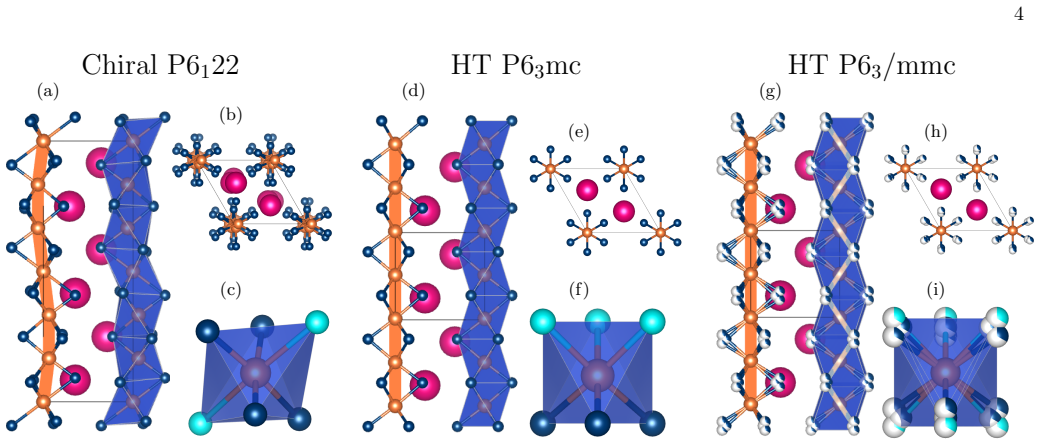
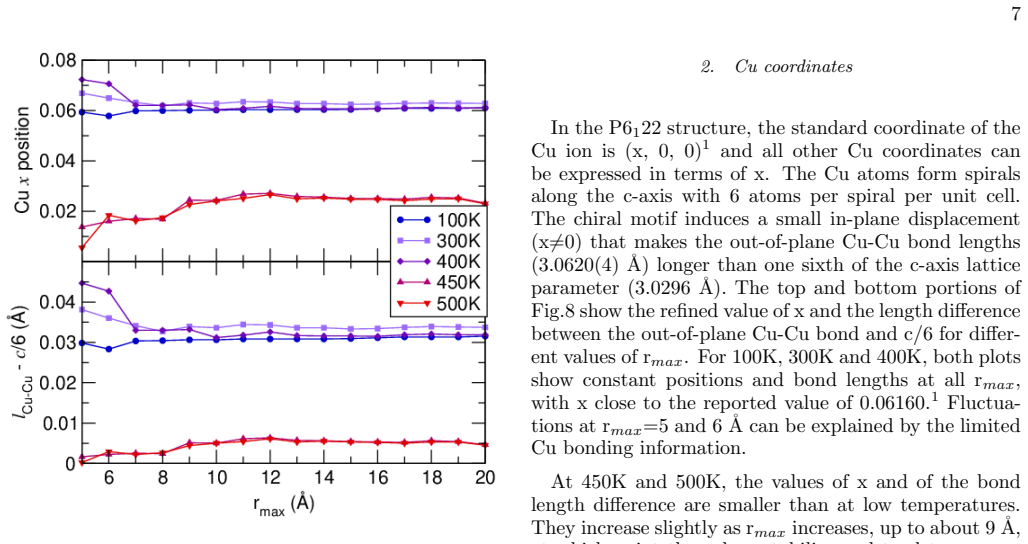
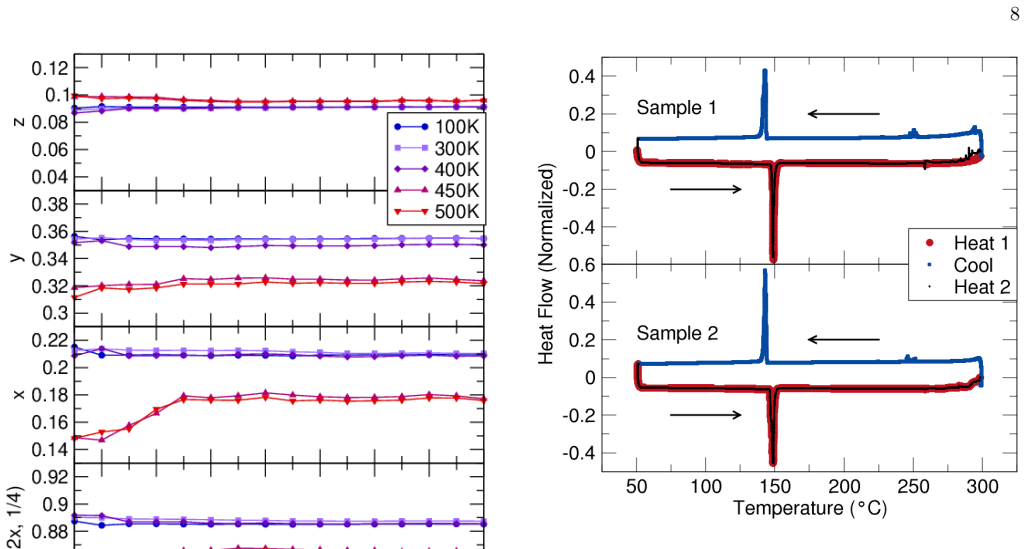
CsCuCl₃ stays locally Jahn-Teller distorted above its 423 K transition with short-range order and mixed chiral domains forming.
A machine-rendered reading of the paper's core claim, the machinery that carries it, and where it could break.
Core claim
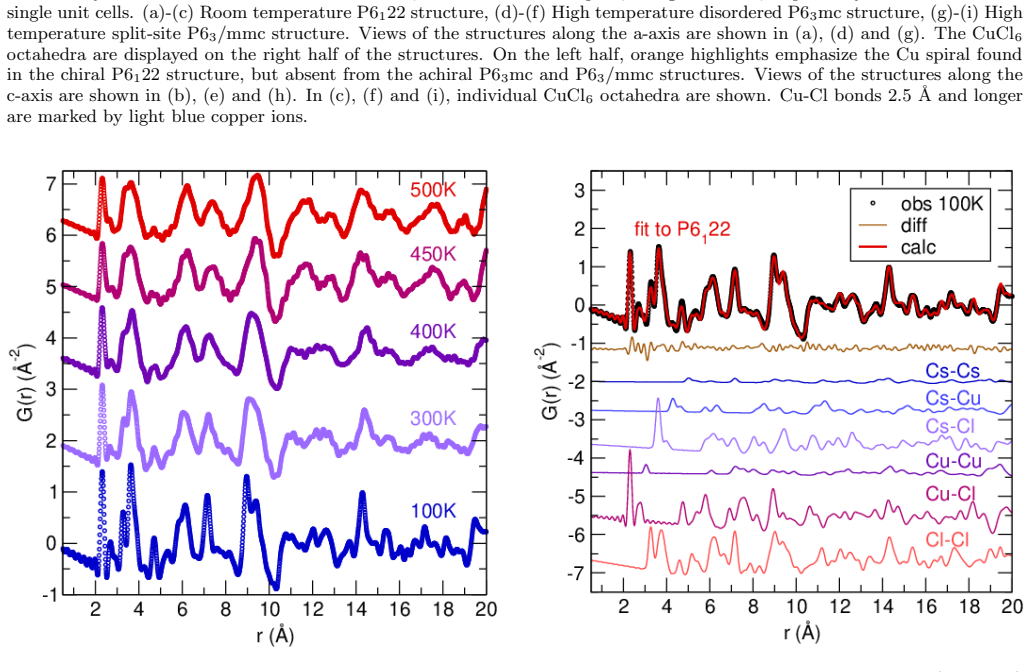
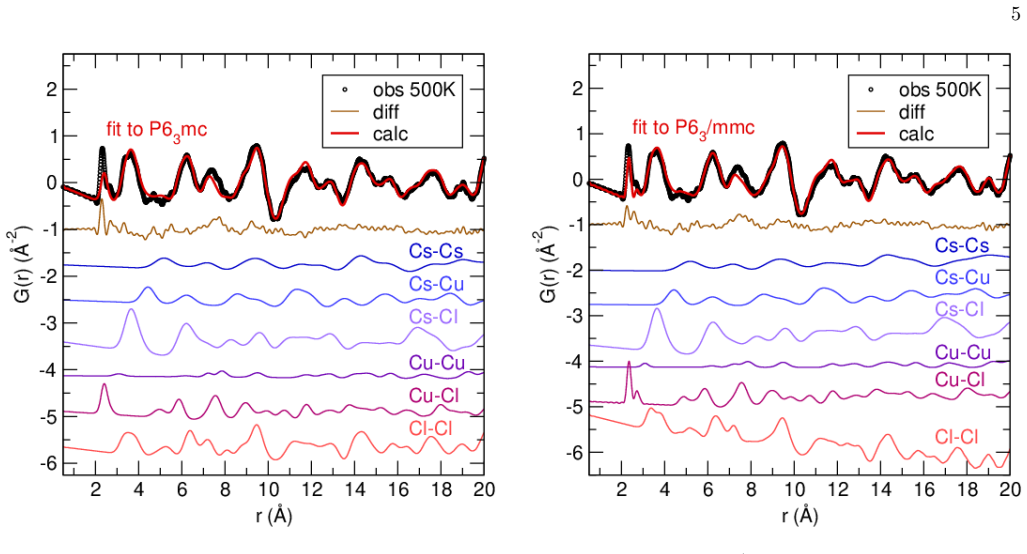
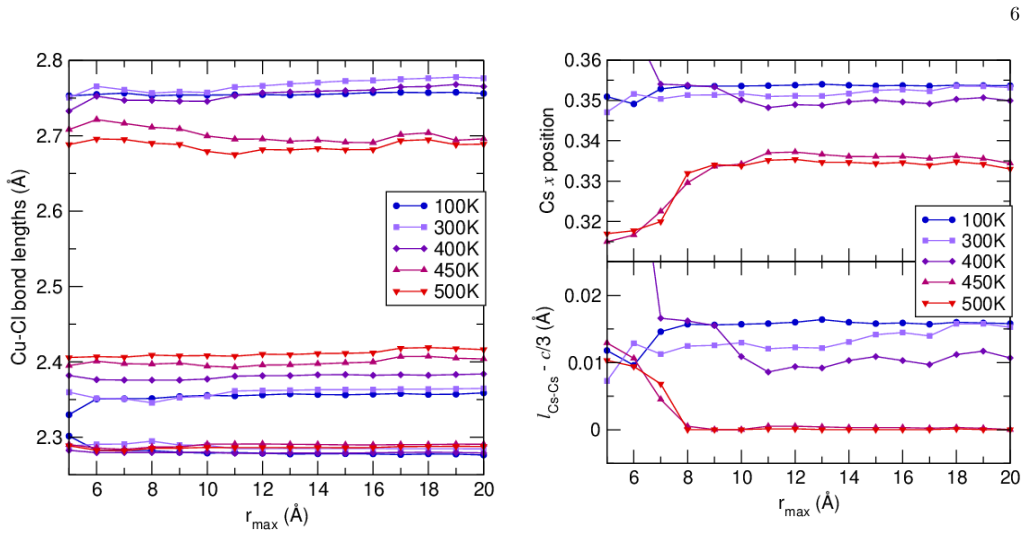
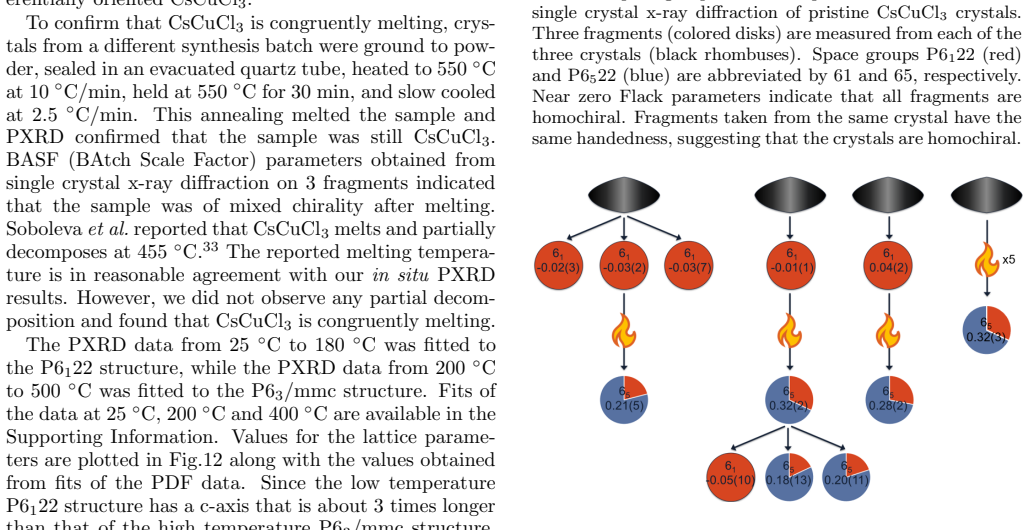
In situ pair distribution function data from powder neutron diffraction confirms that CsCuCl₃ is Jahn-Teller distorted both below and above T_c, and provides a quantitative view of short range order in the high temperature structure. In situ single crystal x-ray diffraction experiments reveal that the phase transition induces domains of mixed handedness in originally homochiral crystals.
What carries the argument
In situ pair distribution function analysis of neutron powder diffraction data to extract local structure and short-range correlations, paired with single-crystal x-ray diffraction to map the formation of chiral domains.
If this is right
- The average high-temperature structure does not represent the actual local atomic arrangement.
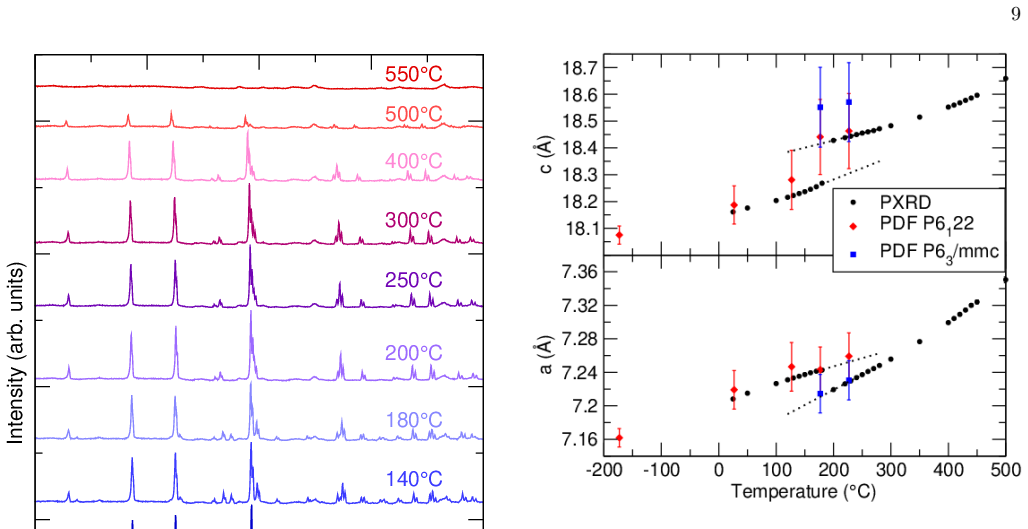
- No further structural transitions occur between 423 K and the congruent melting point.
- The phase transition provides a route to introduce mixed-handedness domains in originally single-chirality crystals.
- Short-range order parameters in the high-temperature phase can be extracted directly from the pair distribution function.
Where Pith is reading between the lines
- Local symmetry breaking may be common in other Jahn-Teller compounds previously classified as undergoing full symmetry restoration.
- Properties sensitive to local Cu geometry, such as magnetic exchange or electronic bands, should show little discontinuity across the transition.
- Thermal cycling protocols could be tested as a general method to control domain chirality in related chiral Jahn-Teller materials.
Load-bearing premise
The pair distribution function analysis of the neutron data correctly identifies persistent local Jahn-Teller distortions rather than a fully symmetric local environment above the transition.
What would settle it
A local-structure measurement above 423 K that shows equal Cu-Cl distances and no short-range order peaks in the pair distribution function would falsify the claim of retained distortion.
Figures


read the original abstract
CsCuCl$_3$, chiral and Jahn-Teller distorted at room temperature, takes a more symmetric structure above 423K. Describing this 'simpler' high temperature structure is far from simple and has been the subject of many, sometimes contradicting, studies. Here we reinvestigate the high temperature structure of CsCuCl$_3$, its thermal stability, and its effect on room temperature chirality. In situ pair distribution function data from powder neutron diffraction confirms that CsCuCl$_3$ is Jahn-Teller distorted both below and above T$_c$, and provides a quantitative view of short range order in the high temperature structure. In situ powder x-ray diffraction shows that CsCuCl$_3$ does not undergo any additional structural changes above 423K and is congruently melting. In situ single crystal x-ray diffraction experiments reveal that the phase transition induces domains of mixed handedness in originally homochiral crystals. These findings contribute to a better understanding of phase transitions in Jahn-Teller distorted compounds, and highlight the potential use of phase transitions to control chiral domains.
Editorial analysis
A structured set of objections, weighed in public.
Referee Report
Summary. The manuscript reports that CsCuCl₃ remains locally Jahn-Teller distorted both below and above Tc = 423 K, with a quantitative characterization of short-range order in the high-T phase provided by in situ neutron pair distribution function analysis from powder diffraction. In situ single-crystal X-ray diffraction shows the transition induces domains of mixed handedness in originally homochiral crystals. Powder X-ray diffraction confirms the absence of additional structural transitions above Tc and congruent melting.
Significance. If the local-structure modeling holds, the work clarifies contradictory prior reports on the high-T phase of this chiral JT compound and demonstrates experimental control of chiral domains via a structural transition. The in situ PDF and XRD approach directly addresses local vs. average structure and is a clear experimental strength.
major comments (2)
- [§4 (Neutron PDF results)] §4 (Neutron PDF results): The central claim of persistent local JT distortion above Tc with quantified short-range order depends on the PDF model details (fitting range, damping, choice of small-box vs. RMC, and comparison to a symmetric local model); these robustness checks and parameter values with uncertainties are not presented, which is load-bearing for distinguishing static distortion from dynamic averaging or resolution limits.
- [§5 (Single-crystal XRD)] §5 (Single-crystal XRD): The observation of mixed-handedness domains is reported but without quantitative measures such as domain volume fractions, sizes, or their temperature dependence across Tc; this weakens support for the claim that the transition induces and controls the domain structure.
minor comments (2)
- [Abstract] The abstract states that PDF data 'provides a quantitative view' but does not report the extracted correlation length or distortion amplitude values.
- [Figure captions] Figure captions for in situ data should explicitly label the temperatures corresponding to below/above Tc for clarity.
Simulated Author's Rebuttal
We thank the referee for their careful reading of the manuscript and for highlighting its significance. We respond to each major comment below.
read point-by-point responses
-
Referee: §4 (Neutron PDF results): The central claim of persistent local JT distortion above Tc with quantified short-range order depends on the PDF model details (fitting range, damping, choice of small-box vs. RMC, and comparison to a symmetric local model); these robustness checks and parameter values with uncertainties are not presented, which is load-bearing for distinguishing static distortion from dynamic averaging or resolution limits.
Authors: We agree that the PDF modeling details are central to the claim and that additional information on robustness would strengthen the manuscript. In the revised version we will explicitly state the fitting ranges employed, the damping parameters, the results of small-box versus RMC comparisons, and a direct comparison against a symmetric (undistorted) local model. Refined parameter values together with their estimated uncertainties will also be reported to allow readers to assess the distinction between static distortion and other possible effects. revision: yes
-
Referee: §5 (Single-crystal XRD): The observation of mixed-handedness domains is reported but without quantitative measures such as domain volume fractions, sizes, or their temperature dependence across Tc; this weakens support for the claim that the transition induces and controls the domain structure.
Authors: The single-crystal XRD data demonstrate the appearance of reflections from both chiralities immediately above Tc in originally homochiral crystals, directly supporting the statement that the transition induces mixed-handedness domains. We acknowledge that quantitative domain volume fractions and sizes are not extracted in the present work. Such quantification would require additional rocking-curve or reciprocal-space mapping measurements that were outside the scope of the reported experiments; we therefore cannot supply these numbers from the existing dataset. revision: partial
- Quantitative domain volume fractions and sizes from the single-crystal XRD measurements, as these were not determined in the original experiments.
Circularity Check
No circularity: purely experimental measurements
full rationale
The paper reports in situ neutron PDF, powder XRD, and single-crystal XRD measurements of structure, phase stability, and domain formation in CsCuCl3. Central claims rest on direct data interpretation (local JT distortion persisting above Tc via PDF, domain mixing via single-crystal XRD) without derivations, parameter fits renamed as predictions, or self-citation chains. No equations or modeling steps reduce to their own inputs by construction; the work is self-contained against external diffraction benchmarks.
Axiom & Free-Parameter Ledger
axioms (1)
- domain assumption Pair distribution function analysis can reliably detect local Jahn-Teller distortions even when the long-range average structure is symmetric.
Reference graph
Works this paper leans on
-
[1]
Synthesis, Crystal Structure and Photoelectric Response of All-Inorganic Copper Halide Salts CsCuCl 3.European Journal of Inorganic Chemistry, 2020(22):2165–2169, June
34 Shuting Cui, Yan Chen, Siwen Tao, Jiawen Cui, Cang Yuan, Ning Yu, Huawei Zhou, Jie Yin, and Xianxi Zhang. Synthesis, Crystal Structure and Photoelectric Response of All-Inorganic Copper Halide Salts CsCuCl 3.European Journal of Inorganic Chemistry, 2020(22):2165–2169, June
2020
-
[2]
Kousaka, T
50 Y. Kousaka, T. Koyama, K. Ohishi, K. Kakurai, V. Hutanu, H. Ohsumi, T. Arima, A. Tokuda, M. Suzuki, N. Kawamura, A. Nakao, T. Hanashima, J. Suzuki, J. Campo, Y. Miyamoto, A. Sera, K. Inoue, and J. Akim- itsu. Monochiral helimagnetism in homochiral crystals of ${\mathrm{CsCuCl}} {3}$.Physical Review Materials, 1(7):071402, December 2017
2017
discussion (0)
Sign in with ORCID, Apple, or X to comment. Anyone can read and Pith papers without signing in.