Mechanical Squeezed-Fock Gravimeter
Pith reviewed 2026-06-29 12:11 UTC · model grok-4.3
The pith
In the squeezed-Fock basis of a driven Duffing oscillator, gravity couples to the anti-squeezed quadrature to enhance transition rates while preserving mass scaling.
A machine-rendered reading of the paper's core claim, the machinery that carries it, and where it could break.
Core claim
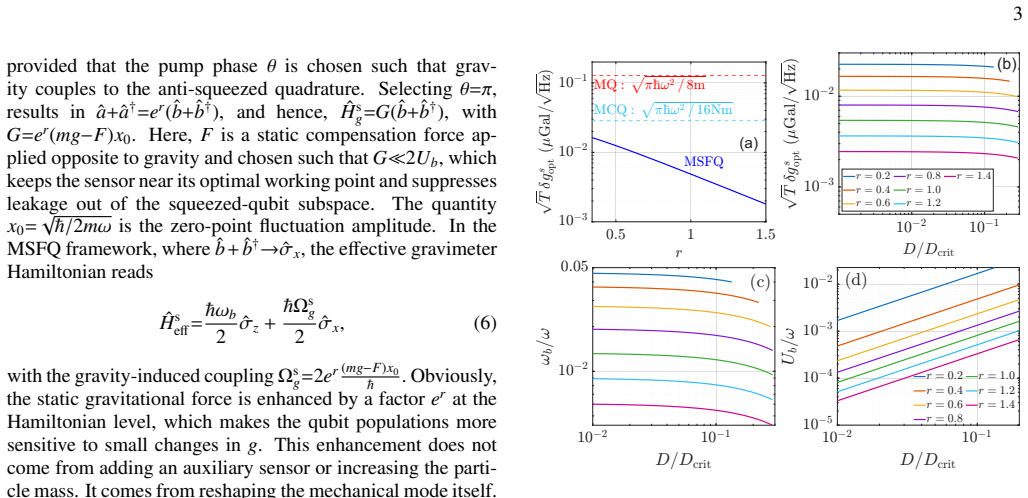
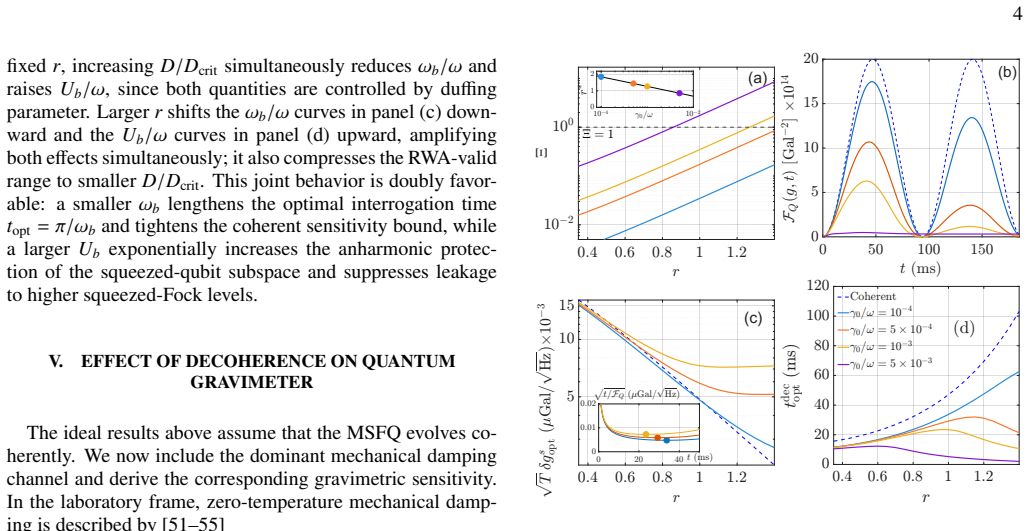
In the squeezed-Fock basis, the gravitational force couples to the anti-squeezed quadrature, which enhances the gravity-induced transition rate while preserving the direct mass scaling of the mechanical force coupling. Sensitivity improves with reduced effective qubit splitting that is controlled by the squeezing parameter and the Duffing nonlinearity. Squeezing converts ordinary dissipation into anisotropic qubit noise, setting a practical trade-off between signal amplification and decoherence rate.
What carries the argument
Squeezed-Fock basis of the driven Duffing oscillator, in which gravity couples to the anti-squeezed quadrature.
If this is right
- The gravity-induced transition rate increases because of the coupling to the anti-squeezed quadrature.
- Sensitivity to gravity rises when the effective qubit splitting is lowered by larger squeezing or stronger Duffing nonlinearity.
- Mechanical damping is converted into anisotropic noise on the effective qubit.
- A direct trade-off appears between the amplified signal strength and the resulting decoherence rate.
Where Pith is reading between the lines
- The same quadrature-coupling mechanism could be tested for sensing other weak accelerations or fields in levitated systems.
- Tuning the two-phonon drive detuning might allow further optimization of the effective splitting without additional hardware changes.
- The anisotropic noise model suggests that readout or cooling protocols could be adapted to the squeezed basis to mitigate the decoherence cost.
Load-bearing premise
The gravitational force couples specifically to the anti-squeezed quadrature once the system is prepared in the squeezed-Fock basis of the driven Duffing oscillator.
What would settle it
An experiment that measures no increase in the gravity-induced transition rate when the oscillator is prepared in the squeezed-Fock state, or that finds the noise remains isotropic rather than anisotropic under squeezing, would falsify the central claims.
Figures
read the original abstract
Levitated mechanical systems are promising candidates for quantum gravimetry, as gravity couples directly to their center-of-mass motion, enabling the large mass of a mesoscopic particle to serve as a sensing resource. In this paper, we propose a mechanical squeezed-Fock qubit gravimeter using a Duffing oscillator that is driven by a detuned two-phonon pump. In the squeezed-Fock basis, the gravitational force couples to the anti-squeezed quadrature, which enhances the gravity-induced transition rate while preserving the direct mass scaling of the mechanical force coupling. We show that sensitivity improves with reduced effective qubit splitting that is controlled by the squeezing parameter and the Duffing nonlinearity. We further analyze mechanical damping and show that squeezing converts ordinary dissipation into anisotropic qubit noise, setting a practical trade-off between signal amplification and decoherence rate. These results identify the mechanical squeezed-Fock qubit as a new platform for quantum-enhanced gravimetry.
Editorial analysis
A structured set of objections, weighed in public.
Referee Report
Summary. The manuscript proposes a mechanical squeezed-Fock qubit gravimeter realized with a levitated Duffing oscillator driven by a detuned two-phonon pump. It claims that, once prepared in the squeezed-Fock basis, the gravitational force (linear in mechanical position) couples selectively to the anti-squeezed quadrature, thereby enhancing the gravity-induced transition rate while preserving the direct mass scaling of the mechanical force. Sensitivity is asserted to improve through a reduced effective qubit splitting controlled by the squeezing parameter and Duffing nonlinearity; mechanical damping is converted into anisotropic qubit noise, establishing a trade-off between signal gain and decoherence.
Significance. If the claimed quadrature-selective coupling and resulting sensitivity enhancement can be rigorously derived, the proposal would identify a new route to quantum-enhanced gravimetry that exploits squeezing in mesoscopic mechanical systems while retaining the favorable mass scaling of the gravitational interaction. The work would also highlight a concrete noise-conversion mechanism arising from the driven Duffing dynamics.
major comments (2)
- [Abstract] Abstract: The central claim that 'the gravitational force couples to the anti-squeezed quadrature' in the squeezed-Fock basis is stated without any Hamiltonian transformation, explicit derivation, or intermediate steps. Because this selective coupling is what produces the enhanced transition rate while preserving mass scaling, the absence of the required check (including possible quadrature-mixing corrections from the two-phonon drive or Duffing terms) renders the enhancement unverified.
- [Abstract] Abstract: No equations, numerical results, error analysis, or parameter scans are supplied to substantiate the asserted improvements in transition rate, sensitivity, or the dissipation-to-anisotropic-noise conversion. The soundness of the proposal therefore cannot be assessed from the given material.
Simulated Author's Rebuttal
We thank the referee for their careful reading and constructive comments. We respond point by point to the major comments and indicate the revisions we will implement.
read point-by-point responses
-
Referee: [Abstract] Abstract: The central claim that 'the gravitational force couples to the anti-squeezed quadrature' in the squeezed-Fock basis is stated without any Hamiltonian transformation, explicit derivation, or intermediate steps. Because this selective coupling is what produces the enhanced transition rate while preserving mass scaling, the absence of the required check (including possible quadrature-mixing corrections from the two-phonon drive or Duffing terms) renders the enhancement unverified.
Authors: The main text derives the transformation to the squeezed-Fock basis and the resulting effective Hamiltonian, confirming selective coupling of the gravitational term to the anti-squeezed quadrature while showing that the two-phonon drive and Duffing nonlinearity introduce no leading-order quadrature mixing. To address the concern that this is not evident from the abstract, we will revise the manuscript to include a brief outline of the transformation in the introduction and a reference in the abstract. revision: yes
-
Referee: [Abstract] Abstract: No equations, numerical results, error analysis, or parameter scans are supplied to substantiate the asserted improvements in transition rate, sensitivity, or the dissipation-to-anisotropic-noise conversion. The soundness of the proposal therefore cannot be assessed from the given material.
Authors: The full manuscript supplies the equations for the transition rates, the sensitivity expression, and the anisotropic noise spectrum in Sections III and IV, together with numerical results, parameter scans over squeezing strength and Duffing coefficient, and an error analysis of the approximations. We will revise the abstract and conclusion to explicitly reference these sections and results so that the supporting material is immediately apparent. revision: partial
Circularity Check
No significant circularity; central claims follow from standard Hamiltonian transformations
full rationale
The paper derives the selective coupling of the gravitational term to the anti-squeezed quadrature by transforming the linear position coupling under the squeezing induced by the detuned two-phonon drive and Duffing nonlinearity. This is a calculational step in the squeezed-Fock basis, not a self-definition or fitted input renamed as prediction. No load-bearing self-citations, uniqueness theorems from the same authors, or ansatzes smuggled via prior work are invoked for the key result. Sensitivity scaling with squeezing parameter and dissipation anisotropy are obtained from the transformed master equation using standard quantum-optomechanics noise models. The derivation chain is self-contained and externally falsifiable via the underlying Hamiltonian.
Axiom & Free-Parameter Ledger
free parameters (2)
- squeezing parameter
- Duffing nonlinearity
axioms (2)
- domain assumption Gravity couples directly to the center-of-mass motion of the levitated particle
- domain assumption In the squeezed-Fock basis the gravitational force couples to the anti-squeezed quadrature
Reference graph
Works this paper leans on
-
[1]
Stray, A
B. Stray, A. Lamb, A. Kaushik, J. V ovrosh, A. Rodgers, J. Winch, F. Hayati, D. Boddice, A. Stabrawa, A. Niggebaum, M. Langlois, Y .-H. Lien, S. Lellouch, S. Roshanmanesh, K. Ri- dley, G. de Villiers, G. Brown, T. Cross, G. Tuckwell, A. Fara- marzi, N. Metje, K. Bongs, and M. Holynski, Quantum sensing for gravity cartography, Nature602, 590 (2022)
2022
-
[2]
S. E. Crawford, G. R. Lander, H. P. Paudel, M. R. Slot, N. Lalam, J. Wuenschell, R. Pingree, R. Oueid, R. Wright, M. Buric, M. M. Brister, and Y . Duan, Quantum sensing for emerging energy technologies, Nat. Rev. Clean Technol.1, 861 (2025)
2025
-
[3]
Forster, A
F. Forster, A. G ¨untner, P. Jousset, M. Reich, B. M¨annel, J. Hin- derer, and K. Erbas, Environmental and anthropogenic gravity contributions at the theistareykir geothermal field, north Ice- land, Geothermal Energy9, 26 (2021)
2021
-
[4]
X. Wu, Z. Pagel, B. S. Malek, T. H. Nguyen, F. Zi, D. S. Scheirer, and H. M ¨uller, Gravity surveys using a mobile atom interferometer, Science Advances5, eaax0800 (2019)
2019
-
[5]
Krelina, Quantum technology for military applications, EPJ Quantum Technol.8, 24 (2021)
M. Krelina, Quantum technology for military applications, EPJ Quantum Technol.8, 24 (2021)
2021
-
[6]
Ye and P
J. Ye and P. Zoller, Essay: Quantum sensing with atomic, molecular, and optical platforms for fundamental physics, Phys. Rev. Lett.132, 190001 (2024)
2024
-
[7]
Poli, F.-Y
N. Poli, F.-Y . Wang, M. G. Tarallo, A. Alberti, M. Prevedelli, and G. M. Tino, Precision measurement of gravity with cold atoms in an optical lattice and comparison with a classical gravimeter, Phys. Rev. Lett.106, 038501 (2011)
2011
-
[8]
Kasevich and S
M. Kasevich and S. Chu, Atomic interferometry using stimu- lated Raman transitions, Phys. Rev. Lett.67, 181 (1991)
1991
-
[9]
Peters, K
A. Peters, K. Y . Chung, and S. Chu, Measurement of gravita- tional acceleration by dropping atoms, Nature400, 849 (1999)
1999
-
[10]
Geiger, A
R. Geiger, A. Landragin, S. Merlet, and F. Pereira Dos Santos, High-accuracy inertial measurements with cold-atom sensors, A VS Quantum Science2, 024702 (2020)
2020
-
[11]
J. Wei, J. Huang, and C. Lee, Adaptive robust high-precision atomic gravimetry, Phys. Rev. Res.7, L012064 (2025)
2025
-
[12]
Bidel, N
Y . Bidel, N. Zahzam, C. Blanchard, A. Bonnin, M. Cadoret, A. Bresson, D. Rouxel, and M. F. Lequentrec-Lalancette, Ab- solute marine gravimetry with matter-wave interferometry, Nat. Commun.9, 627 (2018). 12
2018
-
[13]
Hu, B.-L
Z.-K. Hu, B.-L. Sun, X.-C. Duan, M.-K. Zhou, L.-L. Chen, S. Zhan, Q.-Z. Zhang, and J. Luo, Demonstration of an ultrahigh-sensitivity atom-interferometry absolute gravimeter, Phys. Rev. A88, 043610 (2013)
2013
-
[14]
M ´enoret, P
V . M ´enoret, P. Vermeulen, N. Le Moigne, S. Bonvalot, P. Bouyer, A. Landragin, and B. Desruelle, Gravity measure- ments below 10 −9g with a transportable absolute quantum gravimeter, Sci. Rep.8, 12300 (2018)
2018
-
[15]
Zhang, L.-L
T. Zhang, L.-L. Chen, Y .-B. Shu, W.-J. Xu, Y . Cheng, Q. Luo, Z.-K. Hu, and M.-K. Zhou, Ultrahigh-sensitivity bragg atom gravimeter and its application in testing lorentz violation, Phys. Rev. Applied20, 014067 (2023)
2023
-
[16]
Peters, K
A. Peters, K. Y . Chung, and S. Chu, High-precision gravity measurements using atom interferometry, Metrologia38, 25 (2001)
2001
-
[17]
Le Gou”et, T
J. Le Gou”et, T. E. Mehlst”aubler, J. Kim, S. Merlet, A. Clairon, A. Landragin, and F. Pereira Dos Santos, Limits to the sensitiv- ity of a low noise compact atomic gravimeter, Appl. Phys. B92, 133 (2008)
2008
-
[18]
Merlet, J
S. Merlet, J. Le Gou”et, Q. Bodart, A. Clairon, A. Landragin, F. Pereira Dos Santos, and P. Rouchon, Operating an atom in- terferometer beyond its linear range, Metrologia46, 87 (2009)
2009
-
[19]
Zhou, Z.-K
M.-K. Zhou, Z.-K. Hu, X.-C. Duan, B.-L. Sun, L.-L. Chen, Q.- Z. Zhang, and J. Luo, Performance of a cold-atom gravime- ter with an active vibration isolator, Phys. Rev. A86, 043630 (2012)
2012
-
[20]
Rademacher, J
M. Rademacher, J. Millen, and Y . L. Li, Quantum sensing with nanoparticles for gravimetry: when bigger is better, Adv. Opt. Technol.9, 227 (2020)
2020
-
[21]
Gonzalez-Ballestero, M
C. Gonzalez-Ballestero, M. Aspelmeyer, L. Novotny, R. Quidant, and O. Romero-Isart, Levitodynamics: levita- tion and control of microscopic objects in vacuum, Science 374, eabg3027 (2021)
2021
-
[22]
S. Bose, I. Fuentes, A. A. Geraci, S. M. Khan, S. Qvarfort, M. Rademacher, M. Rashid, M. Toro ˇs, H. Ulbricht, and C. C. Wanjura, Massive quantum systems as interfaces of quantum mechanics and gravity, Rev. Mod. Phys.97, 015003 (2025)
2025
-
[23]
Dania, D
L. Dania, D. S. Bykov, F. Goschin, M. Teller, A. Kassid, and T. E. Northup, Ultrahigh quality factor of a levitated nanome- chanical oscillator, Phys. Rev. Lett.132, 133602 (2024)
2024
-
[24]
Quantum gravimetry with mechanical qubits
X.-W. Huo, J.-H. An, and P.-B. Li, Quantum gravimetry with mechanical qubits (2026), arXiv:2604.14950 [quant-ph]
work page internal anchor Pith review Pith/arXiv arXiv 2026
-
[25]
Deli ´c, M
U. Deli ´c, M. Reisenbauer, K. Dare, D. Grass, V . Vuleti ´c, N. Kiesel, and M. Aspelmeyer, Cooling of a levitated nanopar- ticle to the motional quantum ground state, Science367, 892 (2020)
2020
-
[26]
Tebbenjohanns, M
F. Tebbenjohanns, M. L. Mattana, M. Rossi, M. Frimmer, and L. Novotny, Quantum control of a nanoparticle optically levi- tated in cryogenic free space, Nature595, 378 (2021)
2021
-
[27]
Magrini, P
L. Magrini, P. Rosenzweig, C. Bach, A. Deutschmann-Olek, S. G. Hofer, S. Hong, N. Kiesel, A. Kugi, and M. Aspelmeyer, Real-time optimal quantum control of mechanical motion at room temperature, Nature595, 373 (2021)
2021
-
[28]
Kamba, R
M. Kamba, R. Shimizu, and K. Aikawa, Quantum squeezing of a levitated nanomechanical oscillator, Science389, 1225 (2025)
2025
-
[29]
Marti, U
S. Marti, U. von L ¨upke, O. Joshi, Y . Yang, M. Bild, A. Oma- hen, Y . Chu, and M. Fadel, Quantum squeezing in a nonlinear mechanical oscillator, Nat. Phys.20, 1448 (2024)
2024
-
[30]
Piotrowski, D
J. Piotrowski, D. Windey, J. Vijayan, C. Gonzalez-Ballestero, A. de los R´ıos Sommer, N. Altundaˇs, A. Blais, O. Romero-Isart, R. Quidant, and U. Deli´c, Simultaneous ground-state cooling of two mechanical modes of a levitated nanoparticle, Nat. Phys. 19, 1009 (2023)
2023
-
[31]
Scala, M
M. Scala, M. S. Kim, G. W. Morley, P. F. Barker, and S. Bose, Matter-wave interferometry of a levitated thermal nano-oscillator induced and probed by a spin, Phys. Rev. Lett. 111, 180403 (2013)
2013
-
[32]
Wang, J.-F
L.-Y . Wang, J.-F. Wei, K.-F. Cui, S.-L. Su, L.-L. Yan, H.-Z. Guo, C.-X. Shan, and G. Chen, Enhanced gravity sensing by a levitated mesoscopic nanoparticle, Phys. Rev. Lett.135, 120803 (2025)
2025
-
[33]
Qvarfort, A
S. Qvarfort, A. Serafini, P. F. Barker, and S. Bose, Gravime- try through non-linear optomechanics, Nat. Commun.9, 3690 (2018)
2018
-
[34]
P.-B. Li, Y . Zhou, W.-B. Gao, and F. Nori, Enhancing spin- phonon and spin-spin interactions using linear resources in a hybrid quantum system, Phys. Rev. Lett.125, 153602 (2020)
2020
-
[35]
Li, Z.-L
P.-B. Li, Z.-L. Xiang, P. Rabl, and F. Nori, Hybrid quantum de- vice with nitrogen-vacancy centers in diamond coupled to car- bon nanotubes, Phys. Rev. Lett.117, 015502 (2016)
2016
-
[36]
Rips and M
S. Rips and M. J. Hartmann, Quantum information process- ing with nanomechanical qubits, Phys. Rev. Lett.110, 120503 (2013)
2013
-
[37]
Pistolesi, A
F. Pistolesi, A. N. Cleland, and A. Bachtold, Proposal for a nanomechanical qubit, Phys. Rev. X11, 031027 (2021)
2021
-
[38]
Samanta, S
C. Samanta, S. L. De Bonis, C. B. Møller, R. Tormo-Queralt, W. Yang, C. Urgell, B. Stamenic, B. Thibeault, Y . Jin, D. A. Czaplewski, F. Pistolesi, and A. Bachtold, Nonlinear nanome- chanical resonators approaching the quantum ground state, Nat. Phys.19, 1340 (2023)
2023
- [39]
-
[40]
Savel’ev, X
S. Savel’ev, X. Hu, and F. Nori, Quantum electromechanics: Qubits from buckling nanobars, New J. Phys.8, 105 (2006)
2006
-
[41]
Savel’ev, A
S. Savel’ev, A. L. Rakhmanov, X. Hu, A. Kasumov, and F. Nori, Quantum electromechanics: Quantum tunneling near resonance and qubits from buckling nanobars, Phys. Rev. B75, 165417 (2007)
2007
-
[42]
S. Rips, I. Wilson-Rae, and M. J. Hartmann, Nonlinear nanome- chanical resonators for quantum optoelectromechanics, Phys. Rev. A89, 013854 (2014)
2014
-
[43]
Fl ¨uhmann, T
C. Fl ¨uhmann, T. L. Nguyen, M. Marinelli, V . Negnevitsky, K. Mehta, and J. P. Home, Encoding a qubit in a trapped-ion mechanical oscillator, Nature566, 513 (2019)
2019
-
[44]
Y . Yang, I. Kladari´c, M. Drimmer, U. von L¨upke, D. Lenterman, J. Bus, S. Marti, M. Fadel, and Y . Chu, A mechanical qubit, Science386, 783 (2024)
2024
-
[45]
Pistolesi, The journey to a mechanical qubit, Science386, 728 (2024)
F. Pistolesi, The journey to a mechanical qubit, Science386, 728 (2024)
2024
-
[46]
Qiao, J.-H
Y .-F. Qiao, J.-H. An, and P.-B. Li, Mechanical squeezed-fock qubit: Towards quantum weak-force sensing, Phys. Rev. Lett. 136, 040801 (2026)
2026
-
[47]
C. W. Helstrom, Quantum detection and estimation theory, J. Stat. Phys.1, 231 (1969)
1969
-
[48]
M. G. A. Paris, Quantum estimation for quantum technology, Int. J. Quantum Inf.7, 125 (2009)
2009
-
[49]
Montenegro, C
V . Montenegro, C. Mukhopadhyay, R. Yousefjani, S. Sarkar, U. Mishra, M. G. A. Paris, and A. Bayat, Review: Quantum metrology and sensing with many-body systems, Phys. Rep. 1134, 1 (2025)
2025
-
[50]
S. L. Braunstein and C. M. Caves, Statistical distance and the geometry of quantum states, Phys. Rev. Lett.72, 3439 (1994)
1994
-
[51]
C. W. Gardiner and P. Zoller,Quantum Noise: A Handbook of Markovian and Non-Markovian Quantum Stochastic Methods with Applications to Quantum Optics, 3rd ed. (Springer, Berlin, 2004). 13
2004
-
[52]
Breuer and F
H.-P. Breuer and F. Petruccione,The Theory of Open Quantum Systems(Oxford University Press, Oxford, 2002)
2002
-
[53]
Aspelmeyer, T
M. Aspelmeyer, T. J. Kippenberg, and F. Marquardt, Cavity op- tomechanics, Rev. Mod. Phys.86, 1391 (2014)
2014
-
[54]
A. A. Clerk, M. H. Devoret, S. M. Girvin, F. Marquardt, and R. J. Schoelkopf, Introduction to quantum noise, measurement, and amplification, Rev. Mod. Phys.82, 1155 (2010)
2010
-
[55]
R. Fazio, J. Keeling, L. Mazza, and M. Schir `o, Many-body open quantum systems, SciPost Physics Lecture Notes99, 10.21468/SciPostPhysLectNotes.99 (2025)
discussion (0)
Sign in with ORCID, Apple, or X to comment. Anyone can read and Pith papers without signing in.