T-GINEE: A Tensor-Based Multilayer Graph Representation Learning
Pith reviewed 2026-06-29 14:12 UTC · model grok-4.3
The pith
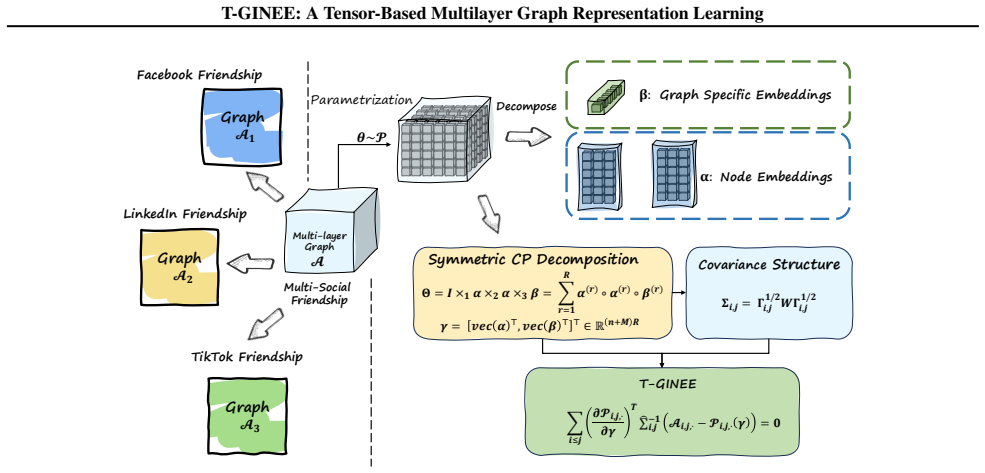
T-GINEE models cross-layer correlations in multilayer networks through CP tensor decomposition inside a generalized estimating equation framework.
A machine-rendered reading of the paper's core claim, the machinery that carries it, and where it could break.
Core claim
T-GINEE is a statistical regularization framework that combines CP tensor decomposition to capture structural dependencies via shared latent factors, a generalized estimating equation framework that models inter-layer correlations through working covariance matrices, and a flexible link function that accommodates traits such as sparsity. The method adds a task-specific loss and supplies theoretical results establishing consistency and asymptotic normality of the estimators under mild conditions. Experiments on both synthetic and real multilayer datasets show improved performance relative to baselines that ignore cross-layer dependence.
What carries the argument
CP tensor decomposition paired with the generalized estimating equation framework whose working covariance matrices encode inter-layer dependence.
If this is right
- Node embeddings respect explicit cross-layer statistical dependence rather than assuming layer independence.
- The estimators remain consistent and asymptotically normal whenever the mild regularity conditions are satisfied.
- The same framework can be paired with different task losses for link prediction, node classification, or community detection on multilayer data.
- Sparsity and other layer-specific traits are handled directly by the choice of link function.
Where Pith is reading between the lines
- If the working covariance matrices are badly misspecified, the method may lose its statistical guarantees, pointing to a need for data-driven covariance estimation.
- The tensor-plus-GEE structure could be extended to time-varying multilayer networks by adding a temporal smoothness term.
- Similar tensor decompositions appear in other network models; comparing the resulting estimators might reveal when the GEE layer adds value beyond pure tensor factorization.
Load-bearing premise
The working covariance matrices chosen inside the generalized estimating equation framework are close enough to the true inter-layer correlation structure.
What would settle it
A controlled simulation in which the true inter-layer correlation matrix is known and deliberately mismatched to the working covariance matrices, then checking whether the claimed consistency and asymptotic normality still hold.
Figures
read the original abstract
Traditional network analysis focuses on single-layer networks, real-world systems often form multilayer networks with multiple relationship types. However, existing methods typically fail to capture complex inter-layer dependencies by treating layers independently or aggregating them. To address this, we propose T-GINEE (Tensor-Based Generalized Multilayer-graph Estimating Equation), a statistical regularization framework combining tensor-based generalized estimating equations with task-specific loss to model cross-network correlations explicitly. Key innovations include: (1) CP tensor decomposition capturing structural dependencies via shared latent factors; (2) a generalized estimating equation framework modeling inter-layer correlations through working covariance matrices; and (3) a flexible link function accommodating characteristics like sparsity. Our theoretical analysis establishes consistency and asymptotic normality under mild conditions. Extensive experiments on synthetic and real-world datasets validate T-GINEE's effectiveness for multilayer network analysis.
Editorial analysis
A structured set of objections, weighed in public.
Referee Report
Summary. The paper proposes T-GINEE, a statistical regularization framework that integrates CP tensor decomposition with generalized estimating equations (GEE) and a task-specific loss to explicitly model inter-layer correlations in multilayer networks. It introduces shared latent factors via CP decomposition, working covariance matrices for correlations, and a flexible link function for sparsity, while claiming consistency and asymptotic normality of estimators under mild conditions, validated through experiments on synthetic and real-world datasets.
Significance. If the theoretical results hold with verifiable conditions, the work offers a statistically grounded alternative to independent or aggregated layer treatments in multilayer graph learning by directly incorporating cross-network dependencies through tensor-GEE machinery. The explicit use of GEE working covariances and CP factors for structural dependencies is a potentially useful synthesis, though its advantage depends on whether the claimed guarantees transfer to typical graph sparsity regimes.
major comments (1)
- [Theoretical Analysis] Theoretical Analysis (or equivalent section containing the consistency/asymptotic normality proofs): The central claim of consistency and asymptotic normality under 'mild conditions' is load-bearing for the paper's contribution, yet the abstract and framework description provide no explicit statement of these conditions (e.g., requirements on moments, identifiability of CP rank, correctness of the link function, or boundedness of the working covariance matrices). Standard GEE theory requires correct mean specification for consistency but ties asymptotic normality and efficiency to the working covariance accurately reflecting inter-layer dependence; without verifying these for multilayer graph sparsity patterns or finite-sample regimes, the guarantees do not demonstrably apply.
minor comments (1)
- [Abstract] Abstract: The description of 'task-specific loss' and 'flexible link function' is high-level; a concrete example of the link function (e.g., logit or identity) and how it interacts with the CP factors would improve clarity.
Simulated Author's Rebuttal
We thank the referee for the detailed and constructive feedback on our manuscript. The concern regarding explicit conditions in the theoretical analysis is well-taken, and we address it directly below with a commitment to revision.
read point-by-point responses
-
Referee: Theoretical Analysis (or equivalent section containing the consistency/asymptotic normality proofs): The central claim of consistency and asymptotic normality under 'mild conditions' is load-bearing for the paper's contribution, yet the abstract and framework description provide no explicit statement of these conditions (e.g., requirements on moments, identifiability of CP rank, correctness of the link function, or boundedness of the working covariance matrices). Standard GEE theory requires correct mean specification for consistency but ties asymptotic normality and efficiency to the working covariance accurately reflecting inter-layer dependence; without verifying these for multilayer graph sparsity patterns or finite-sample regimes, the guarantees do not demonstrably apply.
Authors: We agree that the abstract and framework overview do not enumerate the conditions in detail, which reduces transparency. The proofs in the theoretical analysis section rely on standard GEE regularity conditions adapted to the CP tensor decomposition: (i) finite second moments of the multilayer observations, (ii) identifiability of the CP rank under the assumed decomposition, (iii) correct specification of the conditional mean via the chosen link function, and (iv) bounded eigenvalues of the working covariance matrices ensuring they remain positive definite. To make these explicit, we will add a dedicated 'Assumptions' subsection immediately preceding the consistency and asymptotic normality theorems, listing each condition with precise mathematical statements and references to the relevant lemmas. We will also expand the discussion to address multilayer graph sparsity by noting that the link function (e.g., logit) and the working covariance construction are chosen to be compatible with sparse regimes where edge probabilities decay appropriately, preserving the mean-correctness requirement. For finite-sample behavior, the results are asymptotic; we will add a remark clarifying this and referencing the synthetic experiments that empirically support the theory in moderate-sized sparse graphs. These changes will be incorporated in the revised manuscript. revision: yes
Circularity Check
No significant circularity; framework integrates established tensor and GEE methods without self-referential reductions
full rationale
The described T-GINEE framework combines CP tensor decomposition to capture structural dependencies via shared latent factors, a generalized estimating equation setup with working covariance matrices for inter-layer correlations, and a flexible link function. Theoretical consistency and asymptotic normality are asserted under mild conditions, but the provided abstract and description contain no equations or steps where a prediction or result reduces by construction to a fitted parameter, self-defined quantity, or self-citation chain. The derivation remains self-contained as an application of standard statistical techniques to multilayer graphs.
Axiom & Free-Parameter Ledger
axioms (1)
- domain assumption Mild conditions suffice for consistency and asymptotic normality of the estimators
Reference graph
Works this paper leans on
-
[1]
write newline
" write newline "" before.all 'output.state := FUNCTION n.dashify 't := "" t empty not t #1 #1 substring "-" = t #1 #2 substring "--" = not "--" * t #2 global.max substring 't := t #1 #1 substring "-" = "-" * t #2 global.max substring 't := while if t #1 #1 substring * t #2 global.max substring 't := if while FUNCTION format.date year duplicate empty "emp...
-
[2]
A tensor factorization model of multilayer network interdependence, 2024
Aguiar, I., Taylor, D., and Ugander, J. A tensor factorization model of multilayer network interdependence, 2024. URL https://arxiv.org/abs/2206.01804
-
[3]
G., Mangioni, G., Cingolani, I., Rodrigues, F
Alves, L. G., Mangioni, G., Cingolani, I., Rodrigues, F. A., Panzarasa, P., and Moreno, Y. The nested structural organization of the worldwide trade multi-layer network. Scientific reports, 9 0 (1): 0 2866, 2019
2019
-
[4]
Ash, R. B. and Dol \'e ans-Dade, C. A. Probability and measure theory. Academic press, 2000
2000
-
[5]
Group formation in large social networks: membership, growth, and evolution
Backstrom, L., Huttenlocher, D., Kleinberg, J., and Lan, X. Group formation in large social networks: membership, growth, and evolution. In Proceedings of the 12th ACM SIGKDD international conference on Knowledge discovery and data mining, pp.\ 44--54, 2006
2006
-
[6]
I., G \'o mez-Gardenes, J., Romance, M., Sendiña-Nadal, I., Wang, Z., and Zanin, M
Boccaletti, S., Bianconi, G., Criado, R., Del Genio, C. I., G \'o mez-Gardenes, J., Romance, M., Sendiña-Nadal, I., Wang, Z., and Zanin, M. The structure and dynamics of multilayer networks. Physics Reports, 544 0 (1): 0 1--122, 2014
2014
-
[7]
Mimag: mining coherent subgraphs in multi-layer graphs with edge labels
Boden, B., G \"u nnemann, S., Hoffmann, H., and Seidl, T. Mimag: mining coherent subgraphs in multi-layer graphs with edge labels. Knowledge and Information Systems, 50 0 (2): 0 417--446, 2017
2017
-
[8]
Brown, B. M. Martingale central limit theorems. The Annals of Mathematical Statistics, pp.\ 59--66, 1971
1971
-
[9]
Cai, D., He, X., Han, J., and Huang, T. S. Graph regularized nonnegative matrix factorization for data representation. IEEE transactions on pattern analysis and machine intelligence, 33 0 (8): 0 1548--1560, 2010
2010
-
[10]
W., and Chang, K
Cai, H., Zheng, V. W., and Chang, K. C.-C. A comprehensive survey of graph embedding: Problems, techniques, and applications. IEEE transactions on knowledge and data engineering, 30 0 (9): 0 1616--1637, 2018
2018
-
[11]
A., G \'o mez, S., and Arenas, A
De Domenico, M., Sol \'e -Ribalta, A., Cozzo, E., Kivel \"a , M., Moreno, Y., Porter, M. A., G \'o mez, S., and Arenas, A. Mathematical formulation of multilayer networks. Physical Review X, 3 0 (4): 0 041022, 2013
2013
-
[12]
Structural reducibility of multilayer networks
De Domenico, M., Nicosia, V., Arenas, A., and Latora, V. Structural reducibility of multilayer networks. Nature Communications, 6: 0 6864, 04 2015. doi:10.1038/ncomms7864
-
[13]
Clustering with multi-layer graphs: A spectral perspective
Dong, X., Frossard, P., Vandergheynst, P., and Nefedov, N. Clustering with multi-layer graphs: A spectral perspective. IEEE Transactions on Signal Processing, 60 0 (11): 0 5820--5831, 2012
2012
-
[14]
V., and Swami, A
Dong, Y., Chawla, N. V., and Swami, A. metapath2vec: Scalable representation learning for heterogeneous networks. In Proceedings of the 23rd ACM SIGKDD International Conference on Knowledge Discovery and Data Mining, pp.\ 135--144, 2017
2017
-
[15]
S., and Rabiee, H
Ghorbani, M., Baghshah, M. S., and Rabiee, H. R. Mgcn: semi-supervised classification in multi-layer graphs with graph convolutional networks. In Proceedings of the 2019 IEEE/ACM International Conference on Advances in Social Networks Analysis and Mining, pp.\ 208--211, 2019
2019
-
[16]
Fusion and community detection in multi-layer graphs
Gligorijevi \'c , V., Panagakis, Y., and Zafeiriou, S. Fusion and community detection in multi-layer graphs. In 2016 23rd international conference on pattern recognition (ICPR), pp.\ 1327--1332. IEEE, 2016
2016
-
[17]
Golub, G. H. and Reinsch, C. Singular value decomposition and least squares solutions. In Linear algebra, pp.\ 134--151. Springer, 1971
1971
-
[18]
and Cunningham, P
Greene, D. and Cunningham, P. Producing a unified graph representation from multiple social network views. In Proceedings of the 5th annual ACM web science conference, pp.\ 118--121, 2013
2013
-
[19]
and Leskovec, J
Grover, A. and Leskovec, J. node2vec: Scalable feature learning for networks. In Proceedings of the 22nd ACM SIGKDD International Conference on Knowledge Discovery and Data Mining, pp.\ 855--864, 2016
2016
-
[20]
Inductive representation learning on large graphs
Hamilton, W., Ying, Z., and Leskovec, J. Inductive representation learning on large graphs. Advances in neural information processing systems, 30, 2017
2017
-
[21]
Consistent estimation of dynamic and multi-layer block models
Han, Q., Xu, K., and Airoldi, E. Consistent estimation of dynamic and multi-layer block models. In International Conference on Machine Learning, pp.\ 1511--1520. PMLR, 2015
2015
-
[22]
Huang, Z., Li, X., Ye, Y., and Ng, M. K. Mr-gcn: Multi-relational graph convolutional networks based on generalized tensor product. In IJCAI, volume 20, pp.\ 1258--1264, 2020
2020
-
[23]
Multilayer network simplification: approaches, models and methods
Interdonato, R., Magnani, M., Perna, D., Tagarelli, A., and Vega, D. Multilayer network simplification: approaches, models and methods. Computer Science Review, 36: 0 100246, 2020
2020
-
[24]
An effective and robust framework by modeling correlations of multiplex network embedding
Jiao, P., Lu, R., Jin, D., Wang, Y., and Wu, H. An effective and robust framework by modeling correlations of multiplex network embedding. In 2021 IEEE International Conference on Data Mining (ICDM), pp.\ 1144--1149. IEEE, 2021
2021
-
[25]
Community detection on mixture multilayer networks via regularized tensor decomposition
Jing, B.-Y., Li, T., Lyu, Z., and Xia, D. Community detection on mixture multilayer networks via regularized tensor decomposition. The Annals of Statistics, 49 0 (6): 0 3181--3205, 2021
2021
-
[26]
Kipf, T. N. and Welling, M. Semi-supervised classification with graph convolutional networks. arXiv preprint arXiv:1609.02907, 2016
work page internal anchor Pith review Pith/arXiv arXiv 2016
-
[27]
P., Moreno, Y., and Porter, M
Kivel \"a , M., Arenas, A., Barthelemy, M., Gleeson, J. P., Moreno, Y., and Porter, M. A. Multilayer networks. Journal of Complex Networks, 2 0 (3): 0 203--271, 2014
2014
-
[28]
Kolda, T. G. and Bader, B. W. Tensor decompositions and applications. SIAM review, 51 0 (3): 0 455--500, 2009
2009
-
[29]
Krackhardt, D. Cognitive social structures. Social Networks, 9 0 (2): 0 109--134, 1987. ISSN 0378-8733. doi:https://doi.org/10.1016/0378-8733(87)90009-8
-
[30]
and Seung, H
Lee, D. and Seung, H. S. Algorithms for non-negative matrix factorization. Advances in neural information processing systems, 13, 2000
2000
-
[31]
Consistent community detection in multi-layer network data
Lei, J., Chen, K., and Lynch, B. Consistent community detection in multi-layer network data. Biometrika, 107 0 (1): 0 61--73, 2020
2020
-
[32]
Active module identification from multilayer weighted gene co-expression networks: a continuous optimization approach
Li, D., Pan, Z., Hu, G., Anderson, G., and He, S. Active module identification from multilayer weighted gene co-expression networks: a continuous optimization approach. IEEE/ACM Transactions on Computational Biology and Bioinformatics, 18 0 (6): 0 2239--2248, 2020
2020
-
[33]
and Zeger, S
Liang, K.-Y. and Zeger, S. L. Longitudinal data analysis using generalized linear models. biometrika, pp.\ 13--22, 1986
1986
-
[34]
Principled multilayer network embedding
Liu, W., Chen, P.-Y., Yeung, S., Suzumura, T., and Chen, L. Principled multilayer network embedding. In 2017 IEEE International Conference on Data Mining Workshops (ICDMW), pp.\ 134--141. IEEE, 2017
2017
-
[35]
B., Loscalzo, J., Gao, J., and Sharma, A
Liu, X., Maiorino, E., Halu, A., Glass, K., Prasad, R. B., Loscalzo, J., Gao, J., and Sharma, A. Robustness and lethality in multilayer biological molecular networks. Nature communications, 11 0 (1): 0 6043, 2020
2020
-
[36]
Pretraining representations of multi-modal multi-query e-commerce search
Liu, X., Guan, W., Li, L., Li, H., Lin, C., Li, X., Chen, S., Xu, J., Deng, H., and Zheng, B. Pretraining representations of multi-modal multi-query e-commerce search. In Proceedings of the 28th ACM SIGKDD Conference on Knowledge Discovery and Data Mining, pp.\ 3429--3437, 2022
2022
-
[37]
Latent space model for higher-order networks and generalized tensor decomposition
Lyu, Z., Xia, D., and Zhang, Y. Latent space model for higher-order networks and generalized tensor decomposition. Journal of Computational and Graphical Statistics, 32 0 (4): 0 1320--1336, 2023
2023
-
[38]
and Tapper, U
Paatero, P. and Tapper, U. Positive matrix factorization: A non-negative factor model with optimal utilization of error estimates of data values. Environmetrics, 5 0 (2): 0 111--126, 1994
1994
-
[39]
E., Akoglu, L., and Ience, D
Papalexakis, E. E., Akoglu, L., and Ience, D. Do more views of a graph help? community detection and clustering in multi-graphs. In Proceedings of the 16th International Conference on Information Fusion, pp.\ 899--905. IEEE, 2013
2013
-
[40]
R., and Leskovec, J
Paranjape, A., Benson, A. R., and Leskovec, J. Motifs in temporal networks. In Proceedings of the tenth ACM international conference on web search and data mining, pp.\ 601--610, 2017
2017
-
[41]
Paul, S. and Chen, Y. Spectral and matrix factorization methods for consistent community detection in multi-layer networks. The Annals of Statistics, 48 0 (1): 0 230--250, 2020. doi:10.1214/18-AOS1800
-
[42]
and Scherer, G
Pereyra, V. and Scherer, G. Efficient computer manipulation of tensor products with applications to multidimensional approximation. Math. Comp., 27: 0 595--605, 1973
1973
-
[43]
Deepwalk: Online learning of social representations
Perozzi, B., Al-Rfou, R., and Skiena, S. Deepwalk: Online learning of social representations. In Proceedings of the 20th ACM SIGKDD International Conference on Knowledge Discovery and Data Mining, pp.\ 701--710, 2014
2014
-
[44]
Bridging nestedness and economic complexity in multilayer world trade networks
Ren, Z.-M., Zeng, A., and Zhang, Y.-C. Bridging nestedness and economic complexity in multilayer world trade networks. Humanities and Social Sciences Communications, 7 0 (1): 0 1--8, 2020
2020
-
[45]
Rossi, L. and Magnani, M. Towards effective visual analytics on multiplex and multilayer networks. Chaos, Solitons & Fractals, 72: 0 68--76, 2015. ISSN 0960-0779. doi:https://doi.org/10.1016/j.chaos.2014.12.022. Multiplex Networks: Structure, Dynamics and Applications
-
[46]
S., Thiagarajan, J
Shanthamallu, U. S., Thiagarajan, J. J., Song, H., and Spanias, A. Gramme: Semisupervised learning using multilayered graph attention models. IEEE transactions on neural networks and learning systems, 31 0 (10): 0 3977--3988, 2019
2019
-
[47]
Improved Deep Embeddings for Inferencing with Multi-Layered Networks
Song, H. and Thiagarajan, J. J. Improved deep embeddings for inferencing with multi-layered networks. arXiv preprint arXiv:1811.12156, 2018
work page internal anchor Pith review Pith/arXiv arXiv 2018
-
[48]
Tang, W., Lu, Z., and Dhillon, I. S. Clustering with multiple graphs. In 2009 Ninth IEEE International Conference on Data Mining, pp.\ 1016--1021. IEEE, 2009
2009
-
[49]
Tucker, L. R. Some mathematical notes on three-mode factor analysis. Psychometrika, 31 0 (3): 0 279--311, 1966. doi:10.1007/BF02289464
-
[50]
Van Den Oord, E. J. and Van Rossem, R. Differences in first graders' school adjustment: The role of classroom characteristics and social structure of the group. Journal of School Psychology, 40 0 (5): 0 371--394, 2002
2002
-
[51]
Van der Vaart, A. W. Asymptotic statistics, volume 3. Cambridge university press, 2000
2000
-
[52]
Identifying key nodes in multilayer networks based on tensor decomposition
Wang, D., Wang, H., and Zou, X. Identifying key nodes in multilayer networks based on tensor decomposition. Chaos: An Interdisciplinary Journal of Nonlinear Science, 27 0 (6), 2017 a
2017
-
[53]
Tensor networks meet neural networks: A survey and future perspectives
Wang, M., Pan, Y., Xu, Z., Li, G., Yang, X., Mandic, D., and Cichocki, A. Tensor networks meet neural networks: A survey and future perspectives. arXiv preprint arXiv:2302.09019, 2023 a
-
[54]
Federated knowledge graph completion via latent embedding sharing and tensor factorization
Wang, M., Zeng, D., Xu, Z., Guo, R., and Zhao, X. Federated knowledge graph completion via latent embedding sharing and tensor factorization. In 2023 IEEE International Conference on Data Mining (ICDM), pp.\ 1361--1366. IEEE, 2023 b
2023
-
[55]
Tensorized hypergraph neural networks
Wang, M., Zhen, Y., Pan, Y., Zhao, Y., Zhuang, C., Xu, Z., Guo, R., and Zhao, X. Tensorized hypergraph neural networks. In Proceedings of the 2024 SIAM International Conference on Data Mining (SDM), pp.\ 127--135. SIAM, 2024
2024
-
[56]
Community preserving network embedding
Wang, X., Cui, P., Wang, J., Pei, J., Zhu, W., and Yang, S. Community preserving network embedding. In Proceedings of the AAAI Conference on Artificial Intelligence, volume 31, 2017 b
2017
-
[57]
J., and Ng, A
Xing, E., Jordan, M., Russell, S. J., and Ng, A. Distance metric learning with application to clustering with side-information. Advances in neural information processing systems, 15, 2002
2002
-
[58]
Attentional multi-graph convolutional network for regional economy prediction with open migration data
Xu, F., Li, Y., and Xu, S. Attentional multi-graph convolutional network for regional economy prediction with open migration data. In Proceedings of the 26th ACM SIGKDD International Conference on Knowledge Discovery & Data Mining, pp.\ 2225--2233, 2020
2020
-
[59]
How Powerful are Graph Neural Networks?
Xu, K., Hu, W., Leskovec, J., and Jegelka, S. How powerful are graph neural networks? arXiv preprint arXiv:1810.00826, 2018
work page internal anchor Pith review Pith/arXiv arXiv 2018
-
[60]
Multisage: Empowering gcn with contextualized multi-embeddings on web-scale multipartite networks
Yang, C., Pal, A., Zhai, A., Pancha, N., Han, J., Rosenberg, C., and Leskovec, J. Multisage: Empowering gcn with contextualized multi-embeddings on web-scale multipartite networks. In Proceedings of the 26th ACM SIGKDD international conference on knowledge discovery & data mining, pp.\ 2434--2443, 2020
2020
-
[61]
Y., Medvedovic, M., and Bumgarner, R
Yeung, K. Y., Medvedovic, M., and Bumgarner, R. E. Clustering gene-expression data with repeated measurements. Genome Biology, 4 0 (5): 0 R34, 2003. doi:10.1186/gb-2003-4-5-r34
-
[62]
T., and Ranka, S
Yousefzadeh, N., Thai, M. T., and Ranka, S. A comprehensive survey on multi-layer graph embedding methods. Vietnam Journal of Computer Science, pp.\ 1--40, 2025
2025
-
[63]
and Qu, A
Yuan, Y. and Qu, A. Community detection with dependent connectivity. The Annals of Statistics, 49 0 (4): 0 2378--2428, 2021
2021
-
[64]
Scalable multiplex network embedding
Zhang, H., Qiu, L., Yi, L., and Song, Y. Scalable multiplex network embedding. In IJCAI, volume 18, pp.\ 3082--3088, 2018
2018
-
[65]
Tensor generalized estimating equations for longitudinal imaging analysis
Zhang, X., Li, L., Zhou, H., Zhou, Y., Shen, D., et al. Tensor generalized estimating equations for longitudinal imaging analysis. Statistica Sinica, 29 0 (4): 0 1977, 2019
1977
-
[66]
Control of multilayer biological networks and applied to target identification of complex diseases
Zheng, W., Wang, D., and Zou, X. Control of multilayer biological networks and applied to target identification of complex diseases. BMC bioinformatics, 20: 0 1--12, 2019
2019
discussion (0)
Sign in with ORCID, Apple, or X to comment. Anyone can read and Pith papers without signing in.