Detecting Diffusion-Generated Time Series Under Generator Shift
Pith reviewed 2026-06-29 13:42 UTC · model grok-4.3
The pith
Black-box classifiers detect diffusion-generated time series more reliably than reconstruction methods when the generator is unknown.
A machine-rendered reading of the paper's core claim, the machinery that carries it, and where it could break.
Core claim
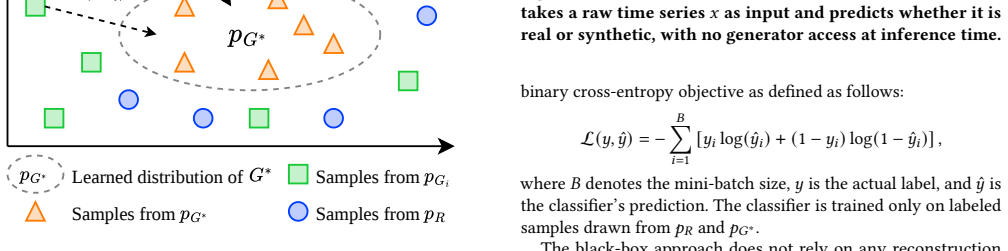
Reconstruction-based white-box detection succeeds in-distribution but collapses under generator shift for diffusion-generated time series because no analogous near-universal reconstruction prior exists, unlike in images. A black-box detector using an off-the-shelf classifier on the raw signal instead reaches an average F1 of 79.2, a 22.1 percent relative improvement, and a TPR at 1 percent FPR of 57.2, establishing that the problem requires distinct approaches.
What carries the argument
The black-box detector, an off-the-shelf classifier applied directly to raw time series signals, which operates without access to the generator.
If this is right
- Black-box classification offers a practical route for detection when the diffusion generator is unknown or proprietary.
- Reconstruction priors that succeed for images do not transfer directly to time series data.
- Detection performance remains measurable even at low false-positive rates, with TPR reaching 57.2 at 1 percent FPR.
- The gap between white-box and black-box methods points to the need for modality-specific detector designs.
Where Pith is reading between the lines
- Similar black-box advantages may appear in other data modalities that lack strong generic reconstruction priors.
- Practical systems could combine black-box detectors with minimal assumptions about the generative process.
- The observed robustness under shift suggests testing the same classifier on non-diffusion generative models for time series.
Load-bearing premise
The claim that reconstruction-based detection fails specifically because time series lack a near-universal generator prior, rather than due to other experimental choices such as datasets or shift severity.
What would settle it
A controlled test in which a reconstruction detector achieves high accuracy under generator shift when provided with a sufficiently general time series generator would falsify the central explanation for the performance gap.
Figures



read the original abstract
The boundary between real and diffusion-generated time series is becoming increasingly difficult to draw, yet detection in this domain remains underexplored, especially when the generator is unknown. We compare white-box detection, which requires access to the generator, against black-box detection, which operates on the raw signal alone. The white-box approach, a reconstruction-based detector adapted from the image domain, works well in in-distribution but breaks down under generator shift: reconstruction-based detection in images succeeds because large generic generators provide a near-universal reconstruction prior, and no analogous generator exists for time series. In contrast, a simple off-the-shelf classifier used as a black-box detector performs remarkably well, achieving an average F1 of 79.2, a 22.1% relative improvement over the white-box approach, and a TPR@1%FPR of 57.2. Diffusion-generated time series detection is therefore not a direct transfer of the image domain problem. This work provides the first systematic exploration of white-box and black-box detection for diffusion-generated time series. We close by identifying several open and promising directions.
Editorial analysis
A structured set of objections, weighed in public.
Referee Report
Summary. The paper compares white-box (reconstruction-based, adapted from images) and black-box (off-the-shelf classifier) detection of diffusion-generated time series under generator shift. It reports that the white-box detector succeeds in-distribution but fails under shift because 'large generic generators provide a near-universal reconstruction prior' in images but 'no analogous generator exists for time series.' In contrast, the black-box approach achieves average F1 of 79.2 (22.1% relative improvement over white-box), TPR@1%FPR of 57.2, and concludes that time-series detection is therefore not a direct transfer of the image-domain problem. The work positions itself as the first systematic exploration and identifies open directions.
Significance. If the reported performance gap and its attribution hold after controls, the result would usefully demonstrate that generator-shift robustness in detection does not transfer directly from images to time series, supplying concrete metrics and motivating domain-specific methods. The empirical framing (rather than a parameter-free derivation) makes the strength conditional on the quality of the experimental design.
major comments (2)
- [Abstract] Abstract: the central explanatory claim—that reconstruction-based detection 'breaks down under generator shift' specifically because 'no analogous generator exists for time series'—is invoked to support the conclusion that detection 'is therefore not a direct transfer.' No ablations, controls, or comparisons are described that isolate this factor from alternatives such as the particular reconstruction architecture chosen, the magnitude of generator shift in the evaluated datasets, or time-series-specific data properties. This attribution is load-bearing for the non-transfer conclusion yet remains untested in the reported evidence.
- [Abstract] Abstract: the performance numbers (F1 79.2, 22.1% relative improvement, TPR@1%FPR 57.2) are presented without accompanying dataset details, number of runs, error bars, statistical tests, or description of the 'off-the-shelf classifier' and white-box baseline architectures. These omissions make it impossible to assess whether the reported gap is robust or sensitive to post-hoc choices.
minor comments (1)
- [Abstract] The abstract supplies concrete metrics but supplies no derivation, error bars, dataset details, or statistical tests.
Simulated Author's Rebuttal
We thank the referee for the constructive and detailed feedback. The comments highlight important aspects of experimental rigor and claim attribution that we address point-by-point below. We propose targeted revisions to clarify the manuscript.
read point-by-point responses
-
Referee: [Abstract] Abstract: the central explanatory claim—that reconstruction-based detection 'breaks down under generator shift' specifically because 'no analogous generator exists for time series'—is invoked to support the conclusion that detection 'is therefore not a direct transfer.' No ablations, controls, or comparisons are described that isolate this factor from alternatives such as the particular reconstruction architecture chosen, the magnitude of generator shift in the evaluated datasets, or time-series-specific data properties. This attribution is load-bearing for the non-transfer conclusion yet remains untested in the reported evidence.
Authors: We agree that the manuscript does not include ablations or controls that isolate the 'no analogous generator' explanation from confounding factors such as architecture choice or the specific magnitude of generator shift. The attribution draws from the performance gap observed in our experiments together with the documented existence of universal reconstruction priors in the image domain. We will revise the abstract to present this as a domain-motivated hypothesis rather than a definitively isolated causal factor, and we will add a dedicated discussion subsection enumerating alternative explanations and their plausibility given the current evidence. revision: yes
-
Referee: [Abstract] Abstract: the performance numbers (F1 79.2, 22.1% relative improvement, TPR@1%FPR 57.2) are presented without accompanying dataset details, number of runs, error bars, statistical tests, or description of the 'off-the-shelf classifier' and white-box baseline architectures. These omissions make it impossible to assess whether the reported gap is robust or sensitive to post-hoc choices.
Authors: The abstract is a concise summary; the full experimental protocol—including the exact datasets, the specific classifier and reconstruction architectures, number of runs, and evaluation protocol—is described in the Experiments and Implementation Details sections. We will add error bars, report the number of independent runs, and include basic statistical comparisons (e.g., paired t-tests where appropriate) to the results tables and figures. If the abstract length permits, we will also insert a brief parenthetical reference to the experimental section for the key metrics. revision: partial
Circularity Check
No circularity; empirical measurements only
full rationale
The paper reports measured performance numbers (average F1 of 79.2, 22.1% relative improvement, TPR@1%FPR of 57.2) from classifier experiments on time-series data. These are direct empirical outcomes, not quantities derived from equations or parameters that are then re-labeled as predictions. The interpretive claim about absence of a 'near-universal reconstruction prior' for time series is presented as background motivation rather than a load-bearing derivation; it does not reduce any reported result to a fitted input or self-citation chain. No equations, fitted parameters, or self-citation steps are invoked in the provided text to support the central empirical comparison.
Axiom & Free-Parameter Ledger
Reference graph
Works this paper leans on
-
[1]
Juan Miguel Lopez Alcaraz and Nils Strodthoff. 2023. Diffusion-based Time Series Imputation and Forecasting with Structured State Space Models.Trans. Mach. Learn. Res.2023 (2023)
2023
-
[2]
Chronos-2: From Univariate to Universal Forecasting
Abdul Fatir Ansari, Oleksandr Shchur, Jaris Küken, Andreas Auer, Boran Han, Pedro Mercado, Syama Sundar Rangapuram, Huibin Shen, Lorenzo Stella, Xiyuan Zhang, Mononito Goswami, Shubham Kapoor, Danielle C. Maddix, Pablo Guerron, Tony Hu, Junming Yin, Nick Erickson, Prateek Mutalik Desai, Hao Wang, Huzefa Rangwala, George Karypis, Yuyang Wang, and Michael B...
work page internal anchor Pith review Pith/arXiv arXiv 2025
-
[3]
Abhimanyu Das, Weihao Kong, Rajat Sen, and Yichen Zhou. 2024. A decoder-only foundation model for time-series forecasting. InICML. PMLR / OpenReview.net, Vienna, Austria, 10148–10167
2024
-
[4]
Schmidt, Jonathan Weber, Geoffrey I
Hassan Ismail Fawaz, Benjamin Lucas, Germain Forestier, Charlotte Pelletier, Daniel F. Schmidt, Jonathan Weber, Geoffrey I. Webb, Lhassane Idoumghar, Pierre- Alain Muller, and François Petitjean. 2020. InceptionTime: Finding AlexNet for time series classification.Data Min. Knowl. Discov.34, 6 (2020), 1936–1962
2020
-
[5]
Seyed Navid Mohammadi Foumani, Chang Wei Tan, and Mahsa Salehi. 2021. Disjoint-CNN for Multivariate Time Series Classification. InICDM (Workshops). IEEE, Auckland, New Zealand, 760–769
2021
-
[6]
Mononito Goswami, Konrad Szafer, Arjun Choudhry, Yifu Cai, Shuo Li, and Artur Dubrawski. 2024. MOMENT: A Family of Open Time-series Foundation Models. InICML. PMLR / OpenReview.net, Vienna, Austria, 16115–16152
2024
- [7]
-
[8]
Jonathan Ho, Ajay Jain, and Pieter Abbeel. 2020. Denoising Diffusion Probabilistic Models. InNeurIPS, Vol. 33. Curran Associates, Inc., Virtual Event, 6840–6851
2020
-
[9]
Junji Hou, Junzhou Zhao, Shuo Zhang, and Pinghui Wang. 2026. A Theoretical Analysis of Detecting Large Model-Generated Time Series. InAAAI. AAAI Press, Singapore, 21788–21796
2026
-
[10]
Christian Internò, Robert Geirhos, Markus Olhofer, Sunny Liu, Barbara Hammer, and David A. Klindt. 2025. AI-Generated Video Detection via Perceptual Straight- ening. InNeurIPS, Vol. 38. Curran Associates, Inc., San Diego, USA, 20672–20705
2025
-
[11]
Ali Ismail-Fawaz, Maxime Devanne, Stefano Berretti, Jonathan Weber, and Ger- main Forestier. 2023. LITE: Light Inception with boosTing tEchniques for Time Series Classification. InDSAA. IEEE, Thessaloniki, Greece, 1–10
2023
-
[12]
Paul Jeha, Michael Bohlke-Schneider, Pedro Mercado, Shubham Kapoor, Rajbir- Singh Nirwan, Valentin Flunkert, Jan Gasthaus, and Tim Januschowski. 2022. PSA-GAN: Progressive Self Attention GANs for Synthetic Time Series. InICLR. OpenReview.net, Virtual Event
2022
-
[13]
Marcel Kollovieh, Abdul Fatir Ansari, Michael Bohlke-Schneider, Jasper Zschieg- ner, Hao Wang, and Yuyang Wang. 2023. Predict, Refine, Synthesize: Self-Guiding Diffusion Models for Probabilistic Time Series Forecasting. InNeurIPS, Vol. 36. Curran Associates, Inc., New Orleans, USA, 28341–28364
2023
-
[14]
Zhifeng Kong, Wei Ping, Jiaji Huang, Kexin Zhao, and Bryan Catanzaro. 2021. DiffWave: A Versatile Diffusion Model for Audio Synthesis. InICLR. OpenRe- view.net, Virtual Event
2021
-
[15]
Hui Li, Yunpeng Cui, Shuo Wang, Juan Liu, Jinyuan Qin, and Yilin Yang. 2020. Multivariate Financial Time-Series Prediction With Certified Robustness.IEEE Access8 (2020), 109133–109143
2020
-
[16]
Liu Sheng, Kensaku Kawamoto, and Samir E
Mohammad Amin Morid, Olivia R. Liu Sheng, Kensaku Kawamoto, and Samir E. Abdelrahman. 2020. Learning hidden patterns from patient multivariate time series data using convolutional neural networks: A case study of healthcare cost prediction.J. Biomed. Informatics111 (2020), 103565
2020
- [17]
-
[18]
Utkarsh Ojha, Yuheng Li, and Yong Jae Lee. 2023. Towards Universal Fake Image Detectors that Generalize Across Generative Models. InCVPR. IEEE, Vancouver, Canada, 24480–24489
2023
-
[19]
Jonas Ricker, Denis Lukovnikov, and Asja Fischer. 2024. AEROBLADE: Training- Free Detection of Latent Diffusion Images Using Autoencoder Reconstruction Error. InCVPR. IEEE, Seattle, USA, 9130–9140
2024
-
[20]
Robin Rombach, Andreas Blattmann, Dominik Lorenz, Patrick Esser, and Björn Ommer. 2022. High-Resolution Image Synthesis with Latent Diffusion Models. InCVPR. IEEE, New Orleans, USA, 10674–10685
2022
-
[21]
Aditya Shankar, Lydia Yiyu Chen, Arie van Deursen, and Rihan Hai. 2025. WaveStitch: Flexible and Fast Conditional Time Series Generation With Dif- fusion Models.Proc. ACM Manag. Data3, 6 (2025), 1–25
2025
-
[22]
Galjaard, Huijuan Wang, and Lydia Y
Zhi Wen Soi, Chaoyi Zhu, Fouad Abiad, Aditya Shankar, Jeroen M. Galjaard, Huijuan Wang, and Lydia Y. Chen. 2025. TimeWak: Temporal Chained-Hashing Watermark for Time Series Data. InNeurIPS, Vol. 38. Curran Associates, Inc., San Diego, USA, 137917–137958
2025
-
[23]
Jiaming Song, Chenlin Meng, and Stefano Ermon. 2021. Denoising Diffusion Implicit Models. InICLR. OpenReview.net, Virtual Event
2021
- [24]
-
[25]
Sheng-Yu Wang, Oliver Wang, Richard Zhang, Andrew Owens, and Alexei A. Efros. 2020. CNN-Generated Images Are Surprisingly Easy to Spot... for Now. In CVPR. Computer Vision Foundation / IEEE, Seattle, USA, 8692–8701
2020
-
[26]
Zhendong Wang, Jianmin Bao, Wengang Zhou, Weilun Wang, Hezhen Hu, Hong Chen, and Houqiang Li. 2023. DIRE for Diffusion-Generated Image Detection. In ICCV. IEEE, Paris, France, 22388–22398
2023
-
[27]
Zhiguang Wang, Weizhong Yan, and Tim Oates. 2017. Time series classification from scratch with deep neural networks: A strong baseline. InIJCNN. IEEE, Anchorage, USA, 1578–1585
2017
-
[28]
Shilin Yan, Ouxiang Li, Jiayin Cai, Yanbin Hao, Xiaolong Jiang, Yao Hu, and Weidi Xie. 2025. A Sanity Check for AI-generated Image Detection. InICLR. OpenReview.net, Singapore
2025
-
[29]
Jinsung Yoon, Daniel Jarrett, and Mihaela van der Schaar. 2019. Time-series Generative Adversarial Networks. InNeurIPS, Vol. 32. Curran Associates, Inc., Vancouver, Canada, 5509–5519
2019
-
[30]
Xinyu Yuan and Yan Qiao. 2024. Diffusion-TS: Interpretable Diffusion for General Time Series Generation. InICLR. OpenReview.net, Vienna, Austria
2024
-
[31]
Bendong Zhao, Huanzhang Lu, Shangfeng Chen, Junliang Liu, and Dongya Wu
-
[32]
Convolutional neural networks for time series classification.J. Syst. Eng. Electron.28, 1 (2017), 162–169. Conference acronym ’XX, June 03–05, 2018, Woodstock, NY Soi et al. Table 3: All metrics are higher the better, with TPR measured at a 1% FPR. Values in gray are ID, while values in black are OOD. The best average OOD scores are highlighted in green ....
2017
discussion (0)
Sign in with ORCID, Apple, or X to comment. Anyone can read and Pith papers without signing in.