You Live More Than Once: Towards Hierarchical Skill Meta-Evolving
Pith reviewed 2026-06-29 12:04 UTC · model grok-4.3
The pith
Hierarchical meta-evolving of skills and their evolution strategy produces higher-quality skill libraries for agents than evolving skills alone.
A machine-rendered reading of the paper's core claim, the machinery that carries it, and where it could break.
Core claim
The central discovery is that meta-evolving, by learning meta-skills from agents' task execution traces, jointly optimizes skills and the skill evolving strategy, resulting in a higher-quality skill library than pure skill evolving and diverse meta-skills tailored to different scenarios, thereby enabling continual experience learning in agentic systems.
What carries the argument
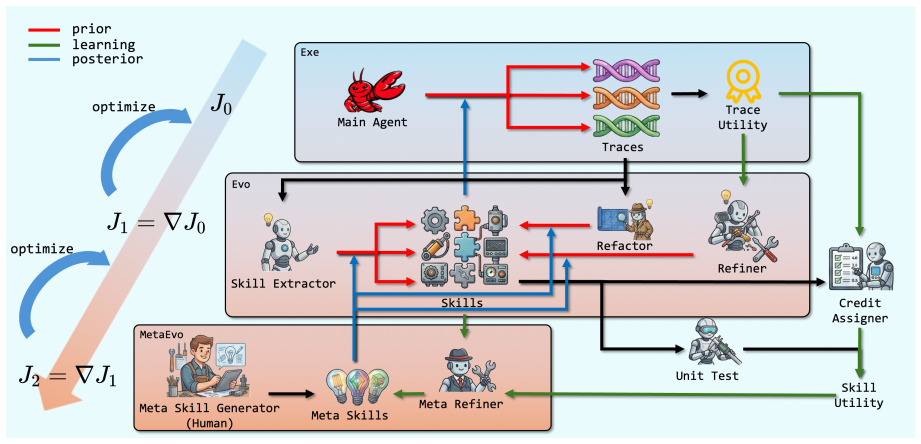
HiSME, the hierarchical skill meta-evolving method that learns meta-skills from task execution traces to optimize both the skill library and the evolving strategy.
If this is right
- Produces higher-quality skill libraries compared to standard skill evolving.
- Derives diverse meta-skills adapted to different downstream scenarios.
- Facilitates future continual experience learning in deployed agent systems.
- Provides lightweight algorithmic adaptation without expensive parameter updates to LLMs.
Where Pith is reading between the lines
- Agents could potentially maintain and improve performance over long periods in changing environments by repeatedly applying meta-evolving.
- This approach might reduce reliance on large-scale retraining for new tasks in AI systems.
- Meta-skills could serve as reusable components across multiple agent deployments.
Load-bearing premise
That learning meta-skills from agents' task execution traces enables effective and lightweight refinement of the skill evolving strategy across scenarios.
What would settle it
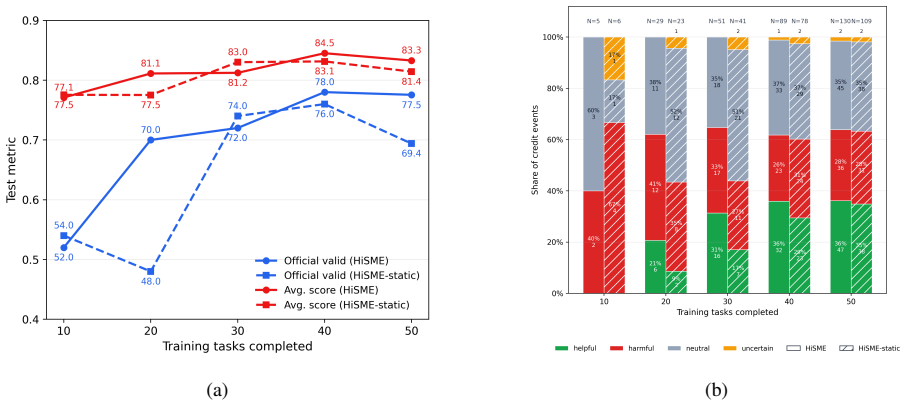
An experiment on the same agentic benchmarks where the HiSME method does not produce a higher-quality skill library or more effective meta-skills than pure skill evolving methods.
Figures
read the original abstract
Test-time skill evolving is regarded as a new paradigm for enhancing deployed agentic systems. Existing works mainly focus on hard-coded skill evolving strategies or parametric learning that rely on expensive parameter updates in the underlying LLMs. In this paper, we demonstrate that test-time refinement of the skill evolving framework itself is necessary for continuous improvement of the agent systems in different downstream scenarios, and lightweight algorithmic adaptation is feasible. Specifically, we propose HiSME, a lightweight hierarchical skill meta-evolving solution that jointly optimizes skills and the skill evolving strategy by learning meta-skills from agents' task execution traces. Experiments on diverse agentic benchmarks show that meta-evolving can produce a higher-quality skill library than pure skill evolving and can derive diverse meta-skills for different scenarios, thereby facilitating future continual experience learning. Our code is temporarily public at https://anonymous.4open.science/r/HiSME-BD45.
Editorial analysis
A structured set of objections, weighed in public.
Referee Report
Summary. The manuscript introduces HiSME, a lightweight hierarchical skill meta-evolving framework for agentic systems. It argues that test-time refinement of the skill evolving strategy itself (via meta-skills learned from execution traces) is both necessary for continual improvement across downstream scenarios and feasible without expensive LLM parameter updates. The central empirical claim is that this joint optimization of skills and evolving strategy yields higher-quality skill libraries than pure skill evolving, while also producing diverse meta-skills tailored to different scenarios.
Significance. If the experimental results hold with proper controls, the work would offer a practical route to adaptive agent systems that improve via algorithmic meta-evolution rather than model retraining. The temporary public release of code is a positive step toward reproducibility.
major comments (2)
- [Abstract] Abstract: the central claim that 'meta-evolving can produce a higher-quality skill library than pure skill evolving' is unsupported by any reported metrics, baselines, benchmark names, or quantitative results; without these the empirical contribution cannot be evaluated.
- [Abstract] Abstract (and implied experimental section): no details are given on how meta-skills are extracted from traces, what the hierarchical structure consists of, or any ablation isolating the contribution of meta-evolving versus skill evolving alone; these omissions are load-bearing for the necessity and feasibility arguments.
minor comments (1)
- The abstract states that code is 'temporarily public' at an anonymous link; a permanent repository or DOI should be provided in the final version.
Simulated Author's Rebuttal
We thank the referee for the constructive feedback. We agree the abstract is too concise and will expand it with quantitative results, benchmark names, and brief method details. The full manuscript already contains the requested experimental information in Sections 3 and 4; we will also improve cross-references from the abstract.
read point-by-point responses
-
Referee: [Abstract] Abstract: the central claim that 'meta-evolving can produce a higher-quality skill library than pure skill evolving' is unsupported by any reported metrics, baselines, benchmark names, or quantitative results; without these the empirical contribution cannot be evaluated.
Authors: The abstract summarizes the outcome at a high level. The full paper reports concrete results in Section 4 on multiple agentic benchmarks (WebArena, ToolBench, ALFWorld), comparing against pure skill-evolving baselines and showing consistent gains in task success rate and skill-library quality metrics. We will revise the abstract to include benchmark names, key quantitative improvements, and baseline references so the central claim is self-contained. revision: yes
-
Referee: [Abstract] Abstract (and implied experimental section): no details are given on how meta-skills are extracted from traces, what the hierarchical structure consists of, or any ablation isolating the contribution of meta-evolving versus skill evolving alone; these omissions are load-bearing for the necessity and feasibility arguments.
Authors: Section 3.1 defines the two-level hierarchy (base skills + meta-skills that control the evolving strategy). Section 3.2 explains meta-skill extraction via trace clustering and pattern identification from execution logs. Section 4.3–4.4 presents ablations that isolate the meta-evolving component. We acknowledge these elements are absent from the abstract and will add a concise description of the extraction process and hierarchy plus a reference to the ablations. If the experimental section needs expanded clarity on the ablations, we will strengthen the text. revision: partial
Circularity Check
No significant circularity identified
full rationale
The paper proposes HiSME as a hierarchical meta-evolving method for agent skills, with central claims resting on empirical comparisons of skill libraries produced by meta-evolving versus pure skill evolving across benchmarks. No equations, derivations, fitted parameters renamed as predictions, or load-bearing self-citations appear in the provided text. The argument structure is a standard proposal-plus-experiment format that does not reduce any result to its own inputs by construction; the derivation chain is therefore self-contained against external benchmarks.
Axiom & Free-Parameter Ledger
Reference graph
Works this paper leans on
-
[1]
SkillsVote: Lifecycle Governance of Agent Skills from Collection, Recommendation to Evolution
Xskill: Continual learning from experience and skills in multimodal agents. Hongyi Liu, Haoyan Yang, Tao Jiang, Bo Tang, Feiyu Xiong, and Zhiyu Li. 2026a. Skillsvote: Lifecycle governance of agent skills from collection, recom- mendation to evolution.Preprint, arXiv:2605.18401. Xingyan Liu, Xiyue Luo, Linyu Li, Gang Huang, Jian- feng Liu, and Hongli Qiao....
work page internal anchor Pith review Pith/arXiv arXiv 2026
-
[2]
Dynamic Dual-Granularity Skill Bank for Agentic RL
Reflexion: language agents with verbal re- inforcement learning. Songjun Tu, Chengdong Xu, Qichao Zhang, Yaocheng Zhang, Xiangyuan Lan, Linjing Li, and Dongbin Zhao. 2026. Dynamic dual-granularity skill bank for agentic rl.Preprint, arXiv:2603.28716. Chenxi Wang, Zhuoyun Yu, Xinghong Xie, Wuguan- nan Yao, Runnan Fang, Shuofei Qiao, Kexin Cao, Guozhou Zhen...
work page internal anchor Pith review Pith/arXiv arXiv 2026
-
[3]
Large Language Models as Optimizers
Large language models as optimizers.ArXiv, abs/2309.03409. Min Yang, Jing Piao, Xuanye Xia, Xiaochong Lan, Jiajun Chen, Yongshun Gong, and Yong Li. 2026. Skillmaster: Toward autonomous skill mastery in llm agents. Shunyu Yao, Jeffrey Zhao, Dian Yu, Nan Du, Izhak Shafran, Karthik Narasimhan, and Yuan Cao. 2022. React: Synergizing reasoning and acting in la...
work page internal anchor Pith review Pith/arXiv arXiv 2026
discussion (0)
Sign in with ORCID, Apple, or X to comment. Anyone can read and Pith papers without signing in.