A Method for Imaging Interplanetary Magnetic Field Strength and Orientation
Pith reviewed 2026-06-29 09:10 UTC · model grok-4.3
The pith
Spectral-line polarization from ground-state alignment and the Hanle effect enables remote imaging of interplanetary magnetic field strength and orientation.
A machine-rendered reading of the paper's core claim, the machinery that carries it, and where it could break.
Core claim
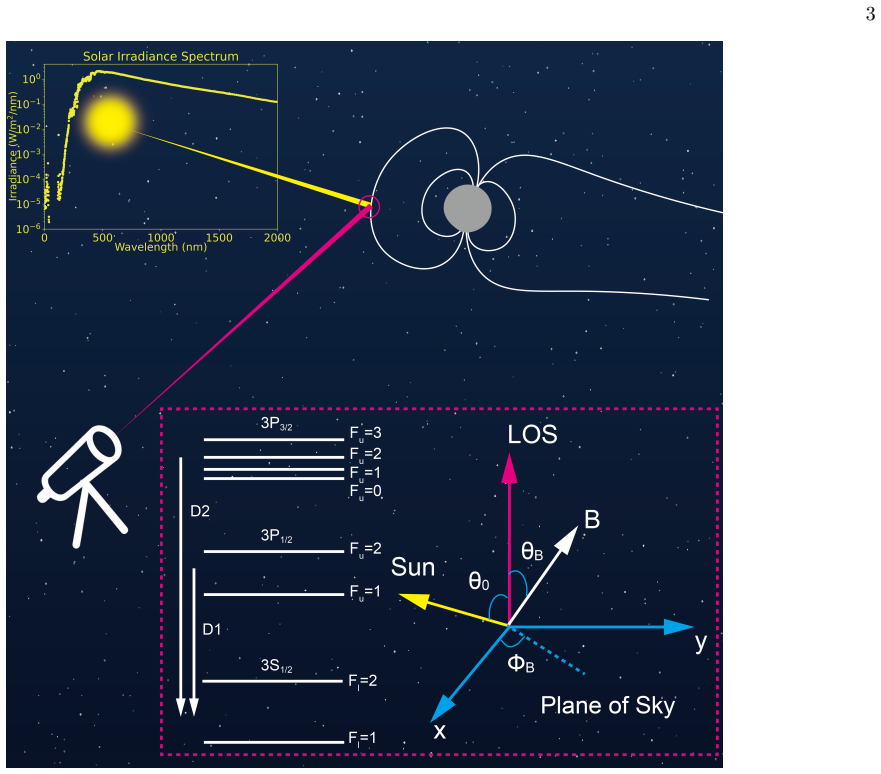
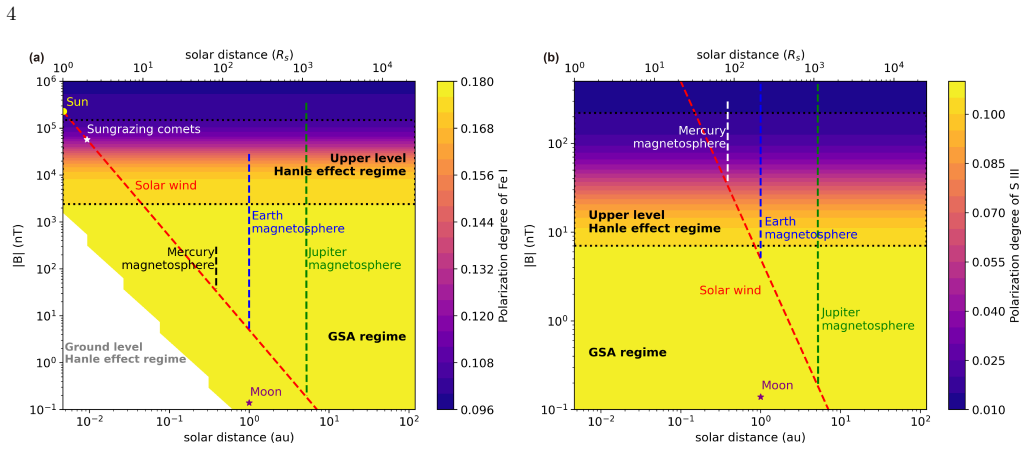
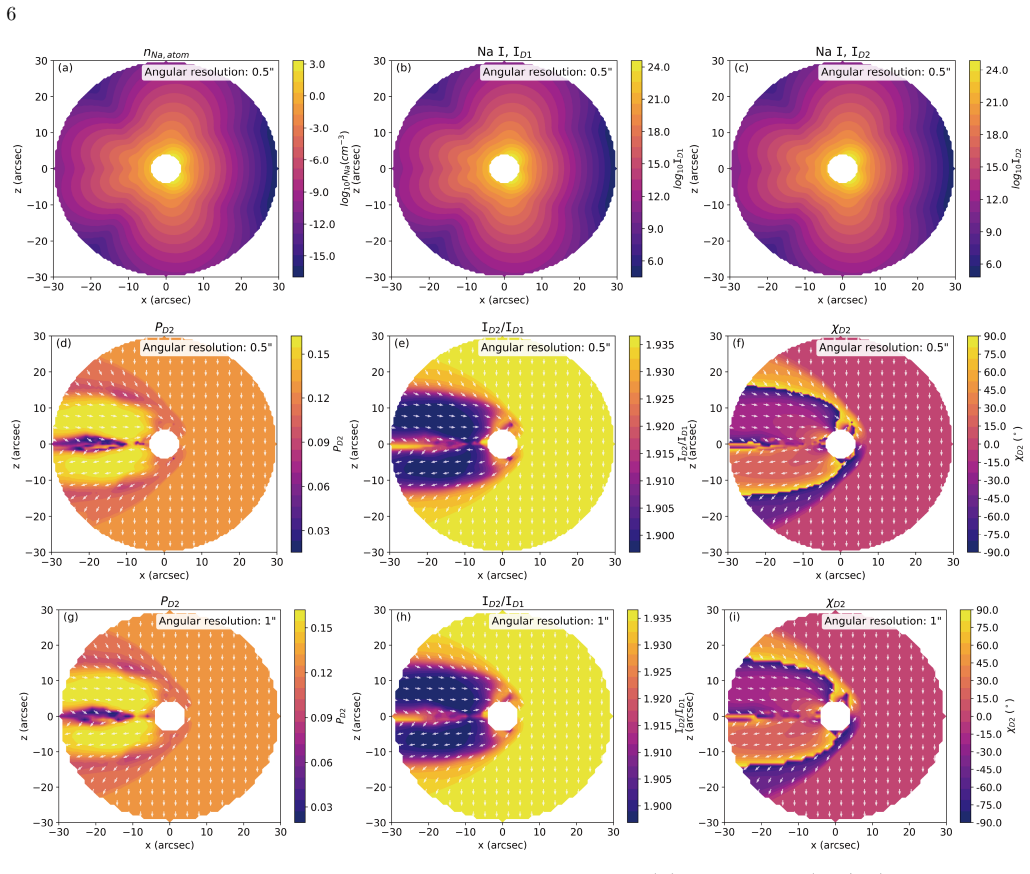
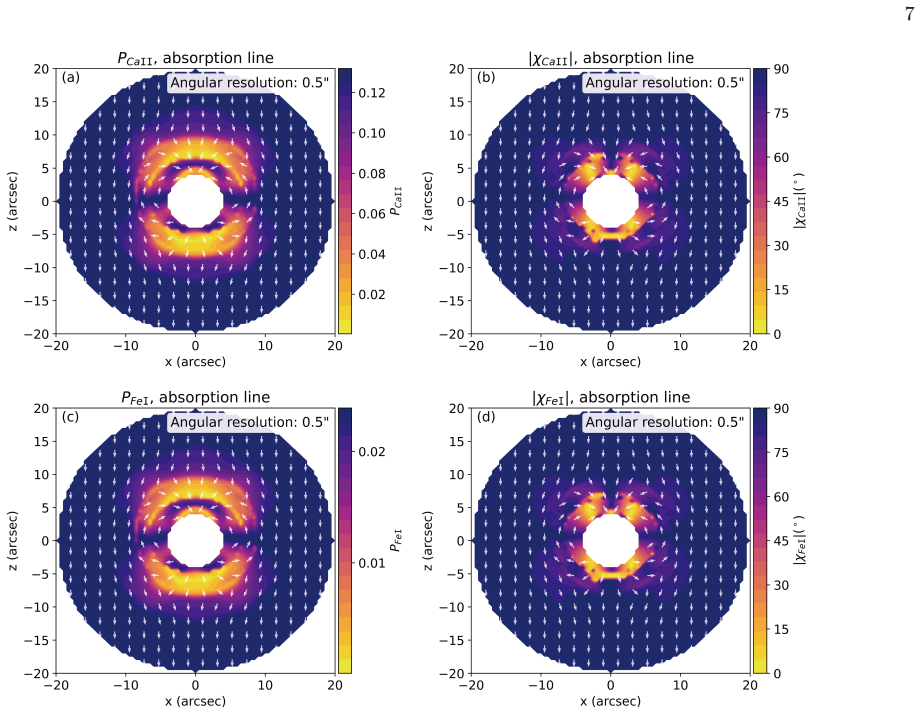
The paper presents a remote-sensing method to constrain weak magnetic field strength and orientation using spectral-line polarization induced by ground-state alignment (GSA) and Hanle effect, with collisional effects taken into account. This method is sensitive to weak magnetic fields in environments ranging from the high solar atmosphere and solar wind to the outer heliosphere, and identifies suitable spectral lines for different targets. Forward modeling of Mercury's magnetosphere demonstrates the feasibility of this imaging method.
What carries the argument
spectral-line polarization induced by ground-state alignment and the Hanle effect with collisional effects included
If this is right
- Enables global remote imaging of heliospheric magnetic structures beyond in-situ sampling.
- Extends beyond the limitations of Faraday rotation which requires specific radio source distributions.
- Diagnoses fields too weak for the Zeeman effect to be useful.
- Provides identified spectral lines for application in solar atmosphere, solar wind and outer heliosphere.
- Forward modeling confirms practicality for imaging features like planetary magnetospheres.
Where Pith is reading between the lines
- Ground-based telescopes could potentially monitor large-scale magnetic field changes continuously.
- The method might be combined with spacecraft data to create three-dimensional maps of magnetic field evolution over time.
- Similar polarization signals could be sought in other environments with weak magnetic fields, such as stellar atmospheres.
Load-bearing premise
Polarization signals induced by ground-state alignment and the Hanle effect in the identified spectral lines must remain detectable above noise and competing effects at the densities and collision rates present in the solar wind and outer heliosphere.
What would settle it
Simultaneous observations of the proposed spectral lines and direct spacecraft measurements of magnetic fields in the solar wind that show no matching polarization signal would falsify the method.
Figures
read the original abstract
Measurements of interplanetary magnetic fields have long relied on spacecraft measurements, which provide only in-situ sampling and therefore cannot capture the global magnetic structure. Faraday rotation of radio signals extends in-situ measurements to line-of-sight measurements, but it still depends on the number and spatial distribution of available radio sources. The Zeeman effect offers another route to remote sensing of magnetic fields, but it is generally too weak to diagnose the weak interplanetary magnetic fields. Here, we present a remote-sensing method to constrain weak magnetic field strength and orientation using spectral-line polarization induced by ground-state alignment (GSA) and Hanle effect, with collisional effects taken into account. This method is sensitive to weak magnetic fields in environments ranging from the high solar atmosphere and solar wind to the outer heliosphere, and we identify suitable spectral lines for different targets. We further perform forward modeling of Mercury's magnetosphere to demonstrate the feasibility of this imaging method. Spectral-polarization imaging therefore provides a new way toward remote imaging of dynamic heliospheric magnetic structures.
Editorial analysis
A structured set of objections, weighed in public.
Referee Report
Summary. The manuscript proposes a remote-sensing technique for constraining the strength and orientation of weak interplanetary magnetic fields via spectral-line polarization arising from ground-state alignment (GSA) combined with the Hanle effect, with collisional depolarization included. Suitable lines are identified for targets ranging from the solar atmosphere to the outer heliosphere, and forward modeling of Mercury’s magnetosphere is used to illustrate the method’s feasibility for imaging dynamic heliospheric structures.
Significance. If the induced polarization signals remain detectable above noise and competing effects at solar-wind densities, the approach would supply a genuinely new remote-imaging capability that complements in-situ sampling and Faraday-rotation measurements. The explicit inclusion of collisions and the identification of target lines are constructive elements; however, the absence of quantitative signal-strength calculations leaves the practical utility unverified.
major comments (2)
- [Abstract / forward-modeling section] Abstract and main text: no Stokes-parameter amplitudes, optical-depth estimates, or signal-to-noise calculations are supplied for the solar-wind density range (∼1–10 cm⁻³) and corresponding collision rates. Without these numbers the central feasibility claim cannot be evaluated.
- [Forward-modeling section] The forward-modeling demonstration for Mercury’s magnetosphere is described, yet the manuscript provides neither the computed fractional polarization values nor a comparison against expected instrumental noise or competing polarization sources at the relevant densities.
Simulated Author's Rebuttal
We thank the referee for the constructive comments, which highlight the need for quantitative support of the feasibility claims. We agree that explicit signal-strength calculations are required to evaluate the method and will add them in revision.
read point-by-point responses
-
Referee: [Abstract / forward-modeling section] Abstract and main text: no Stokes-parameter amplitudes, optical-depth estimates, or signal-to-noise calculations are supplied for the solar-wind density range (∼1–10 cm⁻³) and corresponding collision rates. Without these numbers the central feasibility claim cannot be evaluated.
Authors: We acknowledge the omission. The manuscript emphasized the physical basis, line selection, and inclusion of collisions but did not report numerical Stokes amplitudes or SNR estimates at solar-wind densities. In the revised version we will compute and present the expected fractional polarization (Stokes Q/I, U/I) for densities 1–10 cm⁻³, together with optical-depth estimates and SNR values based on representative instrument sensitivities and integration times. These results will be inserted into the abstract and the relevant sections of the main text. revision: yes
-
Referee: [Forward-modeling section] The forward-modeling demonstration for Mercury’s magnetosphere is described, yet the manuscript provides neither the computed fractional polarization values nor a comparison against expected instrumental noise or competing polarization sources at the relevant densities.
Authors: We agree that the forward-modeling section requires quantitative output. We will extract the fractional polarization values produced by the Mercury magnetosphere simulations and add direct comparisons to expected instrumental noise floors as well as to competing polarization contributions (e.g., resonant scattering, collisional depolarization residuals) at the densities encountered in the model. These additions will be placed in the forward-modeling section and referenced in the abstract. revision: yes
Circularity Check
No circularity; proposal grounded in external atomic physics and forward modeling
full rationale
The manuscript proposes a remote-sensing technique based on GSA/Hanle polarization (with collisions) and demonstrates feasibility via forward modeling of Mercury's magnetosphere plus identification of suitable lines. No equations, fitted parameters, or predictions appear that reduce by construction to the inputs; no self-citation chains or uniqueness theorems are invoked to force the result. The derivation chain is therefore self-contained against external benchmarks of atomic physics and radiative transfer.
Axiom & Free-Parameter Ledger
axioms (1)
- domain assumption Ground-state alignment and Hanle effect produce measurable polarization signals in selected spectral lines even after collisional depolarization in the solar wind and heliosphere.
Reference graph
Works this paper leans on
-
[1]
L., Leblanc, F., Casini, R., et al
Ariste, A. L., Leblanc, F., Casini, R., et al. 2012, Icarus, 220, 1104
2012
-
[2]
2002, Astronomy & Astrophysics, 385, 701
Berdyugina, S., & Solanki, S. 2002, Astronomy & Astrophysics, 385, 701
2002
-
[3]
A., & Killen, R
Bida, T. A., & Killen, R. M. 2017, Icarus, 289, 227
2017
-
[4]
2025, Solar Physics, 300, 49
Chen, J., Su, J., Xie, W., et al. 2025, Solar Physics, 300, 49
2025
-
[5]
Chen, Y. 2024, Transport and distribution of sodium ions in Mercury’s magnetosphere: results from multi-fluid MHD simulations, Zenodo, doi: 10.5281/zenodo.10882126
-
[6]
2024, Geophysical Research Letters, 51, e2024GL110301
Chen, Y., Dong, C., & Sun, W. 2024, Geophysical Research Letters, 51, e2024GL110301
2024
-
[7]
2024, ApJ, 972, 154, doi: 10.3847/1538-4357/ad6307
Chen, Y., Ye, S., Yao, Z., & Zhang, B. 2024, ApJ, 972, 154, doi: 10.3847/1538-4357/ad6307
-
[8]
2023, The Astrophysical Journal, 957, 26
Chen, Y.-W., Shue, J.-H., Zhong, J., & Shen, H.-W. 2023, The Astrophysical Journal, 957, 26
2023
-
[9]
2016, Journal of Geophysical Research: Space Physics, 121, 2264
Clark, G., Mauk, B., Paranicas, C., Kollmann, P., & Smith, H. 2016, Journal of Geophysical Research: Space Physics, 121, 2264
2016
-
[10]
Dakeyo, J.-B., Maksimovic, M., D´ emoulin, P., Halekas, J., & Stevens, M. L. 2022, The Astrophysical Journal, 940, 130 del Pino Alem´ an, T., Casini, R., & Manso Sainz, R. 2016, The Astrophysical Journal Letters, 830, L24 D’Amicis, R., Perrone, D., Bruno, R., & Velli, M. 2021, On Alfv´ enic slow wind: a journey from the Earth back to the
2022
-
[11]
2025, Astronomy & Astrophysics, 693, A243
Sun, Wiley Online Library D’amicis, R., Velli, M., Panasenco, O., et al. 2025, Astronomy & Astrophysics, 693, A243
2025
-
[12]
S., & Heyner, D
Exner, W., Griton, L. S., & Heyner, D. 2024, Journal of Geophysical Research: Space Physics, 129, e2023JA032248
2024
-
[13]
2021, Reviews of Geophysics and Planetary Physics, 52, 361
Fei, H., Zhonghua, Y., & Yong, W. 2021, Reviews of Geophysics and Planetary Physics, 52, 361
2021
-
[14]
Fraternale, F., Pogorelov, N. V., Bera, R. K., et al. 2026, ApJ, accepted, 218, 50, doi: 10.48550/arXiv.2602.10446
-
[15]
Fraternale, F., Adhikari, L., Fichtner, H., et al. 2022, Space Sci. Rev., 218, 50, doi: 10.1007/s11214-022-00914-2
-
[16]
2007, The Astrophysical Journal Letters, 661, L93
Fulle, M., Leblanc, F., Harrison, R., et al. 2007, The Astrophysical Journal Letters, 661, L93
2007
-
[17]
E., Wooden, D
Harker, D. E., Wooden, D. H., Kelley, M. S., & Woodward, C. E. 2023, The Planetary Science Journal, 4, 242
2023
-
[18]
2015, The Astrophysical Journal Letters, 800, L31
He, J., Wang, L., Tu, C., Marsch, E., & Zong, Q. 2015, The Astrophysical Journal Letters, 800, L31
2015
-
[19]
P., He, J., & R´ eville, V
Hou, C., Gannouni, B., Rouillard, A. P., He, J., & R´ eville, V. 2025, Astronomy & Astrophysics, 697, A67
2025
-
[20]
2021, Earth and Planetary Physics, 5, 232
Hou, C., He, J., Zhang, L., Wang, Y., & Duan, D. 2021, Earth and Planetary Physics, 5, 232
2021
-
[21]
P., He, J., et al
Hou, C., Rouillard, A. P., He, J., et al. 2024, The Astrophysical Journal Letters, 968, L28
2024
-
[22]
2014, The Astrophysical Journal, 788, 117 15
Imamura, T., Tokumaru, M., Isobe, H., et al. 2014, The Astrophysical Journal, 788, 117 15
2014
-
[23]
E., Ascione, M
Kooi, J. E., Ascione, M. L., Reyes-Rosa, L. V., Rier, S. K., & Ashas, M. 2021, Solar Physics, 296, 11
2021
-
[24]
E., Wexler, D
Kooi, J. E., Wexler, D. B., Jensen, E. A., et al. 2022, Frontiers in Astronomy and Space Sciences, 9, 841866
2022
-
[25]
2012, The Astrophysical Journal, 744, 100 Landi Degl’Innocenti, E., & Landolfi, M
Landi, E., Alexander, R., Gruesbeck, J., et al. 2012, The Astrophysical Journal, 744, 100 Landi Degl’Innocenti, E., & Landolfi, M. 2004, Astrophysics and space science library, 307
2012
-
[26]
2022, Space Science Reviews, 218, 2
Leblanc, F., Schmidt, C., Mangano, V., et al. 2022, Space Science Reviews, 218, 2
2022
-
[27]
2020, The Astrophysical Journal Letters, 898, L43
Li, H., Jiang, W., Wang, C., et al. 2020, The Astrophysical Journal Letters, 898, L43
2020
-
[28]
2024, The Astrophysical Journal, 974, 154
Li, H., del Pino Alem´ an, T., Trujillo Bueno, J., et al. 2024, The Astrophysical Journal, 974, 154
2024
-
[29]
2025, The Astrophysical Journal, 993, 126
Liu, X., Hou, Y., Li, Y., et al. 2025, The Astrophysical Journal, 993, 126
2025
-
[30]
M., Cim` o, G., et al
Ma, M., Calv´ es, G. M., Cim` o, G., et al. 2022, The Astrophysical Journal Letters, 940, L32
2022
-
[31]
2017, Journal of Geophysical Research: Space Physics, 122, 1763
McComas, D., Allegrini, F., Bagenal, F., et al. 2017, Journal of Geophysical Research: Space Physics, 122, 1763
2017
-
[32]
1986, Nature, 323, 694
McGrath, M., Johnson, R., & Lanzerotti, L. 1986, Nature, 323, 694
1986
-
[33]
2023, Space Weather, 21, e2022SW003396
Chhetri, R. 2023, Space Weather, 21, e2022SW003396
2023
-
[34]
2007, The Astrophysical Journal, 667, 1262 P¨ atzold, M., H¨ ausler, B., Tyler, G
Neugebauer, M., Gloeckler, G., Gosling, J., et al. 2007, The Astrophysical Journal, 667, 1262 P¨ atzold, M., H¨ ausler, B., Tyler, G. L., et al. 2016, Planetary and Space Science, 127, 44
2007
-
[35]
1990, Astronomy and Astrophysics (ISSN 0004-6361), vol
Pequignot, D. 1990, Astronomy and Astrophysics (ISSN 0004-6361), vol. 231, no. 2, May 1990, p. 499-508., 231, 499
1990
-
[36]
Preston, G. W. 1967, Astrophysical Journal, vol. 147, p. 718-742 (1967)., 147, 718
1967
-
[37]
1999, Astronomy and Astrophysics, v
Raouafi, N.-E., Lemaire, P., & Sahal-Br´ echot, S. 1999, Astronomy and Astrophysics, v. 345, p. 999-1005 (1999), 345, 999
1999
-
[38]
M., et al
Raymond, J., Downs, C., Knight, M. M., et al. 2018, The Astrophysical Journal, 858, 19
2018
-
[39]
P., Kouloumvakos, A., Vourlidas, A., et al
Rouillard, A. P., Kouloumvakos, A., Vourlidas, A., et al. 2020, The Astrophysical Journal Supplement Series, 246, 37
2020
-
[40]
H., Schou, J., Bush, R., et al
Scherrer, P. H., Schou, J., Bush, R., et al. 2012, Sol. Phys., 275, 207
2012
-
[41]
2013, Astrophysics and Space Science, 343, 335
Shangguan, J., & Yan, H. 2013, Astrophysics and Space Science, 343, 335
2013
-
[42]
2023, Space: Science & Technology, 3, 0007
Sun, Y., Zhao, J., Hou, C., & Jiao, W. 2023, Space: Science & Technology, 3, 0007
2023
-
[43]
1999, The Astrophysical Journal, 526, 544
Tayal, S., & Gupta, G. 1999, The Astrophysical Journal, 526, 544
1999
-
[44]
1966, Astrophysical Journal, vol
Thackeray, A., Feast, M., & Warner, B. 1966, Astrophysical Journal, vol. 143, p. 276, 143, 276
1966
-
[45]
2007, Journal of Geophysical Research: Space Physics, 112
Tsyganenko, N., & Sitnov, M. 2007, Journal of Geophysical Research: Space Physics, 112
2007
-
[46]
2021, Journal of Geophysical Research: Space Physics, 126, e2020JA029085
Wang, J.-z., Huo, Z.-x., & Zhang, L. 2021, Journal of Geophysical Research: Space Physics, 126, e2020JA029085
2021
-
[47]
R., Scott, C
Watson, S. R., Scott, C. J., Owens, M. J., & Barnard, L. A. 2024, The Astrophysical Journal, 970, 101
2024
-
[48]
2020, Solar Physics, 295, 111
Wexler, D., Imamura, T., Efimov, A., et al. 2020, Solar Physics, 295, 111
2020
-
[49]
K., Smith, S
Wilson, J. K., Smith, S. M., Baumgardner, J., & Mendillo, M. 1999, Geophysical research letters, 26, 1645
1999
-
[50]
2022, in 37th International Cosmic Ray Conference, 38, doi: 10.22323/1.395.0038
Yan, H. 2022 in 37th International Cosmic Ray Conference, 38, doi: 10.22323/1.395.0038
-
[51]
2006, The Astrophysical Journal, 653, 1292
Yan, H., & Lazarian, A. 2006, The Astrophysical Journal, 653, 1292
2006
-
[52]
2007, The Astrophysical Journal, 657, 618
Yan, H., & Lazarian, A. 2007, The Astrophysical Journal, 657, 618
2007
-
[53]
2008, The Astrophysical Journal, 677, 1401
Yan, H., & Lazarian, A. 2008, The Astrophysical Journal, 677, 1401
2008
-
[54]
Yan, H., & Lazarian, A. 2012, Journal of Quantitative Spectroscopy and Radiative Transfer, 113, 1409, doi: https://doi.org/10.1016/j.jqsrt.2012.03.027
-
[55]
2014, in Magnetic Fields in Diffuse Media (Springer), 89–120
Yan, H., & Lazarian, A. 2014, in Magnetic Fields in Diffuse Media (Springer), 89–120
2014
-
[56]
2023, The Astrophysical Journal, 942, 65
Yang, L., Hou, C., Feng, X., et al. 2023, The Astrophysical Journal, 942, 65
2023
-
[57]
2020, Science, 369, 694
Yang, Z., Bethge, C., Tian, H., et al. 2020, Science, 369, 694
2020
-
[58]
2020, The Astrophysical Journal Letters, 902, L7
Zhang, H., Gangi, M., Leone, F., Taylor, A., & Yan, H. 2020, The Astrophysical Journal Letters, 902, L7
2020
-
[59]
2021, arXiv preprint arXiv:2111.09184
Zhang, H., & Yan, H. 2021, arXiv preprint arXiv:2111.09184
-
[60]
2018, Monthly Notices of the Royal Astronomical Society, 479, 3923
Zhang, H., Yan, H., & Richter, P. 2018, Monthly Notices of the Royal Astronomical Society, 479, 3923
2018
-
[61]
2022, Nature Communications, 13, 924
Zhao, J.-T., Zong, Q.-G., Yue, C., et al. 2022, Nature Communications, 13, 924
2022
-
[62]
Zhao, S., Yan, H., & Liu, T. Z. 2025, The Astrophysical Journal, 985, 37
2025
-
[63]
Z., & Hou, C
Zhao, S., Yan, H., Liu, T. Z., & Hou, C. 2026, The Astrophysical Journal, 996, 46
2026
-
[64]
Zhao, S., Yan, H., Liu, T. Z., Liu, M., & Shi, M. 2021, The Astrophysical Journal, 923, 253, doi: 10.3847/1538-4357/ac2ffe 16
-
[65]
Zhao, S., Yan, H., Liu, T. Z., Liu, M., & Wang, H. 2022, The Astrophysical Journal, 937, 102, doi: 10.3847/1538-4357/ac822e
discussion (0)
Sign in with ORCID, Apple, or X to comment. Anyone can read and Pith papers without signing in.