Wigner-Eckart Factorization of the Spectral Boltzmann Collision Operator
Pith reviewed 2026-06-29 10:32 UTC · model grok-4.3
The pith
The eight-dimensional weak form of the Boltzmann collision operator reduces exactly to five dimensions through frame alignment and rotation-group integration, producing a Wigner-Eckart factorization.
A machine-rendered reading of the paper's core claim, the machinery that carries it, and where it could break.
Core claim
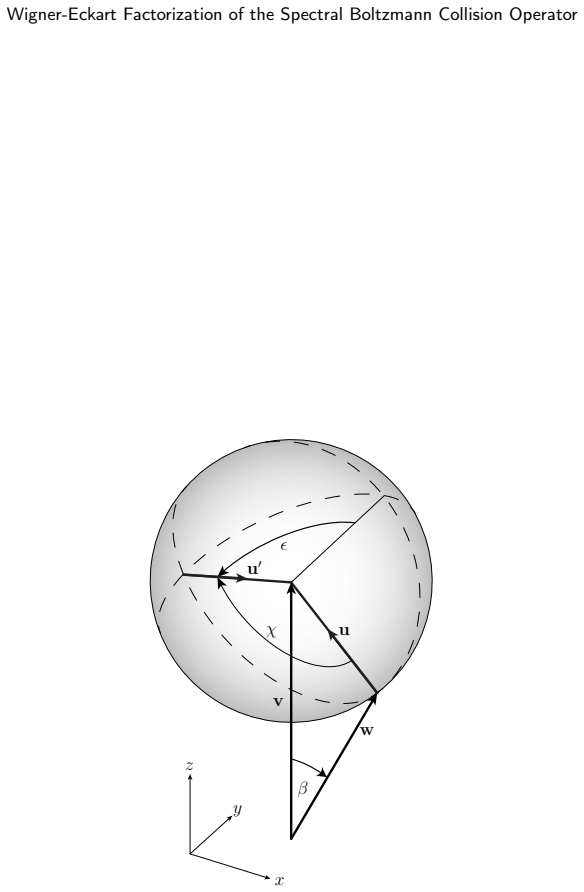
By rigidly rotating the laboratory frame to align with the colliding pair and integrating over the SO(3) rotation group, the eight-dimensional weak form of the bilinear Boltzmann collision operator reduces to a five-dimensional kinematic core. This reduction yields an exact Wigner-Eckart factorization within a spectral Galerkin framework of associated Laguerre polynomials and spherical harmonics. The decomposition decouples the angular geometry from the scattering physics.
What carries the argument
Wigner-Eckart factorization obtained by SO(3) integration after rigid frame rotation to the colliding pair, separating Clebsch-Gordan angular coefficients from the scattering kernel in the Laguerre-spherical harmonic basis.
If this is right
- The angular geometry is represented exactly by Clebsch-Gordan coefficients.
- Scattering physics is evaluated to machine precision using a spectrally convergent singular quadrature.
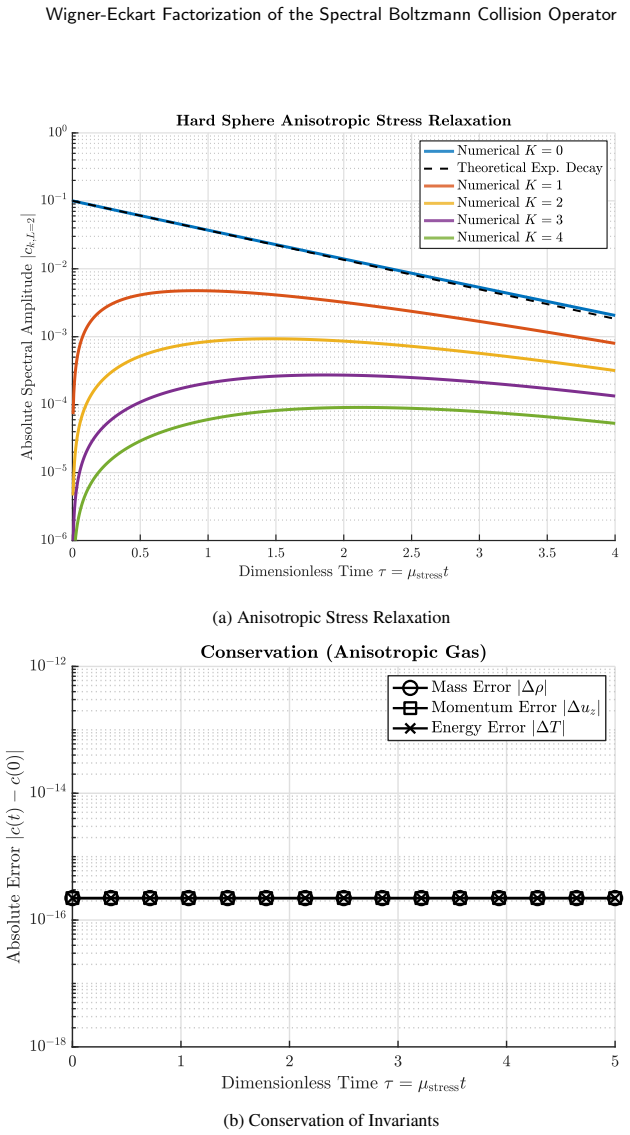
- Macroscopic collision invariants are embedded exactly by zeroing specific entries in the operator.
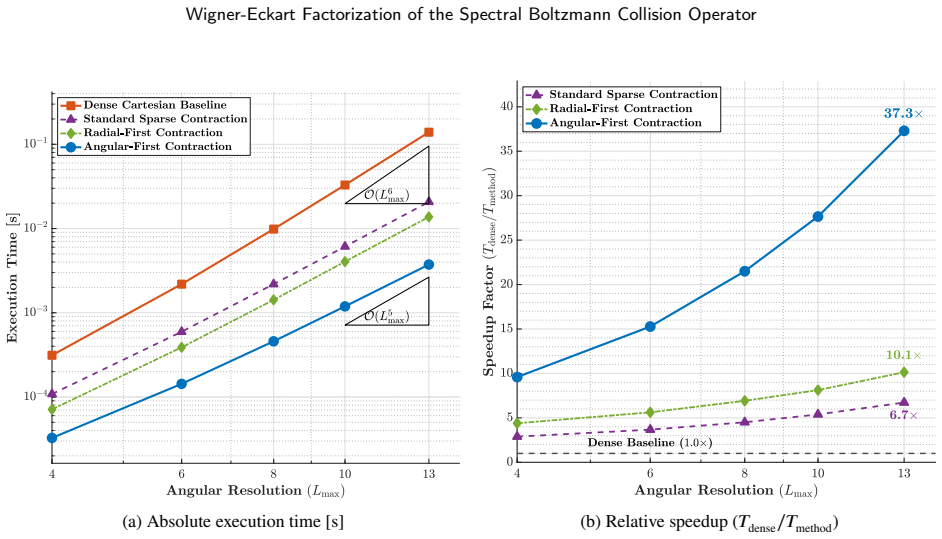
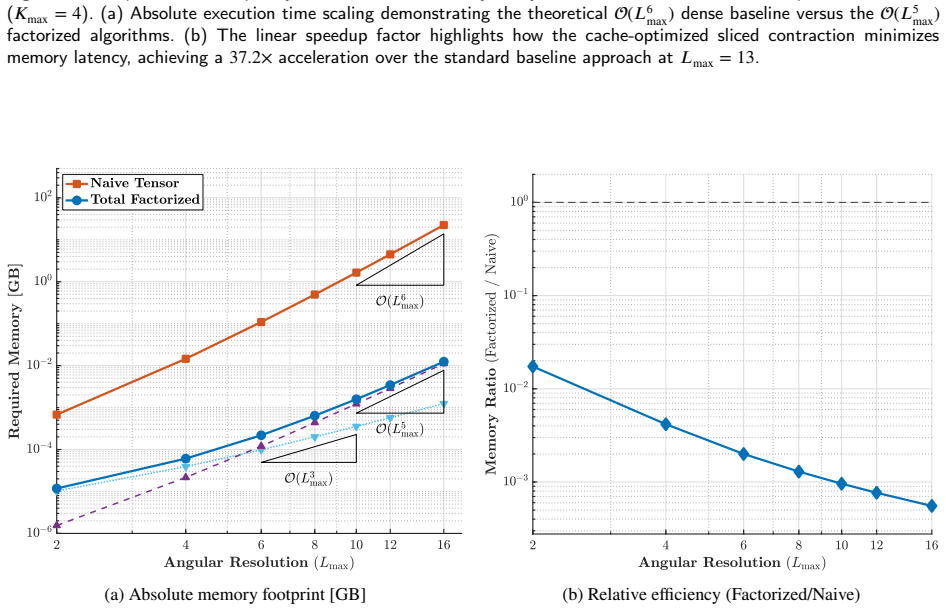
- Cache-optimized matrix contractions yield up to a 37-fold single-core speedup and a 1000-fold memory reduction over dense Cartesian formulations.
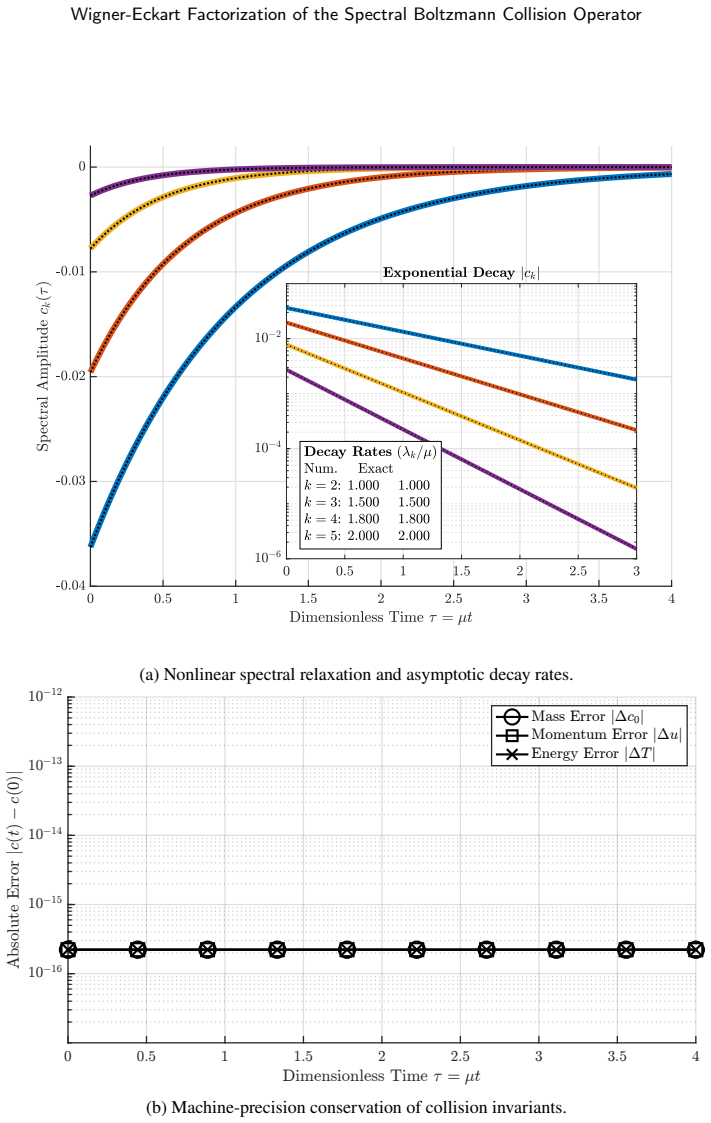
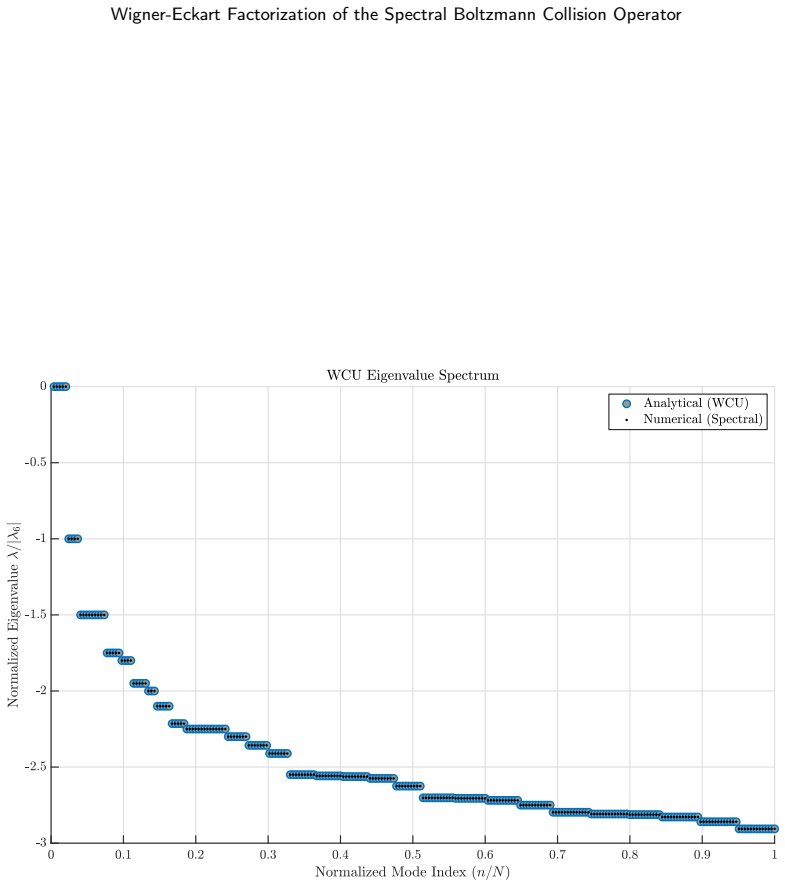
- The method matches analytical solutions for Maxwell molecules and infinite-order Chapman-Enskog viscosity coefficients for hard spheres.
Where Pith is reading between the lines
- This approach may generalize to other integral operators in kinetic theory that possess rotational symmetry, such as the Landau collision operator.
- The memory reduction could allow spectral methods to handle higher-dimensional or multi-species problems on existing hardware.
- Similar symmetry reductions might improve efficiency in related fields like neutron transport or radiative transfer where angular integrals appear.
- Testing the factorization on non-spherical scattering laws would reveal whether the decoupling holds beyond the paper's validation cases.
Load-bearing premise
Rigidly rotating the laboratory frame to align with the colliding pair and integrating over the SO(3) rotation group exactly reduces the eight-dimensional weak form to a five-dimensional kinematic core without loss of information or introduction of approximation.
What would settle it
Direct evaluation of the full eight-dimensional collision integral versus the five-dimensional reduced form for an arbitrary test function and scattering kernel, showing numerical disagreement beyond quadrature error, would falsify the exactness of the reduction.
Figures
read the original abstract
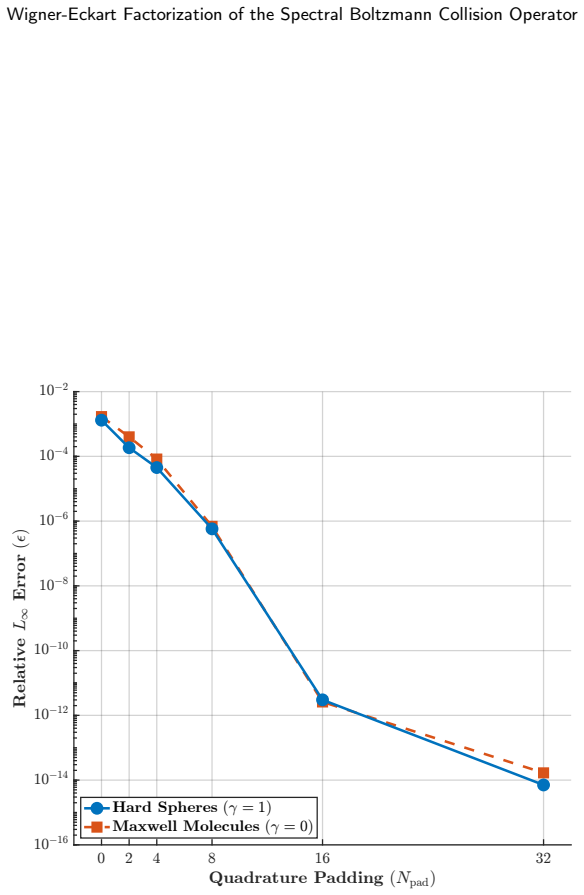
We reduce the eight-dimensional weak form of the bilinear Boltzmann collision operator to a five-dimensional kinematic core by rigidly rotating the laboratory frame to align with the colliding pair and integrating over the $\mathrm{SO}(3)$ rotation group. This reduction yields an exact Wigner--Eckart factorization within a spectral Galerkin framework of associated Laguerre polynomials and spherical harmonics. The decomposition decouples the angular geometry from the scattering physics. The former, represented by Clebsch--Gordan coefficients, is evaluated exactly, while the latter is evaluated to machine precision by a spectrally convergent singular quadrature strategy. By explicitly zeroing specific entries, the macroscopic collision invariants are embedded without approximation. Cache-optimized contractions deliver up to a 37-fold single-core speedup and a 1000-fold memory reduction over standard dense Cartesian formulations. The approach is validated against analytical solutions for Maxwell molecules and infinite-order Chapman--Enskog viscosity coefficients for hard spheres.
Editorial analysis
A structured set of objections, weighed in public.
Referee Report
Summary. The paper claims that rigidly rotating the laboratory frame to align with a colliding pair and integrating the weak form of the bilinear Boltzmann collision operator over the SO(3) group reduces the eight-dimensional integral to an exact five-dimensional kinematic core. Within a spectral Galerkin discretization using associated Laguerre polynomials and spherical harmonics, this produces a Wigner-Eckart factorization that separates Clebsch-Gordan angular factors (evaluated exactly) from a scattering kernel (evaluated to machine precision via singular quadrature). Macroscopic invariants are embedded exactly by zeroing selected matrix entries, yielding up to 37-fold single-core speedup and 1000-fold memory reduction relative to dense Cartesian formulations. Validation is provided against Maxwell-molecule analytics and infinite-order Chapman-Enskog viscosities for hard spheres.
Significance. If the exactness of the factorization in the truncated discrete basis holds, the work would constitute a substantial advance for spectral methods applied to the Boltzmann equation. It would deliver both a rigorous decoupling of geometry from physics and a practical route to high-accuracy, conservation-preserving computations at substantially reduced cost. The reported speedups and memory savings, together with the machine-precision quadrature and explicit invariant embedding, are concrete strengths that would be of immediate interest to the kinetic-theory and computational-physics communities.
major comments (3)
- [Abstract / central reduction] Abstract and the central reduction claim: the assertion that SO(3) integration after frame alignment produces an exact Wigner-Eckart factorization with no information loss or truncation error in the finite Laguerre-spherical-harmonic space requires an explicit demonstration that the chosen basis is closed under the relevant rotation action. Without this, it is unclear whether the five-dimensional kernel fully captures all couplings or whether additional terms outside the truncated space are implicitly neglected.
- [Invariant embedding procedure] The embedding of collision invariants by zeroing specific entries is presented as exact, yet the manuscript does not quantify how this zeroing interacts with the spectral projection or whether it preserves the claimed machine-precision accuracy of the quadrature for all retained modes.
- [Validation / numerical results] Validation section: while comparisons to Maxwell-molecule solutions and Chapman-Enskog coefficients are shown, the paper does not report a direct numerical check (e.g., residual norm of the un-reduced operator versus the factored form) that would confirm the absence of discretization-induced coupling errors at the truncation levels used for the speedup benchmarks.
minor comments (2)
- [Notation] Notation for the five-dimensional kernel and the precise definition of the singular quadrature nodes should be introduced earlier and used consistently throughout.
- [Figures] Figure captions for the performance plots should explicitly state the basis truncation parameters (N_Laguerre, L_max) corresponding to each data point.
Simulated Author's Rebuttal
We thank the referee for the thorough review and valuable comments. We address each major point below and indicate the revisions that will be incorporated.
read point-by-point responses
-
Referee: Abstract / central reduction claim: the assertion that SO(3) integration after frame alignment produces an exact Wigner-Eckart factorization with no information loss or truncation error in the finite Laguerre-spherical-harmonic space requires an explicit demonstration that the chosen basis is closed under the relevant rotation action. Without this, it is unclear whether the five-dimensional kernel fully captures all couplings or whether additional terms outside the truncated space are implicitly neglected.
Authors: Spherical harmonics of fixed degree l form irreducible representations of SO(3) and are therefore closed under rotations, which act via Wigner D-matrices that mix only the azimuthal index m while leaving l invariant. The Wigner-Eckart theorem consequently yields an exact factorization inside any finite truncation that retains the full (2l+1)-dimensional subspace for each l. The SO(3) integral projects precisely onto Clebsch-Gordan-coupled channels without generating couplings to higher l outside the truncation. We will insert a concise paragraph in Section 2.2 explicitly stating this closure property and confirming that the five-dimensional kernel therefore captures all intra-truncation couplings with no implicit neglect of terms. revision: yes
-
Referee: The embedding of collision invariants by zeroing specific entries is presented as exact, yet the manuscript does not quantify how this zeroing interacts with the spectral projection or whether it preserves the claimed machine-precision accuracy of the quadrature for all retained modes.
Authors: The invariants correspond to analytically known null modes of the collision operator. After the spectral projection is performed, these specific matrix entries are set to zero exactly. Because the quadrature evaluates all other entries to machine precision and the zeroing operation is independent of the quadrature (and orthogonal to the retained modes), the machine-precision accuracy of the non-invariant blocks is unaffected. We will add a short quantitative statement, supported by a low-order numerical check, demonstrating that the post-projection zeroing introduces no additional error beyond floating-point roundoff for the retained modes. revision: yes
-
Referee: Validation section: while comparisons to Maxwell-molecule solutions and Chapman-Enskog coefficients are shown, the paper does not report a direct numerical check (e.g., residual norm of the un-reduced operator versus the factored form) that would confirm the absence of discretization-induced coupling errors at the truncation levels used for the speedup benchmarks.
Authors: A direct residual comparison at the largest truncation levels used for the reported speedups is computationally infeasible, as that is the motivation for the reduction. Nevertheless, the existing analytic validations already exercise the full operator. To provide the requested direct check, we will include, in the revised numerical section, residual-norm comparisons between the unreduced and factored forms for all truncation levels small enough that the unreduced operator remains tractable; these will confirm agreement to machine precision and thereby support the absence of discretization-induced coupling errors. revision: partial
Circularity Check
No circularity: derivation follows from explicit SO(3) integration and basis properties
full rationale
The paper's central step reduces the 8D weak form to a 5D kinematic core via rigid frame alignment followed by explicit integration over the SO(3) rotation group, producing a claimed exact Wigner-Eckart factorization inside the associated Laguerre + spherical-harmonic Galerkin space. The abstract and description present this as a direct algebraic consequence of the group action and the chosen spectral basis, with invariants embedded by zeroing entries. No self-citations, fitted parameters renamed as predictions, or ansatzes smuggled via prior work are invoked; the reduction is asserted to hold without truncation error inside the discrete space. The derivation chain is therefore self-contained and does not reduce to its own inputs by construction.
Axiom & Free-Parameter Ledger
axioms (2)
- standard math Integration over the SO(3) rotation group can be performed exactly after rigid frame alignment.
- standard math Clebsch-Gordan coefficients exactly encode the angular coupling of spherical harmonics under rotation.
Reference graph
Works this paper leans on
-
[1]
Exactsolutionsofthenonlinearboltzmannequationandtheirapplicationtothetheoryofgasflows
Bobylev,A.V.,1975. Exactsolutionsofthenonlinearboltzmannequationandtheirapplicationtothetheoryofgasflows. DokladyAkademiiNauk SSSR 225, 1041–1044. Bobylev, A.V., Palczewski, A., Schneider, J.,
1975
-
[2]
Comptes rendus de l’Académie des sciences
On approximation of the boltzmann equation by discrete velocity models. Comptes rendus de l’Académie des sciences. Série I, Mathématique 320, 639–644. Brechtken,S.,Sasse,T.,2018. Normal,highorderdiscretevelocitymodelsoftheboltzmannequation. Computers&MathematicswithApplications 75, 503–519. doi:10.1016/j.camwa.2017.09.024. Cabannes, H.,
-
[3]
Vi. on the law of distribution of molecular velocities, and on the theory of viscosity and thermal conduction, in a non-uniform simple monatomic gas. Philosophical Transactions of the Royal Society of London. Series A, Containing Papers of a Mathematical or Physical Character 216, 279–348. doi:10.1098/rsta.1916.0006. Chapman, S., Cowling, T.G.,
-
[4]
Physics of Fluids 11, 2720–2730
Polynomial expansions for the isotropic boltzmann equation and invariance of the collision integral with respect to the choice of basis functions. Physics of Fluids 11, 2720–2730. doi:10.1063/1.870134. Enskog, D.,
-
[5]
Technical Report SAM Report 2014-13
Polar spectral scheme for the spatially homogeneous Boltzmann equation. Technical Report SAM Report 2014-13. ETH Zürich. Gamba, I.M., Rjasanow, S.,
2014
-
[6]
Journal of Computational Physics 359, 1–25
Galerkin–petrov approach for the boltzmann equation. Journal of Computational Physics 359, 1–25. doi:10.1016/j.jcp.2018.04.017. Gamba, I.M., Tharkabhushanam, S.H.,
-
[7]
Springer, pp
Principles of the kinetic theory of gases, in: Thermodynamik der Gase/Thermodynamics of Gases. Springer, pp. 205–294. Hanke,A.,Torrilhon,M.,2023. Representationtheorybasedalgorithmtocomputeboltzmann’sbilinearcollisionoperatorintheirreduciblespectral burnett ansatz efficiently. Journal of Scientific Computing
2023
-
[8]
doi:10.1007/s10915-023-02168-8. Hiemstra, R.R.,
-
[9]
Official codebase: Wigner-eckart factorization of the spectral boltzmann collision operator. URL:https://doi.org/10. 5281/zenodo.20403094, doi:10.5281/zenodo.20403094. Hu, J., Qi, K.,
-
[10]
Journal of Computational Physics 423, 109806
A fast fourier spectral method for the homogeneous boltzmann equation with non-cutoff collision kernels. Journal of Computational Physics 423, 109806. doi:10.1016/j.jcp.2020.109806. Ivanic, J., Ruedenberg, K.,
-
[11]
direct determination by recursion
Rotation matrices for real spherical harmonics. direct determination by recursion. Journal of Physical Chemistry 100, 6342–6347. doi:10.1021/jp953350u. Keßler,T.,Rjasanow,S.,2019. Fullyconservativespectralgalerkin–petrovmethodfortheinhomogeneousboltzmannequation. KineticandRelated Models 12, 59–84. doi:10.3934/krm.2019003. Kitzler,G.,Schöberl,J.,2015.Ahig...
-
[12]
Australian Journal of Physics 20, 205–238
The chapman-enskog solution of the boltzmann equation. Australian Journal of Physics 20, 205–238. doi:10.1071/PH670205. Kumar, K.,
-
[13]
Mobility and diffusion. I. boltzmann equation treatment for charged particles. Australian Journal of Physics 26, 157–188. doi:10.1071/PH730157. Massot, J.N.,
-
[14]
Journal of Mathematical Physics 17, 1392–1398
Symmetry and invariance properties of the boltzmann collision operator. Journal of Mathematical Physics 17, 1392–1398. doi:10.1063/1.523064. Mouhot, C., Pareschi, L.,
-
[15]
SIAM Journal on Numerical Analysis 37, 1217–1245
Numerical solution of the boltzmann equation I: Spectrally accurate approximation of the collision operator. SIAM Journal on Numerical Analysis 37, 1217–1245. doi:10.1137/S0036142998343300. Pekeris, C.L., Alterman, Z.,
-
[16]
the coefficients of viscosity and heat conduction
Solution of the boltzmann-hilbert integral equation II. the coefficients of viscosity and heat conduction. Proceedings of the National Academy of Sciences USA 43, 998–1007. doi:10.1073/pnas.43.11.998. Platkowski, T., Illner, R.,
-
[17]
Discrete velocity models of the boltzmann equation: a survey on the mathematical aspects of the theory. SIAM review 30, 213–255. doi:10.1137/1030045. Rogier, F., Schneider, J.,
-
[18]
URL https://www.worldscientific.com/ doi/abs/10.1142/0270
A direct method for solving the boltzmann equation. Transport Theory and Statistical Physics 23, 313–338. Varshalovich,D.,Moskalev,A.,Khersonskii,V.,1988. QuantumTheoryofAngularMomentum. WorldScientific,Singapore. doi:10.1142/0270. Wang Chang, C.S., Uhlenbeck, G.E.,
-
[19]
Computer Physics Communications 291, 108812
Multidisciplinary benchmarks of a conservative spectral solver for the nonlinear boltzmann equation. Computer Physics Communications 291, 108812. doi:10.1016/j.cpc.2023.108812. Wu, L., White, C., Scanlon, T.J., Reese, J.M., Zhang, Y.,
-
[20]
Journal of Computational Physics 250, 27–52
Deterministic numerical solutions of the boltzmann equation using the fast spectral method. Journal of Computational Physics 250, 27–52. doi:10.1016/j.jcp.2013.05.003. R.R. Hiemstra, T. Keßler, and M.R.A. Abdelmalik:Preprint submitted to ElsevierPage 22 of 22 Wigner-Eckart Factorization of the Spectral Boltzmann Collision Operator z x y v w u β u′ χ ϵ Fig...
discussion (0)
Sign in with ORCID, Apple, or X to comment. Anyone can read and Pith papers without signing in.