Faster matrix product state preparation by exploiting symmetry-induced block-sparsity
Pith reviewed 2026-06-29 11:29 UTC · model grok-4.3
The pith
U(1) symmetries let block-sparse MPS tensors be permuted into block-diagonal unitaries whose synthesis cost depends only on the largest block.
A machine-rendered reading of the paper's core claim, the machinery that carries it, and where it could break.
Core claim
Block-sparse MPS tensors induced by U(1) symmetries are converted to block-diagonal matrices by row and column permutations. These block-diagonal unitaries are synthesized with cost determined solely by the dimension of the largest block. The synthesis procedure is modified to achieve an extra factor-of-sqrt(2) Toffoli reduction for real-valued unitaries. The resulting circuits prepare the target MPS within the standard ancilla-assisted linear-depth framework at substantially lower cost.
What carries the argument
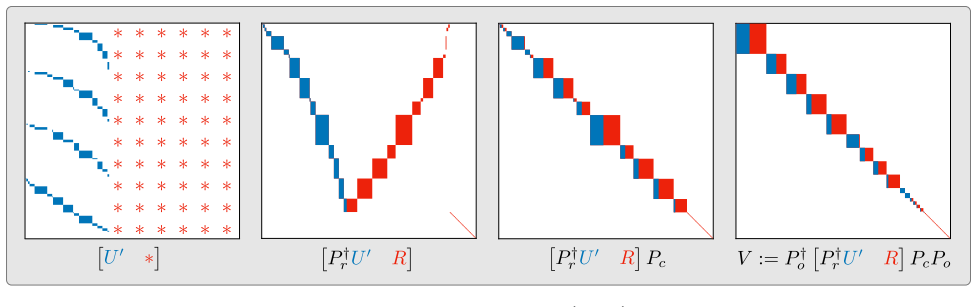
Row-and-column permutations that convert symmetry-induced block-sparse MPS tensors into block-diagonal form, allowing unitary synthesis cost to be governed by the largest block.
If this is right
- Preparation cost scales with the size of the largest symmetry sector instead of the full bond dimension.
- Real-valued unitaries receive an additional sqrt(2) reduction in Toffoli count from the modified synthesis.
- The technique fits inside existing ancilla-assisted linear-depth MPS preparation without further overhead.
- Larger molecular Hamiltonians become reachable inside a fixed fault-tolerant resource budget.
Where Pith is reading between the lines
- The same permutation step could be tested on tensors carrying additional symmetries such as SU(2) spin rotation if their blocks admit a similar reordering.
- Classical preprocessing that finds optimal permutations may combine with other circuit-compression techniques to produce multiplicative savings.
- Systems lacking explicit U(1) conservation might still benefit if approximate block structures can be identified and diagonalized by permutation.
Load-bearing premise
Permutations that turn block-sparse tensors into block-diagonal form add no extra circuit depth or ancilla cost beyond the cost of the largest block.
What would settle it
Measure the Toffoli count of the full preparation circuit for a concrete small MPS both before and after applying the permutations, and check whether the count equals the cost of synthesizing only the largest block.
Figures

read the original abstract
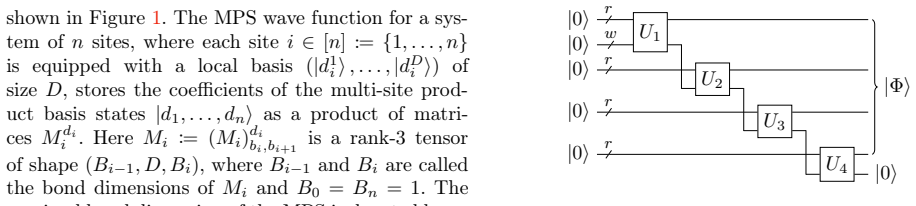
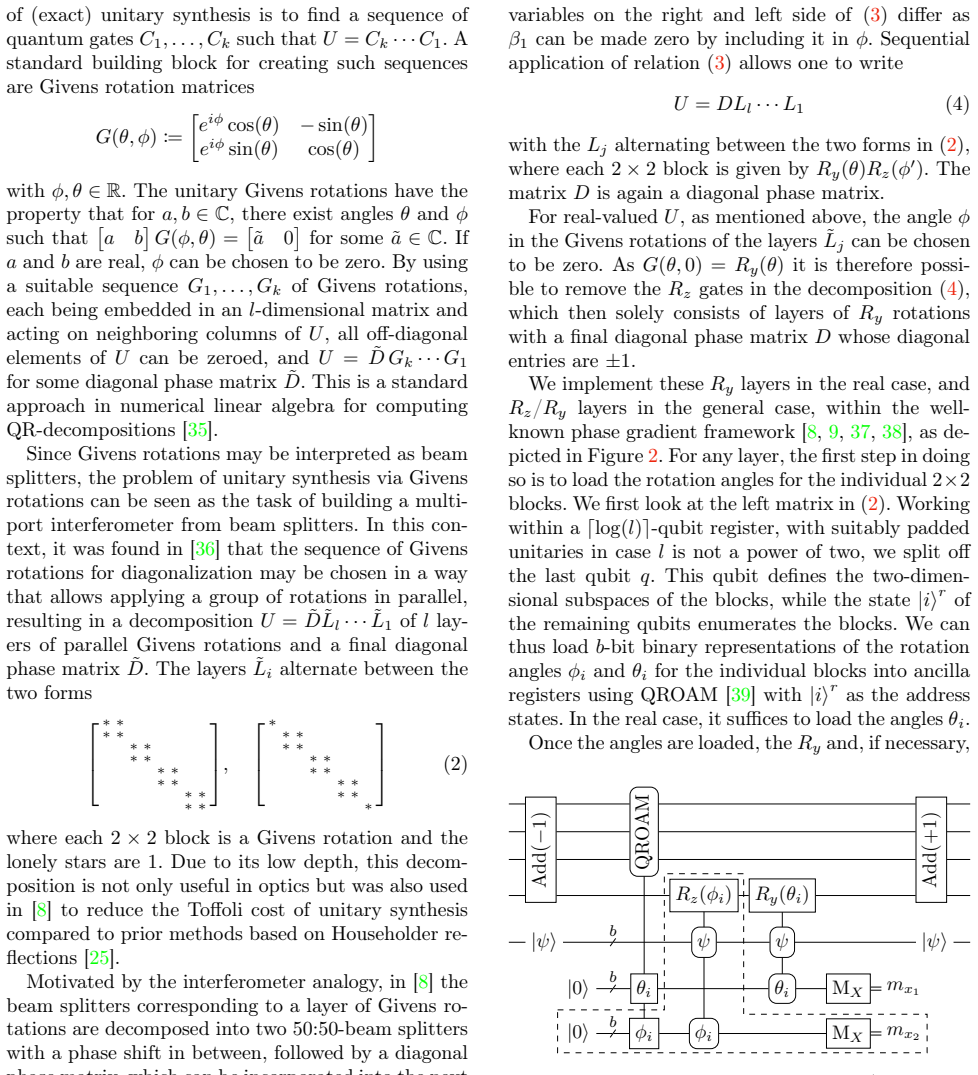
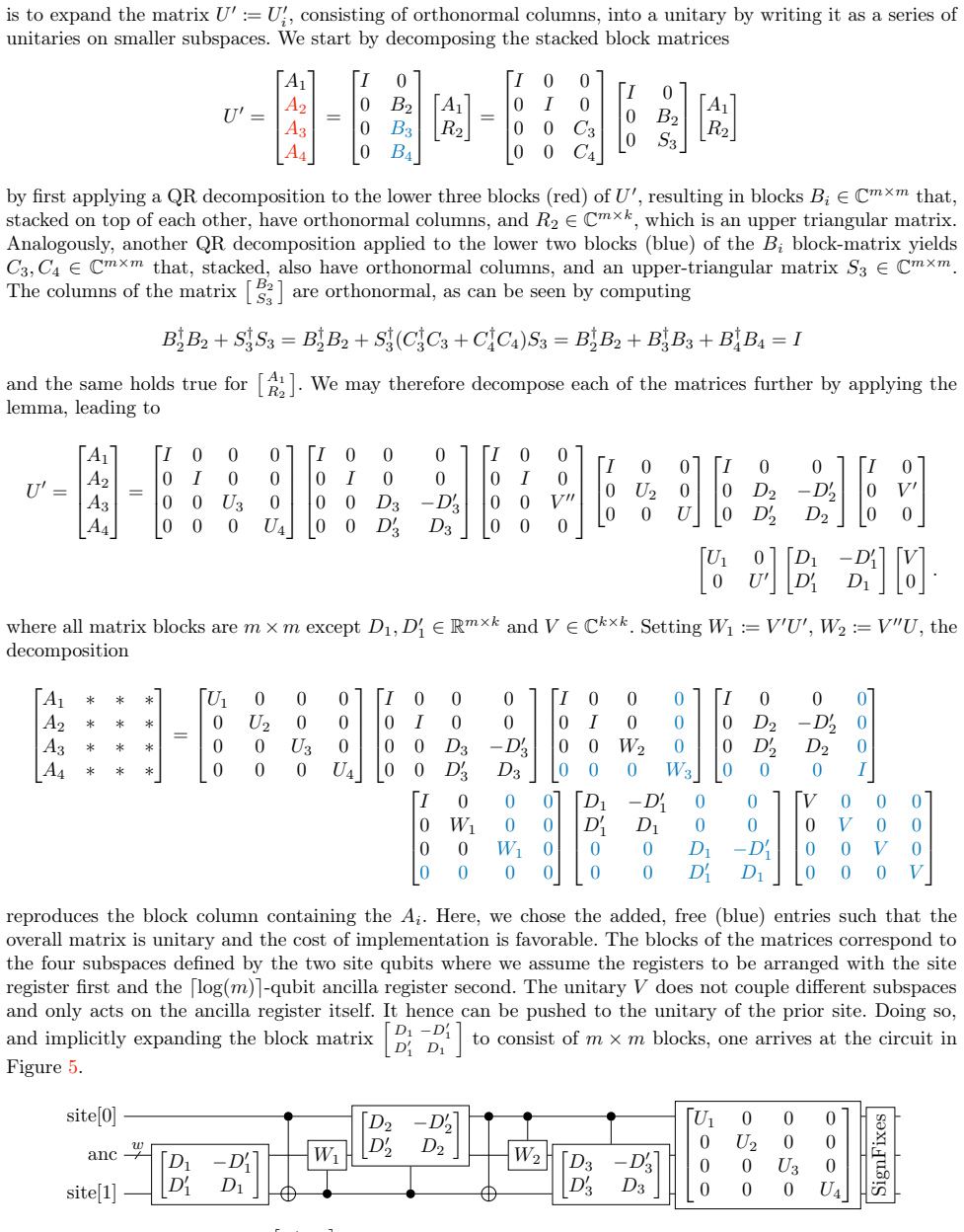
Matrix product states (MPS) serve as a key tool for studying quantum systems from chemistry and condensed-matter physics, making their preparation on quantum computers an important task in interfacing classical and quantum simulation. Many systems of interest have $U(1)$-symmetries induced by particle number and spin projection conservation, allowing to restrict the MPS tensors to be of block-sparse form, a property widely used in the implementation of classical algorithms such as the density matrix renormalization group. We reduce the cost of fault-tolerantly preparing block-sparse MPS within the standard ancilla-assisted linear-depth approach by implementing row and column permutations that transform the block-sparse matrices into block-diagonal form. These block-diagonal unitaries are then implemented via unitary synthesis, with the cost being determined by the size of the largest block. In this context, we modify the unitary synthesis approach of Berry et al. in order to reduce the Toffoli cost for real-valued unitaries by a factor of $\sqrt{2}$. In numerical benchmarks, we achieve Toffoli cost improvement factors of $10 - 30$ compared to the state-of-the-art for MPS of various molecular systems.
Editorial analysis
A structured set of objections, weighed in public.
Referee Report
Summary. The manuscript claims that U(1) symmetries in molecular MPS tensors induce block-sparse structure that can be converted to block-diagonal form by row/column permutations; the resulting unitaries are then synthesized at a cost set only by the largest block (plus a √2 reduction for real-valued unitaries obtained by modifying the Berry et al. routine), yielding 10-30 imes Toffoli-cost reductions versus prior art in the ancilla-assisted linear-depth preparation framework.
Significance. If the permutation overhead is provably sub-dominant, the work would materially lower the fault-tolerant resource cost of preparing symmetry-constrained MPS for quantum chemistry, a central bottleneck in hybrid classical-quantum simulation pipelines. The constant-factor improvement to real unitary synthesis is a reusable, parameter-free optimization.
major comments (1)
- [Abstract] Abstract (and the cost-model paragraph that follows): the central claim that 'the cost being determined by the size of the largest block' treats the quantum circuits realizing the row/column permutations as having negligible Toffoli count and ancilla overhead. No explicit accounting or depth bound for these permutation circuits on the virtual indices is supplied, leaving open the possibility that their cost offsets the reported 10-30 imes savings.
minor comments (1)
- Numerical benchmarks are cited without error bars, exact baseline circuit counts, or circuit diagrams, making the improvement factors difficult to reproduce from the abstract alone.
Simulated Author's Rebuttal
We thank the referee for the detailed reading and for identifying the need for explicit cost accounting of the permutation circuits. We address the comment below and will revise the manuscript to incorporate a quantitative bound.
read point-by-point responses
-
Referee: [Abstract] Abstract (and the cost-model paragraph that follows): the central claim that 'the cost being determined by the size of the largest block' treats the quantum circuits realizing the row/column permutations as having negligible Toffoli count and ancilla overhead. No explicit accounting or depth bound for these permutation circuits on the virtual indices is supplied, leaving open the possibility that their cost offsets the reported 10-30 times savings.
Authors: We agree that the abstract and cost-model paragraph do not supply an explicit Toffoli or depth bound for the permutation circuits. The row/column permutations are fixed, classically precomputed maps on the virtual indices that convert the block-sparse tensors to block-diagonal form; they are therefore independent of the input state and can be realized by a fixed quantum circuit whose gate count scales with the virtual bond dimension D. Because D remains modest (typically 10–200) for the molecular systems considered, this cost is expected to be sub-dominant relative to the block-synthesis cost, which scales with the size of the largest symmetry block. Nevertheless, the manuscript currently lacks a concrete bound. We will add a dedicated paragraph (or short subsection) that (i) states the permutation circuit explicitly as a composition of controlled-SWAPs or a sorting network on the virtual register, (ii) gives an O(D log D) Toffoli upper bound, and (iii) compares this bound numerically to the reported synthesis savings for the benchmark molecules, confirming that the net improvement remains in the 10–30× range. The abstract will be updated to reflect this clarification. revision: yes
Circularity Check
No circularity: cost reduction follows from explicit permutations and external synthesis modification
full rationale
The paper derives its Toffoli-cost improvement by applying row/column permutations to convert block-sparse MPS tensors to block-diagonal form, then synthesizing each block via a modified version of the Berry et al. unitary synthesis routine (with an explicit √2 factor for real-valued unitaries). These operations are defined independently of the final benchmark numbers; the cost model is stated directly in terms of the largest block size without any fitted parameter being relabeled as a prediction, without self-definitional loops, and without load-bearing self-citations. Numerical benchmarks on molecular systems supply external validation rather than being presupposed by the derivation. No step reduces the claimed result to its own inputs by construction.
Axiom & Free-Parameter Ledger
axioms (1)
- domain assumption U(1) symmetries from particle number and spin projection conservation induce block-sparse structure in MPS tensors
Reference graph
Works this paper leans on
-
[1]
The Ground State Electronic Energy of Benzene
Janus J. Eriksen, Tyler A. Anderson, J. Emil- ianoDeustua,KhaldoonGhanem,DiptarkaHait, Mark R. Hoffmann, Seunghoon Lee, Daniel S. Levine, Ilias Magoulas, Jun Shen, Norm M. Tubman, K. Birgitta Whaley, Enhua Xu, Yuan Yao, Ning Zhang, Ali Alavi, Garnet Kin-Lic Chan, Martin Head-Gordon, Wenjian Liu, Pi- otr Piecuch, Sandeep Sharma, Seiichiro L. Ten- no, C. J....
2020
-
[2]
Matrix product states and projected entangled pair states: Con- cepts, symmetries, theorems
J. Ignacio Cirac, David Pérez-García, Norbert Schuch, and Frank Verstraete. “Matrix product states and projected entangled pair states: Con- cepts, symmetries, theorems”. Rev. Mod. Phys. 93, 045003 (2021)
2021
-
[3]
The density-matrix renor- malization group in the age of matrix product states
Ulrich Schollwöck. “The density-matrix renor- malization group in the age of matrix product states”. Annals of Physics326, 96–192 (2011)
2011
-
[4]
Huanchen Zhai, Chenghan Li,Xing Zhang, Zhen- dong Li, Seunghoon Lee, and Garnet Kin-Lic Chan. “Classical solution of the FeMo-cofactor model to chemical accuracy and its implica- tions” (2026). arXiv:2601.04621
work page internal anchor Pith review Pith/arXiv arXiv 2026
-
[5]
Accurate Simulation of the Hubbard Model with Finite Fermionic Projected Entangled Pair States
Wen-Yuan Liu, Huanchen Zhai, Ruojing Peng, Zheng-Cheng Gu, and Garnet Kin-Lic Chan. “Accurate Simulation of the Hubbard Model with Finite Fermionic Projected Entangled Pair States”. Phys. Rev. Lett.134, 256502 (2025)
2025
-
[6]
Hunt- ingforquantumadvantageinelectronicstructure calculations is a highly non-trivial task
Örs Legeza, Andor Menczer, Miklós Antal Werner,SotirisS.Xantheas,FrankNeese,Martin Ganahl, Cole Brower, Samuel Rodriguez Bern- abeu, Jeff Hammond, and John Gunnels. “Hunt- ingforquantumadvantageinelectronicstructure calculations is a highly non-trivial task” (2026). arXiv:2603.28648
-
[7]
Initial State Preparation for Quantum Chem- istry on Quantum Computers
Stepan Fomichev, Kasra Hejazi, Mod- jtaba Shokrian Zini, Matthew Kiser, Joana Fraxanet, Pablo Antonio Moreno Casares, Alain Delgado, Joonsuk Huh, Arne-Christian Voigt, Jonathan E. Mueller, and Juan Miguel Arrazola. “Initial State Preparation for Quantum Chem- istry on Quantum Computers”. PRX Quantum 5, 040339 (2024)
2024
-
[8]
Rapid Initial-State Preparation for the Quantum Simulation of Strongly Correlated Molecules
Dominic W. Berry, Yu Tong, Tanuj Khattar, Alec White, Tae In Kim, Guang Hao Low, Ser- gio Boixo, Zhiyan Ding, Lin Lin, Seunghoon Lee, Garnet Kin-Lic Chan, Ryan Babbush, and Nicholas C. Rubin. “Rapid Initial-State Preparation for the Quantum Simulation of Strongly Correlated Molecules”. PRX Quantum 6, 020327 (2025)
2025
-
[9]
Parameter-optimal unitary synthesis with flag decompositions
Korbinian Kottmann, David Wierichs, Guillermo Alonso-Linaje, and Nathan Killoran. “Parameter-optimal unitary synthesis with flag decompositions” (2026). arXiv:2603.20376
-
[10]
Sequential Generation of En- tangled Multiqubit States
C. Schön, E. Solano, F. Verstraete, J. I. Cirac, and M. M. Wolf. “Sequential Generation of En- tangled Multiqubit States”. Phys. Rev. Lett.95, 110503 (2005)
2005
-
[11]
Preparation of Matrix Product States with Log-Depth Quantum Cir- cuits
Daniel Malz, Georgios Styliaris, Zhi-Yuan Wei, and J. Ignacio Cirac. “Preparation of Matrix Product States with Log-Depth Quantum Cir- cuits”. Phys. Rev. Lett.132, 040404 (2024)
2024
-
[12]
Encoding of matrix product states into quantum circuits of one- and two-qubit gates
Shi-Ju Ran. “Encoding of matrix product states into quantum circuits of one- and two-qubit gates”. Phys. Rev. A101, 032310 (2020)
2020
-
[13]
Constant- Depth Preparation of Matrix Product States with Adaptive Quantum Circuits
Kevin C. Smith, Abid Khan, Bryan K. Clark, S.M. Girvin, and Tzu-Chieh Wei. “Constant- Depth Preparation of Matrix Product States with Adaptive Quantum Circuits”. PRX Quan- tum5, 030344 (2024)
2024
-
[14]
Decomposition of matrix product states into shallow quantum circuits
Manuel S. Rudolph, Jing Chen, Jacob Miller, Atithi Acharya, and Alejandro Perdomo-Ortiz. “Decomposition of matrix product states into shallow quantum circuits”. Quantum Science and Technology9(2022)
2022
-
[15]
Evaluating the evidence for exponential quantum advantage in ground-state quantum chemistry
Seunghoon Lee, Joonho Lee, Huanchen Zhai, Yu Tong, Alexander M. Dalzell, Ashutosh Ku- mar, Phillip Helms, Johnnie Gray, Zhi-Hao Cui, Wenyuan Liu, Michael Kastoryano, Ryan Bab- bush, John Preskill, David R. Reichman, Earl T. Campbell, Edward F. Valeev, Lin Lin, and Gar- net Kin-Lic Chan. “Evaluating the evidence for exponential quantum advantage in ground-...
1952
-
[16]
Data compression for quantum ma- chinelearning
Rohit Dilip, Yu-Jie Liu, Adam Smith, and Frank Pollmann. “Data compression for quantum ma- chinelearning”. Phys.Rev.Res.4,043007(2022)
2022
-
[17]
Effi- cient MPS representations and quantum circuits from the Fourier modes of classical image data
Bernhard Jobst, Kevin Shen, Carlos A. Riofrío, Elvira Shishenina, and Frank Pollmann. “Effi- cient MPS representations and quantum circuits from the Fourier modes of classical image data”. Quantum8, 1544 (2024)
2024
-
[18]
Synergistic pretraining of parametrized quantum circuits via tensor net- works
Manuel S. Rudolph, Jacob Miller, Danial Mot- lagh, Jing Chen, Atithi Acharya, and Alejan- dro Perdomo-Ortiz. “Synergistic pretraining of parametrized quantum circuits via tensor net- works”. NatureCommunications14,8367(2023)
2023
-
[19]
Variational Power of Quantum Circuit Tensor Networks
Reza Haghshenas, Johnnie Gray, Andrew C. Pot- ter, and Garnet Kin-Lic Chan. “Variational Power of Quantum Circuit Tensor Networks”. Phys. Rev. X12, 011047 (2022)
2022
-
[20]
Holographic dynamics simulations with a trapped-ion quantum computer
Eli Chertkov, Justin Bohnet, David Francois, John Gaebler, Dan Gresh, Aaron Hankin, Kenny Lee, David Hayes, Brian Neyenhuis, Andrew C. Stutz, Russelland Potter, and Michael Foss- Feig. “Holographic dynamics simulations with a trapped-ion quantum computer”. Nature Physics 18, 1074–1079 (2022)
2022
-
[21]
Combining matrix product states and noisy quantum computers for quantum simulation
Baptiste Anselme Martin, Thomas Ayral, François Jamet, Marko J. Rančić, and Pascal Simon. “Combining matrix product states and noisy quantum computers for quantum simulation”. Phys. Rev. A109, 062437 (2024)
2024
-
[22]
Even More Efficient Quantum Computations of Chemistry Through Tensor Hypercontraction
Joonho Lee, Dominic W. Berry, Craig Gidney, William J. Huggins, Jarrod R. McClean, Nathan Wiebe, and Ryan Babbush. “Even More Efficient Quantum Computations of Chemistry Through Tensor Hypercontraction”. PRX Quantum2, 030305 (2021)
2021
-
[23]
Norm M. Tubman, Carlos Mejuto-Zaera, Jef- frey M. Epstein, Diptarka Hait, Daniel S. Levine, William Huggins, Zhang Jiang, Jarrod R. Mc- 9 Clean,RyanBabbush,MartinHead-Gordon,and K. Birgitta Whaley. “Postponing the orthogo- nality catastrophe: efficient state preparation for electronic structure simulations on quantum de- vices” (2018). arXiv:1809.05523
work page internal anchor Pith review Pith/arXiv arXiv 2018
-
[24]
Fast Quantum Simulation of Electronic Structure by Spectral Amplification
Guang Hao Low, Robbie King, Dominic W. Berry, Qiushi Han, A. Eugene DePrince, Alec F. White, Ryan Babbush, Rolando D. Somma, and Nicholas C. Rubin. “Fast Quantum Simulation of Electronic Structure by Spectral Amplification”. Phys. Rev. X15, 041016 (2025)
2025
-
[25]
Trading T gates for dirty qubits in state preparation and unitary synthesis
Guang Hao Low, Vadym Kliuchnikov, and Luke Schaeffer. “Trading T gates for dirty qubits in state preparation and unitary synthesis”. Quan- tum8, 1375 (2024)
2024
-
[26]
Resource-optimized fault-tolerant simulation of the Fermi-Hubbard model and high-temperature superconductor models
Angus Kan and Benjamin C. B. Symons. “Resource-optimized fault-tolerant simulation of the Fermi-Hubbard model and high-temperature superconductor models”. npj Quantum Informa- tion11, 138 (2025)
2025
-
[27]
Tensor network states and algo- rithms in the presence of a global U(1) symme- try
Sukhwinder Singh, Robert N. C. Pfeifer, and Guifre Vidal. “Tensor network states and algo- rithms in the presence of a global U(1) symme- try”. Phys. Rev. B83, 115125 (2011)
2011
-
[28]
Particle number conservation and block structures in matrix product states
Markus Bachmayr, Michael Götte, and Max Pf- effer. “Particle number conservation and block structures in matrix product states”. Calcolo59, 24 (2022)
2022
-
[29]
Block2: A comprehensive open source framework to develop and apply state-of-the-art DMRGalgorithmsinelectronicstructureandbe- yond
Huanchen Zhai, Henrik R. Larsson, Seunghoon Lee, Zhi-Hao Cui, Tianyu Zhu, Chong Sun, Lin- qing Peng, Ruojing Peng, Ke Liao, Johannes Tölle, Junjie Yang, Shuoxue Li, and Garnet Kin- Lic Chan. “Block2: A comprehensive open source framework to develop and apply state-of-the-art DMRGalgorithmsinelectronicstructureandbe- yond”. The Journal of Chemical Physics1...
2023
-
[30]
Ef- ficient numerical simulations with Tensor Net- works: Tensor Network Python (TeNPy)
Johannes Hauschild and Frank Pollmann. “Ef- ficient numerical simulations with Tensor Net- works: Tensor Network Python (TeNPy)”. Sci- Post Phys. Lect. Notes5(2018)
2018
-
[31]
The ITensor Software Li- brary for Tensor Network Calculations
Matthew Fishman, Steven R. White, and E. Miles Stoudenmire. “The ITensor Software Li- brary for Tensor Network Calculations”. SciPost Phys. Codebases4(2022)
2022
-
[32]
Reliably assessing the electronic structure of cytochrome P450 on to- day’s classical computers and tomorrow’s quan- tum computers
Joshua J. Goings, Alec White, Joonho Lee, Christofer S. Tautermann, Matthias Degroote, Craig Gidney, Toru Shiozaki, Ryan Babbush, and Nicholas C. Rubin. “Reliably assessing the electronic structure of cytochrome P450 on to- day’s classical computers and tomorrow’s quan- tum computers”. Proceedings of the National Academy of Sciences119, e2203533119 (2022)
2022
-
[33]
Expressing and Analyzing Quantum Algorithms with Qualtran
Matthew P. Harrigan, Tanuj Khattar, Charles Yuan, Anurudh Peduri, Noureldin Yosri, Fionn D. Malone, Ryan Babbush, and Nicholas C. Rubin. “Expressing and Analyzing Quantum Algorithms with Qualtran” (2024). arXiv:2409.04643
-
[34]
Code and as- sets for: Faster matrix product state preparation by exploiting symmetry-induced block-sparsity
Felix Rupprecht and Sabine Wölk. “Code and as- sets for: Faster matrix product state preparation by exploiting symmetry-induced block-sparsity”. Zenodo (2026)
2026
-
[35]
Ma- trix Computations - 4th Edition
Gene H. Golub and Charles F. Van Loan. “Ma- trix Computations - 4th Edition”. Johns Hopkins University Press. Philadelphia, PA (2013)
2013
-
[36]
Optimal design for univer- sal multiport interferometers
William R. Clements, Peter C. Humphreys, Ben- jamin J. Metcalf, W. Steven Kolthammer, and Ian A. Walmsley. “Optimal design for univer- sal multiport interferometers”. Optica3, 1460– 1465 (2016)
2016
-
[37]
Halving the cost of quantum ad- dition
Craig Gidney. “Halving the cost of quantum ad- dition”. Quantum2, 74 (2018)
2018
-
[38]
Classical and Quantum Computa- tion
Alexei Y. Kitaev, Ao Shen, and Mikhail N. Vyalyi. “Classical and Quantum Computa- tion”. Graduate Studies in Mathematics. Ameri- can Mathematical Society. (2002)
2002
-
[39]
Qubiti- zation of Arbitrary Basis Quantum Chemistry Leveraging Sparsity and Low Rank Factoriza- tion
Dominic W. Berry, Craig Gidney, Mario Motta, Jarrod R. McClean, and Ryan Babbush. “Qubiti- zation of Arbitrary Basis Quantum Chemistry Leveraging Sparsity and Low Rank Factoriza- tion”. Quantum3, 208 (2019)
2019
-
[40]
CompilationofFault-TolerantQuantumHeuris- tics for Combinatorial Optimization
Yuval R. Sanders, Dominic W. Berry, Pedro C.S. Costa, Louis W. Tessler, Nathan Wiebe, Craig Gidney, Hartmut Neven, and Ryan Babbush. “CompilationofFault-TolerantQuantumHeuris- tics for Combinatorial Optimization”. PRX Quantum1, 020312 (2020)
2020
-
[41]
Enhancing initial state overlap through or- bital optimization for faster molecular electronic ground-state energy estimation
Pauline Ollitrault, Cristian Cortes, Jérôme Gonthier, Robert Parrish, Dario Rocca, Gian- Luca Anselmetti, Matthias Degroote, Nikolaj Moll, Raffaele Santagati, and Michael Streif. “Enhancing initial state overlap through or- bital optimization for faster molecular electronic ground-state energy estimation”. Zenodo (2024)
2024
-
[42]
Enhancing Initial State Overlap through Orbital Optimization for Faster Molecu- lar Electronic Ground-State Energy Estimation
Pauline J. Ollitrault, Cristian L. Cortes, Jérôme F. Gonthier, Robert M. Parrish, Dario Rocca, Gian-Luca Anselmetti, Matthias Deg- roote, Nikolaj Moll, Raffaele Santagati, and Michael Streif. “Enhancing Initial State Overlap through Orbital Optimization for Faster Molecu- lar Electronic Ground-State Energy Estimation”. Phys. Rev. Lett.133, 250601 (2024)
2024
-
[43]
Low- energy spectrum of iron–sulfur clusters directly from many-particle quantum mechanics
Kantharuban Sharma, Sandeepand Sivalingam, Frank Neese, and Garnet Kin-Lic Chan. “Low- energy spectrum of iron–sulfur clusters directly from many-particle quantum mechanics”. Nature Chemistry6, 927–933 (2014)
2014
-
[44]
Data for
Joshua J. Goings, Alec White, Christofer S. Tautermann, Matthias Degroote, Craig Gidney, Toru Shiozaki, Ryan Babbush, and Nicholas C. Rubin. “Data for "Reliably assessing the elec- tronic structure of cytochrome P450 on today’s classical computers and tomorrow’s quantum computers"”. Zenodo (2022). 10
2022
-
[45]
Spin-adapted density matrix renormalization group algorithms for quantum chemistry
Sandeep Sharma and Garnet Kin-Lic Chan. “Spin-adapted density matrix renormalization group algorithms for quantum chemistry”. The Journal of Chemical Physics136, 124121 (2012)
2012
-
[46]
Sparse quantum state preparation with improved Tof- foli cost
Felix Rupprecht and Sabine Wölk. “Sparse quantum state preparation with improved Tof- foli cost” (2026). arXiv:2601.09388
-
[47]
pyblock3: an efficient python block-sparse tensor and MPS/DMRG library
Huanchen Zhai, Yang Gao, and Garnet K.- L. Chan. “pyblock3: an efficient python block-sparse tensor and MPS/DMRG library”. GitHub (2021). url:https://github.com/ block-hczhai/pyblock3-preview
2021
-
[48]
Tensor net- work states and algorithms in the presence of a global SU(2) symmetry
Sukhwinder Singh and Guifre Vidal. “Tensor net- work states and algorithms in the presence of a global SU(2) symmetry”. Phys. Rev. B86, 195114 (2012)
2012
-
[49]
The Constant Geometric Speed Schedule for Adiabatic State Preparation
Mancheon Han, Hyowon Park, and Sangkook Choi. “The Constant Geometric Speed Sched- ule for Adiabatic State Preparation: Towards Quadratic Speedup without Prior Spectral Knowledge” (2026). arXiv:2510.01923
work page internal anchor Pith review Pith/arXiv arXiv 2026
-
[50]
Ground State Preparation via Dynamical Cool- ing
Danial Motlagh, Modjtaba Shokrian Zini, Juan Miguel Arrazola, and Nathan Wiebe. “Ground State Preparation via Dynamical Cool- ing” (2024). arXiv:2404.05810
-
[51]
Dissi- pative ground state preparation in ab initio elec- tronic structure theory
Hao-En Li, Yongtao Zhan, and Lin Lin. “Dissi- pative ground state preparation in ab initio elec- tronic structure theory”. npj Quantum Informa- tion11, 183 (2025)
2025
-
[52]
Single-ancilla ground state preparation via Lindbladians
Zhiyan Ding, Chi-Fang Chen, and Lin Lin. “Single-ancilla ground state preparation via Lindbladians”. Phys. Rev. Res.6, 033147 (2024)
2024
-
[53]
William J. Huggins, Tanuj Khattar, Amanda Xu, Matthew Harrigan, Christopher Kang, Guang Hao Low, Austin Fowler, Nicholas C. Rubin, and Ryan Babbush. “The fluid alloca- tion of surface code qubits (flasq) cost model for early fault-tolerant quantum algorithms” (2025). arXiv:2511.08508
-
[54]
Yquant: Typesetting quantum circuits in a human-readable language
Benjamin Desef. “Yquant: Typesetting quantum circuits in a human-readable language” (2021). arXiv:2007.12931
-
[55]
Craig Gidney. “A Classical-Quantum Adder with Constant Workspace and Linear Gates” (2025). arXiv:2507.23079
-
[56]
Ryan Babbush, Adam Zalcman, Craig Gidney, Michael Broughton, Tanuj Khattar, Hartmut Neven, Thiago Bergamaschi, Justin Drake, and Dan Boneh. “Securing Elliptic Curve Cryp- tocurrencies against Quantum Vulnerabilities: Resource Estimates and Mitigations” (2026). arXiv:2603.28846. 11 A Measurement-based uncomputation Throughout the paper, we often use measur...
work page internal anchor Pith review Pith/arXiv arXiv 2026
-
[57]
Assuming for now that the ancilla register consists of a single qubit, the state after the measurement process is∑ kak|k⟩if|+⟩a was measured, and∑ k(−1)f(k)ak|k⟩if the measurement yields|−⟩a. Generalizing this to multiple ancilla qubits results in the state∑ k(−1)F(i)ak|k⟩, whereF(i) :=∑ i∈Ifi(k)sums over the valuesfi(k)off(k)at the bitsi∈Ifor which the m...
discussion (0)
Sign in with ORCID, Apple, or X to comment. Anyone can read and Pith papers without signing in.