Stabilizing distribution-free probabilistic forecasts
Pith reviewed 2026-06-29 13:55 UTC · model grok-4.3
The pith
A neural network parameterizing regression splines for conditional quantiles can jointly optimize probabilistic forecast quality and stability.
A machine-rendered reading of the paper's core claim, the machinery that carries it, and where it could break.
Core claim
By representing forecasted conditional quantile functions through regression splines whose parameters are outputs of a neural network, the training objective can include an explicit penalty on the dissimilarity between quantile functions produced at successive forecast origins; minimizing this combined loss yields forecasts whose updates exhibit lower variability while the original quality metrics and coverage properties remain largely unchanged, and the penalty weights can be varied across quantile levels to emphasize stabilization in chosen regions of the distribution.
What carries the argument
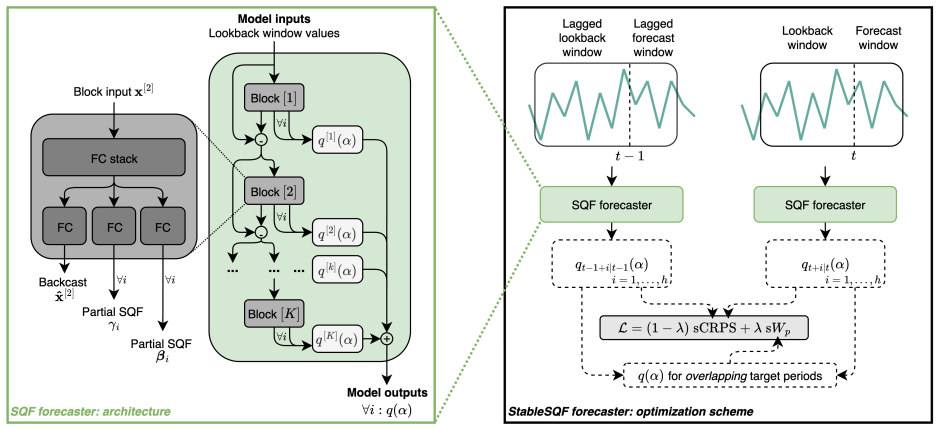
Regression splines parameterized by a neural network for the forecasted conditional quantile functions, with an added dissimilarity penalty between successive forecast updates.
If this is right
- Forecasts for any fixed target period show smaller changes when the forecast origin advances and new observations arrive.
- The relative importance of stability versus quality can be tuned directly in the loss function during training.
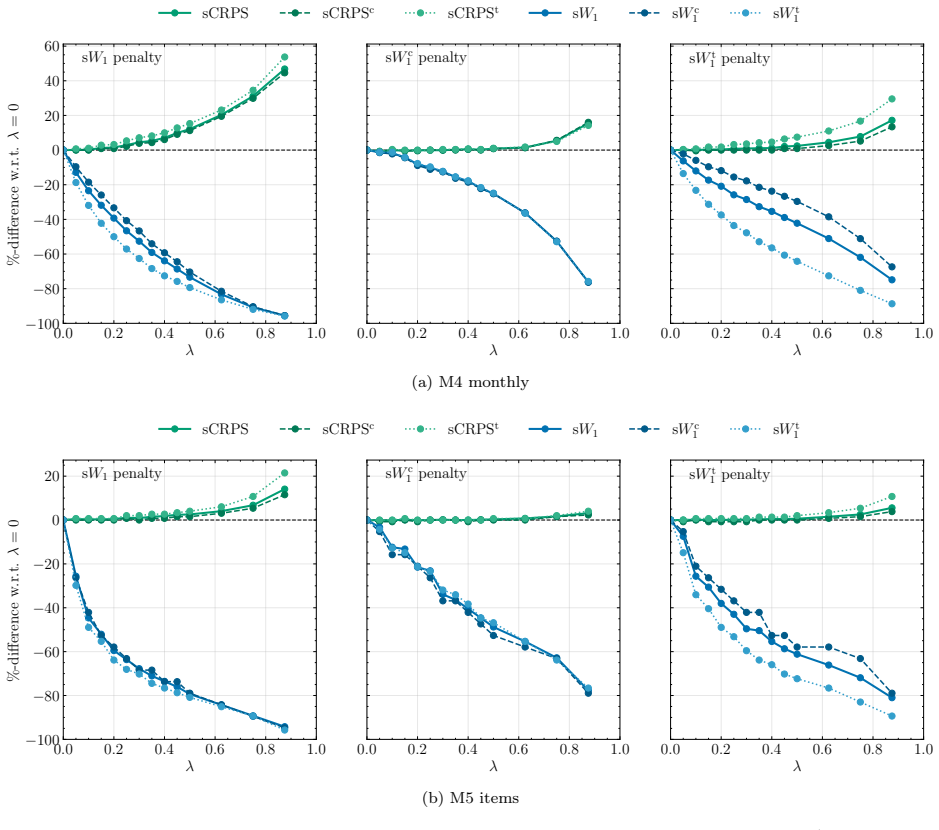
- Stabilization effort can be concentrated on central quantiles, tails, or any chosen subset by adjusting the penalty weights.
- Probabilistic calibration and coverage properties of the base model are preserved to first order after the stability term is added.
Where Pith is reading between the lines
- The same spline-penalty idea could be ported to other distribution-free architectures that already output quantiles, without requiring a full model redesign.
- Inventory or scheduling systems that rely on upper-tail quantiles would see the largest practical benefit when the penalty is concentrated on those regions.
- The approach might be combined with post-processing recalibration steps to recover any small calibration loss introduced by the stability term.
- Testing on datasets with stronger seasonality or regime shifts would reveal whether the stability gains remain consistent when the underlying series are less stationary.
Load-bearing premise
Penalizing differences between spline-parameterized conditional quantile functions from updated forecasts will produce more stable outputs without substantially degrading calibration or accuracy.
What would settle it
Apply the stabilized training procedure to a new dataset and check whether the measured reduction in variance across forecast origins for fixed targets is accompanied by a large rise in pinball loss or by coverage probabilities that fall outside nominal intervals.
Figures
read the original abstract
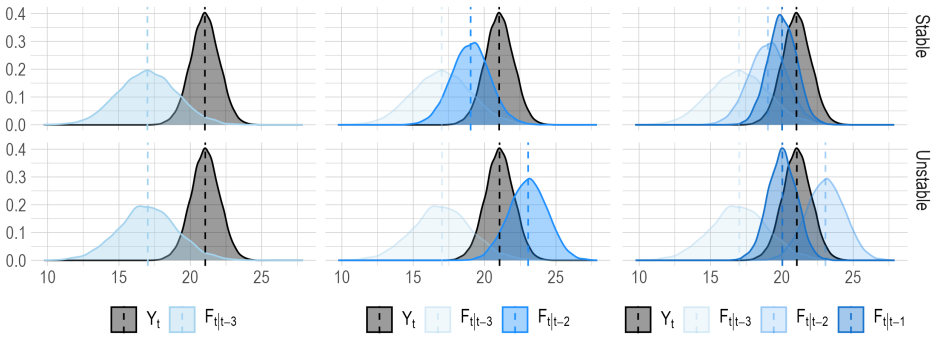
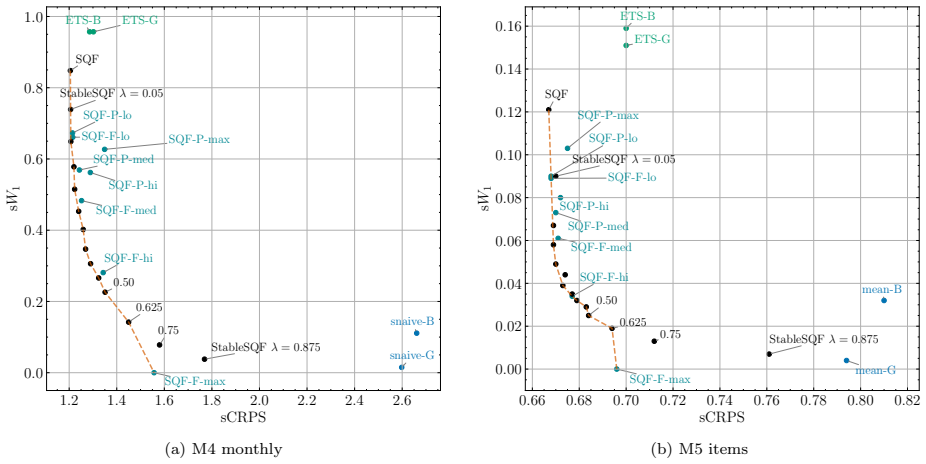
Multi-step-ahead forecasts are often updated as new observations become available, since shorter forecast horizons typically improve forecast quality. However, such improvements come at the cost of forecast instability, i.e., variability in forecasts for the same target period. This instability can trigger costly changes to plans formulated based on the forecasts and may erode trust in the forecasting system. In this work, we integrate forecast stability alongside forecast quality into the training of distribution-free probabilistic time-series forecasting models, allowing us to control this trade-off. We propose a method for generating stabilized forecasted conditional quantile functions using regression splines parameterized by a neural network. This approach enables joint optimization of quality and stability, as it allows us to directly penalize dissimilarities arising from forecast updates. Furthermore, it allows assigning varying importance to stabilizing different parts of the forecast distributions (e.g., central parts vs. tails) to focus on the parts most relevant for the intended downstream use (e.g., the upper tail for inventory management). We empirically evaluate the proposed method on two datasets with different statistical properties and show that it can effectively reduce forecast instability without a substantial loss in forecast quality, and that it can target stabilization effort toward specific parts of the forecast distributions.
Editorial analysis
A structured set of objections, weighed in public.
Referee Report
Summary. The paper claims that by parameterizing conditional quantile functions via regression splines in a neural network and adding a penalty on dissimilarities between successive forecast updates, one can jointly optimize for forecast quality (via pinball loss) and stability in distribution-free probabilistic time-series models. It further claims that importance weights can target stabilization to specific distribution regions, and that experiments on two datasets demonstrate effective instability reduction without substantial quality degradation.
Significance. If the central construction holds, the work would be useful for applications (e.g., inventory, planning) where forecast revisions trigger costly adjustments; the ability to differentially weight distribution regions is a practical feature. The empirical demonstration is limited to two datasets whose statistical properties are only qualitatively described, and no machine-checked proofs or parameter-free derivations are provided.
major comments (2)
- [Method (spline parameterization and combined loss)] The spline parameterization of the conditional quantile functions (described in the method) provides no explicit constraints or reparameterization to enforce monotonicity. Consequently, when the stability penalty dominates, the resulting functions can produce non-monotonic quantile curves, directly violating the ordering required for valid distributions and undermining any coverage guarantees inherited from the base pinball-loss estimator.
- [Method (combined loss) and Experiments] No derivation or bound is given showing that the combined objective (pinball loss + stability penalty) preserves the distribution-free calibration or coverage properties of the underlying quantile estimator. The central claim that stability can be added “without a substantial loss in forecast quality” therefore rests on an unproven assumption that the penalty term does not materially degrade probabilistic calibration.
minor comments (2)
- [Method] The abstract and method description refer to “regression splines parameterized by a neural network” without specifying the knot placement strategy, basis order, or how the neural network outputs are mapped to spline coefficients.
- [Experiments] The two evaluation datasets are described only by “different statistical properties”; quantitative characteristics (length, frequency, missingness, tail behavior) should be reported in a table.
Simulated Author's Rebuttal
We thank the referee for the detailed report and constructive comments. Below we respond point-by-point to the major comments, indicating planned revisions to the manuscript where appropriate.
read point-by-point responses
-
Referee: [Method (spline parameterization and combined loss)] The spline parameterization of the conditional quantile functions (described in the method) provides no explicit constraints or reparameterization to enforce monotonicity. Consequently, when the stability penalty dominates, the resulting functions can produce non-monotonic quantile curves, directly violating the ordering required for valid distributions and undermining any coverage guarantees inherited from the base pinball-loss estimator.
Authors: We agree that the manuscript does not describe explicit monotonicity constraints on the neural-network-parameterized regression splines. This omission leaves open the possibility of non-monotonic quantile functions under a dominant stability penalty. In the revised manuscript we will add a reparameterization (e.g., outputting non-negative increments and taking cumulative sums) to enforce monotonicity by construction while preserving the flexibility of the spline representation. The updated method section will include this change together with a brief verification that the reparameterization does not materially alter the optimization landscape. revision: yes
-
Referee: [Method (combined loss) and Experiments] No derivation or bound is given showing that the combined objective (pinball loss + stability penalty) preserves the distribution-free calibration or coverage properties of the underlying quantile estimator. The central claim that stability can be added “without a substantial loss in forecast quality” therefore rests on an unproven assumption that the penalty term does not materially degrade probabilistic calibration.
Authors: The manuscript frames the combined objective as an empirical regularizer whose effect on forecast quality is assessed experimentally rather than through theoretical bounds. The central claim is therefore limited to the observed behavior on the two evaluated datasets, where pinball loss and empirical coverage remain close to the unregularized baseline. We will revise the introduction, method, and discussion sections to state explicitly that no theoretical guarantee is provided and to list the absence of such a bound as a limitation. In addition, the experimental section will be expanded with per-quantile coverage plots and a sensitivity analysis over the stability weight to strengthen the empirical support for the claim. revision: partial
Circularity Check
No significant circularity; new penalty term and empirical validation are independent of inputs
full rationale
The paper introduces a spline-parameterized neural network for conditional quantile functions and augments the training objective with an explicit dissimilarity penalty between successive forecast updates. This construction is not self-definitional: the stability term is an added regularizer whose effect is measured post-hoc on held-out data rather than being algebraically identical to the quality term. No load-bearing step reduces to a self-citation, fitted parameter renamed as prediction, or imported uniqueness theorem; the central empirical claim (reduced instability with limited quality loss) rests on external dataset evaluation and is therefore falsifiable outside the fitted values themselves.
Axiom & Free-Parameter Ledger
free parameters (2)
- stability penalty coefficient
- importance weights for distribution parts
axioms (1)
- domain assumption The conditional quantile functions can be accurately represented by regression splines.
Reference graph
Works this paper leans on
-
[1]
International Journal of Forecasting 39, 1502–1511
On the evaluation of hierarchical forecasts. International Journal of Forecasting 39, 1502–1511. doi:10.1016/j.ijforecast.2022.08.003. Benidis, K., Rangapuram, S.S., Flunkert, V., Wang, Y., Maddix, D., Turkmen, C., Gasthaus, J., Bohlke-Schneider, M., Salinas, D., Stella, L., et al.,
-
[2]
ACM Computing Surveys 55, 1–36
Deep learning for time series forecasting: Tutorial and literature survey. ACM Computing Surveys 55, 1–36. doi:10.1145/3533382. Buizza, R.,
-
[3]
Monthly Weather Review 136, 3343–3362
Comparison of a 51-member low-resolution (t l 399l62) ensemble with a 6-member high-resolution (t l 799l91) lagged-forecast ensemble. Monthly Weather Review 136, 3343–3362. doi:10.1175/2008MWR2430.1. Caljon, D., Vercauteren, J., De Vos, S., Verbeke, W., Van Belle, J.,
-
[5]
N-HiTS: Neu- ral hierarchical interpolation for time series forecasting, in: Proceedings of the AAAI Conference on Artificial Intelligence, pp. 6989–6997. doi:10.1609/aaai.v37i6.25854. DeYong, G.D., Cattani, K.D.,
-
[6]
European Journal of Operational Research 220, 93–105
Well adjusted: Using expediting and cancelation to manage store replenishment inventory for a seasonal good. European Journal of Operational Research 220, 93–105. doi:10.1016/j.ejor.2012. 01.029. DeYong, G.D., Cattani, K.D.,
-
[7]
International Journal of Production Economics 201, 173–192
The unlimited newsvendor: A general solution to a class of two-period newsven- dor problems. International Journal of Production Economics 201, 173–192. doi:10.1016/j.ijpe.2018.04.018. Ehret, U.,
-
[8]
Falcon, W., The PyTorch Lightning team,
doi:10.1127/0941-2948/2010/0480. Falcon, W., The PyTorch Lightning team,
-
[9]
doi:10.5281/zenodo.3828935 , license =
PyTorch Lightning. URL:https://github.com/Lightning-AI/ lightning, doi:10.5281/zenodo.3828935. Franses, P.H., Legerstee, R.,
-
[10]
Do experts’ adjustments on model-based sku-level forecasts improve forecast quality? Journal of Forecasting 29, 331–340. doi:10.1002/for.1129. Gasthaus, J., Benidis, K., Wang, Y., Rangapuram, S.S., Salinas, D., Flunkert, V., Januschowski, T.,
-
[11]
1901–1910
Proba- bilistic forecasting with spline quantile function RNNs, in: International Conference on Artificial Intelligence and Statistics, pp. 1901–1910. URL:https://proceedings.mlr.press/v89/gasthaus19a.html. Gneiting, T., Balabdaoui, F., Raftery, A.E.,
1901
-
[12]
Journal of the Royal Statistical Society Series B: Statistical Methodology 69, 243–268
Probabilistic forecasts, calibration and sharpness. Journal of the Royal Statistical Society Series B: Statistical Methodology 69, 243–268. doi:10.1111/j.1467-9868.2007.00587.x. Gneiting, T., Raftery, A.E.,
-
[13]
Journal of the American Statistical Association 102, 359–378
Strictly proper scoring rules, prediction, and estimation. Journal of the American Statistical Association 102, 359–378. doi:10.1198/016214506000001437. Gneiting, T., Ranjan, R.,
-
[14]
Journal of Business & Economic Statistics 29, 411–422
Comparing density forecasts using threshold- and quantile-weighted scoring rules. Journal of Business & Economic Statistics 29, 411–422. doi:10.1198/jbes.2010.08110. Godahewa, R., Bergmeir, C., Baz, Z.E., Zhu, C., Song, Z., García, S., Benavides, D.,
-
[15]
International Journal of Forecasting 41, 1539–1558
On forecast stability. International Journal of Forecasting 41, 1539–1558. doi:10.1016/j.ijforecast.2025.01.006. Gouttes, A., Rasul, K., Koren, M., Stephan, J., Naghibi, T.,
-
[16]
doi:10.48550/ arXiv.2107.03743
Probabilistic time series forecasting with implicit quantile networks, in: 38th International Conference on Machine Learning, Time Series Workshop. doi:10.48550/ arXiv.2107.03743. 28 Hyndman, R., Athanasopoulos, G., Bergmeir, C., Caceres, G., Chhay, L., O’Hara-Wild, M., Petropoulos, F., Razbash, S., Wang, E., Yasmeen, F.,
-
[17]
URL: https://pkg.robjhyndman.com/forecast/, doi:10.32614/CRAN.package.forecast
forecast: Forecasting functions for time series and linear models. URL: https://pkg.robjhyndman.com/forecast/, doi:10.32614/CRAN.package.forecast. R package version 8.24.0. Hyndman, R.J., Khandakar, Y.,
-
[18]
Journal of Statistical Software 27, 1–22
Automatic time series forecasting: the forecast package for R. Journal of Statistical Software 27, 1–22. doi:10.18637/jss.v027.i03. In, Y., Jung, J.Y.,
-
[19]
International Journal of Forecasting 38, 1386–1399
Simple averaging of direct and recursive forecasts via partial pooling using machine learning. International Journal of Forecasting 38, 1386–1399. doi:10.1016/j.ijforecast.2021.11.007. Januschowski, T., Gasthaus, J., Wang, Y., Salinas, D., Flunkert, V., Bohlke-Schneider, M., Callot, L.,
-
[20]
International Journal of Forecasting 36, 167–177
Criteria for classifying forecasting methods. International Journal of Forecasting 36, 167–177. doi:10.1016/j.ijforecast. 2019.05.008. Kingma, D.P.,
-
[21]
Adam: A Method for Stochastic Optimization
Adam: A method for stochastic optimization, in: 3rd International Conference on Learning Representations. doi:10.48550/arXiv.1412.6980. Krishnan, J., Kleindorfer, P.R., Heching, A.,
work page internal anchor Pith review Pith/arXiv arXiv doi:10.48550/arxiv.1412.6980
-
[22]
INSEAD Business School Research Paper 2007/44/TOM/ACGRD
Demand distortions and capacity allocation policies. INSEAD Business School Research Paper 2007/44/TOM/ACGRD. doi:10.2139/ssrn.1021950. Laio, F., Tamea, S.,
-
[23]
Hydrology and Earth System Sciences 11, 1267–1277
Verification tools for probabilistic forecasts of continuous hydrological variables. Hydrology and Earth System Sciences 11, 1267–1277. doi:10.5194/hess-11-1267-2007. Lashley, S.L., Fisher, L., Simpson, B., Taylor, J., Weisser, S., Logsdon, J., Lammers, A.,
-
[24]
International Journal of Forecasting 37, 1748–1764
Temporal fusion transformers for interpretable multi-horizon time series forecasting. International Journal of Forecasting 37, 1748–1764. doi:10.1016/j.ijforecast.2021.03.012. Makridakis, S., Spiliotis, E., Assimakopoulos, V.,
-
[25]
International Journal of Forecasting 36, 54–74
The M4-competition: 100,000 time series and 61 forecasting methods. International Journal of Forecasting 36, 54–74. doi:10.1016/j.ijforecast.2019.04.014. Makridakis, S., Spiliotis, E., Assimakopoulos, V.,
-
[26]
International Journal of Forecasting 38, 1325–1336
The M5 competition: Background, organization, and imple- mentation. International Journal of Forecasting 38, 1325–1336. doi:10.1016/j.ijforecast.2021.07.007. Morales-Brotons, D., Vogels, T., Hendrikx, H.,
-
[27]
Mukherjee, S., Shankar, D., Ghosh, A., Tathawadekar, N., Kompalli, P., Sarawagi, S., Chaudhury, K.,
doi:10.48550/arXiv.2411.18704. Mukherjee, S., Shankar, D., Ghosh, A., Tathawadekar, N., Kompalli, P., Sarawagi, S., Chaudhury, K.,
-
[28]
ARMDN: Associative and Recurrent Mixture Density Networks for eRetail Demand Forecasting
AR- MDN: Associative and recurrent mixture density networks for eRetail demand forecasting. arXiv preprint doi:10. 48550/arXiv.1803.03800. Nikolopoulos, K.,
work page internal anchor Pith review Pith/arXiv arXiv
-
[29]
European Journal of Operational Research 291, 549–559
We need to talk about intermittent demand forecasting. European Journal of Operational Research 291, 549–559. doi:10.1016/j.ejor.2019.12.046. Nordhaus, W.D.,
-
[30]
The Review of Economics and Statistics 69, 667–674
Forecasting efficiency: Concepts and applications. The Review of Economics and Statistics 69, 667–674. doi:10.2307/1935962. Olivares, K.G., Challu, C., Marcjasz, G., Weron, R., Dubrawski, A.,
-
[31]
International Journal of Forecasting 39, 884–900
Neural basis expansion analysis with exogenous variables: Forecasting electricity prices with nbeatsx. International Journal of Forecasting 39, 884–900. doi:10.1016/j.ijforecast.2022.03.001. Oreshkin, B.N., Carpov, D., Chapados, N., Bengio, Y.,
-
[32]
doi:10.48550/ arXiv.1905.10437
N-BEATS: Neural basis expansion analysis for in- terpretable time series forecasting, in: 8th International Conference on Learning Representations. doi:10.48550/ arXiv.1905.10437. Oreshkin, B.N., Carpov, D., Chapados, N., Bengio, Y.,
-
[33]
Meta-learning framework with applications to zero- shot time-series forecasting, in: Proceedings of the AAAI Conference on Artificial Intelligence, pp. 9242–9250. doi:10.1609/aaai.v35i10.17115. Pappenberger, F., Cloke, H.L., Persson, A., Demeritt, D.,
-
[34]
On forecast (in)consistency in a hydro-meteorological chain: curse or blessing?
HESS Opinions “On forecast (in)consistency in a hydro-meteorological chain: curse or blessing?". Hydrology and Earth System Sciences 15, 2391–2400. doi:10. 29 5194/hess-15-2391-2011. Park, Y., Maddix, D., Aubet, F.X., Kan, K., Gasthaus, J., Wang, Y.,
2011
-
[35]
Computational Optimal Transport.Found
Computational optimal transport: With applications to data science. Foundations and Trends in Machine Learning 11, 355–607. doi:10.1561/2200000073. Pritularga, K., Kourentzes, N.,
-
[36]
Ruth, D.P., Glahn, B., Dagostaro, V., Gilbert, K.,
doi:10.2139/ssrn.4711817. Ruth, D.P., Glahn, B., Dagostaro, V., Gilbert, K.,
-
[37]
Weather and Forecasting 24, 504–519
The performance of MOS in the digital age. Weather and Forecasting 24, 504–519. doi:10.1175/2008WAF2222158.1. Salinas, D., Flunkert, V., Gasthaus, J., Januschowski, T.,
-
[38]
International Journal of Forecasting 36, 1181–1191
DeepAR:Probabilisticforecastingwithautoregressive recurrent networks. International Journal of Forecasting 36, 1181–1191. doi:10.1016/j.ijforecast.2019.07.001. Spiliotis, E., Petropoulos, F.,
-
[39]
European Journal of Operational Research 314, 111–121
On the update frequency of univariate forecasting models. European Journal of Operational Research 314, 111–121. doi:10.1016/j.ejor.2023.08.056. Sweeney, C., Bessa, R.J., Browell, J., Pinson, P.,
-
[40]
WIREs Energy and Environment 9, e365
The future of forecasting for renewable energy. WIREs Energy and Environment 9, e365. doi:10.1002/wene.365. Syntetos, A.A., Babai, Z., Boylan, J.E., Kolassa, S., Nikolopoulos, K.,
-
[41]
European Journal of Operational Research 252, 1–26
Supply chain forecasting: Theory, practice, their gap and the future. European Journal of Operational Research 252, 1–26. doi:10.1016/j.ejor. 2015.11.010. Syntetos, A.A., Boylan, J.E., Croston, J.,
-
[42]
Journal of the Operational Research Society 56, 495–503
On the categorization of demand patterns. Journal of the Operational Research Society 56, 495–503. doi:10.1057/palgrave.jors.2601841. Taieb, S.B., Atiya, A.F.,
-
[43]
IEEE Transactions on Neural Networks and Learning Systems 27, 62–76
A bias and variance analysis for multistep-ahead time series forecasting. IEEE Transactions on Neural Networks and Learning Systems 27, 62–76. doi:10.1109/TNNLS.2015.2411629. Tashman, L.J.,
-
[44]
International Journal of Forecasting 16, 437–450
Out-of-sample tests of forecasting accuracy: An analysis and review. International Journal of Forecasting 16, 437–450. doi:10.1016/S0169-2070(00)00065-0. Terwiesch, C., Ren, Z.J., Ho, T.H., Cohen, M.A.,
-
[45]
Management Science 51, 208–220
An empirical analysis of forecast sharing in the semiconductor equipment supply chain. Management Science 51, 208–220. doi:10.1287/mnsc.1040.0317. Tunc, H., Kilic, O.A., Tarim, S.A., Eksioglu, B.,
-
[46]
International Journal of Production Economics 141, 619–625
A simple approach for assessing the cost of system nervousness. International Journal of Production Economics 141, 619–625. doi:10.1016/j.ijpe.2012.09.022. Van Belle, J., Crevits, R., Caljon, D., Verbeke, W.,
-
[47]
IEEE Transactions on Neural Networks and Learning Systems 35, 18872–18885
Probabilistic forecasting with modified N-BEATS net- works. IEEE Transactions on Neural Networks and Learning Systems 35, 18872–18885. doi:10.1109/TNNLS.2024. 3450832. Van Belle, J., Crevits, R., Verbeke, W.,
-
[48]
International Journal of Forecasting 39, 1333–1350
Improving forecast stability using deep learning. International Journal of Forecasting 39, 1333–1350. doi:10.1016/j.ijforecast.2022.06.007. Villani, C.,
-
[49]
IEEE Transactions on Sustainable Energy 13, 2250–2263
Continuous and distribution-free probabilistic wind power forecasting: A conditional normalizing flow approach. IEEE Transactions on Sustainable Energy 13, 2250–2263. doi:10.1109/TSTE.2022.3191330. Wen, R., Torkkola, K., Narayanaswamy, B., Madeka, D.,
-
[50]
A Multi-Horizon Quantile Recurrent Forecaster
A multi-horizon quantile recurrent forecaster, in: 31st Conference on Neural Information Processing Systems, Time Series Workshop. doi:10.48550/arXiv.1711.11053. Yeo, I.K., Johnson, R.A.,
work page internal anchor Pith review Pith/arXiv arXiv doi:10.48550/arxiv.1711.11053
-
[51]
A new family of power transformations to improve normality or symmetry. Biometrika 87, 954–959. doi:10.1093/biomet/87.4.954. Zsoter, E., Buizza, R., Richardson, D.,
-
[52]
“Jumpiness" of the ECMWF and Met Office EPS control and ensemble- mean forecasts. Monthly Weather Review 137, 3823–3836. doi:10.1175/2009MWR2960.1. 30
discussion (0)
Sign in with ORCID, Apple, or X to comment. Anyone can read and Pith papers without signing in.