Electron-beam induced methane decomposition for in-situ carbon doping of hexagonal boron nitride
Pith reviewed 2026-06-29 11:02 UTC · model grok-4.3
The pith
Electron beam in methane atmosphere dopes hBN with carbon atoms at nanoscale.
A machine-rendered reading of the paper's core claim, the machinery that carries it, and where it could break.
Core claim
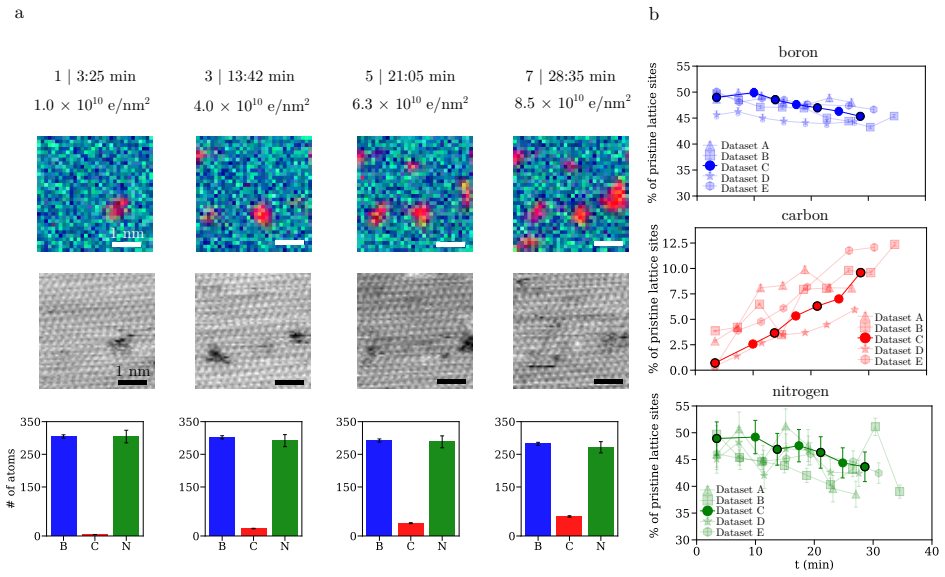
Electron-beam irradiation in a low-pressure methane atmosphere simultaneously generates vacancies in hBN and decomposes methane into individual carbon and hydrogen atoms, producing progressive carbon incorporation into the lattice with 84±7% of carbon-rich regions confined to the exposed area, some diffusion averaging 4.7±0.5 nm beyond it, and incorporated atoms forming hexagonal patterns in patches no larger than ~1 nm.
What carries the argument
Simultaneous vacancy creation in hBN and methane decomposition by the electron beam, tracked via annular dark-field STEM and time-resolved EELS mapping.
If this is right
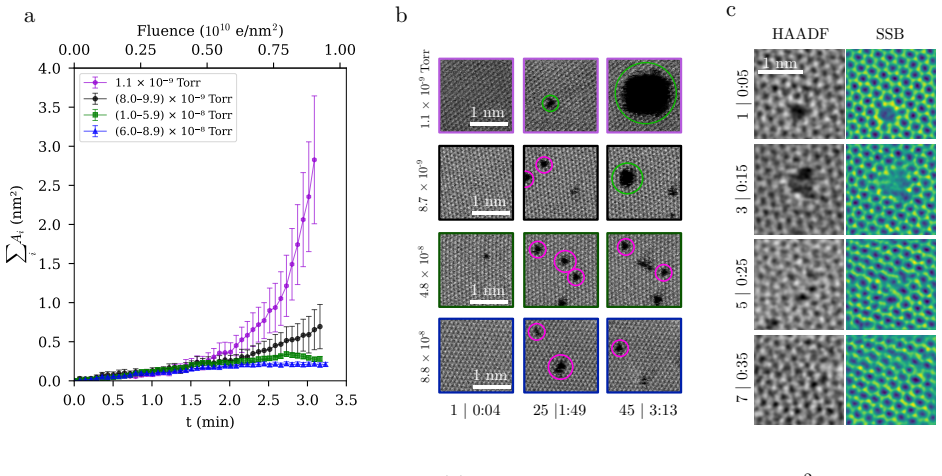
- Higher methane partial pressure suppresses irregular pore growth and favors triangular boron-terminated pores via preferential nitrogen etching.
- Carbon atoms arrange in a hexagonal pattern inside the hBN lattice, forming patches limited to roughly 1 nm.
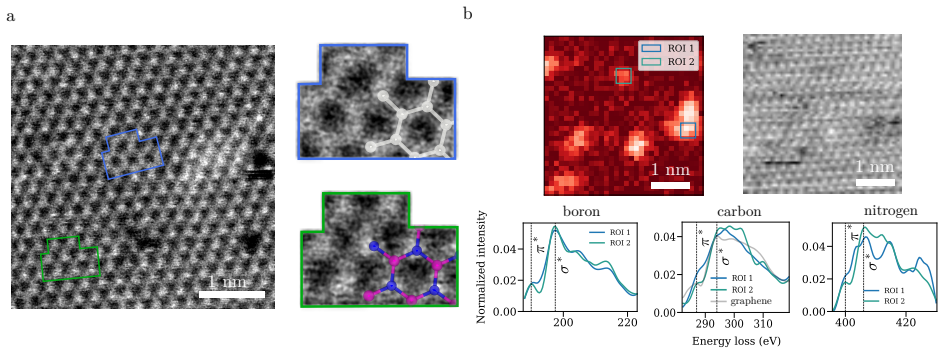
- Local electronic environment around the incorporated carbon changes, as seen in EELS fine structure, with expected effects on optical properties of the defects.
- Most carbon clustering stays within the beam spot while a minority of atoms diffuse a short distance outside it.
Where Pith is reading between the lines
- The method could be used to place carbon-related defects at chosen locations for engineered optical or quantum responses.
- Adjusting beam dose and methane pressure separately might allow independent tuning of vacancy density versus carbon supply.
- The observed 4.7 nm diffusion distance sets a practical limit on how isolated the doped patches can be made.
Load-bearing premise
The detected carbon signal arises mainly from beam-induced breakdown of the supplied methane rather than residual chamber contamination or migration from other sources.
What would settle it
Repeating the irradiation under identical conditions but with no methane gas present and finding no measurable carbon incorporation into the hBN lattice.
Figures
read the original abstract
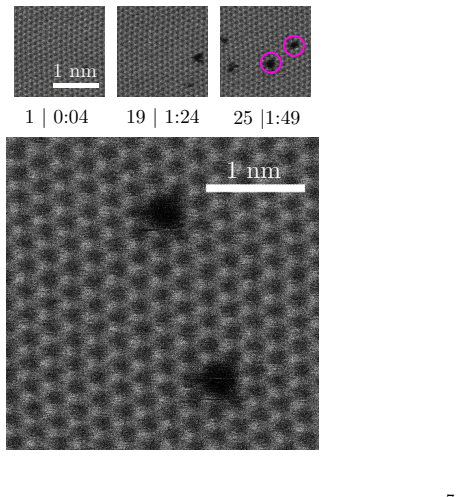
Controlling the spatial incorporation of carbon into hexagonal boron nitride (hBN) is essential for engineering optically active defects, yet existing approaches lack nanoscale precision and control over the carbon supply. Here, we demonstrate a method for carbon doping of hBN using electron-beam irradiation in a low-pressure methane atmosphere, where the beam simultaneously generates vacancies and decomposes methane into individual carbon and hydrogen atoms. Using annular dark-field scanning transmission electron microscopy, we show that increasing the methane partial pressure suppresses pore growth and drives the formation of triangular boron-terminated pores through preferential hydrogen etching of nitrogen. Time-resolved electron energy-loss spectroscopy (EELS) mapping reveals progressive carbon incorporation into the lattice, accompanied by boron and nitrogen depletion. Carbon clustering occurs predominantly within the irradiated area: 84+-7% of carbon-rich regions are confined to the area exposed to the electron beam, while some carbon atoms are also found to diffuse up to an average distance of 4.7+-0.5 nm beyond it. The incorporated carbon atoms arrange in a hexagonal pattern within the lattice, forming patches that do not exceed ~1 nm in size. Analysis of the EELS fine structure indicates modifications to the local electronic environment within these regions, with implications for the optical properties of the resulting carbon-related defects.
Editorial analysis
A structured set of objections, weighed in public.
Referee Report
Summary. The manuscript claims to demonstrate a method for nanoscale carbon doping of hBN via electron-beam irradiation in low-pressure methane, where the beam simultaneously creates vacancies and decomposes CH4. Using ADF-STEM and time-resolved EELS, it reports 84±7% spatial confinement of carbon-rich regions to the irradiated area, average carbon diffusion of 4.7±0.5 nm beyond the beam, formation of ~1 nm hexagonal carbon patches, triangular boron-terminated pores due to H etching, and modifications to local electronic structure.
Significance. If the attribution of carbon incorporation specifically to beam-induced methane decomposition is substantiated, the approach would provide a valuable in-situ technique for controlled doping of hBN with potential applications in engineering optically active defects. The reported confinement statistics and EELS observations of clustering are potentially useful, but the absence of controls for the carbon source limits the current strength of the central claim.
major comments (2)
- [Abstract] Abstract: The progressive carbon incorporation and clustering are attributed to beam-induced methane decomposition, yet no control datasets (e.g., irradiation in vacuum, inert gas, or without methane) or background EELS spectra are reported to exclude residual chamber contamination, surface adsorbates, or pre-existing carbon sources as the origin of the observed EELS carbon signal.
- [Abstract] Abstract: The quantitative values 84±7% confinement and 4.7±0.5 nm diffusion are presented without accompanying details on the statistical methods, baseline subtraction, region-of-interest definition, or error propagation used to derive them from the time-resolved EELS maps and ADF-STEM images.
minor comments (1)
- [Abstract] The abstract states that incorporated carbon atoms 'arrange in a hexagonal pattern' and form patches 'that do not exceed ~1 nm in size,' but additional clarification on the criteria used to identify these patches and the EELS fine-structure analysis would improve reproducibility.
Simulated Author's Rebuttal
We thank the referee for their constructive and detailed review. We address the major comments point-by-point below and will revise the manuscript accordingly.
read point-by-point responses
-
Referee: [Abstract] Abstract: The progressive carbon incorporation and clustering are attributed to beam-induced methane decomposition, yet no control datasets (e.g., irradiation in vacuum, inert gas, or without methane) or background EELS spectra are reported to exclude residual chamber contamination, surface adsorbates, or pre-existing carbon sources as the origin of the observed EELS carbon signal.
Authors: We agree that the absence of explicit control datasets limits the strength of the central claim as presented. Our current evidence rests on the time-resolved increase in carbon signal exclusively during irradiation in the methane atmosphere, the high spatial confinement to the beam area, and the formation of boron-terminated pores consistent with H etching from decomposed methane. To address this, the revised manuscript will include new control experiments (vacuum irradiation) and background EELS spectra from non-irradiated regions to rule out contamination. revision: yes
-
Referee: [Abstract] Abstract: The quantitative values 84±7% confinement and 4.7±0.5 nm diffusion are presented without accompanying details on the statistical methods, baseline subtraction, region-of-interest definition, or error propagation used to derive them from the time-resolved EELS maps and ADF-STEM images.
Authors: The referee is correct that these details were omitted. The confinement percentage was derived by applying intensity thresholds to EELS carbon maps (baseline from pre-irradiation spectra) to identify carbon-rich regions and computing the fraction inside the irradiated area across N=5 independent maps; the diffusion length is the mean distance of outlier carbon pixels beyond the beam edge, with ± values as standard error of the mean. The revised manuscript will add a dedicated methods subsection (and supplementary figures) fully describing ROI selection, baseline procedures, and error propagation. revision: yes
Circularity Check
No circularity: purely experimental observations with no derivations or models
full rationale
The manuscript reports experimental results from STEM imaging and time-resolved EELS mapping in a methane atmosphere. No equations, derivations, fitted parameters, or predictions are present that could reduce to inputs by construction. Reported values (e.g., 84±7% spatial confinement, 4.7±0.5 nm diffusion distance, ~1 nm patch size) are direct measurements from the acquired data, not outputs of any model. No self-citation chains or uniqueness theorems are invoked as load-bearing steps. The work is self-contained against external benchmarks as an experimental demonstration.
Axiom & Free-Parameter Ledger
axioms (1)
- domain assumption Electron energy-loss spectroscopy fine structure reliably indicates carbon incorporation and local electronic environment changes in the hBN lattice
Reference graph
Works this paper leans on
-
[1]
Akbari, S
H. Akbari, S. Biswas, P. K. Jha, J. Wong, B. Vest, and H. A. Atwater, Lifetime-Limited and Tunable Quantum Light Emission in h-BN via Electric Field Modulation, Nano Letters22, 7798 (2022). 15
2022
-
[2]
Dietrich, M
A. Dietrich, M. W. Doherty, I. Aharonovich, and A. Kubanek, Solid-state single photon source with Fourier transform limited lines at room temperature, Physical Review B101, 081401 (2020)
2020
-
[3]
S. X. Li, T. Ichihara, H. Park, G. He, D. Kozawa, Y. Wen, V. B. Koman, Y. Zeng, M. Kuehne, Z. Yuan, S. Faucher, J. H. Warner, and M. S. Strano, Prolonged photostability in hexagonal boron nitride quantum emitters, Communications Materials 2023 4:14, 19 (2023)
2023
-
[4]
Grosso, H
G. Grosso, H. Moon, B. Lienhard, S. Ali, D. K. Efetov, M. M. Furchi, P. Jarillo-Herrero, M. J. Ford, I. Aharonovich, and D. Englund, Tunable and high-purity room temperature single- photon emission from atomic defects in hexagonal boron nitride, Nature Communications 2017 8:18, 1 (2017)
2017
-
[5]
Hanson and D
R. Hanson and D. D. Awschalom, Coherent manipulation of single spins in semiconductors, Nature 2008 453:7198453, 1043 (2008)
2008
-
[6]
J. L. O’Brien, Optical Quantum Computing, Science318, 1567 (2007)
2007
-
[7]
Schirhagl, K
R. Schirhagl, K. Chang, M. Loretz, and C. L. Degen, Nitrogen-vacancy centers in diamond: Nanoscale sensors for physics and biology, Annual Review of Physical Chemistry65, 83 (2014)
2014
-
[8]
Lamprecht, S
D. Lamprecht, S. Chokappa, A. M. Freilinger, B. M. Mayer, M. Melchior, J. Dz´ ıbelov´ a, D. Lor- ber, L. H. Tizei, M. Kociak, C. Mangler, L. Filipovic, and J. Kotakoski, Single photon emitters in hBN: Limitations of atomic resolution imaging and potential sources of error, Ultrami- croscopy282, 114318 (2026)
2026
-
[9]
Iv´ ady, G
V. Iv´ ady, G. Barcza, G. Thiering, S. Li, H. Hamdi, J. P. Chou, O. Legeza, and A. Gali, Ab initio theory of the negatively charged boron vacancy qubit in hexagonal boron nitride, npj Computational Materials 2020 6:16, 41 (2020)
2020
-
[10]
T. Vogl, V. Iv´ ady, I. J. Luxmoore, and H. L. Stern, Defects in hexagonal boron nitride for quantum technologies: a perspective, 2D Materials13, 023001 (2026)
2026
-
[11]
Bourrellier, S
R. Bourrellier, S. Meuret, A. Tararan, O. St´ ephan, M. Kociak, L. H. Tizei, and A. Zobelli, Bright UV single photon emission at point defects in h-BN, Nano Letters16, 4317 (2016)
2016
-
[12]
Zhigulin, K
I. Zhigulin, K. Yamamura, V. Iv´ ady, A. Gale, J. Horder, C. J. Lobo, M. Kianinia, M. Toth, and I. Aharonovich, Photophysics of blue quantum emitters in hexagonal boron nitride, Materials for Quantum Technology3, 015002 (2023)
2023
-
[13]
T. T. Tran, C. Elbadawi, D. Totonjian, C. J. Lobo, G. Grosso, H. Moon, D. R. Englund, M. J. Ford, I. Aharonovich, and M. Toth, Robust multicolor single photon emission from point 16 defects in hexagonal boron nitride, 2017 Conference on Lasers and Electro-Optics (CLEO) 2017-January, 1 (2017)
2017
-
[14]
S. A. Tawfik, S. Ali, M. Fronzi, M. Kianinia, T. T. Tran, C. Stampfl, I. Aharonovich, M. Toth, and M. J. Ford, First-principles investigation of quantum emission from hBN defects, Nanoscale9(2017)
2017
-
[15]
Mendelson, D
N. Mendelson, D. Chugh, J. R. Reimers, T. S. Cheng, A. Gottscholl, H. Long, C. J. Mellor, A. Zettl, V. Dyakonov, P. H. Beton, S. V. Novikov, C. Jagadish, H. H. Tan, M. J. Ford, M. Toth, C. Bradac, and I. Aharonovich, Identifying carbon as the source of visible single- photon emission from hexagonal boron nitride, Nature Materials20(2021)
2021
-
[16]
Williams, A
E. Williams, A. Gale, J. Horder, D. Scognamiglio, M. Toth, and I. Aharonovich, Quantum Emitters in Flux Grown hBN, Crystal Growth and Design25, 2083 (2025)
2083
-
[17]
H. Liu, N. Mendelson, I. H. Abidi, S. Li, Z. Liu, Y. Cai, K. Zhang, J. You, M. Tamtaji, H. Wong, Y. Ding, G. Chen, I. Aharonovich, and Z. Luo, Rational Control on Quantum Emitter Formation in Carbon-Doped Monolayer Hexagonal Boron Nitride, ACS Applied Ma- terials and Interfaces14, 3189 (2022)
2022
-
[18]
T. W. Tang, R. Ritika, M. Tamtaji, H. Liu, Y. Hu, Z. Liu, P. R. Galligan, M. Xu, J. Shen, J. Wang, J. You, Y. Li, G. H. Chen, I. Aharonovich, and Z. Luo, Structured-Defect Engineering of Hexagonal Boron Nitride for Identified Visible Single-Photon Emitters, ACS Nano19, 8509 (2025)
2025
-
[19]
Zhong, S
D. Zhong, S. Gao, M. Saccone, J. R. Greer, M. Bernardi, S. Nadj-Perge, and A. Faraon, Carbon-Related Quantum Emitter in Hexagonal Boron Nitride with Homogeneous Energy and 3-Fold Polarization, Nano Letters24, 1106 (2024)
2024
-
[20]
Ngamprapawat, J
S. Ngamprapawat, J. Kawase, T. Nishimura, K. Watanabe, T. Taniguchi, K. Nagashio, S. Ngamprapawat, J. Kawase, T. Nishimura, K. Nagashio, K. Watanabe, and T. Taniguchi, From h-BN to Graphene: Characterizations of Hybrid Carbon-Doped h-BN for Applications in Electronic and Optoelectronic Devices, Advanced Electronic Materials9, 2300083 (2023)
2023
-
[21]
Y. T. Wu, X. Guo, P. T. Jing, G. L. Liu, Z. Cheng, J. L. Xu, Y. Bao, H. Xu, L. G. Zhang, D. Zhan, J. X. Yan, L. Liu, and D. Z. Shen, Site-Controlled Carbon Implantation for Quantum Emitter Engineering in Hexagonal Boron Nitride, ACS Applied Materials and Interfaces17, 64864 (2025). 17
2025
-
[22]
X. Wei, M. S. Wang, Y. Bando, and D. Golberg, Electron-beam-induced substitutional carbon doping of boron nitride nanosheets, nanoribbons, and nanotubes, ACS Nano5(2011)
2011
-
[23]
X. Wei, M. S. Wang, Y. Bando, and D. Golberg, Post-synthesis carbon doping of individual multiwalled boron nitride nanotubes via electron-beam irradiation, Journal of the American Chemical Society132(2010)
2010
-
[24]
H. Park, Y. Wen, S. Xin Li, W. Choi, G.-D. Lee, M. Strano, J. H. Warner, H. Park, J. H. Warner, Y. Wen, S. X. Li, M. Strano, W. Choi, and G.-d. Lee, Atomically Precise Control of Carbon Insertion into hBN Monolayer Point Vacancies using a Focused Electron Beam Guide, Small17, 2100693 (2021)
2021
-
[25]
T. A. Bui, G. T. Leuthner, J. Madsen, M. R. Monazam, A. I. Chirita, A. Postl, C. Mangler, J. Kotakoski, and T. Susi, Creation of Single Vacancies in hBN with Electron Irradiation, Small19(2023)
2023
-
[26]
Kotakoski, C
J. Kotakoski, C. H. Jin, O. Lehtinen, K. Suenaga, and A. V. Krasheninnikov, Electron knock- on damage in hexagonal boron nitride monolayers, Physical Review B - Condensed Matter and Materials Physics82(2010)
2010
-
[27]
Origin of circular and triangular pores in electron-irradiated hexagonal boron nitride
U. Javed, C. Kofler, C. Mangler, and J. Kotakoski, Influence of low-pressure atmosphere in the pores formed in hexagonal boron nitride under electron irradiation, arXiv , 2507.13180 (2026)
work page internal anchor Pith review Pith/arXiv arXiv 2026
-
[28]
Irschik, D
P. Irschik, D. Lamprecht, S. Chokappa, C. Mangler, C. Speckmann, T. A. Bui, M. L¨ angle, L. Filipovic, and J. Kotakoski, Atomically clean free-standing two-dimensional materials through heating in ultra-high vacuum, 2D Materials13, 025001 (2026)
2026
-
[29]
G. T. Leuthner, S. Hummel, C. Mangler, T. J. Pennycook, T. Susi, J. C. Meyer, and J. Kotakoski, Scanning transmission electron microscopy under controlled low-pressure at- mospheres, Ultramicroscopy203, 76 (2019)
2019
-
[30]
E. H. ˚Ahlgren, A. Markevich, S. Scharinger, B. Fickl, G. Zagler, F. Herterich, N. McEvoy, C. Mangler, and J. Kotakoski, Atomic-Scale Oxygen-Mediated Etching of 2D MoS2 and MoTe2, Advanced Materials Interfaces9(2022)
2022
-
[31]
G. T. Leuthner, T. Susi, C. Mangler, J. C. Meyer, and J. Kotakoski, Chemistry at graphene edges in the electron microscope, 2D Materials8, 10.1088/2053-1583/abf624 (2021)
-
[32]
Kotakoski, D
J. Kotakoski, D. Santos-Cottin, and A. V. Krasheninnikov, Stability of graphene edges under electron beam: Equilibrium energetics versus dynamic effects, ACS Nano6, 671 (2012). 18
2012
-
[33]
S. Li, A. Pershin, G. Thiering, P. Udvarhelyi, and A. Gali, Ultraviolet Quantum Emitters in Hexagonal Boron Nitride from Carbon Clusters, Journal of Physical Chemistry Letters13, 3150 (2022)
2022
-
[34]
Z. Qiu, K. Vaklinova, P. Huang, M. Grzeszczyk, K. Watanabe, T. Taniguchi, K. S. Novoselov, J. Lu, and M. Koperski, Atomic and Electronic Structure of Defects in hBN: Enhancing Single-Defect Functionalities, ACS Nano18, 24035 (2024)
2024
-
[35]
Mangler, J
C. Mangler, J. Meyer, A. Mittelberger, K. Mustonen, T. Susi, and J. Kotakoski, A Materials Scientist’s CANVAS: A System for Controlled Alteration of Nanomaterials in Vacuum Down to the Atomic Scale, Microscopy and Microanalysis28, 2940 (2022)
2022
-
[36]
Speckmann, J
C. Speckmann, J. Lang, J. Madsen, M. R. A. Monazam, G. Zagler, G. T. Leuthner, N. McEvoy, C. Mangler, T. Susi, and J. Kotakoski, Combined electronic excitation and knock-on damage in monolayer MoS2, Physical Review B107, 094112 (2023)
2023
-
[37]
T. Susi, T. P. Hardcastle, H. Hofs¨ ass, A. Mittelberger, T. J. Pennycook, C. Mangler, R. Drummond-Brydson, A. J. Scott, J. C. Meyer, and J. Kotakoski, Single-atom spectroscopy of phosphorus dopants implanted into graphene, 2D Materials4, 021013 (2017)
2017
-
[38]
Susi, Quantifying phase magnitudes of open-source focused-probe 4D-STEM ptychography reconstructions, Journal of Microscopy300, 201 (2025)
T. Susi, Quantifying phase magnitudes of open-source focused-probe 4D-STEM ptychography reconstructions, Journal of Microscopy300, 201 (2025)
2025
-
[39]
Varnavides, J
G. Varnavides, J. M. Bekkevold, S. M. Ribet, M. C. Scott, L. Jones, and C. Ophus, Relaxing direct ptychography sampling requirements via parallax imaging insights, Microscopy and Microanalysis (2025)
2025
-
[40]
quantEM, Quantitative electron microscopy data analysis toolkit,https://github.com/ electronmicroscopy/quantem(2026)
2026
-
[41]
de la Pe˜ na, pburdet, M
F. de la Pe˜ na, pburdet, M. Sarahan, magnunor, T. Ostasevicius, J. Taillon, A. Eljarrat, S. Mazzucco, vidartf, Ga¨ el, L. F. Zagonel, M. Walls, and iygr, Hyperspy: HyperSpy 0.8, Zenodo (2015)
2015
-
[42]
de la Pe˜ na, E
F. de la Pe˜ na, E. Prestat, P. Burdet, J. L¨ ahnemann, K. E. MacArthur, V. T. Fauske, M. Sara- han, C. Francis, D. N. Johnstone, T. Ostasevicius, V. Migunov, T. Furnival, M. Nord, S. Maz- zucco, A. Eljarrat, J. Caron, T. Aarholt, T. Poon, Z. Zhang, P. Jokubauskas, actions-user, F. Winkler, J. Taillon, T. Slater, pquinn-dls, G. Guzzinati, J. C. Myers, and...
2025
-
[43]
EELS.info,https://eels.info/, [Online; accessed 26-May-2026]. 19 Supplemental Material Electron-beam-induced carbon doping of hexagonal boron nitride 20 Dataset A 1 | 3:25 min 1.0×10¹⁰ e/nm2 2 | 7:13 min 2.12×10¹⁰ e/nm2 3 | 11:17 min 3.31×10¹⁰ e/nm2 4 | 15:08 min 4.44×10¹⁰ e/nm2 5 | 18:56 min 5.55×10¹⁰ e/nm2 6 | 23:10 min 6.80×10¹⁰ e/nm2 7 | 27:04 min 7.9...
2026
discussion (0)
Sign in with ORCID, Apple, or X to comment. Anyone can read and Pith papers without signing in.