Ultrafast dynamics of excitons in black phosphorus
Pith reviewed 2026-06-29 10:57 UTC · model grok-4.3
The pith
Phonon-mediated intravalley scattering limits coherent exciton phenomena in single-valley semiconductors like black phosphorus.
A machine-rendered reading of the paper's core claim, the machinery that carries it, and where it could break.
Core claim
Excitons in black phosphorus, generated by resonant mid-infrared photoexcitation, decohere into dark excitons through phonon-mediated intravalley scattering. The quantum-kinetic framework models this process and, when matched to time-resolved photoemission data, quantifies the key parameters of the early non-equilibrium dynamics, establishing phonon scattering as the fundamental limitation for coherent exciton phenomena in single-valley semiconductors.
What carries the argument
Quantum-kinetic theoretical framework that models the decoherence of bright excitons into dark excitons via phonon scattering.
If this is right
- Coherent optical control of the electronic structure is restricted by this intravalley phonon channel in single-valley materials.
- The extracted scattering parameters provide quantitative benchmarks for predicting exciton lifetimes in similar direct-gap semiconductors.
- Design of light-induced band engineering must incorporate strategies that either suppress or exploit this phonon-mediated decoherence.
- Dark exciton populations build up rapidly and must be included in any model of the non-equilibrium state reached after photoexcitation.
Where Pith is reading between the lines
- The same phonon-scattering limit is likely to constrain coherent exciton effects in other single-valley semiconductors not studied here.
- Materials with multiple valleys might show different balances between intra- and intervalley channels, altering the dominant decoherence path.
- Time-resolved photoemission combined with quantum-kinetic modeling could be extended to test whether external fields or strain can tune the phonon scattering rates.
- Device concepts relying on long-lived coherent excitons would need phonon engineering, such as encapsulation or isotopic control, to mitigate the identified limit.
Load-bearing premise
The resonant mid-infrared photoexcitation generates excitons whose observed dynamics are accurately captured by the quantum-kinetic model of phonon scattering without significant contributions from other decoherence channels or experimental artifacts.
What would settle it
Measured exciton decay curves or momentum distributions that deviate markedly from the phonon-scattering predictions, such as coherence times much longer than a few picoseconds or scattering rates inconsistent with the fitted parameters.
Figures
read the original abstract
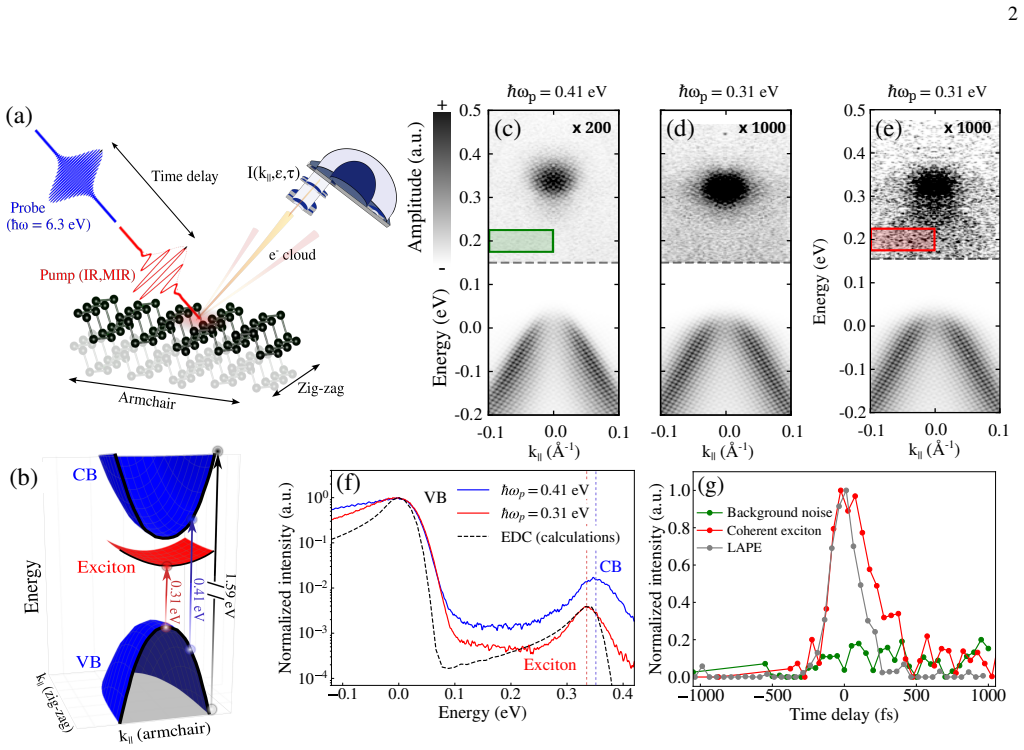
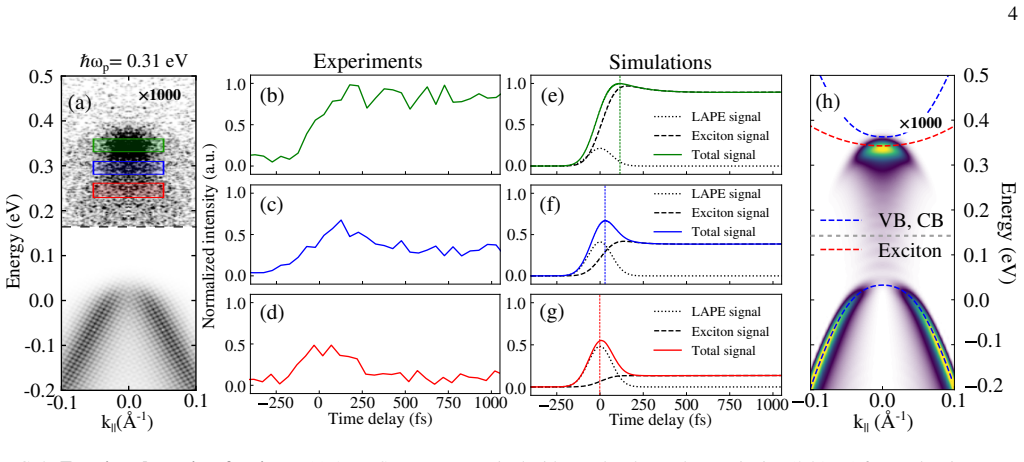
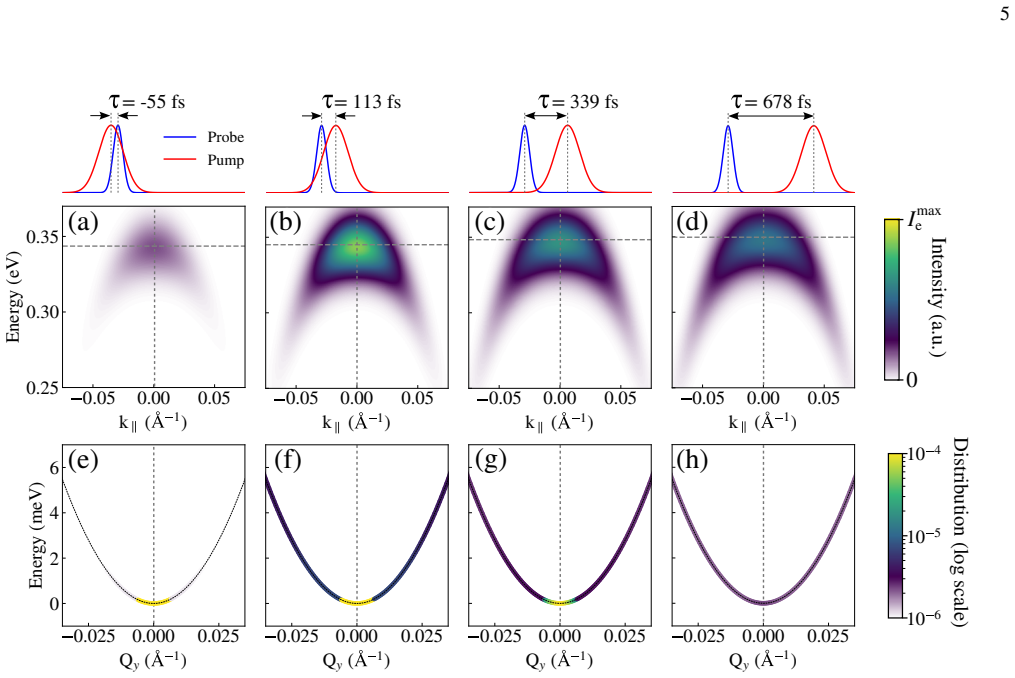
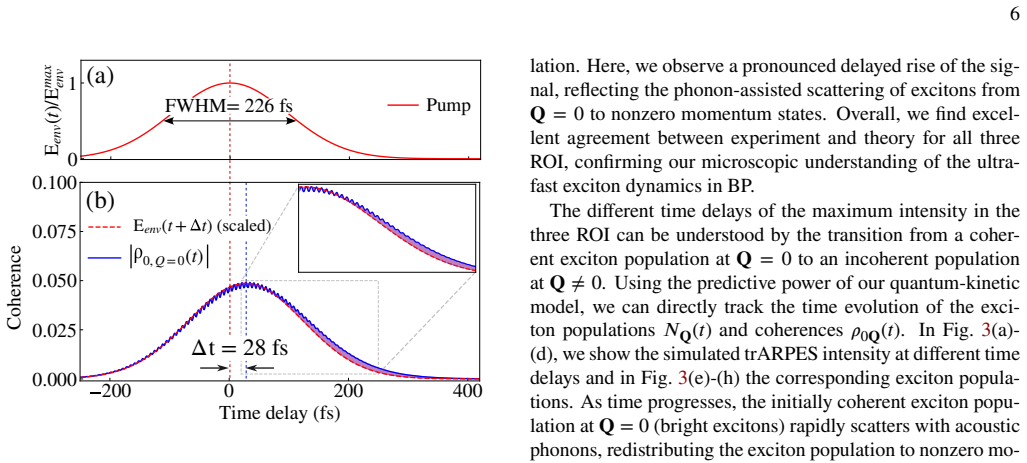
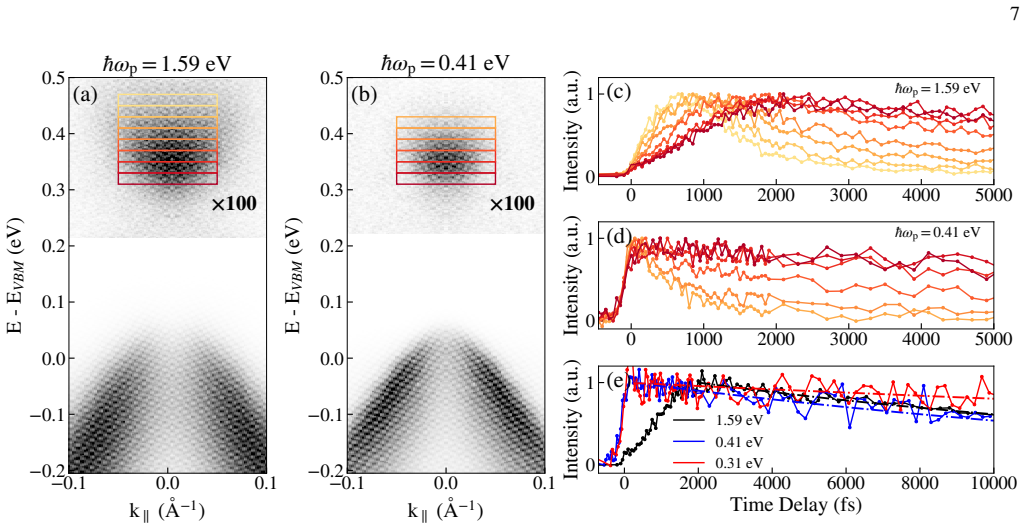
Excitons are key quasiparticles determining the optical properties of solids. As such, they can be utilized to coherently control the electronic structure of materials using optical femtosecond pulses. Identifying the decoherence mechanism during the early non-equilibrium dynamics is crucial to achieve light-induced band-structure engineering in semiconductors. Here, we generate excitons in the direct band gap semiconductor black phosphorus with a resonant mid-infrared photoexcitation. Using time- and angle-resolved photoemission spectroscopy, we track their complex ultrafast dynamics on the few-picosecond time scale. We develop a quantum-kinetic theoretical framework to model the decoherence of excitons into dark excitons via phonon scattering. By combining simulation and experiment, we quantify key parameters describing the early dynamics of the excitons. Our work highlights phonon-mediated intravalley scattering as a fundamental limitation for coherent exciton phenomena in single-valley semiconductors.
Editorial analysis
A structured set of objections, weighed in public.
Referee Report
Summary. The paper reports generation of excitons in the direct-gap semiconductor black phosphorus via resonant mid-infrared photoexcitation, followed by tracking of their ultrafast dynamics on the few-picosecond scale with time- and angle-resolved photoemission spectroscopy (tr-ARPES). A quantum-kinetic theoretical framework is developed to model decoherence of bright excitons into dark excitons via phonon scattering; by combining the simulation with the experimental traces the authors quantify key parameters of the early dynamics and conclude that phonon-mediated intravalley scattering constitutes a fundamental limitation for coherent exciton phenomena in single-valley semiconductors.
Significance. If the quantum-kinetic model is demonstrated to reproduce the measured tr-ARPES dynamics quantitatively with no significant residual from other decoherence channels, the work would identify a concrete microscopic limit on coherent optical control in single-valley materials and supply extractable parameters for future modeling. The present manuscript, however, supplies no evidence that alternative channels have been ruled out, so the central claim remains conditional on that untested assumption.
major comments (2)
- [Abstract] Abstract: the claim that phonon-mediated intravalley scattering is a 'fundamental limitation' requires that the quantum-kinetic phonon-scattering model quantitatively accounts for the observed tr-ARPES dynamics without appreciable residuals from other processes (defect scattering, electron-electron interactions, or experimental broadening). The abstract provides no indication of alternative-model comparisons, temperature-dependent controls, or sample-variation checks that would establish phonon scattering as the dominant channel.
- [Abstract] Abstract: the statement that the model is used to 'quantify key parameters' by combining simulation and experiment does not specify whether the extracted parameters are independent predictions or obtained by fitting to the same tr-ARPES traces later used for validation; without such separation the inference that the model captures the dynamics is at risk of circularity.
Simulated Author's Rebuttal
We thank the referee for the constructive comments on our manuscript. We agree that the abstract requires clarification to accurately represent the strength of our claims and the nature of the parameter extraction. We address each point below and will revise the abstract accordingly.
read point-by-point responses
-
Referee: [Abstract] Abstract: the claim that phonon-mediated intravalley scattering is a 'fundamental limitation' requires that the quantum-kinetic phonon-scattering model quantitatively accounts for the observed tr-ARPES dynamics without appreciable residuals from other processes (defect scattering, electron-electron interactions, or experimental broadening). The abstract provides no indication of alternative-model comparisons, temperature-dependent controls, or sample-variation checks that would establish phonon scattering as the dominant channel.
Authors: We agree that the abstract overstates the exclusivity of the phonon channel. The main text shows quantitative agreement between the quantum-kinetic model and the tr-ARPES traces, but we did not perform dedicated alternative-model comparisons or temperature-dependent controls to rule out other contributions. We will revise the abstract to replace 'fundamental limitation' with 'important limitation' and add a clause noting that the model reproduces the observed dynamics while other channels cannot be excluded on the basis of the present data alone. revision: yes
-
Referee: [Abstract] Abstract: the statement that the model is used to 'quantify key parameters' by combining simulation and experiment does not specify whether the extracted parameters are independent predictions or obtained by fitting to the same tr-ARPES traces later used for validation; without such separation the inference that the model captures the dynamics is at risk of circularity.
Authors: The quantum-kinetic model supplies the microscopic form of the phonon-scattering rates from first-principles matrix elements; the experiment is used only to fix overall scaling factors and initial exciton populations. The longer-time evolution then serves as an independent check. To remove ambiguity we will revise the abstract to state that the key parameters are the scattering rates obtained from the model and constrained by matching the early-time dynamics, with the subsequent evolution providing validation. revision: yes
Circularity Check
No circularity detected; derivation relies on independent model-experiment comparison without self-referential reduction
full rationale
The abstract describes developing a quantum-kinetic framework and combining it with tr-ARPES data to quantify parameters. Without explicit equations or self-citations in the provided text that reduce a claimed prediction to a fitted input by construction, and absent any load-bearing self-citation chain or ansatz smuggling, the central claim does not exhibit the enumerated circular patterns. The derivation appears self-contained against external benchmarks (experimental traces and phonon scattering theory), consistent with a normal non-finding.
Axiom & Free-Parameter Ledger
Reference graph
Works this paper leans on
-
[1]
G. Wang, A. Chernikov, M. M. Glazov, T. F. Heinz, X. Marie, T. Amand, and B. Urbaszek,Colloquium: Excitons in atomi- callythintransitionmetaldichalcogenides,Rev.Mod.Phys.90, 021001 (2018)
2018
-
[2]
Gucci, E
F. Gucci, E. B. Molinero, M. Russo, P. San-Jose, F. V. A. Ca- margo,M.Maiuri,M.Ivanov,A.Jiménez-Galán,R.E.F.Silva, S. Dal Conte, and G. Cerullo, Encoding and manipulating ul- trafast coherent valleytronic information with lightwaves, Nat. Photon.20, 266 (2026)
2026
-
[3]
J.Kasprzak,M.Richard,S.Kundermann,A.Baas,P.Jeambrun, J. M. J. Keeling, F. M. Marchetti, M. H. Szymańska, R. André, J.L.Staehli,V.Savona,P.B.Littlewood,B.Deveaud,andL.S. Dang,Bose-Einsteincondensationofexcitonpolaritons,Nature 443, 409 (2006)
2006
-
[4]
Kobayashi, C
Y. Kobayashi, C. Heide, A. C. Johnson, V. Tiwari, F. Liu, D. A. Reis, T. F. Heinz, and S. Ghimire, Floquet engineering 9 ofstronglydrivenexcitonsinmonolayertungstendisulfide,Na- ture Physics19, 171 (2023)
2023
-
[5]
Menezes,N.S.Chan,J.P.Urquizo,K.Watanabe,T.Taniguchi, E
V.Pareek,D.R.Bacon,X.Zhu,Y.-H.Chan,F.Bussolotti,M.G. Menezes,N.S.Chan,J.P.Urquizo,K.Watanabe,T.Taniguchi, E. Perfetto, M. K. L. Man, J. Madéo, G. Stefanucci, D. Y. Qiu, K.E.J.Goh,F.H.daJornada,andK.M.Dani,DrivingFloquet physics with excitonic fields, Nature Physics22, 209 (2026)
2026
-
[6]
Y.-H. Chan, D. Y. Qiu, F. H. da Jornada, and S. G. Louie, Gi- antself-drivenexciton-Floquetsignaturesintime-resolvedpho- toemissionspectroscopyofMoS 2 fromtime-dependentGWap- proach, Proceedings of the National Academy of Sciences120, e2301957120 (2023)
2023
-
[7]
Antonius and S
G. Antonius and S. G. Louie, Theory of exciton-phonon cou- pling, Phys. Rev. B105, 085111 (2022)
2022
-
[8]
Y.-h. Chan, J. B. Haber, M. H. Naik, J. B. Neaton, D. Y. Qiu, F. H. Da Jornada, and S. G. Louie, Exciton Lifetime and Opti- calLineWidthProfileviaExciton-PhononInteractions: Theory and First-Principles Calculations for Monolayer MoS2, Nano Lett.23, 3971 (2023)
2023
-
[9]
Lechifflart, F
P. Lechifflart, F. Paleari, D. Sangalli, and C. Attaccalite, First- principlesstudyofluminescenceinhexagonalboronnitridesin- gle layer: Exciton-phonon coupling and the role of substrate, Phys. Rev. Materials7, 024006 (2023)
2023
-
[10]
Quantum Electron
M.KiraandS.Koch,Many-bodycorrelationsandexcitonicef- fects in semiconductor spectroscopy, Prog. Quantum Electron. 30, 155 (2006)
2006
-
[11]
H.-Y.Chen,D.Sangalli,andM.Bernardi,First-principlesultra- fast exciton dynamics and time-domain spectroscopies: Dark- exciton mediated valley depolarization in monolayer WSe2, Phys. Rev. Research4, 043203 (2022)
2022
-
[12]
Stefanucci and E
G. Stefanucci and E. Perfetto, Excitonic Bloch equations from first principles, SciPost Phys.18, 009 (2025)
2025
-
[13]
Y.-h. Chan, M. H. Naik, J. B. Haber, J. B. Neaton, S. G. Louie, D. Y. Qiu, and F. H. Da Jornada, Exciton-Phonon Coupling In- duces a New Pathway for Ultrafast Intralayer-to-Interlayer Ex- citon Transition and Interlayer Charge Transfer in WS2 -MoS2 Heterostructure: A First-Principles Study, Nano Lett.24, 7972 (2024)
2024
-
[14]
Y.-h. Chan, J. B. Haber, M. H. Naik, S. G. Louie, J. B. Neaton, F.H.DaJornada,andD.Y.Qiu,Excitonthermalizationdynam- ics in monolayer MoS2 : A first-principles Boltzmann equation study, Phys. Rev. B111, 184305 (2025)
2025
-
[15]
H. Mittenzwey, O. Voigt, and A. Knorr, Excitonic theory of the ultrafast optical response of 2d-quantum-confined semicon- ductors at elevated densities (2026), arXiv:2512.03198 [cond- mat.mes-hall]
-
[16]
Dogadov, H
O. Dogadov, H. Mittenzwey, M. Bertolotti, N. Olsen, T. Deck- ert, C. Trovatello, X. Zhu, D. Brida, G. Cerullo, A. Knorr, and S. Dal Conte, Dissecting intervalley coupling mechanisms in monolayertransitionmetaldichalcogenides,npj2DMaterAppl 10, 21 (2026)
2026
-
[17]
Boschini, M
F. Boschini, M. Zonno, and A. Damascelli, Time-resolved ARPES studies of quantum materials, Rev. Mod. Phys.96, 015003 (2024)
2024
-
[18]
Karmakar, E
M.K.L.Man,J.Madéo,C.Sahoo,K.Xie,M.Campbell,V.Pa- reek, A. Karmakar, E. L. Wong, A. Al-Mahboob, N. S. Chan, D.R.Bacon,X.Zhu,M.M.M.Abdelrasoul,X.Li,T.F.Heinz, F. H. da Jornada, T. Cao, and K. M. Dani, Experimental mea- surement of the intrinsic excitonic wave function, Science Ad- vances7, eabg0192 (2021)
2021
-
[19]
S. Dong, M. Puppin, T. Pincelli, S. Beaulieu, C. Christiansen, H. Huebener, C. Nicholso, R. Xian, M. Dendzik, Y. Deng, Y. Windsor, M. Selig, E. Malic, A. Rubio, A. Knorr, M. Wolf, L. Rettig, and R. Ernstorfer, Directmeasurement of key exci- tonproperties: Energy,dynamics,andspatialdistributionofthe wave function, Natural Sciences1, e10010. (2021)
2021
-
[20]
Reutzel, G
M. Reutzel, G. S. M. Jansen, and S. Mathias, Probing exci- tons with time-resolved momentum microscopy, Advances in Physics: X9, 2378722 (2024)
2024
-
[21]
Bertoni, C
R. Bertoni, C. W. Nicholson, L. Waldecker, H. Hübener, C. Monney, U. De Giovannini, M. Puppin, M. Hoesch, E.Springate,R.T.Chapman,C.Cacho,M.Wolf,A.Rubio,and R. Ernstorfer, Generation and evolution of spin-, valley-, and layer-polarized excited carriers in inversion-symmetric WSe2, Phys. Rev. Lett.117, 277201 (2016)
2016
-
[22]
H.-Y.Chen,D.Sangalli,andM.Bernardi,First-principlesultra- fast exciton dynamics and time-domain spectroscopies: Dark- exciton mediated valley depolarization in monolayer WSe2, Phys. Rev. Res.4, 043203 (2022)
2022
-
[23]
Achstein, C
S.Helmrich,K.Sampson,D.Huang,M.Selig,K.Hao,K.Tran, A. Achstein, C. Young, A. Knorr, E. Malic, U. Woggon, N. Owschimikow, and X. Li, Phonon-assisted intervalley scat- teringdeterminesultrafastexcitondynamicsinMoSe 2 bilayers, Phys. Rev. Lett.127, 157403 (2021)
2021
-
[24]
Schmitt, J
D. Schmitt, J. P. Bange, W. Bennecke, A. AlMutairi, G.Meneghini,K.Watanabe,T.Taniguchi,D.Steil,D.R.Luke, R.T.Weitz,S.Steil,G.S.M.Jansen,S.Brem,E.Malic,S.Hof- mann, M. Reutzel, and S. Mathias, Formation of moiré inter- layer excitons in space and time, Nature608, 499 (2022)
2022
-
[25]
D.Christiansen,M.Selig,E.Malic,R.Ernstorfer,andA.Knorr, Theoryofexcitondynamicsintime-resolvedARPES:Intra-and intervalleyscatteringintwo-dimensionalsemiconductors,Phys. Rev. B100, 205401 (2019)
2019
-
[26]
Güdde, K
R.Wallauer,R.Perea-Causin,L.Münster,S.Zajusch,S.Brem, J. Güdde, K. Tanimura, K.-Q. Lin, R. Huber, E. Malic, and U.Höfer,Momentum-resolvedobservationofexcitonformation dynamics in monolayer WS2, Nano Letters21, 5867 (2021)
2021
-
[27]
V. Tran, R. Soklaski, Y. Liang, and L. Yang, Layer-controlled band gap and anisotropic excitons in few-layer black phospho- rus, Phys. Rev. B89, 235319 (2014)
2014
-
[28]
Zhang, A
G. Zhang, A. Chaves, S. Huang, F. Wang, Q. Xing, T. Low, and H. Yan, Determination of layer-dependent exciton binding energies in few-layer black phosphorus, Sci. Adv.4, eaap9977 (2018)
2018
-
[29]
X. Wang, A. M. Jones, K. L. Seyler, V. Tran, Y. Jia, H. Zhao, H.Wang,L.Yang,X.Xu,andF.Xia,Highlyanisotropicandro- bust excitons in monolayer black phosphorus, Nature Nanotech 10, 517 (2015)
2015
-
[30]
Zahn, P.-N
D. Zahn, P.-N. Hildebrandt, T. Vasileiadis, Y. W. Windsor, Y.Qi,H.Seiler,andR.Ernstorfer,AnisotropicNonequilibrium Lattice Dynamics of Black Phosphorus, Nano Lett.20, 3728 (2020)
2020
-
[31]
Montanaro, F
A. Montanaro, F. Giusti, M. Zanfrognini, P. Di Pietro, F. Glerean, G. Jarc, E. M. Rigoni, S. Y. Mathengattil, D.Varsano,M.Rontani,A.Perucchi,E.Molinari,andD.Fausti, Anomalous non-equilibrium response in black phosphorus to sub-gapmid-infraredexcitation,NatCommun13,2667(2022)
2022
-
[32]
G. Shen, X. Tian, L. Cao, H. Guo, X. Li, Y. Tian, X. Cui, M. Feng, J. Zhao, B. Wang, H. Petek, and S. Tan, Ultrafast en- ergizing the parity-forbidden dark exciton in black phosphorus, Nature Communications16, 3992 (2025)
2025
-
[33]
Dendzik, A
M. Dendzik, A. Marini, S. Beaulieu, S. Dong, T. Pincelli, J. Maklar, R. P. Xian, E. Perfetto, M. Wolf, G. Stefanucci, R. Ernstorfer, and L. Rettig, Ultrafast nonlinear Hall effect in black phosphorus (2026)
2026
-
[34]
E.Golias,M.Krivenkov,andJ.Sánchez-Barriga,Disentangling bulk from surface contributions in the electronic structure of black phosphorus, Phys. Rev. B93, 075207 (2016). 10
2016
-
[35]
Carré, L
E. Carré, L. Sponza, A. Lusson, I. Stenger, E. Gaufrès, A. Loiseau, and J. Barjon, Excitons in bulk black phosphorus evidenced by photoluminescence at low temperature, 2D Mate- rials8, 021001 (2021)
2021
-
[36]
Rustagi and A
A. Rustagi and A. F. Kemper, Photoemission signature of exci- tons, Phys. Rev. B97, 235310 (2018)
2018
-
[37]
Onida, L
G. Onida, L. Reining, and A. Rubio, Electronic excita- tions: density-functional versus many-body Green’s-function approaches, Rev. Mod. Phys.74, 601 (2002)
2002
-
[38]
Beaulieu, S
S. Beaulieu, S. Dong, V. Christiansson, P. Werner, T. Pin- celli, J. D. Ziegler, T. Taniguchi, K. Watanabe, A. Chernikov, M. Wolf, L. Rettig, R. Ernstorfer, and M. Schüler, Berry curva- ture signatures in chiroptical excitonic transitions, Science Ad- vances10, eadk3897 (2024)
2024
-
[39]
Pizzi, V
G. Pizzi, V. Vitale, R. Arita, S. Blügel, F. Freimuth, G. Géran- ton,M.Gibertini,D.Gresch,C.Johnson,T.Koretsune,J.Ibañez Azpiroz, H. Lee, J.-M. Lihm, D. Marchand, A. Marrazzo, Y.Mokrousov,J.I.Mustafa,Y.Nohara,Y.Nomura,L.Paulatto, S. Poncé, T. Ponweiser, J. Qiao, F. Thöle, S. S. Tsirkin, M. Wierzbowska, N. Marzari, D. Vanderbilt, I. Souza, A. A. Mostofi,an...
2020
-
[41]
M.Bieniek,K.Sadecka,L.Szulakowska,andP.Hawrylak,The- ory of Excitons in Atomically Thin Semiconductors: Tight- Binding Approach, Nanomaterials12, 1582 (2022)
2022
-
[42]
A.C.Dias, J.F.Silveira,andF.Qu,WanTiBEXOS:AWannier based Tight Binding code for electronic band structure, exci- tonicandoptoelectronicpropertiesofsolids,Comp.Phys.Com- mun.285, 108636 (2023)
2023
-
[43]
Rohlfing and S
M. Rohlfing and S. G. Louie, Electron-hole excitations and op- ticalspectrafromfirstprinciples,Phys.Rev.B62,4927(2000)
2000
-
[44]
Perfetto and G
E. Perfetto and G. Stefanucci, Real-TimeGW-Ehrenfest-Fan- Migdal Method for Nonequilibrium 2D Materials, Nano Lett. 23, 7029 (2023)
2023
-
[45]
Lindberg and S
M. Lindberg and S. W. Koch, Effective Bloch equations for semiconductors, Phys. Rev. B38, 3342 (1988)
1988
-
[46]
Stefanucci and E
G. Stefanucci and E. Perfetto, Semiconductor electron-phonon equations: A rung above Boltzmann in the many-body ladder, SciPost Phys.16, 073 (2024)
2024
-
[47]
S.Mocatti,G.Marini,G.Volpato,P.Cudazzo,andM.Calandra, Nonequilibrium Photocarrier and Phonon Dynamics from First Principles: a Unified Treatment of Carrier-Carrier, Carrier- Phonon, and Phonon-Phonon Scattering (2025)
2025
-
[48]
G. Stefanucci and E. Perfetto, Unified first-principles formula fortime-resolvedarpesspectraofcoherentandincoherentexci- tons (2026), arXiv:2601.16786 [cond-mat.mtrl-sci]
-
[49]
Schüler and M
M. Schüler and M. A. Sentef, Theory of subcycle time- resolvedphotoemission: Applicationtoterahertzphotodressing ingraphene,JournalofElectronSpectroscopyandRelatedPhe- nomena253, 147121 (2021)
2021
-
[50]
Sheng, X
C.Bao,M.Schüler,T.Xiao,F.Wang,H.Zhong,T.Lin,X.Cai, T. Sheng, X. Tang, H. Zhang, P. Yu, Z. Sun, W. Duan, and S. Zhou, Manipulating the symmetry of photon-dressed elec- tronic states, Nature Communications15, 10535 (2024)
2024
-
[51]
491–597, chaps
C.F.Klingshirn,SemiconductorOptics,4thed.(SpringerBerlin Heidelberg, Berlin, Heidelberg, 2012) pp. 491–597, chaps. 19– 21
2012
-
[52]
Kremer, M
G. Kremer, M. Rumo, C. Yue, A. Pulkkinen, C. W. Nicholson, T. Jaouen, F. O. von Rohr, P. Werner, and C. Monney, Ultrafast dynamicsofthesurfacephotovoltageinpotassium-dopedblack phosphorus, Physical Review B104, 035125 (2021)
2021
-
[53]
Z. Chen, J. Dong, E. Papalazarou, M. Marsi, C. Giorgetti, Z. Zhang, B. Tian, J.-P. Rueff, A. Taleb-Ibrahimi, and L. Per- fetti, Band Gap Renormalization, Carrier Multiplication, and StarkBroadeninginPhotoexcitedBlackPhosphorus,NanoLet- ters19, 488 (2019)
2019
-
[54]
Hedayat, A
H. Hedayat, A. Ceraso, G. Soavi, S. Akhavan, A. Cadore, C. Dallera, G. Cerullo, A. C. Ferrari, and E. Carpene, Non- equilibriumbandbroadening,gaprenormalizationandbandin- version in black phosphorus, 2D Materials8, 025020 (2021)
2021
-
[55]
S. Roth, A. Crepaldi, M. Puppin, G. Gatti, D. Bugini, I. Grimaldi, T. R. Barrilot, C. A. Arrell, F. Frassetto, L. Po- letto, M. Chergui, A. Marini, and M. Grioni, Photocarrier- induced band-gap renormalization and ultrafast charge dynam- ics in black phosphorus, 2D Materials6, 031001 (2019)
2019
-
[56]
Sangalli, E
D. Sangalli, E. Perfetto, G. Stefanucci, and A. Marini, An ab- initio approach to describe coherent and non-coherent exciton dynamics, Eur. Phys. J. B91, 171 (2018)
2018
-
[57]
Gosetti, J
V. Gosetti, J. Cervantes-Villanueva, S. Mor, D. Sangalli, A. Garcia-Cristobal, A. Molina-Sanchez, V. Agekyan, M. Tu- niz, D. Puntel, W. Bronsch, F. Cilento, and S. Pagliara, Unveil- ing the exciton formation in time, energy and momentum do- maininlayeredvanderWaalssemiconductors,ProgressinSur- face Science100, 100777 (2025)
2025
-
[58]
Trovatello, F
C. Trovatello, F. Katsch, N. J. Borys, M. Selig, K. Yao, R.Borrego-Varillas,F.Scotognella,I.Kriegel,A.Yan,A.Zettl, P. J. Schuck, A. Knorr, G. Cerullo, and S. D. Conte, The ultra- fast onset of exciton formation in 2D semiconductors, Nature Communications11, 5277 (2020)
2020
-
[59]
Fanciulli, D
M. Fanciulli, D. Bresteau, J. Gaudin, S. Dong, R. Géneaux, T. Ruchon, O. Tcherbakoff, J. Minár, O. Heckmann, M. C. Richter, K. Hricovini, and S. Beaulieu, Ultrafast hidden spin polarization dynamics of bright and dark excitons in 2H-WSe2, Phys. Rev. Lett.131, 066402 (2023)
2023
-
[60]
Madéo, M
J. Madéo, M. K. L. Man, C. Sahoo, M. Campbell, V. Pareek, E.L.Wong,A.Al-Mahboob,N.S.Chan,A.Karmakar,B.M.K. Mariserla, X. Li, T. F. Heinz, T. Cao, and K. M. Dani, Directly visualizingthemomentum-forbiddendarkexcitonsandtheirdy- namics in atomically thin semiconductors, Science370, 1199 (2020)
2020
-
[61]
D. Wang, P. Yi, L. Wang, L. Zhang, H. Li, M. Lu, X. Xie, L.Huang,andW.Huang,RevisitingtheGrowthofBlackPhos- phorusinSn-IAssistedReactions,FrontiersinChemistry7,21 (2019)
2019
-
[62]
Faure, J
J. Faure, J. Mauchain, E. Papalazarou, W. Yan, J. Pinon, M. Marsi, and L. Perfetti, Full characterization and optimiza- tionofafemtosecondultravioletlasersourcefortimeandangle- resolved photoemission on solid surfaces, Review of Scientific Instruments83, 043109 (2012)
2012
-
[63]
Wortmann, G
D. Wortmann, G. Michalicek, R. Hilgers, A. Neukirchen, H. Janssen, U. Grytsiuk, J. Broeder, and C.-R. Gerhorst, Fleur (2023)
2023
-
[64]
Rev.139, A796 (1965)
L.Hedin,NewMethodforCalculatingtheOne-ParticleGreen’s Function with Application to the Electron-Gas Problem, Phys. Rev.139, A796 (1965)
1965
-
[65]
Pizzi, V
G. Pizzi, V. Vitale, R. Arita, S. Blügel, F. Freimuth, G. Géran- ton, M. Gibertini, D. Gresch, C. Johnson, T. Koretsune, J. Ibañez-Azpiroz, H. Lee, J.-M. Lihm, D. Marchand, A. Mar- razzo, Y. Mokrousov, J. I. Mustafa, Y. Nohara, Y. Nomura, L. Paulatto, S. Poncé, T. Ponweiser, J. Qiao, F. Thöle, S. S. Tsirkin, M. Wierzbowska, N. Marzari, D. Vanderbilt, I. S...
2020
-
[66]
Friedrich, S
C. Friedrich, S. Blügel, and A. Schindlmayr, Efficient imple- mentation of the GW approximation within the all-electron FLAPW method, Phys. Rev. B81, 125102 (2010)
2010
-
[67]
Aryasetiawan, M
F. Aryasetiawan, M. Imada, A. Georges, G. Kotliar, S. Bier- mann, and A. I. Lichtenstein, Frequency-dependent local inter- actions and low-energy effective models from electronic struc- ture calculations, Phys. Rev. B70, 195104 (2004)
2004
-
[68]
G.Cappellini,R.DelSole,L.Reining,andF.Bechstedt,Model dielectric function for semiconductors, Phys. Rev. B47, 9892 (1993)
1993
-
[69]
Zabel, Phonons in layered compounds, Journal of Physics: Condensed Matter13, 7679 (2001)
H. Zabel, Phonons in layered compounds, Journal of Physics: Condensed Matter13, 7679 (2001)
2001
-
[70]
Politano, A
A. Politano, A. R. Marino, D. Campi, D. Farías, R. Miranda, and G. Chiarello, Elastic properties of a macroscopic graphene samplefromphonondispersionmeasurements,Carbon50,4903 (2012)
2012
-
[71]
Fujii, Y
Y. Fujii, Y. Akahama, S. Endo, S. Narita, Y. Yamada, and G. Shirane, Inelastic neutron scattering study of acoustic phonons of black phosphorus, Solid State Communications44, 579 (1982)
1982
-
[72]
Qin, Q.-B
G. Qin, Q.-B. Yan, Z. Qin, S.-Y. Yue, M. Hu, and G. Su, Anisotropic intrinsic lattice thermal conductivity of phospho- rene from first principles, Phys. Chem. Chem. Phys.17, 4854 (2015)
2015
-
[73]
L.Zhu,G.Zhang,andB.Li,Coexistenceofsize-dependentand size-independent thermal conductivities in phosphorene, Phys. Rev. B90, 214302 (2014)
2014
-
[74]
J. R. Yates, X. Wang, D. Vanderbilt, and I. Souza, Spectral and FermisurfacepropertiesfromWannierinterpolation,Phys.Rev. B75, 195121 (2007)
2007
-
[75]
W. Li, J. Carrete, N. A. Katcho, and N. Mingo, Shengbte: A solver of the Boltzmann transport equation for phonons, Com- puter Physics Communications185, 1747 (2014)
2014
-
[76]
Miaja-Avila, C
L. Miaja-Avila, C. Lei, M. Aeschlimann, J. L. Gland, M. M. Murnane, H. C. Kapteyn, and G. Saathoff, Laser-Assisted Pho- toelectric Effect from Surfaces, Phys. Rev. Lett.97, 113604 (2006)
2006
-
[77]
Mahmood, C.-K
F. Mahmood, C.-K. Chan, Z. Alpichshev, D. Gardner, Y. Lee, P. A. Lee, and N. Gedik, Selective scattering between Flo- quet–Bloch and Volkov states in a topological insulator, Nature Physics12, 306 (2016)
2016
-
[78]
Schüler and S
M. Schüler and S. Beaulieu, Probing topological Floquet states in WSe2 using circular dichroism in time- and angle-resolved photoemission spectroscopy, Communications Physics5, 164 (2022)
2022
-
[79]
Ultrafast dynamics of excitons in black phosphorus
G. Saathoff, L. Miaja-Avila, M. Aeschlimann, M. M. Murnane, andH.C.Kapteyn,Laser-assistedphotoemissionfromsurfaces, Physical Review A77, 022903 (2008). ACKNOWLEDGMENTS This project was supported by Swiss National Science Foundation Grant No. 10000782 and No. P00P2_170597. Skillful technical assistance was provided by J. L. Andrey, M. Andrey, F. Bourqui, a...
2008
discussion (0)
Sign in with ORCID, Apple, or X to comment. Anyone can read and Pith papers without signing in.