EntroAD: Structural Entropy-Guided Prompt Adaptation for Zero-Shot Anomaly Detection
Pith reviewed 2026-06-29 13:06 UTC · model grok-4.3
The pith
Structural entropy from self-attention routes tokens to adapt prompts for varied anomaly types in zero-shot detection.
A machine-rendered reading of the paper's core claim, the machinery that carries it, and where it could break.
Core claim
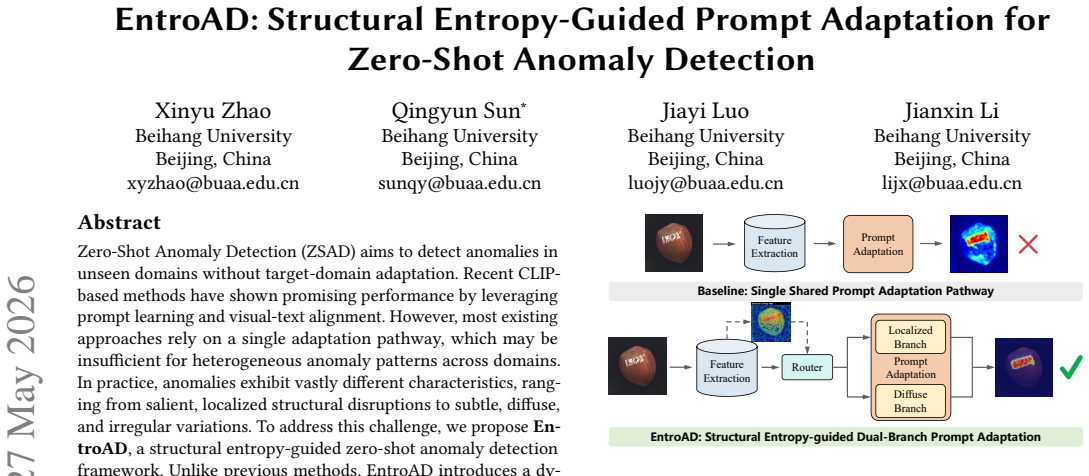
EntroAD estimates patch-level structural entropy from self-attention-induced patch relations and treats it as a proxy for relational uncertainty to drive a dynamic routing mechanism that builds anomaly-aware routed tokens. These tokens feed a confidence-aware dual-branch prompt adaptation module that stabilizes visual-text alignment while keeping CLIP's transferable prior intact, allowing specialized handling of heterogeneous anomaly patterns in cross-dataset zero-shot settings.
What carries the argument
Structural entropy estimated from self-attention-induced patch relations, serving as a proxy for relational uncertainty to guide anomaly-aware token routing.
If this is right
- Allows one model to process both localized structural disruptions and diffuse irregular variations without domain-specific retraining.
- Keeps visual-text alignment stable during adaptation through the dual-branch design.
- Yields state-of-the-art results on ten industrial and medical benchmarks in cross-dataset zero-shot anomaly detection.
- Produces routed tokens that capture anomaly cues matched to each pattern's structural characteristics.
Where Pith is reading between the lines
- The entropy signal might transfer to other prompt-tuning tasks where input heterogeneity is high.
- Attention-derived uncertainty could become a general tool for routing in vision-language models facing mixed data types.
- Testing the same routing on non-industrial domains would show whether the entropy proxy remains effective outside the reported benchmarks.
Load-bearing premise
Patch-level structural entropy from self-attention relations acts as a reliable signal for choosing the right adaptation route across different anomaly patterns.
What would settle it
Running EntroAD on new cross-dataset zero-shot anomaly benchmarks and finding that performance drops to the level of prior single-pathway methods when the entropy routing step is removed would falsify the claim.
Figures


read the original abstract
Zero-Shot Anomaly Detection (ZSAD) aims to detect anomalies in unseen domains without target-domain adaptation. Recent CLIP-based methods have shown promising performance by leveraging prompt learning and visual-text alignment. However, most existing approaches rely on a single adaptation pathway, which may be insufficient for heterogeneous anomaly patterns across domains. In practice, anomalies exhibit vastly different characteristics, ranging from salient, localized structural disruptions to subtle, diffuse, and irregular variations. To address this challenge, we propose EntroAD, a structural entropy-guided zero-shot anomaly detection framework. Unlike previous methods, EntroAD introduces a dynamic routing mechanism to process different types of anomalies with specialized adaptation strategies. Specifically, we estimate patch-level structural entropy from self-attention-induced patch relations and use it as a proxy for relational uncertainty to guide anomaly-aware token routing. Based on this routing signal, we construct anomaly-aware routed tokens to better capture anomaly cues with different structural characteristics. We further introduce a confidence-aware dual-branch prompt adaptation module to stabilize visual-text alignment while preserving CLIP's transferable prior. Extensive experiments on 10 industrial and medical benchmarks show that EntroAD achieves state-of-the-art performance in challenging cross-dataset ZSAD settings.
Editorial analysis
A structured set of objections, weighed in public.
Referee Report
Summary. The manuscript proposes EntroAD, a structural entropy-guided framework for zero-shot anomaly detection (ZSAD) that extends CLIP-based prompt learning. It estimates patch-level structural entropy from self-attention-induced patch relations as a proxy for relational uncertainty, uses this signal for dynamic anomaly-aware token routing, constructs specialized routed tokens, and adds a confidence-aware dual-branch prompt adaptation module. The central claim is that this yields state-of-the-art performance on 10 industrial and medical benchmarks in challenging cross-dataset ZSAD settings.
Significance. If the routing mechanism and performance claims were substantiated, the entropy-based proxy for guiding adaptation across heterogeneous anomaly patterns could represent a useful extension beyond single-pathway CLIP methods. However, the manuscript supplies no equations, algorithmic details, tables, baselines, error bars, or statistical tests, so the significance cannot be evaluated.
major comments (1)
- [Abstract] Abstract: the assertion that 'Extensive experiments on 10 industrial and medical benchmarks show that EntroAD achieves state-of-the-art performance' is unsupported by any quantitative results, baseline comparisons, error bars, or data-exclusion rules, making the central performance claim impossible to assess or reproduce from the provided text.
Simulated Author's Rebuttal
We thank the referee for the detailed feedback. We address the major comment point by point below.
read point-by-point responses
-
Referee: [Abstract] Abstract: the assertion that 'Extensive experiments on 10 industrial and medical benchmarks show that EntroAD achieves state-of-the-art performance' is unsupported by any quantitative results, baseline comparisons, error bars, or data-exclusion rules, making the central performance claim impossible to assess or reproduce from the provided text.
Authors: We agree that the abstract's performance claim is not supported by any quantitative evidence, tables, baselines, error bars, or statistical details in the manuscript. The provided text contains only the abstract and method description without experimental results or algorithmic equations. We will revise the abstract to remove or qualify the unsupported claim. We will also incorporate the missing equations, algorithmic details, tables, baselines, and statistical tests into the revised manuscript. revision: yes
Circularity Check
No circularity in visible derivation chain
full rationale
The provided abstract and method description introduce a structural entropy proxy and routing mechanism as an empirical design choice for handling heterogeneous anomalies, without any equations, derivations, or first-principles claims that reduce to fitted inputs or self-definitions by construction. No predictions are presented as outputs of the method itself, no self-citations are invoked as load-bearing uniqueness theorems, and the SOTA claim is tied to experimental benchmarks rather than a mathematical chain that collapses to its own assumptions. The framework is self-contained as a proposed architecture whose validity is asserted via external evaluation, not internal redefinition.
Axiom & Free-Parameter Ledger
axioms (1)
- domain assumption Patch-level structural entropy from self-attention relations serves as a valid proxy for relational uncertainty to guide token routing
invented entities (1)
-
anomaly-aware routed tokens
no independent evidence
Reference graph
Works this paper leans on
-
[1]
Toshimichi Aota, Lloyd Teh Tzer Tong, and Takayuki Okatani. 2023. Zero-shot versus many-shot: Unsupervised texture anomaly detection. InW ACV. 5564– 5572
2023
-
[2]
Paul Bergmann, Michael Fauser, David Sattlegger, and Carsten Steger. 2019. MVTec AD–A comprehensive real-world dataset for unsupervised anomaly detection. InCVPR. 9592–9600
2019
-
[3]
Yunkang Cao, Jiangning Zhang, Luca Frittoli, Yuqi Cheng, Weiming Shen, and Giacomo Boracchi. 2024. Adaclip: Adapting clip with hybrid learnable prompts for zero-shot anomaly detection. InECCV. Springer, 55–72
2024
- [4]
-
[5]
Thomas Defard, Aleksandr Setkov, Angelique Loesch, and Romaric Audigier
-
[6]
Padim: a patch distribution modeling framework for anomaly detection and localization. InICPR. Springer, 475–489
-
[7]
Hanqiu Deng and Xingyu Li. 2022. Anomaly detection via reverse distillation from one-class embedding. InCVPR. 9737–9746
2022
-
[8]
Alexey Dosovitskiy, Lucas Beyer, Alexander Kolesnikov, Dirk Weissenborn, Xi- aohua Zhai, Thomas Unterthiner, Mostafa Dehghani, Matthias Minderer, Georg Heigold, Sylvain Gelly, et al. 2020. An image is worth 16x16 words: Transformers for image recognition at scale.arXiv preprint arXiv:2010.11929(2020)
work page internal anchor Pith review Pith/arXiv arXiv 2020
-
[9]
Qingqing Fang, Wenxi Lv, and Qinliang Su. 2025. Af-clip: Zero-shot anomaly detection via anomaly-focused clip adaptation. InACM MM. 4846–4855
2025
-
[10]
Tharindu Fernando, Harshala Gammulle, Simon Denman, Sridha Sridharan, and Clinton Fookes. 2021. Deep learning for medical anomaly detection–a survey. CSUR54, 7 (2021), 1–37
2021
- [11]
-
[12]
Zhaopeng Gu, Bingke Zhu, Guibo Zhu, Yingying Chen, Hao Li, Ming Tang, and Jinqiao Wang. 2024. Filo: Zero-shot anomaly detection by fine-grained description and high-quality localization. InACM MM. 2041–2049
2024
-
[13]
Ahmed Hamada. 2020. Br35h:: Brain tumor detection 2020.Kaggle Dataset (2020)
2020
-
[14]
Steven A Hicks, Debesh Jha, Vajira Thambawita, Pål Halvorsen, Hugo L Hammer, and Michael A Riegler. 2021. The EndoTect 2020 challenge: evaluation and comparison of classification, segmentation and inference time for endoscopy. In ICLR. Springer, 263–274
2021
-
[15]
Jeeho Hyun, Sangyun Kim, Giyoung Jeon, Seung Hwan Kim, Kyunghoon Bae, and Byung Jun Kang. 2024. Reconpatch: Contrastive patch representation learning for industrial anomaly detection. InW ACV. 2052–2061
2024
-
[16]
Jongheon Jeong, Yang Zou, Taewan Kim, Dongqing Zhang, Avinash Ravichan- dran, and Onkar Dabeer. 2023. Winclip: Zero-/few-shot anomaly classification and segmentation. InCVPR. 19606–19616
2023
-
[17]
Stepan Jezek, Martin Jonak, Radim Burget, Pavel Dvorak, and Milos Skotak
-
[18]
In2021 13th International congress on ultra modern telecommunications and control systems and workshops (ICUMT)
Deep learning-based defect detection of metal parts: evaluating current methods in complex conditions. In2021 13th International congress on ultra modern telecommunications and control systems and workshops (ICUMT). IEEE, 66–71
-
[19]
Debesh Jha, Pia H Smedsrud, Michael A Riegler, Pål Halvorsen, Thomas De Lange, Dag Johansen, and Håvard D Johansen. 2019. Kvasir-seg: A segmented polyp dataset. InMMM. Springer, 451–462
2019
-
[20]
Pranita Balaji Kanade and PP Gumaste. 2015. Brain tumor detection using MRI images.Brain3, 2 (2015), 146–150
2015
-
[21]
Angsheng Li and Yicheng Pan. 2016. Structural information and dynamical complexity of networks.IEEE TIT62, 6 (2016), 3290–3339
2016
-
[22]
Zhikang Liu, Yiming Zhou, Yuansheng Xu, and Zilei Wang. 2023. Simplenet: A simple network for image anomaly detection and localization. InCVPR. 20402– 20411
2023
-
[23]
Wenxin Ma, Xu Zhang, Qingsong Yao, Fenghe Tang, Chenxu Wu, Yingtai Li, Rui Yan, Zihang Jiang, and S Kevin Zhou. 2025. Aa-clip: Enhancing zero-shot anomaly detection via anomaly-aware clip. InCVPR. 4744–4754
2025
- [24]
-
[25]
Alec Radford, Jong Wook Kim, Chris Hallacy, Aditya Ramesh, Gabriel Goh, Sand- hini Agarwal, Girish Sastry, Amanda Askell, Pamela Mishkin, Jack Clark, et al
-
[26]
Learning transferable visual models from natural language supervision. In ICML. PmLR, 8748–8763
-
[27]
Karsten Roth, Latha Pemula, Joaquin Zepeda, Bernhard Schölkopf, Thomas Brox, and Peter Gehler. 2022. Towards total recall in industrial anomaly detection. In CVPR. 14318–14328
2022
-
[28]
Mohammadreza Salehi, Niousha Sadjadi, Soroosh Baselizadeh, Mohammad H Rohban, and Hamid R Rabiee. 2021. Multiresolution knowledge distillation for anomaly detection. InCVPR. 14902–14912
2021
-
[29]
Claude Elwood Shannon. 1948. A mathematical theory of communication.The Bell system technical journal27, 3 (1948), 379–423
1948
-
[30]
Dingli Su, Hao Peng, Yicheng Pan, and Angsheng Li. 2025. A survey of structural entropy: theory, methods, and applications. InIJCAI. 10660–10668
2025
-
[31]
Ashish Vaswani, Noam Shazeer, Niki Parmar, Jakob Uszkoreit, Llion Jones, Aidan N Gomez, Łukasz Kaiser, and Illia Polosukhin. 2017. Attention is all you need.NeurIPS30 (2017)
2017
-
[32]
Junran Wu, Xueyuan Chen, Bowen Shi, Shangzhe Li, and Ke Xu. 2023. Sega: Structural entropy guided anchor view for graph contrastive learning. InICML. PMLR, 37293–37312
2023
-
[33]
Junran Wu, Xueyuan Chen, Ke Xu, and Shangzhe Li. 2022. Structural entropy guided graph hierarchical pooling. InICML. PMLR, 24017–24030
2022
- [34]
-
[35]
Lewei Yao, Jianhua Han, Xiaodan Liang, Dan Xu, Wei Zhang, Zhenguo Li, and Hang Xu. 2023. Detclipv2: Scalable open-vocabulary object detection pre-training via word-region alignment. InCVPR. 23497–23506
2023
-
[36]
Ximiao Zhang, Min Xu, and Xiuzhuang Zhou. 2024. Realnet: A feature selection network with realistic synthetic anomaly for anomaly detection. InCVPR. 16699– 16708
2024
-
[37]
Yiwu Zhong, Jianwei Yang, Pengchuan Zhang, Chunyuan Li, Noel Codella, Liu- nian Harold Li, Luowei Zhou, Xiyang Dai, Lu Yuan, Yin Li, et al. 2022. Regionclip: Region-based language-image pretraining. InCVPR. 16793–16803
2022
-
[38]
Qihang Zhou, Guansong Pang, Yu Tian, Shibo He, and Jiming Chen. 2024. Anoma- lyCLIP: Object-agnostic Prompt Learning for Zero-shot Anomaly Detection. In ICLR
2024
-
[39]
Jiawen Zhu, Yew-Soon Ong, Chunhua Shen, and Guansong Pang. 2025. Fine- grained abnormality prompt learning for zero-shot anomaly detection. InICCV. 22241–22251
2025
-
[40]
Dongcheng Zou, Hao Peng, Xiang Huang, Renyu Yang, Jianxin Li, Jia Wu, Chun- yang Liu, and Philip S Yu. 2023. Se-gsl: A general and effective graph structure learning framework through structural entropy optimization. InWWW. 499– 510
2023
-
[41]
Yang Zou, Jongheon Jeong, Latha Pemula, Dongqing Zhang, and Onkar Dabeer
-
[42]
Spot-the-difference self-supervised pre-training for anomaly detection and segmentation. InECCV. Springer, 392–408. 9 Zhao et al. Appendix A Datasets We benchmark our method on 10 publicly available datasets that span two major application domains: industrial defect inspection and medical image analysis. All experiments strictly follow the ZSAD protocol, ...
discussion (0)
Sign in with ORCID, Apple, or X to comment. Anyone can read and Pith papers without signing in.