REVIEW 2 major objections 2 minor 35 references
Applications of temporal graph learning for predicting the dynamics of biological systems
T0 review · 2 major / 2 minor · reviewed 2026-06-29 · grok-4.3
Pith's one-line read Temporal graph models of evolving gene regulatory networks outperform static foundation models in forecasting single-cell dynamics.
desk verdict The temporal graph pipeline for single-cell dynamics is a sensible framing but the abstract contains no numbers or details, so the outperformance claim cannot be assessed. read the letter →
The pith
A machine-rendered reading of the paper's core claim, the machinery that carries it, and where it could break.
The reading
What carries the argument
Temporal graph neural networks operating on a sequence of pseudotime-resolved gene regulatory networks, where each network encodes regulatory interactions at one developmental stage and the model learns how those interactions change across stages.
What would settle it
Re-running the experiments after randomly permuting the pseudotime order or after replacing the inferred networks with networks drawn from a null model that preserves degree distribution but removes temporal structure; if the temporal-graph advantage disappears under these controls, the central claim is falsified.
Extended reading notes
Core claim
By inferring pseudotime trajectories from single-cell transcriptomes, dividing cells into ordered developmental snapshots, reconstructing one gene regulatory network per snapshot, and feeding the resulting sequence of graphs into temporal graph neural networks, the method produces forecasts of gene expression, link presence, and out-degree centrality that exceed those of static foundation models on erythroid gastrulation and pancreatic endocrinogenesis data. The performance advantage suggests that modeling the temporal evolution of regulatory interactions supplies useful dynamic information beyond what is available from static representations.
Load-bearing premise
Pseudotime trajectories correctly order the true developmental sequence and gene regulatory networks inferred from each snapshot contain biologically meaningful edges rather than artifacts that drive the observed performance differences.
Editorial extensions
If this is right
- Temporal graph learning captures non-trivial regulatory dynamics that static models miss.
- The same framework identifies temporally important gene hubs via centrality forecasting.
- Temporal graph models constitute a complementary paradigm to current foundation-model approaches in single-cell biology.
Reading between the lines
- The same pipeline could be applied to disease trajectories by substituting pathological pseudotime orderings for developmental ones.
- Hybrid models that combine large-scale static pretraining with subsequent temporal-graph fine-tuning on developmental snapshots may improve both accuracy and data efficiency.
- Because the method separates network inference from temporal modeling, it can incorporate alternative network-reconstruction algorithms without retraining the entire foundation model.
Editorial analysis
A structured set of objections, weighed in public.
Referee Report
Summary. The manuscript proposes a temporal graph-based framework for modeling dynamics in biological systems from single-cell transcriptomic data. Starting from public mouse developmental datasets (erythroid gastrulation and pancreatic endocrinogenesis), the approach infers pseudotime trajectories, discretizes cells into developmental snapshots, reconstructs one gene regulatory network per snapshot, and applies temporal graph neural networks to three tasks: gene-expression forecasting, link prediction, and out-degree centrality prediction. The central claim is that these graph-based models outperform static foundation models such as scGPT and scFoundation, indicating that explicit modeling of evolving regulatory structure supplies information beyond static pretrained representations.
Significance. If the empirical claims are substantiated with quantitative results and controls, the work would establish temporal graph learning as a viable complementary paradigm to transformer-based foundation models in single-cell biology. It would demonstrate that explicitly tracking the evolution of gene regulatory networks across pseudotime can improve forecasting of expression, links, and centrality, potentially aiding interpretation of developmental programs and disease progression.
major comments (2)
- [Abstract] Abstract: The claim that 'graph-based models outperform well-known foundation-model such as scGPT and scFoundation' on gene-expression forecasting, link prediction, and centrality tasks is presented without any quantitative results, error bars, statistical tests, baseline implementation details, or ablation studies. This absence is load-bearing for the central empirical claim and prevents evaluation of whether the reported gains arise from temporal structure modeling.
- [Abstract] Abstract (framework description): The pipeline depends on pseudotime trajectory inference followed by per-snapshot GRN reconstruction, yet no validation is supplied that the inferred networks recover known regulatory interactions or that performance remains stable under alternative pseudotime or GRN inference methods. This is load-bearing because systematic artifacts in the upstream discretization or network inference steps could preferentially benefit temporal GNNs while leaving static baselines unaffected.
minor comments (2)
- [Abstract] Abstract: Grammatical error in 'well-known foundation-model such as scGPT' should read 'well-known foundation models such as scGPT'.
- [Abstract] Abstract: The phrase 'For link prediction and centrality forecasting, temporal graph learning captures non-trivial regulatory dynamics' is stated without reference to any supporting figure, table, or quantitative metric.
Simulated Author's Rebuttal
We thank the referee for the constructive comments on our work-in-progress manuscript. The feedback correctly identifies areas where additional evidence is needed to support the central claims. We respond to each major comment below and will incorporate revisions accordingly.
read point-by-point responses
-
Referee: [Abstract] Abstract: The claim that 'graph-based models outperform well-known foundation-model such as scGPT and scFoundation' on gene-expression forecasting, link prediction, and centrality tasks is presented without any quantitative results, error bars, statistical tests, baseline implementation details, or ablation studies. This absence is load-bearing for the central empirical claim and prevents evaluation of whether the reported gains arise from temporal structure modeling.
Authors: We agree that the abstract currently states the outperformance claim without accompanying quantitative details, which limits evaluation. In the revised manuscript we will augment the abstract with key metrics (including means, standard deviations or error bars, and p-values where appropriate) and ensure the main text supplies full baseline implementation details, ablation studies, and statistical comparisons. These additions will allow direct assessment of whether gains derive from temporal graph modeling. revision: yes
-
Referee: [Abstract] Abstract (framework description): The pipeline depends on pseudotime trajectory inference followed by per-snapshot GRN reconstruction, yet no validation is supplied that the inferred networks recover known regulatory interactions or that performance remains stable under alternative pseudotime or GRN inference methods. This is load-bearing because systematic artifacts in the upstream discretization or network inference steps could preferentially benefit temporal GNNs while leaving static baselines unaffected.
Authors: We concur that validation of the pseudotime and GRN steps is essential to rule out upstream artifacts. In the revision we will add (i) overlap analyses between inferred edges and curated regulatory databases or ChIP-seq resources and (ii) robustness experiments that repeat the full pipeline with alternative trajectory inference algorithms and GRN methods, reporting performance variance across these choices. This will confirm that the reported advantages are not driven by particular discretization or inference choices. revision: yes
Circularity Check
No circularity: purely empirical comparison with no derivations or self-referential predictions
full rationale
The paper describes an empirical pipeline (pseudotime inference, snapshot discretization, per-snapshot GRN reconstruction, temporal GNN training) evaluated on public datasets for forecasting, link prediction, and centrality tasks. No equations, first-principles derivations, fitted parameters renamed as predictions, or load-bearing self-citations appear in the provided text. Performance claims rest on direct comparisons against baselines (scGPT, scFoundation) rather than any quantity defined by the model itself. The work is therefore self-contained against external benchmarks and receives the default non-circularity finding.
Assumptions & free parameters
Cite this review
Pith. "Pith review of Applications of temporal graph learning for predicting the dynamics of biological systems." pith.science (2026). https://pith.science/paper/ZW7VD7NF
@misc{pith2026260528659,
  author       = {Pith},
  title        = {Pith review of: Applications of temporal graph learning for predicting the dynamics of biological systems},
  year         = {2026},
  howpublished = {\url{https://pith.science/paper/ZW7VD7NF}},
  note         = {Machine review of arXiv:2605.28659}
}
read the original abstract
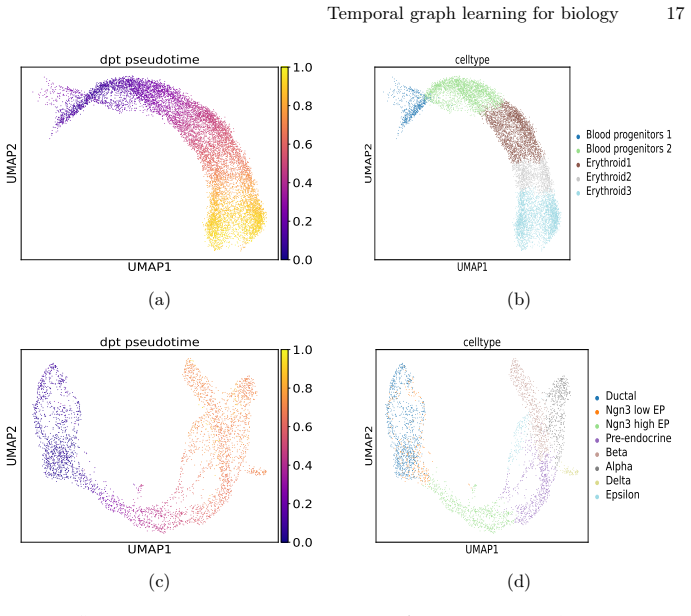
Biological foundation models have shown strong performance in single-cell representation learning by applying transformer architectures directly to gene-expression matrices. However, these approaches predominantly operate in static settings and do not explicitly model the temporal evolution of developmental programs in the cell. Modeling such dynamics is important for understanding how cellular states progressively emerge, differentiate, and reorganize during development or disease progression. In this work-in-progress paper, we investigate an alternative temporal graph-based perspective in which cellular states are represented through pseudotime-resolved gene regulatory networks and modeled as evolving graph structures over persistent gene identities. Starting from single-cell transcriptomic data, we infer pseudotime trajectories, discretize cells into developmental snapshots, reconstruct one gene regulatory network per snapshot, and apply temporal graph neural networks to forecast biological states. We evaluate this framework on two publicly available mouse developmental datasets, erythroid gastrulation and pancreatic endocrinogenesis, considering three complementary tasks: gene-expression forecasting, link prediction, and out-degree centrality prediction. Our results show that graph-based models outperform well-known foundation-model such as scGPT and scFoundation, suggesting that explicitly modeling evolving regulatory structure provides useful information beyond static pretrained representations. For link prediction and centrality forecasting, temporal graph learning captures non-trivial regulatory dynamics and enables the identification of temporally important gene hubs. Overall, our findings support temporal graph learning as a promising direction for modeling dynamic biological systems and as a complementary paradigm to current foundation model approaches in single-cell biology.
Figures


Figures from the paper (2 more)

Reference graph
Works this paper leans on
-
[1]
scgpt:towardbuildingafoundationmodelforsingle-cellmulti-omics using generative ai.Nature Methods, 21(8):1470–1480, Aug 2024
Haotian Cui, Chloe Wang, Hassaan Maan, Kuan Pang, Fengning Luo, Nan Duan, andBoWang. scgpt:towardbuildingafoundationmodelforsingle-cellmulti-omics using generative ai.Nature Methods, 21(8):1470–1480, Aug 2024
2024
-
[2]
Large-scale foundation model on single-cell transcriptomics.Nature Methods, 21(8):1481–1491, Aug 2024
Minsheng Hao, Jing Gong, Xin Zeng, Chiming Liu, Yucheng Guo, Xingyi Cheng, Taifeng Wang, Jianzhu Ma, Xuegong Zhang, and Le Song. Large-scale foundation model on single-cell transcriptomics.Nature Methods, 21(8):1481–1491, Aug 2024
2024
-
[3]
Theodoris, Ling Xiao, Anant Chopra, Mark D
Christina V. Theodoris, Ling Xiao, Anant Chopra, Mark D. Chaffin, Zeina R. Al Sayed, Matthew C. Hill, Helene Mantineo, Elizabeth M. Brydon, Zexian Zeng, X. Shirley Liu, and Patrick T. Ellinor. Transfer learning enables predictions in network biology.Nature, 618(7965):616–624, Jun 2023
2023
-
[4]
Alexander Wolf, and Fabian J
Volker Bergen, Marius Lange, Stefan Peidli, F. Alexander Wolf, and Fabian J. Theis. Generalizing rna velocity to transient cell states through dynamical model- ing.Nature Biotechnology, 38(12):1408–1414, August 2020
2020
-
[5]
Alexander Wolf, Florian Buettner, and Fabian J
Laleh Haghverdi, Maren Büttner, F. Alexander Wolf, Florian Buettner, and Fabian J. Theis. Diffusion pseudotime robustly reconstructs lineage branching. Nature Methods, 13(10):845–848, Oct 2016
2016
-
[6]
Graph neural networks for temporal graphs: State of the art, open challenges, and opportunities.Transactions on Machine Learning Research, 2023
Antonio Longa, Veronica Lachi, Gabriele Santin, Monica Bianchini, Bruno Lepri, Pietro Lio, franco scarselli, and Andrea Passerini. Graph neural networks for temporal graphs: State of the art, open challenges, and opportunities.Transactions on Machine Learning Research, 2023
2023
-
[7]
Dileo et al
Sara Aibar, Carmen Bravo González-Blas, Thomas Moerman, Vân Anh Huynh- Thu, Hana Imrichova, Gert Hulselmans, Florian Rambow, Jean-Christophe Ma- rine, Pierre Geurts, Jan Aerts, Joost van den Oord, Zeynep Kalender Atak, Jasper 14 M. Dileo et al. Wouters, and Stein Aerts. SCENIC: single-cell regulatory network inference and clustering.Nat Methods, 14(11):10...
2017
-
[8]
Burkhardt, Andrea Califano, Jonah Cool, Abby F
Charlotte Bunne, Yusuf Roohani, Yanay Rosen, Ankit Gupta, Xikun Zhang, Mar- cel Roed, Theo Alexandrov, Mohammed AlQuraishi, Patricia Brennan, Daniel B. Burkhardt, Andrea Califano, Jonah Cool, Abby F. Dernburg, Kirsty Ewing, Emily B. Fox, Matthias Haury, Amy E. Herr, Eric Horvitz, Patrick D. Hsu, Viren Jain, Gregory R. Johnson, Thomas Kalil, David R. Kelle...
2024
Show all 35 references
-
[9]
Roohani, Tony J
Yusuf H. Roohani, Tony J. Hua, Po-Yuan Tung, Lexi R. Bounds, Feiqiao B. Yu, Alexander Dobin, Noam Teyssier, Abhinav Adduri, Alden Woodrow, Brian S. Plosky, Reshma Mehta, Benjamin Hsu, Jeremy Sullivan, Chiara Ricci-Tam, Ni- anzhen Li, Julia Kazaks, Luke A. Gilbert, Silvana Kone...
2025
-
[10]
Predicting transcriptional outcomes of novel multigene perturbations with gears.Nature Biotechnology, 42(6):927–935, Jun 2024
Yusuf Roohani, Kexin Huang, and Jure Leskovec. Predicting transcriptional outcomes of novel multigene perturbations with gears.Nature Biotechnology, 42(6):927–935, Jun 2024
2024
-
[11]
HEIST: A graph foundation model for spatial transcriptomics and proteomics data
Hiren Madhu, João Felipe Rocha, Tinglin Huang, Siddharth Viswanath, Smita Krishnaswamy, and Rex Ying. HEIST: A graph foundation model for spatial transcriptomics and proteomics data. InThe Fourteenth International Conference on Learning Representations, 2026
2026
-
[12]
Bronstein, Guillaume Rabusseau, and Reihaneh Rabbany
Shenyang Huang, Farimah Poursafaei, Jacob Danovitch, Matthias Fey, Weihua Hu, Emanuele Rossi, Jure Leskovec, Michael M. Bronstein, Guillaume Rabusseau, and Reihaneh Rabbany. Temporal graph benchmark for machine learning on temporal graphs.CoRR, abs/2307.01026, 2023
2023
-
[13]
Evolvegcn: Evolving graph convolutional networks for dynamic graphs
Aldo Pareja, Giacomo Domeniconi, Jie Chen, Tengfei Ma, Toyotaro Suzumura, Hiroki Kanezashi, Tim Kaler, Tao Schardl, and Charles Leiserson. Evolvegcn: Evolving graph convolutional networks for dynamic graphs. InProceedings of the AAAI conference on artificial intelligence,volum...
2020
-
[14]
Structured sequence modeling with graph convolutional recurrent networks
Youngjoo Seo, Michaël Defferrard, Pierre Vandergheynst, and Xavier Bresson. Structured sequence modeling with graph convolutional recurrent networks. In Neural Information Processing: 25th International Conference, ICONIP 2018, Siem Reap, Cambodia, December 13-16, 2018, Procee...
2018
-
[15]
Roland: Graph learning framework for dynamic graphs
Jiaxuan You, Tianyu Du, and Jure Leskovec. Roland: Graph learning framework for dynamic graphs. InProceedings of the 28th ACM SIGKDD Conference on Knowledge Discovery and Data Mining, KDD ’22, page 2358–2366, New York, NY, USA, 2022. Association for Computing Machinery
2022
-
[16]
Input snapshots fusion for scalable discrete-time dynamic graph neural networks
QingGuo Qi, Hongyang Chen, Minhao Cheng, and Han Liu. Input snapshots fusion for scalable discrete-time dynamic graph neural networks. InProceedings of the 31st ACM SIGKDD Conference on Knowledge Discovery and Data Mining V.1, KDD ’25, page 1138–1149, New York, NY, USA, 2025. ...
2025
-
[17]
Modelling and analysis of gene regulatory net- works.Nature Reviews Molecular Cell Biology, 9(10):770–780, Oct 2008
Guy Karlebach and Ron Shamir. Modelling and analysis of gene regulatory net- works.Nature Reviews Molecular Cell Biology, 9(10):770–780, Oct 2008
2008
-
[18]
Springer New York, New York, NY, 2019
Vân Anh Huynh-Thu and Guido Sanguinetti.Gene Regulatory Network Inference: An Introductory Survey, pages 1–23. Springer New York, New York, NY, 2019
2019
-
[19]
Deep learning in gene regulatory network in- ference: A survey.IEEE/ACM Transactions on Computational Biology and Bioin- formatics, 21(6):2089–2101, 2024
Jiayi Dong, Jiahao Li, and Fei Wang. Deep learning in gene regulatory network in- ference: A survey.IEEE/ACM Transactions on Computational Biology and Bioin- formatics, 21(6):2089–2101, 2024
-
[20]
da Silva, Heder S
José Eduardo H. da Silva, Heder S. Bernardino, Itamar L. de Oliveira, and José J. Camata. A survey of the methodological process of modeling, inference, and eval- uation of gene regulatory networks using scrna-seq data.BioSystems, 253:105464, 2025
2025
-
[21]
Cambridge University Press, Cambridge, 2016
Albert-Laszlo Barabasi and Marton Posfai.Network science. Cambridge University Press, Cambridge, 2016
2016
-
[22]
Lichtenwalter, and Nitesh V
Yang Yang, Ryan N. Lichtenwalter, and Nitesh V. Chawla. Evaluating link pre- diction methods.Knowledge and Information Systems, 45(3):751–782, oct 2014
2014
-
[23]
Temporal graph networks for deep learning on dynamic graphs, 2020
Emanuele Rossi, Ben Chamberlain, Fabrizio Frasca, Davide Eynard, Federico Monti, and Michael Bronstein. Temporal graph networks for deep learning on dynamic graphs, 2020
2020
-
[24]
Towards better evaluation for dynamic link prediction
Farimah Poursafaei, Andy Huang, Kellin Pelrine, and Reihaneh Rabbany. Towards better evaluation for dynamic link prediction. InThirty-sixth Conference on Neural Information Processing Systems Datasets and Benchmarks Track, 2022
2022
-
[25]
Kipf and Max Welling
Thomas N. Kipf and Max Welling. Semi-supervised classification with graph con- volutional networks. InICLR (Poster). OpenReview.net, 2017
2017
-
[26]
Graph attention networks
Petar Veličković, Guillem Cucurull, Arantxa Casanova, Adriana Romero, Pietro Liò, and Yoshua Bengio. Graph attention networks. InInternational Conference on Learning Representations, 2018
2018
-
[27]
Convolutional neural networks on graphs with fast localized spectral filtering
Michaël Defferrard, Xavier Bresson, and Pierre Vandergheynst. Convolutional neural networks on graphs with fast localized spectral filtering. InProceedings of the 30th International Conference on Neural Information Processing Systems, NIPS’16, page 3844–3852, Red Hook, NY, USA...
2016
-
[28]
Towards better dynamic graph learning: New architecture and unified library
Le Yu, Leilei Sun, Bowen Du, and Weifeng Lv. Towards better dynamic graph learning: New architecture and unified library. In A. Oh, T. Naumann, A. Glober- son, K. Saenko, M. Hardt, and S. Levine, editors,Advances in Neural Information Processing Systems, volume 36, pages 67686...
2023
-
[29]
Griffiths, Carolina Guibentif, Tom W
Blanca Pijuan-Sala, Jonathan A. Griffiths, Carolina Guibentif, Tom W. His- cock, Wajid Jawaid, Fernando J. Calero-Nieto, Carla Mulas, Ximena Ibarra-Soria, Richard C. V. Tyser, Debbie Lee Lian Ho, Wolf Reik, Shankar Srinivas, Ben- jamin D. Simons, Jennifer Nichols, John C. Mari...
2019
-
[30]
Comprehensive single cell mrna profiling reveals a detailed roadmap for pancreatic endocrinogenesis.Development, 146(12):dev173849, 06 2019
Aimée Bastidas-Ponce, Sophie Tritschler, Leander Dony, Katharina Scheibner, Marta Tarquis-Medina, Ciro Salinno, Silvia Schirge, Ingo Burtscher, Anika Böttcher,FabianJ.Theis,HeikoLickert,MostafaBakhti,AllonKlein,andBarbara Treutlein. Comprehensive single cell mrna profiling rev...
2019
-
[31]
Oversmoothing, ”oversquashing”, heterophily, long-range, and more: Demystifying common beliefs in graph machine learning
Adrian Arnaiz-Rodriguez and Federico Errica. Oversmoothing, ”oversquashing”, heterophily, long-range, and more: Demystifying common beliefs in graph machine learning. InThe Fourteenth International Conference on Learning Representations, 2026. 16 M. Dileo et al
2026
-
[32]
Erythroid Krüppel-Like factor (KLF1): A surprisingly versatile regulator of erythroid differentiation.Adv Exp Med Biol, 1459:217–242, 2024
James J Bieker and Sjaak Philipsen. Erythroid Krüppel-Like factor (KLF1): A surprisingly versatile regulator of erythroid differentiation.Adv Exp Med Biol, 1459:217–242, 2024
2024
-
[33]
Scott, M
Edward W. Scott, M. Celeste Simon, John Anastasi, and Harinder Singh. Require- ment of transcription factor pu.1 in the development of multiple hematopoietic lineages.Science, 265(5178):1573–1577, 1994
1994
-
[34]
ERG dependence distinguishes developmental control of hematopoietic stem cell maintenance from hematopoietic specification.Genes Dev, 25(3):251–262, January 2011
Samir Taoudi, Thomas Bee, Adrienne Hilton, Kathy Knezevic, Julie Scott, Tracy A Willson, Caitlin Collin, Tim Thomas, Anne K Voss, Benjamin T Kile, Warren S Alexander, John E Pimanda, and Douglas J Hilton. ERG dependence distinguishes developmental control of hematopoietic stem...
2011
-
[35]
The home- odomain protein meis1 is essential for definitive hematopoiesis and vascular pat- terning in the mouse embryo.Dev Biol, 280(2):307–320, April 2005
Valeria Azcoitia, Miguel Aracil, Carlos Martínez-A, and Miguel Torres. The home- odomain protein meis1 is essential for definitive hematopoiesis and vascular pat- terning in the mouse embryo.Dev Biol, 280(2):307–320, April 2005. Appendix Additional information on Dataset Pseud...
2005
Reviewed June 29, 2026 · model on record in the stance chip above.
Discussion (0). Continue with ORCID to comment.