Magnetic Configuration Imprints on Quasi-Periodic Variability in GRMHD Simulations of Thin Accretion Disks
Pith reviewed 2026-06-29 10:35 UTC · model grok-4.3
The pith
Magnetic field configurations set truncation radii and QPO frequencies in thin accretion disk simulations
A machine-rendered reading of the paper's core claim, the machinery that carries it, and where it could break.
Core claim
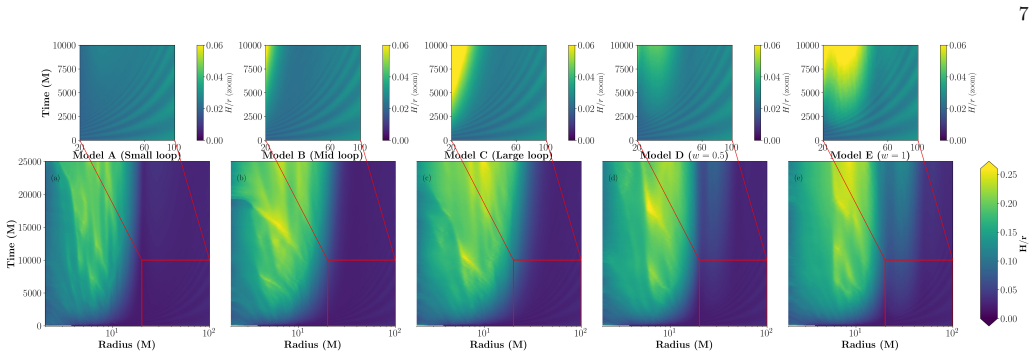
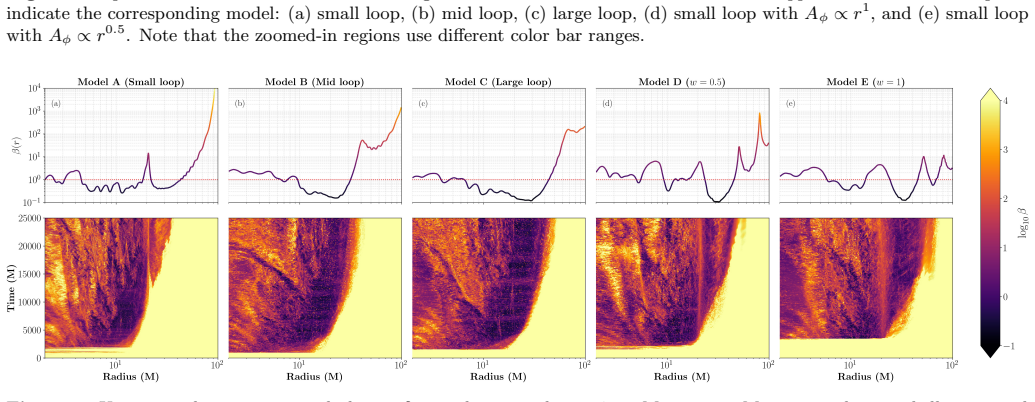
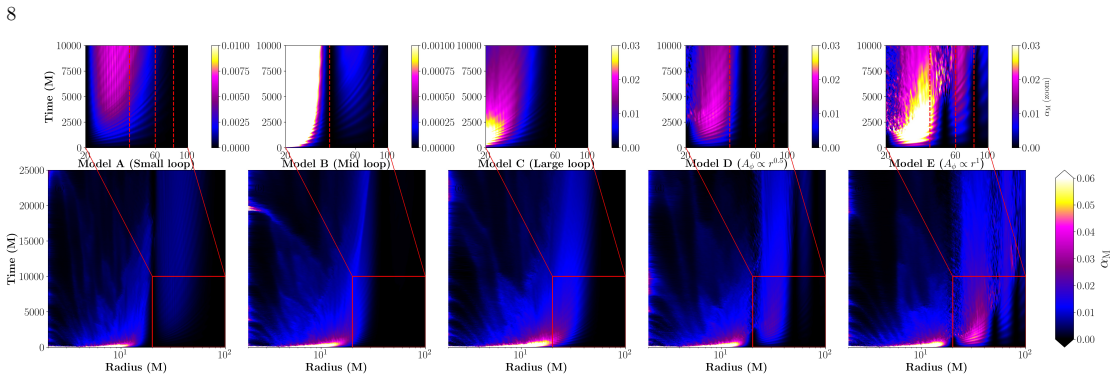
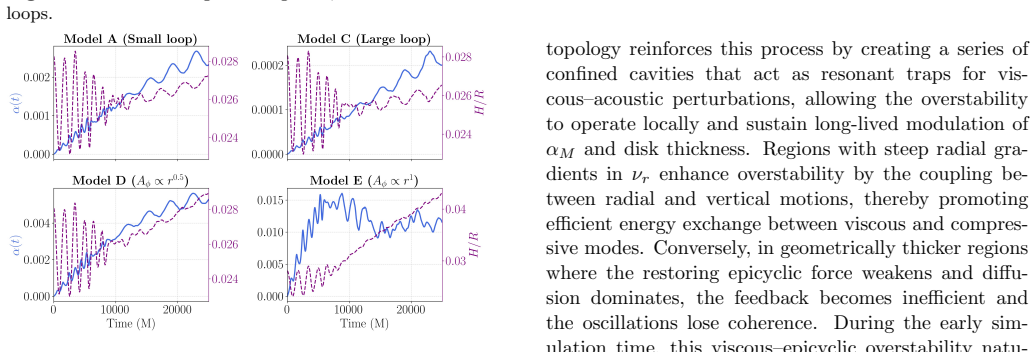
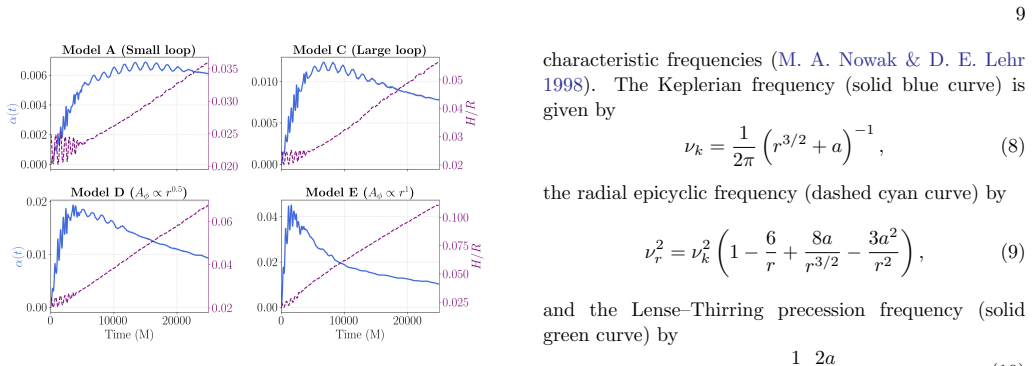
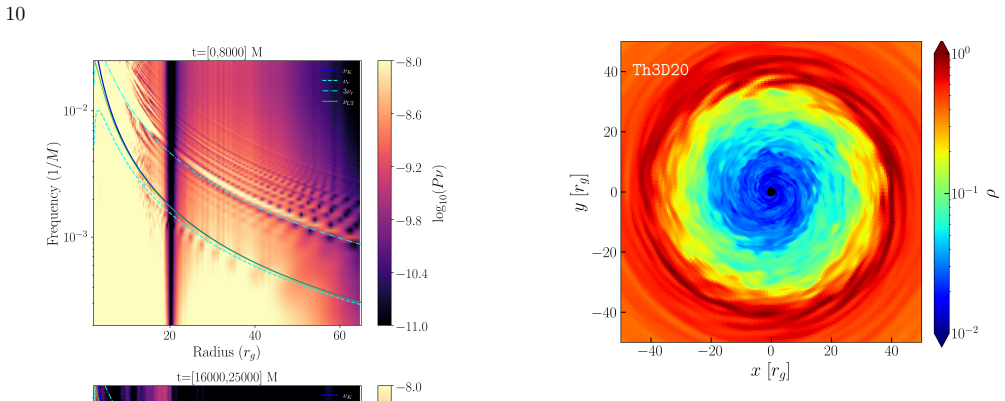
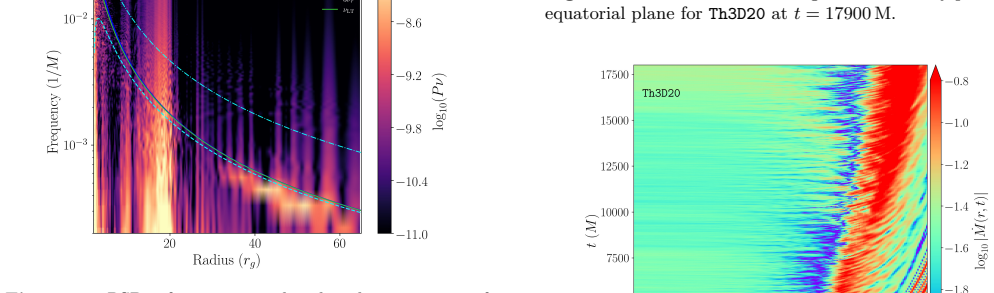
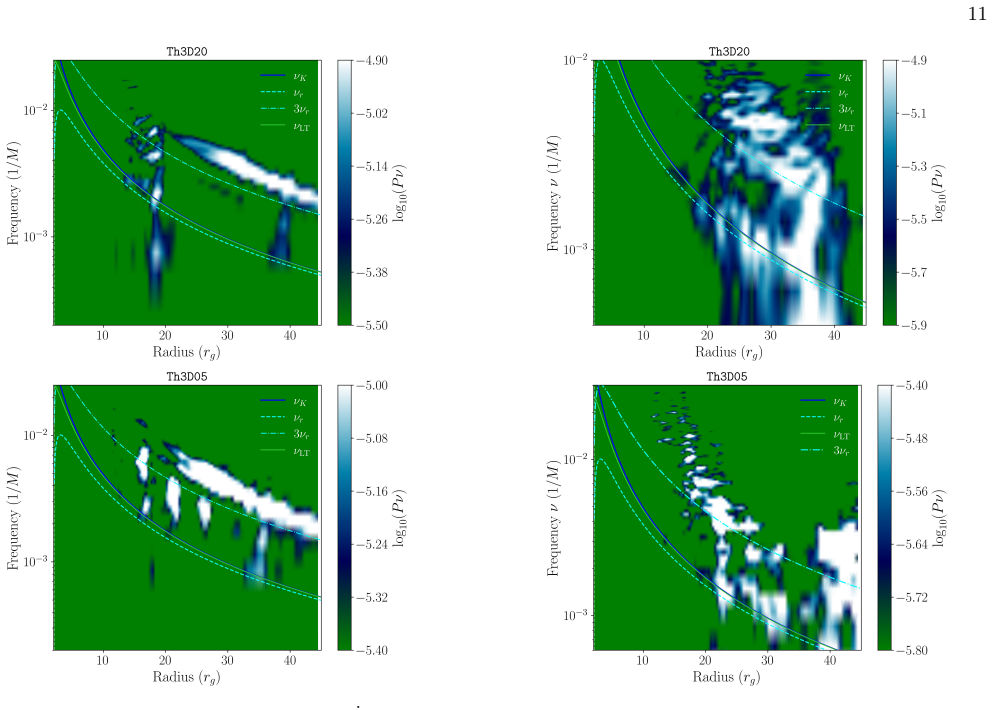
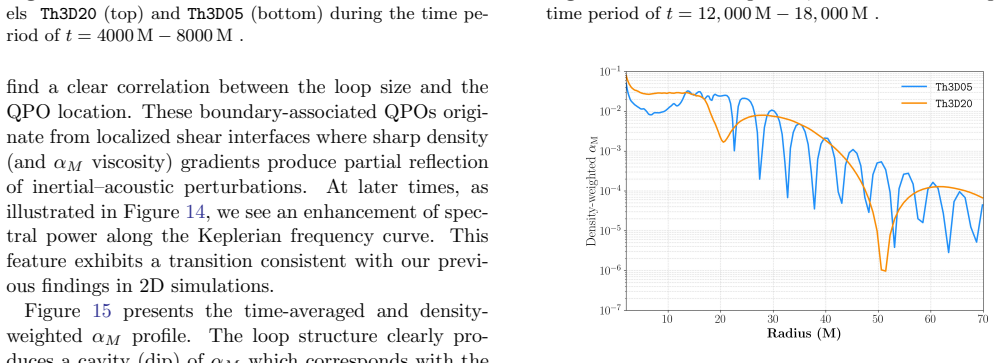
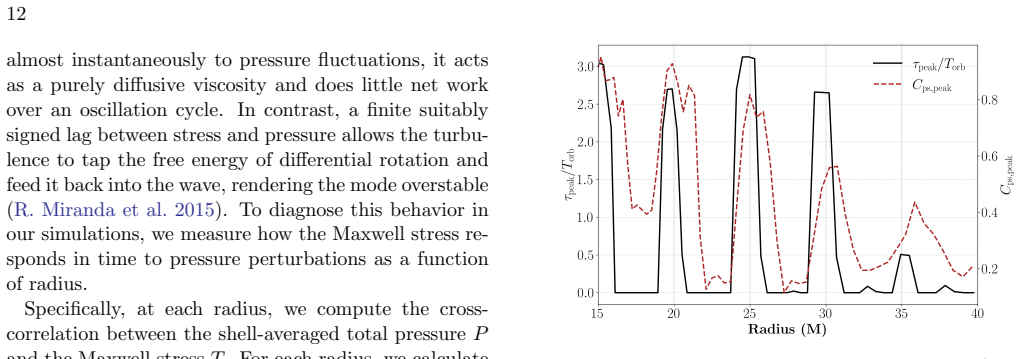
Different multi-loop magnetic field configurations in GRMHD simulations of thin disks naturally generate a puffed-up inner region. QPO-like variability then emerges in effective viscosity and mass accretion rate at frequencies that follow the local radial epicyclic frequency and its harmonics. Time-series diagrams display coherent inclined stripe-like patterns from inertial-acoustic perturbations, while power spectra show narrow bands linked to magnetic truncation radii. Cross-correlation analysis finds a finite lag between pressure and Maxwell stress at these interfaces, consistent with viscous-epicyclic overstability. The magnetic topology regulates both the truncation radius and the locat
What carries the argument
Multi-loop magnetic field configurations that set the truncation radius and sustain resonant cavities for inertial-acoustic perturbations via viscous-epicyclic overstability
If this is right
- QPO frequencies follow the radial epicyclic frequency and its harmonics at magnetic truncation radii.
- A finite lag appears between pressure and Maxwell stress at the truncation interfaces.
- Increased disk thickness suppresses the overstability and associated QPO signals through turbulent diffusion.
- The simulated QPO frequency ranges and evolution match those observed in black hole X-ray binaries during outbursts.
Where Pith is reading between the lines
- The same magnetic topologies could influence the timing of state transitions in accreting black hole systems.
- Similar truncation-radius effects might appear in other disk observables such as continuum spectra or polarization signatures.
Load-bearing premise
The specific multi-loop magnetic field configurations chosen are representative of those present in real thin accretion disks around black holes.
What would settle it
Detection of QPO frequencies in black hole X-ray binaries that do not match the epicyclic frequency at the inferred magnetic truncation radius, or simulations with the same initial configurations that fail to produce the reported lag and stripe patterns.
Figures
read the original abstract
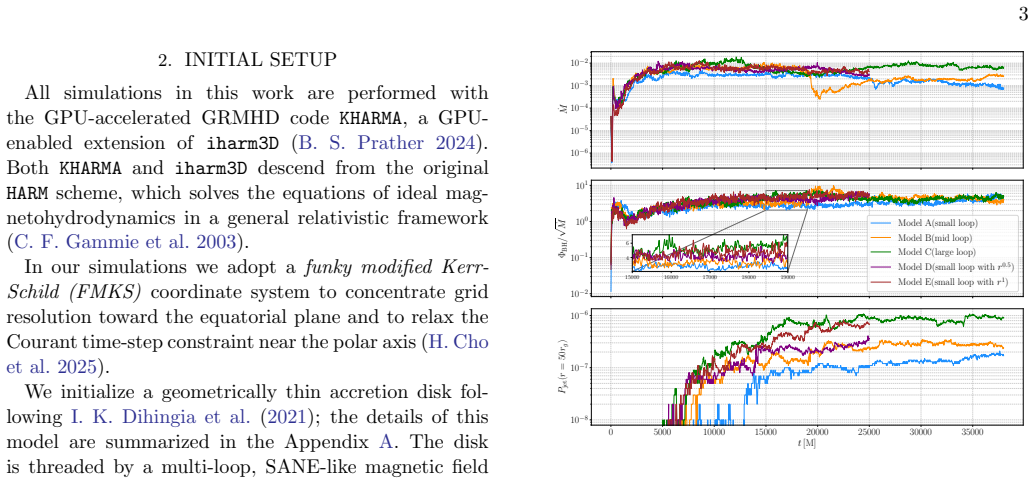
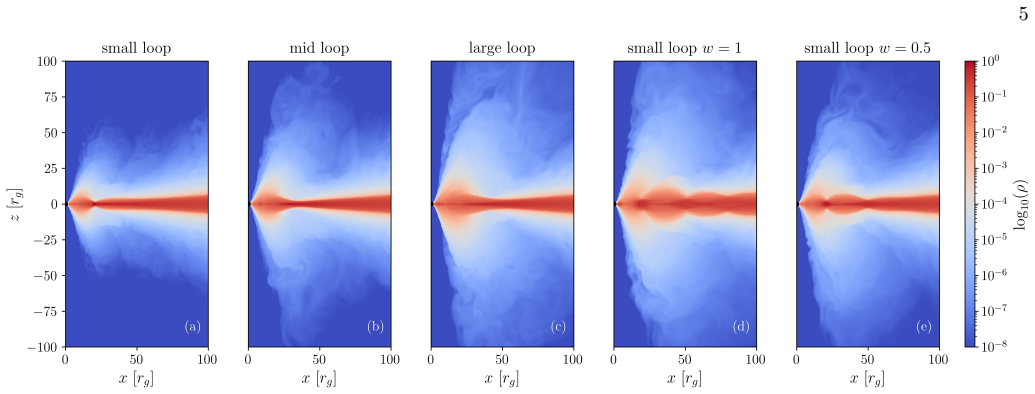
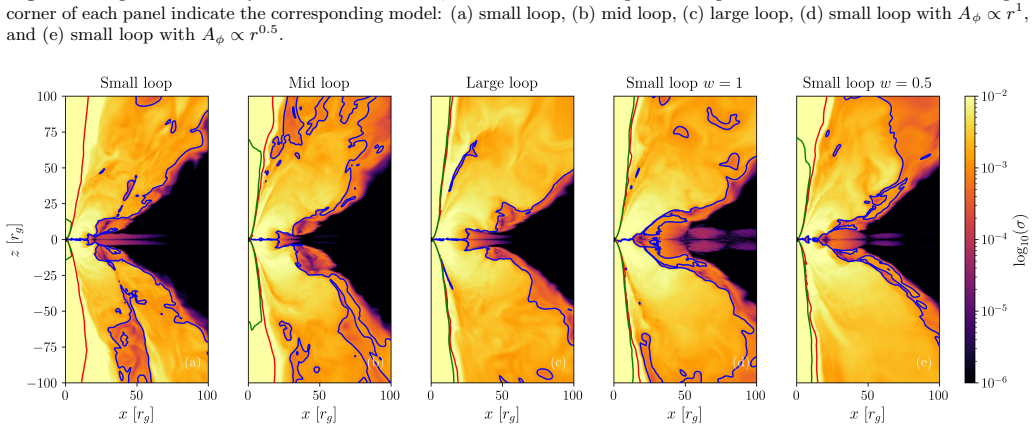
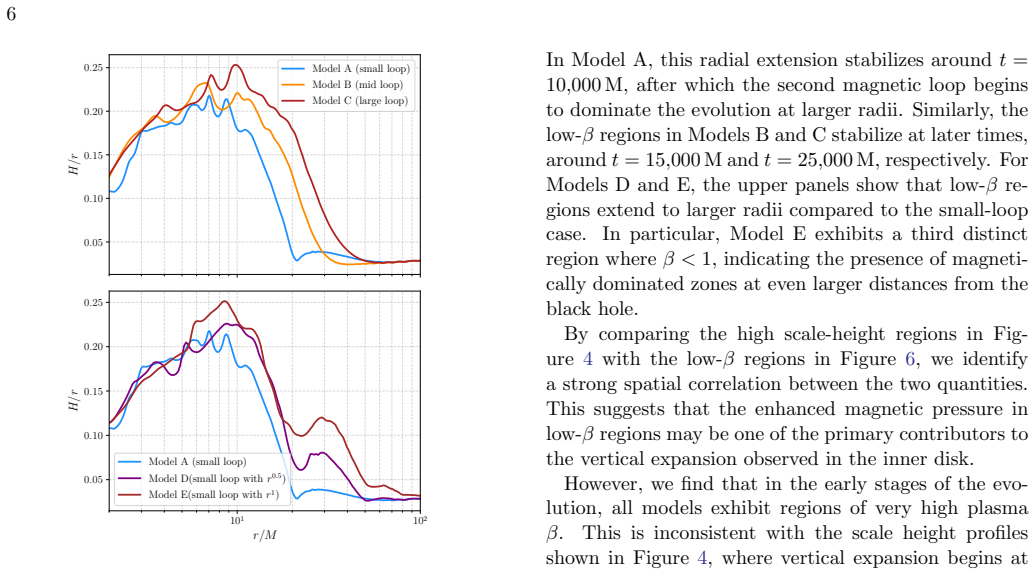
The origin of quasi-periodic oscillations (QPOs) in black hole accretion flow remains uncertain, particularly regarding the role of magnetic field configurations in shaping disk structure and variability signatures. We investigate this using global two- and three-dimensional (2D and 3D) general relativistic magnetohydrodynamic (GRMHD) simulations of geometrically thin disks initialized with different multi-loop magnetic field configurations. These configurations naturally produce a puffed-up inner region. We find that QPO-like variability arises in the effective viscosity and mass accretion rate, with frequencies following the local radial epicyclic frequency and its harmonics. Time-series diagrams show coherent, inclined stripe-like patterns associated with inertial-acoustic perturbations, while power spectra exhibit narrow bands of enhanced variability linked to truncation radii associated with magnetic fields. Cross-correlation analysis reveals a finite lag between pressure and Maxwell stress at these interfaces, consistent with viscous-epicyclic overstability. The magnetic topology regulates both the truncation radius and the location of resonant cavities that sustain oscillations. As the disk becomes thicker, increased turbulent diffusion suppresses the overstability and the associated QPO signals. We find that the QPO frequency ranges and their evolution are consistent with observations of black hole X-ray binaries during outbursts. These results suggest that magnetic field configurations play a pivotal role in shaping disk structure and variability in accreting black holes.
Editorial analysis
A structured set of objections, weighed in public.
Referee Report
Summary. The manuscript reports 2D and 3D GRMHD simulations of geometrically thin accretion disks initialized with multiple multi-loop magnetic field configurations. These setups produce an inner puffed-up region and truncation radius; the simulations exhibit QPO-like variability in effective viscosity and mass accretion rate at frequencies matching the local radial epicyclic frequency and harmonics. The variability is attributed to viscous-epicyclic overstability, with supporting evidence from time-series patterns, power spectra, and cross-correlation lags between pressure and Maxwell stress. The authors conclude that magnetic topology regulates truncation and resonant cavities, and that the resulting QPO frequency ranges and evolution are consistent with black-hole X-ray binary observations.
Significance. If the chosen initial conditions prove representative, the work supplies a concrete mechanism connecting magnetic topology to disk truncation, resonant cavities, and epicyclic overstability, thereby offering a potential explanation for observed QPOs. The global nature of the simulations and the identification of coherent inclined stripe patterns constitute strengths. However, the absence of convergence tests, error bars on reported frequencies, and quantitative sensitivity analysis to field strength or resolution reduces the immediate robustness of the frequency-observation matches.
major comments (2)
- [Abstract and initial-conditions description] The central claim that magnetic configurations play a pivotal role rests on simulations initialized exclusively with multi-loop topologies that produce truncation and overstability. No astrophysical motivation, observational constraint, or direct comparison to single-poloidal-loop configurations (standard in prior thin-disk GRMHD literature) is supplied to establish that these initial conditions occur or dominate in nature. This choice is load-bearing for the extrapolation to real thin disks and observed variability.
- [Results and power-spectra sections] No error bars, resolution or field-strength convergence tests, or quantitative measures of how post-hoc parameter choices affect the reported QPO frequencies are presented. The frequency matches to observations therefore rest on unverified simulation outputs rather than demonstrated numerical robustness.
minor comments (2)
- [Throughout] Notation for the different multi-loop configurations and the precise definition of the truncation radius should be made explicit and consistent across text and figures.
- [Methods] The manuscript would benefit from a brief table summarizing the simulation parameters (resolution, initial field strength, disk aspect ratio) for each run.
Simulated Author's Rebuttal
We thank the referee for their constructive and detailed review. We respond point-by-point to the major comments, indicating where we will revise the manuscript to address the concerns raised.
read point-by-point responses
-
Referee: [Abstract and initial-conditions description] The central claim that magnetic configurations play a pivotal role rests on simulations initialized exclusively with multi-loop topologies that produce truncation and overstability. No astrophysical motivation, observational constraint, or direct comparison to single-poloidal-loop configurations (standard in prior thin-disk GRMHD literature) is supplied to establish that these initial conditions occur or dominate in nature. This choice is load-bearing for the extrapolation to real thin disks and observed variability.
Authors: We acknowledge that the manuscript would be strengthened by explicit motivation for the multi-loop initial conditions and a comparison to the single-poloidal-loop setups common in the thin-disk GRMHD literature. In revision we will expand the introduction and methods to discuss possible astrophysical origins of multi-loop topologies (e.g., via dynamo action or repeated flux advection) and to note that single-loop configurations in prior work generally do not produce the same truncation radius or overstability. We will also add a short paragraph clarifying that the present study demonstrates the mechanism for these configurations rather than claiming they are the only or dominant ones in nature. A full parameter survey comparing all topologies is beyond the scope of the current work but will be flagged as future research. revision: partial
-
Referee: [Results and power-spectra sections] No error bars, resolution or field-strength convergence tests, or quantitative measures of how post-hoc parameter choices affect the reported QPO frequencies are presented. The frequency matches to observations therefore rest on unverified simulation outputs rather than demonstrated numerical robustness.
Authors: We agree that the absence of error bars and explicit convergence information limits the demonstrated robustness of the reported frequencies. In the revised manuscript we will add error bars to the QPO frequencies extracted from the power spectra (derived from the finite duration and stationarity of the time series) and include a new subsection summarizing resolution tests performed on the 2D runs together with a brief discussion of sensitivity to initial field strength. While exhaustive 3D convergence at multiple resolutions is computationally prohibitive, the consistency between 2D and 3D results at the resolutions used will be quantified and reported. revision: yes
Circularity Check
No circularity: simulation outputs independent of fitted inputs or self-definitions
full rationale
The paper reports direct outputs from GRMHD simulations initialized with multi-loop magnetic fields. QPO frequencies are stated to follow the local radial epicyclic frequency as measured in the runs, with no equations or claims reducing these frequencies to parameters fitted from the same data or defined circularly. No self-citation chains, ansatzes smuggled via prior work, or renaming of known results appear as load-bearing steps in the abstract or described methodology. The central claim rests on comparative simulation results across topologies rather than any self-referential derivation. This is the expected non-finding for a simulation study whose results are externally falsifiable against observations.
Axiom & Free-Parameter Ledger
axioms (2)
- standard math Standard general relativistic magnetohydrodynamic equations govern the disk evolution
- domain assumption Initial multi-loop magnetic field configurations are representative of real thin accretion disks
Reference graph
Works this paper leans on
-
[1]
2012, ApJL, 747, L4, doi: 10.1088/2041-8205/747/1/L4
Altamirano, D., & Belloni, T. 2012, ApJL, 747, L4, doi: 10.1088/2041-8205/747/1/L4
-
[2]
title A powerful local shear instability in weakly magnetized disks
Balbus, S. A., & Hawley, J. F. 1991, ApJ, 376, 214, doi: 10.1086/170270
-
[3]
Balbus, S. A., & Hawley, J. F. 1998, Reviews of Modern Physics, 70, 1, doi: 10.1103/RevModPhys.70.1
-
[4]
Basak, R., Zdziarski, A. A., Parker, M., & Islam, N. 2017, MNRAS, 472, 4220, doi: 10.1093/mnras/stx2283
-
[5]
Begelman, M. C., Armitage, P. J., & Reynolds, C. S. 2015, ApJ, 809, 118, doi: 10.1088/0004-637X/809/2/118
-
[6]
2005, A&A, 440, 207, doi: 10.1051/0004-6361:20042457
Belloni, T., Homan, J., Casella, P., et al. 2005, A&A, 440, 207, doi: 10.1051/0004-6361:20042457
-
[7]
Belloni, T. M., Motta, S. E., & Mu˜ noz-Darias, T. 2011, Bulletin of the Astronomical Society of India, 39, 409, doi: 10.48550/arXiv.1109.3388
work page internal anchor Pith review Pith/arXiv arXiv doi:10.48550/arxiv.1109.3388 2011
-
[8]
Belloni, T. M., & Stella, L. 2014, SSRv, 183, 43, doi: 10.1007/s11214-014-0076-0
-
[9]
Blandford, R. D., & Znajek, R. L. 1977, MNRAS, 179, 433, doi: 10.1093/mnras/179.3.433
-
[10]
Buisson, D. J. K., Fabian, A. C., Barret, D., et al. 2019, MNRAS, 490, 1350, doi: 10.1093/mnras/stz2681
-
[11]
2025, arXiv e-prints, arXiv:2507.17818, doi: 10.48550/arXiv.2507.17818 de Avellar, M
Natarajan, P. 2025, arXiv e-prints, arXiv:2507.17818, doi: 10.48550/arXiv.2507.17818 de Avellar, M. G. B., Porth, O., Younsi, Z., & Rezzolla, L. 2018, MNRAS, 474, 3967, doi: 10.1093/mnras/stx3071
-
[12]
Dihingia, I. K., & Fendt, C. 2025, Thin Accretion Disks in GR-MHD Simulations, ed. C. Bambi, Y. Mizuno, S. Shashank, & F. Yuan (Singapore: Springer Nature Singapore), 327–360, doi: 10.1007/978-981-97-8522-3 10
-
[13]
Dihingia, I. K., & Mizuno, Y. 2025, ApJL, 982, L21, doi: 10.3847/2041-8213/adbc6d
-
[14]
Dihingia, I. K., Mizuno, Y., Fromm, C. M., & Younsi, Z. 2025, JCAP, 2025, 152, doi: 10.1088/1475-7516/2025/01/152
-
[15]
Dihingia, I. K., Vaidya, B., & Fendt, C. 2021, MNRAS, 505, 3596, doi: 10.1093/mnras/stab1512
-
[16]
Dihingia, I. K., Vaidya, B., & Fendt, C. 2022, MNRAS, 517, 5032, doi: 10.1093/mnras/stac3021
-
[17]
2007, A&A Rv, 15, 1, doi: 10.1007/s00159-007-0006-1
Done, C., Gierli´ nski, M., & Kubota, A. 2007, A&A Rv, 15, 1, doi: 10.1007/s00159-007-0006-1
-
[18]
Fender, R. P., Belloni, T. M., & Gallo, E. 2004, MNRAS, 355, 1105, doi: 10.1111/j.1365-2966.2004.08384.x
-
[19]
C., Chatterjee, K., Ingram, A., & Middleton, M
Fragile, P. C., Chatterjee, K., Ingram, A., & Middleton, M. 2023, MNRAS, 525, L82, doi: 10.1093/mnrasl/slad099
-
[20]
Gammie, C. F., McKinney, J. C., & T´ oth, G. 2003, ApJ, 589, 444, doi: 10.1086/374594 Garc´ ıa, J. A., Steiner, J. F., McClintock, J. E., et al. 2015, ApJ, 813, 84, doi: 10.1088/0004-637X/813/2/84
-
[21]
Hankla, A. M., Dexter, J., & Scepi, N. 2025, MNRAS, 541, 3184, doi: 10.1093/mnras/staf1169
-
[22]
Held, L. E., & Latter, H. N. 2022, MNRAS, 510, 146, doi: 10.1093/mnras/stab3398
-
[23]
Hogg, J. D., & Reynolds, C. S. 2018, ApJ, 861, 24, doi: 10.3847/1538-4357/aac439
-
[24]
doi:10.1111/j.1365-2966.2011.18674.x , keywords =
Ingram, A., & Done, C. 2011, MNRAS, 415, 2323, doi: 10.1111/j.1365-2966.2011.18860.x
-
[25]
Ingram, A., Done, C., & Fragile, P. C. 2009, MNRAS, 397, L101, doi: 10.1111/j.1745-3933.2009.00693.x
-
[26]
Jiang, H.-X., Mizuno, Y., Dihingia, I. K., et al. 2024, A&A, 688, A82, doi: 10.1051/0004-6361/202449681
-
[27]
Jiang, H.-X., Mizuno, Y., Dihingia, I. K., et al. 2025a, ApJ, 990, 81, doi: 10.3847/1538-4357/adf1e5
-
[28]
Jiang, H.-X., Mizuno, Y., Fromm, C. M., & Nathanail, A. 2023, MNRAS, 522, 2307, doi: 10.1093/mnras/stad1106
-
[29]
Fromm, C. M. 2025b, ApJ, 995, 112, doi: 10.3847/1538-4357/ae19ee
-
[30]
1978, MNRAS, 185, 629, doi: 10.1093/mnras/185.3.629
Kato, S. 1978, MNRAS, 185, 629, doi: 10.1093/mnras/185.3.629
-
[31]
2001, PASJ, 53, 1, doi: 10.1093/pasj/53.1.1
Kato, S. 2001, PASJ, 53, 1, doi: 10.1093/pasj/53.1.1
-
[32]
Lai, D., & Tsang, D. 2009, MNRAS, 393, 979, doi: 10.1111/j.1365-2966.2008.14218.x
-
[33]
Latter, H. N., & Ogilvie, G. I. 2006, MNRAS, 372, 1829, doi: 10.1111/j.1365-2966.2006.11014.x
-
[34]
doi:10.1111/j.1365-2966.2012.21879.x , keywords =
Latter, H. N., & Papaloizou, J. C. B. 2012, MNRAS, 426, 1107, doi: 10.1111/j.1365-2966.2012.21748.x
-
[35]
2019, MNRAS, 487, 550, doi: 10.1093/mnras/stz834
Liska, M., Tchekhovskoy, A., Ingram, A., & van der Klis, M. 2019, MNRAS, 487, 550, doi: 10.1093/mnras/stz834
-
[36]
2020, MNRAS, 494, 3656, doi: 10.1093/mnras/staa955
Liska, M., Tchekhovskoy, A., & Quataert, E. 2020, MNRAS, 494, 3656, doi: 10.1093/mnras/staa955
-
[37]
2024, ApJ, 966, 47, doi: 10.3847/1538-4357/ad344a
Musoke, G. 2024, ApJ, 966, 47, doi: 10.3847/1538-4357/ad344a
-
[38]
Liska, M. T. P., Musoke, G., Tchekhovskoy, A., Porth, O., & Beloborodov, A. M. 2022, ApJL, 935, L1, doi: 10.3847/2041-8213/ac84db
-
[39]
doi:10.1111/j.1365-2966.2012.21879.x , keywords =
McKinney, J. C., Tchekhovskoy, A., & Blandford, R. D. 2012, MNRAS, 423, 3083, doi: 10.1111/j.1365-2966.2012.21074.x
-
[40]
2015, MNRAS, 446, 240, doi: 10.1093/mnras/stu2122
Miranda, R., Hor´ ak, J., & Lai, D. 2015, MNRAS, 446, 240, doi: 10.1093/mnras/stu2122
-
[41]
2022, Universe, 8, 85, doi: 10.3390/universe8020085
Mizuno, Y. 2022, Universe, 8, 85, doi: 10.3390/universe8020085
-
[42]
doi:10.1111/j.1365-2966.2012.21879.x , keywords =
Narayan, R., Sadowski, A., Penna, R.-F., & Kulkarni, A. 2012, MNRAS, 426, 3241, doi: 10.1111/j.1365-2966.2012.22002.x 18
-
[43]
Nathanail, A., Fromm, C. M., Porth, O., et al. 2020, MNRAS, 495, 1549, doi: 10.1093/mnras/staa1165
-
[44]
Noble, S. C., Krolik, J. H., & Hawley, J. F. 2009, ApJ, 692, 411, doi: 10.1088/0004-637X/692/1/411
-
[45]
D., & Thorne, K
Novikov, I. D., & Thorne, K. S. 1973, in Black Holes (Les Astres Occlus), ed. C. Dewitt & B. S. Dewitt, 343–450
1973
-
[46]
Stable Oscillations of Black Hole Accretion Discs
Nowak, M. A., & Lehr, D. E. 1998, in Theory of Black Hole Accretion Disks, ed. M. A. Abramowicz, G. Bj¨ ornsson, & J. E. Pringle, 233–253, doi: 10.48550/arXiv.astro-ph/9812004
work page internal anchor Pith review Pith/arXiv arXiv doi:10.48550/arxiv.astro-ph/9812004 1998
-
[47]
Nowak, M. A., & Wagoner, R. V. 1991, ApJ, 378, 656, doi: 10.1086/170465
-
[48]
Page, D. N., & Thorne, K. S. 1974, ApJ, 191, 499, doi: 10.1086/152990
-
[49]
Perez, C. A., Silbergleit, A. S., Wagoner, R. V., & Lehr, D. E. 1997, ApJ, 476, 589, doi: 10.1086/303658
-
[50]
2015, A&A, 573, A120, doi: 10.1051/0004-6361/201423925
Coriat, M. 2015, A&A, 573, A120, doi: 10.1051/0004-6361/201423925
-
[51]
2019, ApJS, 243, 26, doi: 10.3847/1538-4365/ab29fd
Porth, O., Chatterjee, K., Narayan, R., et al. 2019, ApJS, 243, 26, doi: 10.3847/1538-4365/ab29fd
-
[52]
Prather, B. S. 2024, arXiv e-prints, arXiv:2408.01361, doi: 10.48550/arXiv.2408.01361
-
[53]
Remillard, R. A., & McClintock, J. E. 2006, ARA&A, 44, 49, doi: 10.1146/annurev.astro.44.051905.092532
work page internal anchor Pith review Pith/arXiv arXiv doi:10.1146/annurev.astro.44.051905.092532 2006
-
[54]
Remillard, R. A., McClintock, J. E., Orosz, J. A., & Levine, A. M. 2006, ApJ, 637, 1002, doi: 10.1086/498556
-
[55]
RXTE Observations of 0.1-300 Hz QPOs in the Microquasar GRO J1655-40
Remillard, R. A., Morgan, E. H., McClintock, J. E., Bailyn, C. D., & Orosz, J. A. 1998, arXiv e-prints, astro, doi: 10.48550/arXiv.astro-ph/9806049
work page internal anchor Pith review Pith/arXiv arXiv doi:10.48550/arxiv.astro-ph/9806049 1998
-
[56]
Rezzolla, L., Yoshida, S., Maccarone, T. J., & Zanotti, O. 2003, MNRAS, 344, L37, doi: 10.1046/j.1365-8711.2003.07018.x
-
[57]
Salas, L. D. S., Musoke, G., Chatterjee, K., et al. 2024, MNRAS, 533, 254, doi: 10.1093/mnras/stae1834
-
[58]
Sano, T., Inutsuka, S.-i., Turner, N. J., & Stone, J. M. 2004, ApJ, 605, 321, doi: 10.1086/382184
-
[59]
Schwarz, G. J., Ness, J.-U., Osborne, J. P., et al. 2011, ApJS, 197, 31, doi: 10.1088/0067-0049/197/2/31
-
[60]
I., & Sunyaev, R
Shakura, N. I., & Sunyaev, R. A. 1973, A&A, 24, 337
1973
-
[61]
1998, ApJL, 492, L59, doi: 10.1086/311075
Stella, L., & Vietri, M. 1998, ApJL, 492, L59, doi: 10.1086/311075
-
[62]
Tchekhovskoy, A., Narayan, R., & McKinney, J. C. 2011, MNRAS, 418, L79, doi: 10.1111/j.1745-3933.2011.01147.x
-
[63]
A., Yamaoka, K., Corbel, S., et al
Tomsick, J. A., Yamaoka, K., Corbel, S., et al. 2009, ApJL, 707, L87, doi: 10.1088/0004-637X/707/1/L87
-
[64]
Tsang, D., & Lai, D. 2008, MNRAS, 387, 446, doi: 10.1111/j.1365-2966.2008.13252.x van der Klis, M. 2006, in Compact stellar X-ray sources, ed. W. H. G. Lewin & M. van der Klis, Vol. 39, 39–112
-
[65]
Wagoner, R. V. 1999, PhR, 311, 259, doi: 10.1016/S0370-1573(98)00104-5
-
[66]
Fromm, C. M. 2026, A&A, 707, A27, doi: 10.1051/0004-6361/202557948
-
[67]
2024, MNRAS, 527, 3018, doi: 10.1093/mnras/stad3406
Zhou, H. 2024, MNRAS, 527, 3018, doi: 10.1093/mnras/stad3406
-
[68]
2025, arXiv e-prints, arXiv:2512.03443, doi: 10.48550/arXiv.2512.03443
Zhou, H., Mizuno, Y., & Zhu, Z. 2025, arXiv e-prints, arXiv:2512.03443, doi: 10.48550/arXiv.2512.03443
discussion (0)
Sign in with ORCID, Apple, or X to comment. Anyone can read and Pith papers without signing in.