Variational Quantum Models for Knowledge Graph Embeddings on NISQ Devices
Pith reviewed 2026-06-29 12:03 UTC · model grok-4.3
The pith
A new variational quantum model for knowledge graph embeddings works with fewer qubits by avoiding ancillary qubits and entangled measurements while preserving the score function's meaning.
A machine-rendered reading of the paper's core claim, the machinery that carries it, and where it could break.
Core claim
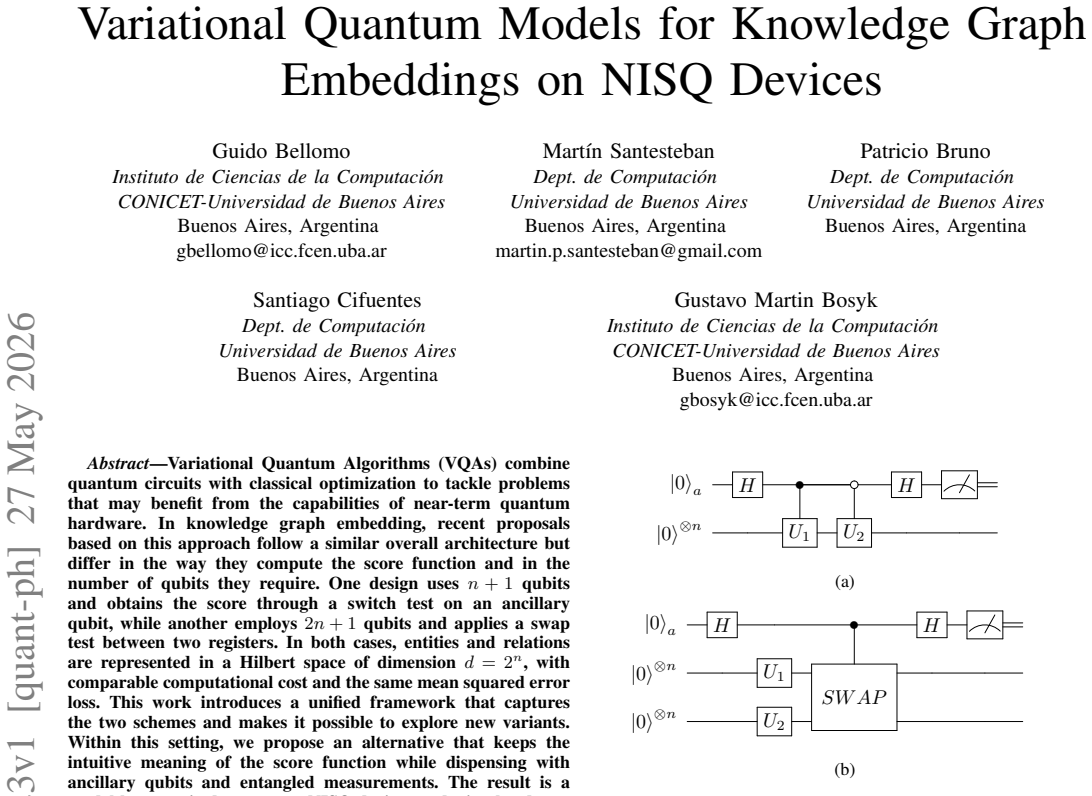
Within a unified setting where entities and relations live in a Hilbert space of dimension 2^n, the two existing schemes use either n+1 or 2n+1 qubits; the paper shows an alternative exists that computes the score directly on n qubits, retains the score's intuitive meaning, and achieves the same mean squared error loss without ancillary qubits or entangled measurements.
What carries the argument
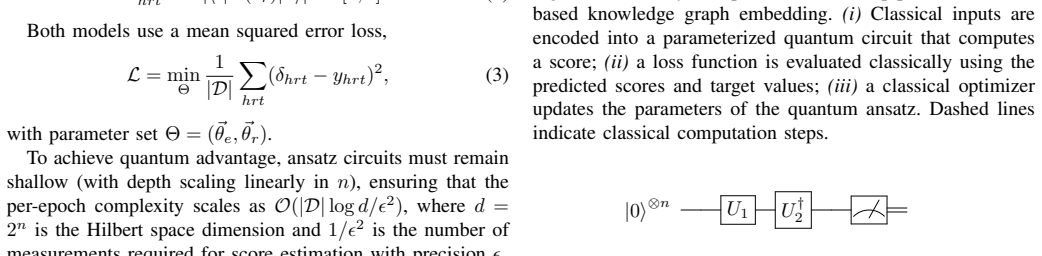
The alternative score-function computation that operates directly on the n-qubit registers representing entities and relations.
If this is right
- The model runs on current NISQ hardware with lower qubit overhead.
- The score remains directly interpretable as before.
- Mean squared error loss stays comparable to the two earlier schemes.
- The unified framework now supports further variants that trade off qubits against measurement complexity.
Where Pith is reading between the lines
- The same qubit-reduction idea could be tested on other quantum embedding tasks that currently rely on swap tests or ancillary registers.
- If the new model scales without loss of accuracy, it would allow larger knowledge graphs to fit within the qubit limits of near-term devices.
- Hardware experiments could directly compare circuit depth and noise resilience between the new scheme and the two older ones on the same device.
Load-bearing premise
The alternative scheme can keep the score function's intuitive meaning and reach the same mean squared error loss as the earlier schemes even after removing ancillary qubits and entangled measurements.
What would settle it
Implement the new model and one of the prior schemes on the same knowledge-graph dataset, measure mean squared error loss and total qubits used on a NISQ simulator or device, and check whether the new model matches the loss while using strictly fewer qubits.
Figures
read the original abstract
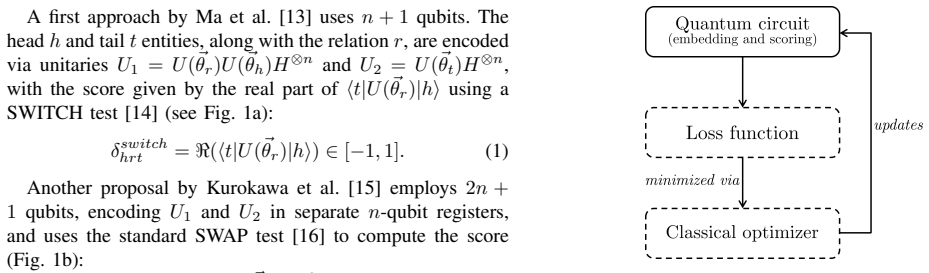
Variational Quantum Algorithms (VQAs) combine quantum circuits with classical optimization to tackle problems that may benefit from the capabilities of near-term quantum hardware. In knowledge graph embedding, recent proposals based on this approach follow a similar overall architecture but differ in the way they compute the score function and in the number of qubits they require. One design uses $n+1$ qubits and obtains the score through a switch test on an ancillary qubit, while another employs $2n+1$ qubits and applies a swap test between two registers. In both cases, entities and relations are represented in a Hilbert space of dimension $d = 2^n$, with comparable computational cost and the same mean squared error loss. This work introduces a unified framework that captures the two schemes and makes it possible to explore new variants. Within this setting, we propose an alternative that keeps the intuitive meaning of the score function while dispensing with ancillary qubits and entangled measurements. The result is a model better suited to current NISQ devices, reducing hardware demands without sacrificing interpretability.
Editorial analysis
A structured set of objections, weighed in public.
Referee Report
Summary. The manuscript introduces a unified framework capturing two existing variational quantum algorithm schemes for knowledge graph embeddings—one using an ancillary qubit and switch test on n+1 qubits, the other a swap test on 2n+1 qubits—both operating in Hilbert space dimension d=2^n with the same mean squared error loss. It proposes a new variant that computes an equivalent score function while dispensing with ancillary qubits and entangled measurements, preserving the intuitive meaning of the score and reducing hardware demands for NISQ devices.
Significance. If the derivations and any supporting results hold, the unified framework and hardware-efficient variant would be a useful contribution to variational quantum models for knowledge graphs, enabling more practical NISQ implementations without loss of interpretability. The ability to explore new variants systematically is a clear strength of the approach.
minor comments (1)
- The abstract states that the new model achieves the same MSE loss as prior schemes; if the full manuscript contains the explicit construction or proof of equivalence, it should be highlighted in a dedicated section or equation for clarity.
Simulated Author's Rebuttal
We thank the referee for the positive summary, significance assessment, and recommendation of minor revision. No specific major comments were provided in the report.
Circularity Check
No significant circularity detected
full rationale
The abstract and skeptic analysis describe an architectural unification of two existing VQA schemes for knowledge graph embeddings followed by a proposed variant that preserves the score function's meaning while reducing qubit count. No equations, derivations, fitted parameters, or self-citations are quoted or referenced that would reduce any claimed prediction or result to its own inputs by construction. The central claims concern hardware suitability and interpretability rather than a mathematical derivation chain, so no load-bearing circular steps exist. This is the expected outcome for a paper whose contribution is a modeling proposal without self-referential fitting or uniqueness theorems.
Axiom & Free-Parameter Ledger
Reference graph
Works this paper leans on
-
[1]
Knowledge graphs,
A. Hogan, E. Blomqvist, M. Cochez, C. D’amato, G. D. Melo, et al., “Knowledge graphs,”ACM Comput. Surv., vol. 54, no. 4, Jul. 2021,ISSN: 0360-0300
2021
-
[2]
Graph pattern matching revised for social network analysis,
W. Fan, “Graph pattern matching revised for social network analysis,” inProceedings of the 15th Int. Conf. on Database Theory, 2012, pp. 8–21
2012
-
[3]
Querying semantic web data with sparql,
M. Arenas and J. P ´erez, “Querying semantic web data with sparql,” inProceedings of the 30th ACM SIGMOD- SIGACT-SIGART Symp. on Principles of Database Sys- tems, 2011, pp. 305–316
2011
-
[4]
Tech- niques for efficiently querying scientific workflow provenance graphs.,
M. K. Anand, S. Bowers, and B. Lud ¨ascher, “Tech- niques for efficiently querying scientific workflow provenance graphs.,” inEDBT, vol. 10, 2010, pp. 287– 298
2010
-
[5]
Knowledge graph embedding for link prediction: A comparative analysis,
A. Rossi, D. Barbosa, D. Firmani, A. Matinata, and P. Merialdo, “Knowledge graph embedding for link prediction: A comparative analysis,”ACM Trans. on Knowledge Discovery from Data (TKDD), vol. 15, no. 2, pp. 1–49, 2021
2021
-
[6]
Using link features for entity clustering in knowledge graphs,
A. Saeedi, E. Peukert, and E. Rahm, “Using link features for entity clustering in knowledge graphs,” in European Semantic Web Conf., Springer, 2018, pp. 576– 592
2018
-
[7]
Link prediction techniques, applications, and performance: A survey,
A. Kumar, S. S. Singh, K. Singh, and B. Biswas, “Link prediction techniques, applications, and performance: A survey,”Physica A: Statistical Mechanics and its Applications, vol. 553, p. 124 289, 2020
2020
-
[8]
Knowledge graph embedding: An overview,
X. Ge, Y . C. Wang, B. Wang, C.-C. J. Kuo, et al., “Knowledge graph embedding: An overview,”APSIPA Trans. on Signal and Inf. Proc., vol. 13, no. 1, 2024
2024
-
[9]
A survey on knowledge graph embedding: Approaches, applications and benchmarks,
Y . Dai, S. Wang, N. N. Xiong, and W. Guo, “A survey on knowledge graph embedding: Approaches, applications and benchmarks,”Electronics, vol. 9, no. 5, p. 750, 2020
2020
-
[10]
A three-way model for collective learning on multi-relational data.,
M. Nickel, V . Tresp, H.-P. Kriegel, et al., “A three-way model for collective learning on multi-relational data.,” inIcml, vol. 11, 2011, pp. 3 104 482–3 104 584
2011
-
[11]
A review of knowledge graph embedding methods of transe, transh and transr for missing links,
S. M. Asmara, N. A. Sahabudin, N. S. N. Ismail, and I. A. A. Sabri, “A review of knowledge graph embedding methods of transe, transh and transr for missing links,” in2023 IEEE 8th ICSECS, IEEE, 2023, pp. 470–475
2023
-
[12]
Rotate: Knowledge graph embedding by relational rotation in complex space,
Z. Sun, Z.-H. Deng, J.-Y . Nie, and J. Tang, “Rotate: Knowledge graph embedding by relational rotation in complex space,” inInt. Conf. on Learning Representa- tions, 2019
2019
-
[13]
Variational quantum circuit model for knowledge graph embed- ding,
Y . Ma, V . Tresp, L. Zhao, and Y . Wang, “Variational quantum circuit model for knowledge graph embed- ding,”Adv. Quantum Tech., vol. 2, no. 7-8, p. 1 800 078, 2019
2019
-
[14]
The switch test for discriminating quantum evolutions,
P. Chamorro-Posada and J. C. Garcia-Escartin, “The switch test for discriminating quantum evolutions,” Journal of Physics A: Mathematical and Theoretical, vol. 56, no. 35, p. 355 301, 2023
2023
-
[15]
Evaluating variational quantum circuit designs for knowledge graph completion,
M. Kurokawa, P. R. Giri, and K. Saito, “Evaluating variational quantum circuit designs for knowledge graph completion,” in2022 IEEE Int. Conf. on Quantum Computing and Engineering (QCE), 2022, pp. 777–778
2022
-
[16]
Quantum fingerprinting,
H. Buhrman, R. Cleve, J. Watrous, and R. de Wolf, “Quantum fingerprinting,”Phys. Rev. Lett., vol. 87, p. 167 902, 16 2001
2001
-
[17]
Santesteban, P
M. Santesteban, P. Bruno, S. Cifuentes, G. Bellomo, and G. Bosyk, inArgentinean Symposium on Quantum Computing, 54JAIIO, 2025
2025
-
[18]
Supervised learning with quantum- enhanced feature spaces,
V . Havl ´ıˇcek et al., “Supervised learning with quantum- enhanced feature spaces,”Nature, vol. 567, no. 7747, pp. 209–212, 2019
2019
-
[19]
Qgo: Quantum circuit optimization via graph-based reinforcement learning,
X. Wu et al., “Qgo: Quantum circuit optimization via graph-based reinforcement learning,”arXiv preprint arXiv:2012.09835, 2020. [Online]. Available: https : / / arxiv.org/abs/2012.09835
-
[20]
Just-in-time quantum circuit optimization: Approximate circuits and improved fidelity,
E. Wilson, V . Gheorghiu, and M. Mosca, “Just-in-time quantum circuit optimization: Approximate circuits and improved fidelity,”arXiv preprint arXiv:2107.06701,
-
[21]
Available: https://arxiv.org/abs/2107
[Online]. Available: https://arxiv.org/abs/2107. 06701
discussion (0)
Sign in with ORCID, Apple, or X to comment. Anyone can read and Pith papers without signing in.