Avoided Stoner instability at a single ordinary Van Hove point
Pith reviewed 2026-06-29 09:45 UTC · model grok-4.3
The pith
In the 2D Hubbard model at an ordinary Van Hove point, the ferromagnetic Stoner instability is avoided down to temperatures an order of magnitude below the mean-field prediction.
A machine-rendered reading of the paper's core claim, the machinery that carries it, and where it could break.
Core claim
When the Fermi surface and the Brillouin zone boundary touch at a Van Hove point, mean-field analysis predicts a ferromagnetic (Stoner) instability at finite T_MF for any coupling strength due to the divergent density of states. However, in the two-dimensional Hubbard model with an ordinary Van Hove singularity, two diagrammatic Monte Carlo approaches demonstrate that the system avoids the Stoner instability down to temperatures an order of magnitude below T_MF. The suppression arises from the combination of the downward renormalization of the effective coupling and the suppression of the density of states by the loss of the quasiparticle residue.
What carries the argument
Diagrammatic Monte Carlo methods (four-channel self-consistent approximation and combinatorial summation with controlled resummation) applied to the Hubbard model at the Van Hove point, which track renormalization of the coupling and quasiparticle residue.
If this is right
- The effective coupling constant is renormalized downward at low temperatures.
- The quasiparticle residue drops, which directly reduces the effective density of states.
- No ferromagnetic instability appears until temperatures are at least an order of magnitude below the mean-field scale.
- This combination of effects accounts for the experimental absence of the predicted Stoner transition.
Where Pith is reading between the lines
- The same suppression mechanisms may operate at other Van Hove singularities or in models with longer-range interactions.
- Numerical studies of doped cuprate-like band structures could check whether the avoided instability persists away from half-filling.
- Analytic resummation techniques might be developed to capture the same renormalization without full Monte Carlo sampling.
Load-bearing premise
The two diagrammatic Monte Carlo methods remain accurate and free of uncontrolled truncation errors when applied to the Hubbard model at the Van Hove point.
What would settle it
Observation of ferromagnetic ordering at a temperature close to the mean-field T_MF in a two-dimensional Hubbard-like system tuned exactly to an ordinary Van Hove point would falsify the claim.
Figures
read the original abstract
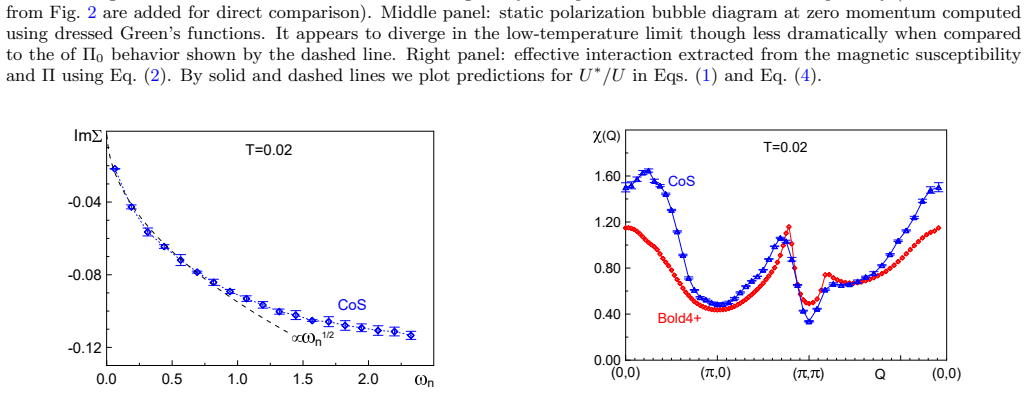
When the Fermi surface and the Brillouin zone boundary touch at a Van Hove point, mean-field analysis predicts a ferromagnetic (Stoner) instability at finite $T_{MF}$ for any coupling strength due to the divergent density of states. However, the predicted effect has not been observed experimentally. Several qualitative theoretical proposals have been put forward to explain why the mean-field prediction fails. Based on numerically exact results for the two-dimensional Hubbard model with an ordinary Van Hove singularity, we uncover the mechanisms behind the suppression of the ferromagnetic instability. We employ two diagrammatic Monte Carlo approaches: (i) the four-channel self-consistent approximation and (ii) numerically exact method of combinatorial summation of diagrams with controlled resummation of the truncated expansion. We find that the system avoids the Stoner instability down to temperatures an order of magnitude below $T_{MF}$ due to the combination of the downward renormalization of the effective coupling and the suppression of the density of states by the loss of the quasiparticle residue.
Editorial analysis
A structured set of objections, weighed in public.
Referee Report
Summary. The paper claims that for the 2D Hubbard model at an ordinary Van Hove singularity, mean-field theory predicts a Stoner ferromagnetic instability at finite T_MF for any U>0 due to divergent DOS, but two diagrammatic Monte Carlo methods (four-channel self-consistent approximation and combinatorial diagram summation with controlled resummation) show the instability is avoided down to T ≪ T_MF. The mechanisms are downward renormalization of the effective interaction plus suppression of the DOS by loss of quasiparticle residue Z.
Significance. If the central claim holds, the work supplies a concrete, non-perturbative explanation for the experimental absence of Stoner ferromagnetism near Van Hove points and demonstrates how diagrammatic resummation captures the interplay of coupling renormalization and Z suppression in a logarithmically divergent DOS. The deployment of two independent controlled diagrammatic Monte Carlo schemes is a methodological strength.
major comments (1)
- [Methods (diagrammatic Monte Carlo sections)] The assertion of 'numerically exact' results (abstract and methods description) is load-bearing for the claim that the Stoner instability is avoided. At the Van Hove point the bare DOS diverges, which can slow diagrammatic convergence; yet the manuscript provides no explicit order-by-order residuals, convergence tables, or quantitative cross-validation between the four-channel self-consistent approximation and the combinatorial summation at the lowest temperatures reported.
minor comments (1)
- Notation for the effective coupling and the quasiparticle residue Z should be introduced with a single equation reference when first used in the results discussion.
Simulated Author's Rebuttal
We thank the referee for their careful reading of the manuscript and for identifying the need for explicit convergence documentation to support the claim of numerically exact results. We address the major comment below and will revise the manuscript accordingly.
read point-by-point responses
-
Referee: [Methods (diagrammatic Monte Carlo sections)] The assertion of 'numerically exact' results (abstract and methods description) is load-bearing for the claim that the Stoner instability is avoided. At the Van Hove point the bare DOS diverges, which can slow diagrammatic convergence; yet the manuscript provides no explicit order-by-order residuals, convergence tables, or quantitative cross-validation between the four-channel self-consistent approximation and the combinatorial summation at the lowest temperatures reported.
Authors: We agree that explicit documentation of convergence is necessary to substantiate the 'numerically exact' characterization, especially given the divergent DOS at the Van Hove point. The combinatorial summation employs a controlled resummation with an explicit truncation-error estimator, and the two independent methods produce consistent results for the key observables. Nevertheless, the original manuscript did not include order-by-order residuals or quantitative cross-validation tables at the lowest temperatures. In the revised version we will add (i) tables and plots of residuals versus diagram order at the lowest reported temperatures for both methods, (ii) a direct quantitative comparison of the two methods' outputs at those temperatures, and (iii) a brief discussion of how the resummation procedure remains stable despite the divergent bare DOS. These additions will directly address the referee's concern. revision: yes
Circularity Check
No circularity: central results obtained from direct numerical summation on the Hubbard model
full rationale
The paper reports its key findings—the avoidance of Stoner instability down to T ≪ T_MF via coupling renormalization and Z suppression—explicitly as outcomes of two diagrammatic Monte Carlo techniques applied to the 2D Hubbard model at the Van Hove point. No analytical derivation chain exists that reduces a claimed prediction to a fitted parameter, self-defined quantity, or self-citation loop; the methods are presented as numerically exact computational tools whose outputs constitute the evidence. The abstract and described approach contain no instances of self-definitional relations, fitted inputs relabeled as predictions, or load-bearing uniqueness theorems imported from prior author work. This is the standard case of a self-contained numerical study whose validity rests on method convergence rather than internal definitional equivalence.
Axiom & Free-Parameter Ledger
axioms (1)
- domain assumption The Hubbard model on a square lattice with nearest-neighbor hopping accurately captures the low-energy physics near an ordinary Van Hove singularity.
Reference graph
Works this paper leans on
-
[1]
E. C. Stoner, Collective electron ferromagnetism II. En- ergy and specific heat, Proc. R. Soc. Lond. Ser. Math. Phys. Sci.169, 339 (1939)
1939
-
[2]
Kanamori, Electron Correlation and Ferromagnetism of Transition Metals, Progress of Theoretical Physics30, 275 (1963)
J. Kanamori, Electron Correlation and Ferromagnetism of Transition Metals, Progress of Theoretical Physics30, 275 (1963)
1963
-
[3]
Shimizu, On the conditions of ferromagnetism by the band model, Proc
M. Shimizu, On the conditions of ferromagnetism by the band model, Proc. Phys. Soc.84, 397 (1964)
1964
-
[4]
E. M. Lifshitz and L. P. Pitaevskij,Statistical Physics. Part 2. Theory of the Condensed State, Course of Theo- retical Physics, Vol. 9 (Elsevier, Oxford, 2006) reprinted edition
2006
-
[5]
Dzero and L
M. Dzero and L. P. Gor’kov, Breakup of a Stoner model for the two-dimensional ferromagnetic quantum critical point, Phys. Rev. B69, 092501 (2004)
2004
-
[6]
Moriya, Spin fluctuations in itinerant electron mag- netism, Springer Science & Business Media56(2012)
T. Moriya, Spin fluctuations in itinerant electron mag- netism, Springer Science & Business Media56(2012)
2012
-
[7]
G. J. Conduit, Itinerant ferromagnetism in a two- dimensional atomic gas, Phys. Rev. A82, 043604 (2010)
2010
-
[8]
Bultinck, S
N. Bultinck, S. Chatterjee, and M. P. Zaletel, Mechanism for Anomalous Hall Ferromagnetism in Twisted Bilayer Graphene., Phys Rev Lett124, 166601 (2020)
2020
-
[9]
Vu and S
D. Vu and S. Das Sarma, Reentrant Bloch ferromag- netism, Physical Review B104, L100405 (2021)
2021
-
[10]
Chatterjee, T
S. Chatterjee, T. Wang, E. Berg, and M. P. Zaletel, Inter- valley coherent order and isospin fluctuation mediated superconductivity in rhombohedral trilayer graphene, Nat. Commun.13, 6013 (2022)
2022
-
[11]
C. Huang, T. M. R. Wolf, W. Qin, N. Wei, I. V. Blinov, and A. H. MacDonald, Spin and orbital metallic mag- netism in rhombohedral trilayer graphene, Phys. Rev. B 107, L121405 (2023); I. V. Blinov, C. Huang, N. Wei, Q. Wei, T. Wolf, and A. H. MacDonald, Partial conden- sation of mobile excitons in graphene multilayers (2023), arxiv:2303.17350 [cond-mat.mes-hall]
-
[12]
Antebi, A
O. Antebi, A. Stern, and E. Berg, Stoner Ferromagnetism in a Momentum-Confined Interacting 2D Electron Gas, Phys. Rev. Lett.132, 086501 (2024)
2024
-
[13]
Z. M. Raines, L. I. Glazman, and A. V. Chubukov, Unconventional discontinuous transitions in isospin sys- tems, Phys. Rev. Lett.133, 146501 (2024); Uncon- ventional discontinuous transitions in a two-dimensional system with spin and valley degrees of freedom, Phys. Rev. B110, 155402 (2024); Z. M. Raines and A. V. Chubukov, Two-dimensional stoner transitio...
2024
-
[14]
A. L. Rakhmanov, A. V. Rozhkov, A. O. Sboychakov, and F. Nori, Half-metal and other fractional metal phases in doped A B bilayer graphene, Physical Review B107, 155112 (2023)
2023
-
[15]
Z. Dong, M. Davydova, O. Ogunnaike, and L. Levi- tov, Isospin- and momentum-polarized orders in bilayer graphene, Phys. Rev. B107, 075108 (2023); Z. Dong, A. V. Chubukov, and L. Levitov, Transformer spin-triplet superconductivity at the onset of isospin order in bilayer graphene, Phys. Rev. B107, 174512 (2023); Z. Dong, L. Levitov, and A. V. Chubukov, Sup...
2023
-
[16]
A. L. Szab´ o and B. Roy, Competing orders and cascade of degeneracy lifting in doped Bernal bilayer graphene, Physical Review B105, L201107 (2022)
2022
-
[17]
H. Zhou, L. Holleis, Y. Saito, L. Cohen, W. Huynh, C. L. Patterson, F. Yang, T. Taniguchi, K. Watanabe, and A. F. Young, Isospin magnetism and spin-polarized su- perconductivity in bernal bilayer graphene, Science375, 774 (2022)
2022
-
[18]
L. Holleis, C. Patterson, Y. Zhang, Y. Vituri, H. M. Yoo, Z. H., T. T., W. K., B. E., and A. F. Nadj-Perge S. F. Young, Nematicity and orbital depairing in su- perconducting bernal bilayer graphene, Nat. Phys.21, https://doi.org/10.1038/s41567-024-02776-7 (2025)
- [19]
-
[20]
A. Ghiotto, L. Wei, L. Song, J. Zang, A. B. Tazi, D. Ostrom, K. Watanabe, T. Taniguchi, J. C. Hone, D. A. Rhodes, A. J. Millis, C. R. Dean, L. Wang, and A. N. Pasupathy, Stoner instabilities and ising excitonic states in twisted transition metal dichalcogenides (2024), arXiv:2405.17316 [cond-mat.str-el]
-
[21]
M. S. Hossain, M. K. Ma, K. A. V. Rosales, Y. J. Chung, L. N. Pfeiffer, K. W. West, K. W. Baldwin, and M. Shayegan, Observation of spontaneous ferromagnetism in a two-dimensional electron system, Proc. Natl. Acad. Sci.117, 32244 (2020); Md. S. Hossain, M. K. Ma, K. A. Villegas-Rosales, Y. J. Chung, L. N. Pfeiffer, K. W. West, K. W. Baldwin, and M. Shayega...
2020
-
[22]
Dzyaloshinskii, Superconducting transitions due to van hove singularities in the electron spectrum, Sov
I. Dzyaloshinskii, Superconducting transitions due to van hove singularities in the electron spectrum, Sov. Phys. JETP66, 848 (1987); I. Dzyaloshinskii and V. M. Yakovenko, Weak coupling theory for La2CuO4,,67, 844 (1988)
1987
-
[23]
Wang, Z.-Z
W.-S. Wang, Z.-Z. Li, Y.-Y. Xiang, and Q.-H. Wang, Competing electronic orders on kagome lattices at van hove filling, Phys. Rev. B87, 115135 (2013)
2013
-
[24]
Chandrasekaran, A
A. Chandrasekaran, A. Shtyk, J. J. Betouras, and C. Chamon, Catastrophe theory classification of fermi surface topological transitions in two dimensions, Phys. Rev. Res.2, 013355 (2020); D. V. Efremov, A. Shtyk, A. W. Rost, C. Chamon, A. P. Mackenzie, and J. J. Be- touras, Multicritical fermi surface topological transitions, Phys. Rev. Lett.123, 207202 (2019)
2020
-
[25]
J. V. Alvarez, J. Gonzalez, F. Guinea, and M. A. H. Voz- mediano, Superconducting, ferromagnetic and antiferro- magnetic phases in the t-t’ hubbard model, Journal of the Physical Society of Japan67, 1868 (1998); C. Hon- erkamp and M. Salmhofer, Temperature-flow renormal- ization group and the competition between supercon- ductivity and ferromagnetism, Phy...
1998
-
[26]
D. V. Chichinadze, L. Classen, and A. V. Chubukov, Valley magnetism, nematicity, and density wave or- ders in twisted bilayer graphene, Phys. Rev. B102, 10.1103/physrevb.102.125120 (2020); D. V. Chichinadze, L. Classen, Y. Wang, and A. V. Chubukov, Cascade of transitions in twisted and non-twisted graphene layers within the van Hove scenario, npj Quantum ...
-
[27]
V. Y. Irkhin, A. A. Katanin, and M. I. Katsnelson, Ef- fects of Van Hove singularities on magnetism and super- conductivity in thet−t ′ Hubbard model: a parquet ap- proach, Phys. Rev. B64, 165107 (2001)
2001
-
[28]
J. Zang, J. Wang, J. Cano, and A. J. Millis, Hartree- Fock study of the moir´ e Hubbard model for twisted bi- layer transition metal dichalcogenides, Phys. Rev. B104, 075150 (2021)
2021
-
[29]
T. Ma, F. Hu, Z. Huang, and H.-Q. Lin, Controllabil- ity of ferromagnetism in graphene, Appl. Phys. Lett.97, 112504 (2010)
2010
-
[30]
C. W. Hicks, D. O. Brodsky, E. A. Yelland, A. S. Gibbs, J. A. N. Bruin, M. E. Barber, S. D. Edkins, K. Nishimura, S. Yonezawa, Y. Maeno, and A. P. Mackenzie, Strong in- crease of Tc of Sr2RuO4 under both tensile and compres- sive strain, Science344, 283 (2014)
2014
-
[31]
M. E. Barber, A. S. Gibbs, Y. Maeno, A. P. Mackenzie, and C. W. Hicks, Resistivity in the vicinity of a van hove singularity: Sr2RuO4 under uniaxial pressure, Phys. Rev. Lett.120, 076602 (2018); V. C. Stangier, E. Berg, and J. Schmalian, Breakdown of the wiedemann-franz law at the lifshitz point of strained sr 2ruo4, Phys. Rev. B105, 115113 (2022); Y.-S. ...
2018
-
[32]
Isobe and L
H. Isobe and L. Fu, Supermetal, Phys. Rev. Res.1, 033206 (2019)
2019
-
[33]
Classen, A
L. Classen, A. V. Chubukov, C. Honerkamp, and M. M. Scherer, Competing orders at higher-order Van Hove points, Phys. Rev. B102, 125141 (2020)
2020
-
[34]
Ojaj¨ arvi, A
R. Ojaj¨ arvi, A. V. Chubukov, Y.-C. Lee, M. Garst, and J. Schmalian, Pairing at a single Van Hove point, NJP Quantum Materials9, 105 (2024)
2024
-
[35]
Prokof’ev and B
N. Prokof’ev and B. Svistunov, Bold diagrammatic Monte Carlo technique: When the sign problem is wel- come, Phys. Rev. Lett.99, 250201 (2007)
2007
-
[36]
Van Houcke, E
K. Van Houcke, E. Kozik, N. Prokof’ev, and B. Svis- tunov, Diagrammatic Monte Carlo, Physics Procedia6, 95 (2010)
2010
-
[37]
Kozik, K
E. Kozik, K. Van Houcke, E. Gull, L. Pollet, N. Prokof’ev, B. Svistunov, and M. Troyer, Diagram- matic Monte Carlo for correlated fermions, Europhys. Lett.90, 10004 (2010)
2010
-
[38]
Kozik, Combinatorial summation of Feynman dia- grams, Nature Communications15, 7916 (2024)
E. Kozik, Combinatorial summation of Feynman dia- grams, Nature Communications15, 7916 (2024)
2024
-
[39]
A. V. Chubukov, A. Klein, and D. L. Maslov, Fermi- Liquid Theory and Pomeranchuk Instabilities: Funda- mentals and New Developments, J. Exp. Theor. Phys. 127, 826 (2018)
2018
-
[40]
ˇSimkovic IV, Y
F. ˇSimkovic IV, Y. Deng, N. V. Prokof’ev, B. V. Svis- tunov, I. S. Tupitsyn, and E. Kozik, Magnetic correla- tions in the two-dimensional repulsive Fermi-Hubbard model, Phys. Rev. B96, 081117(R) (2017)
2017
-
[41]
I. S. Tupitsyn, B. Currie, B. V. Svistunov, E. Kozik, and N. V. Prokof’ev, Numerically exact study of flat- band superconductivity (2026), arXiv:2604.05997 [cond- mat.supr-con]
work page internal anchor Pith review Pith/arXiv arXiv 2026
-
[42]
G. A. Baker Jr, Application of the Pad´ e approximant method to the investigation of some magnetic properties of the Ising model, Phys. Rev.124, 768 (1961)
1961
-
[43]
D. L. Hunter and G. A. Baker, Methods of series analysis. iii. integral approximant methods, Phys. Rev. B19, 3808 (1979)
1979
-
[44]
ˇSimkovic IV and E
F. ˇSimkovic IV and E. Kozik, Determinant Monte Carlo for irreducible Feynman diagrams in the strongly corre- lated regime, Phys. Rev. B100, 121102(R) (2019)
2019
-
[45]
A. V. Chubukov and D. L. Maslov, Spin Conservation and Fermi Liquid near a Ferromagnetic Quantum Critical Point, Phys. Rev. Lett.103, 216401 (2009)
2009
-
[46]
D. V. Efremov, J. J. Betouras, and A. Chubukov, Non- 7 analytic behavior of two-dimensional itinerant ferromag- nets, Phys. Rev. B77, 220401 (2008)
2008
-
[47]
Topological superconductivity from repulsive interactions in twisted wse 2,
D. Guerci, D. Kaplan, J. Ingham, J. H. Pixley, and A. J. Millis, Topological superconductivity from repul- sive interactions in twisted wse2 (2024), arXiv:2408.16075 [cond-mat.supr-con]
-
[48]
Christos, P
M. Christos, P. M. Bonetti, and M. S. Scheurer, Approx- imate symmetries, insulators, and superconductivity in the continuum-model description of twisted wse 2, Phys. Rev. Lett.135, 046503 (2025)
2025
-
[49]
J. Zang, J. Wang, J. Cano, and A. J. Millis, Hartree- fock study of the moir´ e hubbard model for twisted bi- layer transition metal dichalcogenides, Phys. Rev. B104, 075150 (2021)
2021
-
[50]
Devakul, V
T. Devakul, V. Cr´ epel, Y. Zhang, and L. Fu, Magic in twisted transition metal dichalcogenide bilayers, Nature Communications12, 6730 (2021)
2021
-
[51]
A. V. Chubukov and C. M. Varma, Quantum critical- ity and superconductivity in twisted transition metal dichalcogenides, Phys. Rev. B111, 014507 (2025)
2025
-
[52]
Y. Xia, Z. Han, K. Watanabe, T. Taniguchi, J. Shan, and K. F. Mak, Superconductivity in twisted bilayer wse2, Nature 10.1038/s41586-024-08116-2 (2024)
-
[53]
Y. Guo, J. Pack, J. Swann, L. Holtzman, M. Cothrine, K. Watanabe, T. Taniguchi, D. G. Mandrus, K. Barmak, J. Hone, A. J. Millis, A. Pasupathy, and C. R. Dean, Superconductivity in 5.0°twisted bilayer wse2, Nature 637, 839 (2025)
2025
discussion (0)
Sign in with ORCID, Apple, or X to comment. Anyone can read and Pith papers without signing in.