Three-dimensional orbital-free density functional theory description of nuclear pasta in the inner crust of neutron stars
Pith reviewed 2026-06-29 09:17 UTC · model grok-4.3
The pith
A self-consistent extended Thomas-Fermi method allows three-dimensional calculations of nuclear pasta structures without assuming their shapes.
A machine-rendered reading of the paper's core claim, the machinery that carries it, and where it could break.
Core claim
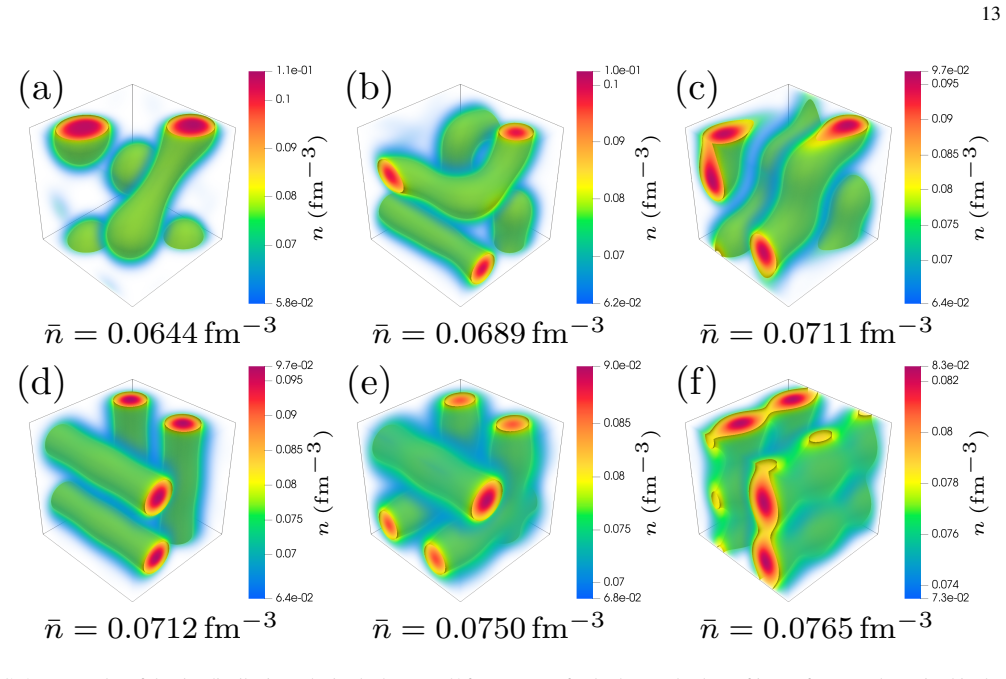
The self-consistent ETF (SC-ETF) method, obtained by applying the variational principle to the second-order extended Thomas-Fermi expansion of the Skyrme energy density functional, determines the optimal three-dimensional neutron and proton density distributions by solving the resulting Euler-Lagrange equations. When applied across the density range of the inner crust, the calculations recover the standard pasta phases reported in earlier work and additionally produce exotic configurations such as bending or connected rods and slabs containing holes, all without any preset geometric templates.
What carries the argument
The self-consistent extended Thomas-Fermi (SC-ETF) method, which reduces the Skyrme energy density functional to an expression depending only on neutron and proton densities and solves the associated Euler-Lagrange equations self-consistently for those densities.
If this is right
- Various pasta structures appear depending on the chosen average nucleon density, reproducing the sequence found in earlier studies.
- Exotic configurations such as bending rods, connected rods, and slabs with holes emerge naturally from the self-consistent solution.
- The approach removes the need to assume geometric shapes in advance, allowing the density profiles to adjust freely.
- Three-dimensional calculations become feasible at modest computational cost, opening the possibility of systematic surveys over wide ranges of density.
- The method yields density distributions that can be used directly for further calculations of transport or emissivity properties.
Where Pith is reading between the lines
- The same variational framework could be applied at finite temperature to map how pasta phases evolve with the thermal conditions inside a cooling neutron star.
- Connected or bent structures found here might alter estimates of shear viscosity or thermal conductivity compared with calculations that assume straight rods or flat slabs.
- If the density profiles are inserted into neutrino-transport simulations, the resulting emissivity could differ measurably from results based on idealized geometries.
- A parameter scan with varying Skyrme forces would test how sensitive the appearance of exotic structures is to the choice of effective interaction.
- The method's efficiency suggests it could be coupled to dynamical simulations of crust motion during a neutron-star merger.
- keywords:[
Load-bearing premise
The second-order extended Thomas-Fermi expansion of the Skyrme energy density functional remains accurate enough for the strongly varying density profiles that appear in nuclear pasta.
What would settle it
A direct numerical comparison of the total energy and the proton and neutron density profiles obtained by the SC-ETF method against a fully microscopic three-dimensional Hartree-Fock calculation performed at the same average density and box size would show whether the two agree to within a few percent.
Figures
read the original abstract
Background: In the bottom layer of the inner crust of neutron stars, various crystalline structures are expected to emerge that are collectively called ``nuclear pasta.'' It is desirable to know properties of nuclear pasta in a wide variety of conditions for astrophysical applications. However, three-dimensional fully-microscopic calculations require huge computational effort that makes it still challenging to carry out systematic calculations. Purpose: In this paper, we propose an efficient method to calculate various nuclear pasta configurations in a non-empirical manner, based on three-dimensional orbital-free density functional theory (OF-DFT). We demonstrate the feasibility of the proposed approach by applying it to densities across the inner crust of neutron stars. Methods: As a first application of OF-DFT for nuclear pasta, we employ the second-order extended Thomas-Fermi (ETF) expansion of Skyrme energy density functional (EDF) to construct an EDF that depends only on neutron and proton number densities. Based on the variational principle, we derive Euler-Lagrange equations to determine optimal neutron and proton density distributions and solve them self-consistently. In this work, we call this approach the self-consistent ETF (SC-ETF) method. Results: We perform three-dimensional SC-ETF calculations with various box sizes. We successfully obtain various pasta structures, depending on given average nucleon number densities, consistent with earlier studies. Moreover, we find other exotic structures, such as bending and/or connected rods, slabs with a hole, etc., underlining the advantage of the self-consistent formalism. Conclusions: We demonstrate that the SC-ETF method proposed in this study, which can be regarded as a realization of OF-DFT, is a promising tool that can efficiently describe complex pasta structures without empirical assumptions on geometric shapes.
Editorial analysis
A structured set of objections, weighed in public.
Referee Report
Summary. The manuscript introduces a self-consistent extended Thomas-Fermi (SC-ETF) method, realized as three-dimensional orbital-free DFT, that applies the second-order gradient expansion to a Skyrme energy density functional. Euler-Lagrange equations for neutron and proton densities are derived variationally and solved self-consistently in periodic boxes of varying sizes. The authors report recovery of standard pasta phases (rods, slabs, etc.) across inner-crust densities together with additional exotic structures (bending/connected rods, slabs with holes) without presupposing geometry, and conclude that the approach is a promising, efficient tool for systematic studies.
Significance. If the second-order ETF approximation proves sufficiently accurate, the method supplies a computationally tractable route to three-dimensional pasta calculations that avoids both the cost of full Hartree-Fock and the bias of assumed geometries, thereby enabling broader surveys of the phase diagram relevant to neutron-star crust modeling.
major comments (2)
- [Methods] Methods section (description of the ETF functional and derivation of the Euler-Lagrange equations): The central claim that SC-ETF reliably describes complex pasta structures rests on the accuracy of the second-order extended Thomas-Fermi expansion for the large density gradients present at nuclear surfaces. No quantitative benchmark against full Hartree-Fock or third-order ETF calculations on the identical Skyrme parametrization is reported for any pasta geometry, so the approximation error remains unquantified.
- [Results] Results section (discussion of structures obtained with various box sizes): While exotic configurations are presented, the manuscript provides no tabulated energy differences, density-profile comparisons, or convergence metrics (e.g., with respect to box size or grid spacing) that would demonstrate these structures are robust rather than numerical artifacts; the abstract notes only qualitative consistency with earlier work.
minor comments (2)
- [Abstract] Abstract: the phrase 'consistent with earlier studies' would be strengthened by citing the specific prior calculations (e.g., by geometry or functional) against which agreement is claimed.
- [Methods] Notation: the definition of the Skyrme parameters and the precise form of the second-order ETF kinetic-energy correction should be stated explicitly rather than referenced only to prior literature.
Simulated Author's Rebuttal
We thank the referee for the constructive report and the positive assessment of the potential significance of the SC-ETF approach. We address the two major comments point by point below and indicate the revisions we will make.
read point-by-point responses
-
Referee: [Methods] Methods section (description of the ETF functional and derivation of the Euler-Lagrange equations): The central claim that SC-ETF reliably describes complex pasta structures rests on the accuracy of the second-order extended Thomas-Fermi expansion for the large density gradients present at nuclear surfaces. No quantitative benchmark against full Hartree-Fock or third-order ETF calculations on the identical Skyrme parametrization is reported for any pasta geometry, so the approximation error remains unquantified.
Authors: We agree that the lack of a direct quantitative benchmark against Hartree-Fock or third-order ETF leaves the approximation error for large density gradients unquantified in the present work. This manuscript presents the first application of the SC-ETF method to three-dimensional nuclear pasta; our focus was on demonstrating that the variational solution can recover known phases and discover additional structures without geometric assumptions. We will revise the Methods and Conclusions sections to include an explicit discussion of the expected accuracy of the second-order ETF expansion, drawing on existing literature for Skyrme functionals in finite nuclei and uniform matter, and to state clearly that systematic benchmarks against full Hartree-Fock remain a task for future work. revision: partial
-
Referee: [Results] Results section (discussion of structures obtained with various box sizes): While exotic configurations are presented, the manuscript provides no tabulated energy differences, density-profile comparisons, or convergence metrics (e.g., with respect to box size or grid spacing) that would demonstrate these structures are robust rather than numerical artifacts; the abstract notes only qualitative consistency with earlier work.
Authors: We acknowledge that tabulated energies, profile comparisons, and explicit convergence tests would strengthen the evidence that the reported exotic structures are physically robust. In the revised manuscript we will add a new subsection (or appendix) presenting (i) the energy per nucleon for each obtained configuration, (ii) direct comparisons of density profiles with selected earlier calculations where geometries overlap, and (iii) results of convergence checks with respect to box size and grid spacing for representative cases. These additions will be placed in the Results section to support the claim that the structures are not numerical artifacts. revision: yes
Circularity Check
Derivation chain is self-contained; no circularity identified
full rationale
The paper applies the standard variational principle to the second-order ETF approximation of the Skyrme EDF to obtain Euler-Lagrange equations for neutron and proton densities, then solves them self-consistently in 3D. This is a direct, non-circular implementation of orbital-free DFT. Skyrme parameters are taken from external prior literature rather than fitted inside the paper, and no load-bearing step reduces to a self-citation, fitted input renamed as prediction, or ansatz smuggled via citation. Results are obtained without geometric assumptions and are compared to external studies for consistency. The central claim therefore rests on independent content.
Axiom & Free-Parameter Ledger
axioms (1)
- domain assumption The second-order extended Thomas-Fermi expansion of the Skyrme energy density functional is sufficiently accurate for the inhomogeneous neutron and proton densities that form nuclear pasta.
Reference graph
Works this paper leans on
-
[1]
cylinder
Equations for neutron star matter To calculate neutron star matter, we minimize the following quantity,Ω, instead ofE ′ (17): Ω≡E cell −µ Z V n(r)dr−A ,(24) whereAstands for the number of nucleons per simulation cell. Here,µis a Lagrange multiplier to control the number of nu- cleons. Since we minimize the energy by adjusting neutron, proton, and electron...
-
[2]
To calcu- late nuclear pasta structures in a 3D simulation box, we em- ploy the periodic boundary conditions
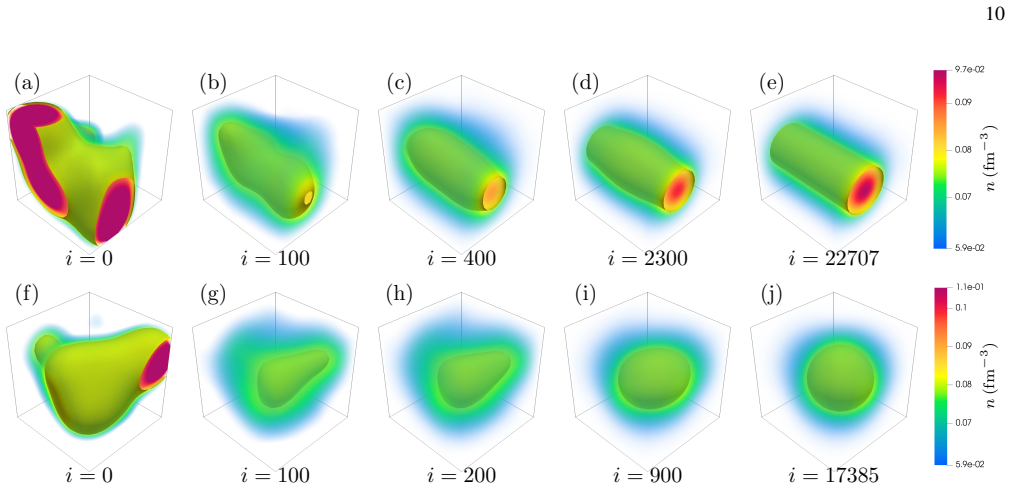
Computational setups In this section, we present the results of SC-ETF calcula- tions for nuclear pasta at a wide range of densities. To calcu- late nuclear pasta structures in a 3D simulation box, we em- ploy the periodic boundary conditions. To examine the box 10 i = 0 i = 100 i = 400 i = 2300 i = 22707 n (fm−3) i = 0 i = 100 i = 200 i = 900 i = 17385 n...
-
[3]
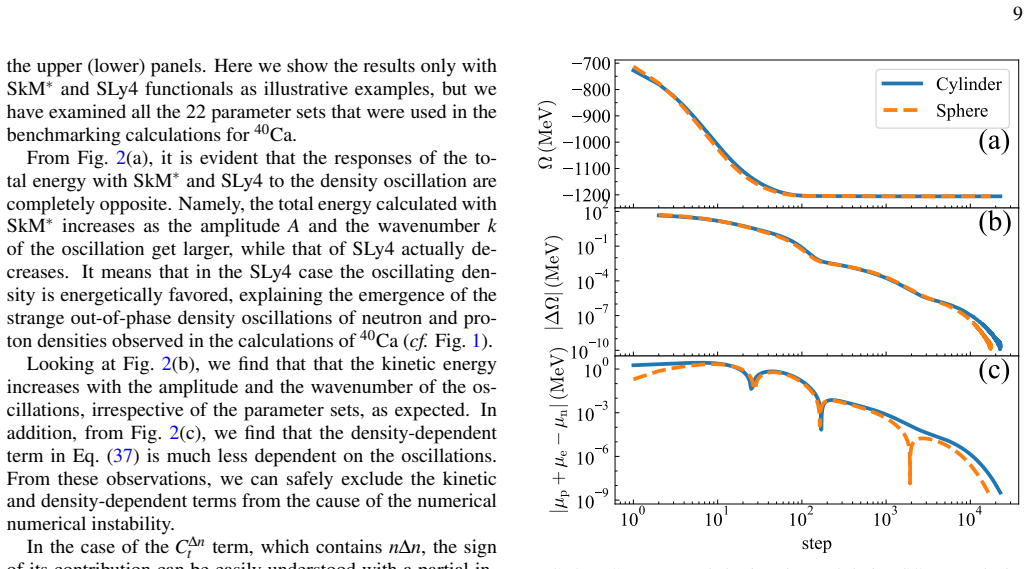
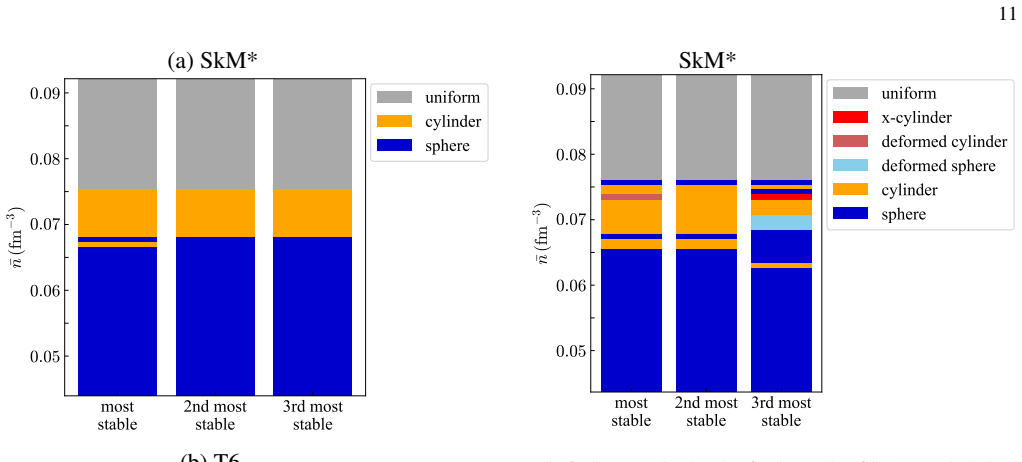
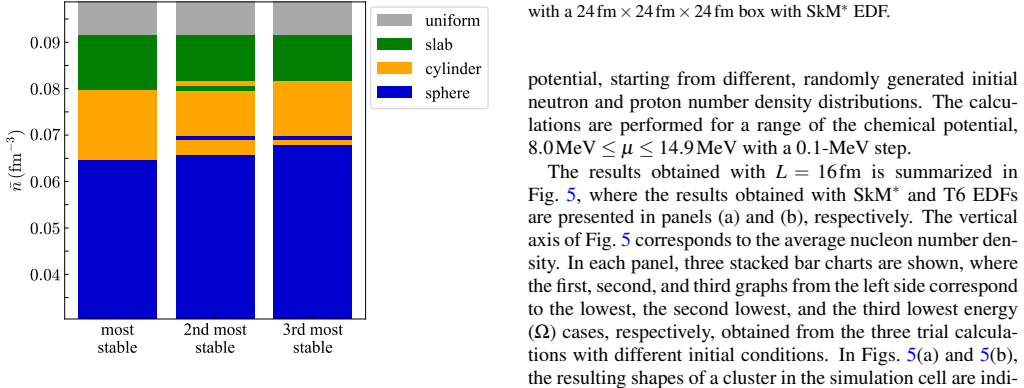
The L=16fm case In this section, we show the results obtained with a 163 fm3 box as the simplest example to demonstrate feasibility of this approach. First of all, to show how SC-ETF calcula- tions work in practice, two typical examples of converging solutions during the gradient decent iterations are shown in Fig.3 forµ=11 MeV with SkM ∗ EDF. In the figu...
-
[4]
deformed sphere,
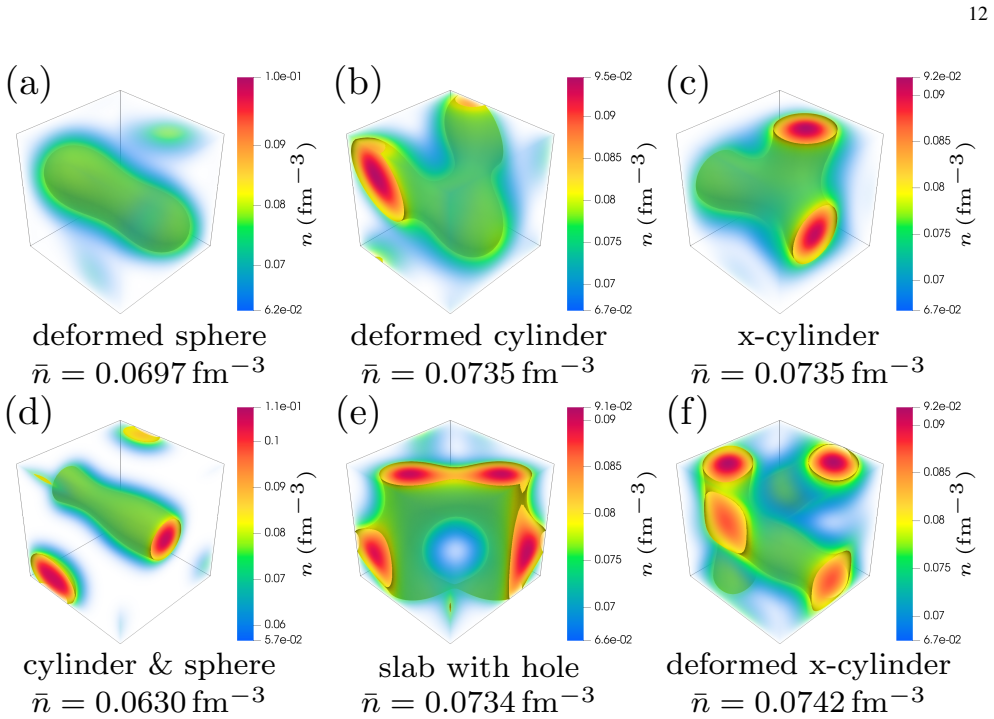
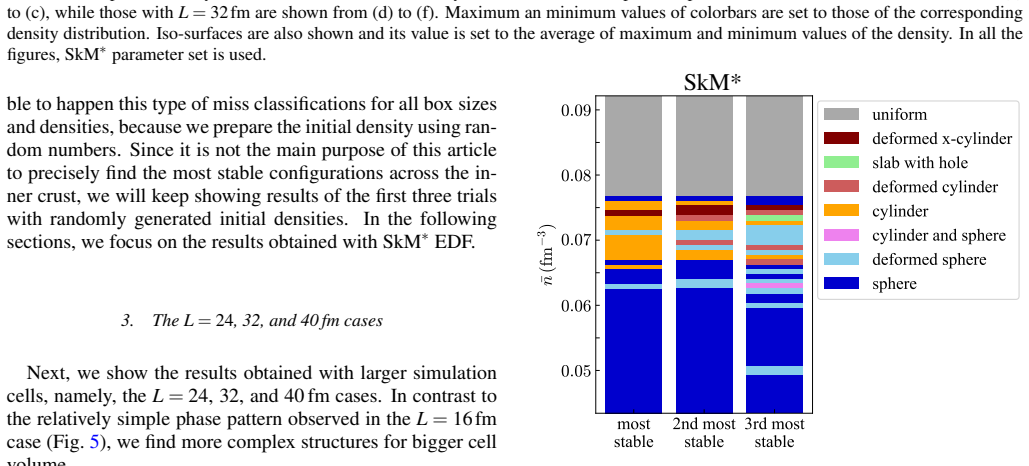
The L=24, 32, and 40 fm cases Next, we show the results obtained with larger simulation cells, namely, theL=24, 32, and 40 fm cases. In contrast to the relatively simple phase pattern observed in theL=16fm case (Fig. 5), we find more complex structures for bigger cell volume. In Fig. 6, the obtained pasta shapes are summarized for the case ofL=24fm. The w...
-
[5]
effective interac- tion
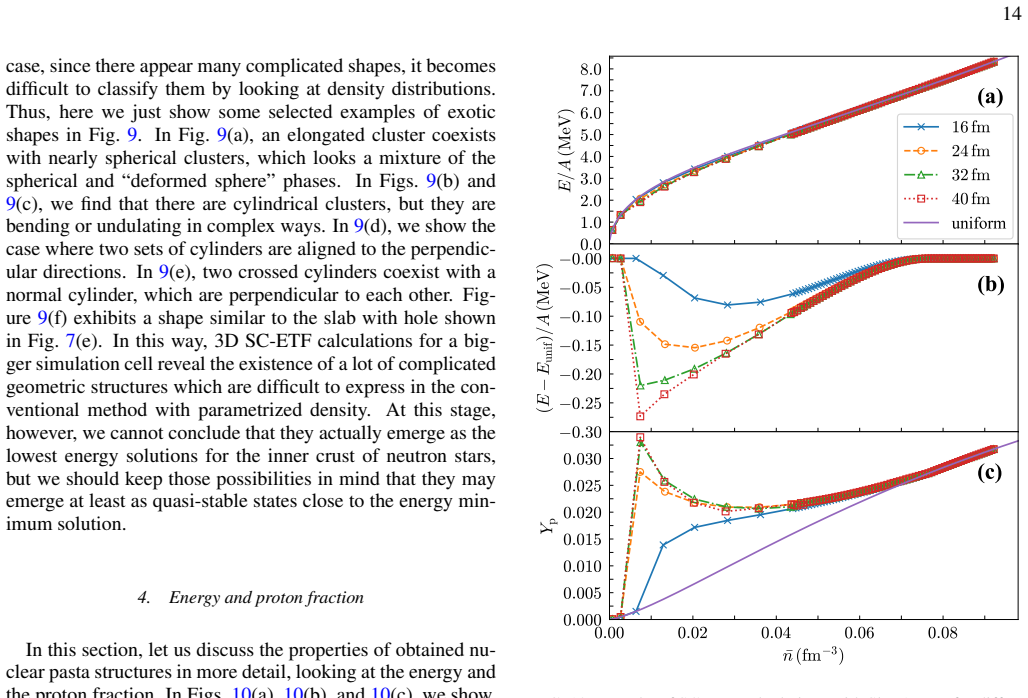
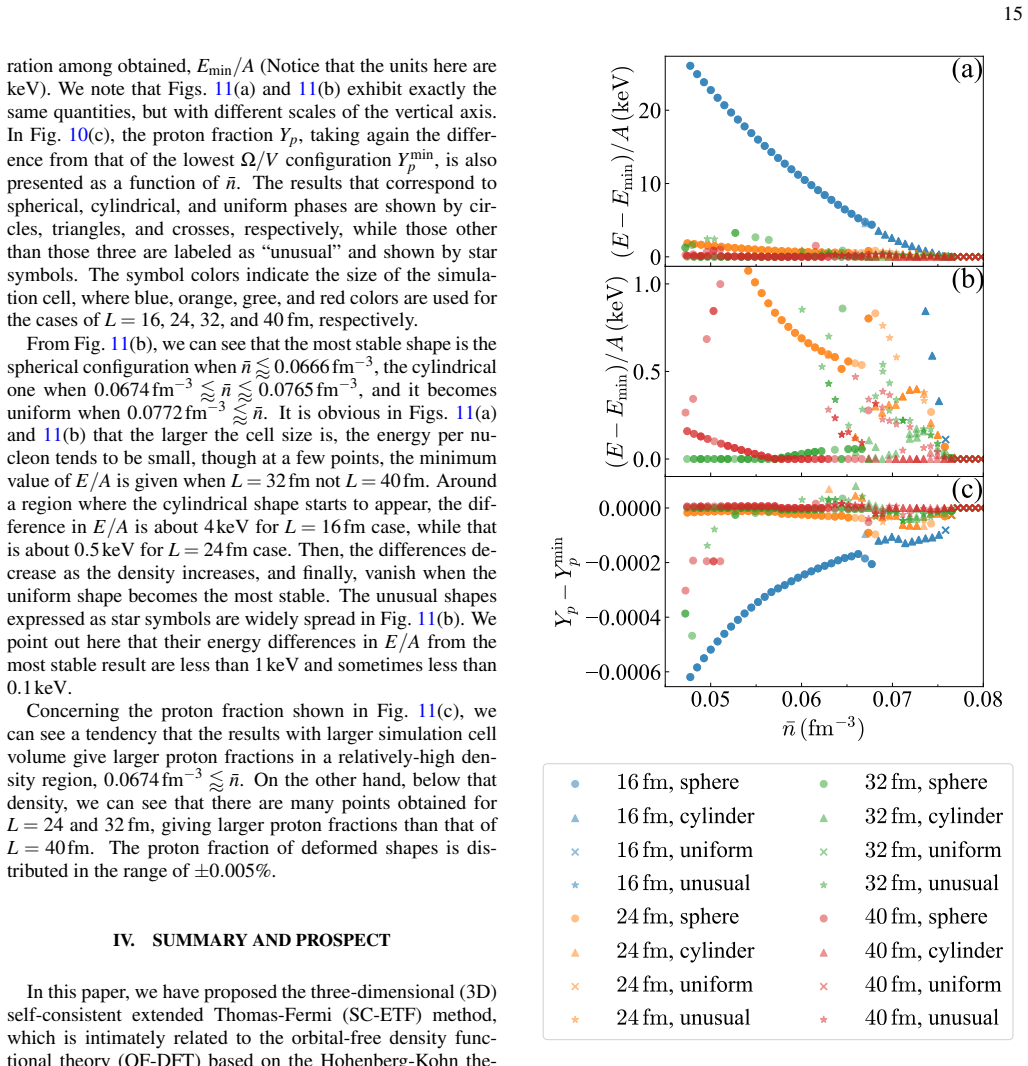
Energy and proton fraction In this section, let us discuss the properties of obtained nu- clear pasta structures in more detail, looking at the energy and the proton fraction. In Figs. 10(a), 10(b), and 10(c), we show, respectively, the energy per nucleonE cell/A, difference of the energy per nucleon between each pasta configuration and that of uniform nu...
-
[6]
12, we show the total energy of 40Ca as a function of the mesh spacing∆xfor various Skyrme parameter sets
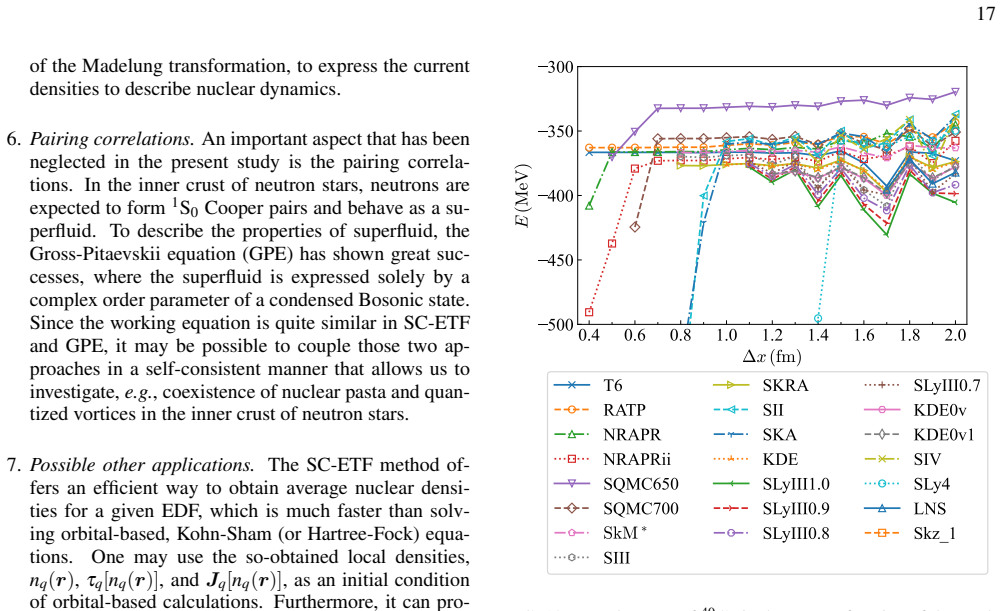
Convergence of total energy In Fig. 12, we show the total energy of 40Ca as a function of the mesh spacing∆xfor various Skyrme parameter sets. As discussed in Sec. III A, T6 and RATP show stable, convergent results for all values of∆xexamined, while other functionals sometimes show a sudden decrease of the total energy that implies the instability problem
-
[7]
Details of Skyrme parameter sets In Table II, we list several key coupling constants of Skyrme EDF that are, at least partly, related to the instability problem, as discussed in Sec. III B. 18 TABLE II. A few selectedCcoefficients of the parameter sets used in Sec. II. All the quantities are expressed in MeVfm5. Cτ 1 C∆ρ 1 C∇J 0 C∇J 1 T6 0 0 −80.25 −26.75...
-
[8]
Hohenberg and W
P. Hohenberg and W. Kohn,Inhomogeneous electron gas, Phys. Rev.136, B864–B871 (1964)
1964
-
[9]
Kohn and L
W. Kohn and L. J. Sham,Self-consistent equations including ex- change and correlation effects, Phys. Rev.140, A1133–A1138 (1965)
1965
-
[10]
Bender, P.-H
M. Bender, P.-H. Heenen, and P.-G. Reinhard,Self-consistent mean-field models for nuclear structure, Rev. Mod. Phys.75, 121–180 (2003)
2003
-
[11]
Wlazłowski, K
G. Wlazłowski, K. Sekizawa, P. Magierski, A. Bulgac, and M. M. Forbes,Vortex pinning and dynamics in the neutron star crust, Phys. Rev. Lett.117, 232701 (2016)
2016
-
[12]
P˛ ecak, N
D. P˛ ecak, N. Chamel, P. Magierski, and G. Wlazłowski,Prop- erties of a quantum vortex in neutron matter at finite tempera- tures, Phys. Rev. C104, 055801 (2021)
2021
-
[13]
P˛ ecak, A
D. P˛ ecak, A. Zdanowicz, N. Chamel, P. Magierski, and G. Wlazłowski,Time-dependent nuclear energy-density func- tional theory toolkit for neutron star crust: Dynamics of a nu- cleus in a neutron superfluid, Phys. Rev. X14, 041054 (2024)
2024
-
[14]
Yoshimura and K
K. Yoshimura and K. Sekizawa,Superfluid extension of the self- consistent time-dependent band theory for neutron star mat- ter: Anti-entrainment versus superfluid effects in the slab phase, Phys. Rev. C109, 065804 (2024)
2024
-
[15]
Yoshimura and K
K. Yoshimura and K. Sekizawa,Phase transitions in the in- ner crust of neutron stars within the superfluid band theory: Competition between 1s0 pairing and spin polarization under finite temperature and magnetic field, Phys. Rev. C112, 065804 (2025)
2025
-
[16]
K. Yoshimura and K. Sekizawa, Superfluid band theory for the rod phase in the magnetized inner crust matter: En- trainment, spin-orbit coupling, spin-triplet pairing (2026), arXiv:2601.13636 [nucl-th]
-
[17]
Bulgac, M
A. Bulgac, M. M. Forbes, S. Jin, R. N. Perez, and N. Schunck, Minimal nuclear energy density functional, Phys. Rev. C97, 044313 (2018)
2018
-
[18]
Colò and K
G. Colò and K. Hagino,Orbital-free density functional theory: Differences and similarities between electronic and nuclear systems, Progress of Theoretical and Experimental Physics 2023, 103D01 (2023)
2023
-
[19]
Hizawa, K
N. Hizawa, K. Hagino, and K. Yoshida,Analysis of a skyrme energy density functional with deep learning, Phys. Rev. C108, 034311 (2023)
2023
-
[20]
Hizawa and K
N. Hizawa and K. Hagino,Nonempirical shape dynamics of heavy nuclei with multitask deep learning, Phys. Rev. C109, 014312 (2024)
2024
-
[21]
X. H. Wu, Z. X. Ren, and P. W. Zhao,Machine learning orbital- free density functional theory resolves shell effects in deformed nuclei, Communications Physics8, 316 (2025)
2025
-
[22]
X. Wu, G. Colò, K. Hagino, and P. Zhao,Nonlocal orbital-free density functional theory incorporating nuclear shell effects, Phys. Rev. Lett.136, 092501 (2026)
2026
-
[23]
K. Yoshimura, Neural-network-based variational method in nu- clear density functional theory: Application to the extended thomas-fermi model (2026), arXiv:2604.25759 [nucl-th]
work page internal anchor Pith review Pith/arXiv arXiv 2026
-
[24]
K. A. Brueckner, J. R. Buchler, S. Jorna, and R. J. Lombard, Statistical theory of nuclei, Phys. Rev.171, 1188–1195 (1968)
1968
-
[25]
H. A. Bethe,Thomas-fermi theory of nuclei, Phys. Rev.167, 879–907 (1968). 19
1968
-
[26]
Lombard,The energy density formalism in nuclei, Annals of Physics77, 380–413 (1973)
R. Lombard,The energy density formalism in nuclei, Annals of Physics77, 380–413 (1973)
1973
-
[27]
Brack, C
M. Brack, C. Guet, and H.-B. Håkansson,Selfconsistent semi- classical description of average nuclear properties—a link be- tween microscopic and macroscopic models, Physics Reports 123, 275–364 (1985)
1985
-
[28]
Grammaticos and A
B. Grammaticos and A. V oros,Semiclassical approximations for nuclear hamiltonians. i. spin-independent potentials, An- nals of Physics123, 359–380 (1979)
1979
-
[29]
Grammaticos and A
B. Grammaticos and A. V oros,Semiclassical approximations for nuclear hamiltonians ii. spin-dependent potentials, Annals of Physics129, 153–171 (1980)
1980
-
[30]
Wigner,On the quantum correction for thermodynamic equi- librium, Phys
E. Wigner,On the quantum correction for thermodynamic equi- librium, Phys. Rev.40, 749–759 (1932)
1932
-
[31]
J. G. Kirkwood,Quantum statistics of almost classical assem- blies, Phys. Rev.44, 31–37 (1933)
1933
-
[32]
J. Tao, J. P. Perdew, V . N. Staroverov, and G. E. Scuseria, Climbing the density functional ladder: Nonempirical meta– generalized gradient approximation designed for molecules and solids, Phys. Rev. Lett.91, 146401 (2003)
2003
-
[33]
Bartel and K
J. Bartel and K. Bencheikh,Nuclear mean fields through self- consistent semiclassical calculations, Eur. Phys. J. A14, 179– 190 (2002)
2002
-
[34]
J. M. Pearson, N. Chamel, and A. Y . Potekhin,Unified equa- tions of state for cold nonaccreting neutron stars with brussels- montreal functionals. ii. pasta phases in semiclassical approxi- mation, Phys. Rev. C101, 015802 (2020)
2020
-
[35]
J. M. Pearson, N. Chamel, A. Y . Potekhin, A. F. Fantina, C. Ducoin, A. K. Dutta, and S. Goriely,Unified equa- tions of state for cold non-accreting neutron stars with brussels–montreal functionals – i. role of symmetry energy, Monthly Notices of the Royal Astronomical Society481, 2994–3026 (2018), https://academic.oup.com/mnras/article- pdf/481/3/2994/25...
2018
-
[36]
Brack, B
M. Brack, B. Jennings, and Y . Chu,On the extended thomas- fermi approximation to the kinetic energy density, Physics Let- ters B65, 1–4 (1976)
1976
-
[37]
Dutta, J.-P
A. Dutta, J.-P. Arcoragi, J. Pearson, R. Behrman, and F. Ton- deur,Thomas-fermi approach to nuclear mass formula: (i). spherical nuclei, Nuclear Physics A458, 77–94 (1986)
1986
-
[38]
Shelley and A
M. Shelley and A. Pastore,Systematic analysis of inner crust composition using the extended thomas-fermi approximation with pairing correlations, Phys. Rev. C103, 035807 (2021)
2021
-
[39]
Schuetrumpf, G
B. Schuetrumpf, G. Martínez-Pinedo, M. Afibuzzaman, and H. M. Aktulga,Survey of nuclear pasta in the intermediate- density regime: Shapes and energies, Phys. Rev. C100, 045806 (2019)
2019
-
[40]
M. RASHDAN,A skyrme parametrization based on nuclear matter bhf calculations, Modern Physics Letters A15, 1287– 1299 (2000), https://doi.org/10.1142/S0217732300001663
-
[41]
Tondeur, M
F. Tondeur, M. Brack, M. Farine, and J. Pearson,Static nuclear properties and the parametrisation of skyrme forces, Nuclear Physics A420, 297–319 (1984)
1984
-
[42]
Rayet, M
M. Rayet, M. Arnould, G. Paulus, and F. Tondeur,Nuclear forces and the properties of matter at high temperature and den- sity, Astron. Astrophys.116, 183–187 (1982)
1982
-
[43]
Steiner, M
A. Steiner, M. Prakash, J. Lattimer, and P. Ellis,Isospin asym- metry in nuclei and neutron stars, Physics Reports411, 325– 375 (2005)
2005
-
[44]
P. D. Stevenson, P. M. Goddard, J. R. Stone, and M. Dutra,Do skyrme forces that fit nuclear matter work well in finite nuclei?, AIP Conference Proceedings1529, 262–268 (2013)
2013
-
[45]
Guichon, H
P. Guichon, H. Matevosyan, N. Sandulescu, and A. Thomas, Physical origin of density dependent forces of skyrme type within the quark meson coupling model, Nuclear Physics A772, 1–19 (2006)
2006
-
[46]
Krivine, J
H. Krivine, J. Treiner, and O. Bohigas,Derivation of a fluid- dynamical lagrangian and electric giant resonances, Nuclear Physics A336, 155–184 (1980)
1980
-
[47]
Beiner, H
M. Beiner, H. Flocard, N. Van Giai, and P. Quentin,Nu- clear ground-state properties and self-consistent calculations with the skyrme interaction: (i). spherical description, Nuclear Physics A238, 29–69 (1975)
1975
-
[48]
Vautherin and D
D. Vautherin and D. M. Brink,Hartree-fock calculations with skyrme’s interaction. i. spherical nuclei, Phys. Rev. C5, 626– 647 (1972)
1972
-
[49]
Köhler,Skyrme force and the mass formula, Nuclear Physics A258, 301–316 (1976)
H. Köhler,Skyrme force and the mass formula, Nuclear Physics A258, 301–316 (1976)
1976
-
[50]
B. K. Agrawal, S. Shlomo, and V . K. Au,Determination of the parameters of a skyrme type effective interaction using the sim- ulated annealing approach, Phys. Rev. C72, 014310 (2005)
2005
-
[51]
Washiyama, K
K. Washiyama, K. Bennaceur, B. Avez, M. Bender, P.-H. Hee- nen, and V . Hellemans,New parametrization of skyrme’s inter- action for regularized multireference energy density functional calculations, Phys. Rev. C86, 054309 (2012)
2012
-
[52]
Chabanat, P
E. Chabanat, P. Bonche, P. Haensel, J. Meyer, and R. Schaeffer, A skyrme parametrization from subnuclear to neutron star den- sities part ii. nuclei far from stabilities, Nuclear Physics A635, 231–256 (1998)
1998
-
[53]
L. G. Cao, U. Lombardo, C. W. Shen, and N. V . Giai,From brueckner approach to skyrme-type energy density functional, Phys. Rev. C73, 014313 (2006)
2006
-
[54]
Margueron, J
J. Margueron, J. Navarro, and N. Van Giai,Instabilities of in- finite matter with effective skyrme-type interactions, Phys. Rev. C66, 014303 (2002)
2002
-
[55]
Centelles, M
M. Centelles, M. Pi, X. Viñas, F. Garcias, and M. Barranco, Self-consistent extended thomas-fermi calculations in nuclei, Nuclear Physics A510, 397–416 (1990)
1990
-
[56]
X. VIÑAS, M. CENTELLES, and M. W ARDA,Semi- classical description of exotic nuclear shapes, Interna- tional Journal of Modern Physics E17, 177–189 (2008), https://doi.org/10.1142/S0218301308009677
-
[57]
Oyamatsu and K
K. Oyamatsu and K. Iida,Symmetry energy at subnuclear den- sities and nuclei in neutron star crusts, Phys. Rev. C75, 015801 (2007)
2007
-
[58]
Schuetrumpf, M
B. Schuetrumpf, M. A. Klatt, K. Iida, J. A. Maruhn, K. Mecke, and P.-G. Reinhard,Time-dependent hartree-fock approach to nuclear “pasta” at finite temperature, Phys. Rev. C87, 055805 (2013)
2013
-
[59]
A. S. Schneider, D. K. Berry, C. M. Briggs, M. E. Caplan, and C. J. Horowitz,Nuclear “waffles”, Phys. Rev. C90, 055805 (2014)
2014
-
[60]
M. Onsi, A. K. Dutta, H. Chatri, S. Goriely, N. Chamel, and J. M. Pearson,Semi-classical equation of state and specific-heat expressions with proton shell corrections for the inner crust of a neutron star, Phys. Rev. C77, 065805 (2008)
2008
-
[61]
Kohn,Nobel lecture: Electronic structure of matter—wave functions and density functionals, Rev
W. Kohn,Nobel lecture: Electronic structure of matter—wave functions and density functionals, Rev. Mod. Phys.71, 1253– 1266 (1999)
1999
-
[62]
Bartel, M
J. Bartel, M. Brack, and M. Durand,Extended thomas-fermi theory at finite temperature, Nuclear Physics A445, 263–303 (1985)
1985
-
[63]
Bulgac, S
A. Bulgac, S. Jin, and I. Stetcu,Unitary evolution with fluctua- tions and dissipation, Phys. Rev. C100, 014615 (2019)
2019
-
[64]
Centelles, X
M. Centelles, X. Viñas, M. Barranco, and P. Schuck,On the relativistic extended thomas-fermi method, Nuclear Physics A 519, 73–82 (1990). 20
1990
-
[65]
Centelles, X
M. Centelles, X. Viñas, M. Barranco, S. Marcos, and R. Lom- bard,Semiclassical approximations in non-linearσ ωmodels, Nuclear Physics A537, 486–500 (1992)
1992
-
[66]
Speicher, R
C. Speicher, R. Dreizler, and E. Engel,Density functional approach to quantumhadrodynamics: Theoretical foundations and construction of extended thomas-fermi models, Annals of Physics213, 312–354 (1992)
1992
-
[67]
V on-Eiff and M
D. V on-Eiff and M. K. Weigel,Relativistic thomas-fermi cal- culations of finite nuclei including quantum corrections, Phys. Rev. C46, 1797–1810 (1992)
1992
-
[68]
Centelles, X
M. Centelles, X. Viñas, M. Barranco, and P. Schuck,A semi- classical approach to relativistic nuclear mean field theory, An- nals of Physics221, 165–204 (1993)
1993
-
[69]
Centelles and X
M. Centelles and X. Viñas,Semiclassical approach to the de- scription of semi-infinite nuclear matter in relativistic mean- field theory, Nuclear Physics A563, 173–204 (1993)
1993
-
[70]
Centelles, X
M. Centelles, X. Viñas, M. Barranco, N. Ohtsuka, A. Faessler, D. T. Khoa, and H. Müther,Relativistic extended thomas-fermi calculations of finite nuclei with realistic nucleon-nucleon in- teractions, Phys. Rev. C47, 1091–1102 (1993)
1993
-
[71]
Speicher, E
C. Speicher, E. Engel, and R. Dreizler,Analysis of semiclassi- cal approximations in the framework of quantumhadrodynam- ics, Nuclear Physics A562, 569–597 (1993)
1993
-
[72]
Centelles, M
M. Centelles, M. Del Estal, and X. Viñas,Semiclassical treat- ment of asymmetric semi-infinite nuclear matter: surface and curvature properties in relativistic and non-relativistic models, Nuclear Physics A635, 193–230 (1998)
1998
discussion (0)
Sign in with ORCID, Apple, or X to comment. Anyone can read and Pith papers without signing in.