Synthesis and properties of bulk Mg₃WN₄ in a wurtzite-derived structure
Pith reviewed 2026-06-29 10:47 UTC · model grok-4.3
The pith
The first bulk synthesis of Mg₃WN₄ in a wurtzite-derived structure is achieved by solid-state metathesis at controlled low temperature.
A machine-rendered reading of the paper's core claim, the machinery that carries it, and where it could break.
Core claim
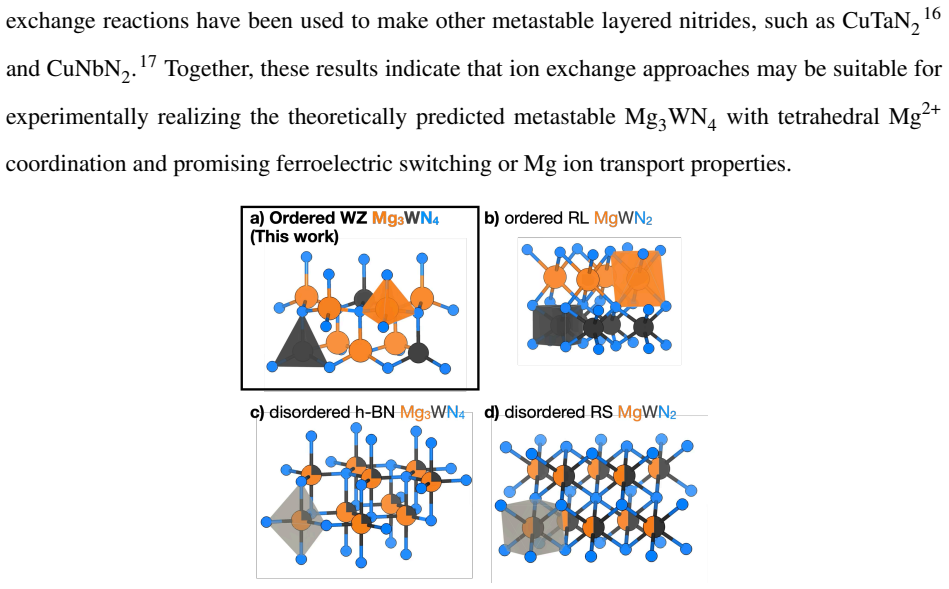
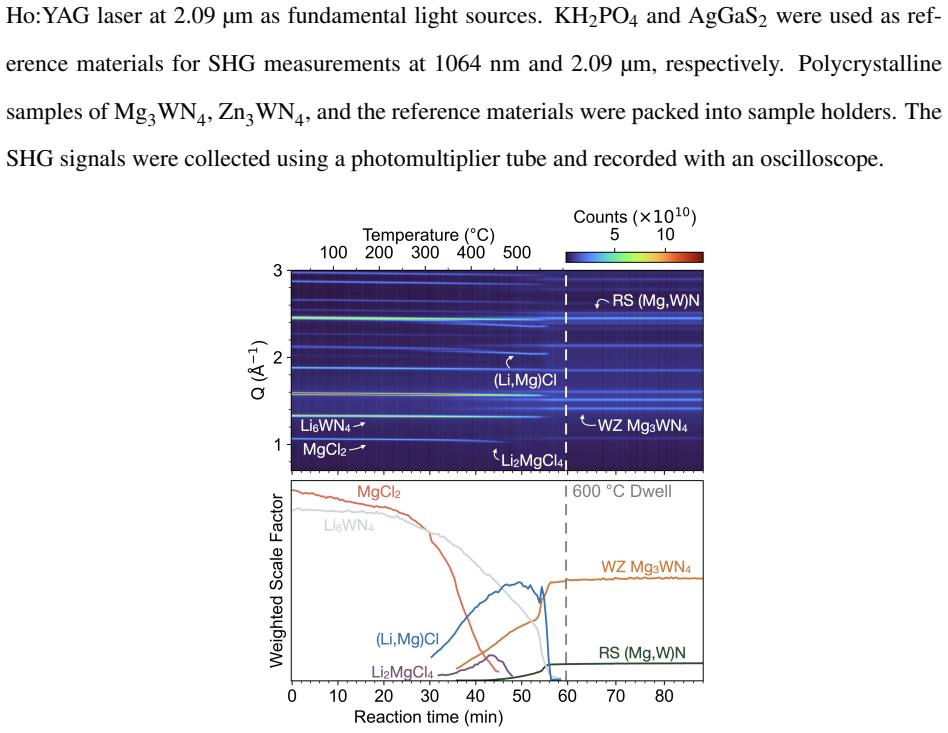
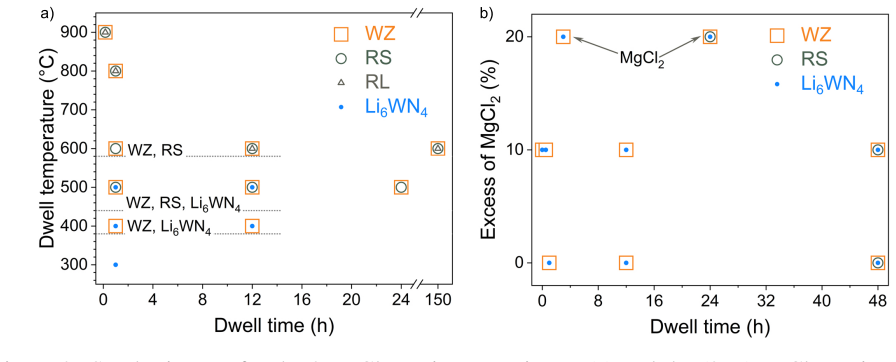
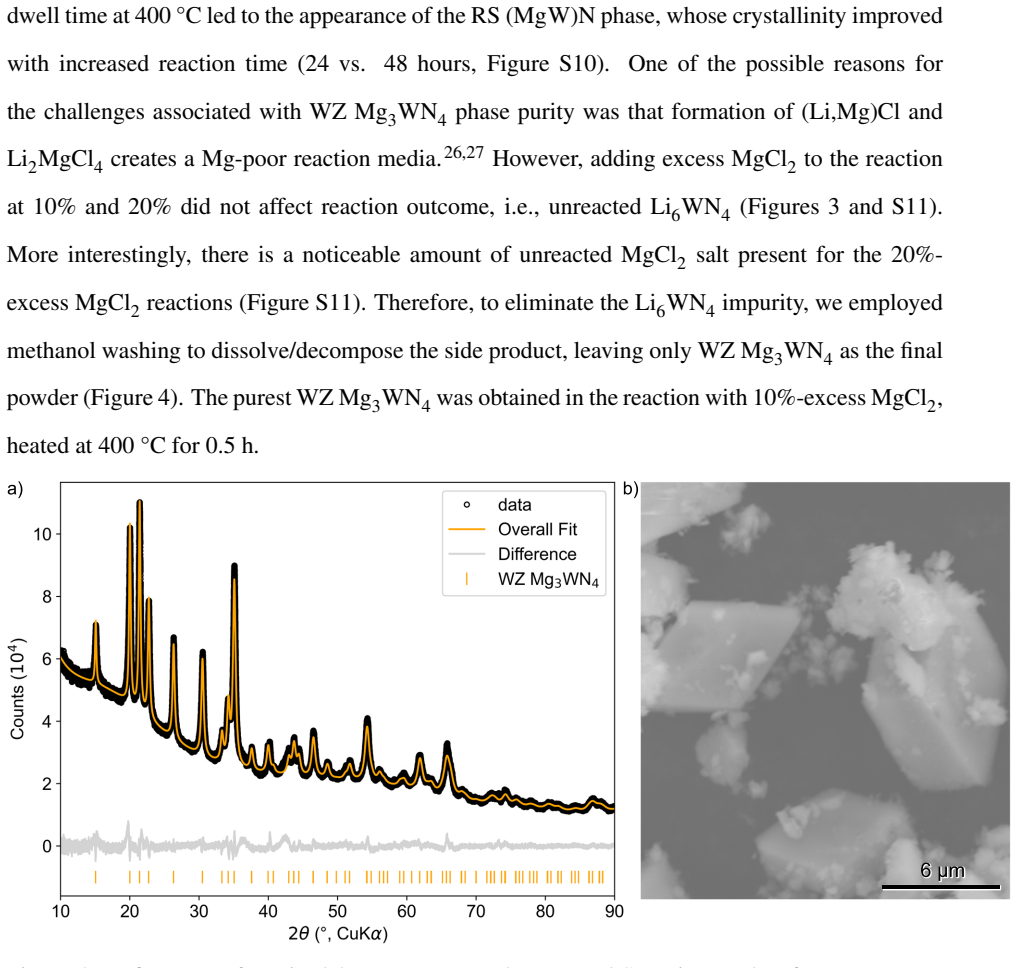
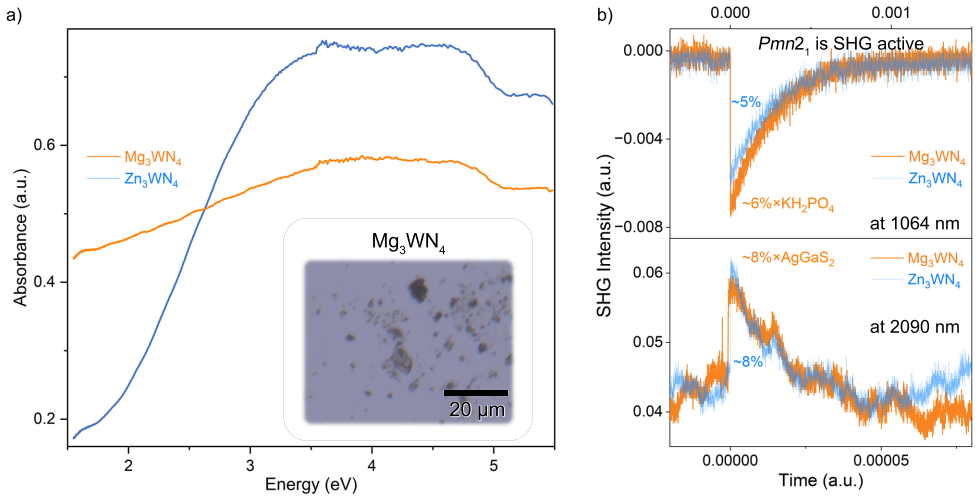
We report for the first time on the bulk synthesis of Mg₃WN₄ in a wurtzite-derived crystal structure via a solid state metathesis reaction. In situ synchrotron powder X-ray diffraction shows how the ion exchange proceeds from Li₆WN₄ + 3 MgCl₂ precursors to Mg₃WN₄ + 6 LiCl products, with the reaction starting slowly near 380 °C and completing by 600 °C, including the presence of a competing disordered rocksalt-derived phase (Mg,W)N above 440 °C. The follow up ex situ powder synthesis at 400 °C for 0.5 hour with 10% excess MgCl₂ reveals the cation-ordered nature of the wurtzite-derived Mg₃WN₄ structure with polar symmetry confirmed by second harmonic generation measurements. Optical absorption
What carries the argument
Solid-state metathesis reaction from Li₆WN₄ + 3 MgCl₂, guided by in situ synchrotron XRD to select a narrow temperature window below 440 °C that favors the ordered wurtzite phase over the disordered rocksalt phase.
If this is right
- Phase-pure bulk wurtzite Mg₃WN₄ enables direct measurement of its optical absorption and defect-related properties.
- Selective ex situ synthesis of ternary nitrides is possible by limiting the thermal budget based on in situ data.
- Cation-ordered wurtzite structures in the Mg-W-N system can now be accessed in bulk form rather than only as films.
- Polar symmetry confirmed by SHG supports further study of potential ferroelectric or ion-transport behavior in this nitride.
Where Pith is reading between the lines
- The same in-situ-guided temperature control could be tested on other predicted Mg-W-N or related ternary nitrides to obtain their bulk wurtzite forms.
- The noted defect formation suggests that longer reaction times or different excess amounts might be needed to improve crystallinity for transport measurements.
- Bulk samples now allow side-by-side comparison of wurtzite versus rocksalt polymorphs in the same composition space.
Load-bearing premise
The ex situ synthesis at 400 °C for 0.5 hour with 10% excess MgCl₂ yields phase-pure cation-ordered wurtzite-derived Mg₃WN₄ without significant competing disordered rocksalt-derived (Mg,W)N phase.
What would settle it
Observation of substantial disordered (Mg,W)N phase or loss of second harmonic generation signal in the 400 °C ex situ product would show that the low-temperature route failed to produce the claimed phase-pure ordered structure.
Figures
read the original abstract
Experimental synthesis of theoretically predicted materials with controlled elemental coordination environments can lead to realization of useful properties, such as facile ion transport or ferroelectric switching. Among such materials are new ternary nitrides in the Mg-W-N composition space, where several new stable and metastable compounds have been predicted and synthesized recently in bulk and film forms. Here, we report for the first time on the bulk synthesis of Mg$_3$WN$_4$ in a wurtzite-derived crystal structure via a solid state metathesis reaction. $In$ $situ$ synchrotron powder X-ray diffraction shows how the ion exchange proceeds from Li$_6$WN$_4$ + 3 MgCl$_2$ precursors to Mg$_3$WN$_4$ + 6 LiCl products, with the reaction starting slowly near 380 $^\circ$C and completing by 600 $^\circ$C, including the presence of a competing disordered rocksalt-derived phase (Mg,W)N above 440 $^\circ$C. The follow up $ex$ $situ$ powder synthesis at 400 $^\circ$C for 0.5 hour with 10% excess MgCl$_2$ reveals the cation-ordered nature of the wurtzite-derived Mg$_3$WN$_4$ structure with polar symmetry confirmed by second harmonic generation measurements. Optical absorption spectra, chemical composition analysis, and electron microscopy imaging suggests that bulk wurtzite Mg$_3$WN$_4$ is prone to defect formation. Overall, this study shows that selective $ex$ $situ$ synthesis of the phase pure ternary nitrides, informed by \textit{in situ} measurements, is possible by carefully controlling the thermal budget of the reaction, and paves a way towards property characterization of wurtzite Mg$_3$WN$_4$.
Editorial analysis
A structured set of objections, weighed in public.
Referee Report
Summary. The manuscript reports the first bulk synthesis of Mg₃WN₄ in a wurtzite-derived crystal structure via solid-state metathesis from Li₆WN₄ + 3 MgCl₂ precursors. In situ synchrotron XRD maps the ion-exchange pathway, with reaction onset near 380 °C and completion by 600 °C, including a competing disordered rocksalt-derived (Mg,W)N phase above 440 °C. Ex situ synthesis at 400 °C for 0.5 h with 10 % excess MgCl₂ is stated to yield the cation-ordered wurtzite phase, whose polar symmetry is confirmed by SHG; optical absorption, composition analysis, and microscopy indicate the material is prone to defect formation.
Significance. If the ex situ product is demonstrably phase-pure and cation-ordered, the result would establish a practical route to a predicted ternary nitride in bulk form, enabling property measurements relevant to ion transport or ferroelectricity. The use of in situ data to define a narrow thermal window for selective ex situ synthesis is a useful methodological contribution.
major comments (2)
- [Abstract] Abstract: the central claim that the 400 °C / 0.5 h ex situ synthesis with 10 % excess MgCl₂ produces phase-pure cation-ordered wurtzite-derived Mg₃WN₄ without significant rocksalt-derived (Mg,W)N rests on the assumption that the narrow window below 440 °C yields complete, selective conversion; however, the in situ data show the target reaction reaches completion only by 600 °C, so quantitative phase fractions or Rietveld refinements of the ex situ product are required to substantiate phase purity.
- [Abstract] Abstract: the statement that the material is 'prone to defect formation' (supported by optical absorption, composition, and microscopy) directly impacts the cation-ordering distinction between the wurtzite-derived phase and the disordered rocksalt competitor; without explicit discussion of how defects were quantified or shown not to produce detectable rocksalt domains, the structural assignment remains uncertain.
minor comments (1)
- [Abstract] Abstract: inconsistent spacing in 'In situ' and 'ex situ' should be standardized for clarity.
Simulated Author's Rebuttal
We thank the referee for their careful reading of the manuscript and for highlighting these important points regarding the strength of the phase-purity and structural-assignment claims. We address each major comment below and will revise the manuscript to incorporate additional quantitative analysis and discussion.
read point-by-point responses
-
Referee: [Abstract] Abstract: the central claim that the 400 °C / 0.5 h ex situ synthesis with 10 % excess MgCl₂ produces phase-pure cation-ordered wurtzite-derived Mg₃WN₄ without significant rocksalt-derived (Mg,W)N rests on the assumption that the narrow window below 440 °C yields complete, selective conversion; however, the in situ data show the target reaction reaches completion only by 600 °C, so quantitative phase fractions or Rietveld refinements of the ex situ product are required to substantiate phase purity.
Authors: We agree that the distinction between the in situ temperature-ramp experiment and the isothermal ex situ hold requires clearer justification. The in situ data map the reaction pathway under continuous heating and identify the competing rocksalt-derived phase above 440 °C, while the ex situ protocol uses a short 0.5 h hold at 400 °C with 10 % excess MgCl₂ to remain within the selective window. The ex situ XRD pattern is consistent with the wurtzite-derived phase, but we acknowledge that visual inspection alone does not quantify minor fractions. In the revised manuscript we will add Rietveld refinement or quantitative phase-fraction analysis of the ex situ diffraction data to substantiate the phase-purity claim. revision: yes
-
Referee: [Abstract] Abstract: the statement that the material is 'prone to defect formation' (supported by optical absorption, composition, and microscopy) directly impacts the cation-ordering distinction between the wurtzite-derived phase and the disordered rocksalt competitor; without explicit discussion of how defects were quantified or shown not to produce detectable rocksalt domains, the structural assignment remains uncertain.
Authors: The referee correctly notes that the defect discussion must be tied explicitly to the structural assignment. The optical absorption, composition, and microscopy data indicate point defects and non-stoichiometry within the wurtzite-derived phase rather than a separate rocksalt phase; no rocksalt reflections are present in the ex situ XRD, and the observed SHG signal confirms retention of polar symmetry. We will revise the manuscript to add an explicit paragraph that quantifies the defect signatures (e.g., sub-bandgap absorption intensity, compositional deviation, and microscopy observations) and explains why these features do not correspond to detectable rocksalt domains, thereby clarifying the distinction. revision: yes
Circularity Check
No circularity: purely experimental synthesis and characterization
full rationale
The paper reports bulk synthesis of Mg₃WN₄ via metathesis, with in situ synchrotron XRD tracking reaction progress and ex situ conditions (400 °C, 0.5 h, 10% excess MgCl₂) yielding the target phase. All claims rest on direct diffraction, SHG, optical absorption, and microscopy data; no equations, fitted parameters, predictions, or self-citation chains are invoked to derive results. The in situ vs. ex situ comparison is observational, not self-referential. This is a standard experimental materials paper with no load-bearing derivations.
Axiom & Free-Parameter Ledger
axioms (2)
- domain assumption Powder X-ray diffraction patterns can be interpreted to identify phases and track reaction progress in situ
- domain assumption Second harmonic generation signal indicates non-centrosymmetric polar symmetry in the crystal structure
Reference graph
Works this paper leans on
-
[1]
Materials design rules for multivalent ion mobility in intercalation structures
Rong, Z.; Malik, R.; Canepa, P.; Sai Gautam, G.; Liu, M.; Jain, A.; Persson, K.; Ceder, G. Materials design rules for multivalent ion mobility in intercalation structures. Chemistry of Materials 2015, 27, 6016--6021
2015
-
[2]
D.; Shi, T.; Tian, Y.; Wang, Y.; Li, J.; Ceder, G
Canepa, P.; Bo, S.-H.; Sai Gautam, G.; Key, B.; Richards, W. D.; Shi, T.; Tian, Y.; Wang, Y.; Li, J.; Ceder, G. High magnesium mobility in ternary spinel chalcogenides. Nature communications 2017, 8, 1759
2017
-
[3]
U.; Yazawa, K.; Brennecka, G
Lee, C.-W.; Din, N. U.; Yazawa, K.; Brennecka, G. L.; Zakutayev, A.; Gorai, P. Emerging materials and design principles for wurtzite-type ferroelectrics. Matter 2024, 7, 1644--1659
2024
-
[4]
AlScN: A III-V semiconductor based ferroelectric
Fichtner, S.; Wolff, N.; Lofink, F.; Kienle, L.; Wagner, B. AlScN: A III-V semiconductor based ferroelectric. Journal of Applied Physics 2019, 125, 114103
2019
-
[5]
L.; O'Donnell, S.; Huang, K.; Klein, R
Rom, C. L.; O'Donnell, S.; Huang, K.; Klein, R. A.; Kramer, M. J.; Smaha, R. W.; Zakutayev, A. Low-temperature synthesis of cation-ordered bulk Zn3WN4 semiconductor via heterovalent solid-state metathesis. Chemical Science 2024, 15, 9709--9718
2024
-
[6]
J.; Arca, E.; Bauers, S
Sun, W.; Bartel, C. J.; Arca, E.; Bauers, S. R.; Matthews, B.; Orva \ n anos, B.; Chen, B.-R.; Toney, M. F.; Schelhas, L. T.; Tumas, W.; Tate, J.; Zakutayev, A.; Lany, S.; Holder, A. M.; Ceder, G. A map of the inorganic ternary metal nitrides. Nature Materials 2019, 18, 732--739
2019
-
[7]
Correcting density functional theory for accurate predictions of compound enthalpies of formation: Fitted elemental-phase reference energies
Stevanovi c \' c , V.; Lany, S.; Zhang, X.; Zunger, A. Correcting density functional theory for accurate predictions of compound enthalpies of formation: Fitted elemental-phase reference energies. Phys. Rev. B 2012, 85, 115104
2012
-
[8]
Band-structure calculations for the 3 d transition metal oxides in GW
Lany, S. Band-structure calculations for the 3 d transition metal oxides in GW. Physical Review B—Condensed Matter and Materials Physics 2013, 87, 085112
2013
-
[9]
Semiconducting transition metal oxides
Lany, S. Semiconducting transition metal oxides. Journal of Physics: Condensed Matter 2015, 27, 283203
2015
-
[10]
L.; Smaha, R
Rom, C. L.; Smaha, R. W.; Knebel, C. A.; Heinselman, K. N.; Neilson, J. R.; Bauers, S. R.; Zakutayev, A. Bulk and film synthesis pathways to ternary magnesium tungsten nitrides. Journal of Materials Chemistry C 2023, 11, 11451--11459
2023
-
[11]
L.; Bauers, S
Zakutayev, A.; Jankousky, M.; Wolf, L.; Feng, Y.; Rom, C. L.; Bauers, S. R.; Borkiewicz, O.; LaVan, D. A.; Smaha, R. W.; Stevanovic, V. Synthesis pathways to thin films of stable layered nitrides. Nature Synthesis 2024, 3, 1471–1480
2024
-
[12]
L.; Jankousky, M.; Phan, M
Rom, C. L.; Jankousky, M.; Phan, M. Q.; O’Donnell, S.; Regier, C. E.; Neilson, J. R.; Stevanovic, V.; Zakutayev, A. Ion Exchange Synthesizes a Metastable Layered Polymorph of MgZrN2 and MgHfN2 Semiconductors. Chemistry of Materials 2025, 37, 2136--2144
2025
-
[13]
L.; Fallon, M
Rom, C. L.; Fallon, M. J.; Wustrow, A.; Prieto, A. L.; Neilson, J. R. Bulk Synthesis, Structure, and Electronic Properties of Magnesium Zirconium Nitride Solid Solutions. Chemistry of Materials 2021, 33, 5345–5354
2021
-
[14]
K.; Fallon, M
Todd, P. K.; Fallon, M. J.; Neilson, J. R.; Zakutayev, A. Two-step solid-state synthesis of ternary nitride materials. ACS Materials Letters 2021, 3, 1677--1683
2021
-
[15]
R.; Holder, A.; Sun, W.; Melamed, C
Bauers, S. R.; Holder, A.; Sun, W.; Melamed, C. L.; Woods-Robinson, R.; Mangum, J.; Perkins, J.; Tumas, W.; Gorman, B.; Tamboli, A.; Ceder, G.; Lany, S.; Zakutayev, A. Ternary nitride semiconductors in the rocksalt crystal structure. Proceedings of the National Academy of Sciences 2019, 116, 14829--14834
2019
-
[16]
S.; DiSalvo, F
Yang, M.; Zakutayev, A.; Vidal, J.; Zhang, X.; Ginley, D. S.; DiSalvo, F. J. Strong optical absorption in CuTaN2 nitride delafossite. Energy & Environmental Science 2013, 6, 2994--2999
2013
-
[17]
J.; Zhang, X.; Vidal, J.; Cui, Z.; Lany, S.; Yang, M.; DiSalvo, F
Zakutayev, A.; Allen, A. J.; Zhang, X.; Vidal, J.; Cui, Z.; Lany, S.; Yang, M.; DiSalvo, F. J.; Ginley, D. S. Experimental synthesis and properties of metastable CuNbN2 and theoretical extension to other ternary copper nitrides. Chemistry of Materials 2014, 26, 4970--4977
2014
-
[18]
Synthesis and structure of the ternary nitride Li6WN4
Yuan, W.; Hu, J.; Song, Y.; Wang, W.; Xu, Y. Synthesis and structure of the ternary nitride Li6WN4 . Powder Diffraction 2005, 20, 18--21
2005
-
[19]
Coelho, A. A. TOPAS and TOPAS-Academic: an optimization program integrating computer algebra and crystallographic objects written in C++. Journal of Applied Crystallography 2018, 51, 210--218
2018
-
[20]
H.; Von Dreele, R
Toby, B. H.; Von Dreele, R. B. GSAS-II: The Genesis of a Modern Open-Source All Purpose Crystallography Software Package . J. Appl. Cryst. 2013, 46, 544–549
2013
-
[21]
J.; Chapman, K
Chupas, P. J.; Chapman, K. W.; Kurtz, C.; Hanson, J. C.; Lee, P. L.; Grey, C. P. A versatile sample-environment cell for non-ambient X-ray scattering experiments. Journal of Applied Crystallography 2008, 41, 822--824
2008
-
[22]
K.; Smith, A
Todd, P. K.; Smith, A. M.; Neilson, J. R. Yttrium manganese oxide phase stability and selectivity using lithium carbonate assisted metathesis reactions. Inorganic Chemistry 2019, 58, 15166--15174
2019
-
[23]
A powder technique for the evaluation of nonlinear optical materials
Kurtz, S.; Perry, T. A powder technique for the evaluation of nonlinear optical materials . J. Appl. Phys. 1968, 39, 3798--3813
1968
-
[24]
Symmetry relations in wurtzite nitrides and oxide nitrides and the curious case of Pmc 2 1
Breternitz, J.; Schorr, S. Symmetry relations in wurtzite nitrides and oxide nitrides and the curious case of Pmc 2 1 . Acta Crystallographica Section A 2021, 77, 208--216
2021
-
[25]
Zur Kenntnis der Chlorid-Spinelle Li2MgCl4 , Li2MnCl4 , Li2FeCl4 , Li2CdCl4
Lutz, H.; Schmidt, W.; Haeuseler, H. Zur Kenntnis der Chlorid-Spinelle Li2MgCl4 , Li2MnCl4 , Li2FeCl4 , Li2CdCl4 . Zeitschrift f \"u r anorganische und allgemeine Chemie 1979, 453, 121--126
1979
-
[26]
J.; Sa, N.; Lipton, A
Wustrow, A.; Key, B.; Phillips, P. J.; Sa, N.; Lipton, A. S.; Klie, R. F.; Vaughey, J. T.; Poeppelmeier, K. R. Synthesis and Characterization of MgCr2S4 Thiospinel as a Potential Magnesium Cathode. Inorganic Chemistry 2018, 57, 8634--8638, PMID: 29969255
2018
-
[27]
Rom, C. L. et al. Mechanistically Guided Materials Chemistry: Synthesis of Ternary Nitrides, CaZrN2 and CaHfN2 . Journal of the American Chemical Society 2024, 146, 4001--4012 mcitethebibliography document
2024
discussion (0)
Sign in with ORCID, Apple, or X to comment. Anyone can read and Pith papers without signing in.