Orthogonal Concept Erasure for Diffusion Models
Pith reviewed 2026-06-29 12:31 UTC · model grok-4.3
The pith
Orthogonal transformations enable precise concept erasure in diffusion models by preserving neuron magnitude and angular geometry.
A machine-rendered reading of the paper's core claim, the machinery that carries it, and where it could break.
Core claim
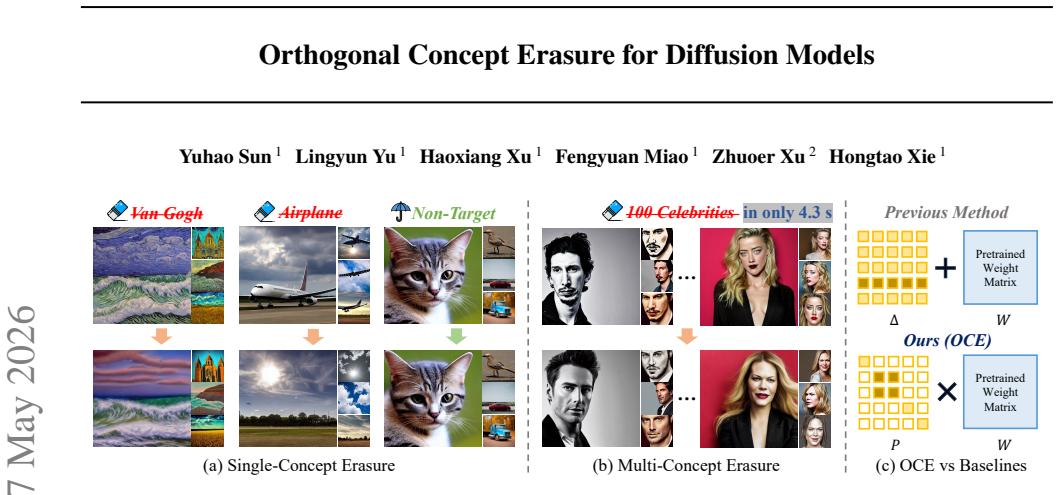
OCE reformulates the problem of editing-based concept erasure as multiplicative parameter updates from a geometric perspective. Specifically, it applies layer-wise orthogonal transformations derived from a closed-form solution to the parameters, enabling precise concept erasure while preserving the neuron magnitude and angular geometry. For multi-concept cases, it introduces a subspace-level objective with structured subspace manipulation.
What carries the argument
Layer-wise orthogonal transformations derived from a closed-form solution
If this is right
- Enables precise single-concept erasure without interfering with overall generative capacity.
- Supports effective and scalable multi-concept erasure through subspace manipulation.
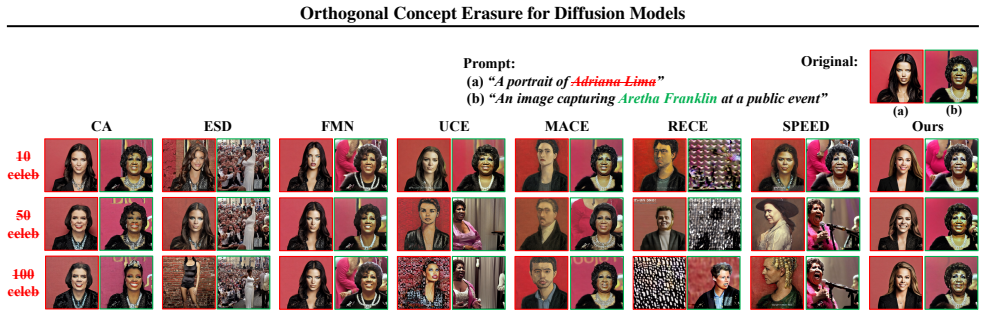
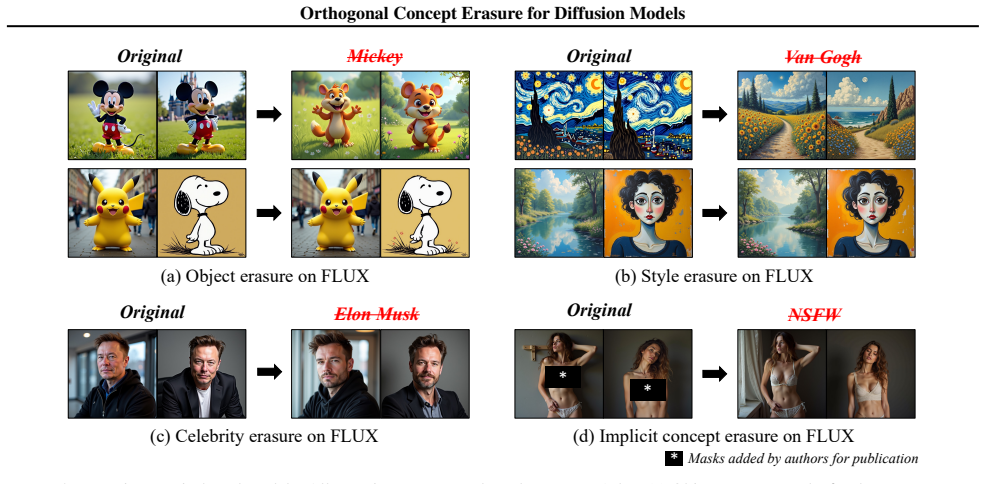
- Outperforms existing methods in both erasure effectiveness and non-target preservation.
- Allows erasing up to 100 concepts in 4.3 seconds.
Where Pith is reading between the lines
- The geometric separation of direction from magnitude and angles could be applied to other parameter editing tasks in neural networks to reduce side effects.
- If the assumption about neuron direction holding semantics holds, this method might extend to erasing concepts in other generative models like GANs or autoregressive models.
- Testing on larger or different diffusion architectures would reveal if the closed-form solution remains efficient at scale.
Load-bearing premise
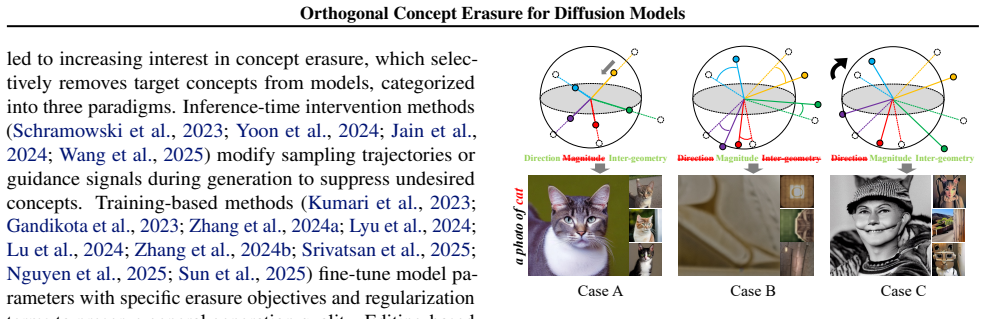
Concept semantics depend primarily on neuron direction rather than magnitude, and generative capacity relies on angular geometry, with additive updates necessarily entangling these quantities.
What would settle it
An experiment where the orthogonal transformation leaves the target concept still generatable at high rates, or where overall generation quality drops by the same amount as with additive updates.
Figures
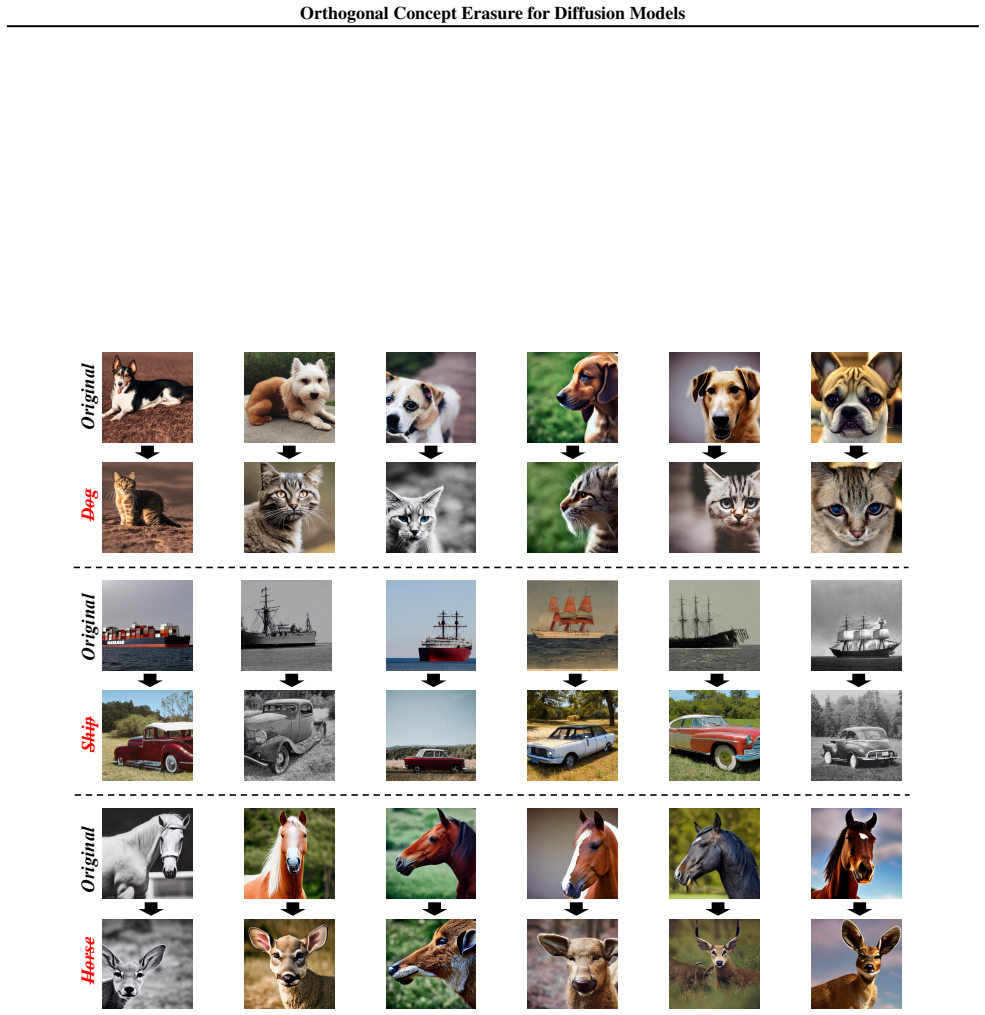
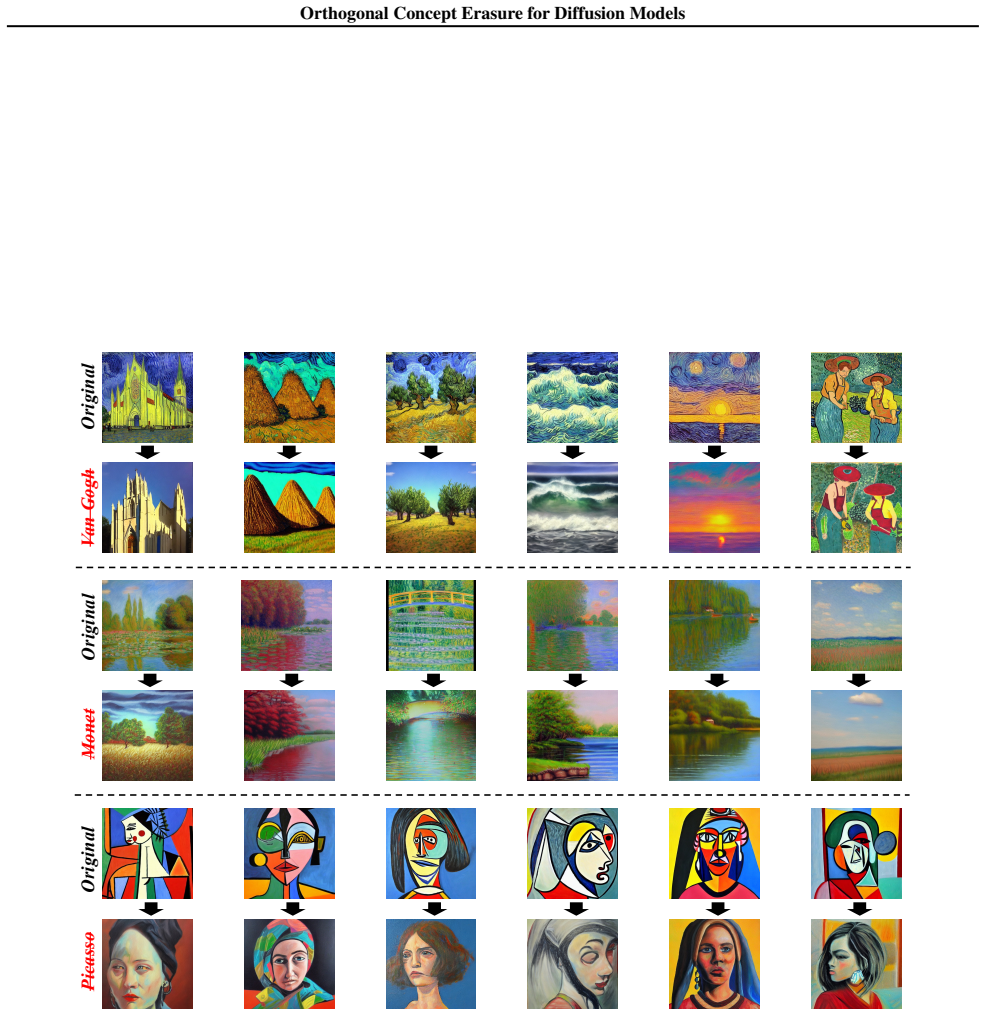

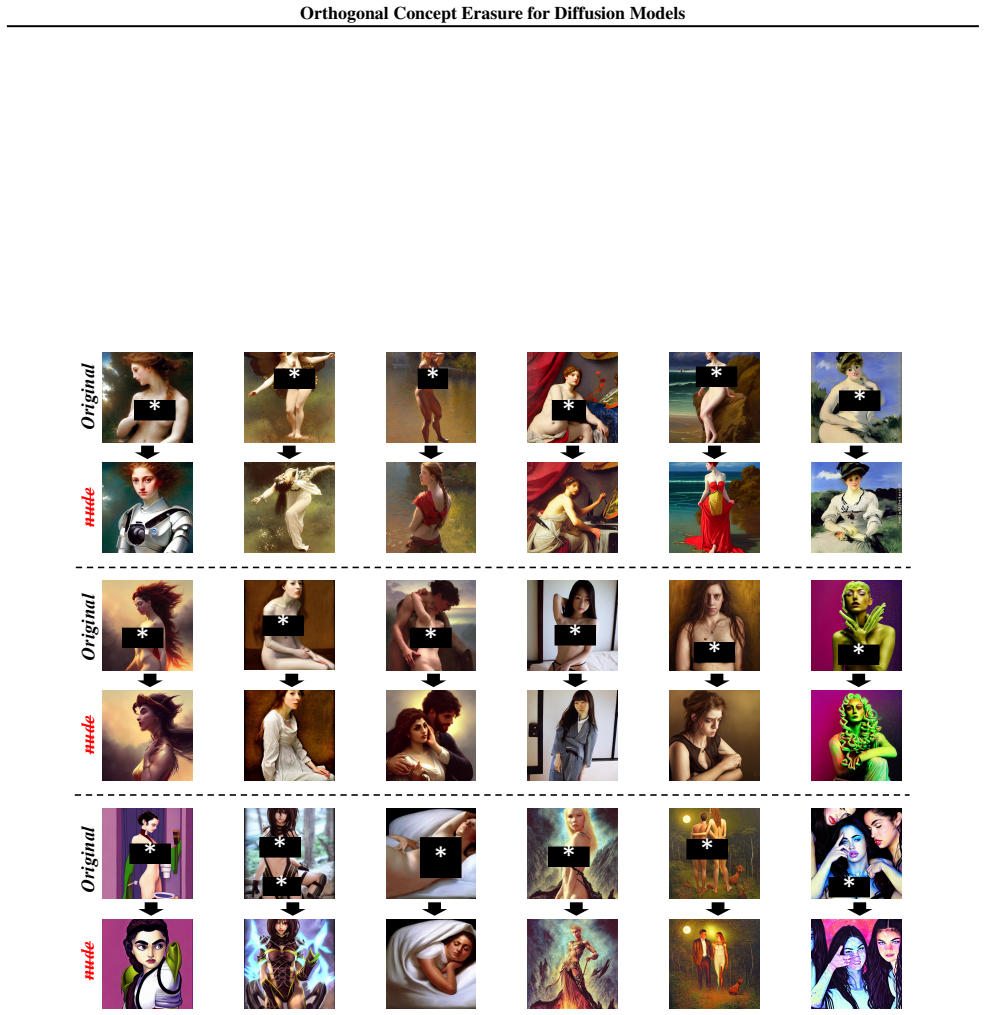
read the original abstract
Concept erasure has emerged as a promising approach to mitigate undesired or unsafe content in diffusion models, yet existing methods still face significant limitations. While training-based methods are effective, their high computational cost limits scalability. Editing-based methods are more efficient and deployment-friendly, yet they struggle to simultaneously achieve precise concept erasure and preserve overall generative capacity. We identify this core limitation of the editing-based methods as reliance on additive parameter updates. Our empirical analysis reveals that concept semantics primarily depend on neuron direction rather than neuron magnitude, while overall generative capacity relies on the angular geometry of neurons. As additive updates inherently entangle direction, magnitude, and angular geometry, they inevitably introduce unintended interference between concept erasure and overall generation performance. To address this, we propose Orthogonal Concept Erasure (OCE), which reformulates editing-based erasure as multiplicative parameter updates from a geometric perspective. Specifically, OCE applies layer-wise orthogonal transformations derived from a closed-form solution to the parameters, enabling precise concept erasure while preserving the neuron magnitude and angular geometry. Furthermore, to address conflicting constraints in multi-concept erasure, OCE introduces a subspace-level objective with structured subspace manipulation, yielding a more effective and scalable erasure. Extensive experiments on single- and multi-concept erasure demonstrate that OCE outperforms existing methods in concept erasure and non-target preservation, erasing up to 100 concepts in 4.3 s. Code: https://github.com/HansSunY/OCE.
Editorial analysis
A structured set of objections, weighed in public.
Referee Report
Summary. The paper claims that editing-based concept erasure in diffusion models is limited by additive parameter updates, which entangle neuron direction (tied to concept semantics), magnitude, and angular geometry (tied to generative capacity). It proposes Orthogonal Concept Erasure (OCE), which reformulates erasure as layer-wise multiplicative orthogonal transformations derived from a closed-form solution; this alters directions to erase concepts while exactly preserving magnitudes and angles. For multi-concept cases, a subspace-level objective with structured manipulation is introduced. Experiments reportedly show superior erasure and preservation performance, including erasure of 100 concepts in 4.3 seconds.
Significance. If the empirical analysis establishing a clean separation between direction-dependent semantics and geometry-dependent capacity is robust, OCE would provide a theoretically grounded, computationally efficient (closed-form per layer) and scalable alternative to both training-based and additive editing methods. The public code release and exact preservation properties of orthogonal matrices are concrete strengths that support reproducibility and falsifiability of the geometric claims.
major comments (2)
- [Empirical Analysis] The central justification for the multiplicative reformulation over additive updates is the empirical claim that 'concept semantics primarily depend on neuron direction rather than neuron magnitude' while 'overall generative capacity relies on the angular geometry of neurons.' This separation must be demonstrated with explicit quantitative controls (e.g., magnitude-only perturbations or direction-only ablations) in the empirical analysis section; without such evidence the claimed advantage of orthogonal transformations does not follow, even though the matrices themselves preserve norms and angles by construction.
- [Method / Closed-form solution] The closed-form derivation of the layer-wise orthogonal transformation is load-bearing for the 'precise concept erasure' claim. The manuscript should explicitly state the optimization objective solved in closed form and verify that the resulting matrix erases the target direction without residual leakage or unintended rotation of other concept subspaces (e.g., via before/after cosine similarities on held-out concept vectors).
minor comments (2)
- [Abstract] The abstract states that OCE 'erases up to 100 concepts in 4.3 s' but does not specify the model size, hardware, or whether this includes the subspace objective computation; a brief clarification would improve reproducibility.
- [Method] Notation for the orthogonal matrix per layer and the subspace objective should be introduced with explicit dimensionality and orthogonality constraints to avoid ambiguity when comparing to prior additive editing baselines.
Simulated Author's Rebuttal
We thank the referee for the constructive feedback. We address each major comment below and will incorporate revisions to strengthen the manuscript.
read point-by-point responses
-
Referee: [Empirical Analysis] The central justification for the multiplicative reformulation over additive updates is the empirical claim that 'concept semantics primarily depend on neuron direction rather than neuron magnitude' while 'overall generative capacity relies on the angular geometry of neurons.' This separation must be demonstrated with explicit quantitative controls (e.g., magnitude-only perturbations or direction-only ablations) in the empirical analysis section; without such evidence the claimed advantage of orthogonal transformations does not follow, even though the matrices themselves preserve norms and angles by construction.
Authors: We acknowledge that while the manuscript presents supporting empirical observations for the direction-magnitude separation, it does not include the specific quantitative controls proposed. To provide rigorous evidence, we will add magnitude-only perturbations and direction-only ablations to the empirical analysis section in the revision. This will directly quantify the separation and strengthen the motivation for orthogonal transformations. revision: yes
-
Referee: [Method / Closed-form solution] The closed-form derivation of the layer-wise orthogonal transformation is load-bearing for the 'precise concept erasure' claim. The manuscript should explicitly state the optimization objective solved in closed form and verify that the resulting matrix erases the target direction without residual leakage or unintended rotation of other concept subspaces (e.g., via before/after cosine similarities on held-out concept vectors).
Authors: We agree that greater explicitness is warranted. The closed-form solution solves a subspace projection objective that nulls the target concept direction while preserving the orthogonal complement. In the revision we will state this objective explicitly and add verification via before/after cosine similarities on held-out concept vectors to confirm erasure without residual leakage or unintended rotations. revision: yes
Circularity Check
No significant circularity; derivation is a geometric reformulation motivated by stated empirical analysis.
full rationale
The paper's central proposal derives OCE from an empirical observation that concept semantics depend on neuron direction while generative capacity depends on angular geometry, then applies closed-form orthogonal transformations that preserve magnitude and angles by linear-algebra construction. This does not reduce to self-definition, fitted inputs renamed as predictions, or load-bearing self-citations; the advantage over additive updates follows from the geometric property once the empirical premise is granted. No equations or claims in the abstract or description exhibit the specific reductions required for circularity flags. The method is presented as a new formulation rather than a tautological restatement of inputs.
Axiom & Free-Parameter Ledger
axioms (3)
- domain assumption Concept semantics are encoded primarily in neuron direction rather than magnitude.
- domain assumption Generative capacity depends on the angular geometry of neurons.
- domain assumption Additive parameter updates necessarily entangle direction, magnitude, and angular geometry.
Reference graph
Works this paper leans on
-
[1]
PMLR, 2020. Fan, C., Liu, J., Zhang, Y ., Wong, E., Wei, D., and Liu, S. Salun: Empowering machine unlearning via gradient- based weight saliency in both image classification and generation.arXiv preprint arXiv:2310.12508, 2023. Farajtabar, M., Azizan, N., Mott, A., and Li, A. Orthogonal gradient descent for continual learning. InInternational conference ...
work page internal anchor Pith review Pith/arXiv arXiv 2020
-
[2]
Springer, 2024. 10 Orthogonal Concept Erasure for Diffusion Models Kumari, N., Zhang, B., Wang, S.-Y ., Shechtman, E., Zhang, R., and Zhu, J.-Y . Ablating concepts in text-to-image dif- fusion models. InProceedings of the IEEE/CVF Interna- tional Conference on Computer Vision, pp. 22691–22702, 2023. Kusumba, N. S. A., Patel, M., Min, K., Kim, C., Baral, C...
discussion (0)
Sign in with ORCID, Apple, or X to comment. Anyone can read and Pith papers without signing in.