The energy conditions and model selection in the local Universe
Pith reviewed 2026-06-29 10:27 UTC · model grok-4.3
The pith
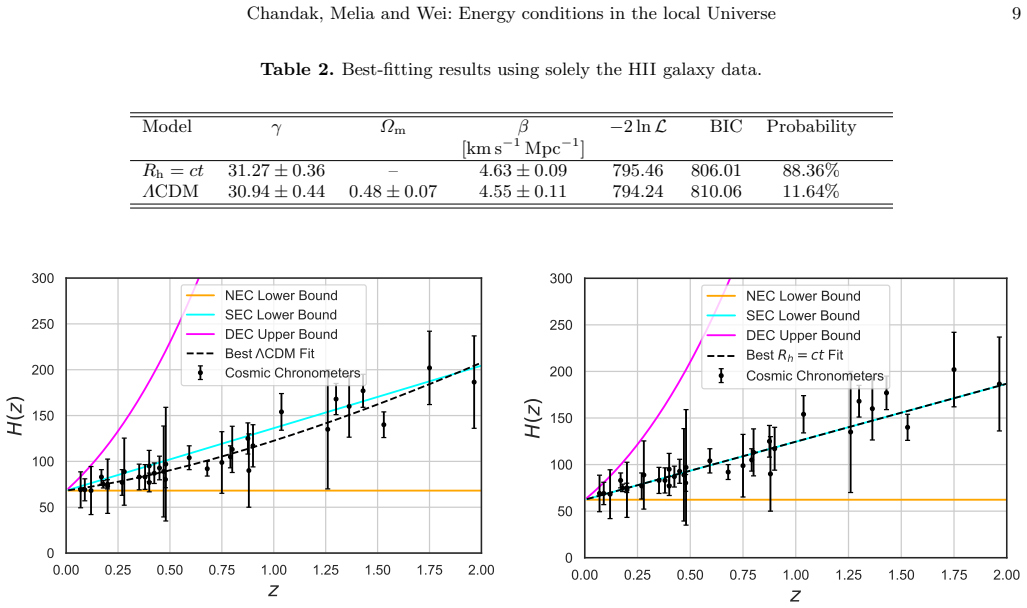
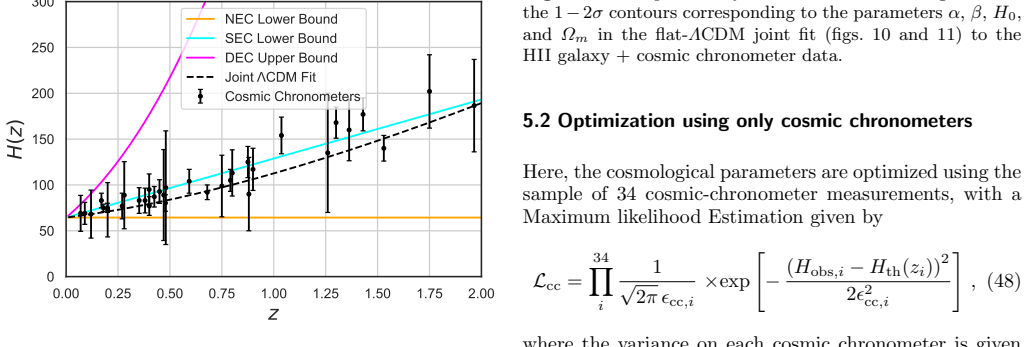
The Rh=ct universe fits local expansion data with 92 percent likelihood and satisfies all four energy conditions while LambdaCDM violates the strong energy condition at low redshifts.
A machine-rendered reading of the paper's core claim, the machinery that carries it, and where it could break.
Core claim
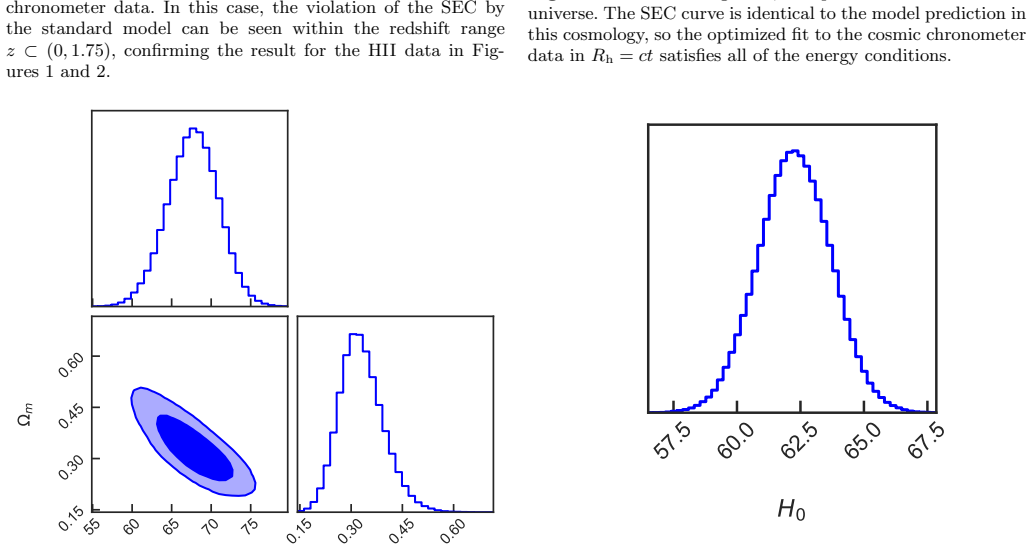
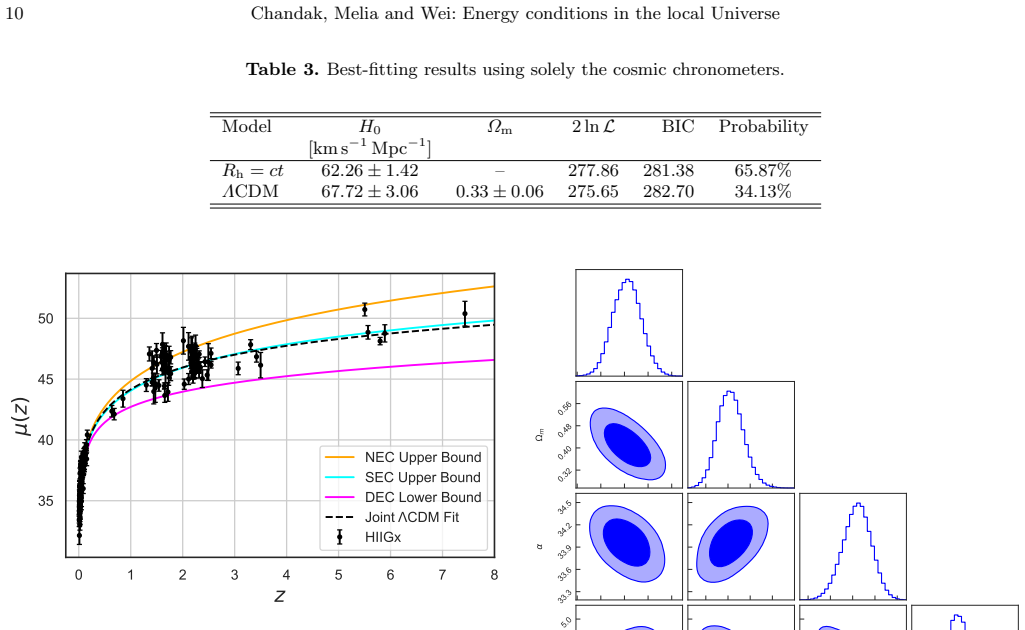
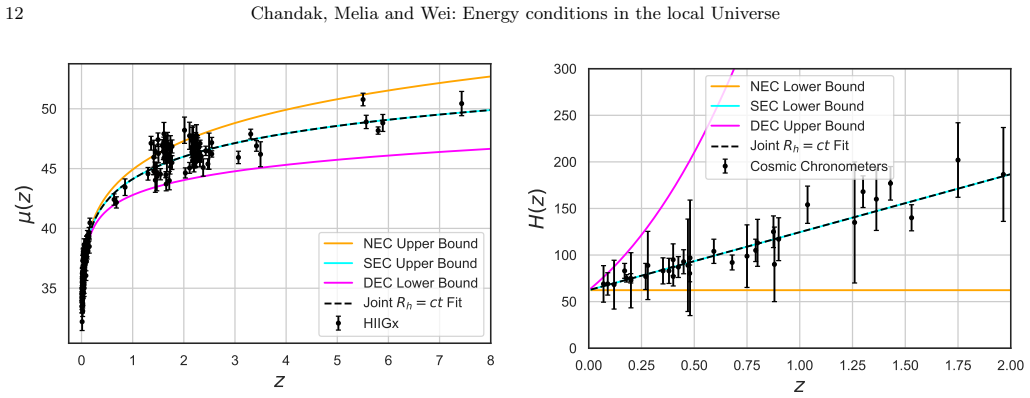
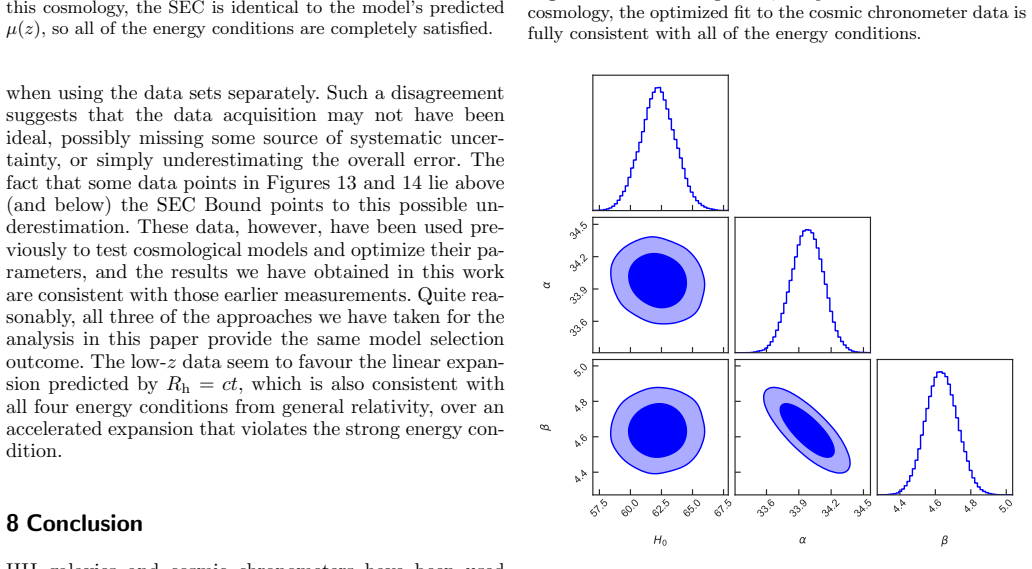
Using a combination of HII galaxy and cosmic chronometer measurements in the local Universe, the Rh=ct cosmology receives a likelihood of approximately 92 percent versus 8 percent for LambdaCDM, and its optimized fit complies with all four energy conditions while LambdaCDM's best fit violates the strong energy condition at redshifts less than or equal to 2.
What carries the argument
Model selection between LambdaCDM and the Rh=ct universe by comparing their predicted expansion histories directly to the four principal energy conditions using local-universe distance and age data.
If this is right
- The Rh=ct universe requires no exotic matter to remain consistent with the energy conditions in the local universe.
- LambdaCDM requires exotic matter to produce the observed violation of the strong energy condition at low redshifts.
- The local data alone already produce a strong statistical preference for the Rh=ct model over LambdaCDM.
- Compliance with the energy conditions holds for the optimized parameters of the Rh=ct fit but not for those of LambdaCDM.
Where Pith is reading between the lines
- If the preference for Rh=ct holds at higher redshifts, it would imply that the apparent acceleration can be described without a cosmological constant while still obeying general relativity's energy conditions.
- The result raises the possibility that the strong energy condition violation inferred in LambdaCDM is an artifact of assuming a constant dark-energy density rather than a feature of the true expansion history.
- Extending the same comparison to supernova or baryon-acoustic-oscillation data at intermediate redshifts would test whether the energy-condition compliance of Rh=ct persists beyond the local universe.
Load-bearing premise
The HII galaxy and cosmic chronometer measurements in the local Universe provide unbiased constraints on the expansion history that can be compared to the energy conditions without significant systematic errors or model-dependent corrections.
What would settle it
An independent set of expansion-rate measurements at redshifts between 0.5 and 2 that yields a best-fit history violating the strong energy condition in the specific manner predicted by the LambdaCDM parameters while remaining inconsistent with the Rh=ct prediction.
Figures

read the original abstract
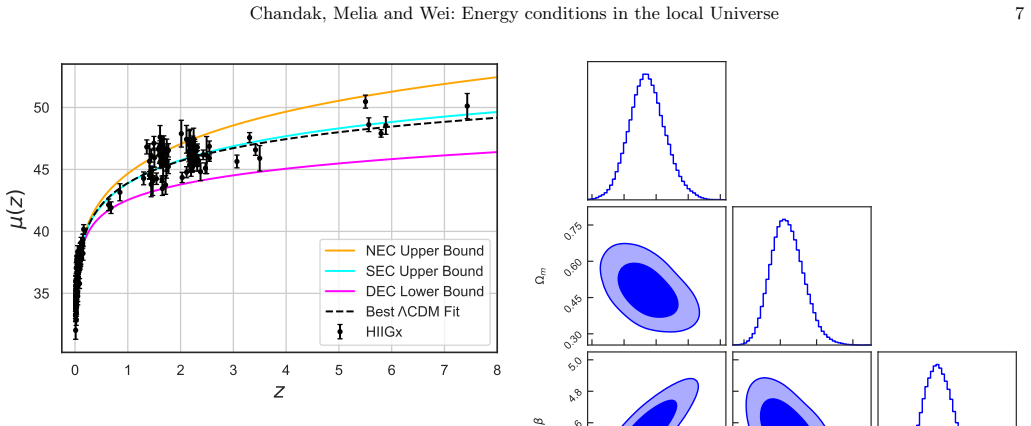
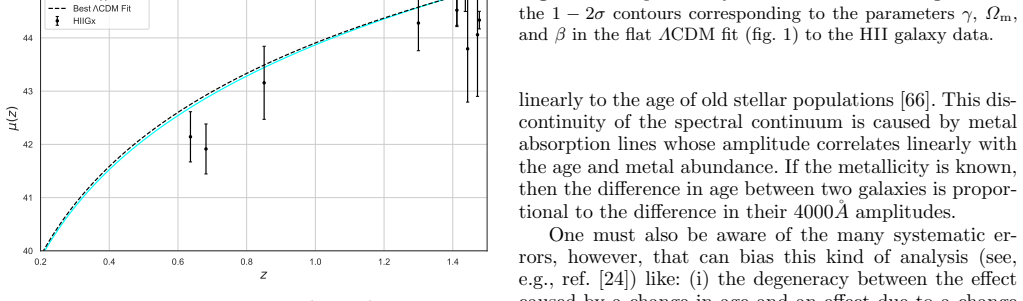
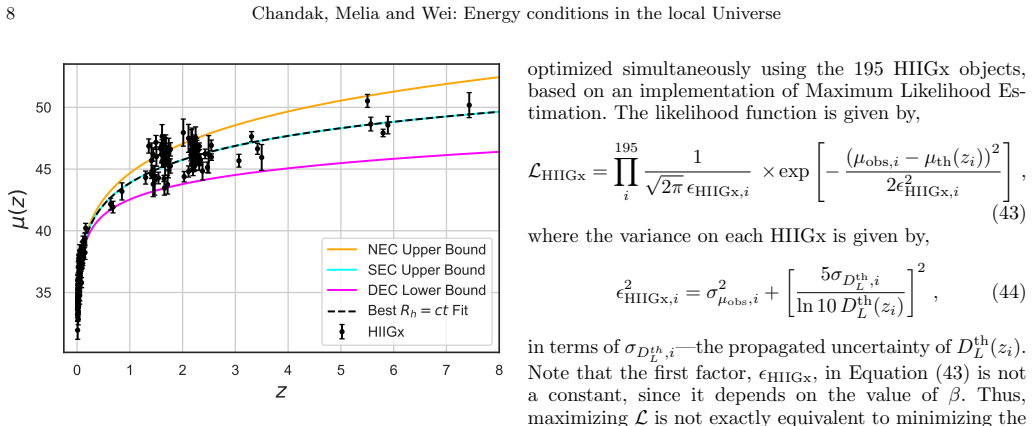
The four principal energy conditions (ECs) in general relativity prohibit negative energies, repulsive gravity and superluminal energy flows. One must invoke exotic matter to violate any one of these, yet $\Lambda$CDM does so quite prominently during inflation and in the epoch of dark energy dominance. In this paper, we carry out model selection between the standard model and the $R_{\rm h}=ct$ universe using a combination of HII galaxy and cosmic chronometer measurements in the local Universe, and directly compare the results to the constraints imposed by the ECs. We find that the latter cosmology is not only strongly favored by these data, with a likelihood of $\sim 92\%$ versus only $\sim 8\%$ for the former, but that its optimized fit is fully compliant with all four ECs, while $\Lambda$CDM's best fit violates the so-called strong energy condition at $z\lesssim 2$.
Editorial analysis
A structured set of objections, weighed in public.
Referee Report
Summary. The manuscript performs model selection between ΛCDM and the Rh=ct cosmology using combined HII-galaxy and cosmic-chronometer data in the local Universe. It reports that Rh=ct is strongly preferred (∼92 % likelihood versus ∼8 % for ΛCDM) and that the optimized Rh=ct expansion history satisfies all four energy conditions while the ΛCDM best fit violates the strong energy condition at z ≲ 2.
Significance. If the likelihood ratio and energy-condition compliance are robust, the result would constitute a direct, data-driven challenge to ΛCDM on the basis of local expansion-history measurements and would strengthen the case for the Rh=ct model. The approach of confronting both models with the same dataset and then testing the resulting best-fit histories against the energy conditions is logically coherent and could be extended to other probes.
major comments (2)
- [Data and likelihood analysis] The reported 92 % / 8 % likelihood ratio rests on the assumption that the HII-galaxy L–σ calibration residuals and the cosmic-chronometer stellar-population corrections are uncorrelated with the functional form of H(z). No quantitative test of this assumption (e.g., residual plots versus the Rh=ct versus ΛCDM predictions) is provided; if the residuals systematically favor a linear coasting solution, both the likelihood ratio and the subsequent energy-condition statements become unreliable.
- [Energy-condition evaluation] The statement that ΛCDM violates the strong energy condition at z ≲ 2 is made for the best-fit parameters obtained from the local data alone. Because the chronometer and HII-galaxy samples extend only to modest redshift, it is unclear whether the violation persists when the same parameter values are extrapolated or whether it is an artifact of the limited redshift lever arm; an explicit plot of ρ + 3p versus z for the reported best-fit ΛCDM parameters is needed.
minor comments (2)
- The abstract states the likelihood percentages to two significant figures; the corresponding section should report the actual Δχ² or evidence ratio together with the number of degrees of freedom so that the reader can judge the statistical significance.
- Notation for the four energy conditions should be defined explicitly (e.g., NEC, WEC, SEC, DEC) at first use rather than assuming familiarity with the acronyms.
Simulated Author's Rebuttal
We thank the referee for the constructive comments, which help clarify the presentation of our results. We address each major comment below and will incorporate the requested diagnostic material into the revised manuscript.
read point-by-point responses
-
Referee: [Data and likelihood analysis] The reported 92 % / 8 % likelihood ratio rests on the assumption that the HII-galaxy L–σ calibration residuals and the cosmic-chronometer stellar-population corrections are uncorrelated with the functional form of H(z). No quantitative test of this assumption (e.g., residual plots versus the Rh=ct versus ΛCDM predictions) is provided; if the residuals systematically favor a linear coasting solution, both the likelihood ratio and the subsequent energy-condition statements become unreliable.
Authors: We agree that residual plots versus model predictions constitute a useful diagnostic. In the revised manuscript we will add such plots for both the HII-galaxy and cosmic-chronometer datasets, comparing the residuals obtained under the Rh=ct and ΛCDM best fits. These plots will allow direct visual assessment of any systematic trends that might correlate with the assumed functional form of H(z). revision: yes
-
Referee: [Energy-condition evaluation] The statement that ΛCDM violates the strong energy condition at z ≲ 2 is made for the best-fit parameters obtained from the local data alone. Because the chronometer and HII-galaxy samples extend only to modest redshift, it is unclear whether the violation persists when the same parameter values are extrapolated or whether it is an artifact of the limited redshift lever arm; an explicit plot of ρ + 3p versus z for the reported best-fit ΛCDM parameters is needed.
Authors: We will include an explicit plot of ρ + 3p versus redshift evaluated at the best-fit ΛCDM parameters obtained from the local data. The plot will span the range 0 ≤ z ≤ 3 to show that the violation of the strong energy condition occurs at z ≲ 2 and is a direct consequence of the parameter values constrained by the data rather than an extrapolation artifact. revision: yes
Circularity Check
No significant circularity; derivation uses independent data fits
full rationale
The paper fits two cosmologies to external HII galaxy and cosmic chronometer data in the local Universe, then evaluates likelihood ratios and energy-condition compliance on those fits. No quoted step reduces the reported 92%/8% ratio or the EC statements to a self-definition, a fitted parameter renamed as prediction, or a load-bearing self-citation chain whose content is unverified outside this work. The Rh=ct model appears via prior literature, but the present analysis supplies new, falsifiable constraints from the cited datasets, rendering the central claims self-contained.
Axiom & Free-Parameter Ledger
Reference graph
Works this paper leans on
-
[1]
A. A. Starobinski ˇi,Spectrum of relict gravitational radiation and the early state of the universe, Soviet Journal of Experimental and Theoretical Physics Letters 30(Dec., 1979) 682
1979
-
[2]
Kazanas,Dynamics of the universe and spontaneous symmetry breaking, ApJ Letters241(Oct., 1980) L59–L63
D. Kazanas,Dynamics of the universe and spontaneous symmetry breaking, ApJ Letters241(Oct., 1980) L59–L63
1980
-
[3]
A. H. Guth,Inflationary universe: A possible solution to the horizon and flatness problems, PRD23(Jan., 1981) 347–356
1981
-
[4]
A. D. Linde,A new inflationary universe scenario: A possible solution of the horizon, flatness, homogeneity, isotropy and primordial monopole problems, Physics Letters B108(Feb., 1982) 389–393
1982
- [5]
- [6]
-
[7]
S. L. Finkelstein, M. B. Bagley, P. Arrabal Haro, M. Dickinson, H. C. Ferguson, J. S. Kartaltepe, C. Papovich, D. Burgarella, D. D. Kocevski, M. Huertas-Company, and et al.,A Long Time Ago in a Galaxy Far, Far Away: A Candidate z∼12 Galaxy in Early JWST CEERS Imaging, ApJ Letters940(Dec.,
- [8]
- [9]
-
[10]
S. Carniani, K. Hainline, F. D’Eugenio, D. J. Eisenstein, P. Jakobsen, J. Witstok, B. D. Johnson, J. Chevallard, R. Maiolino, J. M. Helton, and et al.,Spectroscopic confirmation of two luminous galaxies at a redshift of 14, Nature633(Sept., 2024) 318–322, [arXiv:2405.18485]
-
[11]
Planck Collaboration, P. A. R. Ade, N. Aghanim, C. Armitage-Caplan, M. Arnaud, M. Ashdown, F. Atrio-Barandela, J. Aumont, C. Baccigalupi, A. J. Banday, and et al.,Planck 2013 results. XXII. Constraints on inflation, A&A571(Nov., 2014) A22, [arXiv:1303.5082]
work page internal anchor Pith review Pith/arXiv arXiv 2013
-
[12]
Planck 2018 results. VI. Cosmological parameters
Planck Collaboration, N. Aghanim, Y. Akrami, M. Ashdown, J. Aumont, C. Baccigalupi, M. Ballardini, A. J. Banday, R. B. Barreiro, N. Bartolo, and et al., Planck 2018 results. VI. Cosmological parameters, A&A 641(Sept., 2020) A6, [arXiv:1807.06209]
work page internal anchor Pith review Pith/arXiv arXiv 2018
-
[13]
P. A. Oesch, G. Brammer, P. G. van Dokkum, G. D. Illingworth, R. J. Bouwens, I. Labb´ e, M. Franx, I. Momcheva, M. L. N. Ashby, G. G. Fazio, V. Gonzalez, B. Holden, D. Magee, R. E. Skelton, R. Smit, L. R. Spitler, M. Trenti, and S. P. Willner,A Remarkably Luminous Galaxy at z=11.1 Measured with Hubble Space Telescope Grism Spectroscopy,ApJ819(Mar., 2016) ...
work page internal anchor Pith review Pith/arXiv arXiv 2016
-
[14]
F. Melia,Strong observational support for theR h =ct timeline in the early universe, Physics of the Dark Universe46(Dec., 2024) 101587, [arXiv:2407.15279]
-
[15]
Melia,The cosmic timeline implied by the highest redshift quasars, ApJ Letterssubmitted(Jan., 2024)
F. Melia,The cosmic timeline implied by the highest redshift quasars, ApJ Letterssubmitted(Jan., 2024)
2024
-
[16]
Melia,Strong Observational Support for theR h =ct Timeline in the Early Universe, Physics of the Dark Universesubmitted(Jan., 2024)
F. Melia,Strong Observational Support for theR h =ct Timeline in the Early Universe, Physics of the Dark Universesubmitted(Jan., 2024)
2024
-
[17]
Melia,A Candid Assessment of Standard Cosmology, Pub Astron Soc Pacific134(Dec., 2022) 121001
F. Melia,A Candid Assessment of Standard Cosmology, Pub Astron Soc Pacific134(Dec., 2022) 121001
2022
-
[18]
Melia, The Cosmic Spacetime
F. Melia, The Cosmic Spacetime. Taylor and Francis, Oxford, 2020
2020
-
[19]
Melia, The Physics of Cosmology
F. Melia, The Physics of Cosmology. Elsevier, Amsterdam, 2026
2026
-
[21]
A Solution to the electroweak horizon problem in the R_h=ct universe
F. Melia,A solution to the electroweak horizon problem in the Rh=ct universe, European Physical Journal C78 (Sept., 2018) 739, [arXiv:1809.02885]
work page internal anchor Pith review Pith/arXiv arXiv 2018
-
[22]
Melia,The Friedmann-Lemaˆ ıtre-Robertson-Walker metric, Modern Physics Letters A37(Jan., 2022) 2250016
F. Melia,The Friedmann-Lemaˆ ıtre-Robertson-Walker metric, Modern Physics Letters A37(Jan., 2022) 2250016
2022
-
[23]
A. de Graaff, H.-W. Rix, S. Carniani, K. A. Suess, S. Charlot, E. Curtis-Lake, S. Arribas, W. M. Baker, K. Boyett, A. J. Bunker, and et al.,Ionised gas kinematics and dynamical masses of z≳6 galaxies from JADES/NIRSpec high-resolution spectroscopy, A&A684 (Apr., 2024) A87, [arXiv:2308.09742]
-
[24]
R. Ch´ avez, R. Terlevich, E. Terlevich, A. L. Gonz´ alez-Mor´ an, D. Fern´ andez-Arenas, F. Bresolin, M. Plionis, S. Basilakos, R. Amor´ ın, and M. Llerena, Mapping the Hubble flow from z ˜0 to z ˜7.5 with H II Galaxies, MNRAS538(Apr., 2025) 1264–1271, [arXiv:2404.16261]
-
[25]
M. Moresco, L. Verde, L. Pozzetti, R. Jimenez, and A. Cimatti,New constraints on cosmological parameters and neutrino properties using the expansion rate of the Universe to z ˜1.75, JCAP2012(July, 2012) 053, [arXiv:1201.6658]
work page internal anchor Pith review Pith/arXiv arXiv 2012
-
[26]
M. Moresco, A. Cimatti, R. Jimenez, L. Pozzetti, G. Zamorani, M. Bolzonella, J. Dunlop, F. Lamareille, 14 Chandak, Melia and Wei: Energy conditions in the local Universe M. Mignoli, H. Pearce, and et al.,Improved constraints on the expansion rate of the Universe up to z ˜1.1 from the spectroscopic evolution of cosmic chronometers, JCAP2012(Aug., 2012) 006...
work page internal anchor Pith review Pith/arXiv arXiv 2012
-
[27]
Energy Conditions and Cosmic Acceleration
J. Santos, J. S. Alcaniz, N. Pires, and M. J. Rebou¸ cas, Energy conditions and cosmic acceleration, PRD75 (Apr., 2007) 083523, [astro-ph/0702728]
work page internal anchor Pith review Pith/arXiv arXiv 2007
-
[28]
Melia,Validation of the Numen Field by the Energy Conditions in the Early Universe, Annalen der Physik 535(Sept., 2023) 2300157
F. Melia,Validation of the Numen Field by the Energy Conditions in the Early Universe, Annalen der Physik 535(Sept., 2023) 2300157
2023
-
[29]
Raychaudhuri,Relativistic Cosmology
A. Raychaudhuri,Relativistic Cosmology. I, Physical Review98(May, 1955) 1123–1126
1955
-
[30]
Penrose,Gravitational Collapse and Space-Time Singularities, PRL14(Jan., 1965) 57–59
R. Penrose,Gravitational Collapse and Space-Time Singularities, PRL14(Jan., 1965) 57–59
1965
-
[31]
S. W. Hawking,The Occurrence of Singularities in Cosmology. II, Proceedings of the Royal Society of London Series A295(Dec., 1966) 490–493
1966
-
[32]
S. W. Hawking,The Occurrence of Singularities in Cosmology. III. Causality and Singularities, Proceedings of the Royal Society of London Series A300(Aug., 1967) 187–201
1967
-
[33]
S. W. Hawking and R. Penrose,The Singularities of Gravitational Collapse and Cosmology, Proceedings of the Royal Society of London Series A314(Jan., 1970) 529–548
1970
-
[34]
S. W. Hawking and G. F. R. Ellis, The large-scale structure of space-time. Cambridge University Press, 1973
1973
-
[35]
Curiel, A Primer on Energy Conditions, pp
E. Curiel, A Primer on Energy Conditions, pp. 43–104. Springer New York, New York, NY, 2017
2017
-
[36]
J. L. Friedman, K. Schleich, and D. M. Witt,Topological censorship, PRL71(Sept., 1993) 1486–1489, [gr-qc/9305017]
work page internal anchor Pith review Pith/arXiv arXiv 1993
-
[37]
Schoen and S.-T
R. Schoen and S.-T. Yau,Positivity of the total mass of a general space-time, Phys. Rev. Lett.43(Nov, 1979) 1457–1459
1979
-
[38]
S. A. Fulling, Aspects of Quantum Field Theory in Curved Spacetime. Cambridge University Press, 1989
1989
-
[39]
Scale anomalies imply violation of the averaged null energy condition
M. Visser,Scale anomalies imply violation of the averaged null energy condition, Physics Letters B349 (Feb., 1995) 443–447, [gr-qc/9409043]
work page internal anchor Pith review Pith/arXiv arXiv 1995
-
[40]
No smooth beginning for spacetime
J. Feldbrugge, J.-L. Lehners, and N. Turok,No Smooth Beginning for Spacetime, PRL119(Oct., 2017) 171301, [arXiv:1705.00192]
work page internal anchor Pith review Pith/arXiv arXiv 2017
-
[41]
Poisson, A Relativist’s Toolkit: The Mathematics of Black-Hole Mechanics
E. Poisson, A Relativist’s Toolkit: The Mathematics of Black-Hole Mechanics. Cambridge University Press, Cambridge, 2007
2007
-
[42]
Classical and semi-classical energy conditions
P. Mart´ ın-Moruno and M. Visser,Classical and Semi-classical Energy Conditions, Fundamental Theories of Physics189(Jan., 2017) 193, [arXiv:1702.05915]
work page internal anchor Pith review Pith/arXiv arXiv 2017
-
[43]
Null energy condition and superluminal propagation
S. Dubovsky, T. Gr´ egoire, A. Nicolis, and R. Rattazzi, Null energy condition and superluminal propagation, Journal of High Energy Physics2006(Mar., 2006) [hep-th/0512260]
work page internal anchor Pith review Pith/arXiv arXiv 2006
-
[44]
R. V. Buniy, S. D. H. Hsu, and B. M. Murray,The null energy condition and instability, PRD74(Sept., 2006) 063518, [hep-th/0606091]
work page internal anchor Pith review Pith/arXiv arXiv 2006
-
[45]
Lobo and P
F. Lobo and P. Crawford,Weak Energy Condition Violation and Superluminal Travel, in Current Trends in Relativistic Astrophysics (L. Fern´ andez-Jambrina and L. M. Gonz´ alez-Romero, eds.), vol. 617, p. 277. Springer, 2003
2003
-
[46]
M. S. Morris and K. S. Thorne,Wormholes in spacetime and their use for interstellar travel: A tool for teaching general relativity, American Journal of Physics56(May,
-
[47]
The warp drive: hyper-fast travel within general relativity
M. Alcubierre,LETTER TO THE EDITOR: The warp drive: hyper-fast travel within general relativity, Classical and Quantum Gravity11(May, 1994) L73–L77, [gr-qc/0009013]
work page internal anchor Pith review Pith/arXiv arXiv 1994
-
[48]
E.-A. Kontou and K. Sanders,Energy conditions in general relativity and quantum field theory, Classical and Quantum Gravity37(Oct., 2020) 193001, [arXiv:2003.01815]
-
[49]
T. A. Roman,Quantum stress-energy tensors and the weak energy condition, PRD33(June, 1986) 3526–3533
1986
-
[50]
A. L. Gonz´ alez-Mor´ an, R. Ch´ avez, E. Terlevich, R. Terlevich, D. Fern´ andez-Arenas, F. Bresolin, M. Plionis, J. Melnick, S. Basilakos, and E. Telles, Independent cosmological constraints from high-z H II galaxies: new results from VLT-KMOS data, MNRAS 505(July, 2021) 1441–1457, [arXiv:2105.04025]
-
[51]
M. Llerena, R. Amor´ ın, L. Pentericci, A. Calabr` o, A. E. Shapley, K. Boutsia, E. P´ erez-Montero, J. M. V´ ılchez, and K. Nakajima,Ionized gas kinematics and chemical abundances of low-mass star-forming galaxies at z∼3, A&A676(Aug., 2023) A53, [arXiv:2303.01536]
-
[52]
On the road to precision cosmology with high redshift HII galaxies
R. Terlevich, E. Terlevich, J. Melnick, R. Ch´ avez, M. Plionis, F. Bresolin, and S. Basilakos,On the road to precision cosmology with high-redshift H II galaxies, MNRAS451(Aug., 2015) 3001–3010, [arXiv:1505.04376]
work page internal anchor Pith review Pith/arXiv arXiv 2015
-
[53]
The Dust Content and Opacity of Actively Star-Forming Galaxies
D. Calzetti, L. Armus, R. C. Bohlin, A. L. Kinney, J. Koornneef, and T. Storchi-Bergmann,The Dust Content and Opacity of Actively Star-forming Galaxies, ApJ533(Apr., 2000) 682–695, [astro-ph/9911459]
work page internal anchor Pith review Pith/arXiv arXiv 2000
-
[54]
Determining the Hubble constant using Giant extragalactic HII regions and HII galaxies
R. Ch´ avez, E. Terlevich, R. Terlevich, M. Plionis, F. Bresolin, S. Basilakos, and J. Melnick,Determining the Hubble constant using giant extragalactic H II regions and H II galaxies, MNRAS425(Sept., 2012) L56–L60, [arXiv:1203.6222]
work page internal anchor Pith review Pith/arXiv arXiv 2012
-
[55]
The $L - \sigma$ relation for massive bursts of star formation
R. Ch´ avez, R. Terlevich, E. Terlevich, F. Bresolin, J. Melnick, M. Plionis, and S. Basilakos,The L-σrelation for massive bursts of star formation, MNRAS442 (Aug., 2014) 3565–3597, [arXiv:1405.4010]
work page internal anchor Pith review Pith/arXiv arXiv 2014
-
[56]
Melia, The edge of infinity
F. Melia, The edge of infinity. Supermassive black holes in the universe. Cambridge: Cambridge University Press, 2003
2003
-
[57]
F. Melia,The cosmic horizon, MNRAS382(Dec., 2007) 1917–1921, [arXiv:0711.4181]
work page internal anchor Pith review Pith/arXiv arXiv 2007
-
[58]
F. Melia and M. Abdelqader,The Cosmological Spacetime, International Journal of Modern Physics D18 (Jan., 2009) 1889–1901, [arXiv:0907.5394]
work page internal anchor Pith review Pith/arXiv arXiv 2009
-
[59]
F. Melia and A. S. H. Shevchuk,The R h=ct universe, MNRAS419(Jan., 2012) 2579–2586, [arXiv:1109.5189]
work page internal anchor Pith review Pith/arXiv arXiv 2012
-
[60]
Dunlop, J
J. Dunlop, J. Peacock, H. Spinrad, A. Dey, R. Jimenez, D. Stern, and R. Windhorst,A 3.5-Gyr-old galaxy at redshift 1.55, Nature381(June, 1996) 581–584
1996
-
[61]
LBDS 53W091: An Old red Galaxy at z=1.552
H. Spinrad, A. Dey, D. Stern, J. Dunlop, J. Peacock, R. Jimenez, and R. Windhorst,LBDS 53W091: An Old, Red Galaxy at z = 1.552, ApJ484(July, 1997) 581–601, [astro-ph/9702233]
work page internal anchor Pith review Pith/arXiv arXiv 1997
-
[62]
L. L. Cowie, A. Songaila, and A. J. Barger,Evidence for a Gradual Decline in the Universal Rest-Frame Ultraviolet Chandak, Melia and Wei: Energy conditions in the local Universe 15 Luminosity Density for Z ¡ 1, Astronomical Journal118 (Aug., 1999) 603–612, [astro-ph/9904345]
work page internal anchor Pith review Pith/arXiv arXiv 1999
-
[63]
The Complete Star Formation History of the Universe
A. Heavens, B. Panter, R. Jimenez, and J. Dunlop,The star-formation history of the Universe from the stellar populations of nearby galaxies, Nature428(Apr., 2004) 625–627, [astro-ph/0403293]
work page internal anchor Pith review Pith/arXiv arXiv 2004
-
[64]
The epochs of early-type galaxy formation as a function of environment
D. Thomas, C. Maraston, R. Bender, and C. Mendes de Oliveira,The Epochs of Early-Type Galaxy Formation as a Function of Environment, ApJ621(Mar., 2005) 673–694, [astro-ph/0410209]
work page internal anchor Pith review Pith/arXiv arXiv 2005
-
[65]
The star formation histories of galaxies in the Sloan Digital Sky Survey
B. Panter, R. Jimenez, A. F. Heavens, and S. Charlot, The star formation histories of galaxies in the Sloan Digital Sky Survey, MNRAS378(July, 2007) 1550–1564, [astro-ph/0608531]
work page internal anchor Pith review Pith/arXiv arXiv 2007
-
[66]
T. Treu, R. S. Ellis, T. X. Liao, P. G. van Dokkum, P. Tozzi, A. Coil, J. Newman, M. C. Cooper, and M. Davis,The Assembly History of Field Spheroidals: Evolution of Mass-to-Light Ratios and Signatures of Recent Star Formation, ApJ633(Nov., 2005) 174–197, [astro-ph/0503164]
work page internal anchor Pith review Pith/arXiv arXiv 2005
-
[67]
M. Moresco, R. Jimenez, A. Cimatti, and L. Pozzetti, Constraining the expansion rate of the Universe using low-redshift ellipticals as cosmic chronometers, JCAP 2011(Mar., 2011) 045, [arXiv:1010.0831]
work page internal anchor Pith review Pith/arXiv arXiv 2011
-
[68]
P. G. van Dokkum and M. Franx,The Fundamental Plane in CL 0024 at z = 0.4: implications for the evolution of the mass-to-light ratio., MNRAS281(Aug.,
-
[69]
985–1000, [astro-ph/9603063]
work page internal anchor Pith review Pith/arXiv arXiv
-
[70]
J. Simon, L. Verde, and R. Jimenez,Constraints on the redshift dependence of the dark energy potential, PRD71 (June, 2005) 123001, [astro-ph/0412269]
work page internal anchor Pith review Pith/arXiv arXiv 2005
-
[71]
D. Stern, R. Jimenez, L. Verde, S. A. Stanford, and M. Kamionkowski,Cosmic Chronometers: Constraining the Equation of State of Dark Energy. II. A Spectroscopic Catalog of Red Galaxies in Galaxy Clusters, ApJ Supplements188(May, 2010) 280–289, [arXiv:0907.3152]
work page internal anchor Pith review Pith/arXiv arXiv 2010
-
[72]
D. Foreman-Mackey, D. W. Hogg, D. Lang, and J. Goodman,emcee: The MCMC Hammer, Pub Astron Soc Pacific125(Mar., 2013) 306, [arXiv:1202.3665]
work page internal anchor Pith review Pith/arXiv arXiv 2013
- [73]
-
[74]
Schwarz,Estimating the Dimension of a Model, Annals of Statistics6(July, 1978) 461–464
G. Schwarz,Estimating the Dimension of a Model, Annals of Statistics6(July, 1978) 461–464
1978
-
[75]
Cosmic Chronometers in the R_h=ct Universe
F. Melia and R. S. Maier,Cosmic chronometers in the Rh = ct Universe, MNRAS432(July, 2013) 2669–2675, [arXiv:1304.1802]
work page internal anchor Pith review Pith/arXiv arXiv 2013
-
[76]
A. G. Riess, W. Yuan, L. M. Macri, D. Scolnic, D. Brout, S. Casertano, D. O. Jones, Y. Murakami, G. S. Anand, L. Breuval, T. G. Brink, A. V. Filippenko, S. Hoffmann, S. W. Jha, W. D’arcy Kenworthy, J. Mackenty, B. E. Stahl, and W. Zheng,A Comprehensive Measurement of the Local Value of the Hubble Constant with 1 km s −1 Mpc−1 Uncertainty from the Hubble S...
work page internal anchor Pith review Pith/arXiv arXiv 2022
-
[77]
The HII Galaxy Hubble Diagram Strongly Favors $R_{\rm h}=ct$ over $\Lambda$CDM
J.-J. Wei, X.-F. Wu, and F. Melia,The H II galaxy Hubble diagram strongly favours R h = ct overΛCDM, MNRAS463(Dec., 2016) 1144–1152, [arXiv:1608.02070]
work page internal anchor Pith review Pith/arXiv arXiv 2016
-
[78]
Inflationary paradigm in trouble after Planck2013
A. Ijjas, P. J. Steinhardt, and A. Loeb,Inflationary paradigm in trouble after Planck2013, Physics Letters B 723(June, 2013) 261–266, [arXiv:1304.2785]
work page internal anchor Pith review Pith/arXiv arXiv 2013
- [79]
-
[80]
The R_h=ct Universe Without Inflation
F. Melia,The R h = ct universe without inflation, A&A 553(May, 2013) A76, [arXiv:1206.6527]
work page internal anchor Pith review Pith/arXiv arXiv 2013
discussion (0)
Sign in with ORCID, Apple, or X to comment. Anyone can read and Pith papers without signing in.