Quantum encodings that preserve persistent homology
Pith reviewed 2026-06-29 11:43 UTC · model grok-4.3
The pith
Certain quantum encodings of classical point clouds leave their persistent homology unchanged.
A machine-rendered reading of the paper's core claim, the machinery that carries it, and where it could break.
Core claim
Quantum encodings acting directly on classical datasets are admissible for applying quantum algorithms to extract topological features from those datasets without first constructing combinatorial objects, provided the encoding preserves the persistent homology of the associated filtered complexes.
What carries the argument
Quantum encodings of the raw data whose induced action on the associated filtered complexes leaves the persistent homology unchanged.
If this is right
- Quantum TDA algorithms can begin from the classical dataset directly rather than from pre-constructed simplicial complexes.
- The resource cost of building combinatorial objects can be bypassed for encodings that preserve the filtration.
- Topological invariants remain recoverable from quantum measurements when the encoding condition holds.
- The direct-encoding route extends existing quantum TDA methods that start from combinatorial objects.
Where Pith is reading between the lines
- If such encodings are found, quantum speed-ups in TDA could apply to larger point clouds than current methods allow.
- The same preservation condition might be tested on other topological invariants beyond persistent homology.
- Amplitude or angle encodings could be checked first on low-dimensional point clouds to see whether they satisfy the condition.
Load-bearing premise
There exist quantum encodings of the raw data whose induced action on the associated filtered complexes leaves the persistent homology unchanged or at least computable from the quantum output.
What would settle it
An explicit quantum encoding applied to a simple point cloud whose output filtration yields a different persistent homology barcode than the classical filtration would disprove that preserving encodings exist.
Figures

read the original abstract
Given a data set with a notion of distance, such as a point cloud in Euclidean space, topological data analysis (TDA) uses techniques from algebraic topology and metric geometry to infer the topology of a hypothetical manifold from which the data are sampled. This inference is achieved by calculating topological invariants, some of which are difficult to compute classically. Meanwhile, quantum TDA utilizes quantum processes to extract the invariants used in making such inferences in an attempt to speed up the computations. Because applying transformations to the original classical dataset could alter the associated topological invariants, we investigate which quantum encodings would best preserve the invariants of the original dataset. This line of inquiry is distinct from standard approaches in quantum TDA, whose typical starting point is not from the classical dataset directly, but rather from the associated combinatorial objects, such as simplicial complexes, which typically demand a lot of resources to construct. We take the first step at a more direct approach by focusing on which quantum encodings acting directly on the data are admissible for applying quantum algorithms to extract topological features from classical datasets.
Editorial analysis
A structured set of objections, weighed in public.
Referee Report
Summary. The manuscript proposes to investigate quantum encodings of classical datasets such as point clouds that preserve persistent homology, thereby permitting quantum algorithms to extract topological features directly from the raw data without first constructing combinatorial objects like simplicial complexes. It positions this direct approach as distinct from standard quantum TDA pipelines that begin with pre-built filtered complexes.
Significance. If concrete encodings were supplied together with proofs that they leave the filtration (e.g., Vietoris-Rips) and its persistent homology unchanged, the work would open a route to quantum TDA that avoids classical complex construction overhead. The present text, however, contains only the statement of the investigative goal and supplies neither explicit maps nor any verification, so the potential significance remains unrealized.
major comments (1)
- [Abstract] Abstract: the central claim that admissible quantum encodings exist whose induced action on filtered complexes leaves persistent homology unchanged is asserted as an existence statement but is not supported by any explicit encoding (amplitude, angle, or variational), any derivation showing commutation with a filtration function, or any demonstration that Betti numbers or persistence diagrams can be recovered from the quantum output. This unproven assertion is load-bearing for the claimed distinction from prior quantum TDA work.
Simulated Author's Rebuttal
We thank the referee for their review. The manuscript frames an investigative goal rather than asserting solved constructions, and we address the comment on the abstract below.
read point-by-point responses
-
Referee: [Abstract] Abstract: the central claim that admissible quantum encodings exist whose induced action on filtered complexes leaves persistent homology unchanged is asserted as an existence statement but is not supported by any explicit encoding (amplitude, angle, or variational), any derivation showing commutation with a filtration function, or any demonstration that Betti numbers or persistence diagrams can be recovered from the quantum output. This unproven assertion is load-bearing for the claimed distinction from prior quantum TDA work.
Authors: The abstract does not assert existence of admissible encodings or supply proofs/derivations; it states the goal as investigating 'which quantum encodings would best preserve the invariants' and taking 'the first step at a more direct approach by focusing on which quantum encodings acting directly on the data are admissible'. The distinction from prior work is in the starting point (raw classical dataset vs. pre-built complexes), which the text makes explicit without claiming completed verification. We agree the work is preliminary and would benefit from future explicit examples, but the current scope is accurately reflected and no change to the abstract is required. revision: no
Circularity Check
No circularity; paper is prospective investigation without derivations or fitted results
full rationale
The manuscript states an intent to investigate admissible quantum encodings that preserve persistent homology invariants but supplies no explicit maps, equations, proofs, or parameter fits. The abstract and provided text frame the work as taking 'the first step' toward a direct approach, with no load-bearing claims that reduce by construction to inputs, self-citations, or ansatzes. This matches the reader's assessment of a purely prospective text with no derivation chain to analyze.
Axiom & Free-Parameter Ledger
Reference graph
Works this paper leans on
-
[1]
Identify the fundamental domain of the quantum encoding centered at 0
-
[2]
Then calculate the strain, distortion, and stress associ- ated with the quantum encoding
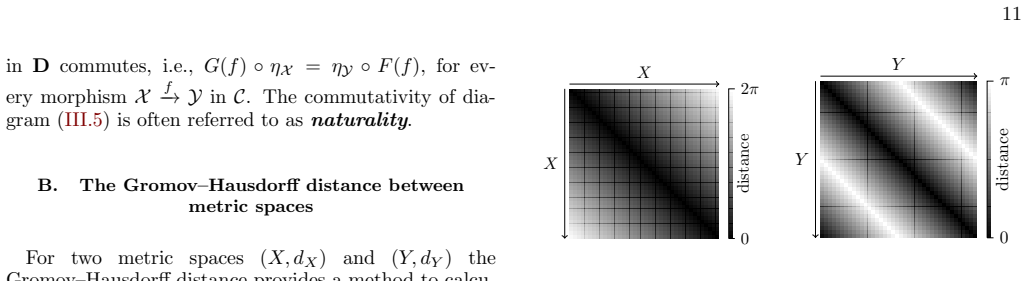
For several values ofr, calculate the associated Bu- res fidelity distance matrixd F and visualize it as a heat map while simultaneously comparing it to the original distance matrix associated withd X. Then calculate the strain, distortion, and stress associ- ated with the quantum encoding
-
[3]
If the codomain of the quantum encoding is the space of qubits, visualize the quantum encoded data on the Bloch sphere. If the dimension of the quantum state space exceeds three, apply cMDS to the distance matrix of the quantum encoded data to visualize the relative positions of the data points back in Euclidean spaceR 2. This provides an alter- native vi...
-
[4]
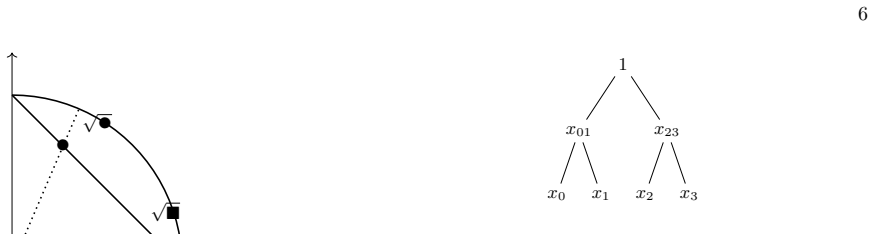
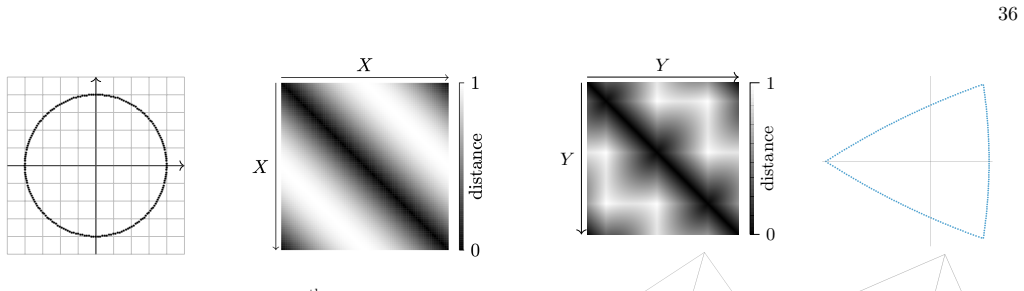
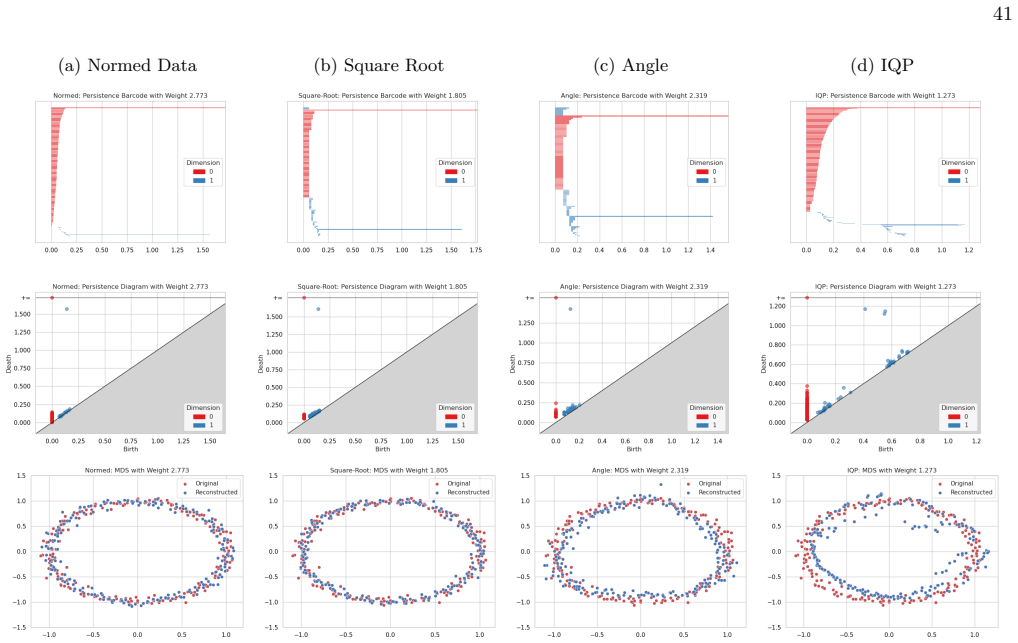
Square-root encoding for ideal circle For square-root encoding as defined in Example II.17, we first must apply the uniform transformation (IV.30) to map then th roots of unity onto the standard 2-simplex Y Y 1 0 distance FIG. 13. A heatmap of the Bures fidelity distance matrix associated with the quantum encoding given by first applying the uniform trans...
-
[5]
In this example, we specifically use the pure state from Eqn
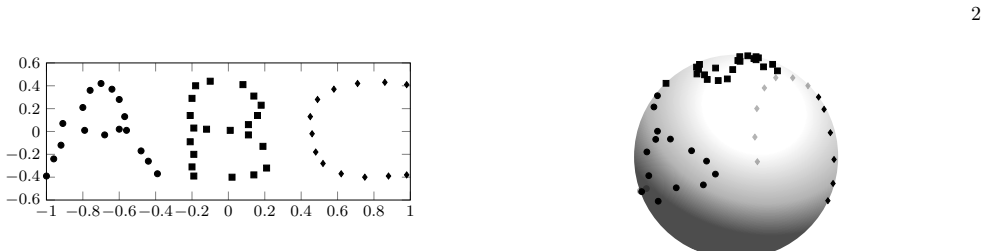
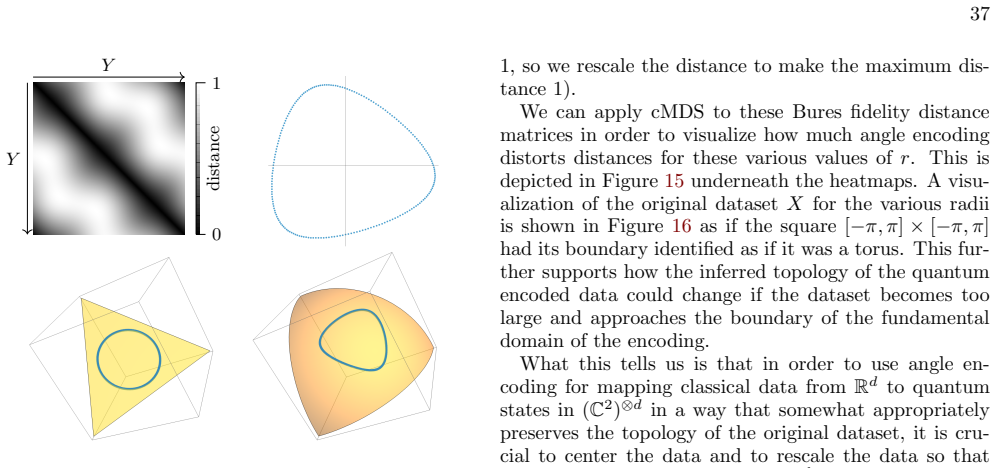
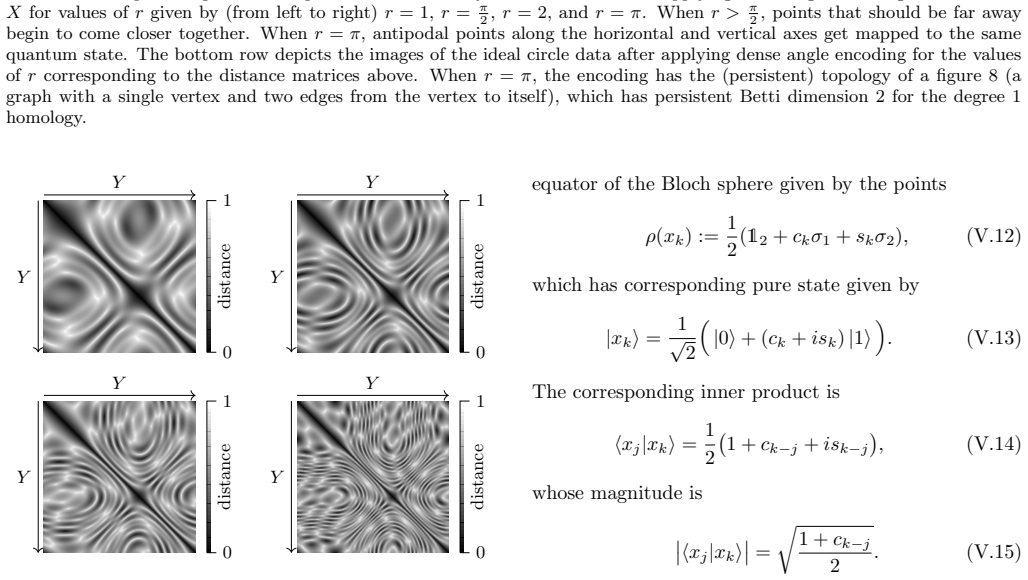
Angle encoding for ideal circle For angle encoding, we refer back to Example II.3. In this example, we specifically use the pure state from Eqn. II.9 or equivalently the density matrix from Eqn. II.10. The elementx k of the setXgets sent to the 2-qubit pure quantum state |xk⟩= cos rck 2 |0⟩+ sin rck 2 |1⟩ ⊗ cos rsk 2 |0⟩+ sin rsk 2 |1⟩ .(V.6) The inner pr...
-
[6]
From that Bloch sphere, we can see the topology change directly from the data without the need for cMDS as in the case for ordinary angle encoding
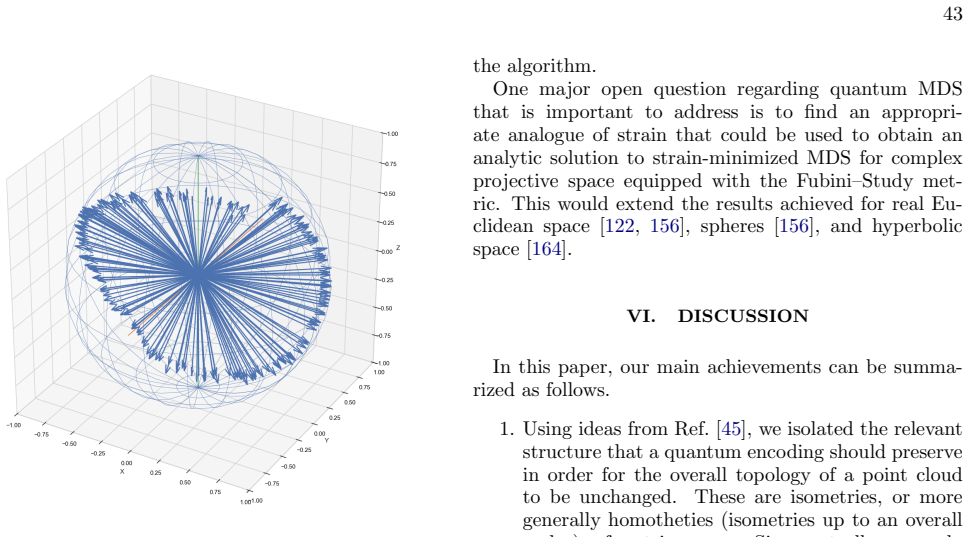
Dense angle encoding for ideal circle The benefit of dense angle encoding for then th roots of unity data setXis that we can actually visualize the quantum encoded data on the Bloch sphere. From that Bloch sphere, we can see the topology change directly from the data without the need for cMDS as in the case for ordinary angle encoding. Moreover, the funda...
-
[7]
Un- der this encoding, the elementx k = (rck, rsk) of the set Xgets sent to the 2-qubit pure quantum state |xk⟩=e i rckσ1⊗12+rsk12⊗σ1+(π−rck)(π−rsk)σ1⊗σ1 |00⟩
IQP encoding for ideal circle For IQP encoding, we refer back to Example II.22. Un- der this encoding, the elementx k = (rck, rsk) of the set Xgets sent to the 2-qubit pure quantum state |xk⟩=e i rckσ1⊗12+rsk12⊗σ1+(π−rck)(π−rsk)σ1⊗σ1 |00⟩. (V.11) In this case, the explicit calculation of the inner prod- uct⟨x j|xk⟩is not particularly illuminating and is q...
-
[8]
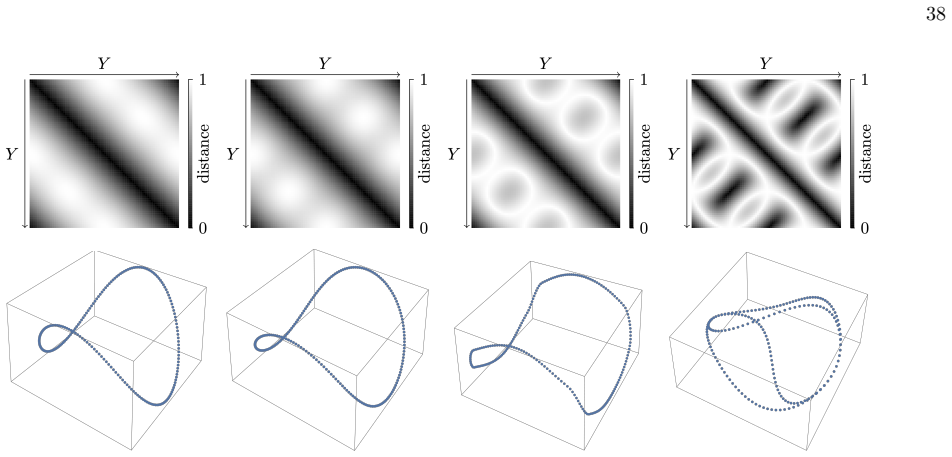
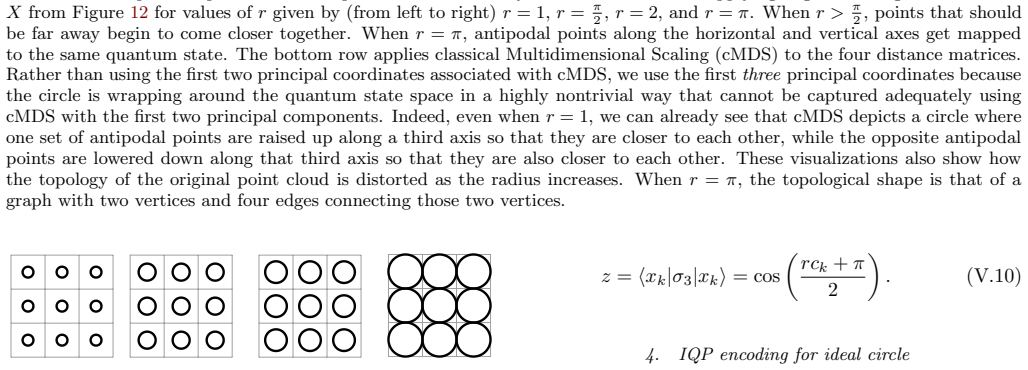
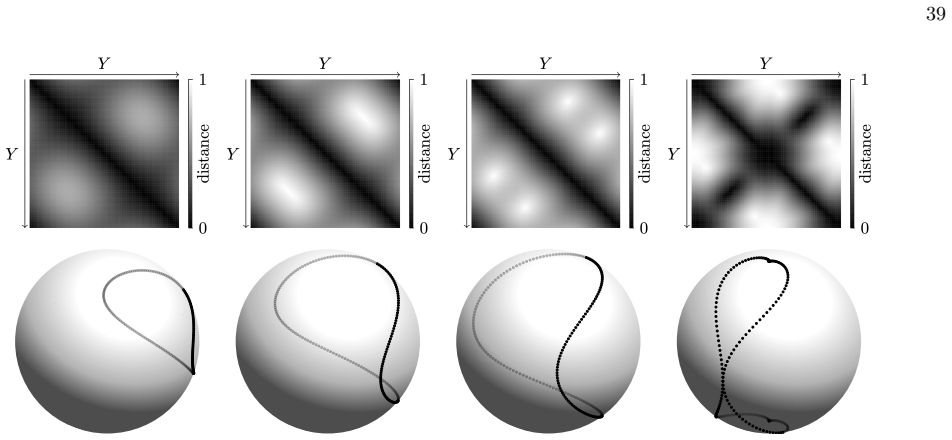
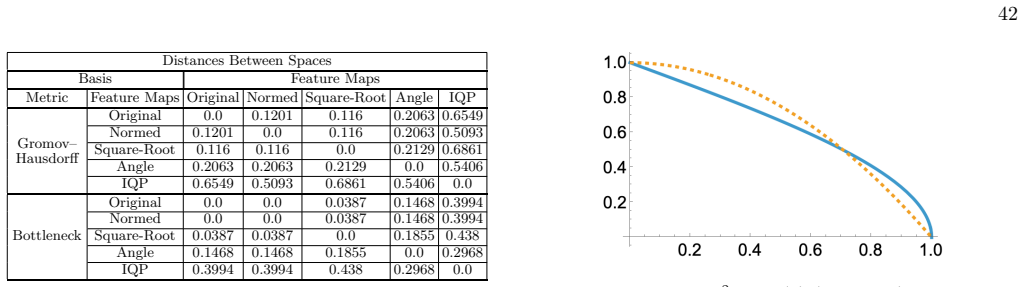
MDS encoding We next briefly analyze MDS encoding by finding a functionf:X→CP 1 that minimizes stress (IV.52). 39 FIG. 17. The top row depicts heatmaps of the Bures fidelity distance matrix after applying dense angle encoding to the dataset Xfor values ofrgiven by (from left to right)r= 1,r= π 2 ,r= 2, andr=π. Whenr > π 2 , points that should be far away ...
-
[9]
[45], we isolated the relevant structure that a quantum encoding should preserve in order for the overall topology of a point cloud to be unchanged
Using ideas from Ref. [45], we isolated the relevant structure that a quantum encoding should preserve in order for the overall topology of a point cloud to be unchanged. These are isometries, or more generally homotheties (isometries up to an overall scalar), of metric spaces. Since not all commonly used quantum encodings preserve distances exactly or up...
-
[10]
We included several simple examples to illustrate the main ideas as well as how the associ- ated quantities are computed, such as birth-death diagrams and bottleneck distances
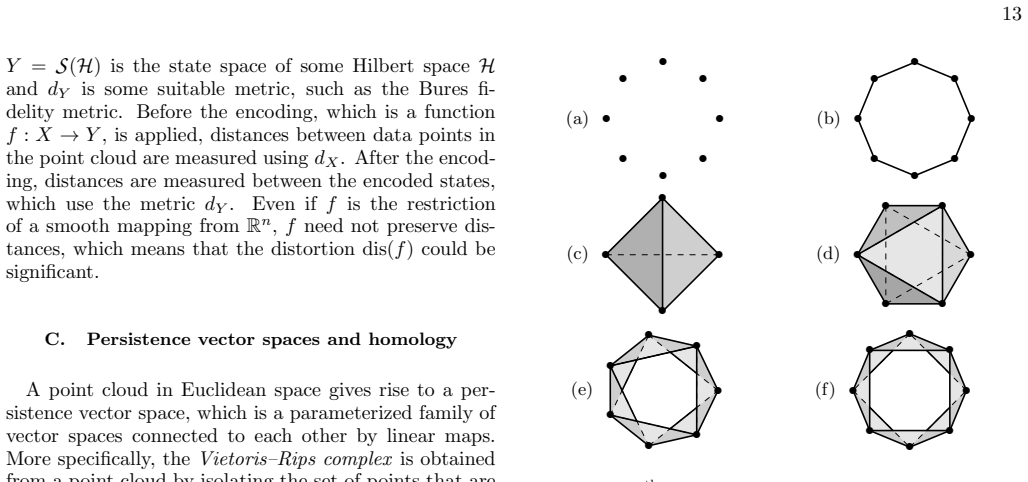
We reviewed Topological Data Analysis (TDA), fo- cusing on persistent homology and the stability the- orem, the latter of which provides bounds relating the bottleneck distance to the Gromov–Hausdorff distance. We included several simple examples to illustrate the main ideas as well as how the associ- ated quantities are computed, such as birth-death diag...
-
[11]
This explicitly shows that there is indeed a quantum encoding that can (in principle) perfectly preserve the topology of a dataset
Our first main result is Corollary IV.36 (a conse- quence of Theorem IV.34), which provides a quan- tum encoding thatexactlypreserves (up to an overall constant) all of the distances from a point cloud in Euclidean space, and therefore preserves all of the topological invariants that could be com- puted from TDA including persistent Betti num- bers. This ...
-
[12]
We then used metric Multidimensional Scaling to formalize the idea that everyquantum encodingmustdistort the classical data by at least a certain amount
Since the quantum encoding that perfectly pre- serves the topology involves the preparation of mixed quantum states, we supplied an alternative quantum encoding that only requires the prepara- tion of pure quantum states. We then used metric Multidimensional Scaling to formalize the idea that everyquantum encodingmustdistort the classical data by at least...
-
[13]
DTTL”), its global network of member firms, and their related entities (collectively, the “Deloitte organization
We posed the next major problem for this line of re- search, which is to find anefficientquantum encod- ing that minimizes distortion/Gromov–Hausdorff distance. The theoretically optimal solution is not necessarily an implementable and efficient quantum encoding. Ideally, one would hope that there exists an efficient implementation that is at least close ...
2026
-
[14]
F. Chazal and B. Michel, An introduction to topo- logical data analysis: Fundamental and practi- cal aspects for data scientists, Front. Artif. Intell. 4, 10.3389/frai.2021.667963 (2021), arXiv:1710.04019 [math.ST]
-
[15]
Niyogi, S
P. Niyogi, S. Smale, and S. Weinberger, Finding the ho- mology of submanifolds with high confidence from ran- dom samples, Discrete Comput. Geom.39, 419 (2008)
2008
-
[16]
Chazal, D
F. Chazal, D. Cohen-Steiner, and Q. M´ erigot, Geomet- ric inference for probability measures, Found. Comput. Math.11, 733 (2011)
2011
-
[17]
Efficient and Robust Persistent Homology for Measures
M. Buchet, F. Chazal, S. Y. Oudot, and D. R. Sheehy, Efficient and robust persistent homology for measures, Comput. Geom.58, 70 (2016), arXiv:1306.0039 [cs.CG]
work page internal anchor Pith review Pith/arXiv arXiv 2016
-
[18]
A. N. Gorban and I. Y. Tyukin, Blessing of dimensional- ity: mathematical foundations of the statistical physics of data, Philos. Trans. R. Soc. A376, 20170237 (2018), arXiv:1801.03421 [cs.LG]
work page internal anchor Pith review Pith/arXiv arXiv 2018
-
[19]
Spivak,Calculus on manifolds: A modern approach to classical theorems of advanced calculus, Mathematics Monograph Series (Benjamin Cummings, 1965)
M. Spivak,Calculus on manifolds: A modern approach to classical theorems of advanced calculus, Mathematics Monograph Series (Benjamin Cummings, 1965)
1965
-
[20]
J. R. Munkres,Analysis on manifolds(CRC Press, Boca Raton, FL, 1991)
1991
-
[21]
Lee,Introduction to topological manifolds, 2nd ed., Grad
J. Lee,Introduction to topological manifolds, 2nd ed., Grad. Texts Math., Vol. 202 (Springer, New York, NY, 2011)
2011
-
[22]
J. M. Lee,Introduction to smooth manifolds, 2nd ed., Grad. Texts Math., Vol. 218 (Springer, New York, NY, 2013)
2013
-
[23]
J. W. Milnor,Topology from the differentiable viewpoint, Princeton Landmarks in Mathematics and Physics (Princeton University Press, Princeton, NJ, 1997) based on notes by David W. Weaver; Revised reprint of the 1965 original
1997
-
[24]
Testing the Manifold Hypothesis
C. Fefferman, S. Mitter, and H. Narayanan, Testing the manifold hypothesis, J. Am. Math. Soc.29, 983 (2016), arXiv:1310.0425 [math.ST]
work page internal anchor Pith review Pith/arXiv arXiv 2016
-
[25]
Jones, Diffusion geometry (2024), arXiv:2405.10858 [math.MG]
I. Jones, Diffusion geometry (2024), arXiv:2405.10858 [math.MG]
-
[26]
Hatcher,Algebraic topology(Cambridge University Press, Cambridge, UK, 2002)
A. Hatcher,Algebraic topology(Cambridge University Press, Cambridge, UK, 2002)
2002
-
[27]
J. R. Munkres,Elements Of Algebraic Topology(CRC Press, 1984)
1984
-
[28]
J. P. May,A concise course in algebraic topology (Chicago, IL: University of Chicago Press, 1999)
1999
-
[29]
L. Wasserman, Topological data analysis, Annu. Rev. Stat. Appl5, 501 (2018), arXiv:1609.08227 [stat.ME]
work page internal anchor Pith review Pith/arXiv arXiv 2018
-
[30]
Carlsson, Topology and data, Bull
G. Carlsson, Topology and data, Bull. Am. Math. Soc., New Ser.46, 255 (2009)
2009
-
[31]
S. Y. Oudot,Persistence theory: from quiver representa- tions to data analysis, Mathematical Surveys and Mono- graphs, Vol. 209 (American Mathematical Soc., Provi- dence, RI, 2017)
2017
-
[32]
Carlsson and M
G. Carlsson and M. Vejdemo-Johansson,Topological data analysis with applications(Cambridge University Press, Cambridge, UK, 2021)
2021
-
[33]
Ghrist, Barcodes: the persistent topology of data, Bull
R. Ghrist, Barcodes: the persistent topology of data, Bull. Amer. Math. Soc.45, 61 (2008)
2008
-
[34]
Carlsson and F
G. Carlsson and F. M´ emoli, Characterization, stability and convergence of hierarchical clustering methods, J. Mach. Learn. Res.11, 1425 (2010)
2010
-
[35]
M´ emoli, Metric structures on datasets: stability and classification of algorithms, inInternational Con- ference on Computer Analysis of Images and Patterns (Springer, 2011) pp
F. M´ emoli, Metric structures on datasets: stability and classification of algorithms, inInternational Con- ference on Computer Analysis of Images and Patterns (Springer, 2011) pp. 1–33
2011
-
[36]
Hensel, M
F. Hensel, M. Moor, and B. Rieck, A survey of topolog- ical machine learning methods, Front. Artif. Intell.4, 681108 (2021)
2021
- [37]
-
[38]
Abousamra, R
S. Abousamra, R. Gupta, T. Kurc, D. Samaras, J. Saltz, and C. Chen, Topology-guided multi-class cell context generation for digital pathology, inProceedings of the IEEE/CVF conference on computer vision and pattern recognition(2023) pp. 3323–3333
2023
-
[39]
R. M. Levenson, Y. Singh, B. Rieck, Q. A. Hathaway, C. Farrelly, J. Rozenblit, P. Prasanna, B. Erickson, A. Choudhary, G. Carlsson,et al., Advancing precision medicine: algebraic topology and differential geometry in radiology and computational pathology, Lab. Invest. 104, 102060 (2024)
2024
-
[40]
Torras-P´ erez, I
M. Torras-P´ erez, I. H. R. Yoon, P. Weeratunga, L.-P. Ho, H. M. Byrne, U. Tillmann, and H. A. Harrington, Topology across scales on heterogeneous cell data, PLoS Comput. Biol.21, e1013460 (2025)
2025
-
[41]
R. J. Gardner, E. Hermansen, M. Pachitariu, Y. Burak, N. A. Baas, B. A. Dunn, M.-B. Moser, and E. I. Moser, Toroidal topology of population activity in grid cells, Nature602, 123 (2022)
2022
-
[42]
Schonsheck and C
N. Schonsheck and C. Giusti, Learning local geometry and nonlinear topology of neural manifolds via spike- timing dependent plasticity (2025), bioRxiv preprint
2025
-
[43]
I. H. R. Yoon, G. Henselman-Petrusek, Y. Yu, R. Ghrist, S. L. Smith, and C. Giusti, Tracking the topology of neural manifolds across populations, Proc. Natl. Acad. Sci. U.S.A.121, e2407997121 (2024)
2024
-
[44]
Guardamagna, E
M. Guardamagna, E. Hermansen, J. Carpenter, C. M. Lykken, B. A. Dunn, E. I. Moser, and M.-B. Moser, Toroidal topology of grid-cell activity precedes spa- tial navigation during development (2026), bioRxiv preprint
2026
-
[45]
S. Krishnagopal and G. Bianconi, Topology and dy- namics of higher-order multiplex networks, Chaos Solit. Fractals.177, 114296 (2023), arXiv:2308.14189 [nlin.AO]
- [46]
-
[47]
A. P. Mill´ an, H. Sun, L. Giambagli, R. Muolo, T. Car- letti, J. J. Torres, F. Radicchi, J. Kurths, and G. Bian- coni, Topology shapes dynamics of higher-order net- works, Nat. Phys.21, 353 (2025)
2025
-
[48]
Bianconi,Higher-Order Networks, Elements in the Structure and Dynamics of Complex Networks (Cam- bridge University Press, Cambridge, UK, 2021)
G. Bianconi,Higher-Order Networks, Elements in the Structure and Dynamics of Complex Networks (Cam- bridge University Press, Cambridge, UK, 2021)
2021
- [49]
-
[50]
(GUDHI Editorial Board, 2020)
The GUDHI Project,GUDHI User and Reference Man- ual, 3.1.1 ed. (GUDHI Editorial Board, 2020)
2020
-
[51]
C. T. Nathaniel Saul, Scikit-tda: Topological data anal- ysis for python (2019)
2019
- [52]
-
[53]
Simi, A scalable approach for mapper via efficient spatial search, Trans
L. Simi, A scalable approach for mapper via efficient spatial search, Trans. Mach. Learn. Res. (2025)
2025
- [54]
-
[55]
Quantum algorithms for topological and geometric analysis of big data
S. Lloyd, S. Garnerone, and P. Zanardi, Quantum al- gorithms for topological and geometric analysis of data, Nat. Commun.7, 10138 (2016), arXiv:1408.3106 [quant- ph]
work page internal anchor Pith review Pith/arXiv arXiv 2016
-
[56]
Virk, An introduction to persistent homology (2022), last accessed fromhttp://zalozba.fri.uni-lj.si/ virk2022.pdfon 2025/06/23
ˇZ. Virk, An introduction to persistent homology (2022), last accessed fromhttp://zalozba.fri.uni-lj.si/ virk2022.pdfon 2025/06/23
2022
-
[57]
A. Vlasic and A. Pham, Understanding the mapping of encode data through an implementation of quantum topological analysis, Quantum Inf. Comput.33, 1091 (2023), arXiv:2209.10596 [quant-ph]
- [58]
-
[59]
Chazal, D
F. Chazal, D. Cohen-Steiner, L. J. Guibas, F. M´ emoli, and S. Y. Oudot, Gromov-Hausdorff stable signatures for shapes using persistence, Comput. Graph. Forum 28, 1393 (2009)
2009
-
[60]
Cohen-Steiner, H
D. Cohen-Steiner, H. Edelsbrunner, and J. Harer, Sta- bility of persistence diagrams, Discrete Comput. Geom. 37, 103 (2007)
2007
-
[61]
Gardner, The stability theorem of persistent homol- ogy, Morfismos21, 15 (2017)
A. Gardner, The stability theorem of persistent homol- ogy, Morfismos21, 15 (2017)
2017
-
[62]
Chazal, D
F. Chazal, D. Cohen-Steiner, M. Glisse, L. J. Guibas, and S. Y. Oudot, Proximity of persistence modules and their diagrams, inProceedings of the Twenty-Fifth An- nual Symposium on Computational Geometry, SCG ’09 (Association for Computing Machinery, New York, NY, USA, 2009) pp. 237–246
2009
-
[63]
de Leeuw and W
J. de Leeuw and W. Heiser, Theory of multidimen- sional scaling, inClassification Pattern Recognition and Reduction of Dimensionality, Handbook of Statistics, Vol. 2 (North-Holland Publishing Company, 1982) pp. 285–316
1982
- [64]
- [65]
-
[66]
J. R. McClean, S. Boixo, V. N. Smelyanskiy, R. Bab- bush, and H. Neven, Barren plateaus in quantum neu- ral network training landscapes, Nat. Commun.9, 4812 (2018), arXiv:1803.11173 [quant-ph]
work page internal anchor Pith review Pith/arXiv arXiv 2018
-
[67]
M. Larocca, S. Thanasilp, S. Wang, K. Sharma, J. Biamonte, P. J. Coles, L. Cincio, J. R. McClean, Z. Holmes, and M. Cerezo, Barren plateaus in vari- ational quantum computing, Nat. Rev. Phys.7, 174 (2025), arXiv:2405.00781 [quant-ph]
-
[68]
S. Thanasilp, S. Wang, M. Cerezo, and Z. Holmes, Ex- ponential concentration in quantum kernel methods, Nat. Commun.15, 5200 (2024), arXiv:2208.11060v2 [quant-ph]
-
[69]
S. Rethinasamy, R. Agarwal, K. Sharma, and M. M. Wilde, Estimating distinguishability measures on quan- tum computers, Phys. Rev. A108, 012409 (2023), arXiv:2108.08406 [quant-ph]
-
[70]
J. A. Perea, Multiscale projective coordinates via persis- tent cohomology of sparse filtrations, Discrete Comput. Geom.59, 175 (2018), arXiv:1612.02861 [math.AT]
work page internal anchor Pith review Pith/arXiv arXiv 2018
-
[71]
V. P. Grande and M. T. Schaub, Non-isotropic per- sistent homology: Leveraging the metric dependency of PH, inProceedings of the Second Learning on Graphs Conference, Proceedings of Machine Learning Research, Vol. 231, edited by S. Villar and B. Cham- berlain (PMLR, 2024) pp. 17:1–17:19, arXiv:2310.16437 [math.AT]
-
[72]
R. R. Coifman and S. Lafon, Diffusion maps, Appl. Comput. Harmon. Anal.21, 5 (2006)
2006
-
[73]
J. Biamonte, P. Wittek, N. Pancotti, P. Rebentrost, N. Wiebe, and S. Lloyd, Quantum machine learning, Nature549, 195 (2017), arXiv:1611.09347 [quant-ph]
work page internal anchor Pith review Pith/arXiv arXiv 2017
-
[74]
Schuld and F
M. Schuld and F. Petruccione,Machine Learning with Quantum Computers, 2nd ed., Vol. 676 (Springer, Cham, CH, 2021)
2021
-
[75]
Aaronson, Read the fine print, Nature Phys.11, 291 (2015)
S. Aaronson, Read the fine print, Nature Phys.11, 291 (2015)
2015
- [76]
-
[77]
Quantum embeddings for machine learning,
S. Lloyd, M. Schuld, A. Ijaz, J. Izaac, and N. Killo- ran, Quantum embeddings for machine learning (2020), arXiv:2001.03622 [quant-ph]
-
[78]
M. A. Khan, M. N. Aman, and B. Sikdar, Beyond bits: A review of quantum embedding techniques for efficient information processing, IEEE Access12, 46118 (2024)
2024
-
[79]
R. LaRose and B. Coyle, Robust data encodings for quantum classifiers, Phys. Rev. A102, 032420 (2020), arXiv:2003.01695 [quant-ph]
-
[80]
Mac Lane,Categories for the working mathematician, Vol
S. Mac Lane,Categories for the working mathematician, Vol. 5 (Springer, New York, NY, 2013)
2013
discussion (0)
Sign in with ORCID, Apple, or X to comment. Anyone can read and Pith papers without signing in.