Impact of the equation of state on core collapse supernovae I: the low-T/|W| instability
Pith reviewed 2026-06-29 10:25 UTC · model grok-4.3
The pith
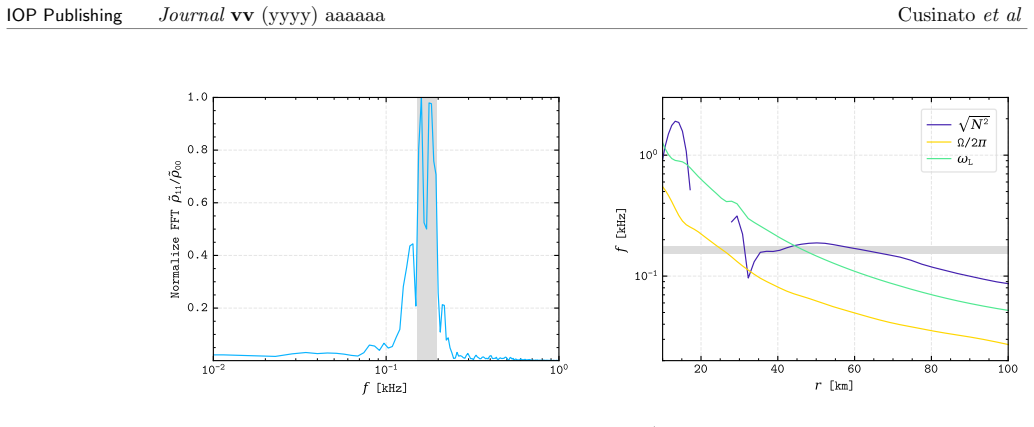
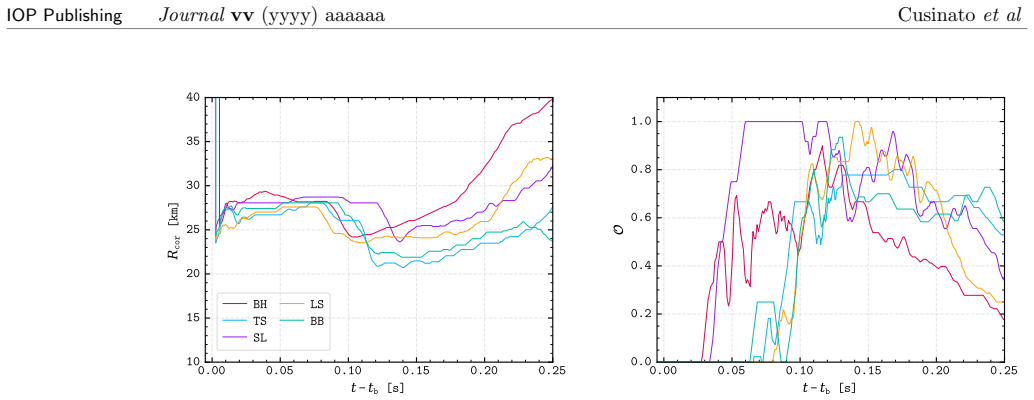
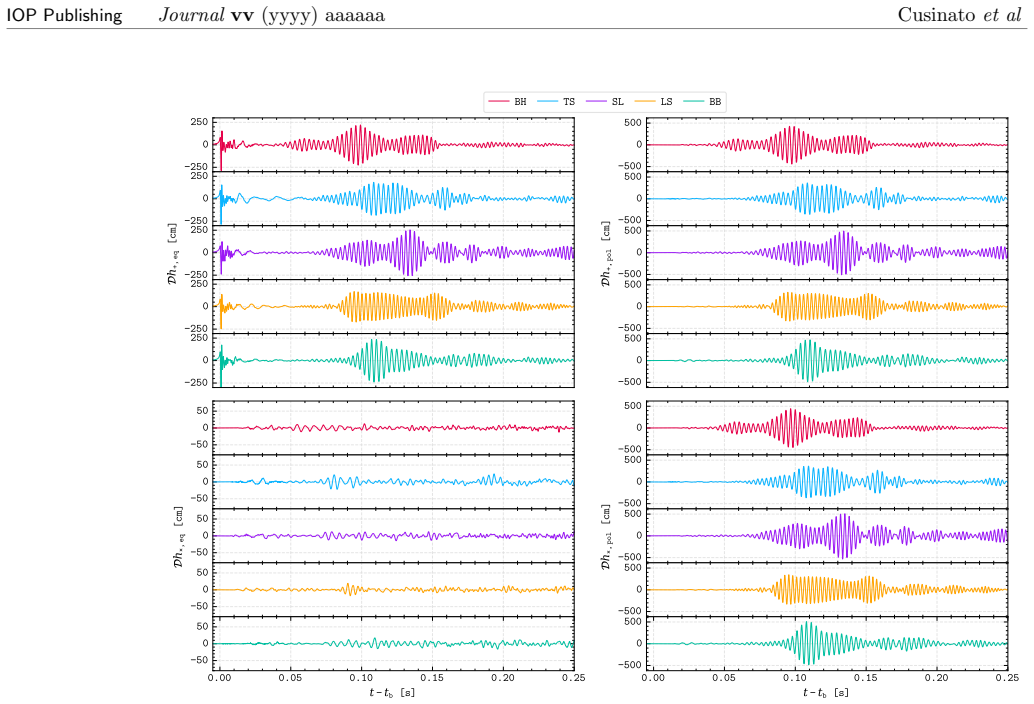
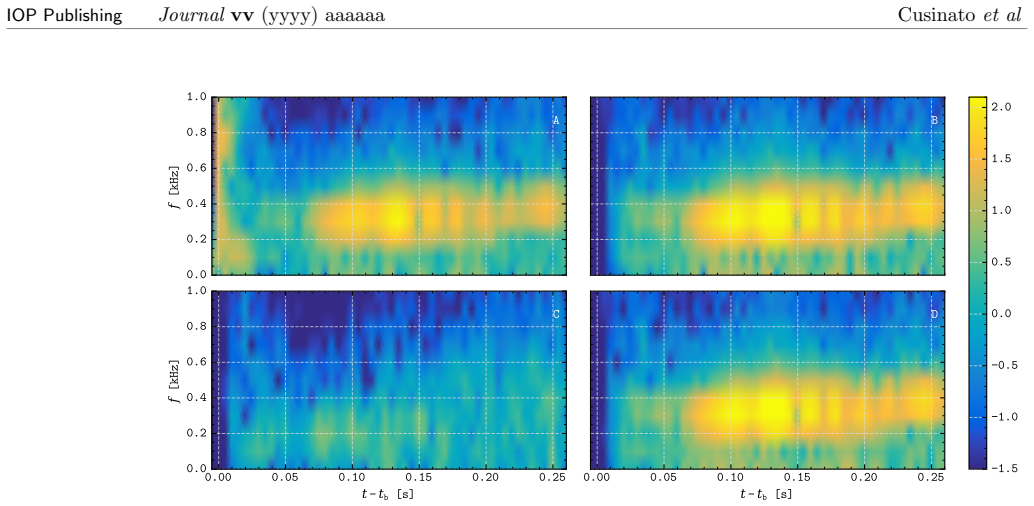
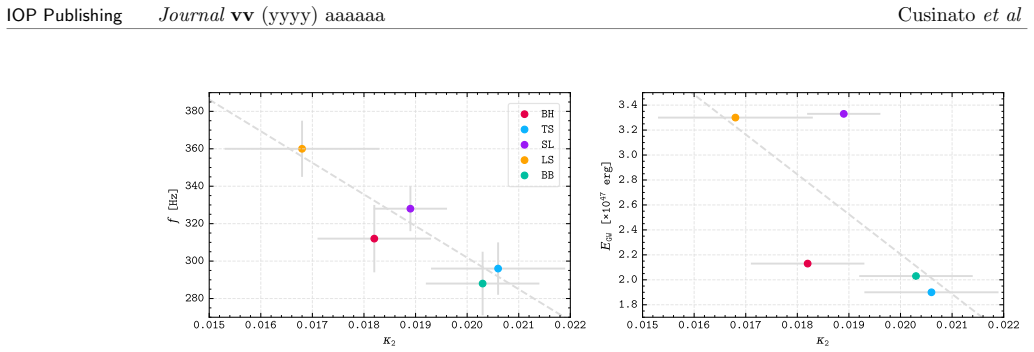
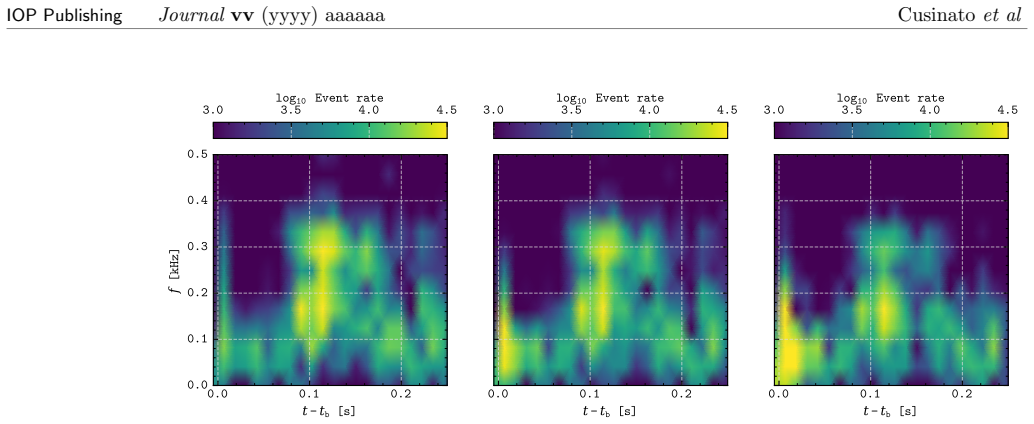
The dominant gravitational wave frequency from the low-T/|W| instability rises with proto-neutron star stiffness and compactness across five equations of state.
A machine-rendered reading of the paper's core claim, the machinery that carries it, and where it could break.
Core claim
In all five equation-of-state models the low-T/|W| instability occurs and generates large-scale spiral modes whose gravitational-wave emission frequency correlates directly with the effective stiffness and compactness of the proto-neutron star.
What carries the argument
The low-T/|W| instability, a non-axisymmetric dynamical instability in the differentially rotating proto-neutron star that drives m=1 or m=2 spiral modes and associated gravitational-wave emission.
Load-bearing premise
Differences in onset time, dominant mode, lifetime, and gravitational-wave frequency across the five runs are produced by genuine equation-of-state effects on proto-neutron star structure rather than by any of the simulation choices held fixed.
What would settle it
A set of otherwise identical simulations that yields the same dominant gravitational-wave frequency for two equations of state whose proto-neutron stars differ measurably in compactness or stiffness would falsify the reported correlation.
Figures
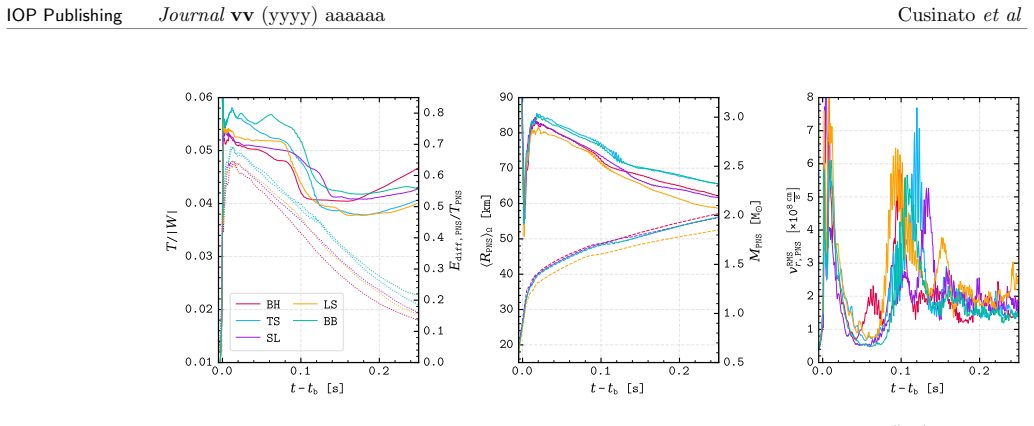
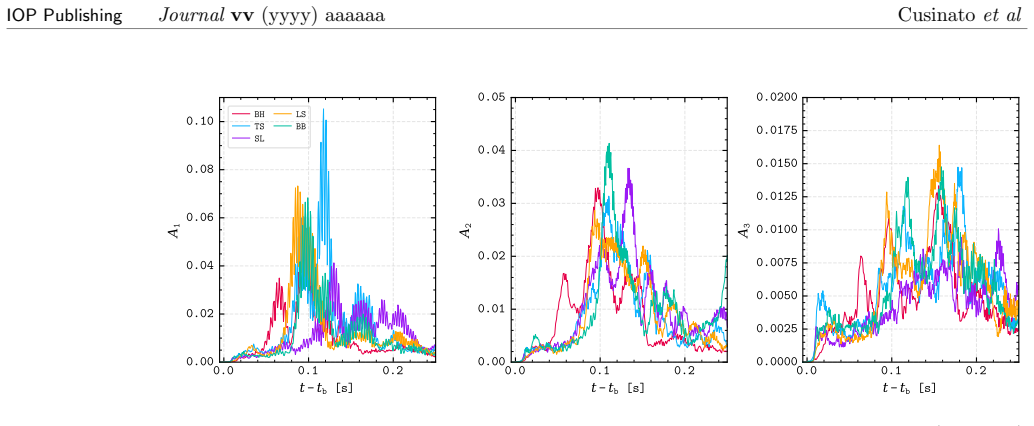
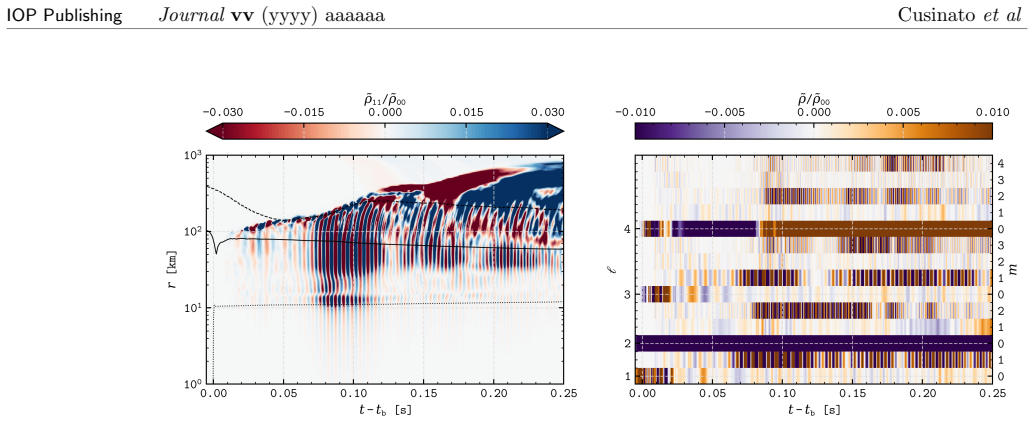
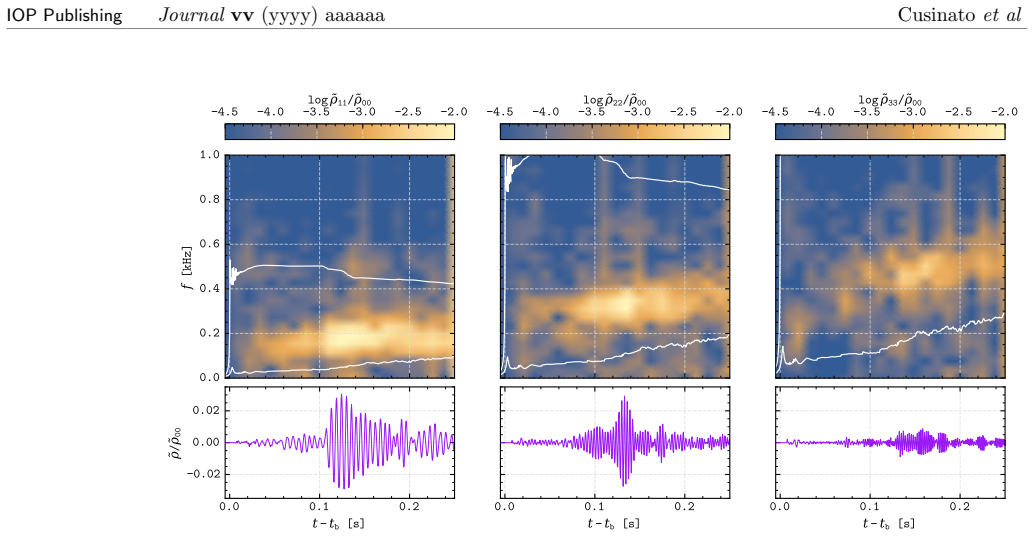
read the original abstract
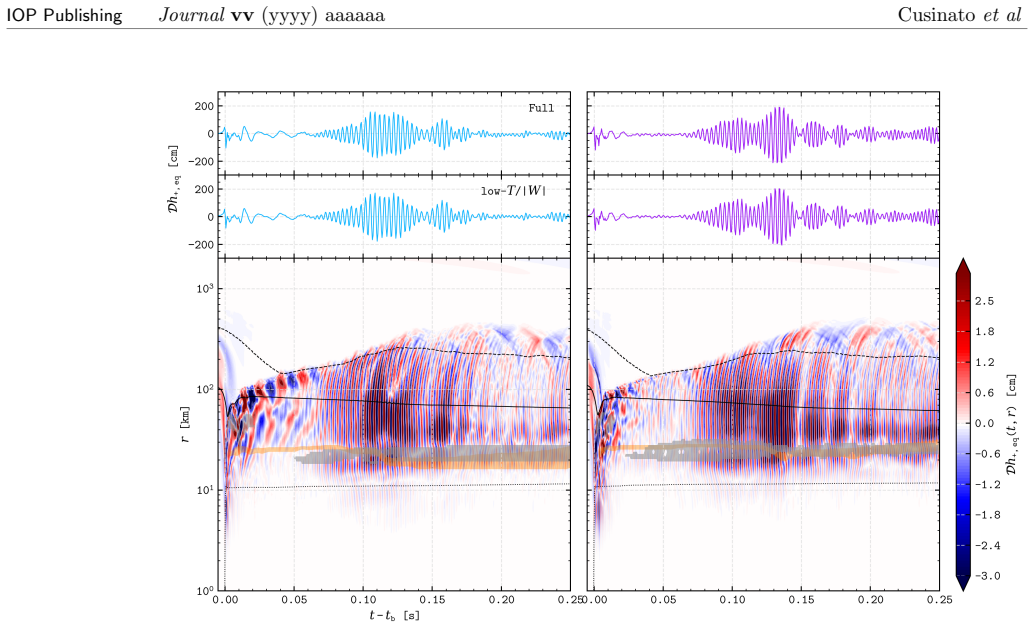
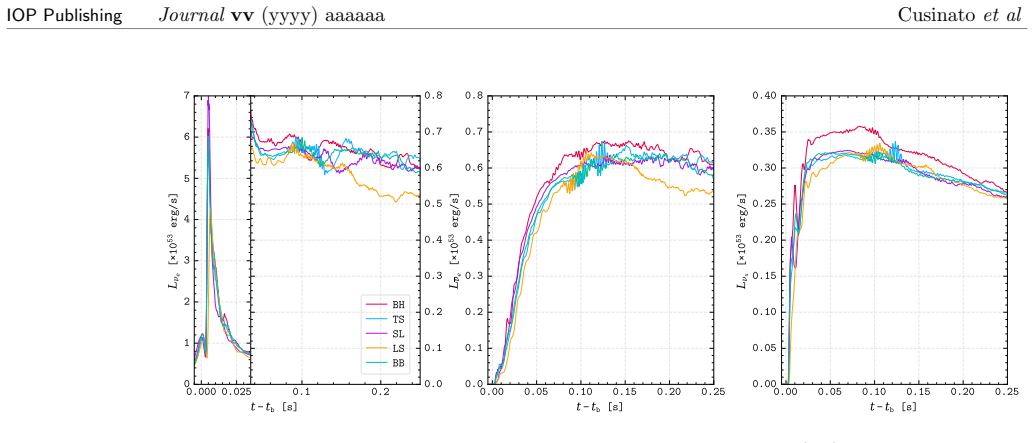
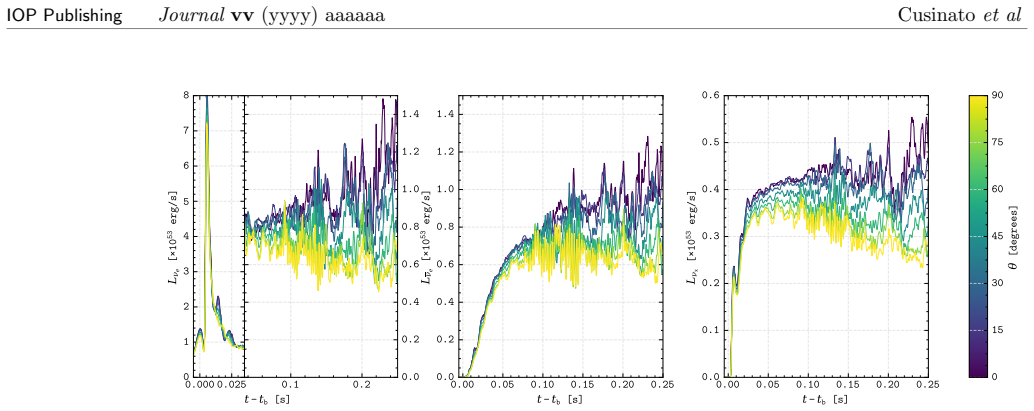
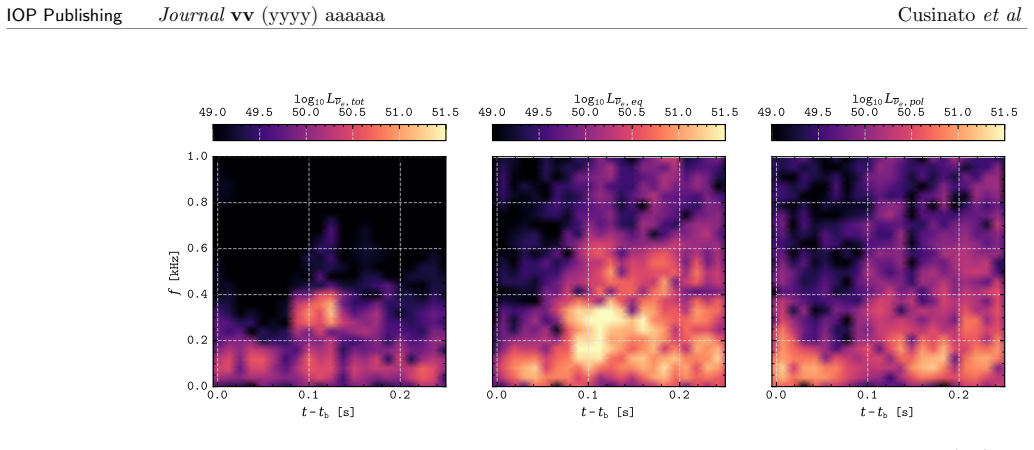
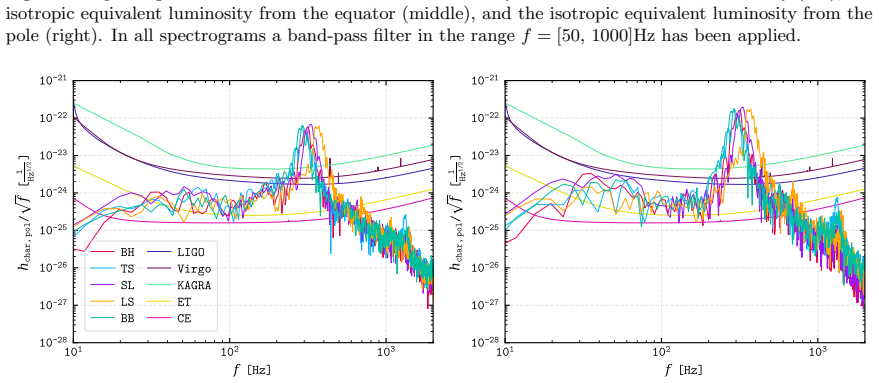
Rapidly rotating core-collapse supernovae are promising sources of multimessenger emission, as non-axisymmetric dynamics in the newly formed proto-neutron star can leave characteristic imprints on both gravitational waves and neutrinos. We present three-dimensional neutrino-magnetohydrodynamics simulations of the collapse of a rapidly rotating $35\,\mathrm{M}_\odot$ progenitor, performed with five different finite-temperature nuclear equations of state, to investigate how dense-matter physics affects the development of the low-$T/|W|$ instability and its associated multimessenger signatures. We find that the low-$T/|W|$ instability develops in all equation of state models considered, indicating that its occurrence is robust for this rapidly rotating progenitor. However, its onset time, dominant azimuthal structure, lifetime, and characteristic multimessenger frequencies vary among models, reflecting differences in the evolving proto-neutron star structure and rotation profile. The instability produces large-scale spiral modes that generate quasi-periodic gravitational wave emission and modulate the neutrino luminosities, especially along directions close to the equatorial plane. The dominant gravitational wave frequency associated with the instability correlates with the effective stiffness and compactness of the proto-neutron star: models with more compact/stiffer configurations emit at higher frequencies. This suggests that, in rapidly rotating core-collapse supernovae, the frequency of the low-$T/|W|$ instability-driven gravitational wave signal may provide a diagnostic of the dense-matter equation of state, complementary to the information carried by the neutrino signal.
Editorial analysis
A structured set of objections, weighed in public.
Referee Report
Summary. The manuscript reports three-dimensional neutrino-magnetohydrodynamics simulations of the collapse of a rapidly rotating 35 M_⊙ progenitor using five different finite-temperature nuclear equations of state. It claims that the low-T/|W| instability develops in all five models, with variations in onset time, dominant azimuthal mode, lifetime, and multimessenger frequencies that reflect EOS-dependent differences in proto-neutron star structure and rotation; the dominant gravitational-wave frequency is reported to correlate with PNS compactness and stiffness, suggesting a potential EOS diagnostic complementary to the neutrino signal.
Significance. If the reported frequency variations prove robust, the work would identify a potentially useful multimessenger signature linking gravitational-wave observations to the dense-matter equation of state in rapidly rotating core-collapse supernovae. The demonstration that the instability occurs across all five EOS models is a clear strength.
major comments (1)
- [Abstract] Abstract, paragraph 2: the claim that onset time, dominant mode, lifetime, and GW frequency vary across the five EOS runs and that frequency correlates with compactness/stiffness (thereby providing an EOS diagnostic) is load-bearing for the central multimessenger inference, yet the abstract supplies no quantitative frequencies, compactness values, correlation metrics, error bars, or resolution studies. Without these, it is impossible to assess whether the ordering survives changes in grid resolution or neutrino-transport approximations.
minor comments (1)
- [Abstract] Abstract: the notation T/|W| is used without a brief parenthetical definition or reference to its standard meaning in the rotating stellar context.
Simulated Author's Rebuttal
We thank the referee for their careful reading and constructive feedback. We address the single major comment below.
read point-by-point responses
-
Referee: [Abstract] Abstract, paragraph 2: the claim that onset time, dominant mode, lifetime, and GW frequency vary across the five EOS runs and that frequency correlates with compactness/stiffness (thereby providing an EOS diagnostic) is load-bearing for the central multimessenger inference, yet the abstract supplies no quantitative frequencies, compactness values, correlation metrics, error bars, or resolution studies. Without these, it is impossible to assess whether the ordering survives changes in grid resolution or neutrino-transport approximations.
Authors: We agree that the abstract would benefit from quantitative support for the reported variations and correlation. In the revised manuscript we will incorporate specific dominant GW frequencies, PNS compactness values, and the correlation metric drawn from the results section. The study was performed at a single fiducial resolution with our standard neutrino-transport treatment; no dedicated resolution or transport-approximation scans were carried out. We have added an explicit statement of this limitation to the discussion. revision: partial
- Robustness of the reported frequency ordering and correlation under changes in grid resolution or neutrino-transport approximations.
Circularity Check
No circularity: empirical simulation outcomes independent of inputs
full rationale
The paper reports results from a suite of 3D neutrino-MHD simulations run with five different finite-temperature EOS models on the same 35 M⊙ progenitor. Observed variations in onset time, dominant mode, lifetime, and GW frequency are presented as direct numerical outcomes reflecting EOS-induced differences in PNS structure and rotation. No equations are fitted to subsets of the data and then re-predicted, no self-definitional relations equate outputs to inputs, and no uniqueness theorems or ansatzes are imported via self-citation to force the reported correlation. The suggested diagnostic use of GW frequency follows from the empirical ordering across runs rather than reducing to the simulation inputs by construction.
Axiom & Free-Parameter Ledger
axioms (1)
- domain assumption Ideal magnetohydrodynamics and the chosen neutrino transport scheme accurately capture the relevant dynamics of the proto-neutron star.
Reference graph
Works this paper leans on
-
[1]
Adam Burrows. “Supernova Neutrinos”. In: ApJ 334 (Nov. 1988), p. 891.doi: 10.1086/166885
-
[2]
A New Gravitational-Wave Signature from Standing Accretion Shock Instabilities in Supernovae
Takami Kuroda, Kei Kotake, and Tomoya Takiwaki. “A New Gravitational-wave Signature from Standing Accretion Shock Instability in Supernovae”. In: ApJ 829.1, L14 (Sept. 2016), p. L14.doi:10.3847/2041-8205/829/1/L14. arXiv:1605.09215 [astro-ph.HE]
work page internal anchor Pith review Pith/arXiv arXiv doi:10.3847/2041-8205/829/1/l14 2016
-
[3]
Equation of State Effects on Gravitational Waves from Rotating Core Collapse
Sherwood Richers, Christian D. Ott, Ernazar Abdikamalov, Evan O’Connor, and Chris Sullivan. “Equation of state effects on gravitational waves from rotating core collapse”. In: Phys. Rev. D 95.6, 063019 (Mar. 2017), p. 063019.doi: 10.1103/PhysRevD.95.063019. arXiv: 1701.02752 [astro-ph.HE]
work page internal anchor Pith review Pith/arXiv arXiv doi:10.1103/physrevd.95.063019 2017
-
[5]
R. Daniel Murphy, Alejandro Casallas-Lagos, Anthony Mezzacappa, Michele Zanolin, Ryan E. Landfield, Eric J. Lentz, Pedro Marronetti, Javier M. Antelis, and Claudia Moreno. “Depen- dence of the reconstructed core-collapse supernova gravitational wave high-frequency feature on the nuclear equation of state in real interferometric data”. In: Phys. Rev. D 110...
-
[6]
Alexei V. Filippenko. “Optical Spectra of Supernovae”. In: ARA&A 35 (Jan. 1997), pp. 309– 355.doi:10.1146/annurev.astro.35.1.309. 31 IOP PublishingJournalvv(yyyy) aaaaaa Cusinatoet al
-
[7]
Progenitors of Core-Collapse Supernovae
Stephen J. Smartt. “Progenitors of Core-Collapse Supernovae”. In: ARA&A 47.1 (Sept. 2009), pp. 63–106.doi: 10 . 1146 / annurev - astro - 082708 - 101737. arXiv: 0908 . 0700 [astro-ph.SR]
2009
-
[8]
2025.Approaches to Automated NACE Coding of German Business Activity Descriptions
Avishay Gal-Yam. “Observational and Physical Classification of Supernovae”. In:Handbook of Supernovae. Ed. by Athem W. Alsabti and Paul Murdin. 2017, p. 195.doi: 10.1007/978-3- 319-21846-5_35
-
[9]
Supernova remnants: the X-ray perspective
Jacco Vink. “Supernova remnants: the X-ray perspective”. In: A&A Rev. 20, 49 (Dec. 2012), p. 49.doi:10.1007/s00159-011-0049-1. arXiv:1112.0576 [astro-ph.HE]
work page internal anchor Pith review Pith/arXiv arXiv doi:10.1007/s00159-011-0049-1 2012
-
[10]
S. Orlando et al. “Tracing the ejecta structure of supernova 1987A: Insights and diagnostics from 3D magnetohydrodynamic simulations”. In: A&A 699, A305 (July 2025), A305.doi: 10.1051/0004-6361/202554862. arXiv:2504.19896 [astro-ph.HE]
-
[11]
LIGO Scientific Collaboration et al. “Advanced LIGO”. In:Classical and Quantum Gravity32.7, 074001 (Apr. 2015), p. 074001.doi: 10.1088/0264-9381/32/7/074001 . arXiv: 1411.4547 [gr-qc]
work page internal anchor Pith review Pith/arXiv arXiv doi:10.1088/0264-9381/32/7/074001 2015
-
[13]
KAGRA: 2.5 generation interferometric gravitational wave detector
T. Akutsu et al. “KAGRA: 2.5 generation interferometric gravitational wave detector”. In: Nature Astronomy 2019 3:13 (1 Jan. 2019), pp. 35–40.issn: 2397-3366.doi: 10.1038/s41550- 018-0658-y.url:https://www.nature.com/articles/s41550-018-0658-y
-
[14]
Science-driven Tunable Design of Cosmic Explorer Detectors
Varun Srivastava, Derek Davis, Kevin Kuns, Philippe Landry, Stefan Ballmer, Matthew Evans, Evan D. Hall, Jocelyn Read, and B. S. Sathyaprakash. “Science-driven Tunable Design of Cosmic Explorer Detectors”. In: ApJ 931.1, 22 (May 2022), p. 22.doi: 10 . 3847 / 1538 - 4357/ac5f04. arXiv:2201.10668 [gr-qc]
-
[16]
Real-Time Supernova Neutrino Burst Monitor at Super-Kamiokande
K. Abe et al. “Real-time supernova neutrino burst monitor at Super-Kamiokande”. In:As- troparticle Physics81 (Aug. 2016), pp. 39–48.doi: 10.1016/j.astropartphys.2016.04.003. arXiv:1601.04778 [astro-ph.HE]
work page internal anchor Pith review Pith/arXiv arXiv doi:10.1016/j.astropartphys.2016.04.003 2016
-
[17]
Thomas Dealtry. “Hyper-Kamiokande”. In:arXiv e-prints, arXiv:1904.10206 (Apr. 2019), arXiv:1904.10206.doi:10.48550/arXiv.1904.10206. arXiv:1904.10206 [hep-ex]
work page internal anchor Pith review Pith/arXiv arXiv doi:10.48550/arxiv.1904.10206 1904
-
[18]
Fengpeng An et al. “Neutrino physics with JUNO”. In:Journal of Physics G Nuclear Physics 43.3, 030401 (Mar. 2016), p. 030401.doi: 10 . 1088 / 0954 - 3899 / 43 / 3 / 030401. arXiv: 1507.05613 [physics.ins-det]
work page internal anchor Pith review Pith/arXiv arXiv 2016
-
[19]
B. Abi et al. “Deep Underground Neutrino Experiment (DUNE), Far Detector Technical Design Report, Volume II: DUNE Physics”. In:arXiv e-prints, arXiv:2002.03005 (Feb. 2020), arXiv:2002.03005.doi:10.48550/arXiv.2002.03005. arXiv:2002.03005 [hep-ex]
-
[20]
IceCube Sensitivity for Low-Energy Neutrinos from Nearby Supernovae
R. Abbasi et al. “IceCube sensitivity for low-energy neutrinos from nearby supernovae”. In: A&A 535, A109 (Nov. 2011), A109.doi: 10.1051/0004-6361/201117810. arXiv: 1108.0171 [astro-ph.HE]
work page internal anchor Pith review Pith/arXiv arXiv doi:10.1051/0004-6361/201117810 2011
-
[21]
Supernova Neutrino Detection with IceCube
Lutz K¨ opke and IceCube Collaboration. “Supernova Neutrino Detection with IceCube”. In: Journal of Physics Conference Series. Vol. 309. Journal of Physics Conference Series. IOP, Aug. 2011, 012029, p. 012029.doi: 10.1088/1742-6596/309/1/012029 . arXiv: 1106.6225 [astro-ph.HE]
-
[22]
Letter of Intent for KM3NeT 2.0
KM3NeT Collaboration. “Letter of intent for KM3NeT 2.0”. In:Journal of Physics G Nuclear Physics43.8, 084001 (Aug. 2016), p. 084001.doi: 10.1088/0954-3899/43/8/084001. arXiv: 1601.07459 [astro-ph.IM]
work page internal anchor Pith review Pith/arXiv arXiv doi:10.1088/0954-3899/43/8/084001 2016
-
[23]
Observation of a neutrino burst in coincidence with supernova 1987A in the Large Magellanic Cloud
R. M. Bionta et al. “Observation of a neutrino burst in coincidence with supernova 1987A in the Large Magellanic Cloud”. In: Phys. Rev. Lett. 58.14 (Apr. 1987), pp. 1494–1496.doi: 10.1103/PhysRevLett.58.1494
-
[24]
Observation of a neutrino burst from the supernova SN1987A
K. Hirata et al. “Observation of a neutrino burst from the supernova SN1987A”. In: Phys. Rev. Lett. 58.14 (Apr. 1987), pp. 1490–1493.doi:10.1103/PhysRevLett.58.1490. 32 IOP PublishingJournalvv(yyyy) aaaaaa Cusinatoet al
-
[25]
E. N. Alexeyev, L. N. Alexeyeva, I. V. Krivosheina, and V. I. Volchenko. “Detection of the neutrino signal from SN 1987A in the LMC using the INR Baksan underground scintillation telescope”. In:Physics Letters B205.2-3 (Apr. 1988), pp. 209–214.doi: 10.1016/0370- 2693(88)91651-6
-
[27]
Neutrino Emission from Supernovae
Hans-Thomas Janka. “Neutrino Emission from Supernovae”. In:Handbook of Supernovae. Ed. by Athem W. Alsabti and Paul Murdin. 2017, p. 1575.doi: 10.1007/978-3-319-21846-5_4
-
[28]
Hydrodynamics of core-collapse supernovae and their progenitors
Bernhard M¨ uller. “Hydrodynamics of core-collapse supernovae and their progenitors”. In: Living Reviews in Computational Astrophysics6.1, 3 (June 2020), p. 3.doi: 10.1007/s41115- 020-0008-5. arXiv:2006.05083 [astro-ph.SR]
-
[29]
Core-collapse supernova explosion theory
A. Burrows and D. Vartanyan. “Core-collapse supernova explosion theory”. In: Nature 589.7840 (Jan. 2021), pp. 29–39.doi: 10.1038/s41586-020-03059-w . arXiv: 2009.14157 [astro-ph.SR]
-
[30]
Physical mechanism of core-collapse supernovae that neutrinos drive
Shoichi Yamada, Hiroki Nagakura, Ryuichiro Akaho, Akira Harada, Shun Furusawa, Wakana Iwakami, Hirotada Okawa, Hideo Matsufuru, and Kohsuke Sumiyoshi. “Physical mechanism of core-collapse supernovae that neutrinos drive”. In:Proceedings of the Japan Academy, Series B100.3 (Mar. 2024), pp. 190–233.doi:10.2183/pjab.100.015
-
[31]
Supernovae and Postcollapse Behavior
J. R. Wilson. “Supernovae and Postcollapse Behavior”. In:Numerical Astrophysics. Ed. by J. M. Centrella, J. M. LeBlanc, and R. L. Bowers. Boston: Jones and Bartlett, 1982, pp. 422– 434
1982
-
[32]
Revival of a stalled supernova shock by neutrino heating
H. A. Bethe and J. R. Wilson. “Revival of a stalled supernova shock by neutrino heating”. In: ApJ 295 (Aug. 1985), pp. 14–23.doi:10.1086/163343
-
[33]
Explosion Mechanisms of Core-Collapse Supernovae
Hans-Thomas Janka. “Explosion Mechanisms of Core-Collapse Supernovae”. In:Annual Review of Nuclear and Particle Science62.1 (Nov. 2012), pp. 407–451.doi: 10.1146/annurev-nucl- 102711-094901. arXiv:1206.2503 [astro-ph.SR]
work page internal anchor Pith review Pith/arXiv arXiv doi:10.1146/annurev-nucl- 2012
-
[34]
The Evolution and Impacts of Magnetorotational Instability in Magnetized Core-Collapse Supernovae
Hidetomo Sawai and Shoichi Yamada. “The Evolution and Impacts of Magnetorotational Instability in Magnetized Core-collapse Supernovae”. In: ApJ 817.2, 153 (Feb. 2016), p. 153. doi:10.3847/0004-637X/817/2/153. arXiv:1504.03035 [astro-ph.HE]
work page internal anchor Pith review Pith/arXiv arXiv doi:10.3847/0004-637x/817/2/153 2016
-
[35]
Magnetorotational Core-Collapse Supernovae in Three Dimensions
Philipp M¨ osta, Sherwood Richers, Christian D. Ott, Roland Haas, Anthony L. Piro, Kristen Boydstun, Ernazar Abdikamalov, Christian Reisswig, and Erik Schnetter. “Magnetorotational Core-collapse Supernovae in Three Dimensions”. In: ApJ 785.2, L29 (Apr. 2014), p. L29.doi: 10.1088/2041-8205/785/2/L29. arXiv:1403.1230 [astro-ph.HE]
work page internal anchor Pith review Pith/arXiv arXiv doi:10.1088/2041-8205/785/2/l29 2014
-
[36]
M. Obergaulinger and M. ´A. Aloy. “Magnetorotational core collapse of possible gamma-ray burst progenitors - IV. A wider range of progenitors”. In: MNRAS 512.2 (May 2022), pp. 2489– 2507.doi:10.1093/mnras/stac613. arXiv:2108.13864 [astro-ph.HE]
-
[37]
The impact of non- dipolar magnetic fields in core-collapse supernovae
M. Bugli, J. Guilet, M. Obergaulinger, P. Cerd´ a-Dur´ an, and M. A. Aloy. “The impact of non- dipolar magnetic fields in core-collapse supernovae”. In: MNRAS 492.1 (Feb. 2020), pp. 58–71. doi:10.1093/mnras/stz3483. arXiv:1909.02824 [astro-ph.HE]
-
[38]
Black Hole Formation in Failing Core-Collapse Supernovae
Evan O’Connor and Christian D. Ott. “Black Hole Formation in Failing Core-Collapse Supernovae”. In: ApJ 730.2, 70 (Apr. 2011), p. 70.doi: 10.1088/0004- 637X/730/2/70 . arXiv:1010.5550 [astro-ph.HE]
work page internal anchor Pith review Pith/arXiv arXiv doi:10.1088/0004- 2011
-
[39]
L. Dessart, A. Burrows, E. Livne, and C. D. Ott. “The Proto-Neutron Star Phase of the Collapsar Model and the Route to Long-Soft Gamma-Ray Bursts and Hypernovae”. In: ApJ 673.1 (Jan. 2008), p. L43.doi:10.1086/527519. arXiv:0710.5789 [astro-ph]
work page internal anchor Pith review Pith/arXiv arXiv doi:10.1086/527519 2008
-
[40]
Protomagnetar and black hole formation in high-mass stars
M. Obergaulinger and M. ´A. Aloy. “Protomagnetar and black hole formation in high-mass stars”. In: MNRAS 469.1 (July 2017), pp. L43–L47.doi: 10.1093/mnrasl/slx046 . arXiv: 1703.09893 [astro-ph.SR]
work page internal anchor Pith review Pith/arXiv arXiv doi:10.1093/mnrasl/slx046 2017
-
[41]
Goni Halevi, Swapnil Shankar, Philipp M¨ osta, Roland Haas, and Erik Schnetter. “A Black Hole Is Born: 3D General-relativistic Magnetohydrodynamic Simulation of Black Hole Formation from Core Collapse”. In: ApJ 991.2, L51 (Oct. 2025), p. L51.doi: 10.3847/2041-8213/ae08a6. arXiv:2506.20837 [astro-ph.HE]. 33 IOP PublishingJournalvv(yyyy) aaaaaa Cusinatoet al
-
[42]
Magnetic support for neutrino-driven explosion of 3D non-rotating core-collapse supernova models
J. Matsumoto, Y. Asahina, T. Takiwaki, K. Kotake, and H. R. Takahashi. “Magnetic support for neutrino-driven explosion of 3D non-rotating core-collapse supernova models”. In: MNRAS 516.2 (Oct. 2022), pp. 1752–1767.doi: 10 . 1093 / mnras / stac2335. arXiv: 2202 . 07967 [astro-ph.HE]
2022
-
[43]
N., Subramaniam, A., Girish, V ., et al
Tianshu Wang and Adam Burrows. “Nucleosynthetic Analysis of Three-dimensional Core- collapse Supernova Simulations”. In: ApJ 962.1, 71 (Feb. 2024), p. 71.doi: 10.3847/1538- 4357/ad12b8. arXiv:2311.03446 [astro-ph.HE]
-
[44]
Neutrino-driven massive stellar explosions in 3D fostered by magnetic fields via turbulentα-effect
Jin Matsumoto, Tomoya Takiwaki, and Kei Kotake. “Neutrino-driven massive stellar explosions in 3D fostered by magnetic fields via turbulentα-effect”. In: MNRAS 528.1 (Feb. 2024), pp. L96– L101.doi:10.1093/mnrasl/slad173. arXiv:2307.03400 [astro-ph.HE]
-
[45]
Kuo-Chuan Pan, Matthias Liebend¨ orfer, Sean M. Couch, and Friedrich-Karl Thielemann. “Equation of State Dependent Dynamics and Multi-messenger Signals from Stellar-mass Black Hole Formation”. In: ApJ 857.1, 13 (Apr. 2018), p. 13.doi: 10.3847/1538-4357/aab71d . arXiv:1710.01690 [astro-ph.HE]
work page internal anchor Pith review Pith/arXiv arXiv doi:10.3847/1538-4357/aab71d 2018
-
[46]
The final core collapse of pulsational pair instability supernovae
Jade Powell, Bernhard M¨ uller, and Alexander Heger. “The final core collapse of pulsational pair instability supernovae”. In: MNRAS 503.2 (May 2021), pp. 2108–2122.doi: 10.1093/ mnras/stab614. arXiv:2101.06889 [astro-ph.HE]
-
[47]
Black Hole Supernovae, Their Equation of State Dependence, and Ejecta Composition
Oliver Eggenberger Andersen, Evan O’Connor, Haakon Andresen, Andr´ e da Silva Schneider, and Sean M. Couch. “Black Hole Supernovae, Their Equation of State Dependence, and Ejecta Composition”. In: ApJ 980.1, 53 (Feb. 2025), p. 53.doi: 10.3847/1538-4357/ada899. arXiv: 2411.11969 [astro-ph.HE]
-
[48]
On the Importance of the Equation of State for the Neutrino-Driven Supernova Explosion Mechanism
Yudai Suwa, Tomoya Takiwaki, Kei Kotake, Tobias Fischer, Matthias Liebend¨ orfer, and Katsuhiko Sato. “On the Importance of the Equation of State for the Neutrino-driven Supernova Explosion Mechanism”. In: ApJ 764.1, 99 (Feb. 2013), p. 99.doi: 10.1088/0004-637X/764/ 1/99. arXiv:1206.6101 [astro-ph.HE]
work page internal anchor Pith review Pith/arXiv arXiv doi:10.1088/0004-637x/764/ 2013
-
[49]
Impact of the nuclear equation of state on the explodability of massive stars
Jade Powell and Bernhard M¨ uller. “Impact of the nuclear equation of state on the explodability of massive stars”. In:arXiv e-prints, arXiv:2510.20076 (Oct. 2025), arXiv:2510.20076.doi: 10.48550/arXiv.2510.20076. arXiv:2510.20076 [astro-ph.HE]
work page internal anchor Pith review Pith/arXiv arXiv doi:10.48550/arxiv.2510.20076 2025
-
[51]
Gravitational Waves from a Core g Mode in Supernovae as Probes of the High-Density Equation of State
Pia Jakobus, Bernhard M¨ uller, Alexander Heger, Shuai Zha, Jade Powell, Anton Motornenko, Jan Steinheimer, and Horst St¨ ocker. “Gravitational Waves from a Core g Mode in Supernovae as Probes of the High-Density Equation of State”. In: Phys. Rev. Lett. 131.19, 191201 (Nov. 2023), p. 191201.doi:10.1103/PhysRevLett.131.191201. arXiv:2301.06515 [astro-ph.HE]
-
[52]
A Model for Gravitational Wave Emission from Neutrino-Driven Core-Collapse Supernovae
Jeremiah W. Murphy, Christian D. Ott, and Adam Burrows. “A Model for Gravitational Wave Emission from Neutrino-Driven Core-Collapse Supernovae”. In: ApJ 707.2 (Dec. 2009), pp. 1173–1190.doi:10.1088/0004-637X/707/2/1173. arXiv:0907.4762 [astro-ph.SR]
work page internal anchor Pith review Pith/arXiv arXiv doi:10.1088/0004-637x/707/2/1173 2009
-
[53]
Gravitational Waves from Core Collapse Supernovae
Konstantin N. Yakunin et al. “Gravitational waves from core collapse supernovae”. In:Classical and Quantum Gravity27.19, 194005 (Oct. 2010), p. 194005.doi: 10.1088/0264-9381/27/ 19/194005. arXiv:1005.0779 [gr-qc]
work page internal anchor Pith review Pith/arXiv arXiv doi:10.1088/0264-9381/27/ 2010
-
[54]
Bernhard M¨ uller, Hans-Thomas Janka, and Andreas Marek. “A New Multi-dimensional General Relativistic Neutrino Hydrodynamics Code of Core-collapse Supernovae. III. Gravitational Wave Signals from Supernova Explosion Models”. In: ApJ 766.1, 43 (Mar. 2013), p. 43.doi: 10.1088/0004-637X/766/1/43. arXiv:1210.6984 [astro-ph.SR]
work page internal anchor Pith review Pith/arXiv arXiv doi:10.1088/0004-637x/766/1/43 2013
-
[55]
Konstantin N. Yakunin et al. “Gravitational wave signatures of ab initio two-dimensional core collapse supernova explosion models for 12 -25 M ⊙ stars”. In: Phys. Rev. D 92.8, 084040 (Oct. 2015), p. 084040.doi:10.1103/PhysRevD.92.084040. arXiv:1505.05824 [astro-ph.HE]
work page internal anchor Pith review Pith/arXiv arXiv doi:10.1103/physrevd.92.084040 2015
-
[56]
Alejandro Torres-Forn´ e, Pablo Cerd´ a-Dur´ an, Andrea Passamonti, and Jos´ e A. Font. “Towards asteroseismology of core-collapse supernovae with gravitational-wave observations - I. Cowling approximation”. In: MNRAS 474.4 (Mar. 2018), pp. 5272–5286.doi: 10.1093/mnras/stx3067. arXiv:1708.01920 [astro-ph.SR]. 34 IOP PublishingJournalvv(yyyy) aaaaaa Cusinatoet al
work page internal anchor Pith review Pith/arXiv arXiv doi:10.1093/mnras/stx3067 2018
-
[57]
Alejandro Torres-Forn´ e, Pablo Cerd´ a-Dur´ an, Andrea Passamonti, Martin Obergaulinger, and Jos´ e A. Font. “Towards asteroseismology of core-collapse supernovae with gravitational wave observations - II. Inclusion of space-time perturbations”. In: MNRAS 482.3 (Jan. 2019), pp. 3967–3988.doi:10.1093/mnras/sty2854. arXiv:1806.11366 [astro-ph.HE]
work page internal anchor Pith review Pith/arXiv arXiv doi:10.1093/mnras/sty2854 2019
-
[58]
Convection signatures in early-time gravi- tational waves from core-collapse supernovae
M. Cusinato, M. Obergaulinger, and M. ´A. Aloy. “Convection signatures in early-time gravi- tational waves from core-collapse supernovae”. In: A&A 705, A179 (Jan. 2026), A179.doi: 10.1051/0004-6361/202556543. arXiv:2507.16903 [astro-ph.HE]
-
[59]
Stability of Standing Accretion Shocks, With an Eye Toward Core Collapse Supernovae
John M. Blondin, Anthony Mezzacappa, and Christine DeMarino. “Stability of Standing Accretion Shocks, with an Eye toward Core-Collapse Supernovae”. In: ApJ 584.2 (Feb. 2003), pp. 971–980.doi:10.1086/345812. arXiv:astro-ph/0210634 [astro-ph]
work page internal anchor Pith review Pith/arXiv arXiv doi:10.1086/345812 2003
-
[60]
Pulsar spins from an instability in the accretion shock of supernovae
John M. Blondin and Anthony Mezzacappa. “Pulsar spins from an instability in the accretion shock of supernovae”. In: Nature 445.7123 (Jan. 2007), pp. 58–60.doi: 10.1038/nature05428. arXiv:astro-ph/0611680 [astro-ph]
work page internal anchor Pith review Pith/arXiv arXiv doi:10.1038/nature05428 2007
-
[61]
Gravitational wave signatures in black-hole-forming core collapse
Pablo Cerd´ a-Dur´ an, Nicolas DeBrye, Miguel A. Aloy, Jos´ e A. Font, and Martin Obergaulinger. “Gravitational Wave Signatures in Black Hole Forming Core Collapse”. In: ApJ 779.2, L18 (Dec. 2013), p. L18.doi:10.1088/2041-8205/779/2/L18. arXiv:1310.8290 [astro-ph.SR]
work page internal anchor Pith review Pith/arXiv arXiv doi:10.1088/2041-8205/779/2/l18 2013
-
[62]
Gravitational Wave Signals from 3D Neutrino Hydrodynamics Simulations of Core-Collapse Supernovae
H. Andresen, B. M¨ uller, E. M¨ uller, and H. -Th. Janka. “Gravitational wave signals from 3D neutrino hydrodynamics simulations of core-collapse supernovae”. In: MNRAS 468.2 (June 2017), pp. 2032–2051.doi:10.1093/mnras/stx618. arXiv:1607.05199 [astro-ph.HE]
work page internal anchor Pith review Pith/arXiv arXiv doi:10.1093/mnras/stx618 2017
-
[63]
Gravitational-wave signal of a core-collapse supernova explosion of a 15 M ⊙ star
Anthony Mezzacappa et al. “Gravitational-wave signal of a core-collapse supernova explosion of a 15 M ⊙ star”. In: Phys. Rev. D 102.2, 023027 (July 2020), p. 023027.doi: 10.1103/ PhysRevD.102.023027. arXiv:2007.15099 [astro-ph.HE]
-
[64]
Core collapse supernova gravitational wave emission for progenitors of 9.6, 15, and 25M ⊙
Anthony Mezzacappa et al. “Core collapse supernova gravitational wave emission for progenitors of 9.6, 15, and 25M ⊙”. In: Phys. Rev. D 107.4, 043008 (Feb. 2023), p. 043008.doi: 10.1103/ PhysRevD.107.043008. arXiv:2208.10643 [astro-ph.SR]
-
[65]
Resonant am- plification of multimessenger emission in rotating stellar core collapse
Marco Cusinato, Martin Obergaulinger, Miguel ´A. Aloy, and Jos´ e A. Font. “Resonant am- plification of multimessenger emission in rotating stellar core collapse”. In:Physical Review Research8.1, 013180 (Feb. 2026), p. 013180.doi:10.1103/6wp3-sw9y
-
[66]
Exploring the expanding universe and dark energy using the Statefinder diagnostic
Masaru Shibata, Shigeyuki Karino, and Yoshiharu Eriguchi. “Dynamical instability of differ- entially rotating stars”. In: MNRAS 334.2 (Aug. 2002), pp. L27–L31.doi:10.1046/j.1365- 8711.2002.05724.x. arXiv:gr-qc/0206002 [gr-qc]
-
[67]
Masaru Shibata, Shigeyuki Karino, and Yoshiharu Eriguchi. “Dynamical bar-mode instability of differentially rotating stars: effects of equations of state and velocity profiles”. In: MNRAS 343.2 (Aug. 2003), pp. 619–626.doi: 10.1046/j.1365-8711.2003.06699.x . arXiv: astro- ph/0304298 [astro-ph]
-
[68]
The nature of low T/|W| dynamical instabilities in differentially rotating stars
A. L. Watts, N. Andersson, and D. I. Jones. “The Nature of Low T/—W— Dynamical Instabilities in Differentially Rotating Stars”. In: ApJ 618.1 (Jan. 2005), pp. L37–L40.doi: 10.1086/427653. arXiv:astro-ph/0309554 [astro-ph]
work page internal anchor Pith review Pith/arXiv arXiv doi:10.1086/427653 2005
-
[69]
Motoyuki Saijo and Shin’ichirou Yoshida. “Low T/—W— dynamical instabilities in differen- tially rotating stars: Diagnosis with canonical angular momentum”. In:Albert Einstein Century International Conference. Ed. by Jean-Michel Alimi and Andr´ e F¨ uzfa. Vol. 861. American Institute of Physics Conference Series. AIP, Nov. 2006, pp. 728–735.doi: 10.1063/1....
work page internal anchor Pith review Pith/arXiv arXiv doi:10.1063/1.2399650 2006
-
[70]
A new gravitational- wave signature of low-T/—W— instability in rapidly rotating stellar core collapse
Shota Shibagaki, Takami Kuroda, Kei Kotake, and Tomoya Takiwaki. “A new gravitational- wave signature of low-T/—W— instability in rapidly rotating stellar core collapse”. In: MNRAS 493.1 (Mar. 2020), pp. L138–L142.doi: 10 . 1093 / mnrasl / slaa021. arXiv: 1909 . 09730 [astro-ph.HE]
2020
-
[71]
Tomoya Takiwaki, Kei Kotake, and Thierry Foglizzo. “Insights into non-axisymmetric insta- bilities in three-dimensional rotating supernova models with neutrino and gravitational-wave signatures”. In: MNRAS 508.1 (Nov. 2021), pp. 966–985.doi: 10.1093/mnras/stab2607 . arXiv:2107.02933 [astro-ph.HE]
-
[72]
M. Bugli, J. Guilet, T. Foglizzo, and M. Obergaulinger. “Three-dimensional core-collapse supernovae with complex magnetic structures - II. Rotational instabilities and multimessenger signatures”. In: MNRAS 520.4 (Apr. 2023), pp. 5622–5634.doi: 10.1093/mnras/stad496 . arXiv:2210.05012 [astro-ph.HE]. 35 IOP PublishingJournalvv(yyyy) aaaaaa Cusinatoet al
-
[73]
One-armed Spiral Instability in a Low T/|W| Postbounce Supernova Core
Christian D. Ott, Shangli Ou, Joel E. Tohline, and Adam Burrows. “One-armed Spiral Instability in a Low-T/—W— Postbounce Supernova Core”. In: ApJ 625.2 (June 2005), pp. L119–L122.doi:10.1086/431305. arXiv:astro-ph/0503187 [astro-ph]
work page internal anchor Pith review Pith/arXiv arXiv doi:10.1086/431305 2005
-
[74]
Gravitational waves from 3D MHD core collapse simulations
S. Scheidegger, T. Fischer, S. C. Whitehouse, and M. Liebend¨ orfer. “Gravitational waves from 3D MHD core collapse simulations”. In: A&A 490.1 (Oct. 2008), pp. 231–241.doi: 10.1051/0004-6361:20078577. arXiv:0709.0168 [astro-ph]
work page internal anchor Pith review Pith/arXiv arXiv doi:10.1051/0004-6361:20078577 2008
-
[75]
S. Scheidegger, R. K¨ appeli, S. C. Whitehouse, T. Fischer, and M. Liebend¨ orfer. “The influence of model parameters on the prediction of gravitational wave signals from stellar core collapse”. In: A&A 514, A51 (May 2010), A51.doi: 10.1051/0004-6361/200913220. arXiv: 1001.1570 [astro-ph.HE]
work page internal anchor Pith review Pith/arXiv arXiv doi:10.1051/0004-6361/200913220 2010
-
[76]
Astrophysical magnetohydrodynamics and radiative transfer: numerical methods and applications
M. Obergaulinger. “Astrophysical magnetohydrodynamics and radiative transfer: numerical methods and applications”. PhD thesis. Max-Planck-Institute for Astrophysics, Garching, Jan. 2008
2008
-
[77]
A new multidimensional, energy-dependent two-moment transport code for neutrino-hydrodynamics
O. Just, M. Obergaulinger, and H. -T. Janka. “A new multidimensional, energy-dependent two-moment transport code for neutrino-hydrodynamics”. In: MNRAS 453.4 (Nov. 2015), pp. 3386–3413.doi:10.1093/mnras/stv1892. arXiv:1501.02999 [astro-ph.HE]
work page internal anchor Pith review Pith/arXiv arXiv doi:10.1093/mnras/stv1892 2015
-
[78]
O. Just, R. Bollig, H. -Th Janka, M. Obergaulinger, R. Glas, and S. Nagataki. “Core-collapse supernova simulations in one and two dimensions: comparison of codes and approximations”. In: MNRAS 481.4 (Dec. 2018), pp. 4786–4814.doi: 10.1093/mnras/sty2578. arXiv: 1805.03953 [astro-ph.HE]
work page internal anchor Pith review Pith/arXiv arXiv doi:10.1093/mnras/sty2578 2018
-
[79]
Core collapse with magnetic fields and rotation
M. Obergaulinger, O. Just, and M. A. Aloy. “Core collapse with magnetic fields and rotation”. In:Journal of Physics G Nuclear Physics45.8 (Aug. 2018), p. 084001.doi: 10.1088/1361- 6471/aac982. arXiv:1806.00393 [astro-ph.HE]
work page internal anchor Pith review Pith/arXiv arXiv doi:10.1088/1361- 2018
-
[80]
The first 3D MHD core-collapse progenitors I: General properties, convection and nuclear burning
Adam Griffiths, Miguel- ´Angel Aloy, and Martin Obergaulinger. “The first 3D MHD core- collapse progenitors I: General properties, convection and nuclear burning”. In:arXiv e-prints, arXiv:2605.22927 (May 2026), arXiv:2605.22927. arXiv:2605.22927 [astro-ph.SR]
work page internal anchor Pith review Pith/arXiv arXiv 2026
-
[81]
Maximum Entropy Distribution and Closure for Bose- Einstein and Fermi-Dirac Radiation Transport
J. Cernohorsky and S. A. Bludman. “Maximum Entropy Distribution and Closure for Bose- Einstein and Fermi-Dirac Radiation Transport”. In: ApJ 433 (Sept. 1994), p. 250.doi: 10.1086/174640
-
[82]
Conservative Moment Equations for Neutrino Radiation Transport with Limited Relativity
Eirik Endeve, Christian Y. Cardall, and Anthony Mezzacappa. “Conservative Moment Equations for Neutrino Radiation Transport with Limited Relativity”. In:arXiv e-prints, arXiv:1212.4064 (Dec. 2012), arXiv:1212.4064.doi: 10 . 48550 / arXiv . 1212 . 4064. arXiv: 1212.4064 [astro-ph.SR]
work page internal anchor Pith review Pith/arXiv arXiv 2012
-
[83]
M. Rampp and H. -T. Janka. “Radiation hydrodynamics with neutrinos. Variable Eddington factor method for core-collapse supernova simulations”. In: A&A 396 (Dec. 2002), pp. 361–392. doi:10.1051/0004-6361:20021398. arXiv:astro-ph/0203101 [astro-ph]
work page internal anchor Pith review Pith/arXiv arXiv doi:10.1051/0004-6361:20021398 2002
-
[84]
The Progenitor Stars of Gamma-Ray Bursts
S. E. Woosley and A. Heger. “The Progenitor Stars of Gamma-Ray Bursts”. In: ApJ 637.2 (Feb. 2006), pp. 914–921.doi:10.1086/498500. arXiv:astro-ph/0508175 [astro-ph]
work page internal anchor Pith review Pith/arXiv arXiv doi:10.1086/498500 2006
-
[85]
M. ´A. Aloy and M. Obergaulinger. “Magnetorotational core collapse of possible GRB pro- genitors - II. Formation of protomagnetars and collapsars”. In: MNRAS 500.4 (Jan. 2021), pp. 4365–4397.doi:10.1093/mnras/staa3273. arXiv:2008.03779 [astro-ph.HE]
discussion (0)
Sign in with ORCID, Apple, or X to comment. Anyone can read and Pith papers without signing in.