Prime Number Identification Demonstrated with Quantum Processors Using a New Rescaling-Based Noise Mitigation Technique
Pith reviewed 2026-06-29 11:21 UTC · model grok-4.3
The pith
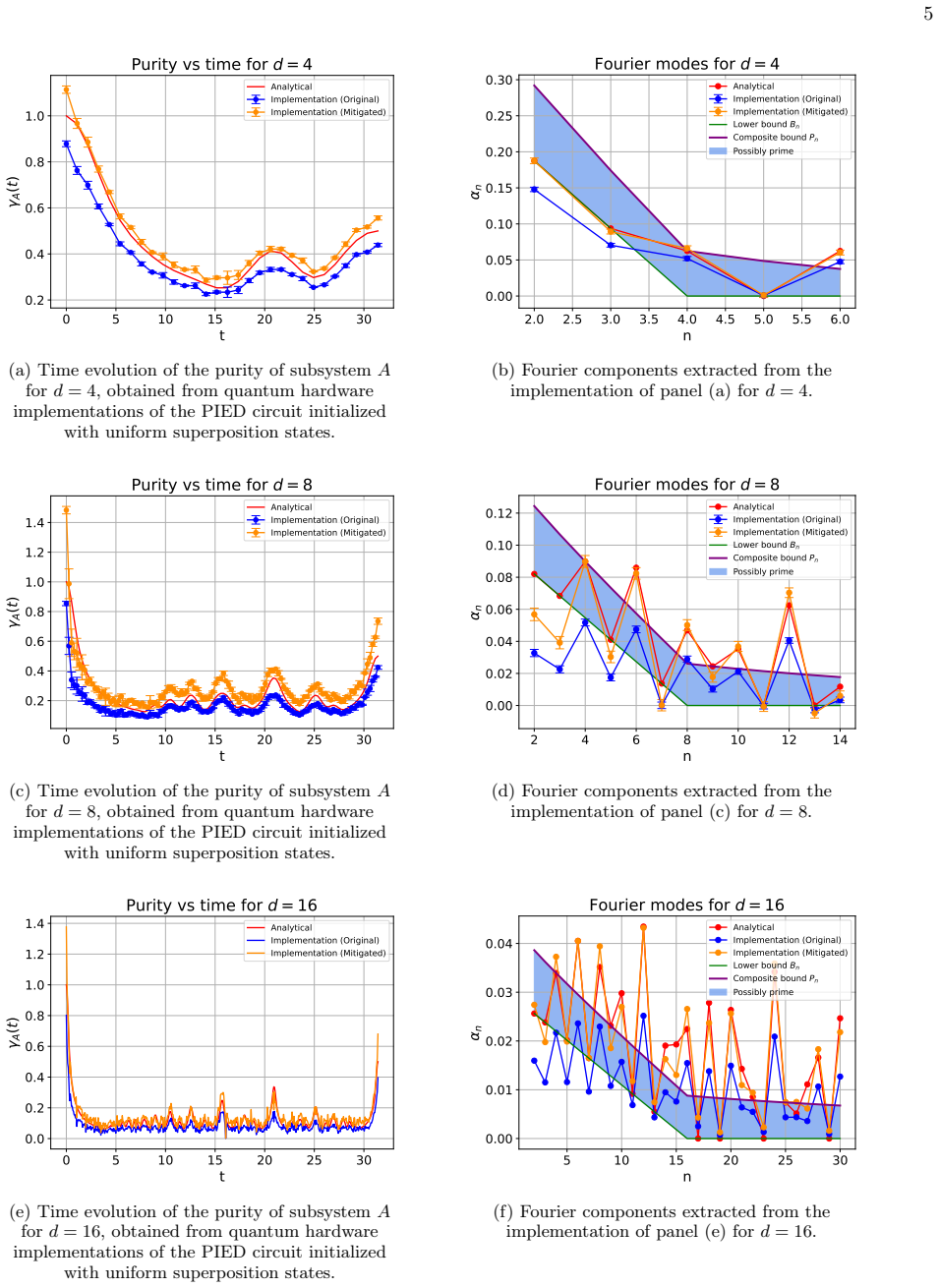
Primality is identified by specific Fourier components in the time evolution of entanglement within a bipartite quantum system on NISQ hardware.
A machine-rendered reading of the paper's core claim, the machinery that carries it, and where it could break.
Core claim
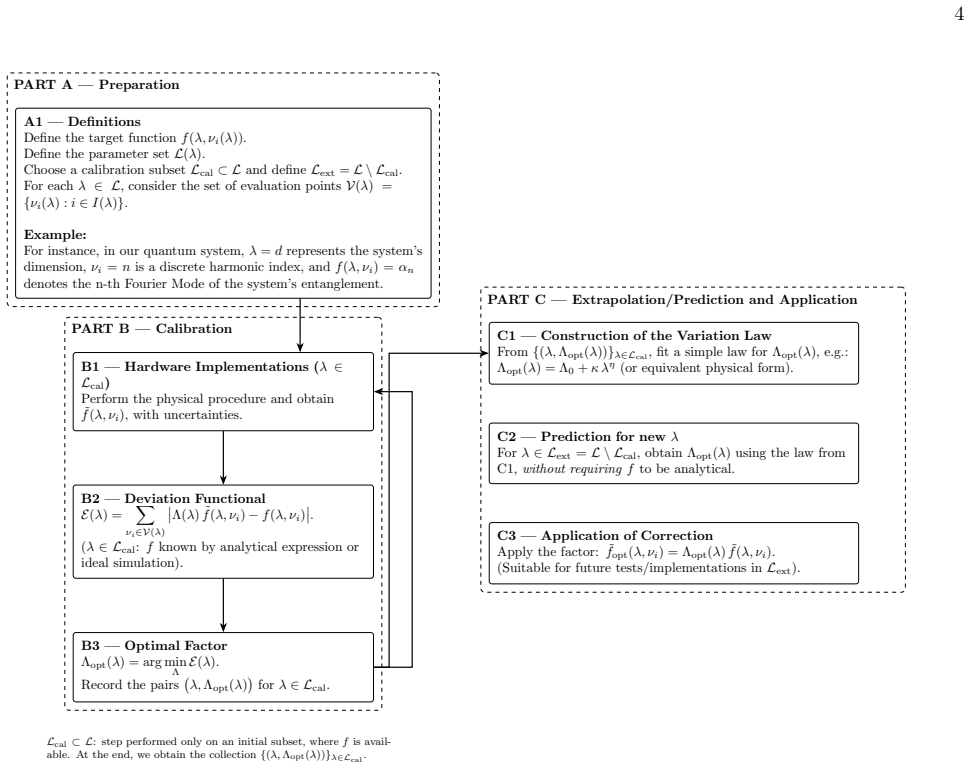
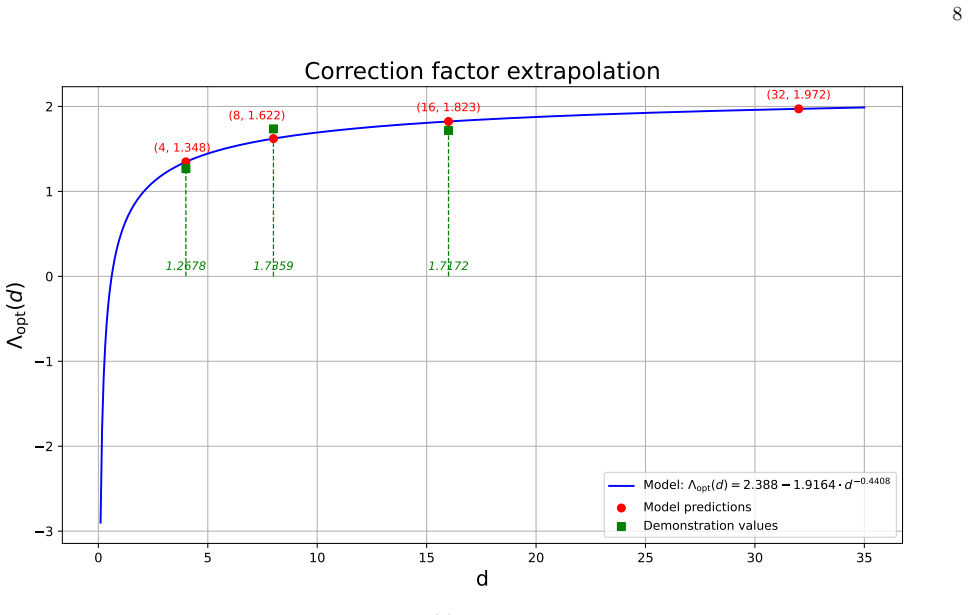
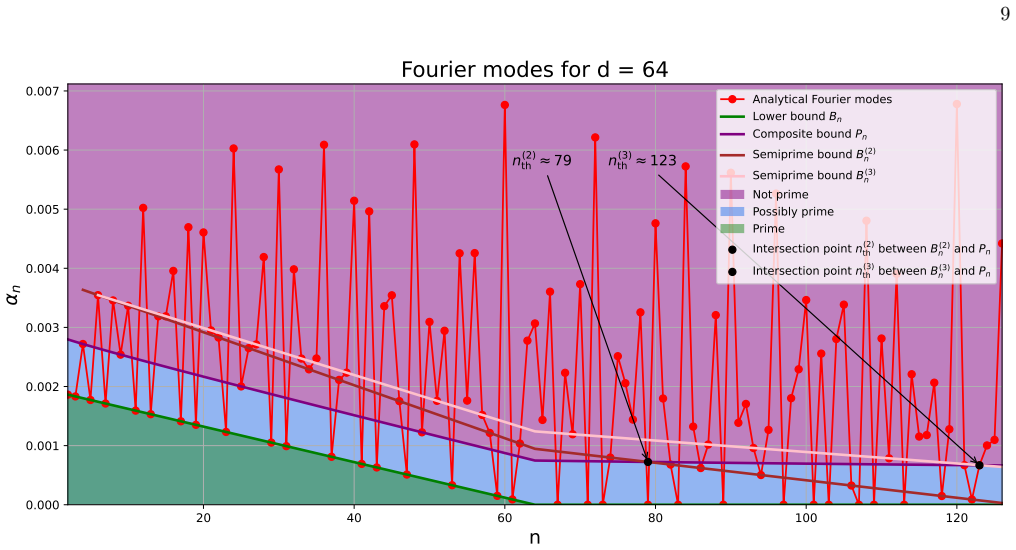
The primality of an integer is linked to specific Fourier components extracted from the time evolution of entanglement in a bipartite quantum system. A new analytical bound for the Fourier modes, derived under an initial uniform superposition, enhances the separation between prime and composite numbers under moderate experimental deviations. Implementation on IBM processors uses a global rescaling noise-mitigation factor calibrated on a subset of circuits and extrapolated across configurations.
What carries the argument
The mapping from primality to selected Fourier modes of bipartite entanglement evolution, reinforced by an analytical bound that assumes uniform superposition and separates primes from composites.
If this is right
- The Fourier-mode distinction remains observable on NISQ hardware provided the new bound holds under the observed noise levels.
- A single calibrated rescaling factor suffices to restore usable separation across multiple circuit configurations.
- The protocol constitutes a step toward number-theoretic applications on current quantum processors rather than purely theoretical demonstrations.
Where Pith is reading between the lines
- Similar dynamical signatures might be sought for other arithmetic properties such as primality of higher-order forms or factorization hints.
- The rescaling calibration procedure could be generalized to adaptive or circuit-specific corrections for larger integers.
- Hybrid workflows that pre-select candidate numbers classically and verify them via this quantum signature become conceivable once the bound is tightened.
Load-bearing premise
The global rescaling factor calibrated on a subset of circuits can be accurately extrapolated across different configurations without introducing systematic bias that erases the prime-composite distinction.
What would settle it
After applying the rescaled protocol to a known composite number, if the relevant Fourier component lies inside the interval the bound reserves for primes, the claimed separation is refuted.
Figures
read the original abstract
We implement a quantum protocol for prime number identification based on entanglement dynamics, using IBM quantum processors. The method links the primality of an integer to specific Fourier components extracted from the time evolution of entanglement in a bipartite quantum system. To mitigate experimental noise, we introduce a noise-mitigation method based on a global rescaling factor, which is calibrated on a subset of circuits and extrapolated across different configurations. Theoretical support is provided by a new analytical bound for the Fourier modes derived assuming an initial uniform superposition state. This new bound enhances the separation between prime and composite numbers under moderate experimental deviations. These results represent a step toward practical number-theoretic applications on noisy intermediate-scale quantum (NISQ) devices.
Editorial analysis
A structured set of objections, weighed in public.
Referee Report
Summary. The manuscript reports an experimental demonstration on IBM quantum processors of a protocol that identifies primes via specific Fourier components extracted from the time evolution of entanglement in a bipartite quantum system initialized in a uniform superposition. It introduces a global rescaling noise-mitigation technique calibrated on a subset of circuits and extrapolated to others, and derives a new analytical bound on the Fourier modes that is claimed to enhance prime-composite separation under moderate noise.
Significance. If the central experimental claims and the validity of the global-rescaling extrapolation hold, the work would constitute a concrete NISQ demonstration linking quantum entanglement dynamics to a number-theoretic task, together with a mitigation method whose analytical support could be of broader interest.
major comments (2)
- [Noise-mitigation technique and experimental results sections] The global rescaling factor is calibrated on a subset of circuits and extrapolated; the analytical bound (derived for the ideal uniform-superposition case) is then invoked to guarantee separation. No data, error bars, or circuit-depth dependence are supplied to show that the same scalar restores the claimed Fourier-mode distinction across different integers and depths. This assumption is load-bearing for the experimental claim.
- [Analytical bound derivation] The abstract states that the bound 'enhances separation under moderate experimental deviations,' yet supplies neither the explicit form of the bound, the derivation steps, nor quantitative comparison (with/without the bound) on the mitigated data. Without these, the theoretical support for the prime-composite distinction cannot be evaluated.
minor comments (2)
- Figure captions and table entries should include the number of shots, the precise definition of the rescaling factor, and the integers tested so that the extrapolation procedure can be reproduced.
- The manuscript should state the initial state actually prepared on the hardware and quantify any deviation from the uniform superposition assumed in the bound.
Simulated Author's Rebuttal
We thank the referee for the detailed and constructive report. We address the two major comments below. Both points identify areas where the manuscript can be strengthened with additional material, and we will incorporate the requested clarifications and supporting data in a revised version.
read point-by-point responses
-
Referee: [Noise-mitigation technique and experimental results sections] The global rescaling factor is calibrated on a subset of circuits and extrapolated; the analytical bound (derived for the ideal uniform-superposition case) is then invoked to guarantee separation. No data, error bars, or circuit-depth dependence are supplied to show that the same scalar restores the claimed Fourier-mode distinction across different integers and depths. This assumption is load-bearing for the experimental claim.
Authors: We agree that explicit validation of the extrapolation is necessary. In the revised manuscript we will add (i) the full set of raw and mitigated Fourier-mode values for all tested integers together with statistical error bars obtained from multiple circuit executions, (ii) a systematic study of the rescaling factor as a function of circuit depth, and (iii) a direct comparison of prime-composite separation before and after rescaling for several depths. These additions will substantiate that the single scalar remains effective across the reported range of integers and depths. revision: yes
-
Referee: [Analytical bound derivation] The abstract states that the bound 'enhances separation under moderate experimental deviations,' yet supplies neither the explicit form of the bound, the derivation steps, nor quantitative comparison (with/without the bound) on the mitigated data. Without these, the theoretical support for the prime-composite distinction cannot be evaluated.
Authors: We will include a dedicated subsection that states the explicit analytical bound, provides the complete derivation from the ideal uniform-superposition initial state, and presents quantitative comparisons of the Fourier-mode separation on the mitigated experimental data both with and without application of the bound. These additions will make the theoretical support fully evaluable. revision: yes
Circularity Check
No significant circularity; derivation remains self-contained
full rationale
The abstract and description present an independent analytical bound on Fourier modes derived from the uniform-superposition initial state, which directly supports prime-composite separation under moderate deviations. The global rescaling is described as a calibrated mitigation technique applied after the fact; nothing indicates that the bound or the primality link is defined in terms of the rescaling factor or reduces to it by construction. No equations, self-citations, or uniqueness theorems are quoted that would force the central result. The experimental demonstration therefore rests on content external to the fitted parameter itself.
Axiom & Free-Parameter Ledger
Reference graph
Works this paper leans on
-
[1]
By analyzing the time evolution of entanglement in a bipartite system, we extracted Fourier components that act as signatures of primality. Within the interval Nd = [2,2(d−1)], PIED consistently identifies prime numbers by associating them with minimal values of the corresponding Fourier modes, while composite numbers yield larger and distinguishable valu...
-
[2]
To see that, we calculate∆(n, k)and ∂∆(n,k) ∂n both atn= 0. We have ∆(0, k) =d 2 −2dk >0,(A14) and ∂∆(n, k) ∂n = 1− 2d k + d n =⇒ ∂∆(0, k) ∂n = +∞.(A15) Considering∆(n, k)is only defined forn≥0, these cal- culations allow us to conclude that the only admissible threshold valuen(k) th is the rightmost root,n(k) + : n(k) th = 4d3 k −6d 2 + 4dk+ 4 q 2 k (d−k...
-
[3]
are the boson annihilation (creation) operators of input modes 0 and 1, respectively. It can be shown by the Baker-Hausdorff lemma that the input and output mode operators relate through ˆa0 = cos(θ/2)ˆa2 −e iϕ sin(θ/2)ˆa3 ˆa1 = cos(θ/2)ˆa3 +e −iϕ sin(θ/2)ˆa2, (C5) whereˆa2,ˆa3 (ˆa† 2,ˆa†
-
[4]
are the annihilation (creation) op- erators of output modes 2 and 3. By acting (C4) on the state|0 0, N1⟩(vacuum on mode0,Nbosons on mode1) one gets (in the Heisenberg picture): |00, N1⟩= (ˆa† 1)N √ N! |00,0 1⟩ = 1√ N! eiϕ sin(θ/2)ˆa† 2 + cos(θ/2)ˆa† 3 N |02,0 3⟩ = 1√ N! NX k=0 N k eiϕ sin(θ/2)ˆa† 2 k cos(θ/2)ˆa† 3 N−k |02,0 3⟩ = 1√ N! NX k=0 N k eiϕ sin(...
-
[5]
G. H. Hardy and E. M. Wright,An Introduction to the Theory of Numbers, 6th ed. (Oxford University Press, Oxford, 2008)
2008
-
[6]
K. Ford, B. Green, S. Konyagin, and T. Tao, Large gaps between consecutive prime numbers, Ann. Math. 183, 935 (2016)
2016
-
[7]
Maynard, The twin prime conjecture, Jpn
J. Maynard, The twin prime conjecture, Jpn. J. Math. 14, 175 (2019)
2019
- [8]
-
[9]
Wu, On smooth gaps between primes using the Maynard–Tao sieve, Integers 25, A44 (2025)
C. Wu, On smooth gaps between primes using the Maynard–Tao sieve, Integers 25, A44 (2025)
2025
-
[10]
P. W. Shor, Polynomial-Time Algorithms for Prime Fac- torization and Discrete Logarithms on a Quantum Com- puter, SIAM J. Comput. 26, 1484 (1997)
1997
-
[11]
Agrawal, N
M. Agrawal, N. Kayal, and N. Saxena, PRIMES is in P, Ann. Math. 160, 781–793 (2004)
2004
-
[12]
J. I. Latorre and G. Sierra, Quantum computation of prime number functions, Quantum Inf. Comput. 14, 577– 588 (2014)
2014
-
[13]
Miller and J
J. Miller and J. M. Lukens, Quantum algorithms for number-theoretic functions, Phys. Rev. A 100, 012301 (2019)
2019
-
[14]
J. I. Latorre and G. Sierra, There is entanglement in the primes, Quantum Inf. Comput. 15, 622–676 (2015)
2015
-
[15]
García-Martín, E
D. García-Martín, E. Ribas, S. Carrazza, J. I. Latorre, and G. Sierra, The prime state and its quantum relatives, Quantum 4, 371 (2020)
2020
-
[16]
Schumayer and D
D. Schumayer and D. A. W. Hutchinson, Colloquium: Physics of the Riemann hypothesis, Rev. Mod. Phys. 83, 307 (2011)
2011
-
[17]
C. E. Creffield and G. Sierra, Finding zeros of the Rie- mann zeta function by periodic driving of cold atoms, Phys. Rev. A 91, 063608 (2015)
2015
-
[18]
V. F. dos Santos and J. Maziero, Using quantum com- puters to identify prime numbers via entanglement dy- namics, Phys. Rev. A 110, 022405 (2024)
2024
-
[19]
A. L. M. Southier, L. F. Santos, P. H. Souto Ribeiro, and A. D. Ribeiro, Identifying primes from entanglement dynamics, Phys. Rev. A 108, 042404 (2023)
2023
-
[20]
Zylberman and F
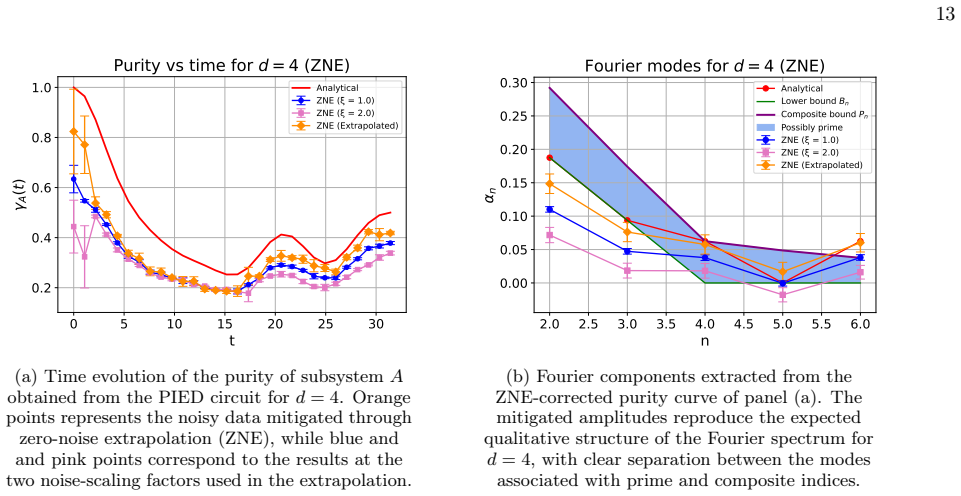
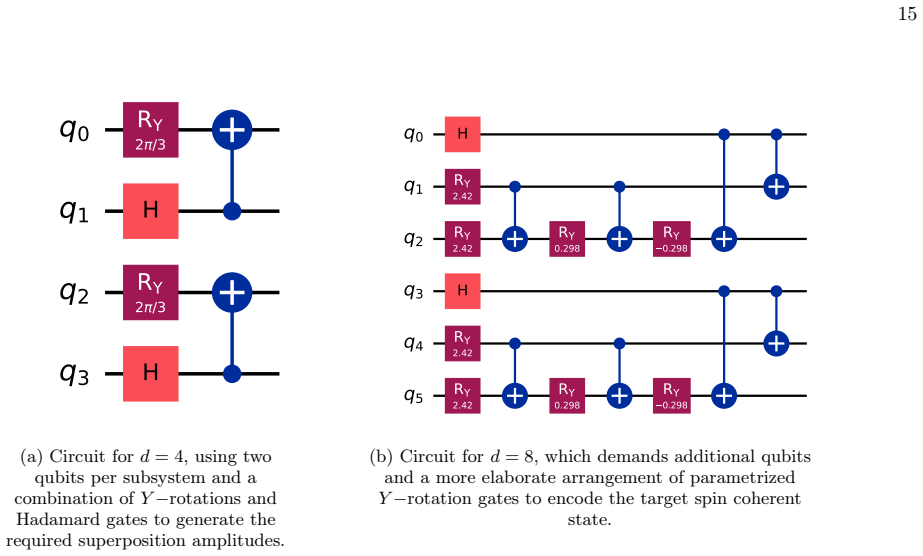
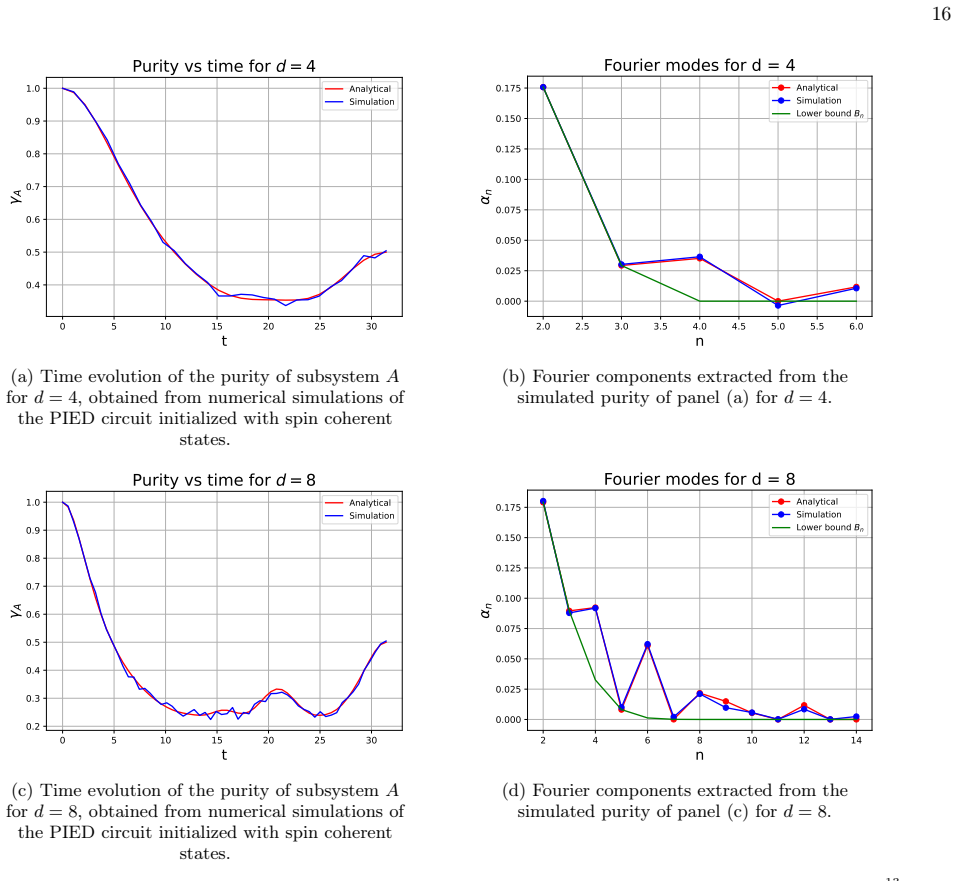
J. Zylberman and F. Debbasch, Efficient quantum state 16 0 5 10 15 20 25 30 t 0.4 0.5 0.6 0.7 0.8 0.9 1.0A Purity vs time for d = 4 Analytical Simulation (a) Time evolution of the purity of subsystemA ford= 4, obtained from numerical simulations of the PIED circuit initialized with spin coherent states. 2.0 2.5 3.0 3.5 4.0 4.5 5.0 5.5 6.0 n 0.000 0.025 0....
2024
-
[21]
M. A. Nielsen and I. L. Chuang,Quantum Computation and Quantum Information, 10th Anniversary Ed. (Cam- bridge University Press, Cambridge, 2010)
2010
-
[22]
Preskill, Quantum computing in the NISQ era and beyond, Quantum 2, 79 (2018)
J. Preskill, Quantum computing in the NISQ era and beyond, Quantum 2, 79 (2018)
2018
-
[23]
Russo and A
V. Russo and A. Mari, Quantum error mitigation by layerwise Richardson extrapolation, Phys. Rev. A 110, 062420 (2024)
2024
-
[24]
Welch, D
J. Welch, D. Greenbaum, S. Mostame, and A. Aspuru- Guzik, Efficient quantum circuits for diagonal unitaries without ancillas, New J. Phys. 16, 033040 (2014)
2014
-
[25]
Pérez and I
E. Pérez and I. García-Mata, Walsh-function approaches to efficient Hamiltonian simulation, Phys. Rev. A 105, 042436 (2022)
2022
-
[26]
V. V. Shende, S. S. Bullock, and I. L. Markov, Synthesis of quantum-logic circuits, IEEE Trans. Comput.-Aided Des. Integr. Circuits Syst. 25, 1000–1010 (2006)
2006
-
[27]
Zhang, K
S. Zhang, K. Huang, and L. Li, Depth-optimized quan- tum circuit synthesis for diagonal unitary operators with asymptotically optimal gate count, Phys. Rev. A 109, 042601 (2024)
2024
-
[28]
Huang, T
X. Huang, T. Kosugi, H. Nishi, and Y.-i. Matsushita, Op- timized Synthesis of Circuits for Diagonal Unitary Ma- trices with Reflection Symmetry, J. Phys. Soc. Jpn. 93, 17 054002 (2024)
2024
-
[29]
A. K. Ekert, C. M. Alves, D. K. L. Oi, M. Horodecki, P. Horodecki, and L. C. Kwek, Direct estimations of linear and nonlinear functionals of a quantum state, Phys. Rev. Lett. 88, 217901 (2002)
2002
-
[30]
Elben, B
A. Elben, B. Vermersch, M. Dalmonte, J. I. Cirac, and P. Zoller, Rényi entropies from randomized measurements, Phys. Rev. Lett. 120, 050406 (2018)
2018
-
[31]
Brydgeset al., Probing entanglement entropy via ran- domized measurements, Science 364, 260–263 (2019)
T. Brydgeset al., Probing entanglement entropy via ran- domized measurements, Science 364, 260–263 (2019)
2019
-
[32]
Huang, R
H.-Y. Huang, R. Kueng, and J. Preskill, Predicting many properties of a quantum system from few measurements, Nat. Phys. 16, 1050 (2020)
2020
-
[33]
Elben, R
A. Elben, R. Kueng, H.-Y. Huang, and P. Zoller, The randomized measurement toolbox, Nat. Rev. Phys. 5, 9 (2023)
2023
-
[34]
K. C. Tan and T. Volkoff, Variational quantum algo- rithms to estimate rank, quantum entropies, fidelity, and Fisher information via purity minimization, Phys. Rev. Research 3, 033251 (2021)
2021
-
[35]
A. Javadi-Abhari et al., Quantum comput- ing with Qiskit, arXiv:2405.08810 (2024). doi: 10.48550/arXiv.2405.08810
work page internal anchor Pith review Pith/arXiv arXiv doi:10.48550/arxiv.2405.08810 2024
-
[36]
Czarnik, M
P. Czarnik, M. McKerns, A. T. Sornborger, and L. Cin- cio, Improving the efficiency of learning-based error mit- igation, Quantum 9, 1727 (2025)
2025
-
[37]
F. T. Arecchi, E. Courtens, R. Gilmore, and H. Thomas, Atomic coherent states in quantum optics, Phys. Rev. A 6, 2211 (1972)
1972
-
[38]
J. M. Radcliffe, Some properties of coherent spin states, J. Phys. A: Gen. Phys. 4, 313 (1971)
1971
-
[39]
Perelomov,Generalized Coherent States and Their Applications, Springer, Berlin (1986)
A. Perelomov,Generalized Coherent States and Their Applications, Springer, Berlin (1986). [36]https://github.com/santosvictorf/ primes-identification-using-qcomputers
1986
-
[40]
LaRose et al., Mitiq: A software package for error mitigation on noisy quantum computers, Quantum 6, 774 (2022)
R. LaRose et al., Mitiq: A software package for error mitigation on noisy quantum computers, Quantum 6, 774 (2022)
2022
-
[41]
Z. Cai, R. Babbush, S. C. Benjamin, S. Endo, W. J. Hug- gins, Y. Li, J. R. McClean and T. E. O’Brien, Quantum error mitigation, Rev. Mod. Phys. 95, 045005 (2023)
2023
-
[42]
S. Endo, S. C. Benjamin, and Y. Li, Practical quantum error mitigation for near-future applications, Phys. Rev. X 8, 031027 (2018)
2018
-
[43]
Temme, S
K. Temme, S. Bravyi, and J. M. Gambetta, Error mitiga- tion for short-depth quantum circuits, Phys. Rev. Lett. 119, 180509 (2017)
2017
-
[44]
Li and S
Y. Li and S. C. Benjamin, Efficient variational quantum simulator incorporating active error minimization, Phys. Rev. X 7, 021050 (2017)
2017
-
[45]
A. He, B. Nachman, W. A. de Jong, and C. W. Bauer, Zero-noise extrapolation for quantum-gate error mitiga- tion with identity insertions, Phys. Rev. A 102, 012426 (2020)
2020
-
[46]
T. Giurgica-Tiron, Y. Hindy, R. LaRose, A. Mari, and W. J. Zeng, Digital zero noise extrapolation for quantum error mitigation, Proc. IEEE Int. Conf. Quantum Com- put. Eng. (QCE), 10.1109/QCE49297.2020.00045 (2020)
-
[47]
Cai, Multi-exponential error extrapolation and com- bining error mitigation techniques for NISQ applications, npj Quantum Inf
Z. Cai, Multi-exponential error extrapolation and com- bining error mitigation techniques for NISQ applications, npj Quantum Inf. 7, 80 (2021)
2021
-
[48]
Czarnik, A
P. Czarnik, A. Arrasmith, P. J. Coles, and M. Cerezo, Error mitigation with Clifford data regression, Quantum 5, 592 (2021)
2021
-
[49]
D. Qin, Y. Chen, and Y. Li, Error statistics and scalabil- ity of quantum error-mitigation formulas, npj Quantum Inf. 9, 35 (2023)
2023
-
[50]
R. A. Campos, B. E. A. Saleh, and M. C. Teich, Quantum-mechanical lossless beam splitter: SU(2) sym- metry and photon statistics, Phys. Rev. A 40, 1371 (1989)
1989
-
[51]
M. S. Kim, W. Son, V. Bužek, and P. L. Knight, Entan- glement by a beam splitter: Nonclassicality as a prereq- uisite for entanglement, Phys. Rev. A 65, 032323 (2002)
2002
-
[52]
Schwinger, On angular momentum, Dover Books on Physics, ISBN 978-0486788104 (2015)
J. Schwinger, On angular momentum, Dover Books on Physics, ISBN 978-0486788104 (2015)
2015
-
[53]
P. C. Encinar, A. Agustí, and C. Sabín, Digital quan- tum simulation of beam splitters and squeezing with IBM quantum computers, Phys. Rev. A 104, 052609 (2021)
2021
-
[54]
Sabín, Digital quantum simulation of linear and non- linearopticalelements, QuantumRep.2, 208–220(2020)
C. Sabín, Digital quantum simulation of linear and non- linearopticalelements, QuantumRep.2, 208–220(2020)
2020
-
[55]
N. K. Mohan, R. Bhowmick, D. Kumar, and R. Chaurasiya, Digital quantum simulations of Hong–Ou–Mandel interference, Phys. Scr. 100, 035118 (2025)
2025
discussion (0)
Sign in with ORCID, Apple, or X to comment. Anyone can read and Pith papers without signing in.