Generalized Software Product Line Extraction
Pith reviewed 2026-06-29 10:33 UTC · model grok-4.3
The pith
A workbench-agnostic protocol extracts feature models from software artifacts using lightweight atoms.
A machine-rendered reading of the paper's core claim, the machinery that carries it, and where it could break.
Core claim
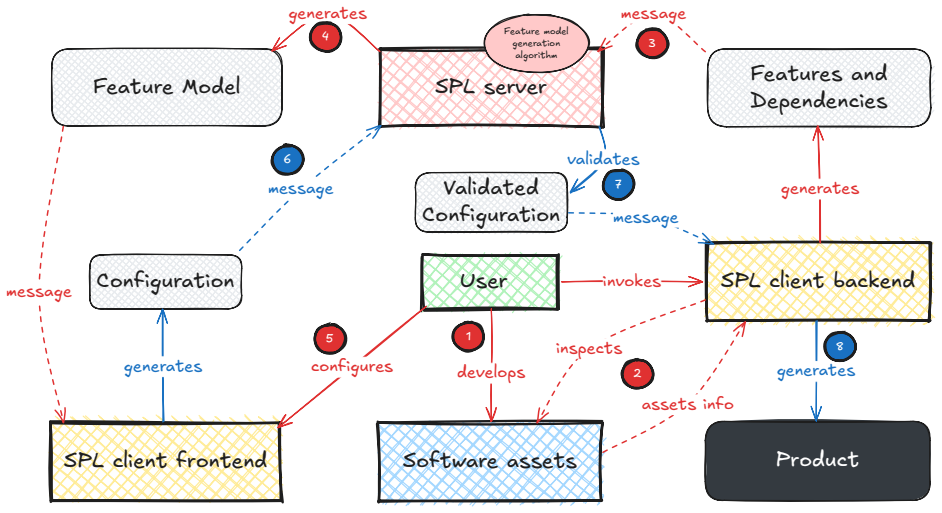
The protocol follows a bottom-up approach based on lightweight dependency units called atoms, and organizes the extraction and configuration process around an SPL server (workbench-independent) and an SPL client with a workbench-specific backend and a generic frontend. The protocol makes few assumptions on the underlying software artifacts and is therefore applicable to varied SPLs. The applicability of this approach is presented through a prototypical implementation of the architecture in which several subsystems interact and can be swapped freely without affecting the others, with focus on language product lines while preserving workbench-agnosticism.
What carries the argument
Lightweight dependency units called atoms that capture feature dependencies, organized through a client-server architecture with an agnostic SPL server and workbench-specific client backends.
If this is right
- Extraction and configuration steps can be reused across different IDEs and languages.
- Software product lines can be derived independently of the original development environment.
- The same server can support multiple client backends for different technological spaces.
- Subsystems in the architecture can be replaced without changing the overall protocol.
Where Pith is reading between the lines
- The method could be applied to extract product lines from legacy systems where features are not explicitly declared.
- Atoms might enable mixing components written in unrelated languages within one product line.
- The protocol could be tested on an SPL whose artifacts use a composer not represented in the Neverlang example.
Load-bearing premise
That atoms can be defined and extracted in a way that captures the necessary feature dependencies without requiring strong assumptions on the technological space or specific composer mechanisms.
What would settle it
A case where atoms cannot be identified for a given SPL without embedding assumptions about its particular language or composer.
Figures
read the original abstract
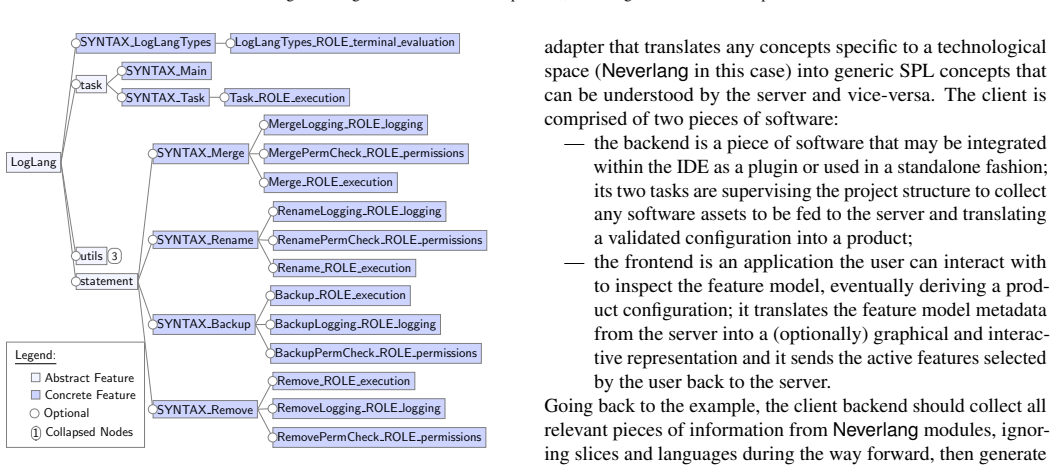
Software product line (SPL) engineering has been successfully applied to software development by obtaining software systems as compositions of modular features. Existing approaches to SPL engineering, however, are typically bound to a specific technological space (such as, a programming language and a composer) and integrated development environment (IDE), and rely on extraction mechanisms that make strong assumptions on the underlying technological space. This tight coupling hinders reuse, evolution, and adoption of heterogeneous development environments. We propose a general, workbench-agnostic protocol for extracting feature models from existing software artifacts and for configuring and deriving software products. The protocol follows a bottom-up approach based on lightweight dependency units called "atoms", and organizes the extraction and configuration process around an SPL server (workbench-independent) and an SPL client with a workbench-specific backend and a generic frontend. The protocol makes few assumptions on the underlying software artifacts and is therefore applicable to varied SPLs. The applicability of this approach is presented through a prototypical implementation of the architecture in which several subsystems interact and can be swapped freely without affecting the others. In particular, we focus on the application of such a protocol in the context of language product lines (LPLs), demonstrating its applicability to concrete scenarios while preserving workbench-agnosticism. From bottom to top, the implementation comprises: Neverlang language artifacts, a Java SPL client backend, an agnostic and reusable SPL server written in Go and Prolog, and a JavaScript SPL client frontend.
Editorial analysis
A structured set of objections, weighed in public.
Referee Report
Summary. The paper proposes a general, workbench-agnostic protocol for extracting feature models from existing software artifacts and for configuring/deriving products. It uses a bottom-up approach based on lightweight dependency units called 'atoms', organized around an SPL server (implemented in Go and Prolog) that is independent of any specific workbench and SPL clients that have workbench-specific backends but generic frontends. The protocol is claimed to make few assumptions on artifacts and thus apply to varied SPLs; applicability is shown via a prototype focused on language product lines (LPLs) using Neverlang artifacts, with swappable subsystems.
Significance. If the atom-based extraction can be shown to work without reintroducing technology-specific assumptions, the client-server separation and reusable server could enable broader reuse and evolution of SPL engineering across heterogeneous environments. The architecture's modularity (server in Go/Prolog, swappable clients) is a concrete strength that supports the workbench-agnostic claim.
major comments (1)
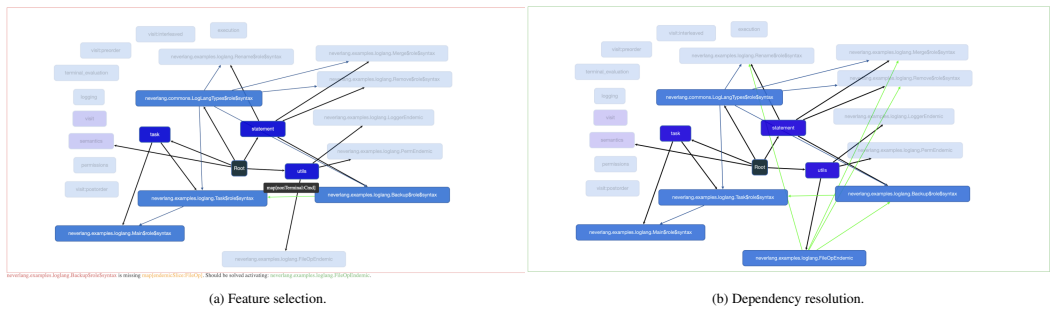
- [Abstract] Abstract: the central claim that the protocol 'makes few assumptions on the underlying software artifacts and is therefore applicable to varied SPLs' is load-bearing for the contribution, yet the only concrete extraction and dependency handling described uses Neverlang language artifacts; no argument, mapping, or example is supplied showing how atoms and their dependency relations would be identified for a non-language SPL (e.g., C preprocessor-based) without reintroducing the technological assumptions the protocol claims to avoid.
Simulated Author's Rebuttal
We thank the referee for the constructive review and for highlighting the architecture's modularity as a potential strength. We address the single major comment below.
read point-by-point responses
-
Referee: [Abstract] Abstract: the central claim that the protocol 'makes few assumptions on the underlying software artifacts and is therefore applicable to varied SPLs' is load-bearing for the contribution, yet the only concrete extraction and dependency handling described uses Neverlang language artifacts; no argument, mapping, or example is supplied showing how atoms and their dependency relations would be identified for a non-language SPL (e.g., C preprocessor-based) without reintroducing the technological assumptions the protocol claims to avoid.
Authors: We agree with the observation. The manuscript's concrete extraction logic and atom identification are demonstrated exclusively through Neverlang language artifacts, while the core protocol (atoms as minimal dependency units, server-side resolution in Prolog, and client backends) is presented abstractly. No explicit mapping or worked example is supplied for a non-language SPL such as one based on the C preprocessor. We will revise the paper to add a dedicated subsection that sketches how atoms and their relations could be extracted from preprocessor directives (or equivalent artifacts) while keeping the protocol-level assumptions minimal and technology-independent; the revision will also clarify the separation between the general protocol and the workbench-specific extraction performed by clients. revision: yes
Circularity Check
No circularity: architectural protocol proposal with no equations, fits, or self-referential derivations
full rationale
The paper presents a new workbench-agnostic extraction protocol organized around atoms, an SPL server, and client backends. No equations, parameter fitting, or predictive derivations appear in the provided text. The generality claim rests on the stated design property that the protocol 'makes few assumptions on the underlying software artifacts,' which is an architectural assertion rather than a reduction of an output to its own inputs by construction. No self-citations are invoked as load-bearing uniqueness theorems, and the single Neverlang example is presented as a demonstration, not as a fitted input renamed as a prediction. The derivation chain is therefore self-contained as a proposal of structure and interfaces.
Axiom & Free-Parameter Ledger
axioms (1)
- domain assumption Lightweight dependency units called atoms can capture necessary feature dependencies without strong assumptions on the underlying technological space.
invented entities (1)
-
atoms
no independent evidence
Reference graph
Works this paper leans on
-
[1]
Mathieu Acher, Anthony Cleve, Philippe Collet, Philippe Merle, Laurence Duchien, and Philippe Lahire. 2014. Ex- traction and Evolution of Architectural Variability Models in Plugin-Based Systems.Software and Systems Modeling 13, 4 (July 2014), 1367–1394
2014
-
[2]
Aho, Ravi Sethi, and Jeffrey D
Alfred V . Aho, Ravi Sethi, and Jeffrey D. Ullman. 1986. Compilers: Principles, Techniques, and Tools. Addison Wesley, Reading, Massachusetts
1986
-
[3]
Sven Apel and Christian Kästner. 2009. An Overview of Feature-Oriented Software Development.Journal of Object Technology8, 5 (July 2009), 49–84
2009
-
[4]
Sven Apel, Alexander von Thein, Philipp Wendler, Armin Größlinger, and Firk Beyer. 2013. Strategies for Product- Line Verification: Case Studies and Experiments. InPro- ceedings of the 35th International Conference on Software Engineering (ICSE’13), Betty H. Chang and Klaus Pohl (Eds.). IEEE, San Francisco, CA, USA, 482–491
2013
-
[5]
Wesley K. G. Assunção, Roberto E. Lopez-Herrejon, Lukas Linsbauer, Silvia R. Vergilio, and Alexander Egyed
-
[6]
2017), 2972–3016
Reengineering Legacy Applications into Software Product Lines: A Systematic Mapping.Empirical Software Engineering22, 6 (Feb. 2017), 2972–3016
2017
-
[7]
Don Batory. 2005. Feature Models, Grammars, and Propo- sitional Formulas. InProceedings of the 4th International Conference on Software Product-Line (SPLC’05) (LNCS 3714), Henk Obbink and Klaus Pohl (Eds.). Springer, Rennes, France, 7–20. 14
2005
-
[8]
Don Batory, Jacob Neal Sarvela, and Axel Rauschmayer
-
[9]
Scaling Step-Wise Refinement.IEEE Transactions on Software Engineering30, 6 (June 2004), 355–371
2004
-
[10]
ter Beek, Ferruccio Damiani, Michael Lien- hardt, Franco Mazzanti, and Luca Paolini
Maurice H. ter Beek, Ferruccio Damiani, Michael Lien- hardt, Franco Mazzanti, and Luca Paolini. 2019. Static Analysis of Featured Transition Systems. InProceedings of the 23rd International Systems and Software Product Line Conference (SPLC’19), Laurence Duchien and Thomas Thüm (Eds.). ACM, Paris, France, 39–51
2019
-
[11]
David Benavides, Sergio Segura, and Antonio Ruiz-Cortés
-
[12]
2010), 615–636
Automated Analysis of Feature Models 20 Years Later: A Literature Review.Information Systems35, 6 (Sept. 2010), 615–636
2010
-
[13]
Lorenzo Bettini. 2016. Implementing Type Systems for the IDE with Xsemantics.Journal of Logical and Algebraic Methods in Programming85, 5 (Aug. 2016), 655–680
2016
-
[14]
Lorenzo Bettini and Pierluigi Crescenzi. 2015. An Eclipse IDE for Teaching Java--. InProceedings of 10th Interna- tional Conference on Software Technology (ICSOFT’15) (Communications in Computer and Information Science 586), Pascal Lorenz, Jorge Cardoso, Leszek A. Maciaszek, and Marten van Sinderen (Eds.). Springer, Colmar, France, 63–78
2015
-
[15]
Federico Bruzzone and Walter Cazzola
-
[16]
Meta-Monomorphizing Specializations
Meta-Monomorphizing Specializations. arXiv:2602.12973 [cs.PL] https://arxiv.org/ abs/2602.12973
work page internal anchor Pith review Pith/arXiv arXiv
-
[18]
Code Less to Code More: Streamlining Language Server Protocol and Type System Development for Lan- guage Families.Journal of Systems and Software231 (Jan. 2026). doi:10.1016/j.jss.2025.112554
-
[19]
Federico Bruzzone, Walter Cazzola, and Luca Favalli
-
[20]
arXiv:2602.03777 [cs.PL] https://arxiv
From Separate Compilation to Sound Language Composition. arXiv:2602.03777 [cs.PL] https://arxiv. org/abs/2602.03777
-
[21]
Federico Bruzzone, Walter Cazzola, and Luca Favini
-
[22]
arXiv:2601.16008 [cs.PL] https://arxiv.org/abs/2601.16008
Prioritizing Configuration Relevance via Compiler- Based Refined Feature Ranking. arXiv:2601.16008 [cs.PL] https://arxiv.org/abs/2601.16008
-
[23]
Hendrick Bünder and Herbert Kuchen. 2019. Towards Multi-editor Support for Domain-Specific Languages Uti- lizing the Language Server Protocol. InProceedings of the 7th International Conference on Model-Driven Engi- neering and Software Development (MODELSWARD’19), Slimane Hammoudi, Luís Ferreira Pires, and Bran Seli ´c (Eds.). Springer, Prague, Czech Repu...
2019
-
[24]
Bruno B. P. Cafeo, Elder Cirilo, Alessandro Garcia, Fran- cisco Dantas, and Jaejoon Lee. 2016. Feature Dependen- cies as Change Propagators: An Exploratory Study of Soft- ware Product Lines.Information and Software Technology 69 (Jan. 2016), 37–49
2016
-
[25]
Walter Cazzola. 2012. Domain-Specific Languages in Few Steps: The Neverlang Approach. InProceedings of the 11th International Conference on Software Composi- tion (SC’12) (Lecture Notes in Computer Science 7306), Thomas Gschwind, Flavio De Paoli, V olker Gruhn, and Matthias Book (Eds.). Springer, Prague, Czech Republic, 162–177
2012
-
[26]
Walter Cazzola and Luca Favalli. 2022. Towards a Recipe for Language Decomposition: Quality Assessment of Lan- guage Product Lines.Empirical Software Engineering27, 4 (April 2022). doi:10.1007/s10664-021-10074-6
-
[27]
Walter Cazzola and Luca Favalli. 2023. The Language Mutation Problem: Leveraging Language Product Lines for Mutation Testing of Interpreters.Journal of Systems and Software195 (Jan. 2023). doi: 10.1016/j.jss.2022. 111533
-
[28]
Walter Cazzola and Diego Mathias Olivares. 2016. Grad- ually Learning Programming Supported by a Growable Programming Language.IEEE Transactions on Emerg- ing Topics in Computing4, 3 (Sept. 2016), 404–415. doi:10.1109/TETC.2015.2446192 Special Issue on Emerg- ing Trends in Education
-
[29]
2000.Java Card Technology for Smart Cards: Architecture and Programmer’s Guide
Zhiqun Chen. 2000.Java Card Technology for Smart Cards: Architecture and Programmer’s Guide. Addison- Wesley, Reading, MA, USA
2000
-
[30]
Alain Colmerauer and Philippe Roussel. 1996. The Birth of Prolog. InHistory of Programming Languages, Thomas J. Bergin and Richard G. Gibson (Eds.). ACM, Chapter VII, 331–367
1996
-
[31]
Crane and Juergen Dingel
Michelle L. Crane and Juergen Dingel. 2005. UML vs. Classical vs. Rhapsody Statecharts: Not All Models Are Created Equal. InProceedings of the 8th International Conference on Model Driven Engineering Languages and Systems (MoDELS’05) (Lecture Notes in Computer Science 3713), Lionel Briand and Clay Williams (Eds.). Springer, Montego Bay, Jamaica, 97–112
2005
-
[32]
Krzysztof Czarnecki and Andrzej W ˛ asowski. 2007. Fea- ture Diagrams and Logics: There and Back Again. InPro- ceedings of the 11th International Software Product Line Conference (SPLC’07), Tomoji Kishi and Dirk Muthig (Eds.). IEEE, Kyoto, Japan, 23–34
2007
-
[33]
Thomas Degueule, Benoît Combemale, Arnaud Blouin, Olivier Barais, and Jean-Marc Jézéquel. 2015. Melange: a Meta-Language for Modular and Reusable Development of DSLs. InProceedings of the 8th International Confer- ence on Software Language Engineering (SLE’15), Davide Di Ruscio and Markus Völter (Eds.). ACM, Pittsburgh, PA, USA, 25–36
2015
-
[34]
Florian Drux, Nico Jansen, and Bernhard Rumpe. 2022. A Catalog of Design Patterns for Compositional Language Engineering.Journal of Object Technology21, 4 (Oct. 15 2022), 4:1–13. doi: 10.5381/jot.2022.21.4.a4 Special Issue dedicated to Antonio Vallecillo on his 60th Birthday
-
[35]
Sebastian Erdweg, Tillmann Rendel, Christian Kästner, and Klaus Ostermann. 2011. SugarJ: Library-Based Syn- tactic Language extensibility. InProceedings of the 26th ACM SIGPLAN Conference on Object-Oriented Program- ming (OOPSLA’11). ACM, Portland, Oregon, USA, 391– 406
2011
-
[36]
Luca Favalli, Thomas Kühn, and Walter Cazzola. 2020. Neverlang and FeatureIDE Just Married: Integrated Lan- guage Product Line Development Environment. InPro- ceedings of the 24th International Software Product Line Conference (SPLC’20), Philippe Collet and Sarah Nadi (Eds.). ACM, Montréal, Canada, 285–295
2020
-
[37]
Haslinger, Roberto E
Elisabeth N. Haslinger, Roberto E. Lopez-Herrejon, and Alexander Egyed. 2013. On Extracting Feature Models from Sets of Valid Feature Combinations. InProceedings of the 16th International Conference on Fundamental Ap- proaches to Software Engineering (FASE’13) (LNCS 7793), Vittorio Cortellessa and Daniel Varrò (Eds.). Springer, Rome, Italy, 53–67
2013
-
[38]
1968.Logical Writings
Jacques Herbrand. 1968.Logical Writings. Springer. «Écrits Logiques» translated in English by Jean van Hei- jenoort
1968
-
[39]
Kang, Sholom G
Kyo C. Kang, Sholom G. Cohen, James A. Hess, William E. Novak, and A. Spencer Peterson. 1990.Feature-Oriented Domain Analysis (FODA) Feasibility Study. Technical Report CMU/SEI-90-TR-21. Carnegie Mellon University, Pittsburgh, Pennsylvania, USA
1990
-
[40]
Lennart C. L. Kats, Eelco Visser, and Guido Wachsmuth
-
[41]
InProceedings of ACM Conference on New Ideas in Programming and Reflections on Software (Onward! 2010)
Pure and Declarative Syntax Definition: Paradise Lost and Regained. InProceedings of ACM Conference on New Ideas in Programming and Reflections on Software (Onward! 2010). ACM, Reno-Tahoe, Nevada, USA
2010
-
[42]
Gregor Kiczales, Erik Hilsdale, Jim Hugunin, Mik Ker- sten, JeffPalm, and Bill Griswold. 2001. An Overview of AspectJ. InProceedings of the 15th European Conference on Object-Oriented Programming (ECOOP’01) (LNCS 2072), Jørgen Lindskov Knudsen (Ed.). Springer-Verlag, Budapest, Hungary, 327–353
2001
-
[43]
Paul Klint, Tijs van der Storm, and Jurgen Vinju. 2009. EASY Meta-Programming with Rascal. InProceedings of the International Summer School on Generative and Transformational Techniques in Software Engineering III (GTTSE’09) (Lecture Notes in Computer Science 6491), João M. Fernandes, Ralf Lämmel, Joost Visser, and João Saraiva (Eds.). Springer, Braga, Po...
2009
-
[44]
Holger Krahn, Bernhard Rumpe, and Steven Völkel. 2010. MontiCore: A Framework for Compositional Development of Domain Specific Languages.International Journal on Software Tools for Technology Transfer12, 5 (Sept. 2010), 353–372
2010
-
[45]
Charles W. Krueger. 2001. Easing the Transition to Soft- ware Mass Customization. InProceedings of the 1st Inter- national Workshop on Software Product-Family Engineer- ing (PFE’01) (Lecture Notes in Computer Science 2290), F. van der Linden (Ed.). Springer, Bilbao, Spain, 282–293
2001
-
[46]
Thomas Kühn and Walter Cazzola. 2016. Apples and Or- anges: Comparing Top-Down and Bottom-Up Language Product Lines. InProceedings of the 20th International Software Product Line Conference (SPLC’16), Rick Ra- biser and Bing Xie (Eds.). ACM, Beijing, China, 50–59
2016
-
[47]
Thomas Kühn, Walter Cazzola, and Diego Mathias Oli- vares. 2015. Choosy and Picky: Configuration of Language Product Lines. InProceedings of the 19th International Software Product Line Conference (SPLC’15), Goetz Bot- terweck and Jules White (Eds.). ACM, Nashville, TN, USA, 71–80
2015
-
[48]
Bissyandé, Jacques Klein, and Yves le Traon
Jabier Martinez, Tewfik Ziadi, Tegawendé F. Bissyandé, Jacques Klein, and Yves le Traon. 2015. Automating the Extraction of Model-Based Software Product Lines from Model Variants. InProceedings of the 30th IEEE/ACM In- ternational Conference on Automated Software Engineer- ing (ASE’15), Myra Cohen, Lars Grunske, and Michael Whalen (Eds.). IEEE, Lincoln, N...
2015
-
[49]
Matsakis
Nicholas D. Matsakis. 2018. Maximally Min- imal Specialization: Always Applicable impls. Blog Post. https://smallcultfollowing. com/babysteps/blog/2018/02/09/ maximally-minimal-specialization-always-applicable-impls/
2018
-
[50]
Marcilio Mendonca, Moises Branco, and Donald Cowan
-
[51]
InCompanion Proceedings of the 24th Conference on Object-Oriented Programming Systems Languages and Applications (Companion OOPSLA’09)
S.P.L.O.T.—Software Product Lines Online Tools. InCompanion Proceedings of the 24th Conference on Object-Oriented Programming Systems Languages and Applications (Companion OOPSLA’09). ACM, Orlando, FL, USA, 761–762
-
[52]
Pierre M. Nugues. 2014.An Introduction to Language Processing with Perl and Prolog(second ed.). Springer
2014
-
[53]
Jérôme Pfeiffer and Andreas Wortmann. 2021. Towards the Black-Box Aggregation of Language Components. In Proceedings of the 3rd International Workshop on Mod- elling Language Engineering (MLE’21), Federico Cic- cozzi, Thomas Degueule, Romina Eramo, and Sébastien Gérard (Eds.). IEEE, Fukuoka, Japan, 576–585
2021
-
[54]
Jérôme Pfeiffer and Andreas Wortmann. 2023. A Low- Code Platform for Systematic Component-Oriented Lan- guage Composition. InProceedings of the 16th Inter- national Conference on Software Language Engineering (SLE’23), Thomas Degueuele and Elizabeth Scott (Eds.). ACM, Cascais, Portugal, 208–213
2023
-
[55]
van der Linden
Klaus Pohl, Klaus Böckle, and Frank J. van der Linden. 2005.Software Product Line Engineering: Foundations, Principles and Techniques. Springer. 16
2005
-
[56]
Alan Robinson
J. Alan Robinson. 1965. A Machine-Oriented Logic Based on the Resolution Principle.J. ACM12, 1 (Jan. 1965), 23–41
1965
-
[57]
Ina Schaefer, Lorenzo Bettini, Viviana Bono, Ferruccio Damiani, and Nico Tanzarella. 2010. Delta-Oriented Pro- gramming of Software Product Lines. InProceedings of the 14th International Software Product Line Conference (SPLC’10) (Lecture Notes on Computer Science 6287), Jan Bosch and Jaejoon Lee (Eds.). Springer, Jeju Island, South Korea, 77–91
2010
-
[58]
Baliga, Jonathan T
Paul Shannon, Andrew Markiel, Owen Ozier, Nitin S. Baliga, Jonathan T. Wang, Daniel Ramage, Nada Amin, Benno Schwikowski, and Trey Ideker. 2003. Cytoscape: A Software Environment for Integrated Models of Biomolec- ular Interaction Networks.Genome Research13, 11 (Nov. 2003), 2498–2504
2003
-
[59]
Steven She, Rafael Lotufo, Thorsten Berger, Andrzej W˛ asowski, and Krzysztof Czarnecki. 2011. Reverse Engi- neering Feature Models. InProceedings of the 33rd Inter- national Conference on Software Engineering (ICSE’11), Harald Gall and Nenad Medvidovi´c (Eds.). IEEE, Waikiki, Honolulu, Hawaii, 461–470
2011
-
[60]
Thomas Thüm, Christian Kästner, Fabian Benduhn, Jens Meinicke, Gunter Saake, and Thomas Leich. 2014. Fea- tureIDE: An Extensible Framework for Feature-Oriented Software Development.Science of Computer Program- ming79, 1 (Jan. 2014), 70–85
2014
-
[61]
Laurence Tratt. 2008. Domain Specific Language Imple- mentation Via Compile-Time Meta-Programming.ACM Transactions on Programming Languages and Systems30, 6 (Oct. 2008), 31:1–31:40
2008
-
[62]
Aaron Turon. 2017. Shipping Specialization: A Story of Soundness. Blog Post. https://aturon.github.io/ blog/2017/07/08/lifetime-dispatch/
2017
-
[63]
Edoardo Vacchi and Walter Cazzola. 2015. Neverlang: A Framework for Feature-Oriented Language Development. Computer Languages, Systems&Structures43, 3 (Oct. 2015), 1–40. doi:10.1016/j.cl.2015.02.001
-
[64]
Edoardo Vacchi, Walter Cazzola, Benoît Combemale, and Mathieu Acher. 2014. Automating Variability Model In- ference for Component-Based Language Implementations. InProceedings of the 18th International Software Product Line Conference (SPLC’14), Patrick Heymans and Julia Rubin (Eds.). ACM, Florence, Italy, 167–176
2014
-
[65]
Edoardo Vacchi, Walter Cazzola, Suresh Pillay, and Benoît Combemale. 2013. Variability Support in Domain-Specific Language Development. InProceedings of 6 th Interna- tional Conference on Software Language Engineering (SLE’13) (Lecture Notes on Computer Science 8225), Mar- tin Erwig, Richard F. Paige, and Eric Van Wyk (Eds.). Springer, Indianapolis, USA, 76–95
2013
-
[66]
Markus Völter, Daniel Ratiu, Bernhard Schätz, and Bernd Kolb. 2012. mbeddr: an Extensible C-Based Programming Language and IDE for Embedded Systems. InProceedings of the 3rd Annual Conference on Systems, Programming, and Applications: Software for Humanity (SPLASH’12). ACM, Tucson, AZ, USA, 121–140
2012
-
[67]
Wachsmuth, Gabriël D
Guido H. Wachsmuth, Gabriël D. P. Konat, and Eelco Visser. 2014. Language Design with the Spoofax Language Workbench.IEEE Software31, 5 (Sept./Oct. 2014), 35– 43
2014
-
[68]
Huilin Ye and Hanchang Liu. 2005. Approach to Modelling Feature Variability and Dependencies in Software Product Lines.IEE Proceedings—Software152, 3 (June 2005), 101–109. 17
2005
discussion (0)
Sign in with ORCID, Apple, or X to comment. Anyone can read and Pith papers without signing in.