Universal response of Rydberg manifolds to standing light waves from the microwave to the X-ray regime
Pith reviewed 2026-06-29 09:03 UTC · model grok-4.3
The pith
Standing light waves organize Rydberg atom electron density into five regimes across microwave to X-ray wavelengths, with transitions set by critical wavelengths that hold for wide ranges of principal quantum number.
A machine-rendered reading of the paper's core claim, the machinery that carries it, and where it could break.
Core claim
Standing light waves structure the electronic density of a Rydberg atom in a rich but surprisingly systematic fashion. These systematics are nearly universal across a large range of principal quantum numbers n. Varying the wavelength of the standing light over several orders of magnitude reveals five qualitatively different regimes whose transitions are given by specific critical wavelengths. The bandwidth of the lattice spectrum, shown in the energy difference between states at the edges of the degeneracy-lifted n-manifolds, together with the organization of the electron density in coordinate and momentum space, rationalizes the observed systematics. An experimental setup is proposed to mea
What carries the argument
The lattice spectrum bandwidth and the organization of electron density in coordinate and momentum space, used to identify and explain the five regimes separated by critical wavelengths.
If this is right
- The response remains nearly universal for a large range of principal quantum numbers n.
- Five regimes exist with transitions fixed by specific critical wavelengths.
- The lattice spectrum bandwidth sets the energy spread between states on the edges of each lifted n-manifold.
- Electron density arranges in distinct patterns in coordinate and momentum space within each regime.
- An experimental setup can directly observe the features predicted for each regime.
Where Pith is reading between the lines
- The critical wavelengths could serve as practical guides for choosing light frequencies when manipulating Rydberg states in different spectral ranges.
- The universality across n might reduce the need for case-by-case calculations when modeling Rydberg atoms in periodic light fields.
- Similar regime analysis could apply to other atoms or molecules exposed to standing waves, provided the underlying interaction model holds.
Load-bearing premise
The underlying model of the atom-light interaction captures the electron density organization and lattice spectrum bandwidth across all regimes without higher-order effects or n-dependent corrections.
What would settle it
Measurement of the energy spectrum or electron density distribution of a Rydberg atom in a standing wave at wavelengths near the predicted critical values, checking whether the regime transitions and bandwidth changes match the five-regime description.
Figures

read the original abstract
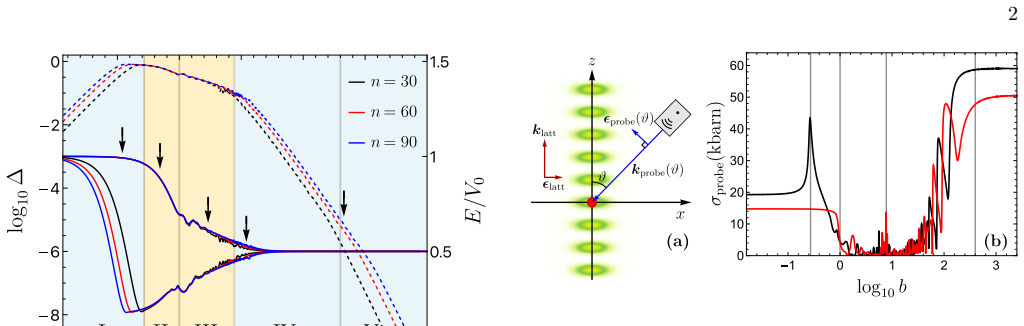
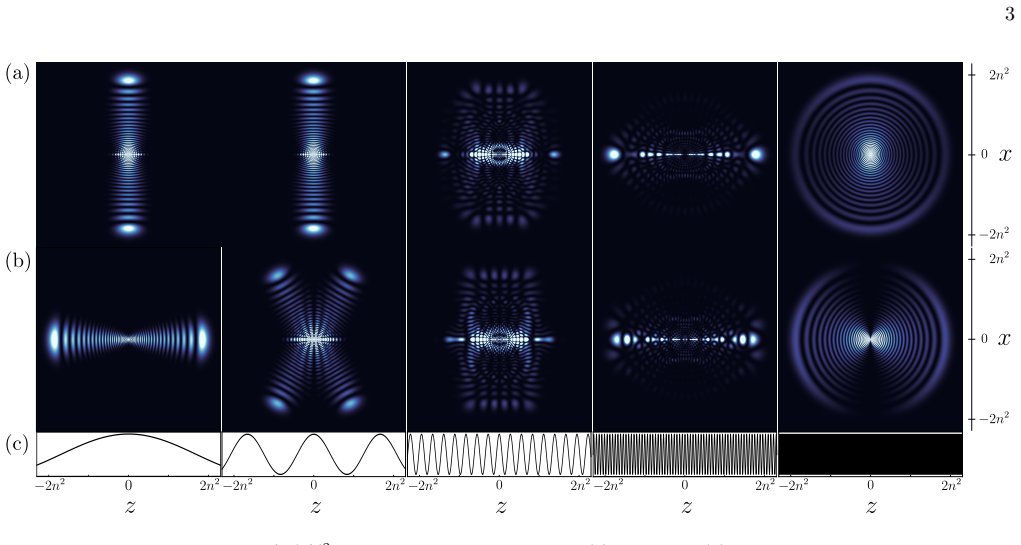
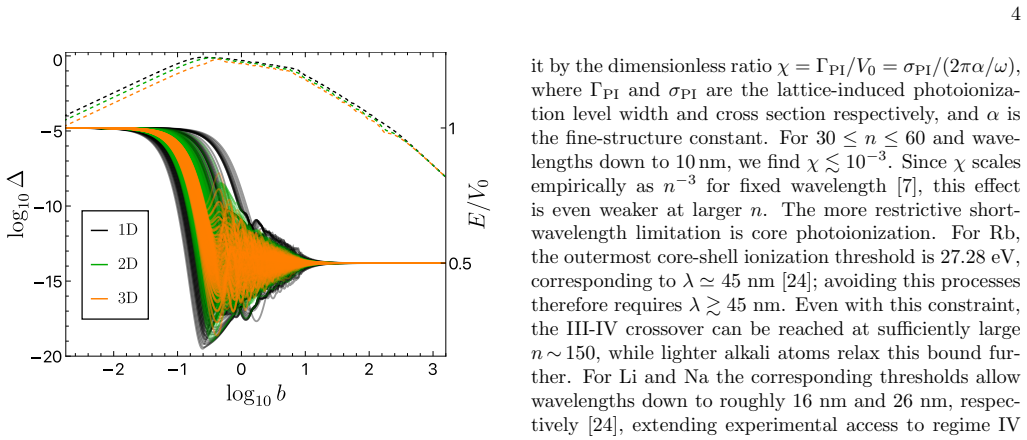
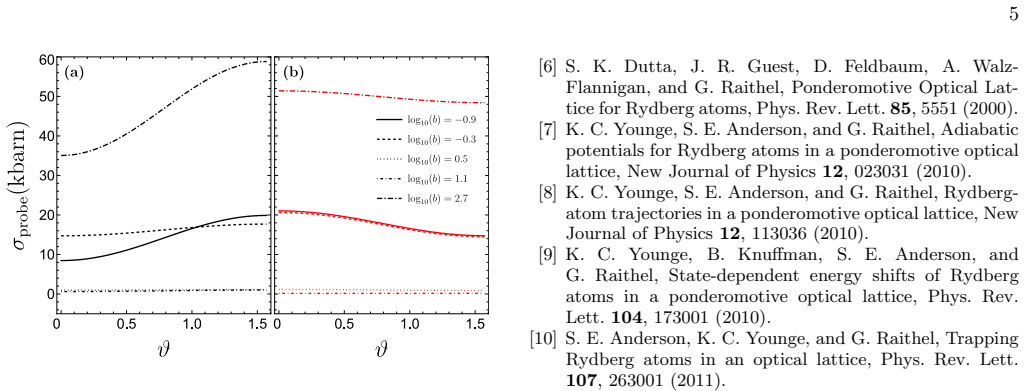
Standing light waves structure the electronic density of a Rydberg atom in a rich but surprisingly systematic fashion. We uncover these systematics, which are nearly universal across a large range of principal quantum numbers n, by varying the wavelength of the standing light over several orders of magnitude. Thereby, we identify five qualitatively different regimes and give their transition criteria in terms of specific critical wavelengths. The bandwidth of the lattice spectrum, manifested in the difference of energies between the states on the edges of the degeneracy-lifted n-manifolds, as well as the organization of the electron density in coordinate and momentum space are used to rationalize the systematics. A experimental setup is proposed to measure the features in the different regimes.
Editorial analysis
A structured set of objections, weighed in public.
Referee Report
Summary. The manuscript examines the structuring of electronic density in Rydberg atoms by standing light waves. By varying the standing-wave wavelength over several orders of magnitude (microwave to X-ray), it identifies five qualitatively distinct regimes whose boundaries are expressed via critical wavelengths. These regimes are shown to be nearly universal across a broad range of principal quantum numbers n. The regimes are rationalized using the bandwidth of the lifted degeneracy in the n-manifold and the organization of the electron density in coordinate and momentum space. An experimental setup is proposed to observe the predicted features.
Significance. If the claimed universality and the associated transition criteria hold, the work supplies a compact, wavelength-spanning classification of Rydberg–lattice interactions that is largely free of adjustable parameters. The explicit critical-wavelength expressions and the use of both spectral bandwidth and real-space/momentum-space diagnostics constitute concrete, falsifiable predictions that could guide experiments in quantum simulation and precision metrology.
minor comments (3)
- [Abstract and §4] The abstract states that five regimes are identified and that transition criteria are given in terms of critical wavelengths, yet the main text should explicitly list the five regime names (or labels) together with the corresponding critical-wavelength formulas in a single table or equation block for immediate reference.
- [Experimental proposal section] The proposed experimental setup is described only qualitatively; adding a schematic diagram or a brief discussion of the required laser intensities, detection scheme, and expected signal-to-noise would make the feasibility claim more concrete.
- [§2] Notation for the lattice wave vector k and the Rydberg radius should be introduced once with a clear definition (e.g., in §2) and then used consistently; occasional redefinition of symbols interrupts readability.
Simulated Author's Rebuttal
We thank the referee for the positive summary, significance assessment, and recommendation of minor revision. No specific major comments were raised in the report, so we interpret the minor revision as pertaining to any editorial or presentational adjustments that may arise during production.
Circularity Check
No significant circularity; derivation self-contained
full rationale
The provided abstract and context describe a standard atom-light interaction model applied across wavelength regimes to identify five regimes via critical wavelengths, with outputs like lattice spectrum bandwidth and electron density organization. No equations, fitted parameters renamed as predictions, self-definitional steps, or load-bearing self-citations are visible in the text. The central claims rest on the model's application rather than reducing to its own inputs by construction. This is the expected outcome for a paper whose derivation chain is not shown to collapse internally.
Axiom & Free-Parameter Ledger
Reference graph
Works this paper leans on
-
[1]
Bloch, Ultracold quantum gases in optical lattices, Na- ture Physics1, 23 (2005)
I. Bloch, Ultracold quantum gases in optical lattices, Na- ture Physics1, 23 (2005)
2005
-
[2]
W. Jark, S. Di Fonzo, A. Cedola, and S. Lagomarsino, The application of resonantly enhanced x-ray standing waves in fluorescence and waveguide experiments, Spec- trochimica Acta Part B: Atomic Spectroscopy54, 1487 (1999)
1999
-
[3]
X. Shi, W. W. Lee, A. Karnieli, L. M. Lohse, A. Gorlach, L. W. W. Wong, T. Salditt, S. Fan, I. Kaminer, and L. J. Wong, Quantum nanophotonics with energetic particles: X-rays and free electrons, Progress in Quantum Electron- ics102, 100577 (2025)
2025
-
[4]
J. B. Balewski, A. T. Krupp, A. Gaj, D. Peter, H. P. B¨ uchler, R. L¨ ow, S. Hofferberth, and T. Pfau, Coupling a single electron to a Bose–Einstein condensate, Nature 502, 664 (2013)
2013
-
[5]
Schlagm¨ uller, T
M. Schlagm¨ uller, T. C. Liebisch, F. Engel, K. S. Klein- bach, F. B¨ ottcher, U. Hermann, K. M. Westphal, A. Gaj, R. L¨ ow, S. Hofferberth, T. Pfau, J. P´ erez-R´ ıos, and C. H. Greene, Ultracold chemical reactions of a single Rydberg atom in a dense gas, Physical Review X6, 031020 (2016)
2016
-
[6]
S. K. Dutta, J. R. Guest, D. Feldbaum, A. Walz- Flannigan, and G. Raithel, Ponderomotive Optical Lat- tice for Rydberg atoms, Phys. Rev. Lett.85, 5551 (2000)
2000
-
[7]
K. C. Younge, S. E. Anderson, and G. Raithel, Adiabatic potentials for Rydberg atoms in a ponderomotive optical lattice, New Journal of Physics12, 023031 (2010)
2010
-
[8]
K. C. Younge, S. E. Anderson, and G. Raithel, Rydberg- atom trajectories in a ponderomotive optical lattice, New Journal of Physics12, 113036 (2010)
2010
-
[9]
K. C. Younge, B. Knuffman, S. E. Anderson, and G. Raithel, State-dependent energy shifts of Rydberg atoms in a ponderomotive optical lattice, Phys. Rev. Lett.104, 173001 (2010)
2010
-
[10]
S. E. Anderson, K. C. Younge, and G. Raithel, Trapping Rydberg atoms in an optical lattice, Phys. Rev. Lett. 107, 263001 (2011)
2011
-
[11]
S. E. Anderson and G. Raithel, Dependence of Rydberg- atom optical lattices on the angular wave function, Phys. Rev. Lett.109, 023001 (2012)
2012
-
[12]
S. E. Anderson and G. Raithel, Ionization of Rydberg atoms by standing-wave light fields, Nature Communica- tions4, 2967 (2013)
2013
-
[13]
Topcu and A
T. Topcu and A. Derevianko, Intensity landscape and the possibility of magic trapping of alkali-metal Ryd- berg atoms in infrared optical lattices, Phys. Rev. A88, 043407 (2013)
2013
-
[14]
Topcu and A
T. Topcu and A. Derevianko, Tune-out wavelengths and landscape-modulated polarizabilities of alkali-metal Ryd- berg atoms in infrared optical lattices, Phys. Rev. A88, 053406 (2013)
2013
-
[15]
K. R. Moore and G. Raithel, Probe of Rydberg-atom transitions via an amplitude-modulated optical standing wave with a ponderomotive interaction, Phys. Rev. Lett. 115, 163003 (2015)
2015
-
[16]
Wang and F
X. Wang and F. Robicheaux, Energy shift and state mix- ing of Rydberg atoms in ponderomotive optical traps, Journal of Physics B: Atomic, Molecular and Optical Physics49, 164005 (2016)
2016
-
[17]
V. S. Malinovsky, K. R. Moore, and G. Raithel, Modula- tion spectroscopy of Rydberg atoms in an optical lattice, Phys. Rev. A101, 033414 (2020)
2020
-
[18]
Cardman, J
R. Cardman, J. L. MacLennan, S. E. Anderson, Y.-J. Chen, and G. Raithel, Photoionization of Rydberg atoms in optical lattices, New Journal of Physics23, 063074 (2021)
2021
-
[19]
Cardman and G
R. Cardman and G. Raithel, Driving alkali Rydberg tran- sitions with a phase-modulated optical lattice, Phys. Rev. Lett.131, 023201 (2023)
2023
-
[20]
P. H. Bucksbaum, D. W. Schumacher, and M. Bashkan- sky, High-intensity Kapitza-Dirac effect, Phys. Rev. Lett. 61, 1182 (1988)
1988
-
[21]
K. Lin, S. Eckart, H. Liang, A. Hartung, S. Jacob, Q. Ji, L. P. H. Schmidt, M. S. Sch¨ offler, T. Jahnke, M. Kunitski, et al., Ultrafast Kapitza-Dirac effect, Science383, 1467 (2024)
2024
-
[22]
Y. Gu, H. Liang, W. Zheng, A. Lin, J. Zhang, Z. Li, J. Du, L. Ying, P. He, J.-M. Rost, S. Jacob, M. Kunitski, T. Jahnke, S. Eckart, K. Lin, and R. D¨ orner, Dynamical phase evolution of Coulomb-focused electrons in strong- field ionization probed by a standing light wave, Phys. Rev. Lett.136, 103201 (2026)
2026
-
[23]
We will usem >0 for both values 6 ±m
For the choice ofZ 0=0 the potential has reflection sym- metry,V P (r,0) =V P (−r,0), rendering the eigenenergies for±mdegenerate. We will usem >0 for both values 6 ±m
-
[24]
Kramida, Yu
A. Kramida, Yu. Ralchenko, J. Reader, and and NIST ASD Team, NIST Atomic Spectra Database (ver. 5.12), [Online]. Available:https://physics.nist.gov/asd [2025, June 12]. National Institute of Standards and Technology, Gaithersburg, MD. (2024)
2025
-
[25]
A. L. Hunter, M. T. Eiles, A. Eisfeld, and J. M. Rost, Rydberg composites, Phys. Rev. X10, 031046 (2020)
2020
-
[26]
Microscopic Rydberg electron orbit manipulation with optical tweezers
H. Rivera-Rodr´ ıguez, M. T. Eiles, T. Pfau, and F. Mein- ert, Microscopic Rydberg electron orbit manipulation with optical tweezers, arXiv preprint arXiv:2602.15723 (2026). 7 END MA TTER A. Reduced Rydberg densities and Gaussian representation The reduced axial density of the Rydberg electron is ρz(z) = Z ∞ −∞ Z ∞ −∞ |Ψ(r)|2 dx dy.(S1) Figure S1 compares...
work page internal anchor Pith review Pith/arXiv arXiv 2026
discussion (0)
Sign in with ORCID, Apple, or X to comment. Anyone can read and Pith papers without signing in.