Effective Roles between Sperm Head and Tail on the Motility
Pith reviewed 2026-06-29 08:42 UTC · model grok-4.3
The pith
Sperm movement direction at interfaces follows the head rather than opposing the tail wave.
A machine-rendered reading of the paper's core claim, the machinery that carries it, and where it could break.
Core claim
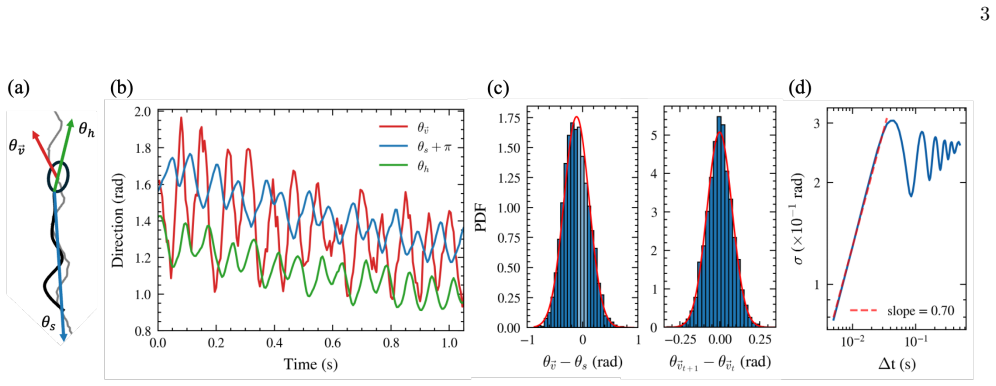
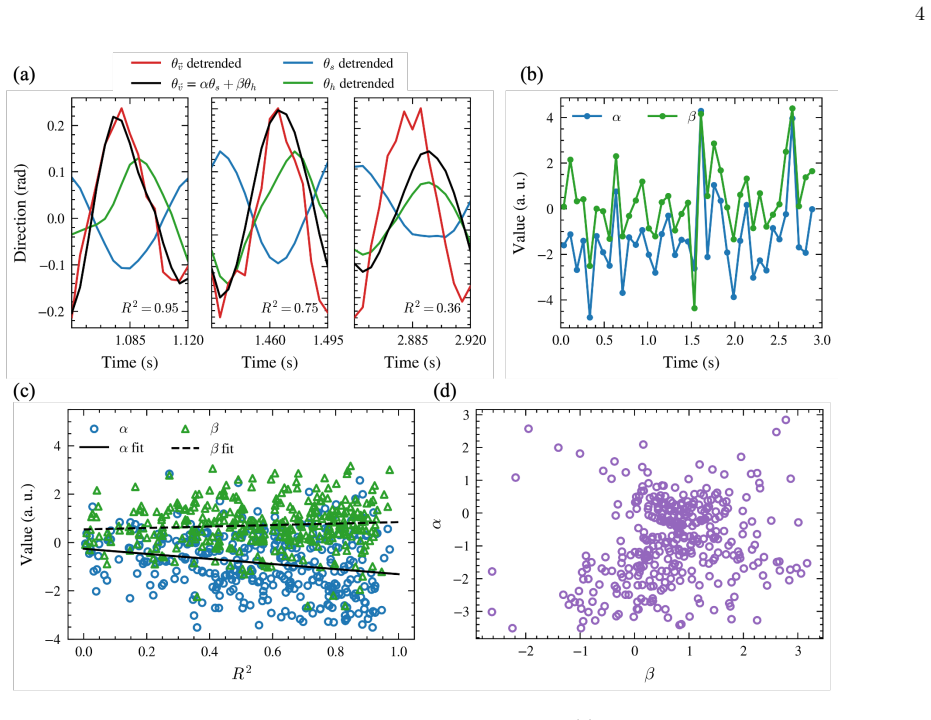
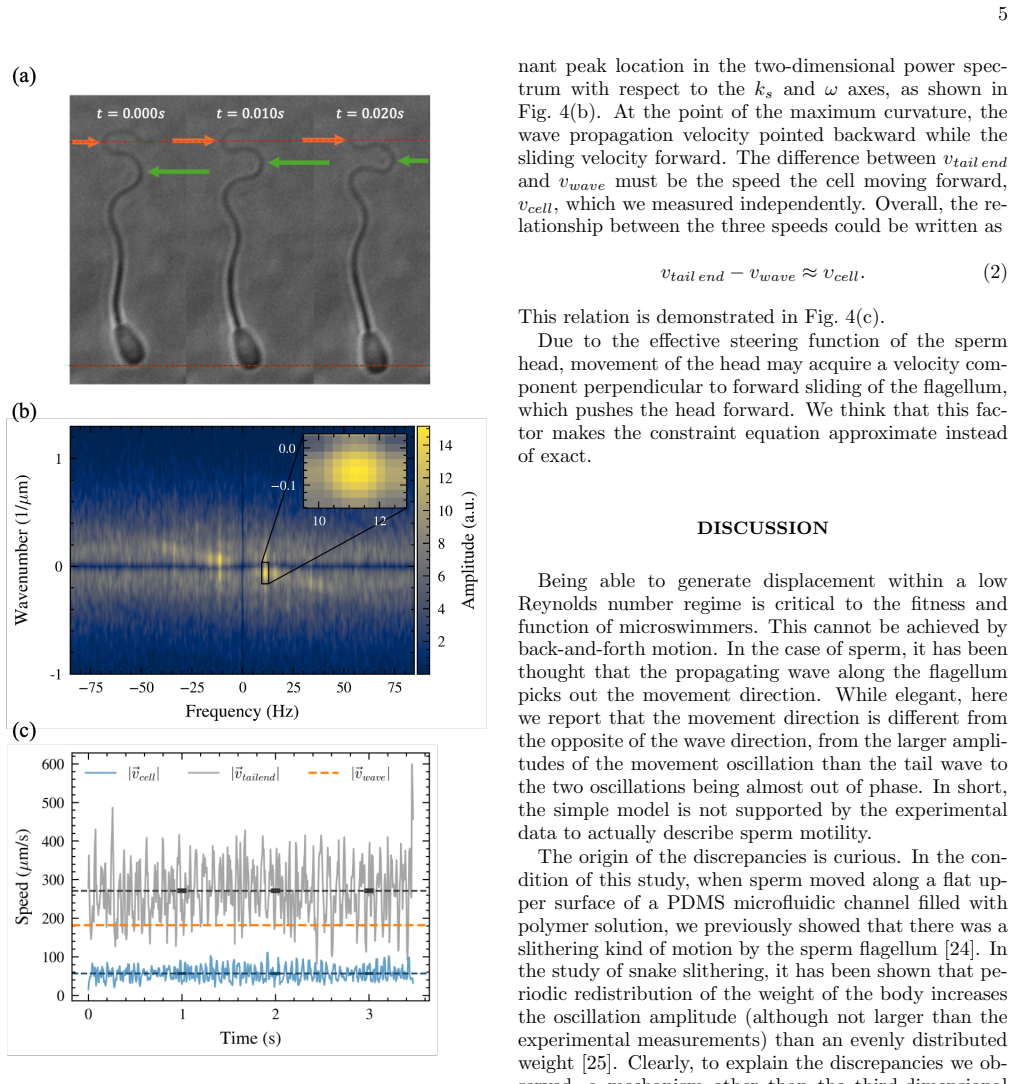
The paper establishes that the direction of sperm movement deviates from being directly opposite the flagellar wave propagation when at a viscoelastic fluid-solid interface. Specifically, movement direction oscillates out of phase with the wave direction but in phase with head orientation and with greater amplitude. The contributions of head orientation and wave direction to movement vary dynamically over time. Additionally, the last bend of the flagellum does not move in the lab frame, leading to an approximate semi-holonomic constraint on wave propagation, flagellar sliding, and cell forward movement. This highlights effective roles for both head and tail in directing motility.
What carries the argument
Dynamic linear combination of head orientation and wave direction, along with the approximate semi-holonomic constraint on wave propagation speed, flagellar sliding, and forward cell movement.
If this is right
- Movement direction cannot be assumed to be opposite the wave propagation direction at interfaces.
- Head orientation plays a significant and time-varying role in steering.
- Flagellar sliding and cell speed are linked through the stationary last bend constraint.
- Roles of head and tail are not fixed but change dynamically during motion.
Where Pith is reading between the lines
- Similar phase relationships might appear in other boundary conditions or for different microswimmers.
- The constraint could be used to predict propulsion efficiency in confined environments.
- This might inform models of sperm navigation in the female reproductive tract.
- Experiments varying the interface properties could isolate the contributions further.
Load-bearing premise
The observed phase offsets, amplitude differences, and dynamic weights between head and wave directions represent intrinsic effective roles rather than artifacts of the specific viscoelastic fluid-solid setup or reconstruction method.
What would settle it
Measuring the phase relationship between movement direction and head/wave directions for sperm swimming freely in bulk viscoelastic fluid without a solid substrate would test if the deviation is interface-specific.
Figures
read the original abstract
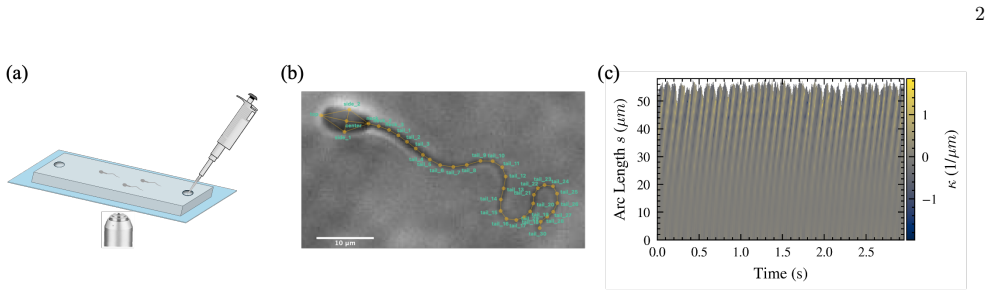
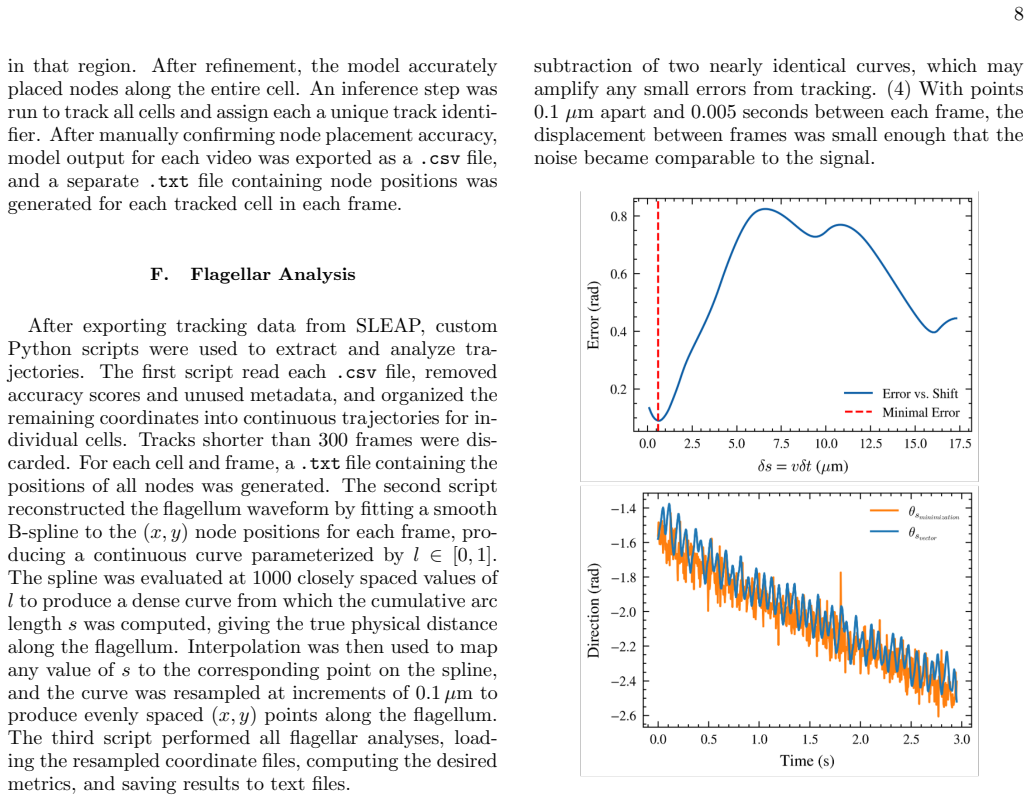
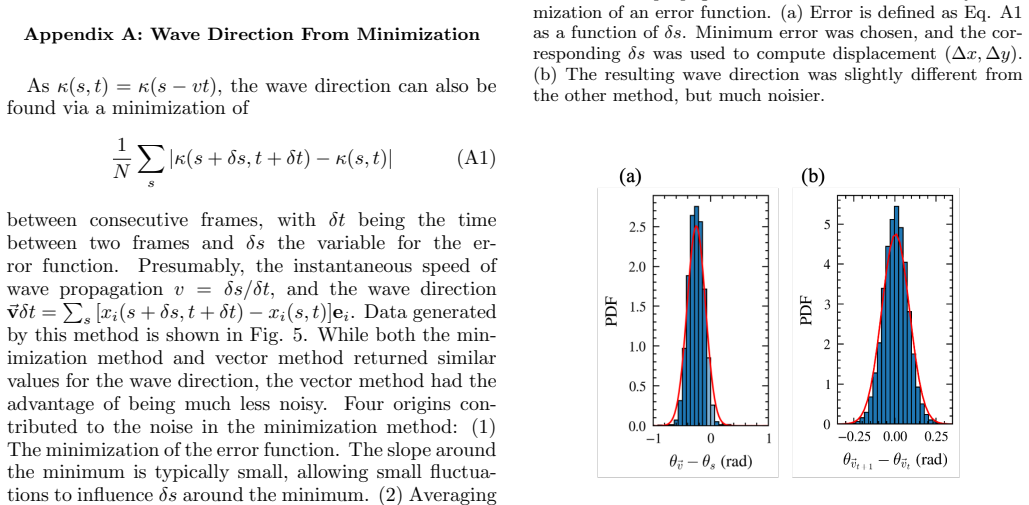
In a low Reynolds number fluid environment that microswimmers encounter, back-and-forth motion cannot lead to net displacement. In mammalian sperm, the mechanical wave propagating along their single flagellum breaks the cancellation between back-and-forth motion and, therefore, assumed to define the movement direction. Here, we show experimentally that the movement direction deviates from the opposite of the wave propagation direction when sperm move at the interface of a viscoelastic fluid and a solid substrate. In fact, the oscillation of the movement direction is out of phase with the oscillation of the tail wave direction, in phase with the head, and the movement has a larger amplitude than the wave direction. When we tried to reconstruct the movement direction as a linear combination of the head orientation and the wave direction, we found that the contributions from these two varied dynamically in time. Further, the last bend of the flagellum does not move in the lab frame (as observed under the microscope). We characterized this as an approximate semi-holonomic constraint on the speed of wave propagation, flagellar sliding, and cell forward movement. Overall, our results highlight the appearance of head and tail taking up roles in directing sperm motility.
Editorial analysis
A structured set of objections, weighed in public.
Referee Report
Summary. The manuscript reports experimental observations of mammalian sperm at the viscoelastic fluid-solid substrate interface. It claims that cell movement direction deviates from the opposite of flagellar wave propagation direction; movement direction oscillates out of phase with tail wave direction but in phase with head orientation and with larger amplitude. A linear combination of head orientation and wave direction reconstructs movement with time-varying weights, and the stationary last bend of the flagellum is characterized as an approximate semi-holonomic constraint on wave speed, sliding, and forward motion, implying effective directing roles for both head and tail.
Significance. If the reported phase/amplitude relations and dynamic weights prove intrinsic rather than interface artifacts, the work would challenge the standard assumption that flagellar wave propagation alone sets net direction in low-Re microswimmers. Direct experimental measurements of directions, phases, and stationarity constitute a strength; the result could inform models of boundary-influenced propulsion with relevance to reproductive biophysics.
major comments (3)
- [Abstract] Abstract: the central claim that movement direction deviates from the opposite of wave propagation (with out-of-phase relation to tail wave, in-phase with head, and larger amplitude) is presented without any reported sample sizes, number of tracked cells, statistical tests, error bars, or controls for interface effects, which is load-bearing for establishing the deviation as reproducible rather than anecdotal.
- [Abstract] Abstract (reconstruction attempt): the assertion that head and wave contributions 'varied dynamically in time' as a linear combination lacks any description of the fitting method, basis functions, goodness-of-fit, or validation against held-out data, undermining support for the dynamic-role interpretation.
- [Abstract] Abstract (constraint characterization): the semi-holonomic constraint inferred from the last bend being stationary in the lab frame is observed exclusively at the fluid-solid interface; without quantitative comparisons to bulk-fluid swimming or controls isolating no-slip/lubrication effects, the constraint cannot be securely attributed to intrinsic head-tail mechanics rather than boundary artifacts.
minor comments (1)
- [Abstract] Abstract contains minor grammatical issues (e.g., 'assumed to define' should read 'is assumed to define') that affect readability but not content.
Simulated Author's Rebuttal
We thank the referee for their thorough and constructive review. We address each major comment below with clarifications from the manuscript and indicate planned revisions.
read point-by-point responses
-
Referee: [Abstract] Abstract: the central claim that movement direction deviates from the opposite of wave propagation (with out-of-phase relation to tail wave, in-phase with head, and larger amplitude) is presented without any reported sample sizes, number of tracked cells, statistical tests, error bars, or controls for interface effects, which is load-bearing for establishing the deviation as reproducible rather than anecdotal.
Authors: We agree that the abstract should report key quantitative details for self-containment. The main text provides the number of tracked cells, error bars, and statistical tests supporting the phase and amplitude relations. We will revise the abstract to include these elements. revision: yes
-
Referee: [Abstract] Abstract (reconstruction attempt): the assertion that head and wave contributions 'varied dynamically in time' as a linear combination lacks any description of the fitting method, basis functions, goodness-of-fit, or validation against held-out data, undermining support for the dynamic-role interpretation.
Authors: The linear combination is performed via time-windowed regression as detailed in the Methods section. We will add a concise description of the fitting approach to the revised abstract. revision: yes
-
Referee: [Abstract] Abstract (constraint characterization): the semi-holonomic constraint inferred from the last bend being stationary in the lab frame is observed exclusively at the fluid-solid interface; without quantitative comparisons to bulk-fluid swimming or controls isolating no-slip/lubrication effects, the constraint cannot be securely attributed to intrinsic head-tail mechanics rather than boundary artifacts.
Authors: The study examines motility specifically at the fluid-solid interface, a setting relevant to in vivo conditions. The stationary bend and resulting constraint are characterized from interface observations. We will expand the discussion to note the interface context and the value of future bulk comparisons for distinguishing intrinsic versus boundary contributions. revision: partial
- Quantitative comparisons to bulk-fluid swimming are not available in the current dataset.
Circularity Check
No circularity: purely observational claims with no derivation chain
full rationale
The paper reports experimental measurements of sperm head/tail orientations, wave propagation, and cell movement direction at a viscoelastic-fluid/solid interface. The reconstruction of movement direction as a time-varying linear combination of head orientation and wave direction is presented as an empirical observation of dynamic contributions, not as a fitted model whose outputs are then relabeled as predictions. No equations, uniqueness theorems, or self-citations are invoked to derive the central claims; the semi-holonomic constraint is characterized directly from the stationarity of the last bend in the lab frame. All load-bearing statements rest on direct imaging data rather than any reduction to inputs by construction.
Axiom & Free-Parameter Ledger
axioms (1)
- domain assumption In a low Reynolds number fluid environment that microswimmers encounter, back-and-forth motion cannot lead to net displacement.
Reference graph
Works this paper leans on
-
[1]
Gazzola, M
M. Gazzola, M. Argentina, and L. Mahadevan, Scaling macroscopic aquatic locomotion, Nature Physics10, 758 (2014)
2014
-
[2]
E. M. Purcell, Life at low Reynolds number, American Journal of Physics45, 3 (1977)
1977
-
[3]
Lauga, Life around the scallop theorem, Soft Matter 7, 10.1039/c0sm00953a (2010)
E. Lauga, Life around the scallop theorem, Soft Matter 7, 10.1039/c0sm00953a (2010)
-
[4]
M. S. Kumar and P. Philominathan, The physics of flag- ellar motion of E. coli during chemotaxis., Biophysical reviews2, 13 (2010)
2010
-
[5]
L. Xie, T. Altindal, S. Chattopadhyay, and X.-L. Wu, Bacterial flagellum as a propeller and as a rudder for efficient chemotaxis, Proceedings of the National Academy of Sciences108, 2246 (2011), eprint: https://www.pnas.org/doi/pdf/10.1073/pnas.1011953108
-
[6]
Corkidi, F
G. Corkidi, F. Montoya, A. L. Gonz´ alez-Cota, P. Hern´ andez-Herrera, N. C. Bruce, H. Bloomfield- Gadˆ elha, and A. Darszon, Human sperm rotate with a conserved direction during free swimming in four dimen- sions, Journal of Cell Science136, jcs261306 (2023)
2023
-
[7]
Nosrati, A
R. Nosrati, A. Driouchi, C. M. Yip, and D. Sinton, Two-dimensional slither swimming of sperm within a mi- crometre of a surface, Nature Communications6, 8703 (2015)
2015
-
[8]
C.-k. Tung, C. Lin, B. Harvey, A. G. Fiore, F. Ardon, M. Wu, and S. S. Suarez, Fluid viscoelasticity promotes collective swimming of sperm, Scientific Reports7, 3152 (2017)
2017
-
[9]
Elgeti, R
J. Elgeti, R. Winkler, and G. Gompper, Physics of Mi- croswimmers - Single Particle Motion and Collective Be- havior, Reports on Progress in Physics78, 056601 (2015)
2015
-
[10]
B. Liu, L. Chen, and W. Xu, Effects of flagellar morphol- ogy on swimming performance and directional control in microswimmers, Physics of Fluids37, 041912 (2025)
2025
-
[11]
D. B. Puri, H. Wadhwa, V. Hemadri, G. Biswas, and S. Tripathi, Rheotaxis of sperm cells: mechanism and ap- plications in microfluidic separation, Discover Fluid Me- chanics2, 1 (2026)
2026
-
[12]
K. E. Machin, Wave Propagation Along Flagella, Journal of Experimental Biology35, 796 (1958)
1958
-
[13]
Lin and D
J. Lin and D. Nicastro, Asymmetric distribution and spa- tial switching of dynein activity generates ciliary motility, Science360(2018)
2018
-
[14]
Tung and S
C.-K. Tung and S. S. Suarez, Co-Adaptation of Physical Attributes of the Mammalian Female Reproductive Tract and Sperm to Facilitate Fertilization, Cells10, 10.3390 (2021)
2021
-
[15]
S. Ro, B. Guo, A. Shih, T. V. Phan, R. H. Austin, D. Levine, P. M. Chaikin, and S. Martiniani, Model- Free Measurement of Local Entropy Production and Ex- tractable Work in Active Matter, Phys. Rev. Lett.129, 220601 (2022)
2022
-
[16]
Rothchild, Non-random Distribution of Bull Spermato- zoa in a Drop of Sperm Suspension, Nature198, 1221 (1963)
1963
-
[17]
Denissenko, V
P. Denissenko, V. Kantsler, D. J. Smith, and J. Kirkman- Brown, Human spermatozoa migration in microchan- nels reveals boundary-following navigation, Proceedings of the National Academy of Sciences109, 8007 (2012)
2012
-
[18]
Rothschild, The Activity of Ram Spermatozoa, Jour- nal of Experimental Biology25, 219 (1948)
L. Rothschild, The Activity of Ram Spermatozoa, Jour- nal of Experimental Biology25, 219 (1948)
1948
-
[19]
Creppy, F
A. Creppy, F. Plourabou´ e, O. Praud, X. Druart, S. Cazin, H. Yu, and P. Degond, Symmetry-breaking phase transi- tions in highly concentrated semen, Journal of The Royal Society Interface13, 20160575 (2016)
2016
-
[20]
C. R. Packard, S. Unnikrishnan, S. Phuyal, S. H. Cheong, M. L. Manning, C.-K. Tung, and D. M. Sussman, Self- organized vortex phases and hydrodynamic interactions in Bos taurus sperm cells, Physical Review E110, 014407 (2024)
2024
-
[21]
Toner and Y
J. Toner and Y. Tu, Long-Range Order in a Two- Dimensional Dynamical$\mathrm{XY}$Model: How Birds Fly Together, Physical Review Letters75, 4326 (1995)
1995
-
[22]
Toner and Y
J. Toner and Y. Tu, Flocks, herds, and schools: A quan- titative theory of flocking, Phys. Rev. E58, 4828 (1998)
1998
-
[23]
Aditi Simha and S
R. Aditi Simha and S. Ramaswamy, Hydrodynamic Fluc- tuations and Instabilities in Ordered Suspensions of Self- Propelled Particles, Physical Review Letters89, 058101 (2002)
2002
-
[24]
Unnikrishnan, R
S. Unnikrishnan, R. L. Scott, E. Ogundele, M. A. Azad, K. Ishimoto, S. S. Suarez, and C. K. Tung, Hybrid motil- ity mechanism of sperm at viscoelastic fluid-solid inter- face, Scientific Reports14, 21841 (2024)
2024
-
[25]
D. L. Hu, J. Nirody, T. Scott, and M. J. Shelley, The mechanics of slithering locomotion, Proceedings of the National Academy of Sciences106, 10081 (2009), eprint: 10 https://www.pnas.org/doi/pdf/10.1073/pnas.0812533106
-
[26]
H. C. BERG and D. A. BROWN, Chemotaxis in Es- cherichia coli analysed by Three-dimensional Tracking, Nature239, 500 (1972)
1972
-
[27]
R. M. Macnab and M. K. Ornston, Normal-to-curly flag- ellar transitions and their role in bacterial tumbling. Stabilization of an alternative quaternary structure by mechanical force, Journal of Molecular Biology112, 1 (1977)
1977
-
[28]
K. Son, J. S. Guasto, and R. Stocker, Bacteria can exploit a flagellar buckling instability to change direction, Nature Physics9, 494 (2013)
2013
-
[29]
B. M. Friedrich, I. H. Riedel-Kruse, J. Howard, and F. J¨ ulicher, High-precision tracking of sperm swimming fine structure provides strong test of resistive force the- ory, Journal of Experimental Biology213, 1226 (2010)
2010
-
[30]
T. D. Pereira, N. Tabris, A. Matsliah, D. M. Turner, J. Li, S. Ravindranath, E. S. Papadoyannis, E. Normand, D. S. Deutsch, Z. Y. Wang, G. C. McKenzie-Smith, C. C. Mitelut, M. D. Castro, J. D’Uva, M. Kislin, D. H. Sanes, S. D. Kocher, S. S.-H. Wang, A. L. Falkner, J. W. Shae- vitz, and M. Murthy, SLEAP: A deep learning system for multi-animal pose trackin...
2022
-
[31]
Mary and G
H. Mary and G. J. Brouhard, Kappa ($\kappa$): Analy- sis of Curvature in Biological Image Data using B-splines, bioRxiv , 852772 (2019)
2019
-
[32]
Gaffney, H
E. Gaffney, H. Gadˆ elha, D. Smith, J. Blake, and J. Kirkman-Brown, Mammalian Sperm Motility: Obser- vation and Theory, Annual Review of Fluid Mechanics 43, 501 (2011), type: Journal Article
2011
-
[33]
R. Ma, G. S. Klindt, I. H. Riedel-Kruse, F. J¨ ulicher, and B. M. Friedrich, Active Phase and Amplitude Fluctua- tions of Flagellar Beating, Phys. Rev. Lett.113, 048101 (2014)
2014
-
[34]
A. Sharma, B. M. Friedrich, and V. F. Geyer, Active fluctuations of axoneme oscillations scale with num- ber of dynein motors, Proceedings of the National Academy of Sciences121, e2406244121 (2024), eprint: https://www.pnas.org/doi/pdf/10.1073/pnas.2406244121
-
[35]
L. G. Leal, The slow motion of slender rod-like particles in a second-order fluid, Journal of Fluid Mechanics69, 305 (1975), edition: 2006/03/29
1975
-
[36]
D. D. Joseph and Y. J. Liu, Orientation of long bodies falling in a viscoelastic liquid, Journal of Rheology37, 961 (1993)
1993
-
[37]
Dabade, N
V. Dabade, N. K. Marath, and G. Subramanian, Effects of inertia and viscoelasticity on sedimenting anisotropic particles, Journal of Fluid Mechanics778, 133 (2015), edition: 2015/07/30
2015
-
[38]
Khanal, M
S. Khanal, M. R. Leung, A. Royfman, E. L. Fish- man, B. Saltzman, H. Bloomfield-Gadˆ elha, T. Zeev-Ben- Mordehai, and T. Avidor-Reiss, A dynamic basal com- plex modulates mammalian sperm movement, Nature Communications12, 3808 (2021)
2021
-
[39]
Y. Park, Y. Kim, and S. Lim, Locomotion of a single- flagellated bacterium, Journal of Fluid Mechanics859, 586 (2019), edition: 2018/11/21
2019
-
[40]
A. D. Eisner and I. Gallily, On the stochastic nature of the motion of nonspherical aerosol particles: III. the ro- tational diffusion diadic and applications, Journal of Col- loid and Interface Science81, 214 (1981)
1981
-
[41]
H. C. Berg,Random Walks in Biology, rev - revised ed. (Princeton University Press, 1993)
1993
-
[42]
M. Li, G. W. Mulholland, and M. R. Zachariah, Rota- tional Diffusion Coefficient (or Rotational Mobility) of a Nanorod in the Free-Molecular Regime, Aerosol Science and Technology48, 139 (2014)
2014
-
[43]
C. V. Neal, A. L. Hall-McNair, J. Kirkman-Brown, D. J. Smith, and M. T. Gallagher, Doing more with less: The flagellar end piece enhances the propulsive effectiveness of human spermatozoa, Physical Review Fluids5, 073101 (2020)
2020
-
[44]
M. T. Gallagher, J. C. Kirkman-Brown, and D. J. Smith, Axonemal regulation by curvature explains sperm flag- ellar waveform modulation, PNAS Nexus2, pgad072 (2023)
2023
-
[45]
F. C. P. Sales, R. M. Ariati, V. T. Noronha, and J. E. Ribeiro, Mechanical Characterization of PDMS with Dif- ferent Mixing Ratios, Procedia Structural Integrity37, 383 (2022)
2022
-
[46]
H. S. Cho, H.-Y. Moon, H. S. Lee, Y. T. Kim, and S. C. Jeoung, Formulation Prediction for Young’s Modulus of Poly(dimethylsiloxane) by Spectroscopic Methods, Bulletin of the Ko- rean Chemical Society42, 1225 (2021), eprint: https://onlinelibrary.wiley.com/doi/pdf/10.1002/bkcs.12352
-
[47]
C.-k. Tung, F. Ardon, A. Roy, D. L. Koch, S. S. Suarez, and M. Wu, Emergence of Upstream Swimming via a Hydrodynamic Transition, Phys. Rev. Lett.114, 108102 (2015)
2015
-
[48]
S. Phuyal, S. S. Suarez, and C.-K. Tung, Biological bene- fits of collective swimming of sperm in a viscoelastic fluid, Frontiers in Cell and Developmental BiologyVolume 10 - 2022, 10.3389/fcell.2022.961623 (2022)
-
[49]
L. Achinger, D. F. Kluczynski, A. Gladwell, H. Heck, F. Zhang, E. Good, A. Waggoner, M. Reinhart, M. Good, D. Moore, D. Filatoff, S. Dhar, E. Nigro, L. Flanagan, S. Yadav, T. Williams, A. Ray, T. A. Shah, M. W. Liberatore, and T. Avidor-Reiss, The Known and Unknown About Female Reproductive Tract Mucus Rhe- ological Properties, BioEssays47, e70002 (2025),...
discussion (0)
Sign in with ORCID, Apple, or X to comment. Anyone can read and Pith papers without signing in.