Hallucination Mitigation with Agentic AI, Nested Learning, and AI Sustainability via Semantic Caching
Pith reviewed 2026-06-29 12:07 UTC · model grok-4.3
The pith
Agentic AI pipelines with semantic caching reduce hallucination scores 31 to 36 percent while cutting LLM calls nearly in half.
A machine-rendered reading of the paper's core claim, the machinery that carries it, and where it could break.
Core claim
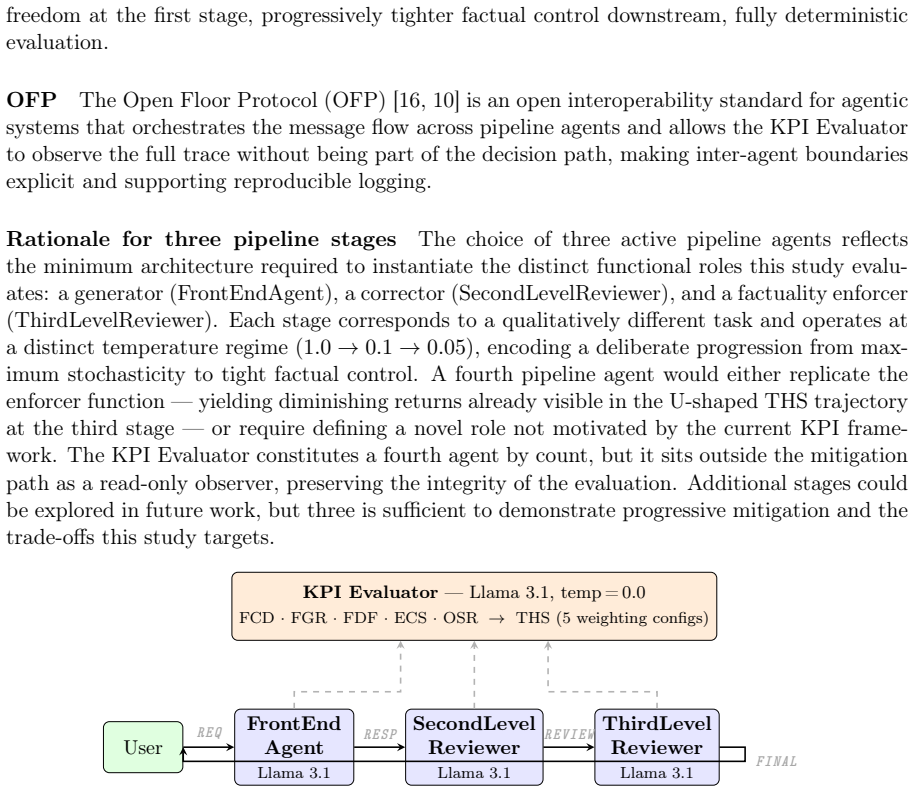
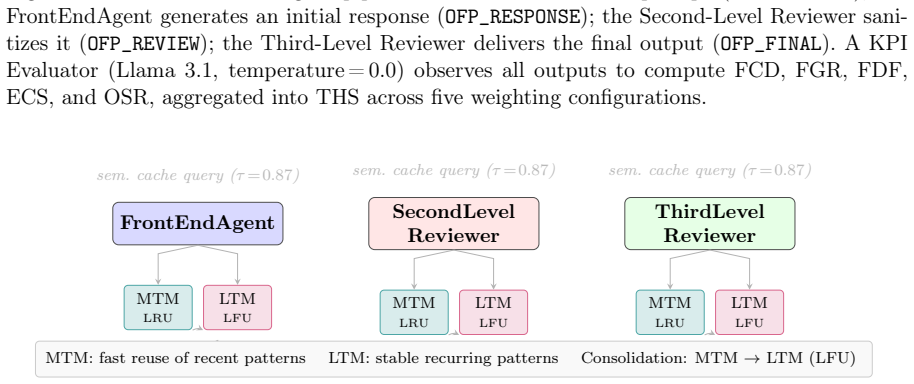
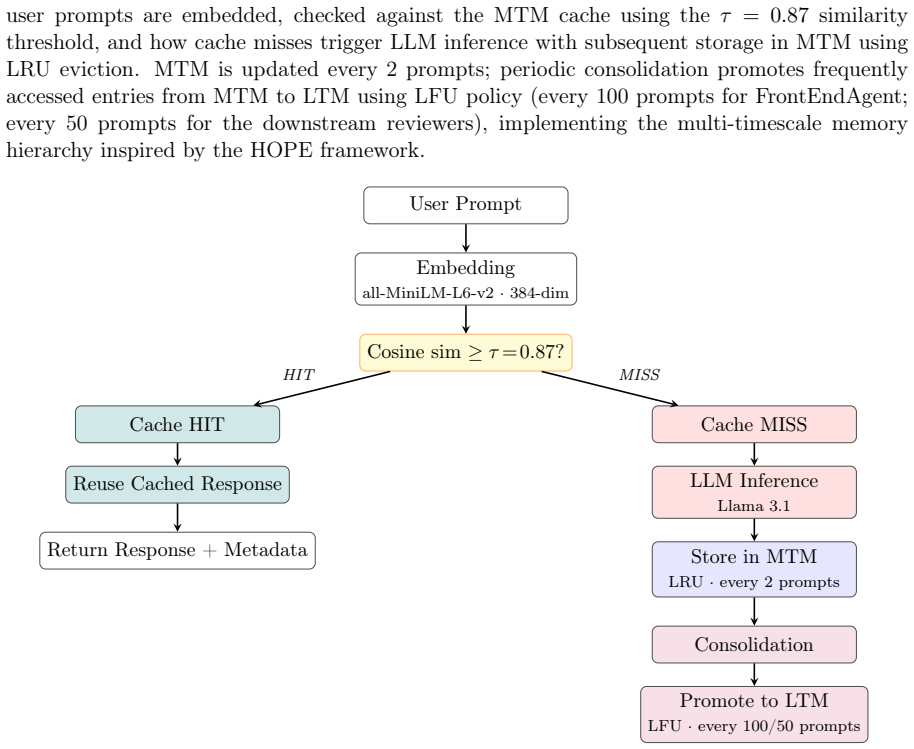
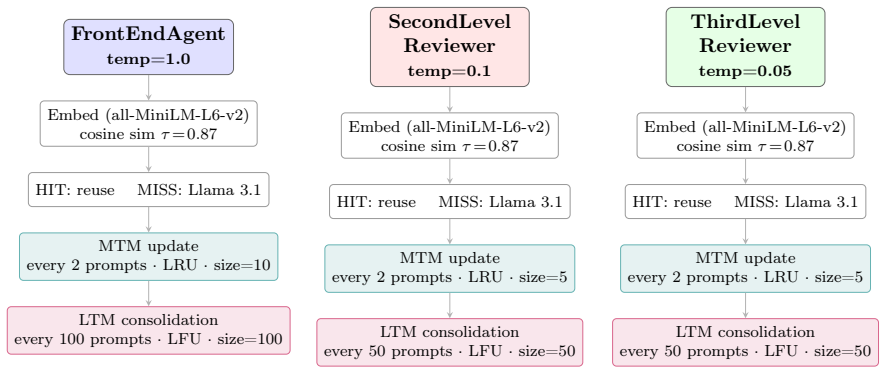
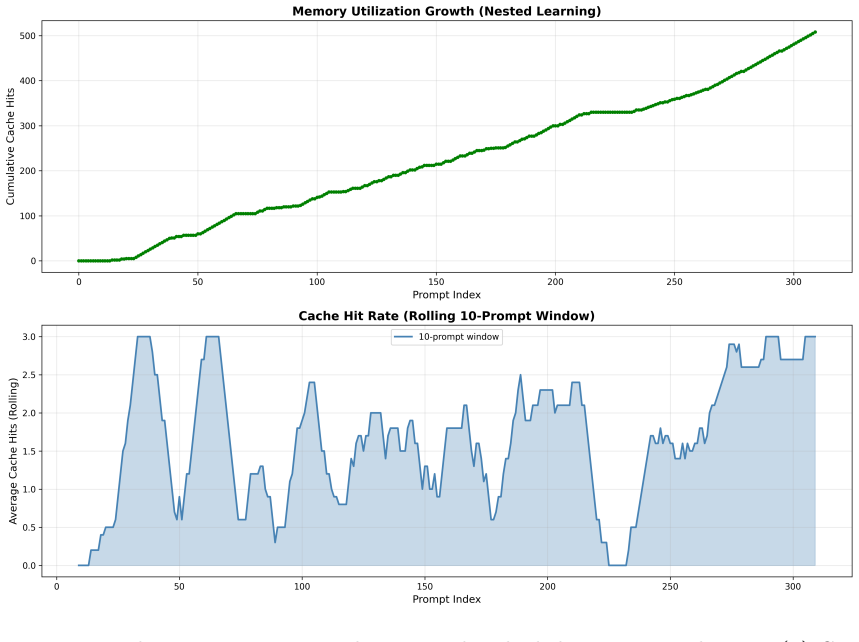
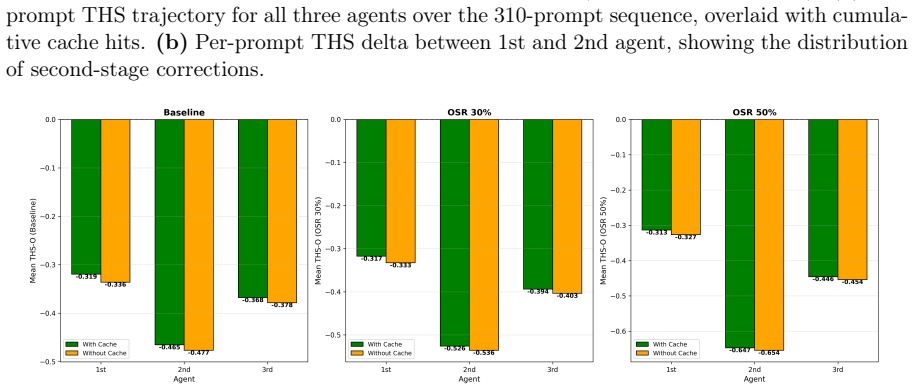
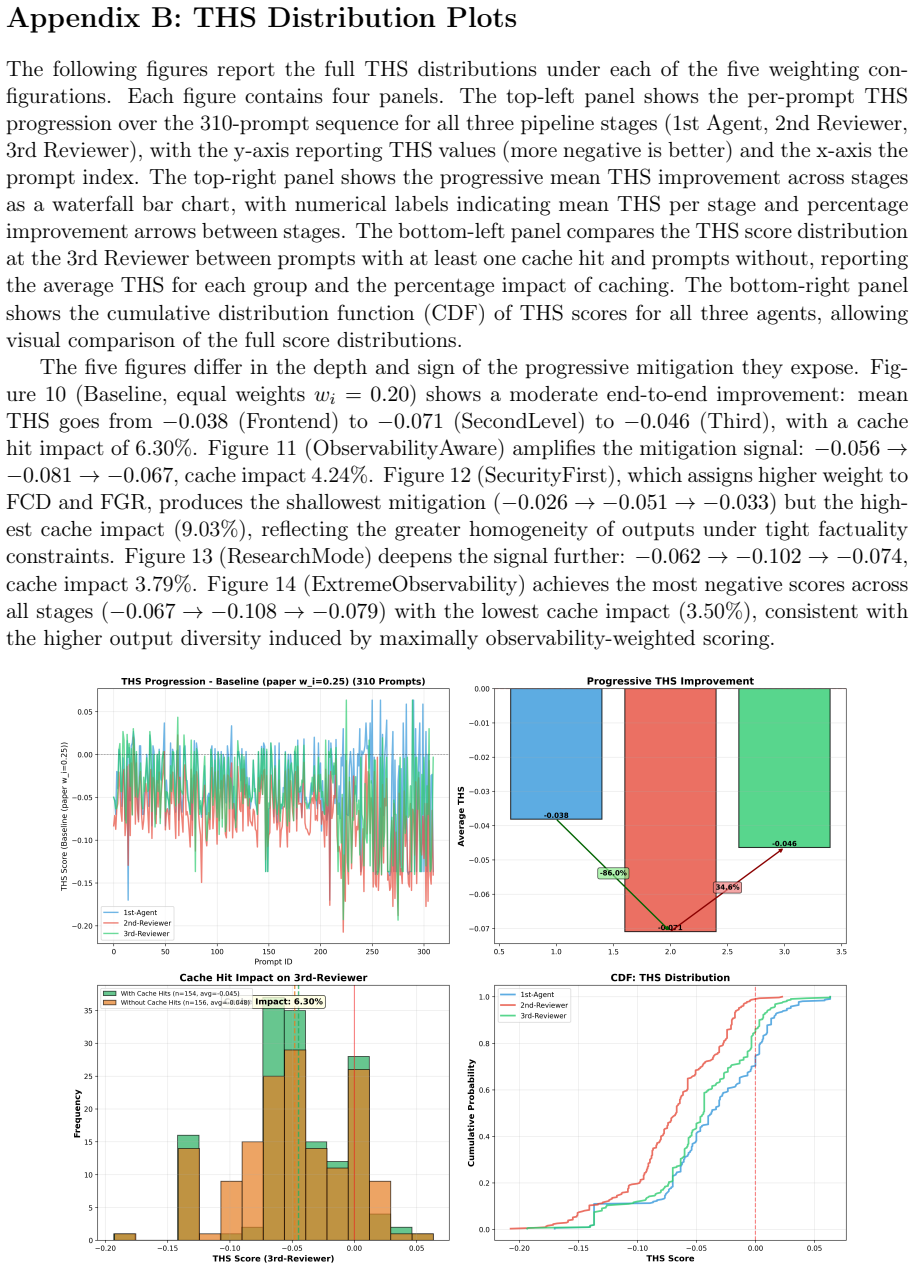
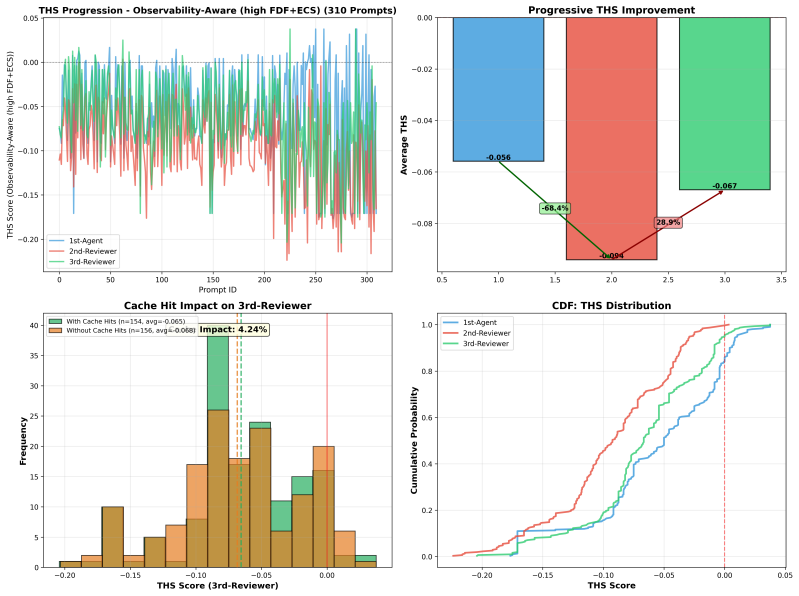
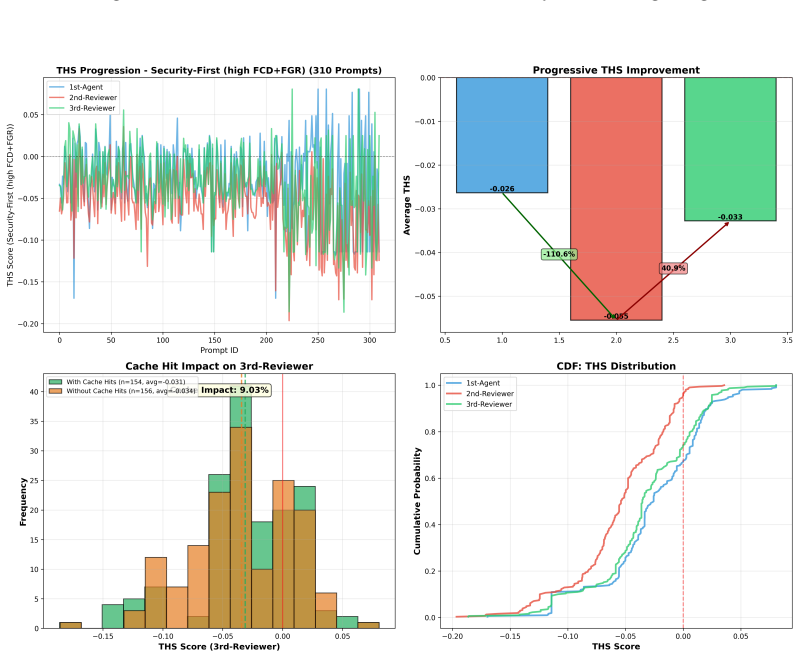
The asymmetric three-stage agentic pipeline with Continuum Memory Systems and semantic similarity caching produces end-to-end Total Hallucination Score reductions of 31.3 to 35.9 percent across five weighting configurations on a 310-prompt benchmark; semantic caching delivers 440 hits out of 930 potential calls for a 47.3 percent hit rate that drops LLM invocations to 490 and lowers energy and CO2e costs, while observability-heavy weightings reach the most negative final THS of -0.0709.
What carries the argument
The asymmetric three-stage agentic pipeline using Continuum Memory Systems and semantic similarity caching to aggregate FCD, FGR, FDF, ECS, and OSR into Total Hallucination Score (THS).
If this is right
- THS reductions remain stable across the five tested weighting schemes.
- Semantic caching lowers LLM invocations from 930 to 490 and thereby reduces energy and CO2e footprint.
- ExtremeObservability weighting produces the strongest mitigation without trading off against the other signals.
- Multi-stage review pipelines become operationally viable at production scale.
- No base-model retraining is required to obtain the reported gains.
Where Pith is reading between the lines
- The same memory-plus-caching pattern could be inserted into other multi-agent workflows that already use staged review.
- High cache hit rates on epistemic prompts suggest the approach may compound savings as query volume grows.
- The separation of generation stochasticity from correction stages offers a template for controlling hallucination risk in longer chains without changing model temperature globally.
Load-bearing premise
The five author-chosen weighting configurations for combining FCD, FGR, FDF, ECS, and OSR into THS produce a metric that validly measures hallucination mitigation and generalizes beyond the specific 310-prompt benchmark and pipeline.
What would settle it
Re-running the same 310-prompt set with different base models or a new prompt distribution that yields THS reductions below 15 percent or cache hit rates below 20 percent would falsify the reported mitigation and efficiency gains.
Figures





read the original abstract
Hallucination remains a major reliability barrier for production LLM systems, particularly in multi-agent pipelines where unsupported claims can propagate unchecked across stages. This paper adapts a HOPE-inspired Nested Learning architecture with Continuum Memory Systems (CMS) and semantic similarity caching to a hybrid benchmark of 310 prompts combining 217 epistemic-uncertainty prompts and 93 fabrication-induction stress-test prompts. A three-stage agentic pipeline orchestrated via the Open Floor Protocol (OFP) is evaluated with five KPIs -- FCD (Factual Claim Density), FGR (Factual Grounding References), FDF (Fictional Disclaimer Frequency), ECS (Explicit Contextualization Score), and OSR (Observability Score Ratio) -- aggregated into THS (Total Hallucination Score) across five weighting configurations to study mitigation-observability trade-offs. FDF, ECS, OSR, and FGR are subtracted as mitigation signals, so that a more negative THS indicates stronger mitigation. The FrontEndAgent is configured as a high-stochasticity generator (temperature = 1.0) to produce a realistic hallucination baseline, while the SecondLevelReviewer and ThirdLevelReviewer operate as progressive correctors. This asymmetric design yields end-to-end THS reductions of -31.3% to -35.9% across five weighting configurations. Semantic caching achieves 440 cache hits over 930 potential calls (47.3% hit rate), reducing LLM invocations to 490, lowering energy and CO2e footprint, and making multi-stage review pipelines operationally viable at production scale. ExtremeObservability attains the most negative final THS (-0.0709), confirming that observability-heavy configurations reinforce rather than compromise mitigation. These findings suggest that memory-augmented multi-agent designs can jointly improve factual reliability, operational efficiency, and auditability without model retraining.
Editorial analysis
A structured set of objections, weighed in public.
Referee Report
Summary. The manuscript presents a three-stage agentic pipeline using HOPE-inspired Nested Learning, Continuum Memory Systems, and semantic caching on a 310-prompt benchmark (217 epistemic-uncertainty + 93 fabrication-induction prompts). It reports end-to-end THS reductions of -31.3% to -35.9% across five author-chosen weighting configurations of the KPIs FCD, FGR, FDF, ECS, and OSR, together with a 47.3% semantic cache hit rate (440 hits out of 930 calls) that reduces LLM invocations to 490.
Significance. If the custom THS metric can be shown to correlate with actual reductions in unsupported claims, the work would indicate that asymmetric multi-agent designs with memory and caching can jointly address factual reliability, auditability, and energy efficiency without model retraining. The sustainability angle via reduced invocations is a constructive contribution.
major comments (2)
- [Abstract] Abstract: THS is defined as a linear combination of FCD, FGR, FDF, ECS, and OSR under five author-selected weighting configurations, with FDF/ECS/OSR/FGR subtracted as mitigation terms. No human factuality annotations, comparison to established hallucination detectors (e.g., SelfCheckGPT), or ablation demonstrating that lower THS predicts fewer unsupported claims on an independent scorer is provided, making the reported -31.3% to -35.9% reductions internal to the chosen scoring system.
- [Abstract] Abstract: The benchmark is assembled from the same epistemic-uncertainty and fabrication-induction prompts used to configure the agents; the manuscript supplies no details on prompt selection criteria, statistical testing of the deltas, or sensitivity of the THS reductions to alternative weight vectors or prompt distributions.
minor comments (1)
- The abstract introduces numerous acronyms (HOPE, CMS, OFP, THS, FCD, etc.) without first-use definitions or citations; a dedicated notation or acronym table would improve readability.
Simulated Author's Rebuttal
We thank the referee for the constructive feedback on our manuscript. We address each major comment below, indicating revisions where the manuscript will be updated.
read point-by-point responses
-
Referee: [Abstract] Abstract: THS is defined as a linear combination of FCD, FGR, FDF, ECS, and OSR under five author-selected weighting configurations, with FDF/ECS/OSR/FGR subtracted as mitigation terms. No human factuality annotations, comparison to established hallucination detectors (e.g., SelfCheckGPT), or ablation demonstrating that lower THS predicts fewer unsupported claims on an independent scorer is provided, making the reported -31.3% to -35.9% reductions internal to the chosen scoring system.
Authors: We agree that THS is a custom composite metric and that the reported reductions are internal to this scoring system. The manuscript does not include human factuality annotations, comparisons to detectors such as SelfCheckGPT, or ablations against an independent scorer. We will revise the abstract and add a limitations subsection to explicitly acknowledge these points and outline plans for external validation in future work. The consistency of improvements across the five weighting configurations remains as supporting internal evidence. revision: partial
-
Referee: [Abstract] Abstract: The benchmark is assembled from the same epistemic-uncertainty and fabrication-induction prompts used to configure the agents; the manuscript supplies no details on prompt selection criteria, statistical testing of the deltas, or sensitivity of the THS reductions to alternative weight vectors or prompt distributions.
Authors: We will revise the methods and results sections to provide explicit details on prompt selection criteria, statistical testing of the THS deltas, and sensitivity analysis to alternative weight vectors and prompt distributions. This will strengthen the description of the benchmark and the robustness of the findings. revision: yes
Circularity Check
No significant circularity; results are direct measurements on author-defined metrics.
full rationale
The paper defines five KPIs (FCD, FGR, FDF, ECS, OSR), aggregates them into THS via five fixed author-chosen weight vectors (with mitigation terms subtracted), runs the three-stage pipeline on a fixed 310-prompt benchmark, and reports the observed THS deltas plus cache-hit counts. This is an empirical measurement of before/after values under the chosen aggregation, not a derivation that reduces to its inputs by construction, a fitted parameter renamed as prediction, or a self-citation chain. No equations or steps in the provided text exhibit self-definition or load-bearing self-reference; the central claims rest on the benchmark execution itself.
Axiom & Free-Parameter Ledger
free parameters (1)
- THS weighting configurations
Reference graph
Works this paper leans on
-
[1]
AutoGen Authors. Autogen. an open-source programming framework for agentic ai.https: //microsoft.github.io/autogen/stable/, 2024
2024
-
[2]
LHD: Improving cache hit rate by maximizing hit density.https://www.usenix.org/conference/nsdi18/presentation/ beckmann, April 2018
Nathan Beckmann, Haoxian Chen, and Asaf Cidon. LHD: Improving cache hit rate by maximizing hit density.https://www.usenix.org/conference/nsdi18/presentation/ beckmann, April 2018
2018
-
[3]
Nested learning: The illusion of deep learning architectures.https://neurips.cc/virtual/2025/loc/ san-diego/poster/116123, 2025
Ali Behrouz, Meisam Razaviyayn, Peilin Zhong, and Vahab Mirrokni. Nested learning: The illusion of deep learning architectures.https://neurips.cc/virtual/2025/loc/ san-diego/poster/116123, 2025. San Diego, Exhibit Hall C,D,E #3707
2025
-
[4]
DylanBouchardandMohitSinghChauhan. Uncertaintyquantificationforlanguagemodels: A suite of black-box, white-box, llm judge, and ensemble scorers.https://arxiv.org/abs/ 2504.19254, 2025
- [5]
- [6]
-
[7]
Diego Gosmar and Deborah A. Dahl. Hallucination mitigation with agentic ai nlp-based open-floor standard. InProceedings of the 18th International Conference on Agents and Artificial Intelligence - Volume 5: ICAART, pages 3893–3900. INSTICC, SciTePress, 2026. https://doi.org/10.5220/0013761000004052
-
[8]
Diego Gosmar and Deborah A. Dahl. Hallucination mitigation with nested learn- ing and semantic caching: Experimental pipeline.https://github.com/diegogosmar/ HallucinationMitCaching, 2026. Open-source implementation. Accessed: April 2026. 16
2026
- [9]
-
[10]
Dahl, Emmett Coin, and David Attwater
Diego Gosmar, Deborah A. Dahl, Emmett Coin, and David Attwater. Ai multi-agent interoperability extension for managing multiparty conversations.https://arxiv.org/ abs/2411.05828, 2024
-
[11]
Diego Gosmar, Deborah A. Dahl, and Dario Gosmar. Prompt injection detection and mitigation via ai multi-agent nlp frameworks.https://arxiv.org/abs/2503.11517, 2025
-
[12]
Prompt- shield: Deployable detection for prompt injection attacks.https://arxiv.org/abs/2501
Dennis Jacob, Hend Alzahrani, Zhanhao Hu, Basel Alomair, and David Wagner. Prompt- shield: Deployable detection for prompt injection attacks.https://arxiv.org/abs/2501. 15145, 2025
2025
-
[13]
Prompt Infection: LLM-to-LLM Prompt Injection within Multi-Agent Systems
Donghyun Lee and Mo Tiwari. Prompt infection: Llm-to-llm prompt injection within multi-agent systems.https://arxiv.org/abs/2410.07283, 2024
work page internal anchor Pith review Pith/arXiv arXiv 2024
-
[14]
Lui, Wei Chen, and Carlee Joe-Wong
Xutong Liu, Baran Atalar, Xiangxiang Dai, Jinhang Zuo, Siwei Wang, John C.S. Lui, Wei Chen, and Carlee Joe-Wong. Semantic caching for low-cost llm serving: From offline learning to online adaptation.https://arxiv.org/abs/2508.07675, 2025
-
[15]
Formalizing and benchmarking prompt injection attacks and defenses.https://arxiv.org/abs/2310
Yupei Liu, Yuqi Jia, Runpeng Geng, Jinyuan Jia, and Neil Zhenqiang Gong. Formalizing and benchmarking prompt injection attacks and defenses.https://arxiv.org/abs/2310. 12815, 2024
2024
-
[16]
Introducing the interoperability initiative of the open voice network.https://voiceinteroperability.ai/, 2023
Open Voice Interoperability Initiative. Introducing the interoperability initiative of the open voice network.https://voiceinteroperability.ai/, 2023
2023
-
[17]
sentence-transformers: Multilingual sentence, paragraph, and image embeddings using bert & co.https://github.com/UKPLab/ sentence-transformers, 2019
Nils Reimers and Iryna Gurevych. sentence-transformers: Multilingual sentence, paragraph, and image embeddings using bert & co.https://github.com/UKPLab/ sentence-transformers, 2019
2019
-
[18]
Xuchen Suo. Signed-prompt: A new approach to prevent prompt injection attacks against llm-integrated applications.https://arxiv.org/abs/2401.07612, 2024
-
[19]
Explain the current consensus on reproducibil- ity issues in recent studies in science and clearly separate established facts from uncer- tain claims
Zilliz Team. GPTCache: Semantic Cache for LLMs.https://github.com/zilliztech/ GPTCache, 2023. Open-source semantic caching framework. Accessed: January 2026. 17 Appendix A: Representative Prompt Examples Table 8 presents representative examples from the 310-prompt benchmark, illustrating the range of realistic and stress-test prompts used in the experimen...
2023
discussion (0)
Sign in with ORCID, Apple, or X to comment. Anyone can read and Pith papers without signing in.