Parallel Adaptive Multi-Objective Evolutionary Learning of Discretized Bayesian Network Classifiers for Clinical Data
Pith reviewed 2026-06-29 13:52 UTC · model grok-4.3
The pith
Baymex parallelizes and adapts a multi-objective evolutionary algorithm to learn compact, clinically inspectable Bayesian network classifiers that match or exceed standard models on real patient data.
A machine-rendered reading of the paper's core claim, the machinery that carries it, and where it could break.
Core claim
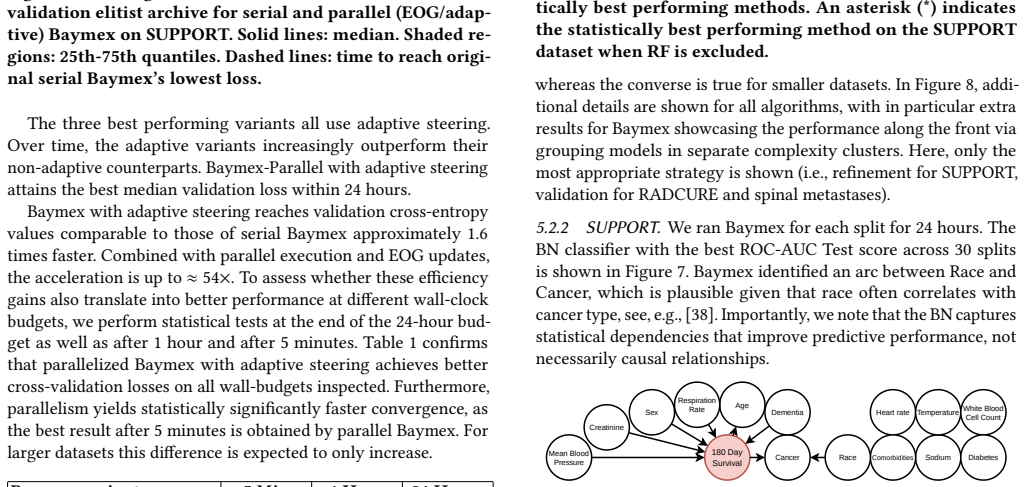
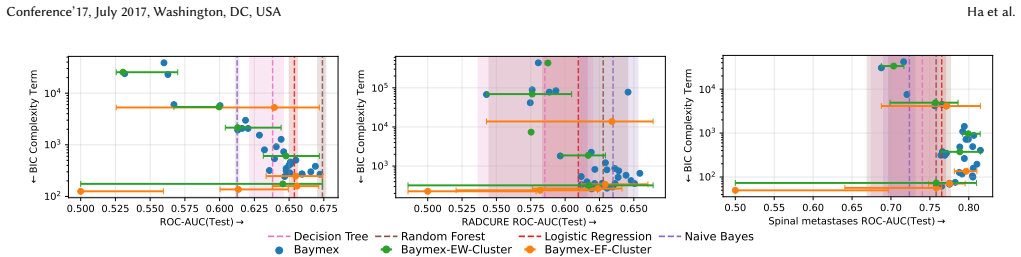
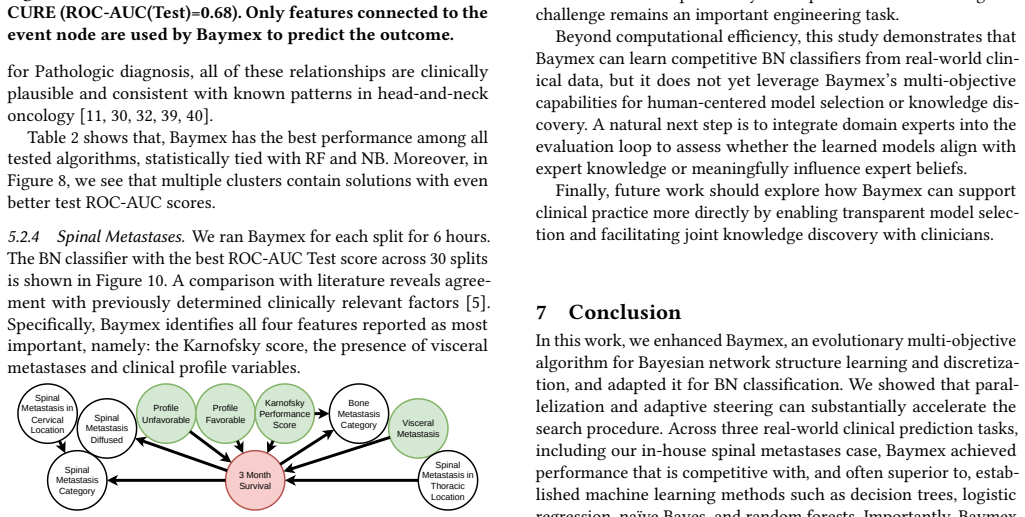
After parallelization and adaptive steering, Baymex obtains statistically similar or better predictive performance on clinical classification tasks while producing compact, clinically inspectable Bayesian networks; it also identifies multiple plausible classifiers whose predictors align with established clinical factors.
What carries the argument
The parallel adaptive multi-objective evolutionary algorithm that simultaneously minimizes cross-entropy loss and the BIC complexity penalty when searching over discretized Bayesian network structures.
Load-bearing premise
The chosen combination of cross-entropy loss, BIC penalty, parallel search, and adaptive steering will reliably produce classifiers that generalize to unseen clinical cases without hidden selection of runs or datasets.
What would settle it
On a fresh clinical dataset the Bayesian networks returned by Baymex show statistically worse predictive performance than the four baseline methods.
Figures


read the original abstract
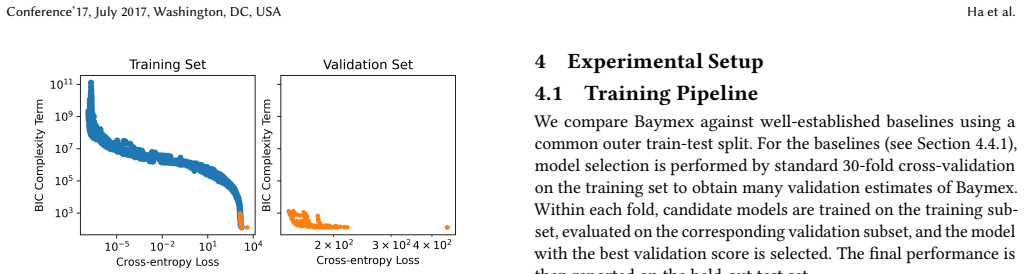
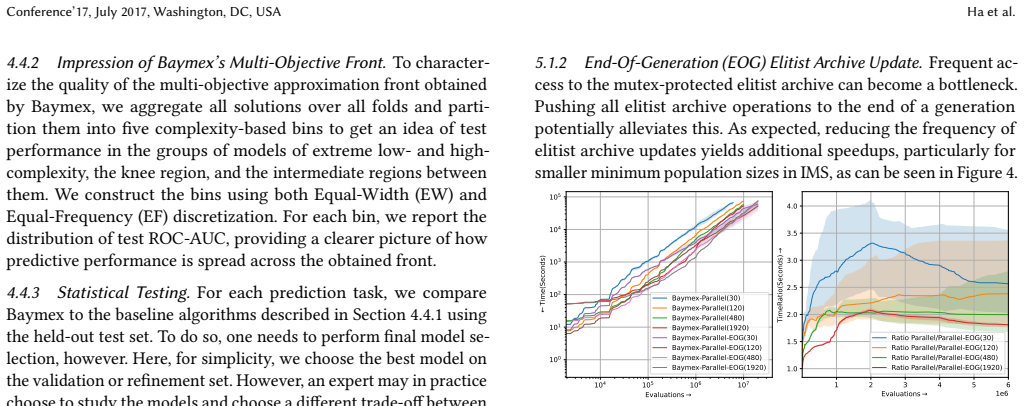
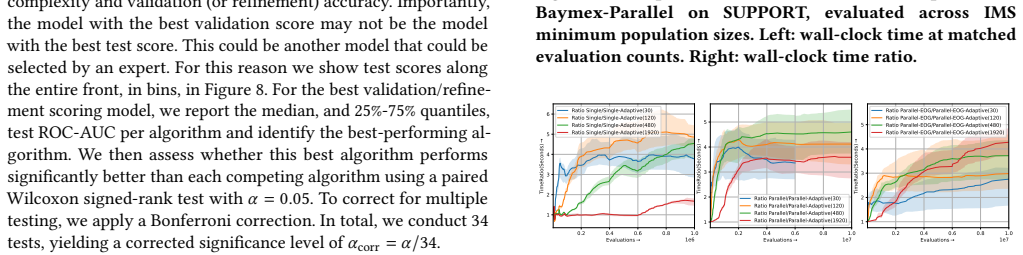
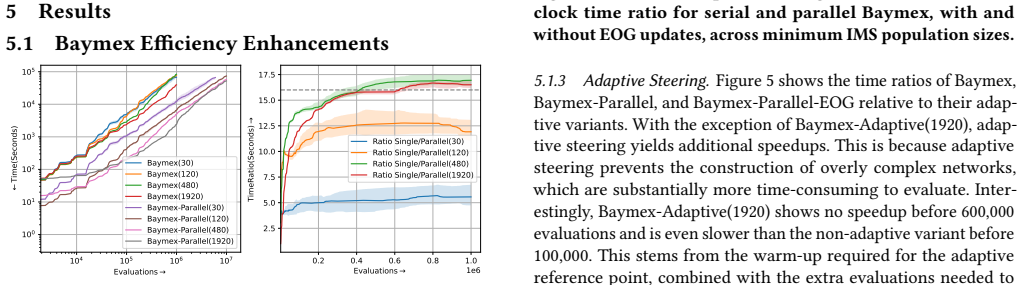
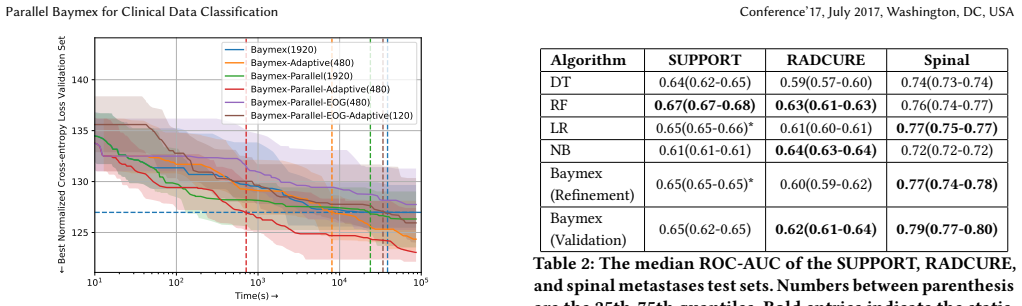
Bayesian Networks (BNs) are of interest from an explainable AI viewpoint, offering transparent probabilistic models for decision support. Baymex is a recently introduced multi-objective evolutionary algorithm for learning discretized BNs, enabling experts to trade-off different objectives of interest, such as likelihood, model complexity, and prior beliefs. While Baymex has been shown to outperform state-of-the-art BN learning approaches, Baymex still 1) requires a lot of computation time and 2) has only been evaluated on synthetic data. To improve scalability, we introduce a parallelization strategy as well as a mechanism that enables adaptively steering optimization toward networks that overfit less. We furthermore reconfigure Baymex to train a BN classifier through multi-objective optimization of cross-entropy loss and the BIC complexity term so as to evaluate its performance on real-world clinical classification tasks. Besides observing speedups up to over 54 times on a 16-core CPU, comparisons against clinically familiar baselines (decision trees, logistic regression, naive Bayes, and random forests) on two open-source (RADCURE and SUPPORT) and one in-house dataset, show that Baymex obtains statistically similar or better predictive performance while producing compact, clinically inspectable BNs. Importantly, Baymex finds multiple plausible BN classifiers that contain predictors consistent with established clinical factors.
Editorial analysis
A structured set of objections, weighed in public.
Referee Report
Summary. The manuscript extends the Baymex multi-objective evolutionary algorithm for discretized Bayesian network learning by adding a parallelization strategy and an adaptive steering mechanism to reduce overfitting. It reconfigures the objectives to cross-entropy loss plus the BIC term to target BN classifiers and evaluates the approach on three clinical datasets (RADCURE, SUPPORT, and one in-house), claiming speed-ups of up to 54 imes on 16 cores together with statistically similar or better predictive performance than decision trees, logistic regression, naïve Bayes, and random forests while yielding compact, clinically inspectable networks containing established predictors.
Significance. If the reported performance and clinical plausibility claims hold under rigorous statistical controls and without post-hoc selection, the work would meaningfully advance scalable, interpretable BN classifiers for clinical decision support. The combination of multi-objective search with parallel/adaptive mechanisms directly tackles the scalability barrier noted for prior Baymex work, and the use of open clinical datasets is a positive step toward reproducibility.
major comments (2)
- [Abstract / Experiments] Abstract and Experiments section: the central claim that Baymex 'obtains statistically similar or better predictive performance' is presented without any numerical performance values, error bars, number of independent runs, or description of the statistical test(s) employed. These omissions are load-bearing because the abstract itself supplies no quantitative evidence from which the claim can be assessed.
- [Experiments] Experiments section: the manuscript does not describe the procedure for selecting the final reported BN classifiers from the Pareto front (e.g., whether selection was performed on held-out validation performance alone or after inspecting clinical plausibility of the networks). This detail is required to substantiate the claim that the algorithm 'finds multiple plausible BN classifiers' as a reliable output rather than a post-hoc choice.
minor comments (1)
- [Abstract] Abstract: the speedup claim 'up to over 54 times' would be clearer if the exact maximum observed speedup and the corresponding dataset/size were stated.
Simulated Author's Rebuttal
We thank the referee for the constructive comments on strengthening the presentation of our results and methodology. We address each major comment below and will revise the manuscript accordingly.
read point-by-point responses
-
Referee: [Abstract / Experiments] Abstract and Experiments section: the central claim that Baymex 'obtains statistically similar or better predictive performance' is presented without any numerical performance values, error bars, number of independent runs, or description of the statistical test(s) employed. These omissions are load-bearing because the abstract itself supplies no quantitative evidence from which the claim can be assessed.
Authors: We agree that the abstract lacks the quantitative details needed to support the performance claim. In the revised manuscript we will add concise numerical results (e.g., mean AUC or accuracy with standard deviations across runs), the number of independent runs, and the statistical test(s) employed (with p-values) directly into the abstract. The experiments section will be expanded to ensure all supporting statistics, error bars, and test descriptions are fully reported and cross-referenced from the abstract. revision: yes
-
Referee: [Experiments] Experiments section: the manuscript does not describe the procedure for selecting the final reported BN classifiers from the Pareto front (e.g., whether selection was performed on held-out validation performance alone or after inspecting clinical plausibility of the networks). This detail is required to substantiate the claim that the algorithm 'finds multiple plausible BN classifiers' as a reliable output rather than a post-hoc choice.
Authors: We acknowledge that the selection procedure from the Pareto front was not described. In the revised manuscript we will add an explicit subsection detailing the selection process, stating that networks were chosen primarily according to held-out validation performance metrics to ensure the output is reproducible and not post-hoc. We will also clarify that the algorithm returns the full Pareto front, enabling users to apply their own selection criteria (including clinical plausibility) if desired. revision: yes
Circularity Check
Minor self-citation of prior Baymex work; central clinical performance claims remain independent
full rationale
The paper reconfigures the existing Baymex multi-objective EA (cross-entropy + BIC) with new parallelization and adaptive steering, then evaluates the resulting classifiers on held-out splits of three clinical datasets against external baselines (decision trees, logistic regression, naive Bayes, random forests). No equation or procedure in the provided text reduces a reported performance number or 'plausible BN' selection to a quantity fitted inside the same optimization loop. The single self-citation to the original Baymex introduction is not load-bearing for the new scalability and clinical results.
Axiom & Free-Parameter Ledger
Reference graph
Works this paper leans on
-
[1]
Tanja Alderliesten, Peter A. N. Bosman, and Arjan Bel. 2015. Getting the most out of additional guidance information in deformable image registration by leveraging multi-objective optimization. InMedical Imaging 2015: Image Pro- cessing, Sébastien Ourselin and Martin A. Styner (Eds.), Vol. 9413. International Society for Optics and Photonics, SPIE, Orland...
-
[2]
João Miguel Alves, Daniel Matos, Tiago Martins, Diogo Cavaco, Pedro Carmo, Pedro Galvão, Francisco Moscoso Costa, Francisco Morgado, António Miguel Ferreira, Pedro Freitas, Cláudia Camila Dias, Pedro Pereira Rodrigues, and Pedro Adragão. 2025. Predicting Atrial Fibrillation Relapse Using Bayesian Networks: Explainable AI Approach.JMIR Cardio9 (11 Feb 2025...
-
[3]
Alice Bernasconi, Alessio Zanga, Peter J. F. Lucas, Marco Scutari, Serena Di Cosimo, Maria Carmen De Santis, Eliana La Rocca, Paolo Baili, Ilaria Cav- allo, Paolo Verderio, Chiara M. Ciniselli, Sara Pizzamiglio, Adriana Blanda, Paola Perego, Paola Vallerio, Fabio Stella, Annalisa Trama, and The Ada Work- ing Group. 2024. From Real-World Data to Causally I...
-
[4]
Concha Bielza and Pedro Larrañaga. 2014. Discrete Bayesian Network Classifiers: A Survey.ACM Comput. Surv.47, 1, Article 5 (July 2014), 43 pages. doi:10.1145/ 2576868
2014
-
[5]
van der Linden, Willem Pondaag, Marta Fiocco, Bas P.M
Laurens Bollen, Yvette M. van der Linden, Willem Pondaag, Marta Fiocco, Bas P.M. Pattynama, Corrie A.M. Marijnen, Rob G.H.H. Nelissen, Wilco C. Peul, and P.D. Sander Dijkstra. 2014. Prognostic factors associated with survival in patients with symptomatic spinal bone metastases: a retrospective cohort study of 1 043 patients.Neuro-Oncology16, 7 (01 2014), ...
-
[6]
Anton Bouter, Ngoc Hoang Luong, Cees Witteveen, Tanja Alderliesten, and Peter A. N. Bosman. 2017. The Multi-Objective Real-Valued Gene-Pool Optimal Mixing Evolutionary Algorithm. InProceedings of the Genetic and Evolutionary Computation Conference (GECCO ’17). Association for Computing Machinery, New York, NY, USA, 537–544. doi:10.1145/3071178.3071274
-
[7]
Anton Bouter, Dirk Thierens, and Peter A. N. Bosman. 2025. The Pitfalls and Potentials of Adding Gene-invariance to Optimal Mixing. InProceedings of the Genetic and Evolutionary Computation Conference Companion(NH Malaga Hotel, Malaga, Spain)(GECCO ’25 Companion). Association for Computing Machinery, New York, NY, USA, 1918–1926. doi:10.1145/3712255.3734293
-
[8]
Erick Cantú-Paz and David E. Goldberg. 2000. Efficient parallel genetic algorithms: theory and practice.Computer Methods in Applied Mechanics and Engineering 186, 2 (2000), 221–238. doi:10.1016/S0045-7825(99)00385-0
-
[9]
David Maxwell Chickering. 1996. Learning Bayesian Networks is NP-Complete. InLearning from Data, Doug Fisher and Hans-J. Lenz (Eds.). Lecture Notes in Statistics, Vol. 112. Springer, New York, NY, 121–130. doi:10.1007/978-1-4612- 2404-4_12
-
[10]
Alfred F. Jr Connors, Neal V. Dawson, Norman A. Desbiens, et al . 1995. A Controlled Trial to Improve Care for Seriously Ill Hospitalized Patients: The Study to Understand Prognoses and Preferences for Outcomes and Risks of Treatments (SUPPORT).JAMA274, 20 (Nov. 1995), 1591–1598. doi:10.1001/jama. 1995.03530200027032
-
[11]
Gefter Thiago Batista Corrêa, Gabriela Alencar Bandeira, Bruna Gonçalves Cavalcanti, Francis Balduíno Guimarães, Cristine Maria de Albuquerque Pi- cado, Daniela Alves Cunha, Lívia Morais Cabral, Thays Cesário Farias, Juliana Herânio da Silva, Francisco Luiz Dias, Diogo Arcoverde de Souza, Celso Gonçalves Ramos, Marise de Medeiros Macieira de Albuquerque, ...
-
[12]
Cover and Joy A
Thomas M. Cover and Joy A. Thomas. 2006.Elements of Information Theory (Wiley Series in Telecommunications and Signal Processing). Wiley-Interscience, USA
2006
-
[13]
Kalyanmoy Deb. 2000. An efficient constraint handling method for genetic algorithms.Computer methods in applied mechanics and engineering186, 2-4 (2000), 311–338
2000
-
[14]
Fayyad and Keki B
Usama M. Fayyad and Keki B. Irani. 1993. Multi-Interval Discretization of Continuous-Valued Attributes for Classification Learning. InProceedings of the Thirteenth International Joint Conference on Artificial Intelligence (IJCAI-93), Vol. 2. Morgan Kaufmann, 1022–1027. https://www.ijcai.org/Proceedings/93- 2/Papers/022.pdf
1993
-
[15]
Nir Friedman, Dan Geiger, and Moises Goldszmidt. 1997. Bayesian Network Classifiers.Machine Learning29 (1997), 131–163. doi:10.1023/A:1007465528199
-
[16]
Ruiz, and Mariano Luque
Sandra González-Gallardo, Rubén Saborido, Ana B. Ruiz, and Mariano Luque. 2021. Desirable Objective Ranges in Preference-Based Evolutionary Multiobjective Optimization. InApplications of Evolutionary Computation, Pedro A. Castillo and Juan Luis Jiménez Laredo (Eds.). Springer International Publishing, Cham, 227–241
2021
-
[17]
Arthur Guijt, Dirk Thierens, Tanja Alderliesten, and Peter A.N. Bosman. 2023. The Impact of Asynchrony on Parallel Model-Based EAs. InProceedings of the Genetic and Evolutionary Computation Conference(Lisbon, Portugal)(GECCO ’23). Association for Computing Machinery, New York, NY, USA, 910–918. doi:10. 1145/3583131.3590406
-
[18]
Damy Ha, Tanja Alderliesten, and Peter A.N. Bosman. 2026.Baymex: A Novel Tool for Expert-A ware Discretized Bayesian Network Learning from Data. SSRN Working Paper. SSRN. 33 pages. doi:10.2139/ssrn.6029523 Posted January 6, 2026. SSRN abstract ID 6029523
-
[19]
Beichen Huang, Ran Cheng, Zhuozhao Li, Yaochu Jin, and Kay Chen Tan. 2025. EvoX: A Distributed GPU-Accelerated Framework for Scalable Evolutionary Computation.IEEE Transactions on Evolutionary Computation29, 5 (2025), 1649–
2025
-
[20]
doi:10.1109/TEVC.2024.3388550
-
[21]
Constantinou, Zhigao Guo, Yang Liu, and Kiattikun Chobtham
Neville Kenneth Kitson, Anthony C. Constantinou, Zhigao Guo, Yang Liu, and Kiattikun Chobtham. 2023. A survey of Bayesian Network structure learning. Artificial Intelligence Review56 (2023), 8721–8814. doi:10.1007/s10462-022-10351- w
-
[22]
William Knottenbelt, William McGough, Rebecca Wray, Woody Zhidong Zhang, Jiashuai Liu, Ines Prata Machado, Zeyu Gao, and Mireia Crispin-Ortuzar. 2025. CoxKAN: Kolmogorov-Arnold networks for interpretable, high-performance survival analysis.Bioinformatics41, 8 (Aug. 2025), btaf413. doi:10.1093/ bioinformatics/btaf413 PMID: 40685627. PMCID: PMC12341683. Pub...
2025
-
[23]
2009.Probabilistic Graphical Models: Principles and Techniques
Daphne Koller and Nir Friedman. 2009.Probabilistic Graphical Models: Principles and Techniques. The MIT Press, Cambridge, MA. doi:10.5555/1795555
-
[24]
Evangelia Kyrimi, Kudakwashe Dube, Norman Fenton, Ali Fahmi, Mari- ana Raniere Neves, William Marsh, and Scott McLachlan. 2021. Bayesian net- works in healthcare: What is preventing their adoption?Artificial Intelligence in Medicine116 (2021), 102079. doi:10.1016/j.artmed.2021.102079 Epub 2021-04-22
-
[25]
Luong and Peter A
Hoang N. Luong and Peter A. N. Bosman. 2012. Elitist Archiving for Multi- Objective Evolutionary Algorithms: To Adapt or Not to Adapt. InParallel Prob- lem Solving from Nature - PPSN XII, Carlos A. Coello Coello, Vincenzo Cutello, Kalyanmoy Deb, Stephanie Forrest, Giuseppe Nicosia, and Mario Pavone (Eds.). Springer Berlin Heidelberg, Berlin, Heidelberg, 72–81
2012
-
[26]
Ngoc Hoang Luong, Han La Poutré, and Peter A.N. Bosman. 2018. Multi-objective Gene-pool Optimal Mixing Evolutionary Algorithm with the Interleaved Multi- start Scheme.Swarm and Evolutionary Computation40 (2018), 238–254. doi:10. 1016/j.swevo.2018.02.005
2018
- [27]
-
[28]
Mafalda Malafaia, Peter A. N. Bosman, Coen Rasch, and Tanja Alderliesten
-
[29]
arXiv:2509.21600 [cs.AI] https://arxiv.org/abs/2509.21600
Automated and Interpretable Survival Analysis from Multimodal Data. arXiv:2509.21600 [cs.AI] https://arxiv.org/abs/2509.21600
-
[30]
Pedro Mateus, Ruud G. P. M. van Stiphout, Sanne Mook, Vincenzo Valentini, Maria Anna Gambacorta, Quirina Monzani, Monique Intven, Arnaud Jochems, and Philippe Lambin. 2025. Predicting near-complete pathological response to (chemo)radiotherapy in patients with rectal cancer: A federated learning study. Medical Physics52, 9 (2025), 6854–6865. doi:10.1002/mp.18034
-
[31]
Bloemen- van Gurp, Andre Dekker, and Rianne R.R
Biche Osong, Hajar Hasannejadasl, Henk van der Poel, Ben Vanneste, Joep van Roermund, Katja Aben, Johan Van Soest, Inge Van Oort, Laura Hochstenbach, Esther J. Bloemen- van Gurp, Andre Dekker, and Rianne R.R. Fijten. 2024. The value of PROMs for predicting erectile dysfunction in prostate cancer patients with Bayesian network.Technical Innovations & Patie...
-
[32]
Jong Chul Park, Geun Hee Ye, Ross Merkin, and Thomas Roberts
-
[33]
Outcomes for recurrent or metastatic head and neck cancer by HPV status: a systematic review and meta-analysis.The Oncolo- gist30, 4 (04 2025), oyaf043. arXiv:https://academic.oup.com/oncolo/article- pdf/30/4/oyaf043/62909659/oyaf043.pdf doi:10.1093/oncolo/oyaf043
-
[34]
1988.Probabilistic Reasoning in Intelligent Systems: Networks of Plausible Inference
Judea Pearl. 1988.Probabilistic Reasoning in Intelligent Systems: Networks of Plausible Inference. Morgan Kaufmann Publishers, San Mateo, CA. xix+552 pages. doi:10.5555/534975 Other printings list ISBN 1558604790 / 9781558604797
-
[35]
Cielito C. Reyes-Gibby, Karen O. Anderson, Kelly W. Merriman, Knox H. Todd, Sanjay S. Shete, and Ehab E. Hanna. 2014. Survival patterns in squamous cell carcinoma of the head and neck: Pain as an independent prognostic factor for survival.The Journal of Pain15, 10 (2014), 1015–1022. doi:10.1016/j.jpain.2014.07. 003
-
[36]
Ana Ruiz, Rubén Saborido, and Mariano Luque. 2015. A preference-based evo- lutionary algorithm for multiobjective optimization: the weighting achievement scalarizing function genetic algorithm.Journal of Global Optimization62, 1 (May 2015), 101–129. doi:10.1007/s10898-014-0214-y Conference’17, July 2017, Washington, DC, USA Ha et al
-
[37]
Thalea Schlender, Catharina J. A. Romme, Yvette M. van der Linden, Luc R. C. W. van Lonkhuijzen, Peter A. N. Bosman, and Tanja Alderliesten. 2025. PISA: An AI Pipeline for Interpretable-by-design Survival Analysis Providing Multiple Complexity-Accuracy Trade-off Models. arXiv:2509.22673 [stat.AP] doi:10.48550/ arXiv.2509.22673
-
[38]
Gideon Schwarz. 1978. Estimating the Dimension of a Model.The Annals of Statistics6, 2 (March 1978), 461–464. doi:10.1214/aos/1176344136
-
[39]
Erica Secchettin, Salvatore Paiella, Danila Azzolina, Fabio Casciani, Roberto Salvia, Giuseppe Malleo, and Dario Gregori. 2025. Expert Judgment Supporting a Bayesian Network to Model the Survival of Pancreatic Cancer Patients.Cancers (Basel)17, 2 (Jan. 2025), 301. doi:10.3390/cancers17020301
-
[40]
Elsbeth Steenland, Jan Leer, Hans van Houwelingen, Wendy J Post, Wilbert B van den Hout, Job Kievit, Hanneke de Haes, Hendrik Martijn, Bing Oei, Ernest Vonk, et al. 1999. The effect of a single fraction compared to multiple fractions on painful bone metastases: a global analysis of the Dutch Bone Metastasis Study. Radiotherapy and Oncology52, 2 (1999), 101–109
1999
-
[41]
Claire E Thomas and Ulrike Peters. 2025. Genomic landscape of cancer in racially and ethnically diverse populations.Nature Reviews Genetics26, 5 (2025), 336–349
2025
-
[42]
VanderWalde, Mary Fleming, Jared Weiss, and Bhishamjit S
Noam A. VanderWalde, Mary Fleming, Jared Weiss, and Bhishamjit S. Chera
-
[43]
doi:10.1634/theoncologist.2012-0427
Treatment of Older Patients With Head and Neck Cancer: A Review.The Oncologist18, 5 (05 2013), 568–578. doi:10.1634/theoncologist.2012-0427
-
[44]
Wang, Steven Habbous, Osvaldo Espin-Garcia, Duoduo Chen, Shao Hui Huang, Colleen Simpson, Wei Xu, Fei Fei Liu, Dale H
Jennifer R. Wang, Steven Habbous, Osvaldo Espin-Garcia, Duoduo Chen, Shao Hui Huang, Colleen Simpson, Wei Xu, Fei Fei Liu, Dale H. Brown, Ralph W. Gilbert, Patrick J. Gullane, Jonathan C. Irish, David P. Goldstein, and Geoffrey Liu
-
[45]
Comorbidity and performance status as independent prognostic factors in patients with head and neck squamous cell carcinoma.Head & Neck38, 5 (2016), 736–742. doi:10.1002/hed.23947
-
[46]
Mattea L. Welch, Sejin Kim, Andrew J. Hope, Shao Hui Huang, Zhibin Lu, Joseph Marsilla, Michal Kazmierski, Katrina Rey-McIntyre, Tirth Patel, Brian O’Sullivan, John Waldron, Scott Bratman, Benjamin Haibe-Kains, Tony Tadic, Princess Mar- garet Head, and Neck Site Group. 2024. RADCURE: An open-source head and neck cancer CT dataset for clinical radiation th...
-
[47]
Yifan Yu, Shuaijie Zhang, Hongkai Li, and Fuzhong Xue. 2025. A bayesian network model for neurocognitive disorders digital screening in Chinese population: development and validation study.BMC Psychiatry25, 1, Article 760 (2025), 14 pages. doi:10.1186/s12888-025-07189-1 Published 04 Aug 2025
-
[48]
Fei Zheng and Geoffrey I. Webb. 2010.Tree Augmented Naive Bayes. Springer US, Boston, MA, 990–991. doi:10.1007/978-0-387-30164-8_850
-
[49]
Lu Zhong, Fan Yang, Shanshan Sun, Lijie Wang, Hong Yu, Xiushan Nie, Ailing Liu, Ning Xu, Lanfang Zhang, Mingjuan Zhang, Yue Qi, Huaijun Ji, Guiyuan Liu, Huan Zhao, Yinan Jiang, Jingyi Li, Chengcun Song, Xin Yu, Liu Yang, Jinchao Yu, Hu Feng, Fujun Yang, Xiaolei Guo, and Fuzhong Xue. 2024. Predicting lung cancer survival prognosis based on the conditional ...
discussion (0)
Sign in with ORCID, Apple, or X to comment. Anyone can read and Pith papers without signing in.