The Importance of Out-of-Band Metadata for Safe Autonomous Agents: The Redpanda Agentic Data Plane
Pith reviewed 2026-06-29 11:57 UTC · model grok-4.3
The pith
Out-of-band metadata channels enforce governance on autonomous AI agents by carrying policy signals outside their control.
A machine-rendered reading of the paper's core claim, the machinery that carries it, and where it could break.
Core claim
The Redpanda Agentic Data Plane uses out-of-band metadata channels to enforce governance at every stage of the agent lifecycle by scoping data access on the way in, constraining actions during execution, and capturing tamper-proof transcripts on the way out, with the channels operating deterministically across heterogeneous infrastructure entirely outside the agent's read and write path.
What carries the argument
Out-of-band metadata channels: infrastructure pathways that carry security context, policy signals, and audit trails deterministically outside the agent's read and write path.
If this is right
- Per-client data access can be restricted at entry without depending on the agent to respect boundaries.
- Action constraints such as trade approval thresholds can be applied during execution regardless of agent interpretation.
- Tamper-proof transcripts can be generated on exit to support auditing independent of agent-generated reports.
- The same channel mechanism can span multiple isolated accounts in a multi-agent portfolio system.
Where Pith is reading between the lines
- Externalizing safety controls this way could reduce reliance on internal agent alignment methods.
- The pattern may transfer to other high-stakes domains where agents handle regulated information.
- Standardizing the channel interfaces could simplify deployment across existing enterprise data systems.
Load-bearing premise
Out-of-band metadata channels can be implemented across heterogeneous infrastructure such that agents can neither see nor bypass them.
What would settle it
An experiment showing an agent successfully reading, altering, or bypassing an out-of-band metadata channel while still completing its assigned task would falsify the enforcement claim.
Figures
read the original abstract
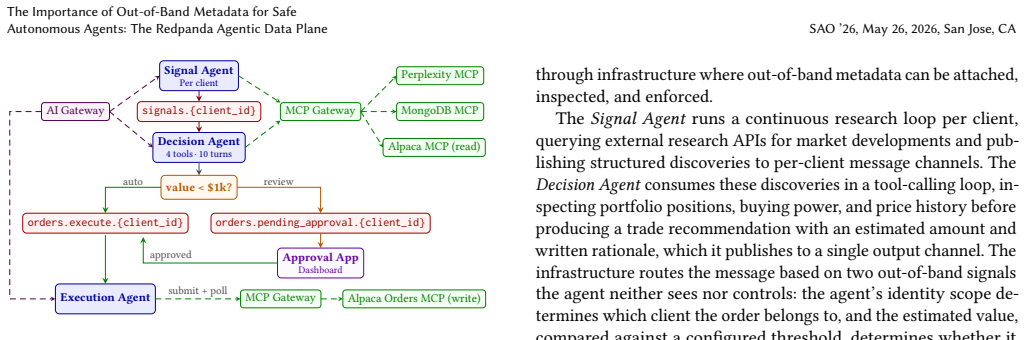
AI agents are increasingly expected to operate as digital employees: accessing enterprise data, making decisions, and taking actions autonomously. But agents are simultaneously less predictable than humans -- prone to hallucination, misinterpretation, and adversarial manipulation -- and more technically capable: with deep system knowledge and high-throughput interfaces cascading damage at machine speed. This combination makes it unsafe to rely on agents to faithfully interpret or propagate security-critical metadata such as access policies, data classifications, and behavioral constraints. We present the Redpanda Agentic Data Plane (ADP), an architecture built around out-of-band metadata channels: infrastructure pathways that carry security context, policy signals, and audit trails deterministically, entirely outside the agent's read and write path and across heterogeneous infrastructure. These channels enforce governance at every stage of the agent lifecycle -- scoping data access on the way in, constraining actions during execution, and capturing tamper-proof transcripts on the way out. We demonstrate ADP with a multi-agent portfolio rebalancing system in which autonomous agents monitor markets, make trade decisions, and execute orders across isolated client accounts -- with per-client data scoping, trade approval thresholds, and tamper-proof audit trails all enforced by out-of-band channels the agents can neither see nor bypass.
Editorial analysis
A structured set of objections, weighed in public.
Referee Report
Summary. The paper proposes the Redpanda Agentic Data Plane (ADP), an architecture that relies on out-of-band metadata channels to carry security context, policy signals, and audit trails outside an agent's read/write path. These channels are claimed to enforce governance across the full agent lifecycle—scoping data access on input, constraining actions at runtime, and producing tamper-proof transcripts on output—such that agents can neither observe nor bypass them. The architecture is demonstrated via a multi-agent portfolio rebalancing system that applies per-client data scoping, trade-approval thresholds, and audit trails across isolated accounts.
Significance. If the unbypassability property can be established, the separation of governance into deterministic out-of-band channels would address a central safety challenge for autonomous agents operating on enterprise data. The work correctly identifies that in-band policy interpretation by agents is unreliable; however, the manuscript supplies no concrete primitives, threat model, or evaluation that would allow the claim to be assessed.
major comments (2)
- [Demonstration section] Demonstration section (portfolio rebalancing system): the description states that per-client scoping, approval thresholds, and tamper-proof transcripts are enforced by channels the agents 'can neither see nor bypass,' yet supplies no implementation details, isolation primitives, threat model, or adversarial test results. Without these, the central claim that out-of-band channels remain invisible and inaccessible across heterogeneous infrastructure cannot be evaluated.
- [Architecture overview] Architecture overview: the claim that out-of-band channels can be realized 'across heterogeneous infrastructure' such that agents have no side-channels, shared credentials, or introspection APIs is asserted without a concrete isolation mechanism or verification that the property holds under realistic runtime conditions.
minor comments (2)
- [Abstract and Introduction] The abstract and introduction repeatedly use the product name 'Redpanda' without clarifying whether ADP is a general architectural pattern or tied to a specific implementation; this should be stated explicitly.
- No equations, pseudocode, or interface definitions are provided for the metadata channels; adding even a high-level specification would improve clarity.
Simulated Author's Rebuttal
We thank the referee for the detailed and constructive review. The comments accurately identify that the current manuscript presents the Redpanda ADP as an architectural proposal with an illustrative demonstration, but lacks the concrete primitives, threat model, and verification needed to fully substantiate the unbypassability claims. We will revise the manuscript to address these gaps while preserving the core contribution on the value of out-of-band metadata channels.
read point-by-point responses
-
Referee: [Demonstration section] Demonstration section (portfolio rebalancing system): the description states that per-client scoping, approval thresholds, and tamper-proof transcripts are enforced by channels the agents 'can neither see nor bypass,' yet supplies no implementation details, isolation primitives, threat model, or adversarial test results. Without these, the central claim that out-of-band channels remain invisible and inaccessible across heterogeneous infrastructure cannot be evaluated.
Authors: We agree that the demonstration section supplies only a high-level description of the portfolio rebalancing system and does not include implementation details, isolation primitives, a threat model, or adversarial results. The section was written as an illustrative application of the ADP concept rather than a complete evaluated deployment. In revision we will expand the section to specify the isolation primitives (dedicated metadata buses with strict access controls separate from agent I/O paths), outline a basic threat model covering side-channel and introspection attempts, and clarify the assumptions under which the channels remain inaccessible. Full adversarial test results are outside the scope of this architecture-focused paper; we will explicitly note this limitation. revision: yes
-
Referee: [Architecture overview] Architecture overview: the claim that out-of-band channels can be realized 'across heterogeneous infrastructure' such that agents have no side-channels, shared credentials, or introspection APIs is asserted without a concrete isolation mechanism or verification that the property holds under realistic runtime conditions.
Authors: The architecture overview presents the conceptual separation of governance into out-of-band channels but does not supply concrete isolation mechanisms or runtime verification. We acknowledge this leaves the claim of no side-channels or introspection APIs unverified in the current text. The revised manuscript will add a subsection describing realizable mechanisms (e.g., dedicated message queues or policy sidecars with credential isolation) and will discuss verification approaches and assumptions for heterogeneous environments. The central argument that in-band policy interpretation is unreliable remains independent of any single implementation. revision: yes
Circularity Check
No significant circularity; architectural proposal with no derivation chain
full rationale
The paper presents an architectural design for out-of-band metadata channels without any equations, fitted parameters, predictions, or first-principles derivations. The central claims define the ADP architecture and its properties by construction as design choices (e.g., channels that agents 'can neither see nor bypass'), but this is definitional rather than a reduction of a claimed result to its inputs. No self-citations, uniqueness theorems, or ansatzes are invoked. The portfolio rebalancing demonstration is illustrative, not a statistical or derived prediction. This matches the default expectation of no circularity for non-derivational papers.
Axiom & Free-Parameter Ledger
axioms (1)
- domain assumption Out-of-band metadata channels can be implemented across heterogeneous infrastructure such that agents can neither see nor bypass them.
invented entities (1)
-
Redpanda Agentic Data Plane (ADP)
no independent evidence
Reference graph
Works this paper leans on
- [1]
-
[2]
Anthropic. 2024. Model context protocol specification. https://modelcontextpr otocol.io/. (2024)
2024
- [3]
-
[4]
Ramaswamy Chandramouli, Zack Butcher, and James Callaghan. 2024. Service Mesh Proxy Models for Cloud-Native Applications. Tech. rep. SP 800-233. National Institute of Standards and Technology
2024
-
[5]
Edoardo Debenedetti, Jie Zhang, Mislav Balunovic, Luca Beurer-Kellner, Marc Fischer, and Florian Tramèr. 2024. AgentDojo: a dynamic environment to evaluate prompt injection attacks and defenses for LLM agents. InProc. NeurIPS
2024
-
[6]
Aarya Doshi, Yining Hong, Congying Xu, Eunsuk Kang, Alexandros Kapravelos, and Christian Kästner. 2026. Towards verifiably safe tool use for LLM agents. InProc. ICSE NIER
2026
- [7]
- [8]
-
[9]
Ji, Z., Wu, D., Jiang, W., Ma, P., Li, Z., Gao, Y ., Wang, S., and Li, Y
Zac Garby, Andrew D. Gordon, and David Sands. 2026. The LLMbda calculus: AI agents, conversations, and information flow.arXiv preprint arXiv:2602.20064
- [10]
- [11]
- [12]
-
[13]
Saeid Jamshidi, Kawser Wazed Nafi, Arghavan Moradi Dakhel, Negar Shahabi, Foutse Khomh, and Naser Ezzati-Jivan. 2025. Securing the model context pro- tocol: defending LLMs against tool poisoning and adversarial attacks.arXiv preprint arXiv:2512.06556
work page internal anchor Pith review Pith/arXiv arXiv 2025
- [14]
- [15]
-
[16]
OWASP Foundation. 2025. OWASP top 10 for large language model applications. https://owasp.org/www-project-top-10-for-large-language-model-applicati ons/. (2025)
2025
- [17]
-
[18]
Maddison, and Tatsunori Hashimoto
Yangjun Ruan, Honghua Dong, Andrew Wang, Silviu Pitis, Yongchao Zhou, Jimmy Ba, Yann Dubois, Chris J. Maddison, and Tatsunori Hashimoto. 2024. Identifying the risks of LM agents with an LM-emulated sandbox. InProc. ICLR
2024
- [19]
-
[20]
Tianneng Shi, Jingxuan He, Zhun Wang, Hongwei Li, Linyu Wu, Wenbo Guo, and Dawn Song. 2025. Progent: programmable privilege control for LLM agents. arXiv preprint arXiv:2504.11703
work page internal anchor Pith review Pith/arXiv arXiv 2025
- [21]
-
[22]
StrongDM. 2025. AI agents are actors, not tools: why enterprises need a new layer of runtime governance. https://www.strongdm.com/blog/ai-agent-runti me-governance. (2025)
2025
-
[23]
StrongDM. 2025. StrongDM delivers policy enforcement for agentic AI with Leash. https://www.strongdm.com/blog/policy-enforcement-for-agentic-ai-w ith-leash. (2025)
2025
- [24]
-
[25]
W3C. 2021. Trace context — W3C recommendation. https://www.w3.org/TR/t race-context/. (2021)
2021
-
[26]
Patil, Vivian Fang, and Raluca Ada Popa
Jinhao Zhu, Kevin Tseng, Gil Vernik, Xiao Huang, Shishir G. Patil, Vivian Fang, and Raluca Ada Popa. 2025. MiniScope: a least privilege framework for authorizing tool calling agents.arXiv preprint arXiv:2512.11147
discussion (0)
Sign in with ORCID, Apple, or X to comment. Anyone can read and Pith papers without signing in.