Toward User Preference Alignment in LLM Recommendation via Explicit Context Feedback
Pith reviewed 2026-06-29 09:28 UTC · model grok-4.3
The pith
LLM recommender systems should prioritize explicit context feedback from user comments to achieve better preference alignment.
A machine-rendered reading of the paper's core claim, the machinery that carries it, and where it could break.
Core claim
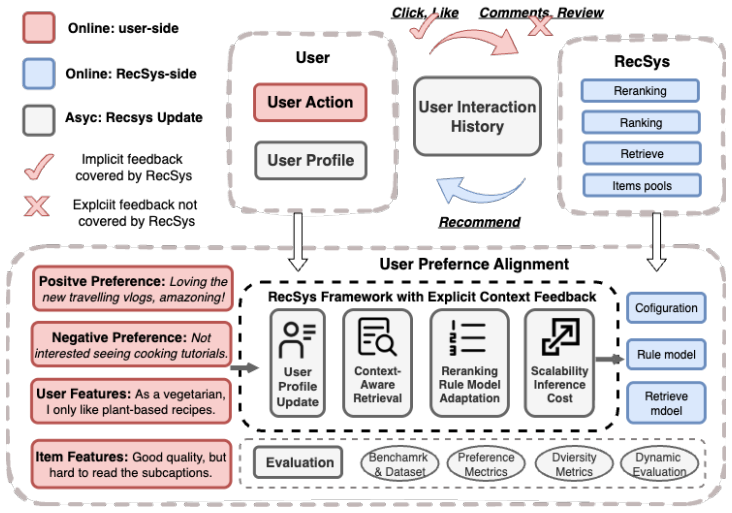
Explicit context feedback captures nuanced reasons behind user decisions and offers heterogeneous information for preference alignment and explainable recommendations. Overlooking it misaligns preferences. Recent LLM advances allow harnessing user-generated content, but current systems still focus on metadata. The paper advocates prioritizing this feedback in next-generation LLM-based RecSys through new frameworks for integration.
What carries the argument
Frameworks for integrating explicit user signals into scalable LLM-driven RecSys, which use context-rich feedback to model user preferences.
If this is right
- More accurate recommendations by understanding semantic context behind choices.
- Reduced filter bubbles through better preference alignment.
- Enhanced explainability of why certain items are recommended.
- Development of new benchmarks and metrics focused on context feedback.
- Scalable integration of user text signals into LLM systems.
Where Pith is reading between the lines
- Platforms might need to redesign interfaces to collect more explicit feedback.
- This approach could generalize to other AI systems that model user intent from text.
- Potential to address biases in recommendations by incorporating diverse user expressions.
Load-bearing premise
Explicit context feedback is underutilized and LLMs can harness it effectively for preference alignment without introducing scalability or bias issues.
What would settle it
Comparing an LLM recommender using only implicit data against one that also processes explicit review text, measuring differences in accuracy, diversity, and explanation quality.
Figures
read the original abstract
Traditional recommender systems (RecSys) primarily infer user preferences from implicit signals (such as clicks, watches, and purchases), often neglecting the rich explicit contextual feedback users provide through verbal text, like comments and reviews. This explicit context feedback captures the nuanced reasons behind user decisions regarding their preferences. In addition, it offers critical heterogeneous information for user preference alignment and more explainable recommendations. Overlooking such signals can lead to misaligned user preferences and further reinforce filter bubbles, as algorithms fail to understand the "semantic context" behind user choices. Recent advances in Large Language Models (LLMs) present new opportunities to harness user-generated content for more accurate and diverse recommendations, yet current LLM-based recommendations still focus on using item meta-data and underutilize this resource. In this paper, we advocate for prioritizing explicit context feedback in the next generation of LLM-based RecSys. We review the evolution of recommendation paradigms, highlight the value of context-rich feedback, call for new benchmarks and metrics, and introduce frameworks for integrating explicit user signals into scalable LLM-driven RecSys. Centering on user-preference modeling, we aim to foster more personalized, transparent, and explainable RecSys online platforms.
Editorial analysis
A structured set of objections, weighed in public.
Referee Report
Summary. The manuscript is a position paper advocating prioritization of explicit context feedback (user comments, reviews, and verbal text) in LLM-based recommender systems. It contrasts this with traditional implicit-signal RecSys and current LLM approaches that rely primarily on item metadata, arguing that explicit signals capture semantic reasons for preferences, enable better alignment, diversity, and explainability, and help avoid filter bubbles. The paper reviews the evolution of recommendation paradigms, highlights the value of context-rich feedback, calls for new benchmarks and metrics, and introduces high-level frameworks for integrating these signals into scalable LLM-driven systems.
Significance. If the advocated shift proves effective, the work could stimulate research on semantically richer user modeling in RecSys, addressing limitations in personalization and transparency. The call for new benchmarks targets an evaluation gap in context-aware LLM recommendations. As a position paper with frameworks, it provides a conceptual roadmap rather than empirical results.
major comments (2)
- [Abstract] Abstract: The central motivation—that 'current LLM-based recommendations still focus on using item meta-data and underutilize this resource'—is stated without citing specific prior LLM-RecSys works or providing even a brief survey of current practices. This undercuts the load-bearing claim that explicit context feedback is a neglected opportunity.
- The introduced frameworks for integrating explicit user signals are described only at a conceptual level with no discussion of implementation challenges (e.g., handling noisy or sparse textual feedback at scale, or potential introduction of new biases from LLM processing of reviews). This weakens the claim of 'scalable LLM-driven RecSys' without concrete grounding.
minor comments (1)
- The review of recommendation paradigms would benefit from explicit section headings or a timeline figure to improve readability for readers unfamiliar with the historical arc.
Simulated Author's Rebuttal
We thank the referee for the thoughtful review and constructive suggestions. As a position paper, our goal is to outline a conceptual direction rather than provide exhaustive empirical validation. We address each major comment below and will incorporate revisions to strengthen the manuscript.
read point-by-point responses
-
Referee: [Abstract] Abstract: The central motivation—that 'current LLM-based recommendations still focus on using item meta-data and underutilize this resource'—is stated without citing specific prior LLM-RecSys works or providing even a brief survey of current practices. This undercuts the load-bearing claim that explicit context feedback is a neglected opportunity.
Authors: We agree that the abstract would benefit from explicit citations to support the claim. In the revised manuscript, we will add representative references to recent LLM-RecSys works that primarily rely on item metadata (such as those focusing on sequential recommendation or metadata-augmented prompting) and include a concise survey of prevailing practices in the introduction section to better ground the motivation. revision: yes
-
Referee: The introduced frameworks for integrating explicit user signals are described only at a conceptual level with no discussion of implementation challenges (e.g., handling noisy or sparse textual feedback at scale, or potential introduction of new biases from LLM processing of reviews). This weakens the claim of 'scalable LLM-driven RecSys' without concrete grounding.
Authors: The frameworks are presented at a high level consistent with the position-paper format, which prioritizes vision over detailed engineering. However, we acknowledge that briefly addressing implementation realities would improve the discussion of scalability. We will add a short paragraph in the frameworks section noting key challenges, including noise and sparsity in textual feedback, computational scaling considerations, and potential biases introduced by LLM interpretation of reviews. revision: yes
Circularity Check
Position paper with no derivation chain
full rationale
This is a position paper that reviews prior paradigms, argues for prioritizing explicit context feedback in LLM-based RecSys, and outlines high-level frameworks plus calls for new benchmarks. It contains no equations, no fitted parameters, no predictions of quantities, and no derivation steps that could reduce to inputs by construction or via self-citation chains. All central claims are aspirational advocacy rather than technical assertions whose correctness depends on an internal chain that loops back to the paper's own definitions or fits.
Axiom & Free-Parameter Ledger
Reference graph
Works this paper leans on
-
[1]
Recommender systems based on user reviews: the state of the art,
L. Chen, G. Chen, and F. Wang, “Recommender systems based on user reviews: the state of the art,”User Modeling and User-Adapted Interaction, vol. 25, no. 2, pp. 99–154, 2015
2015
-
[2]
Based recommender systems: a survey of approaches, challenges and future perspectives,
E. Hasan, M. Rahman, C. Ding, J. Huang, and S. Raza, “Based recommender systems: a survey of approaches, challenges and future perspectives,”ACM Computing Surveys, 2024
2024
-
[3]
A review-aware graph contrastive learning framework for recommenda- tion,
J. Shuai, K. Zhang, L. Wu, P. Sun, R. Hong, M. Wang, and Y . Li, “A review-aware graph contrastive learning framework for recommenda- tion,” inProceedings of the 45th international ACM SIGIR conference on research and development in information retrieval, 2022, pp. 1283– 1293
2022
-
[4]
Counterfactual review-based recommendation,
K. Xiong, W. Ye, X. Chen, Y . Zhang, W. X. Zhao, B. Hu, Z. Zhang, and J. Zhou, “Counterfactual review-based recommendation,” inProceedings of the 30th ACM International Conference on Information & Knowledge Management, 2021, pp. 2231–2240
2021
-
[5]
Beyond explicit and implicit: How users provide feedback to shape personalized recommen- dation content,
W. Li, J.-C. Kuo, M. Sheng, P. Zhang, and Q. Wu, “Beyond explicit and implicit: How users provide feedback to shape personalized recommen- dation content,” inProceedings of the 2025 CHI Conference on Human Factors in Computing Systems, 2025, pp. 1–17
2025
-
[6]
OneRec: Unifying Retrieve and Rank with Generative Recommender and Iterative Preference Alignment
J. Deng, S. Wang, K. Cai, L. Ren, Q. Hu, W. Ding, Q. Luo, and G. Zhou, “Onerec: Unifying retrieve and rank with generative recommender and iterative preference alignment,”arXiv preprint arXiv:2502.18965, 2025
work page internal anchor Pith review Pith/arXiv arXiv 2025
-
[7]
Tutorial on large language models for recommendation,
W. Hua, L. Li, S. Xu, L. Chen, and Y . Zhang, “Tutorial on large language models for recommendation,” inProceedings of the 17th ACM Conference on Recommender Systems, 2023, pp. 1281–1283
2023
-
[8]
LLM-based User Profile Management for Recommender System
S. Bang and H. Song, “Llm-based user profile management for recom- mender system,”arXiv preprint arXiv:2502.14541, 2025
work page internal anchor Pith review Pith/arXiv arXiv 2025
-
[9]
User feedback alignment for llm-powered exploration in large-scale recommendation systems,
J. Wang, Y . Liu, Y . Sun, X. Ma, Y . Wang, H. Ma, Z. Su, M. Chen, M. Gao, O. Dalalet al., “User feedback alignment for llm-powered exploration in large-scale recommendation systems,”arXiv preprint arXiv:2504.05522, 2025
-
[10]
Content-based recommendation systems,
M. J. Pazzani and D. Billsus, “Content-based recommendation systems,” inThe adaptive web: methods and strategies of web personalization. Springer, 2007, pp. 325–341
2007
-
[11]
A review of content-based and context-based recommendation systems,
U. Javed, K. Shaukat, I. A. Hameed, F. Iqbal, T. M. Alam, and S. Luo, “A review of content-based and context-based recommendation systems,” International Journal of Emerging Technologies in Learning (iJET), vol. 16, no. 3, pp. 274–306, 2021
2021
-
[12]
Wide & deep learning for recommender systems,
H.-T. Cheng, L. Koc, J. Harmsen, T. Shaked, T. Chandra, H. Aradhye, G. Anderson, G. Corrado, W. Chai, M. Ispiret al., “Wide & deep learning for recommender systems,” inProceedings of the 1st workshop on deep learning for recommender systems, 2016, pp. 7–10
2016
-
[13]
Deepfm: a factorization- machine based neural network for ctr prediction,
H. Guo, R. Tang, Y . Ye, Z. Li, and X. He, “Deepfm: a factorization- machine based neural network for ctr prediction,” inProceedings of the 26th International Joint Conference on Artificial Intelligence, 2017, pp. 1725–1731
2017
-
[14]
Deep & cross network for ad click predictions,
R. Wang, B. Fu, G. Fu, and M. Wang, “Deep & cross network for ad click predictions,” inProceedings of the ADKDD’17, 2017, pp. 1–7
2017
-
[15]
Learning deep structured semantic models for web search using clickthrough data,
P.-S. Huang, X. He, J. Gao, L. Deng, A. Acero, and L. Heck, “Learning deep structured semantic models for web search using clickthrough data,” inProceedings of the 22nd ACM international conference on Information & Knowledge Management, 2013, pp. 2333–2338
2013
-
[16]
W. Zhang, Y . Bei, L. Yang, H. P. Zou, P. Zhou, A. Liu, Y . Li, H. Chen, J. Wang, Y . Wanget al., “Cold-start recommendation towards the era of large language models (llms): A comprehensive survey and roadmap,” arXiv preprint arXiv:2501.01945, 2025
-
[17]
Diversity, serendipity, novelty, and coverage: a survey and empirical analysis of beyond-accuracy objectives in recommender systems,
M. Kaminskas and D. Bridge, “Diversity, serendipity, novelty, and coverage: a survey and empirical analysis of beyond-accuracy objectives in recommender systems,”ACM Transactions on Interactive Intelligent Systems (TiiS), vol. 7, no. 1, pp. 1–42, 2016
2016
-
[18]
Echo chambers, filter bubbles, and polarisation: A literature review,
A. Ross Arguedas, C. Robertson, R. Fletcher, and R. Nielsen, “Echo chambers, filter bubbles, and polarisation: A literature review,” 2022
2022
-
[19]
Advances in collaborative filtering,
Y . Koren, S. Rendle, and R. Bell, “Advances in collaborative filtering,” Recommender systems handbook, pp. 91–142, 2021
2021
-
[20]
Mixed supervised graph contrastive learning for recommendation,
W. Zhang, L. Yang, Z. Song, H. P. Zou, K. Xu, Y . Zhu, and P. S. Yu, “Mixed supervised graph contrastive learning for recommendation,” arXiv preprint arXiv:2404.15954, 2024
-
[21]
A collaborative filtering recommender systems: Survey,
M. F. Aljunid, D. Manjaiah, M. K. Hooshmand, W. A. Ali, A. M. Shetty, and S. Q. Alzoubah, “A collaborative filtering recommender systems: Survey,”Neurocomputing, vol. 617, p. 128718, 2025
2025
-
[22]
Prob- abilistic memory-based collaborative filtering,
K. Yu, A. Schwaighofer, V . Tresp, X. Xu, and H.-P. Kriegel, “Prob- abilistic memory-based collaborative filtering,”IEEE Transactions on Knowledge and Data Engineering, vol. 16, no. 1, pp. 56–69, 2004
2004
-
[23]
Model-based collaborative filtering,
C. C. Aggarwal, “Model-based collaborative filtering,” inRecommender systems: the textbook. Springer, 2016, pp. 71–138
2016
-
[24]
Matrix factorization model in collaborative filtering algorithms: A survey,
D. Bokde, S. Girase, and D. Mukhopadhyay, “Matrix factorization model in collaborative filtering algorithms: A survey,”Procedia Computer Science, vol. 49, pp. 136–146, 2015
2015
-
[25]
Neural col- laborative filtering,
X. He, L. Liao, H. Zhang, L. Nie, X. Hu, and T.-S. Chua, “Neural col- laborative filtering,” inProceedings of the 26th international conference on world wide web, 2017, pp. 173–182
2017
-
[26]
A comprehensive survey on graph neural networks,
Z. Wu, S. Pan, F. Chen, G. Long, C. Zhang, and P. S. Yu, “A comprehensive survey on graph neural networks,”IEEE transactions on neural networks and learning systems, vol. 32, no. 1, pp. 4–24, 2020
2020
-
[27]
Graph-based village level poverty identification,
J. Ma, L. Yang, Q. Feng, W. Zhang, and P. S. Yu, “Graph-based village level poverty identification,” inProceedings of the ACM web conference 2023, 2023, pp. 4115–4119
2023
-
[28]
Lightgcn: Simplifying and powering graph convolution network for recommenda- tion,
X. He, K. Deng, X. Wang, Y . Li, Y . Zhang, and M. Wang, “Lightgcn: Simplifying and powering graph convolution network for recommenda- tion,” inProceedings of the 43rd International ACM SIGIR conference on research and development in Information Retrieval, 2020, pp. 639– 648
2020
-
[29]
Self- supervised graph learning for recommendation,
J. Wu, X. Wang, F. Feng, X. He, L. Chen, J. Lian, and X. Xie, “Self- supervised graph learning for recommendation,” inProceedings of the 44th international ACM SIGIR conference on research and development in information retrieval, 2021, pp. 726–735
2021
-
[30]
Are graph augmentations necessary? simple graph contrastive learning for recommendation,
J. Yu, H. Yin, X. Xia, T. Chen, L. Cui, and Q. V . H. Nguyen, “Are graph augmentations necessary? simple graph contrastive learning for recommendation,” inProceedings of the 45th international ACM SIGIR conference on research and development in information retrieval, 2022, pp. 1294–1303
2022
-
[31]
Sgcl: Unifying self-supervised and supervised learning for graph recommendation,
W. Zhang, L. Yang, Z. Song, H. P. Zou, K. Xu, Y . Zhu, and P. S. Yu, “Sgcl: Unifying self-supervised and supervised learning for graph recommendation,” inProceedings of the Nineteenth ACM Conference on Recommender Systems, 2025, pp. 671–676
2025
-
[32]
Ultragcn: ultra simplification of graph convolutional networks for recommendation,
K. Mao, J. Zhu, X. Xiao, B. Lu, Z. Wang, and X. He, “Ultragcn: ultra simplification of graph convolutional networks for recommendation,” in Proceedings of the 30th ACM international conference on information & knowledge management, 2021, pp. 1253–1262
2021
-
[33]
Do we really need graph convolution during training? light post- training graph-ode for efficient recommendation,
W. Zhang, L. Yang, Z. Song, H. P. Zou, K. Xu, L. Fang, and P. S. Yu, “Do we really need graph convolution during training? light post- training graph-ode for efficient recommendation,” inProceedings of the 33rd ACM International Conference on Information and Knowledge Management, 2024, pp. 3248–3258
2024
-
[34]
Graph neural ordinary differential equations-based method for collaborative filtering,
K. Xu, Y . Zhu, W. Zhang, and P. S. Yu, “Graph neural ordinary differential equations-based method for collaborative filtering,” in2023 IEEE International Conference on Data Mining (ICDM). IEEE, 2023, pp. 1445–1450
2023
-
[35]
Graph neural con- trolled differential equations for collaborative filtering,
K. Xu, W. Zhang, Z. Song, Y . Zhu, and P. S. Yu, “Graph neural con- trolled differential equations for collaborative filtering,” inCompanion Proceedings of the ACM on Web Conference 2025, 2025, pp. 1446–1449
2025
-
[36]
Bias and debias in recommender system: A survey and future directions,
J. Chen, H. Dong, X. Wang, F. Feng, M. Wang, and X. He, “Bias and debias in recommender system: A survey and future directions,”ACM Transactions on Information Systems, vol. 41, no. 3, pp. 1–39, 2023
2023
-
[37]
A survey on popularity bias in recommender systems,
A. Klimashevskaia, D. Jannach, M. Elahi, and C. Trattner, “A survey on popularity bias in recommender systems,”User Modeling and User- Adapted Interaction, vol. 34, no. 5, pp. 1777–1834, 2024
2024
-
[38]
Sequential recommender systems: challenges, progress and prospects,
S. Wang, L. Hu, Y . Wang, L. Cao, Q. Z. Sheng, and M. Orgun, “Sequential recommender systems: challenges, progress and prospects,” arXiv preprint arXiv:2001.04830, 2019
-
[39]
Factorizing personalized markov chains for next-basket recommendation,
S. Rendle, C. Freudenthaler, and L. Schmidt-Thieme, “Factorizing personalized markov chains for next-basket recommendation,” inPro- ceedings of the 19th international conference on World wide web, 2010, pp. 811–820
2010
-
[40]
Session-based Recommendations with Recurrent Neural Networks
B. Hidasi, A. Karatzoglou, L. Baltrunas, and D. Tikk, “Session- based recommendations with recurrent neural networks,”arXiv preprint arXiv:1511.06939, 2015
work page internal anchor Pith review Pith/arXiv arXiv 2015
-
[41]
Self-attentive sequential recommenda- tion,
W.-C. Kang and J. McAuley, “Self-attentive sequential recommenda- tion,” in2018 IEEE international conference on data mining (ICDM). IEEE, 2018, pp. 197–206
2018
-
[42]
Bert4rec: Sequential recommendation with bidirectional encoder representations from transformer,
F. Sun, J. Liu, J. Wu, C. Pei, X. Lin, W. Ou, and P. Jiang, “Bert4rec: Sequential recommendation with bidirectional encoder representations from transformer,” inProceedings of the 28th ACM international confer- ence on information and knowledge management, 2019, pp. 1441–1450
2019
-
[43]
Recommender systems in the era of large language models (llms),
Z. Zhao, W. Fan, J. Li, Y . Liu, X. Mei, Y . Wang, Z. Wen, F. Wang, X. Zhao, J. Tanget al., “Recommender systems in the era of large language models (llms),”IEEE Transactions on Knowledge and Data Engineering, vol. 36, no. 11, pp. 6889–6907, 2024
2024
-
[44]
Text is all you need: Learning language representations for sequential recommendation,
J. Li, M. Wang, J. Li, J. Fu, X. Shen, J. Shang, and J. McAuley, “Text is all you need: Learning language representations for sequential recommendation,” inProceedings of the 29th ACM SIGKDD Conference on Knowledge Discovery and Data Mining, 2023, pp. 1258–1267
2023
-
[45]
Recommendation as language processing (rlp): A unified pretrain, personalized prompt & predict paradigm (p5),
S. Geng, S. Liu, Z. Fu, Y . Ge, and Y . Zhang, “Recommendation as language processing (rlp): A unified pretrain, personalized prompt & predict paradigm (p5),” inProceedings of the 16th ACM conference on recommender systems, 2022, pp. 299–315
2022
-
[46]
Large language models are zero-shot rankers for recommender systems,
Y . Hou, J. Zhang, Z. Lin, H. Lu, R. Xie, J. McAuley, and W. X. Zhao, “Large language models are zero-shot rankers for recommender systems,” inEuropean Conference on Information Retrieval. Springer, 2024, pp. 364–381
2024
-
[47]
The movielens datasets: History and context,
F. M. Harper and J. A. Konstan, “The movielens datasets: History and context,”Acm transactions on interactive intelligent systems (tiis), vol. 5, no. 4, pp. 1–19, 2015
2015
-
[48]
Bridging Language and Items for Retrieval and Recommendation: Benchmarking LLMs as Semantic Encoders
Y . Hou, J. Li, Z. He, A. Yan, X. Chen, and J. McAuley, “Bridging language and items for retrieval and recommendation,”arXiv preprint arXiv:2403.03952, 2024
work page internal anchor Pith review Pith/arXiv arXiv 2024
-
[49]
Improving aggregate recommendation diversity using ranking-based techniques,
G. Adomavicius and Y . Kwon, “Improving aggregate recommendation diversity using ranking-based techniques,”IEEE Transactions on Knowl- edge and Data Engineering, vol. 24, no. 5, pp. 896–911, 2011
2011
-
[50]
Novelty and diversity in top-n recommendation–analysis and evaluation,
N. Hurley and M. Zhang, “Novelty and diversity in top-n recommendation–analysis and evaluation,”ACM Transactions on Inter- net Technology (TOIT), vol. 10, no. 4, pp. 1–30, 2011
2011
-
[51]
Joint deep modeling of users and items using reviews for recommendation,
L. Zheng, V . Noroozi, and P. S. Yu, “Joint deep modeling of users and items using reviews for recommendation,” inProceedings of the tenth ACM international conference on web search and data mining, 2017, pp. 425–434
2017
-
[52]
Neural attentional rating regression with review-level explanations,
C. Chen, M. Zhang, Y . Liu, and S. Ma, “Neural attentional rating regression with review-level explanations,” inProceedings of the 2018 world wide web conference, 2018, pp. 1583–1592
2018
-
[53]
A contrastive framework with user, item and review alignment for recommendation,
H. V . Dong, Y . Fang, and H. W. Lauw, “A contrastive framework with user, item and review alignment for recommendation,” inProceedings of the Eighteenth ACM International Conference on Web Search and Data Mining, 2025, pp. 117–126
2025
-
[54]
Item cluster-aware prompt learning for session-based recommendation,
W. Yang, C. Wang, Z. Song, W. Zhang, and P. S. Yu, “Item cluster-aware prompt learning for session-based recommendation,”arXiv preprint arXiv:2410.04756, 2024
-
[55]
Rdrec: Rationale distilla- tion for llm-based recommendation,
X. Wang, J. Cui, Y . Suzuki, and F. Fukumoto, “Rdrec: Rationale distilla- tion for llm-based recommendation,”arXiv preprint arXiv:2405.10587, 2024
-
[56]
Liu,Sentiment analysis and opinion mining
B. Liu,Sentiment analysis and opinion mining. Springer Nature, 2022
2022
-
[57]
Contrastive learning for cold-start recommendation,
Y . Wei, X. Wang, Q. Li, L. Nie, Y . Li, X. Li, and T.-S. Chua, “Contrastive learning for cold-start recommendation,” inProceedings of the 29th ACM international conference on multimedia, 2021, pp. 5382–5390
2021
-
[58]
Learning from negative user feedback and measuring responsiveness for sequential recommenders,
Y . Wang, Y . Halpern, S. Chang, J. Feng, E. Y . Le, L. Li, X. Liang, M.-C. Huang, S. Li, A. Beutelet al., “Learning from negative user feedback and measuring responsiveness for sequential recommenders,” inProceedings of the 17th ACM Conference on Recommender Systems, 2023, pp. 1049–1053
2023
-
[59]
Context-aware recommender sys- tems,
G. Adomavicius and A. Tuzhilin, “Context-aware recommender sys- tems,” inRecommender systems handbook. Springer, 2010, pp. 217– 253
2010
-
[60]
Memory and new controls for chatgpt,
OpenAI, “Memory and new controls for chatgpt,” https://openai.com/index/memory-and-new-controls-for-chatgpt/, 2024, accessed: 2025-09-26
2024
-
[61]
Claude introduces memory for teams at work,
Anthropic, “Claude introduces memory for teams at work,” https://www.anthropic.com/news/memory, 2024, accessed: 2025-09-26
2024
-
[62]
Human-inspired perspectives: A survey on ai long-term memory,
L. Heet al., “Human-inspired perspectives: A survey on ai long-term memory,”arXiv preprint arXiv:2411.00489, 2024
-
[63]
Ader: Adaptively distilled exemplar replay towards continual learning for session-based recommendation,
F. Mi, X. Lin, and B. Faltings, “Ader: Adaptively distilled exemplar replay towards continual learning for session-based recommendation,” inProceedings of the 14th ACM Conference on Recommender Systems, 2020, pp. 408–413
2020
-
[64]
Rating and aspect-based opinion graph embeddings for explainable recommendations,
I. Cantador, A. Carvallo, and F. Diez, “Rating and aspect-based opinion graph embeddings for explainable recommendations,”arXiv preprint arXiv:2107.03385, 2021
-
[65]
Askat: Aspect sentiment knowledge graph attention network for recommendation,
Y . Cui, P. Zhou, H. Yu, P. Sun, H. Cao, and P. Yang, “Askat: Aspect sentiment knowledge graph attention network for recommendation,” Electronics, vol. 13, no. 1, p. 216, 2024
2024
-
[66]
Disentangled graph contrastive learning for review-based recommendation,
Y . Ren, H. Zhang, Q. Li, L. Fu, J. Ding, X. Cao, X. Wang, and C. Zhou, “Disentangled graph contrastive learning for review-based recommendation,”arXiv preprint arXiv:2209.01524, 2022
-
[67]
Learning hierarchical review graph representations for recommendation,
Y . Liu, S. Yang, Y . Zhang, C. Miao, Z. Nie, and J. Zhang, “Learning hierarchical review graph representations for recommendation,”IEEE Transactions on Knowledge and Data Engineering, vol. 35, no. 1, pp. 658–671, 2021
2021
-
[68]
Personax: A recommendation agent oriented user modeling framework for long behavior sequence,
Y . Shi, W. Xu, Z. Zhang, X. Zi, Q. Wu, and M. Xu, “Personax: A recommendation agent oriented user modeling framework for long behavior sequence,”arXiv preprint arXiv:2503.02398, 2025
-
[69]
PersonaAgent: Bridging Memory and Action for Personalized LLM Agents
W. Zhang, X. Zhang, C. Zhang, L. Yang, J. Shang, Z. Wei, H. P. Zou, Z. Huang, Z. Wang, Y . Gaoet al., “Personaagent: When large language model agents meet personalization at test time,”arXiv preprint arXiv:2506.06254, 2025
work page internal anchor Pith review Pith/arXiv arXiv 2025
-
[70]
Knowledge graph self- supervised rationalization for recommendation,
Y . Yang, C. Huang, L. Xia, and C. Huang, “Knowledge graph self- supervised rationalization for recommendation,” inProceedings of the 29th ACM SIGKDD conference on knowledge discovery and data mining, 2023, pp. 3046–3056
2023
-
[71]
Llminit: A free lunch from large language models for selective initialization of recommendation,
W. Zhang, L. Yang, W. Yang, H. P. Zou, Y . Liu, K. Xu, S. Medya, and P. S. Yu, “Llminit: A free lunch from large language models for selective initialization of recommendation,”arXiv preprint arXiv:2503.01814, 2025
-
[72]
Graphs meet ai agents: Taxonomy, progress, and future opportunities,
Y . Bei, W. Zhang, S. Wang, W. Chen, S. Zhou, H. Chen, Y . Li, J. Bu, S. Pan, Y . Yuet al., “Graphs meet ai agents: Taxonomy, progress, and future opportunities,”arXiv preprint arXiv:2506.18019, 2025
-
[73]
Explainable recommendation: A survey and new perspectives,
Y . Zhang, X. Chenet al., “Explainable recommendation: A survey and new perspectives,”Foundations and Trends® in Information Retrieval, vol. 14, no. 1, pp. 1–101, 2020
2020
-
[74]
Retrieval- augmented generation for knowledge-intensive nlp tasks,
P. Lewis, E. Perez, A. Piktus, F. Petroni, V . Karpukhin, N. Goyal, H. K ¨uttler, M. Lewis, W.-t. Yih, T. Rockt ¨aschelet al., “Retrieval- augmented generation for knowledge-intensive nlp tasks,”Advances in neural information processing systems, vol. 33, pp. 9459–9474, 2020
2020
-
[75]
Cold- start recommendation with knowledge-guided retrieval-augmented gen- eration,
W. Yang, W. Zhang, Y . Liu, Y . Han, Y . Wang, J. Lee, and P. S. Yu, “Cold- start recommendation with knowledge-guided retrieval-augmented gen- eration,”arXiv preprint arXiv:2505.20773, 2025
-
[76]
Improving recommendation lists through topic diversification,
C.-N. Ziegler, S. M. McNee, J. A. Konstan, and G. Lausen, “Improving recommendation lists through topic diversification,” inProceedings of the 14th international conference on World Wide Web, 2005, pp. 22–32
2005
-
[77]
Hybrid recommender systems: Survey and experiments,
R. Burke, “Hybrid recommender systems: Survey and experiments,” User modeling and user-adapted interaction, vol. 12, no. 4, pp. 331–370, 2002
2002
-
[78]
J. Gu, X. Jiang, Z. Shi, H. Tan, X. Zhai, C. Xu, W. Li, Y . Shen, S. Ma, H. Liuet al., “A survey on llm-as-a-judge,”arXiv preprint arXiv:2411.15594, 2024
work page internal anchor Pith review Pith/arXiv arXiv 2024
-
[79]
Image-based recommendations on styles and substitutes,
J. McAuley, C. Targett, Q. Shi, and A. Van Den Hengel, “Image-based recommendations on styles and substitutes,” inProceedings of the 38th international ACM SIGIR conference on research and development in information retrieval, 2015, pp. 43–52
2015
-
[80]
Atten- tive collaborative filtering: Multimedia recommendation with item-and component-level attention,
J. Chen, H. Zhang, X. He, L. Nie, W. Liu, and T.-S. Chua, “Atten- tive collaborative filtering: Multimedia recommendation with item-and component-level attention,” inProceedings of the 40th International ACM SIGIR conference on Research and Development in Information Retrieval, 2017, pp. 335–344
2017
discussion (0)
Sign in with ORCID, Apple, or X to comment. Anyone can read and Pith papers without signing in.