Restarted Accelerated Primal-Dual Algorithms with Adaptive Stepsizes for Nonlinear Conic Constrained Convex Optimization
Pith reviewed 2026-06-29 06:25 UTC · model grok-4.3
The pith
Restarted accelerated primal-dual algorithms achieve global linear convergence for nonlinear conic convex optimization under metric subregularity of the KKT mapping.
A machine-rendered reading of the paper's core claim, the machinery that carries it, and where it could break.
Core claim
For convex nonlinear conic programs, the restarted accelerated primal-dual algorithm with backtracking establishes global linear convergence by proving that metric subregularity of the KKT mapping implies quadratic growth of the self-centered smoothed duality gap; this holds even when extending metric subregularity conditions to certain nonconvex problems over polyhedral cones.
What carries the argument
The rAPDB algorithm combining fixed-frequency or adaptive restarts with monotone or non-monotone adaptive stepsize search, which adapts to local curvature in the non-bilinear minimax reformulation.
If this is right
- Global linear convergence rates are guaranteed for the proposed methods on problems satisfying the metric subregularity condition.
- The algorithms are first-order and thus scalable to large instances with GPU acceleration.
- Sufficient conditions ensure metric subregularity for nonconvex problems with convex polyhedral cones.
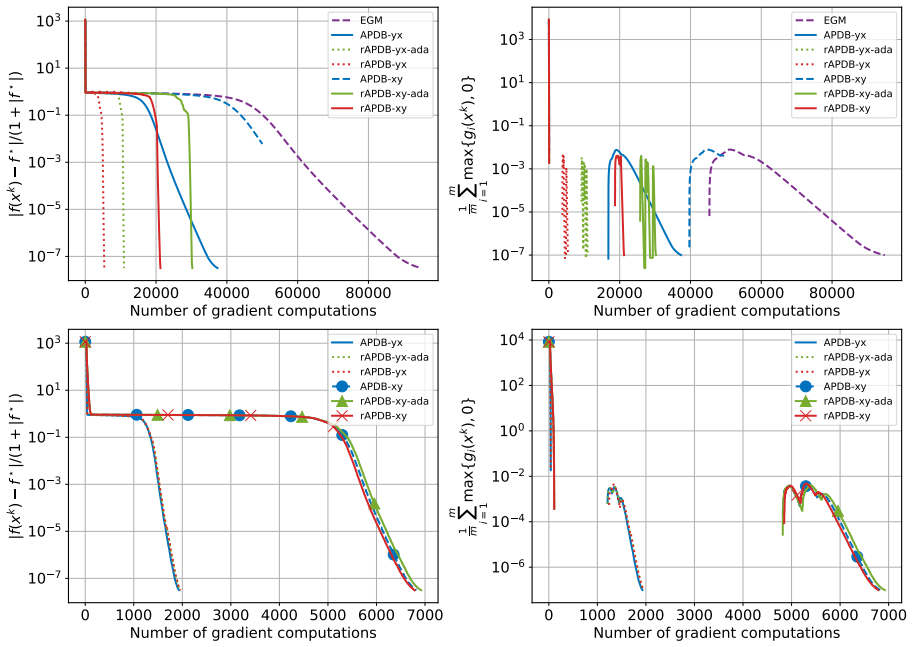
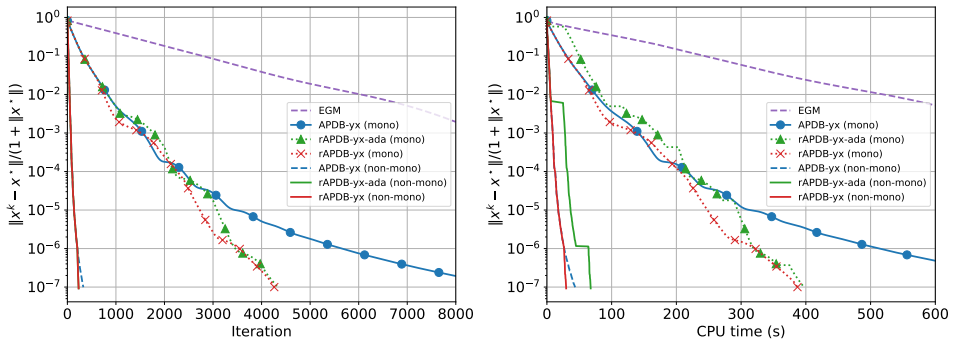
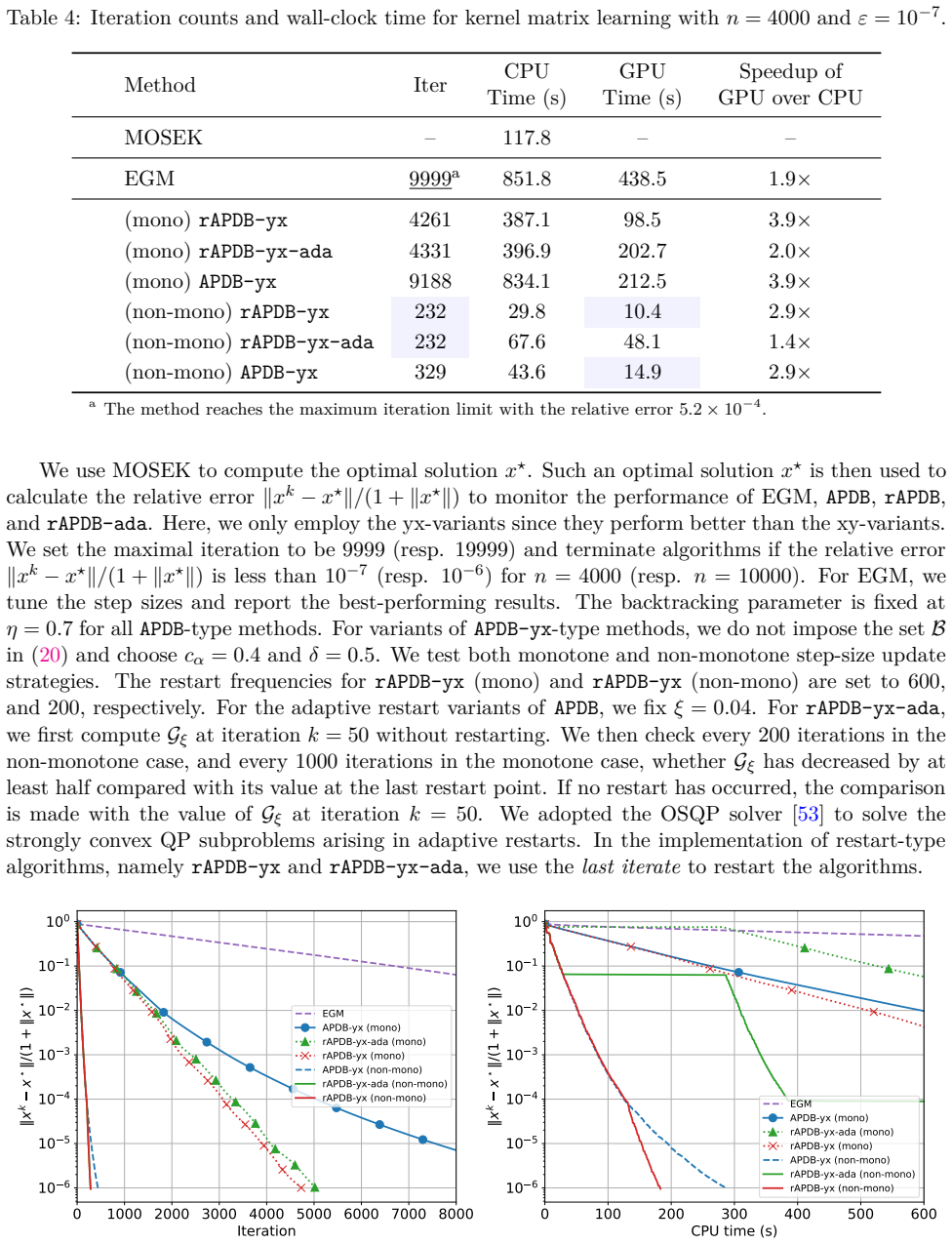
- Numerical tests confirm strong performance on random QCQPs and kernel matrix learning.
Where Pith is reading between the lines
- The non-monotone stepsize strategy may offer practical advantages in ill-conditioned problems beyond what linear convergence theory predicts.
- Similar restart schemes could apply to other accelerated methods in conic programming with nonlinear couplings.
- The quadratic growth property might be leveraged to derive rates for related duality gap measures in broader optimization settings.
Load-bearing premise
The KKT mapping of the optimization problem satisfies metric subregularity.
What would settle it
An instance of a nonlinear conic program where the KKT mapping is metrically subregular but the self-centered smoothed duality gap fails to exhibit quadratic growth, or where the algorithm convergence rate is observed to be sublinear.
Figures
read the original abstract
We propose restarted accelerated primal-dual algorithms with (non-monotone) backtracking (rAPDB) for convex nonlinear conic programs, with quadratically constrained quadratic programs (QCQPs) as a special case. Unlike linear and quadratic programs, these problems give rise to convex-concave minimax reformulations with non-bilinear coupling terms; therefore, the existing primal-dual methods for bilinear couplings are not applicable. To address this challenge, we build on the accelerated primal-dual method with adaptive stepsize search -- as it adapts to the local curvature -- and develop both fixed-frequency and adaptive restart schemes, incorporating both monotone and non-monotone adaptive step-size search strategies. The resulting algorithms require only first-order information and matrix-vector products, making them suitable for large-scale and GPU-accelerated implementation. Under metric subregularity of the KKT mapping, we prove a quadratic growth property for a self-centered smoothed duality gap and establish global linear convergence of the proposed restarted methods. We also establish sufficient conditions under which the metric subregularity holds even for general nonconvex problems over convex polyhedral cones. These results are new and may be of independent interest. Numerical experiments on random QCQPs and kernel matrix learning instances show that the proposed methods, especially with non-monotone adaptive stepsizes and GPU acceleration, achieve strong practical performance.
Editorial analysis
A structured set of objections, weighed in public.
Referee Report
Summary. The paper proposes restarted accelerated primal-dual algorithms with monotone and non-monotone adaptive backtracking stepsizes (rAPDB) for convex nonlinear conic programs (with QCQPs as a special case). It proves a quadratic growth property for a self-centered smoothed duality gap and global linear convergence of the restarted methods under the assumption of metric subregularity of the KKT mapping. Sufficient conditions for metric subregularity are also established for certain nonconvex problems over convex polyhedral cones. The algorithms use only first-order information and are tested numerically on random QCQPs and kernel matrix learning problems, showing strong practical performance especially with non-monotone stepsizes and GPU acceleration.
Significance. If the derivations hold, the work extends primal-dual convergence analysis beyond bilinear saddle-point problems to nonlinear couplings and supplies conditional linear-rate guarantees together with sufficient conditions for metric subregularity that may be of independent interest. The adaptive restart and backtracking schemes, combined with first-order and matrix-vector product requirements, position the methods for large-scale implementation.
major comments (2)
- [Abstract; main convergence theorems] Abstract and the statements of the main convergence theorems: global linear convergence is established only after deriving quadratic growth from metric subregularity of the KKT mapping. While sufficient conditions are supplied for polyhedral cones (including some nonconvex cases), no analogous conditions or verification procedure is given for general nonlinear cones; the assumption therefore remains external and problem-dependent for the primary problem class stated in the title.
- [Numerical experiments] Numerical experiments section: the reported runs demonstrate practical speed but contain no diagnostic checking whether metric subregularity holds on the test instances, nor any measured convergence rates that could corroborate the predicted linear regime. Without such checks the experiments do not directly support the linear-rate claim.
minor comments (2)
- [Preliminaries / notation] The precise definition and properties of the 'self-centered smoothed duality gap' should be stated with an equation number at the first appearance rather than deferred.
- [Introduction] A short discussion contrasting the new restart schemes with existing restart techniques for accelerated methods would improve readability.
Simulated Author's Rebuttal
We thank the referee for the careful reading and constructive comments on our manuscript. We address each major comment below and indicate whether revisions will be made.
read point-by-point responses
-
Referee: [Abstract; main convergence theorems] Abstract and the statements of the main convergence theorems: global linear convergence is established only after deriving quadratic growth from metric subregularity of the KKT mapping. While sufficient conditions are supplied for polyhedral cones (including some nonconvex cases), no analogous conditions or verification procedure is given for general nonlinear cones; the assumption therefore remains external and problem-dependent for the primary problem class stated in the title.
Authors: We agree that the linear convergence result is conditional on metric subregularity of the KKT mapping. The paper's main contribution is the development of the restarted algorithms together with the proof that this assumption implies quadratic growth of the self-centered smoothed duality gap and global linear convergence. Sufficient conditions are derived for the important subclass of convex polyhedral cones (covering QCQPs and other practical cases, including certain nonconvex problems). For general nonlinear cones, universal sufficient conditions are inherently problem-dependent because they rely on the specific geometry of the cone and the constraint functions; providing them would require case-by-case analysis that lies beyond the scope of the present work. We will revise the abstract and introduction to clarify the scope of the sufficient conditions and to state explicitly that the linear-rate guarantee holds under the metric-subregularity assumption, with the polyhedral case serving as a verifiable subclass. revision: partial
-
Referee: [Numerical experiments] Numerical experiments section: the reported runs demonstrate practical speed but contain no diagnostic checking whether metric subregularity holds on the test instances, nor any measured convergence rates that could corroborate the predicted linear regime. Without such checks the experiments do not directly support the linear-rate claim.
Authors: We acknowledge that the current numerical section does not include explicit verification of metric subregularity or quantitative rate measurements. Direct numerical verification of metric subregularity is difficult because it requires an accurate estimate of the solution set. In the revision we will add log-scale plots of the smoothed duality gap versus iteration count for the QCQP and kernel-matrix instances, together with estimated linear rates extracted from the later iterations. These additions will provide visual and quantitative support for the linear regime predicted by the theory. revision: yes
Circularity Check
No circularity; convergence rests on external metric subregularity assumption
full rationale
The derivation chain establishes quadratic growth and linear convergence explicitly under the external hypothesis of metric subregularity of the KKT mapping (abstract and theorem statements). Sufficient conditions for subregularity on polyhedral cones are supplied as independent results, not derived from the algorithm or prior self-citations. No self-definitional reductions, fitted inputs renamed as predictions, or load-bearing self-citation chains appear; the claims remain self-contained against the stated assumptions and do not reduce to their own inputs by construction.
Axiom & Free-Parameter Ledger
axioms (1)
- domain assumption Metric subregularity of the KKT mapping
Reference graph
Works this paper leans on
-
[1]
Second-order cone programming.Mathematical program- ming, 95(1):3–51, 2003
Farid Alizadeh and Donald Goldfarb. Second-order cone programming.Mathematical program- ming, 95(1):3–51, 2003
2003
-
[2]
Degenerate nonlinear programming with a quadratic growth condition.SIAM Journal on Optimization, 10(4):1116–1135, 2000
Mihai Anitescu. Degenerate nonlinear programming with a quadratic growth condition.SIAM Journal on Optimization, 10(4):1116–1135, 2000
2000
-
[3]
Practical large-scale linear programming using primal-dual hybrid gradient
David Applegate, Mateo Díaz, Oliver Hinder, Haihao Lu, Miles Lubin, Brendan O’Donoghue, and Warren Schudy. Practical large-scale linear programming using primal-dual hybrid gradient. Advances in Neural Information Processing Systems, 34:20243–20257, 2021
2021
-
[4]
PDLP: A practical first-order method for large-scale linear programming
David Applegate, Mateo Díaz, Oliver Hinder, Haihao Lu, Miles Lubin, Brendan O’Donoghue, and Warren Schudy. PDLP: A practical first-order method for large-scale linear programming. Mathematical Programming Computation, pages 1–45, 2026
2026
-
[5]
Fasterfirst-orderprimal-dualmeth- ods for linear programming using restarts and sharpness.Mathematical Programming, 201(1):133– 184, 2023
DavidApplegate, OliverHinder, HaihaoLu, andMilesLubin. Fasterfirst-orderprimal-dualmeth- ods for linear programming using restarts and sharpness.Mathematical Programming, 201(1):133– 184, 2023
2023
-
[6]
Parameter-free FISTA by adaptive restart and backtracking.SIAM Journal on Optimiza- tion, 34(4):3259–3285, 2024
Jean-François Aujol, Luca Calatroni, Charles Dossal, Hippolyte Labarrière, and Aude Ronde- pierre. Parameter-free FISTA by adaptive restart and backtracking.SIAM Journal on Optimiza- tion, 34(4):3259–3285, 2024
2024
-
[7]
A distributed ADMM-like method for resource sharing over time-varying networks.SIAM Journal on Optimization, 29(4):3036–3068, 2019
Necdet Serhat Aybat and Erfan Yazdandoost Hamedani. A distributed ADMM-like method for resource sharing over time-varying networks.SIAM Journal on Optimization, 29(4):3036–3068, 2019
2019
-
[8]
Projecting onto the intersection of a cone and a sphere.SIAM Journal on Optimization, 28(3):2158–2188, 2018
Heinz H Bauschke, Minh N Bui, and Xianfu Wang. Projecting onto the intersection of a cone and a sphere.SIAM Journal on Optimization, 28(3):2158–2188, 2018
2018
-
[9]
SIAM, 2001
Aharon Ben-Tal and Arkadi Nemirovski.Lectures on modern convex optimization: analysis, algorithms, and engineering applications. SIAM, 2001
2001
-
[10]
Springer Science & Business Media, 2000
J Frederic Bonnans and Alexander Shapiro.Perturbation Analysis of Optimization Problems. Springer Science & Business Media, 2000
2000
-
[11]
Cambridge University Press, 2004
Stephen Boyd and Lieven Vandenberghe.Convex optimization. Cambridge University Press, 2004
2004
-
[12]
Burke and Abraham Engle
James V. Burke and Abraham Engle. Strong metric (sub)regularity of Karush-Kuhn-Tucker map- pings for piecewise linear-quadratic convex-composite optimization and the quadratic convergence of Newton’s method.Mathematics of Operations Research, 45(3):1164–1192, 2020
2020
-
[13]
A first-order primal-dual algorithm for convex problems with applications to imaging.Journal of Mathematical Imaging and Vision, 40(1):120–145, 2011
Antonin Chambolle and Thomas Pock. A first-order primal-dual algorithm for convex problems with applications to imaging.Journal of Mathematical Imaging and Vision, 40(1):120–145, 2011
2011
-
[14]
On the ergodic convergence rates of a first-order primal– dual algorithm.Mathematical Programming, 159(1):253–287, 2016
Antonin Chambolle and Thomas Pock. On the ergodic convergence rates of a first-order primal– dual algorithm.Mathematical Programming, 159(1):253–287, 2016
2016
-
[15]
HPR-LP: An implementation of an HPR method for solving linear programming.Mathematical Programming Computation, pages 1–28, 2025
Kaihuang Chen, Defeng Sun, Yancheng Yuan, Guojun Zhang, and Xinyuan Zhao. HPR-LP: An implementation of an HPR method for solving linear programming.Mathematical Programming Computation, pages 1–28, 2025
2025
-
[16]
Kaihuang Chen, Defeng Sun, Yancheng Yuan, Guojun Zhang, and Xinyuan Zhao. HPR-QP: A dual Halpern Peaceman-Rachford method for solving large-scale convex composite quadratic programming.arXiv:2507.02470, 2025. 32
-
[17]
On the relationships among GPU-accelerated first-order methods for solving linear programming
Kaihuang Chen, Defeng Sun, Yancheng Yuan, Guojun Zhang, and Xinyuan Zhao. On the relationships among GPU-accelerated first-order methods for solving linear programming. arXiv:2509.23903, 2025
-
[18]
An exponential cone programming approach for managing electric vehicle charging.Operations Research, 72(5):2215–2240, 2024
Li Chen, Long He, and Yangfang Zhou. An exponential cone programming approach for managing electric vehicle charging.Operations Research, 72(5):2215–2240, 2024
2024
-
[19]
Alocalnearlylinearlyconvergentfirst-ordermethodfornonsmooth functions with quadratic growth.Foundations of Computational Mathematics, 25(3):943–1024, 2025
DamekDavisandLiweiJiang. Alocalnearlylinearlyconvergentfirst-ordermethodfornonsmooth functions with quadratic growth.Foundations of Computational Mathematics, 25(3):943–1024, 2025
2025
-
[20]
A survey of direct methods for sparse linear systems.Acta Numerica, 25:383–566, 2016
Timothy A Davis, Sivasankaran Rajamanickam, and Wissam M Sid-Lakhdar. A survey of direct methods for sparse linear systems.Acta Numerica, 25:383–566, 2016
2016
-
[21]
CVXPY: A Python-embedded modeling language for convex optimization.Journal of Machine Learning Research, 17(83):1–5, 2016
Steven Diamond and Stephen Boyd. CVXPY: A Python-embedded modeling language for convex optimization.Journal of Machine Learning Research, 17(83):1–5, 2016
2016
-
[22]
Mateo Díaz, Pedro Izquierdo Lehmann, Haihao Lu, and Jinwen Yang. Active set identification and rapid convergence for degenerate primal-dual problems.arXiv:2602.10436, 2026
-
[23]
Asen L Dontchev and R Tyrrell Rockafellar.Implicit functions and solution mappings, volume
-
[24]
Error bounds, quadratic growth, and linear conver- gence of proximal methods.Mathematics of Operations Research, 43(3):919–948, 2018
Dmitriy Drusvyatskiy and Adrian S Lewis. Error bounds, quadratic growth, and linear conver- gence of proximal methods.Mathematics of Operations Research, 43(3):919–948, 2018
2018
-
[25]
Springer, New York, 2003
Francisco Facchinei and Jong-Shi Pang.Finite-Dimensional Variational Inequalities and Com- plementarity Problems. Springer, New York, 2003
2003
-
[26]
Quadratic error bound of the smoothed gap and the restarted averaged primal- dual hybrid gradient.Open Journal of Mathematical Optimization, 4:1–34, 2023
Olivier Fercoq. Quadratic error bound of the smoothed gap and the restarted averaged primal- dual hybrid gradient.Open Journal of Mathematical Optimization, 4:1–34, 2023
2023
-
[27]
Projection onto the exponential cone: A univariate root-finding problem
Henrik A Friberg. Projection onto the exponential cone: A univariate root-finding problem. Optimization Methods and Software, 38(3):457–473, 2023
2023
-
[28]
Computational optimal transport with applications to data sciences.Foundations and Trends®in Machine Learning, 11(5-6):355–607, 2019
Peyré Gabriel and Cuturi Marco. Computational optimal transport with applications to data sciences.Foundations and Trends®in Machine Learning, 11(5-6):355–607, 2019
2019
-
[29]
Sido: A pharmacology dataset.http://www.causality.inf.ethz.ch/data/ SIDO.html, 2008
Isabelle Guyon. Sido: A pharmacology dataset.http://www.causality.inf.ethz.ch/data/ SIDO.html, 2008. Accessed: 2008
2008
-
[30]
A primal-dual algorithm with line search for general convex-concave saddle point problems.SIAM Journal on Optimization, 31(2):1299– 1329, 2021
Erfan Yazdandoost Hamedani and Necdet Serhat Aybat. A primal-dual algorithm with line search for general convex-concave saddle point problems.SIAM Journal on Optimization, 31(2):1299– 1329, 2021
2021
-
[31]
A restarted primal-dual hybrid conjugate gradient method for large-scale quadratic programming
Yicheng Huang, Wanyu Zhang, Hongpei Li, Dongdong Ge, Huikang Liu, and Yinyu Ye. A restarted primal-dual hybrid conjugate gradient method for large-scale quadratic programming. INFORMS Journal on Computing, 2025
2025
-
[32]
Nonconvex optimization for regression with fairness constraints
Junpei Komiyama, Akiko Takeda, Junya Honda, and Hajime Shimao. Nonconvex optimization for regression with fairness constraints. InInternational Conference on Machine Learning, pages 2737–2746. PMLR, 2018
2018
-
[33]
Learning the kernel matrix with semidefinite programming.Journal of Machine Learning Research, 5(Jan):27–72, 2004
Gert RG Lanckriet, Nello Cristianini, Peter Bartlett, Laurent El Ghaoui, and Michael I Jor- dan. Learning the kernel matrix with semidefinite programming.Journal of Machine Learning Research, 5(Jan):27–72, 2004
2004
-
[34]
Error bounds, PL condition, and quadratic growth for weakly convex functions, and linear convergences of proximal point methods
Feng-Yi Liao, Lijun Ding, and Yang Zheng. Error bounds, PL condition, and quadratic growth for weakly convex functions, and linear convergences of proximal point methods. In6th Annual Learning for Dynamics & Control Conference, pages 993–1005. PMLR, 2024. 33
2024
-
[35]
Zhenwei Lin, Zikai Xiong, Dongdong Ge, and Yinyu Ye. PDCS: A primal-dual large-scale conic programming solver with GPU enhancements.arXiv:2505.00311, 2025
-
[36]
A technical note on the implementation and use of PDCS.arXiv:2603.15504, 2026
Zhenwei Lin, Zikai Xiong, Dongdong Ge, and Yinyu Ye. A technical note on the implementation and use of PDCS.arXiv:2603.15504, 2026
-
[37]
cuPDLP.jl: A GPU implementation of restarted primal-dual hybrid gradient for linear programming in Julia.Operations Research, 73(6):3440–3452, 2025
Haihao Lu and Jinwen Yang. cuPDLP.jl: A GPU implementation of restarted primal-dual hybrid gradient for linear programming in Julia.Operations Research, 73(6):3440–3452, 2025
2025
-
[38]
Haihao Lu and Jinwen Yang. An overview of GPU-based first-order methods for linear program- ming and extensions.arXiv:2506.02174, 2025
-
[39]
A practical and optimal first-order method for large-scale convex quadratic programming.Mathematical Programming, 215(1):771–808, 2026
Haihao Lu and Jinwen Yang. A practical and optimal first-order method for large-scale convex quadratic programming.Mathematical Programming, 215(1):771–808, 2026
2026
-
[40]
Semidefi- nite relaxation of quadratic optimization problems.IEEE Signal Processing Magazine, 27(3):20– 34, 2010
Zhi-Quan Luo, Wing-Kin Ma, Anthony Man-Cho So, Yinyu Ye, and Shuzhong Zhang. Semidefi- nite relaxation of quadratic optimization problems.IEEE Signal Processing Magazine, 27(3):20– 34, 2010
2010
-
[41]
A first-order primal-dual algorithm with linesearch.SIAM Journal on Optimization, 28(1):411–432, 2018
Yura Malitsky and Thomas Pock. A first-order primal-dual algorithm with linesearch.SIAM Journal on Optimization, 28(1):411–432, 2018
2018
-
[42]
Angelia Nedic and Asuman Ozdaglar. Ch. cooperative distributed multi-agent optimization. Convex optimization in signal processing and communications, page 340, 2010
2010
-
[43]
Operator splitting for a homogeneous embedding of the linear comple- mentarity problem.SIAM Journal on Optimization, 31(3):1999–2023, 2021
Brendan O’Donoghue. Operator splitting for a homogeneous embedding of the linear comple- mentarity problem.SIAM Journal on Optimization, 31(3):1999–2023, 2021
1999
-
[44]
Conic optimization via operator splitting and homogeneous self-dual embedding.Journal of Optimization Theory and Applica- tions, 169(3):1042–1068, June 2016
Brendan O’Donoghue, Eric Chu, Neal Parikh, and Stephen Boyd. Conic optimization via operator splitting and homogeneous self-dual embedding.Journal of Optimization Theory and Applica- tions, 169(3):1042–1068, June 2016
2016
-
[45]
Adaptive restart for accelerated gradient schemes
Brendan O’donoghue and Emmanuel Candes. Adaptive restart for accelerated gradient schemes. Foundations of Computational Mathematics, 15(3):715–732, 2015
2015
-
[46]
Proximal algorithms.Foundations and Trends in Optimization, 1(3):127–239, 2014
Neal Parikh and Stephen Boyd. Proximal algorithms.Foundations and Trends in Optimization, 1(3):127–239, 2014
2014
-
[47]
Quadratically constrained quadratic programming: Some applications and a method for solution.Zeitschrift für Operations Research, 26(1):105–119, 1982
E Phan-huy Hao. Quadratically constrained quadratic programming: Some applications and a method for solution.Zeitschrift für Operations Research, 26(1):105–119, 1982
1982
-
[48]
Fast convergence to non-isolated minima: Four equivalent conditions forC 2 functions.Mathematical Programming, 213(1):151–199, 2025
Quentin Rebjock and Nicolas Boumal. Fast convergence to non-isolated minima: Four equivalent conditions forC 2 functions.Mathematical Programming, 213(1):151–199, 2025
2025
-
[49]
A simple nearly optimal restart scheme for speeding up first-order methods.Foundations of Computational Mathematics, 22(1):211–256, 2022
James Renegar and Benjamin Grimmer. A simple nearly optimal restart scheme for speeding up first-order methods.Foundations of Computational Mathematics, 22(1):211–256, 2022
2022
-
[50]
Strongly regular generalized equations.Mathematics of Operations Re- search, 5(1):43–62, 1980
Stephen M Robinson. Strongly regular generalized equations.Mathematics of Operations Re- search, 5(1):43–62, 1980
1980
-
[51]
Springer Science & Business Media, 2009
R Tyrrell Rockafellar and Roger J-B Wets.Variational Analysis. Springer Science & Business Media, 2009
2009
-
[52]
Sharpness, restart and acceleration.SIAM Journal on Optimization, 30(1):262–289, 2020
Vincent Roulet and Alexandre d’Aspremont. Sharpness, restart and acceleration.SIAM Journal on Optimization, 30(1):262–289, 2020
2020
-
[53]
OSQP: An operator splitting solver for quadratic programs
Bartolomeo Stellato, Goran Banjac, Paul Goulart, Alberto Bemporad, and Stephen Boyd. OSQP: An operator splitting solver for quadratic programs. In2018 UKACC 12th international confer- ence on control (CONTROL), pages 339–339. IEEE, 2018. 34
2018
-
[54]
Cambridge university press, 1996
Rangarajan K Sundaram.A first course in optimization theory. Cambridge university press, 1996
1996
-
[55]
Rest-Katyusha: Exploiting the solution’s structure via scheduled restart schemes.Advances in Neural Information Processing Systems, 31, 2018
Junqi Tang, Mohammad Golbabaee, Francis Bach, et al. Rest-Katyusha: Exploiting the solution’s structure via scheduled restart schemes.Advances in Neural Information Processing Systems, 31, 2018
2018
-
[56]
Solving Stackelberg pre- diction game with least squares loss via spherically constrained least squares reformulation
Jiali Wang, Wen Huang, Rujun Jiang, Xudong Li, and Alex L Wang. Solving Stackelberg pre- diction game with least squares loss via spherically constrained least squares reformulation. In International Conference on Machine Learning, pages 22665–22679. PMLR, 2022
2022
-
[57]
Learning the kernel matrix in discriminant analysis via quadratically constrained quadratic programming
Jieping Ye, Shuiwang Ji, and Jianhui Chen. Learning the kernel matrix in discriminant analysis via quadratically constrained quadratic programming. InProceedings of the 13th ACM SIGKDD International Conference on Knowledge Discovery and Data Mining, pages 854–863, 2007
2007
-
[58]
Metric subregularity and constraint qualifications for convex generalized equations in Banach spaces.SIAM Journal on Optimization, 18(2):437–460, 2007
Xi Yin Zheng and Kung Fu Ng. Metric subregularity and constraint qualifications for convex generalized equations in Banach spaces.SIAM Journal on Optimization, 18(2):437–460, 2007. 7 Appendix 7.1 Proof of Theorem 4.1 SinceK⊂Rm is polyhedral, there existsA∈R¯m×mfor some¯m∈Z+ such that K={y∈Rm :Ay≥0};(72) therefore, for anyx∈Rn, g(x)∈−K ⇐⇒Ag(x)≤0.(73) Defin...
2007
discussion (0)
Sign in with ORCID, Apple, or X to comment. Anyone can read and Pith papers without signing in.