Source-driven torsional optical activity in geometrically chiral media
Pith reviewed 2026-06-29 06:14 UTC · model grok-4.3
The pith
A Chern-Simons coupling to axial torsion produces source-driven circular birefringence that stays Lorentz reciprocal.
A machine-rendered reading of the paper's core claim, the machinery that carries it, and where it could break.
Core claim
Starting from the gauge-invariant field strength, the model introduces a Chern-Simons-type term that couples the vector potential to the axial contortion. The resulting inhomogeneous Maxwell equations admit analytic solutions for a circulating cylindrical-shell current. In the circular basis the homogeneous problem diagonalizes, producing torsion-split radial wavenumbers. These wavenumbers generate longitudinal circular birefringence whose weak-torsion limit yields polarization rotation linear in propagation length together with oscillatory conversion between orthogonal linear polarizations. The source fixes the relative excitation of the eigenmodes and therefore the measurable power and Poy
What carries the argument
The Chern-Simons-type coupling between the electromagnetic vector potential and the medium's axial contortion, which generates torsion-dependent propagation constants for circular polarizations.
If this is right
- In the weak-torsion regime polarization rotation grows linearly with propagation length.
- Orthogonal linear polarizations undergo oscillatory power conversion along the guide.
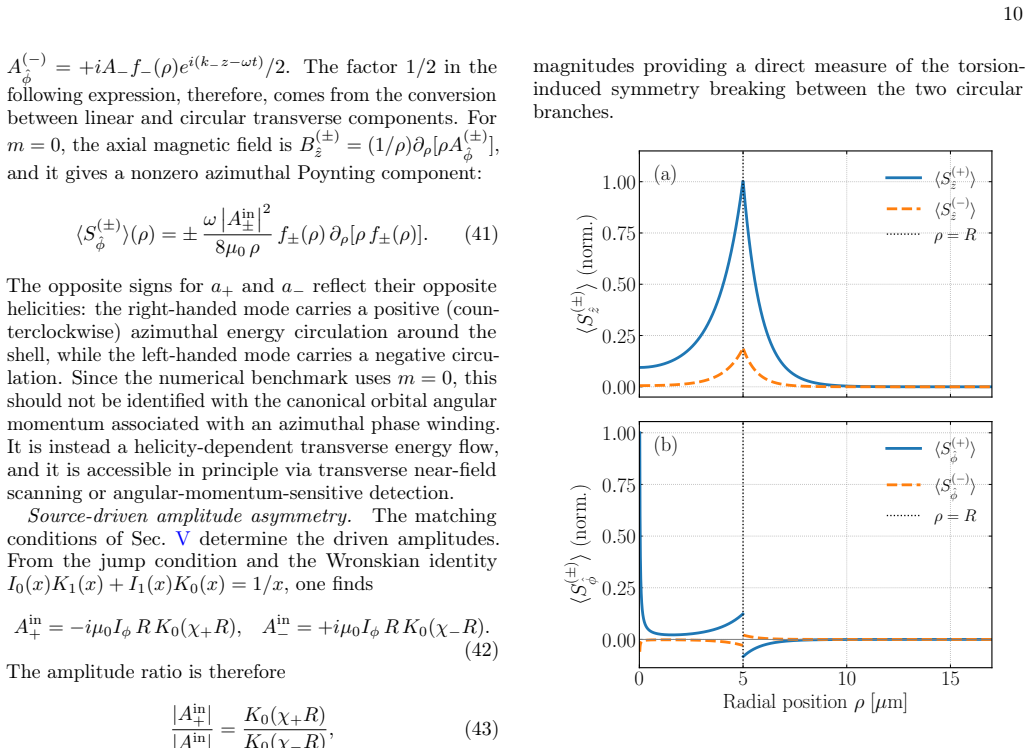
- Modal power and Poynting-flow patterns become measurable signatures of the torsion.
- Two-port scattering analysis places the activity in the reciprocal geometric class.
Where Pith is reading between the lines
- The same coupling might be engineered in metamaterials by imposing a uniform twist on the lattice.
- Extensions to non-uniform torsion profiles could produce position-dependent rotation rates.
- The reciprocity result suggests the effect can be cascaded without isolation requirements.
Load-bearing premise
The model assumes that a Chern-Simons-type coupling between the vector potential and the axial contortion provides the correct effective description of geometrically chiral media with uniform axial torsion.
What would settle it
A measurement of polarization rotation angle for both forward and reverse propagation directions in a two-port waveguide would show whether the rotation sense is independent of direction, as required for reciprocity.
Figures
read the original abstract
We develop an effective field-theoretical model for source-driven electromagnetic waves in a geometrically chiral optical medium described by a uniform axial torsion. Starting from the gauge-invariant electromagnetic field strength, we introduce a Chern--Simons-type coupling between the vector potential and the medium's axial contortion, thereby obtaining an inhomogeneous Maxwell system with prescribed external sources. For transverse cylindrical source profiles, we derive the coupled radial equations and solve them analytically for a circulating cylindrical-shell current. In the circular basis, the homogeneous problem diagonalizes, yielding torsion-split radial wavenumbers that give rise to longitudinal circular birefringence under guided-mode boundary conditions. In the weak-torsion regime, this birefringence produces a polarization rotation proportional to the propagation length and an oscillatory conversion between orthogonal linear polarizations. The source fixes the jump conditions and the relative excitation of the circular eigenmodes, thereby yielding measurable modal power and Poynting-flow signatures. A two-port scattering analysis shows that the apparent direction dependence remains Lorentz reciprocal, placing the effect in the class of reciprocal geometric optical activity rather than Faraday isolation.
Editorial analysis
A structured set of objections, weighed in public.
Referee Report
Summary. The manuscript develops an effective field-theoretical model for source-driven electromagnetic waves in a geometrically chiral optical medium with uniform axial torsion. It introduces a Chern-Simons-type coupling between the vector potential and the medium's axial contortion to obtain an inhomogeneous Maxwell system, derives analytic solutions to the coupled radial equations for a circulating cylindrical-shell current, obtains torsion-split radial wavenumbers yielding longitudinal circular birefringence, and performs a two-port scattering analysis to establish that the apparent direction dependence remains Lorentz reciprocal, thereby classifying the effect as reciprocal geometric optical activity rather than Faraday isolation.
Significance. If the central results hold, the work supplies an analytic treatment of torsional optical activity with explicit source-driven modal excitations and Poynting-flow signatures, together with a reciprocity classification that distinguishes geometric from non-reciprocal activity. The provision of closed-form radial solutions and the scattering argument constitute concrete, falsifiable elements that could guide experiments in chiral photonics.
major comments (1)
- [Abstract (model construction)] Abstract (model construction step): the Chern-Simons-type coupling is introduced as the appropriate effective description for geometrically chiral media with uniform axial torsion, yet no microscopic derivation from the underlying geometry or comparison against alternative effective Lagrangians is supplied; this assumption is load-bearing for the inhomogeneous Maxwell system, the torsion-split wavenumbers, and the subsequent reciprocity conclusion.
Simulated Author's Rebuttal
We thank the referee for the positive evaluation and the detailed comment. We respond point by point below.
read point-by-point responses
-
Referee: Abstract (model construction step): the Chern-Simons-type coupling is introduced as the appropriate effective description for geometrically chiral media with uniform axial torsion, yet no microscopic derivation from the underlying geometry or comparison against alternative effective Lagrangians is supplied; this assumption is load-bearing for the inhomogeneous Maxwell system, the torsion-split wavenumbers, and the subsequent reciprocity conclusion.
Authors: The manuscript presents an effective field theory in which the Chern-Simons-type term is the lowest-order, gauge-invariant coupling between the vector potential and axial contortion that is consistent with the symmetries of uniform axial torsion. A microscopic derivation from a specific lattice or metamaterial geometry is necessarily model-dependent and lies beyond the scope of the present work, which focuses on the electromagnetic consequences of this coupling. We have added a clarifying paragraph in Section II stating that the interaction is chosen on effective-theory grounds and that higher-order or alternative terms are possible but do not change the leading torsion-induced birefringence or the reciprocity properties derived from the sourced Maxwell equations. The torsion-split wavenumbers and the two-port reciprocity argument follow directly from the structure of the inhomogeneous system once the coupling is adopted; they are therefore robust within the class of effective models that share this leading interaction. revision: partial
Circularity Check
No significant circularity; derivation is self-contained
full rationale
The paper introduces an effective Chern-Simons coupling by ansatz to model the medium, derives the inhomogeneous Maxwell equations, solves the radial wave equations for a specific source, obtains torsion-split wavenumbers and birefringence in the circular basis, and applies a two-port scattering analysis to confirm Lorentz reciprocity. None of these steps reduce by construction to fitted inputs, self-definitions, or load-bearing self-citations; the reciprocity classification follows from the scattering matrix properties once the effective equations are adopted. The model-construction step is an external assumption rather than an internal tautology, leaving the logical chain independent of its own outputs.
Axiom & Free-Parameter Ledger
axioms (2)
- standard math Electromagnetic field strength is gauge-invariant.
- ad hoc to paper A Chern-Simons-type coupling between vector potential and axial contortion describes the geometrically chiral medium.
invented entities (1)
-
Uniform axial torsion (contortion) in the optical medium
no independent evidence
Reference graph
Works this paper leans on
-
[1]
The dynamics of the electromagnetic potential in the presence of sources and torsion are governed by 11 a system of coupled inhomogeneous wave equations, given by Eq. (18)
-
[2]
The trans- verse splitting in Eq.(22) becomes a longitudinal splitting, Eq.(28), once a guided-mode boundary condition is imposed
A change to the circular polarization basis diagonal- izes the homogeneous part of the system, revealing a torsion-induced circular birefringence. The trans- verse splitting in Eq.(22) becomes a longitudinal splitting, Eq.(28), once a guided-mode boundary condition is imposed
-
[3]
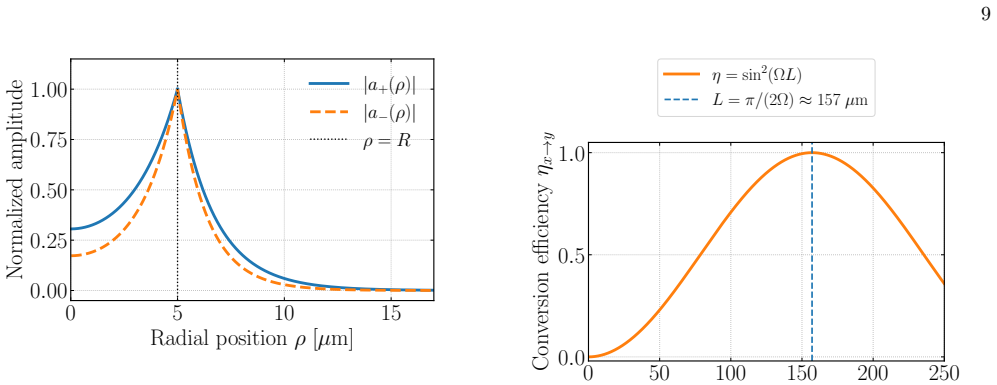
This birefringence leads to a robust and control- lable rotation of the linear polarization plane. As shown in our numerical analysis, this effect can be remarkably efficient, allowing, in principle, complete polarization conversion over microscale distances in the ideal lossless modal model for the benchmark effective torsion parameter considered here
-
[4]
(29)–(32)
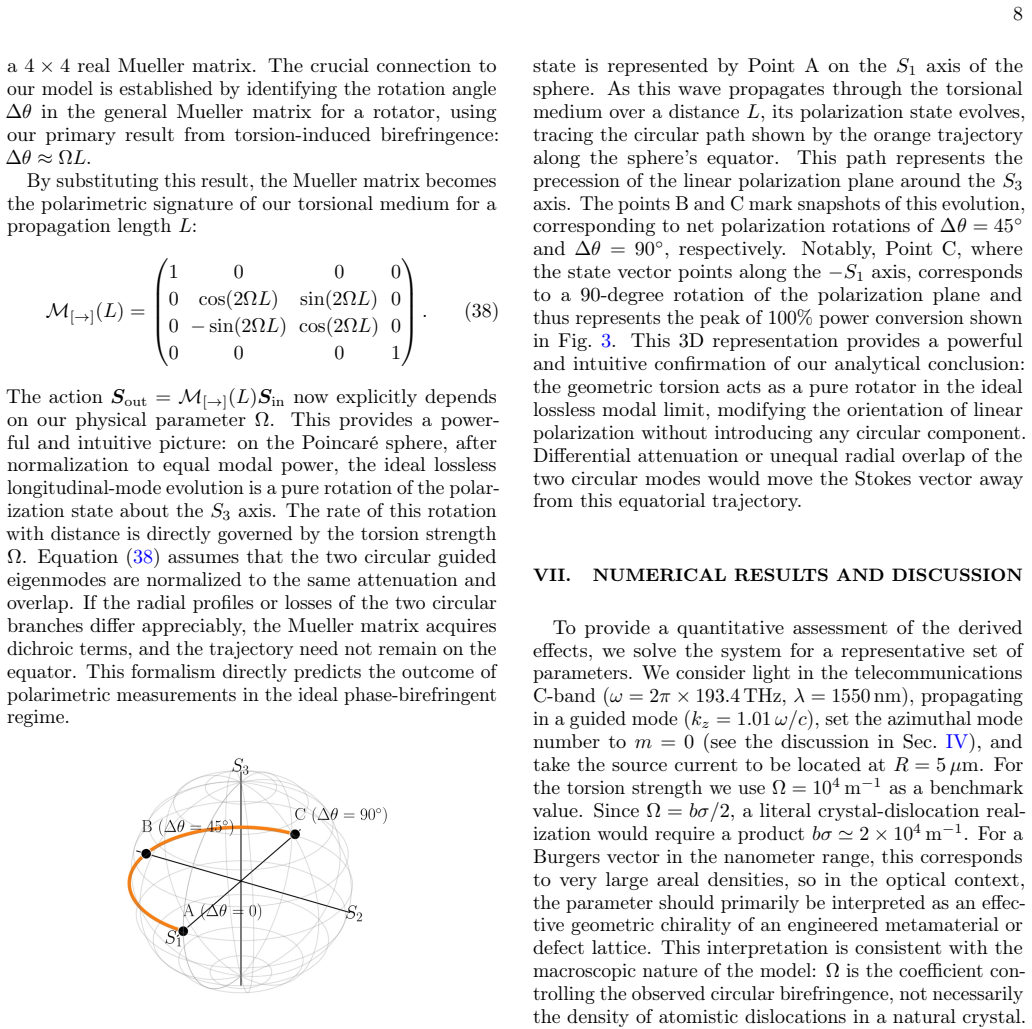
The torsion-induced rotation is direction dependent, as demonstrated by the Jones matrix analysis in Eqs. (29)–(32). The two-port scattering analysis of Sec. VIC establishes that the medium is Lorentz reciprocal: the scattering matrix satisfiesS12 =S T 21 and the round-trip Jones matrix equals the identity, placing torsion-induced rotation in the same sym...
-
[5]
The integral of the second derivative gives the jump in the first derivative: lim ϵ→0 Z R+ϵ R−ϵ d2aϕ dρ2 dρ= lim ϵ→0 daϕ dρ R+ϵ R−ϵ = ∂ρaϕ R.(E3)
-
[6]
For instance: lim ϵ→0 Z R+ϵ R−ϵ 1 ρ daϕ dρ dρ= lim ϵ→0 (2ϵ)×(finite value) = 0.(E4)
For any term involving functions that are finite and continuous at ρ = R (such as aϕ and aρ, and even daϕ/dρ itself), their integral over an infinitesimal interval of width2 ϵ will vanish as ϵ→ 0. For instance: lim ϵ→0 Z R+ϵ R−ϵ 1 ρ daϕ dρ dρ= lim ϵ→0 (2ϵ)×(finite value) = 0.(E4)
-
[7]
The integral over the one-dimensional radial Dirac delta function on the right-hand side is, by definition in our shell-current convention, Z R+ϵ R−ϵ µ0Iϕ δ(ρ−R)dρ=µ 0Iϕ.(E5) Ifoneinsteadwritesthesourceentirelyincoordinate components, the factor relating J ˆϕ and J ϕ must be kept together with the cylindrical measure; the same physical jump condition is r...
2022
-
[8]
L. D. Barron,Molecular Light Scattering and Optical Activity, 2nd ed. (Cambridge University Press, 2004)
2004
-
[9]
Tang and A
Y. Tang and A. E. Cohen, Phys. Rev. Lett.104, 163901 (2010)
2010
-
[10]
Plebanski, Phys
J. Plebanski, Phys. Rev.118, 1396 (1960)
1960
-
[11]
B. A. Bilby, R. Bullough, and E. Smith, Proc. R. Soc. A 231, 263 (1955)
1955
-
[12]
Kröner, inPhysics of Defects (Les Houches, Session XXXV)(North-Holland, 1980) pp
E. Kröner, inPhysics of Defects (Les Houches, Session XXXV)(North-Holland, 1980) pp. 215–315
1980
-
[13]
M. O. Katanaev and I. V. Volovich, Ann. Phys.216, 1 (1992)
1992
-
[14]
R. A. Puntigam and H. H. Soleng, Class. Quantum Grav. 14, 1129 (1997)
1997
-
[15]
Furtado, V
C. Furtado, V. B. Bezerra, and F. Moraes, Phys. Lett. A 289, 160 (2001)
2001
-
[16]
A. L. S. Netto and C. Furtado, Journal of Physics: Con- densed Matter20, 125209 (2008)
2008
-
[17]
Bakke, A
K. Bakke, A. Y. Petrov, and C. Furtado, Ann. Phys.327, 2946 (2012)
2012
-
[18]
Y. N. Obukhov and F. W. Hehl, Physics Letters A311, 277 (2003)
2003
-
[19]
Itin, General Relativity and Gravitation40, 1219 (2008)
Y. Itin, General Relativity and Gravitation40, 1219 (2008)
2008
-
[20]
Yu and S
Z. Yu and S. Fan, Nat. Photonics3, 91 (2009)
2009
-
[21]
Raghu and F
S. Raghu and F. D. M. Haldane, Phys. Rev. Lett.100, 013904 (2008)
2008
-
[22]
J. B. Pendry, D. Schurig, and D. R. Smith, Science312, 1780 (2006)
2006
-
[23]
A. V. Kildishev, A. Boltasseva, and V. M. Shalaev, Science 339, 1232009 (2013)
2013
-
[24]
Cortijo, Y
A. Cortijo, Y. Ferreiros, K. Landsteiner, and M. A. H. Vozmediano, Phys. Rev. Lett.115, 177202 (2015)
2015
-
[25]
D. I. Pikulin, A. Chen, and M. Franz, Phys. Rev. X6, 041021 (2016)
2016
-
[26]
S. M. Carroll, G. B. Field, and R. Jackiw, Phys. Rev. D 41, 1231 (1990)
1990
-
[27]
Wilczek, Phys
F. Wilczek, Phys. Rev. Lett.58, 1799 (1987)
1987
-
[28]
X.-L. Qi, T. L. Hughes, and S.-C. Zhang, Phys. Rev. B 78, 195424 (2008)
2008
-
[29]
A. M. Essin, J. E. Moore, and D. Vanderbilt, Phys. Rev. Lett.102, 146805 (2009)
2009
-
[30]
Hurwitz and R
H. Hurwitz and R. C. Jones, J. Opt. Soc. Am.31, 493 (1941)
1941
-
[31]
J.-F. m. c. Bisson, Phys. Rev. A108, 033511 (2023)
2023
-
[32]
Jalas, A
D. Jalas, A. Petrov, M. Eich, W. Freude, S. Fan, Z. Yu, R. Baets, M. Popovic, A. Melloni, J. D. Joannopoulos, M. Vanwolleghem, C. R. Doerr, and H. Renner, Nat. Photonics7, 579 (2013)
2013
-
[33]
Kliger and J
D. Kliger and J. Lewis,Polarized Light in Optics and Spectroscopy(Academic Press, 2012)
2012
-
[34]
Shieh and I
W. Shieh and I. Djordjevic,OFDM for Optical Commu- nications(Academic Press, 2009)
2009
-
[35]
Morse and H
P. Morse and H. Feshbach,Methods of Theoretical Physics, International series in pure and applied physics (McGraw- Hill, 1953)
1953
discussion (0)
Sign in with ORCID, Apple, or X to comment. Anyone can read and Pith papers without signing in.