Candidate collapse-noise correlators from Generalized Trace Dynamics: a Hubble-scale spectral line under structural assumptions
Pith reviewed 2026-06-29 07:20 UTC · model grok-4.3
The pith
An auxiliary fermionic Fock sector added to generalized trace dynamics produces a candidate collapse-noise Wightman line at twice the Hubble frequency.
A machine-rendered reading of the paper's core claim, the machinery that carries it, and where it could break.
Core claim
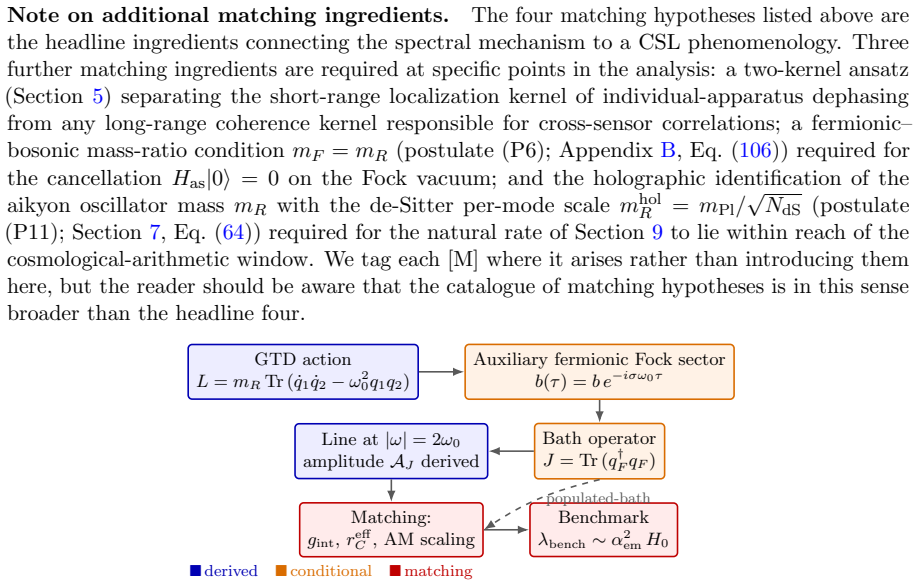
Under the auxiliary postulate of an auxiliary canonical fermionic Fock-space sector together with scalar bilinear J as bath operator, positive-norm canonical quantization, and effective sign choice σ=±1, elementary Wick contraction gives a Wightman line at |ω|=2ω0 with amplitude A_J=(ℏ/2m_R ω0 L_aik²)²·N·D; the cosmological identification ω0∼H0 places the line at twice the Hubble scale.
What carries the argument
The auxiliary canonical fermionic Fock-space sector for q_F that replaces the nilpotent pure-fermion coefficient β1β2 by an ordinary effective scalar body parameter, enabling definition of the bath operator J and subsequent Wick contraction to the two-point function.
If this is right
- The resulting spectrum is narrow-band and lies at twice the Hubble scale.
- This location falls outside the frequency bands constrained by existing CSL experiments.
- The amplitude scales explicitly with the product N·D where N counts modes and D is dimension.
- The construction remains conditional on the listed auxiliary postulates rather than following from the minimal Grassmann algebra alone.
Where Pith is reading between the lines
- If the auxiliary sector is physically realized, low-frequency experiments targeting cosmological scales could search for this specific line as a signature of the extended framework.
- Tying the noise frequency to the Hubble parameter suggests a possible direct connection between collapse dynamics and cosmic expansion that could be tested by varying the identification ω0 ∼ H0 across different epochs.
- The sign choice σ=±1 and the precise prefactor involving L_aik could be constrained by comparing predicted amplitudes against future data at the predicted frequency.
Load-bearing premise
The independent structural postulate that replaces the nilpotent pure-fermion coefficient β1β2 by an ordinary effective scalar body parameter through introduction of an auxiliary canonical fermionic Fock-space sector for q_F.
What would settle it
Detection or non-detection of a narrow spectral feature exactly at frequency 2H0 in sufficiently sensitive low-frequency collapse-noise measurements.
Figures
read the original abstract
We present a conditional construction of candidate CSL-type collapse-noise correlators inspired by Generalized Trace Dynamics (GTD). The construction is not a parameter-free derivation from the minimal GTD Grassmann algebra. It rests on a chain of explicit structural postulates, listed in Section 1; within that auxiliary structure the spectral form and amplitude follow by computation rather than by phenomenological fitting. The resulting narrow-band spectrum at the Hubble scale lies outside the bands of current CSL bounds, so the framework is not in tension with existing high-frequency data. We compute the two-point function of a candidate collapse-noise operator associated with the GTD aikyon decomposition $q_i = q_B + a_0\beta_i q_F$. In the minimal Grassmann algebra, $q_F$ appears only multiplied by Grassmann generators $\beta_i$, the reduction of $\mathrm{Tr}(q_F^\dagger\Gamma^\mu q_F)$ to ghost-mode operators is obstructed by the nilpotent $\delta\beta = \beta_2 - \beta_1$, and the pure-fermion coefficient $\beta_1\beta_2$ has no ordinary sign, modulus, or inverse. We therefore introduce an auxiliary canonical fermionic Fock-space sector for $q_F$, equivalently replacing the nilpotent pure-fermion coefficient by an ordinary effective scalar body parameter. This replacement is an independent structural postulate, not a consequence of the original minimal action. Under this auxiliary postulate, together with a scalar bilinear $J = \mathrm{Tr}(q_F^\dagger q_F)$ as bath operator, positive-norm canonical quantization, and an effective sign choice $\sigma = \pm1$ for the scalarized pure-fermion sector, elementary Wick contraction gives a Wightman line at $|\omega| = 2\omega_0$ with amplitude $A_J = (\hbar/2m_R\omega_0 L_{\mathrm{aik}}^2)^2\cdot N\cdot D$. The cosmological identification $\omega_0 \sim H_0$ places the line at twice the Hubble scale. [truncated]
Editorial analysis
A structured set of objections, weighed in public.
Referee Report
Summary. The manuscript presents a conditional construction of candidate CSL-type collapse-noise correlators inspired by Generalized Trace Dynamics. It explicitly lists a chain of auxiliary structural postulates (auxiliary canonical fermionic Fock-space sector for q_F that scalarizes the nilpotent β1β2 coefficient, scalar bilinear J=Tr(q_F†q_F) as bath operator, positive-norm canonical quantization, and effective sign choice σ=±1). Within this added structure, elementary Wick contraction of the candidate collapse-noise operator associated with the aikyon decomposition q_i = q_B + a0 β_i q_F yields a Wightman line at |ω|=2ω0 with amplitude A_J=(ℏ/2m_R ω0 L_aik²)²·N·D. The additional cosmological step identifies ω0∼H0, placing the line at twice the Hubble scale. The abstract and Section 1 state that the construction is not a derivation from the minimal GTD Grassmann algebra.
Significance. If the listed auxiliary postulates are granted, the result supplies a concrete, computable narrow-band spectrum for collapse noise lying outside current CSL bounds, thereby generating a specific, in-principle falsifiable prediction. The manuscript's explicit framing of the result as conditional on independent structural assumptions, rather than a claim of derivation from minimal GTD, is a strength in transparency and avoids overstatement. The computation itself follows by standard Wick contraction once the auxiliary Fock-space sector and sign choice are introduced.
minor comments (1)
- [abstract / §1] The amplitude expression in the abstract contains the factor L_aik² in the denominator; the manuscript should confirm in the main text (near the definition of the aikyon decomposition) whether this is L_aik or L_aik² and whether the square arises from the trace or from the Wick contraction.
Simulated Author's Rebuttal
We thank the referee for their positive evaluation and recommendation to accept the manuscript. The referee's summary correctly identifies the conditional character of the construction and the explicit listing of auxiliary postulates.
Circularity Check
No significant circularity; conditional construction on explicit auxiliary postulates
full rationale
The paper states in the abstract that 'The construction is not a parameter-free derivation from the minimal GTD Grassmann algebra. It rests on a chain of explicit structural postulates, listed in Section 1; within that auxiliary structure the spectral form and amplitude follow by computation rather than by phenomenological fitting.' It further notes that the auxiliary fermionic Fock-space sector 'is an independent structural postulate, not a consequence of the original minimal action.' The central result (Wightman line at |ω|=2ω0 via Wick contraction) is presented as computation inside this added structure, with no claim that the postulates are derived from minimal GTD or that the output is forced by the original Grassmann algebra. No self-definitional step, fitted input renamed as prediction, or load-bearing self-citation chain is present; the derivation is self-contained against the stated assumptions.
Axiom & Free-Parameter Ledger
free parameters (2)
- ω0 =
~H0
- m_R, L_aik, N, D
axioms (3)
- ad hoc to paper Auxiliary canonical fermionic Fock-space sector for q_F that replaces the nilpotent pure-fermion coefficient with an ordinary effective scalar body parameter
- ad hoc to paper Scalar bilinear J = Tr(q_F† q_F) as bath operator
- ad hoc to paper Positive-norm canonical quantization and effective sign choice σ=±1 for the scalarized pure-fermion sector
invented entities (1)
-
Candidate collapse-noise operator associated with the GTD aikyon decomposition q_i = q_B + a0 β_i q_F
no independent evidence
Reference graph
Works this paper leans on
-
[1]
Unified dynamics for microscopic and macroscopic systems,
G. C. Ghirardi, A. Rimini, and T. Weber, “Unified dynamics for microscopic and macroscopic systems,” Phys. Rev. D34, 470 (1986)
1986
-
[2]
Combining stochastic dynamical state-vector reduction with spontaneous local- ization,
P. Pearle, “Combining stochastic dynamical state-vector reduction with spontaneous local- ization,” Phys. Rev. A39, 2277 (1989)
1989
-
[3]
Markov processes in Hilbert space and continuous spontaneous localization of systems of identical particles,
G. C. Ghirardi, P. Pearle, and A. Rimini, “Markov processes in Hilbert space and continuous spontaneous localization of systems of identical particles,” Phys. Rev. A42, 78 (1990)
1990
-
[4]
Models of wave-function collapse, underlying theories, and experimental tests,
A. Bassi, K. Lochan, S. Satin, T. P. Singh, and H. Ulbricht, “Models of wave-function collapse, underlying theories, and experimental tests,” Rev. Mod. Phys.85, 471 (2013). 52
2013
-
[5]
Novel CSL bounds from the noise-induced radiation emission from atoms,
S. Donadi, K. Piscicchia, R. Del Grande, C. Curceanu, M. Laubenstein, and A. Bassi, “Novel CSL bounds from the noise-induced radiation emission from atoms,” Eur. Phys. J. C 81, 773 (2021); arXiv:2107.11237
-
[6]
Challenging spontaneous quantum collapse with XENONnT,
E. Aprileet al.(XENON Collaboration), “Challenging spontaneous quantum collapse with XENONnT,” Phys. Rev. Lett.136, 120201 (2026); arXiv:2506.05507
-
[7]
Search for spontaneous radiation from wave function collapse in the Majorana Demonstrator,
I. J. Arnquistet al.(Majorana Collaboration), “Search for spontaneous radiation from wave function collapse in the Majorana Demonstrator,” Phys. Rev. Lett.129, 080401 (2022); arXiv:2202.01343
-
[8]
Narrowing the parameter space of collapse models with ultracold layered force sensors,
A. Vinanteet al., “Narrowing the parameter space of collapse models with ultracold layered force sensors,” Phys. Rev. Lett.125, 100404 (2020)
2020
-
[9]
Bounds on collapse models from cold-atom experiments,
M. Bilardello, S. Donadi, A. Vinante, and A. Bassi, “Bounds on collapse models from cold-atom experiments,” Physica A462, 764 (2016)
2016
-
[10]
Experimental bounds on collapse models from gravitational wave detectors,
M. Carlesso, A. Bassi, P. Falferi, and A. Vinante, “Experimental bounds on collapse models from gravitational wave detectors,” Phys. Rev. D94, 124036 (2016)
2016
-
[11]
Collapse models with non-white noises
S. L. Adler and A. Bassi, “Collapse models with non-white noises,” J. Phys. A: Math. Theor. 40, 15083 (2007); arXiv:0708.3624
work page internal anchor Pith review Pith/arXiv arXiv 2007
-
[12]
On spontaneous photon emission in collapse models
S. L. Adler, A. Bassi, and S. Donadi, “On spontaneous photon emission in collapse models,” J. Phys. A46, 245304 (2013); arXiv:1011.3941
work page internal anchor Pith review Pith/arXiv arXiv 2013
-
[13]
A universal master equation for the gravitational violation of quantum mechanics,
L. Diosi, “A universal master equation for the gravitational violation of quantum mechanics,” Phys. Lett. A120, 377 (1987)
1987
-
[14]
Models for universal reduction of macroscopic quantum fluctuations,
L. Diosi, “Models for universal reduction of macroscopic quantum fluctuations,” Phys. Rev. A40, 1165 (1989)
1989
-
[15]
On gravity’s role in quantum state reduction,
R. Penrose, “On gravity’s role in quantum state reduction,” Gen. Relativ. Gravit.28, 581 (1996)
1996
-
[16]
S. L. Adler,Quantum Theory as an Emergent Phenomenon(Cambridge University Press, Cambridge, 2004)
2004
-
[17]
Lower and upper bounds on CSL parameters from latent image formation and IGM heating,
S. L. Adler, “Lower and upper bounds on CSL parameters from latent image formation and IGM heating,” J. Phys. A40, 2935 (2007)
2007
-
[18]
M. Palemkota and T. P. Singh, “Proposal for a new quantum theory of gravity III: Equations for quantum gravity, and the origin of spontaneous localisation,” Z. Naturforsch. A75, 143 (2020); arXiv:1908.04309
-
[19]
Trace dynamics, and a ground state in spontaneous quantum gravity,
A. K. Roy, A. Sahu, and T. P. Singh, “Trace dynamics, and a ground state in spontaneous quantum gravity,” Mod. Phys. Lett. A36, 2150019 (2021); arXiv:2104.14344
-
[20]
Spontaneous localisation from a coarse-grained deterministic and non-unitary dynamics,
K. Kakade, A. Singh, and T. P. Singh, “Spontaneous localisation from a coarse-grained deterministic and non-unitary dynamics,” Phys. Lett. A490, 129191 (2023)
2023
-
[21]
In models of spontaneous wave-function collapse, why only fermions collapse, not bosons?
T. P. Singh, “In models of spontaneous wave-function collapse, why only fermions collapse, not bosons?” arXiv:2602.15044 (2026)
-
[22]
S. Farnsworth, F. Finster, C. F. Paganini, and T. P. Singh, “Causal Fermion Systems, Non-Commutative Geometry and Generalized Trace Dynamics,” arXiv:2603.05018 (2026). 53
-
[23]
On dissipative systems and related variational principles,
H. Bateman, “On dissipative systems and related variational principles,” Phys. Rev.38, 815 (1931)
1931
-
[24]
Quantization of the damped harmonic oscillator,
H. Feshbach and Y. Tikochinsky, “Quantization of the damped harmonic oscillator,” Trans. New York Acad. Sci.38, 44 (1977)
1977
-
[25]
M. Blasone and P. Jizba, “Quantum mechanics of the damped harmonic oscillator,” Can. J. Phys.80, 645 (2002); arXiv:quant-ph/0102128
work page internal anchor Pith review Pith/arXiv arXiv 2002
-
[26]
Quantum mechanics of damped systems II. Damping and parabolic potential barrier,
D. Chru´ sci´ nski, “Quantum mechanics of damped systems II. Damping and parabolic potential barrier,” J. Math. Phys.45, 841 (2004)
2004
-
[27]
Two quantization approaches to the Bateman oscillator model,
S. Deguchi, Y. Fujiwara, and K. Nakano, “Two quantization approaches to the Bateman oscillator model,” Ann. Phys.403, 34 (2019); arXiv:1807.04403
-
[28]
Breuer and F
H.-P. Breuer and F. Petruccione,The Theory of Open Quantum Systems(Oxford University Press, 2002)
2002
-
[29]
Colored collapse models from the non-interferometric perspective,
M. Carlesso, L. Ferialdi, and A. Bassi, “Colored collapse models from the non-interferometric perspective,” Eur. Phys. J. D72, 159 (2018)
2018
-
[30]
Present status and future challenges of non-interferometric tests of collapse models,
M. Carlesso, S. Donadi, L. Ferialdi, M. Paternostro, H. Ulbricht, and A. Bassi, “Present status and future challenges of non-interferometric tests of collapse models,” Nature Physics 18, 243–250 (2022)
2022
-
[31]
Planck 2018 results. VI. Cosmological parame- ters,
N. Aghanimet al.(Planck Collaboration), “Planck 2018 results. VI. Cosmological parame- ters,” Astron. Astrophys.641, A6 (2020)
2018
-
[32]
Effective Field Theory, Black Holes, and the Cosmological Constant
A. G. Cohen, D. B. Kaplan, and A. E. Nelson, “Effective field theory, black holes, and the cosmological constant,” Phys. Rev. Lett.82, 4971 (1999); arXiv:hep-th/9803132
work page internal anchor Pith review Pith/arXiv arXiv 1999
-
[33]
Entropy bounds and dark energy,
S. D. H. Hsu, “Entropy bounds and dark energy,” Phys. Lett. B594, 13 (2004); arXiv:hep- th/0403052
-
[34]
A model of holographic dark energy,
M. Li, “A model of holographic dark energy,” Phys. Lett. B603, 1 (2004); arXiv:hep- th/0403127
-
[35]
N. Secrest, S. von Hausegger, M. Rameez, R. Mohayaee, and S. Sarkar, “Colloquium: The cosmic dipole anomaly,” Rev. Mod. Phys.97, 041001 (2025); arXiv:2505.23526
-
[36]
Planck 2013 results. XXVII. Doppler boosting of the CMB: Eppur si muove
N. Aghanimet al.(Planck Collaboration), “Planck 2013 results. XXVII. Doppler boosting of the CMB: Eppur si muove,” Astron. Astrophys.571, A27 (2014), arXiv:1303.5087
work page internal anchor Pith review Pith/arXiv arXiv 2013
-
[37]
S. L. Adler, “Connecting the dots: Mott for emulsions, collapse models, colored noise, frame dependence of measurements, evasion of the ‘Free Will Theorem’,” Found. Phys.48, 1557 (2018); arXiv:1807.11450
-
[38]
Quantum Brownian motion in a general environment: Exact master equation with nonlocal dissipation and colored noise,
B. L. Hu, J. P. Paz, and Y. Zhang, “Quantum Brownian motion in a general environment: Exact master equation with nonlocal dissipation and colored noise,” Phys. Rev. D45, 2843 (1992)
1992
-
[39]
The International Pulsar Timing Array checklist for the detection of nanohertz gravitational waves,
B. Allenet al., “The International Pulsar Timing Array checklist for the detection of nanohertz gravitational waves,” arXiv:2304.04767 (2023). 54
discussion (0)
Sign in with ORCID, Apple, or X to comment. Anyone can read and Pith papers without signing in.