Optical transmission spectrum of HAT-P-47b: evidence for aerosols and tentative TiO absorption
Pith reviewed 2026-06-29 00:58 UTC · model grok-4.3
The pith
HAT-P-47b's optical transmission spectrum indicates aerosols with 5000 times the scattering of pure H2 and moderate evidence for TiO absorption.
A machine-rendered reading of the paper's core claim, the machinery that carries it, and where it could break.
Core claim
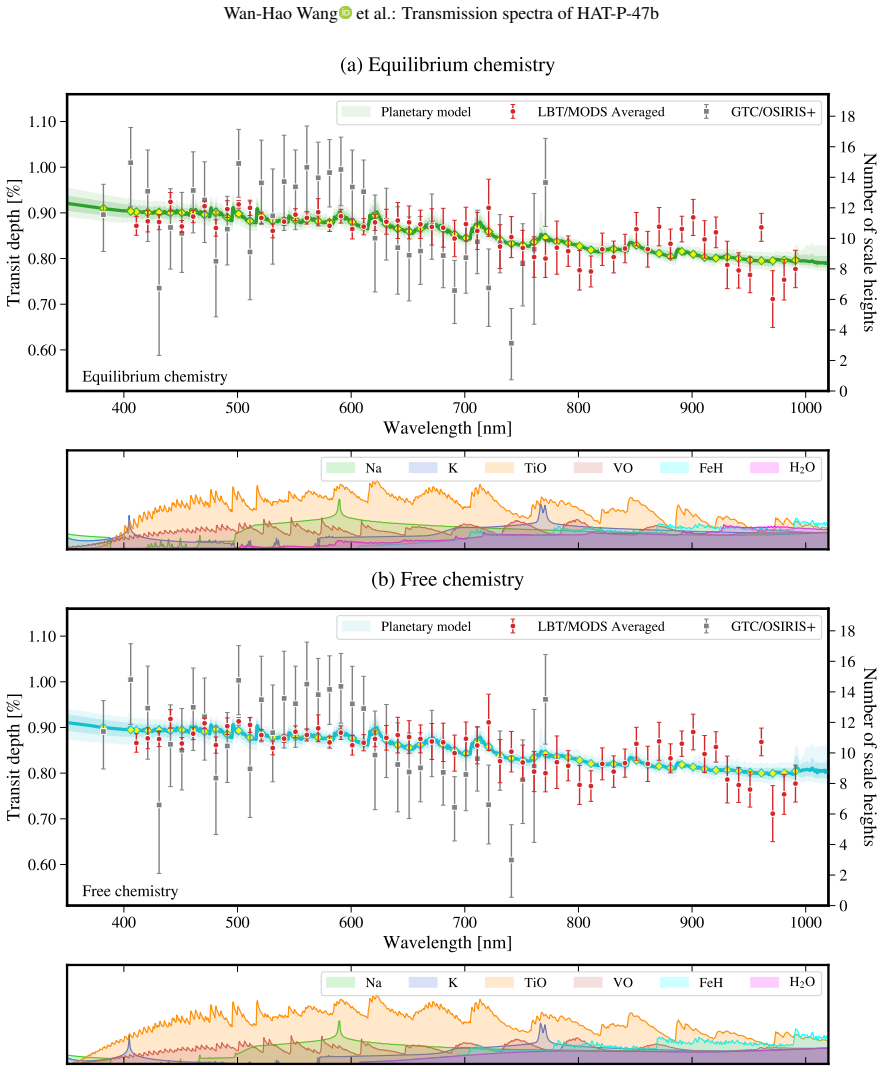
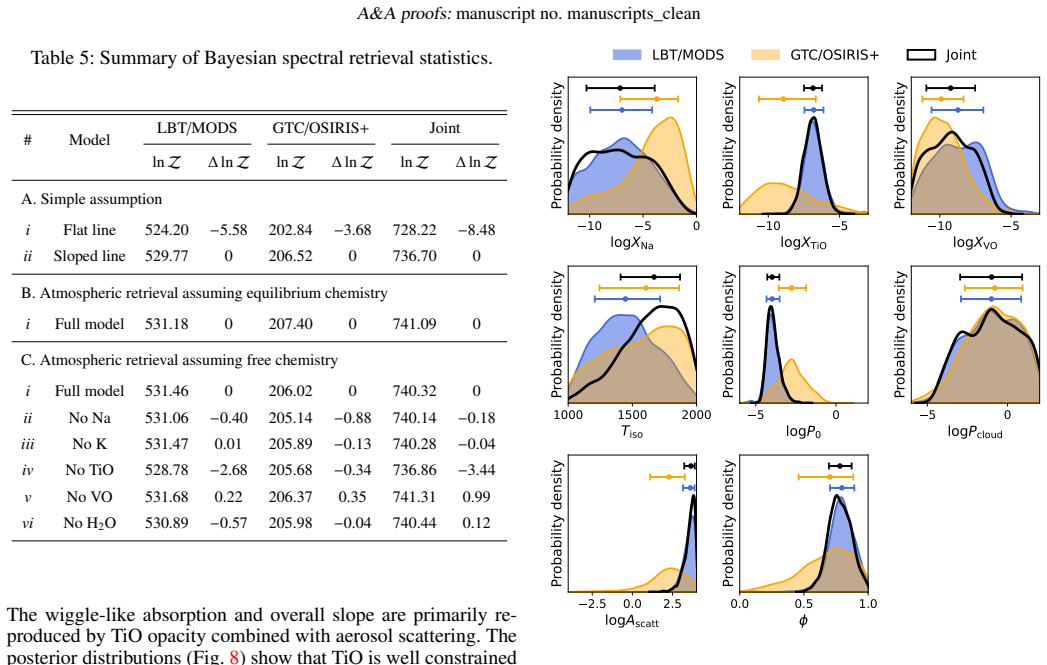
The MODS and OSIRIS+ joint free-chemistry retrieval yields moderate evidence (ΔlnZ=3.44) for TiO with a log mass fraction of -6.86+0.64-0.63 dex; the same model indicates an aerosol contribution to the optical scattering opacity approximately 5000× larger than pure H2 Rayleigh scattering. HAT-P-47b appears to host a cloudy atmosphere with evidence for aerosols and tentative evidence for TiO absorption.
What carries the argument
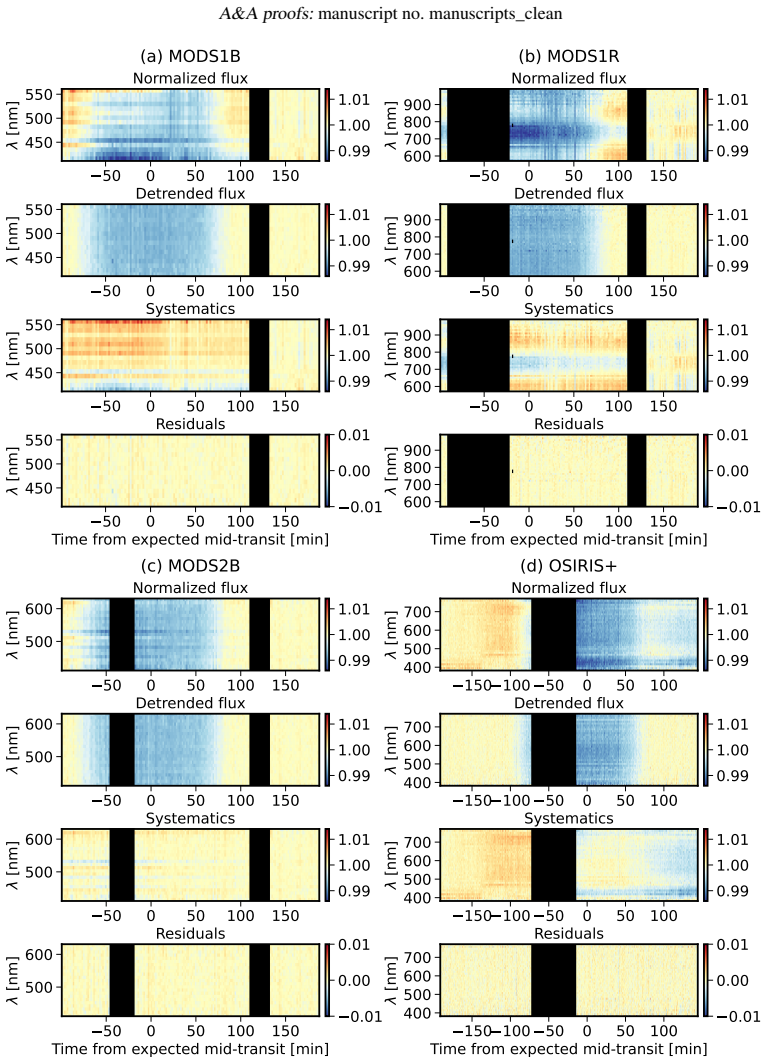
Bayesian spectral retrievals comparing free-chemistry models with and without TiO opacity and an enhanced aerosol scattering term, applied to instrument-specific transmission spectra derived from chromatic transit light curves.
If this is right
- The planet's optical spectrum is shaped primarily by aerosol scattering rather than molecular features alone.
- A TiO mass fraction near 10^-7 would contribute to the atmospheric energy balance and thermal structure.
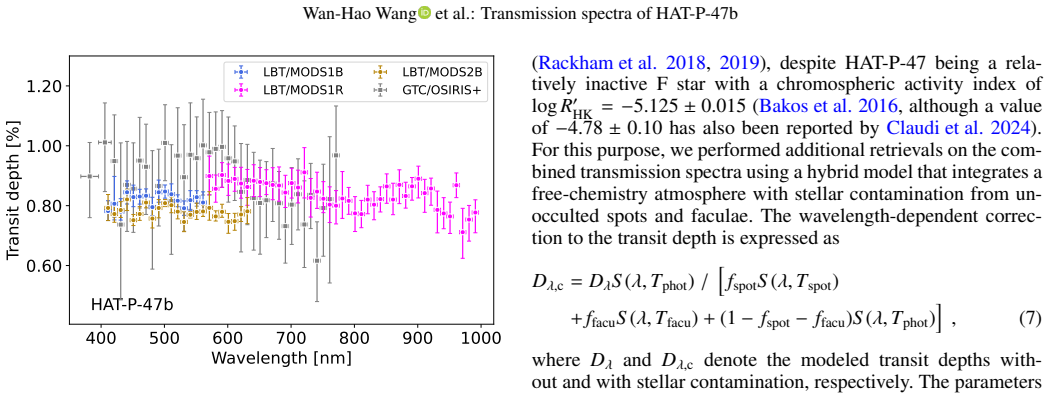
- The two instruments yield differing strengths of evidence for TiO, with the higher-S/N MODS data dominating the joint result.
- Future observations are required to confirm or refute the TiO detection and refine the aerosol properties.
Where Pith is reading between the lines
- Similar aerosol levels in other hot Jupiters could systematically suppress molecular features in optical spectra.
- The moderate Bayesian evidence level means that one or two additional high-quality transits could shift the result from tentative to strong or to absent.
- Independent constraints on aerosol particle size or composition would test whether the slope attribution is unique.
Load-bearing premise
The wavelength-dependent slope is produced by aerosol scattering rather than residual instrumental systematics or stellar activity.
What would settle it
Additional high-precision optical transit observations that either detect TiO absorption bands at higher significance or reproduce the slope without requiring enhanced aerosol opacity.
Figures
read the original abstract
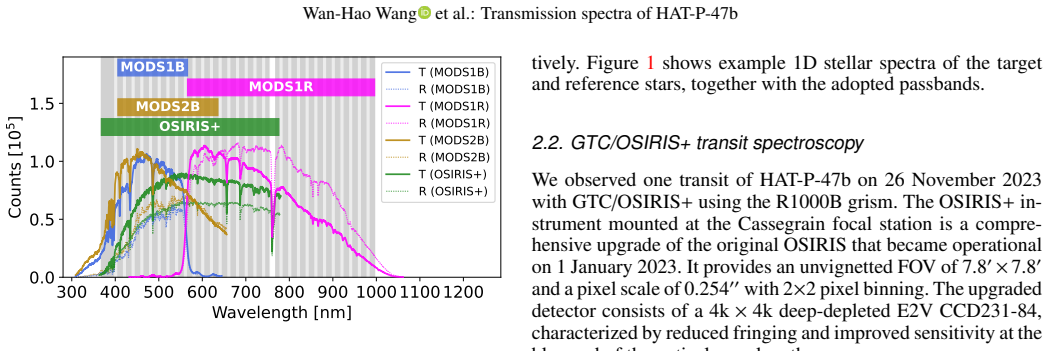
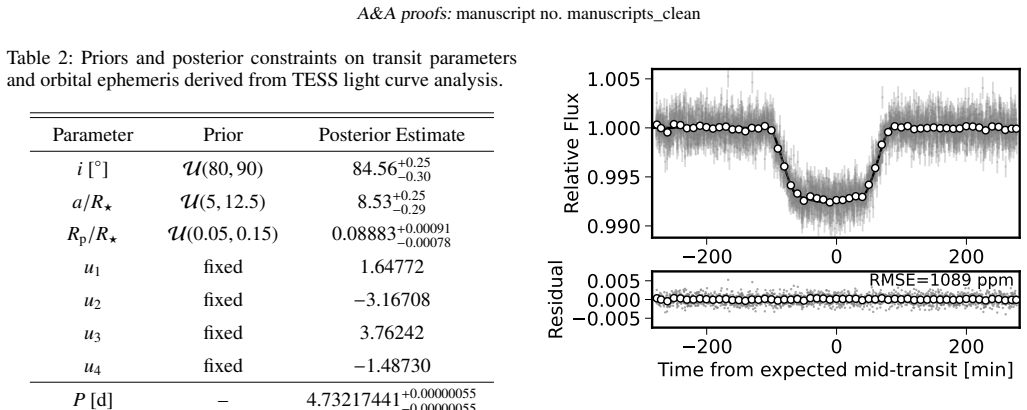
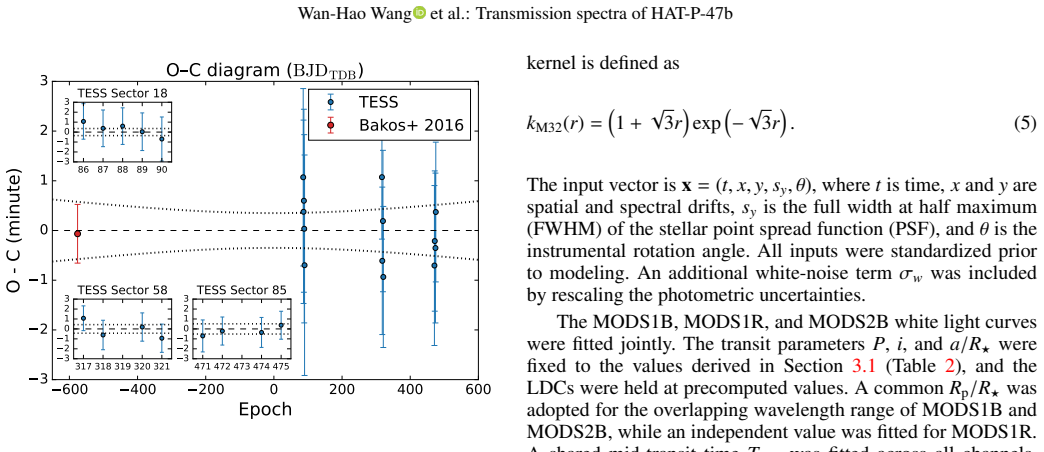
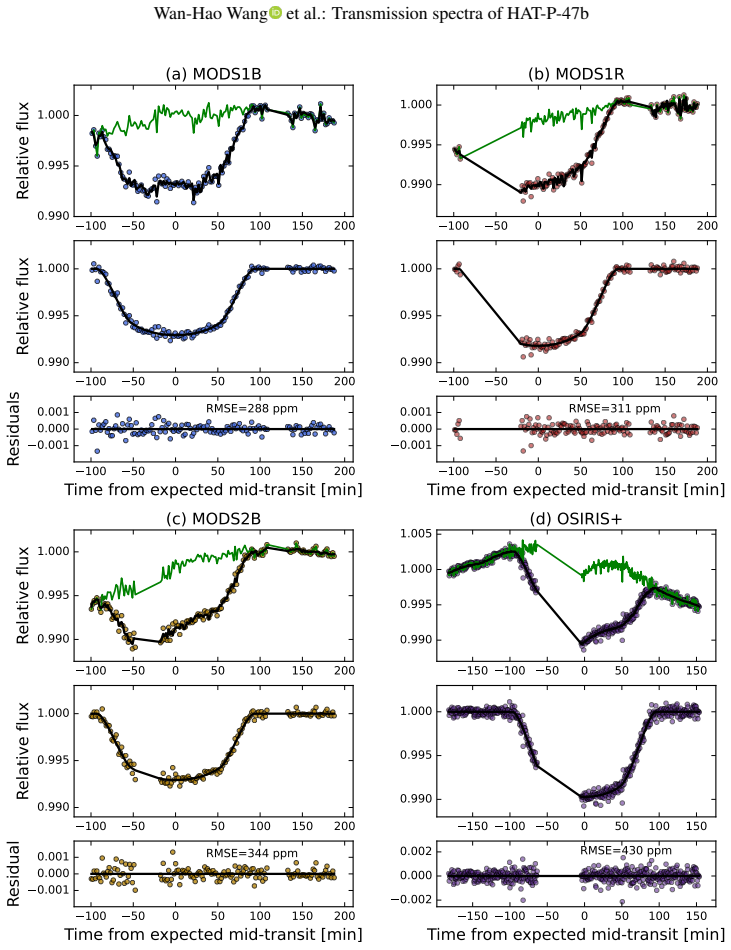
Transmission spectroscopy enables the characterization of exoplanet atmospheres by probing absorption features in their terminator regions. In the optical, it is particularly sensitive to metal oxides and atomic species that can strongly influence atmospheric energy balance and thermal structure. We aim to investigate the atmospheric properties of the hot Jupiter HAT-P-47b through optical transmission spectroscopy. Thirteen TESS transits were analyzed to refine the planetary ephemeris and system parameters. Two ground-based transits were observed with LBT/MODS and GTC/OSIRIS+. Chromatic transit light curves were modeled to derive instrument-specific transmission spectra and multiple Bayesian spectral retrievals were performed to characterize the atmospheric properties. The MODS transmission spectrum provides moderate Bayesian evidence ($\Delta\ln\mathcal{Z}=2.68$) for TiO absorption, whereas the OSIRIS+ spectrum does not yield statistically significant evidence for any specific opacity source. Both datasets exhibit a wavelength-dependent slope indicative of enhanced aerosol scattering. The MODS and OSIRIS+ joint free-chemistry retrieval, dominated by the higher signal-to-noise MODS data, yields moderate evidence ($\Delta\ln\mathcal{Z}=3.44$) for TiO with a log mass fraction of $-6.86^{+0.64}_{-0.63}$ dex. The same model indicates an aerosol contribution to the optical scattering opacity approximately $5000\times$ larger than pure H$_2$ Rayleigh scattering. HAT-P-47b appears to host a cloudy atmosphere with evidence for aerosols and tentative evidence for TiO absorption. Future high-precision observations will be essential to confirm the presence of TiO and further characterize its atmospheric structure.
Editorial analysis
A structured set of objections, weighed in public.
Referee Report
Summary. The manuscript presents optical transmission spectra of HAT-P-47b from LBT/MODS and GTC/OSIRIS+ observations, combined with 13 TESS transits for ephemeris refinement. Chromatic light curves are modeled to produce instrument-specific transmission spectra, followed by multiple Bayesian retrievals. Both datasets show a negative wavelength-dependent slope; the joint free-chemistry retrieval yields moderate evidence (ΔlnZ=3.44) for TiO at log mass fraction -6.86 dex and an aerosol scattering opacity ~5000× larger than pure H2 Rayleigh, leading to the conclusion of a cloudy atmosphere with aerosols and tentative TiO.
Significance. If the central claims hold, the work would contribute a new optical transmission spectrum to the hot-Jupiter sample, illustrating the combined effects of aerosols and possible metal-oxide absorption. The multi-instrument dataset, joint retrieval, and explicit reporting of Bayesian evidence values are positive features that allow direct assessment of the strength of the TiO detection.
major comments (2)
- [Abstract and retrieval section] Abstract and retrieval section: the attribution of the entire observed slope to an aerosol scattering term (5000× H2 Rayleigh) is load-bearing for both the aerosol and TiO claims, yet the retrieval description provides no external constraint or test (e.g., simultaneous photometry, activity indicators, or telluric-correction diagnostics) to exclude residual ground-based systematics or stellar activity as the origin of the slope.
- [Joint retrieval results] Joint retrieval results: because the joint ΔlnZ=3.44 is dominated by the higher-S/N MODS data, any unmodeled low-level slope in MODS propagates directly into both the aerosol amplitude and the marginal TiO abundance; the manuscript does not report robustness tests that isolate this dependence.
minor comments (1)
- [Abstract] The abstract correctly qualifies the TiO result as 'tentative' given ΔlnZ=3.44; this language should be retained consistently in the discussion.
Simulated Author's Rebuttal
We thank the referee for their constructive review and for highlighting key points regarding the robustness of our aerosol scattering and TiO claims. We address each major comment below and indicate where revisions will be made.
read point-by-point responses
-
Referee: [Abstract and retrieval section] Abstract and retrieval section: the attribution of the entire observed slope to an aerosol scattering term (5000× H2 Rayleigh) is load-bearing for both the aerosol and TiO claims, yet the retrieval description provides no external constraint or test (e.g., simultaneous photometry, activity indicators, or telluric-correction diagnostics) to exclude residual ground-based systematics or stellar activity as the origin of the slope.
Authors: We agree that external validation would strengthen the interpretation. The slope appears consistently in two independent instruments (LBT/MODS and GTC/OSIRIS+) taken on separate nights with different telescopes and reduction pipelines, which reduces the probability of instrument-specific systematics. The TESS light curves used for ephemeris refinement show no significant out-of-transit variability indicative of strong stellar activity. However, the manuscript does not present dedicated activity indicators extracted from the spectra or simultaneous photometry. We will revise the retrieval section to include an expanded discussion of these limitations and any available telluric diagnostics from the observations. revision: partial
-
Referee: [Joint retrieval results] Joint retrieval results: because the joint ΔlnZ=3.44 is dominated by the higher-S/N MODS data, any unmodeled low-level slope in MODS propagates directly into both the aerosol amplitude and the marginal TiO abundance; the manuscript does not report robustness tests that isolate this dependence.
Authors: The manuscript already notes that the joint retrieval is dominated by the higher-S/N MODS dataset. To isolate the dependence, we will add explicit robustness tests in the revised manuscript, including (i) retrievals performed on the MODS spectrum alone, (ii) retrievals on the OSIRIS+ spectrum alone, and (iii) a test in which the MODS slope is artificially flattened to quantify the impact on the TiO Bayesian evidence. These additional results will be reported alongside the existing joint retrieval. revision: yes
Circularity Check
No significant circularity detected
full rationale
The paper derives transmission spectra from observed light curves (MODS and OSIRIS+), then performs standard Bayesian retrievals to fit atmospheric parameters including aerosol opacity scale and TiO abundance, reporting ΔlnZ values from model comparison. These steps use external data as input and produce posterior inferences; no equation or claim reduces by construction to a prior fit of the same quantity, no self-citation chain bears the central result, and no ansatz or uniqueness theorem is imported from the authors' prior work. The analysis is self-contained against the provided spectra and TESS ephemeris.
Axiom & Free-Parameter Ledger
free parameters (2)
- TiO log mass fraction =
-6.86
- Aerosol scattering opacity multiplier =
5000
axioms (1)
- domain assumption Atmosphere is adequately described by a 1D plane-parallel model with free chemistry abundances
Reference graph
Works this paper leans on
-
[1]
2025, MNRAS, 540, 2535
Ahrer, E.-M., Gandhi, S., Alderson, L., et al. 2025, MNRAS, 540, 2535
2025
-
[2]
R., MacDonald, R
Alderson, L., Wakeford, H. R., MacDonald, R. J., et al. 2022, MNRAS, 512, 4185
2022
-
[3]
W., & O’Neil, M
Ambikasaran, S., Foreman-Mackey, D., Greengard, L., Hogg, D. W., & O’Neil, M. 2015, IEEE Transactions on Pattern Analysis and Machine Intelligence, 38, 252
2015
-
[4]
Bakos, G. Á., Hartman, J. D., Torres, G., et al. 2016, arXiv e-prints, arXiv:1606.04556
work page internal anchor Pith review Pith/arXiv arXiv 2016
-
[5]
J., Crouzet, N., Cubillos, P
Bell, T. J., Crouzet, N., Cubillos, P. E., et al. 2024, Nature Astronomy, 8, 879
2024
-
[6]
2002, A&A, 390, 779 Article number, page 13 A&A proofs:manuscript no
Borysow, A. 2002, A&A, 390, 779 Article number, page 13 A&A proofs:manuscript no. manuscripts_clean
2002
-
[7]
& Frommhold, L
Borysow, A. & Frommhold, L. 1989, ApJ, 341, 549
1989
-
[8]
1989, ApJ, 336, 495
Borysow, A., Frommhold, L., & Moraldi, M. 1989, ApJ, 336, 495
1989
-
[9]
G., & Fu, Y
Borysow, A., Jorgensen, U. G., & Fu, Y . 2001, J. Quant. Spectr. Rad. Transf., 68, 235
2001
-
[10]
1988, ApJ, 326, 509
Borysow, J., Frommhold, L., & Birnbaum, G. 1988, ApJ, 326, 509
1988
-
[11]
The TESS All-Sky Rotation Survey: Periods for 1,046,317 Stars Within 500 pc
Boyle, A. W., Bouma, L. G., & Mann, A. W. 2026, arXiv e-prints, arXiv:2603.05586
work page internal anchor Pith review Pith/arXiv arXiv 2026
-
[12]
2014, A&A, 564, A125
Buchner, J., Georgakakis, A., Nandra, K., et al. 2014, A&A, 564, A125
2014
-
[13]
A., Tenenbaum, P., Twicken, J
Caldwell, D. A., Tenenbaum, P., Twicken, J. D., et al. 2020, Research Notes of the American Astronomical Society, 4, 201
2020
-
[14]
G., et al
Cepa, J., Aguiar, M., Escalera, V . G., et al. 2000, in Society of Photo-Optical Instrumentation Engineers (SPIE) Conference Series, V ol. 4008, Optical and IR Telescope Instrumentation and Detectors, ed. M. Iye & A. F. Moorwood, 623–631
2000
-
[15]
A., Lothringer, J., & Blake, G
Chachan, Y ., Knutson, H. A., Lothringer, J., & Blake, G. A. 2023, ApJ, 943, 112
2023
-
[16]
Chan, Y . M. & Dalgarno, A. 1965, Proceedings of the Physical Society, 85, 227
1965
-
[17]
2021, ApJ, 913, L16
Chen, G., Pallé, E., Parviainen, H., Murgas, F., & Yan, F. 2021, ApJ, 913, L16
2021
-
[18]
2024, A&A, 682, A136
Claudi, R., Bruno, G., Fossati, L., et al. 2024, A&A, 682, A136
2024
-
[19]
2021, A&A, 651, A33
Cont, D., Yan, F., Reiners, A., et al. 2021, A&A, 651, A33
2021
-
[20]
& Williams, D
Dalgarno, A. & Williams, D. A. 1962, ApJ, 136, 690
1962
-
[21]
2024, Nature, 625, 51
Dyrek, A., Min, M., Decin, L., et al. 2024, Nature, 625, 51
2024
-
[22]
Eastman, J., Siverd, R., & Gaudi, B. S. 2010, PASP, 122, 935
2010
-
[23]
& Changeat, Q
Edwards, B. & Changeat, Q. 2024, ApJ, 962, L30
2024
-
[24]
& Jordán, A
Espinoza, N. & Jordán, A. 2015, MNRAS, 450, 1879
2015
-
[25]
V ., Jordán, A., et al
Espinoza, N., Rackham, B. V ., Jordán, A., et al. 2019, MNRAS, 482, 2065
2019
-
[26]
M., Sing, D
Evans, T. M., Sing, D. K., Goyal, J. M., et al. 2018, AJ, 156, 283
2018
-
[27]
2017, AJ, 154, 220
Foreman-Mackey, D., Agol, E., Ambikasaran, S., & Angus, R. 2017, AJ, 154, 220
2017
-
[28]
W., Lang, D., & Goodman, J
Foreman-Mackey, D., Hogg, D. W., Lang, D., & Goodman, J. 2013, PASP, 125, 306
2013
-
[29]
J., Lodders, K., Marley, M
Fortney, J. J., Lodders, K., Marley, M. S., & Freedman, R. S. 2008, ApJ, 678, 1419
2008
-
[30]
J., Radica, M., et al
Fournier-Tondreau, M., MacDonald, R. J., Radica, M., et al. 2024, MNRAS, 528, 3354
2024
-
[31]
2023, AJ, 165, 242
Gandhi, S., Kesseli, A., Zhang, Y ., et al. 2023, AJ, 165, 242
2023
-
[32]
R., Moran, S
Gao, P., Wakeford, H. R., Moran, S. E., & Parmentier, V . 2021, Journal of Geo- physical Research (Planets), 126, e06655
2021
-
[33]
P., Aigrain, S., Barstow, J
Gibson, N. P., Aigrain, S., Barstow, J. K., et al. 2013, MNRAS, 428, 3680
2013
-
[34]
P., Aigrain, S., Roberts, S., et al
Gibson, N. P., Aigrain, S., Roberts, S., et al. 2012, MNRAS, 419, 2683
2012
-
[35]
K., Wakeford, H
Grant, D., Lewis, N. K., Wakeford, H. R., et al. 2023, ApJ, 956, L32
2023
-
[36]
2010, A&A, 520, A27
Guillot, T. 2010, A&A, 520, A27
2010
-
[37]
J., de Kok, R
Hoeijmakers, H. J., de Kok, R. J., Snellen, I. A. G., et al. 2015, A&A, 575, A20
2015
-
[38]
J., Kitzmann, D., Morris, B
Hoeijmakers, H. J., Kitzmann, D., Morris, B. M., et al. 2024, A&A, 685, A139
2024
-
[39]
J., Seidel, J
Hoeijmakers, H. J., Seidel, J. V ., Pino, L., et al. 2020, A&A, 641, A123
2020
-
[40]
X., Vanderburg, A., Pál, A., et al
Huang, C. X., Vanderburg, A., Pál, A., et al. 2020, Research Notes of the Amer- ican Astronomical Society, 4, 206
2020
-
[41]
2003, ApJ, 594, 1011
Hubeny, I., Burrows, A., & Sudarsky, D. 2003, ApJ, 594, 1011
2003
-
[42]
M., Sing, D
Huitson, C. M., Sing, D. K., Pont, F., et al. 2013, MNRAS, 434, 3252
2013
-
[43]
2013, A&A, 553, A6
Husser, T.-O., Wende-von Berg, S., Dreizler, S., et al. 2013, A&A, 553, A6
2013
-
[44]
E., Lewis, N
Inglis, J., Batalha, N. E., Lewis, N. K., et al. 2024, ApJ, 973, L41
2024
-
[45]
M., Twicken, J
Jenkins, J. M., Twicken, J. D., McCauliff, S., et al. 2016, in Society of Photo- Optical Instrumentation Engineers (SPIE) Conference Series, V ol. 9913, Soft- ware and Cyberinfrastructure for Astronomy IV , ed. G. Chiozzi & J. C. Guz- man, 99133E
2016
-
[46]
2024, A&A, 682, A73
Jiang, C., Chen, G., Murgas, F., et al. 2024, A&A, 682, A73
2024
-
[47]
2022, A&A, 664, A50
Jiang, C., Chen, G., Pallé, E., et al. 2022, A&A, 664, A50
2022
-
[48]
The Effect of Atmospheric Chemistry on the Optical Geometric Albedos of Hot Jupiters
Jones, K. D., Morris, B. M., & Heng, K. 2026, arXiv e-prints, arXiv:2603.02409
work page internal anchor Pith review Pith/arXiv arXiv 2026
-
[49]
& Ikoma, M
Kawashima, Y . & Ikoma, M. 2019, ApJ, 877, 109
2019
-
[50]
Kipping, D. M. 2010, MNRAS, 408, 1758
2010
-
[51]
A., Howard, A
Knutson, H. A., Howard, A. W., & Isaacson, H. 2010, ApJ, 720, 1569
2010
-
[52]
2015, PASP, 127, 1161 Lecavelier Des Etangs, A., Pont, F., Vidal-Madjar, A., & Sing, D
Kreidberg, L. 2015, PASP, 127, 1161 Lecavelier Des Etangs, A., Pont, F., Vidal-Madjar, A., & Sing, D. 2008, A&A, 481, L83
2015
-
[53]
& Mollière, P
Lei, E. & Mollière, P. 2025, The Journal of Open Source Software, 10, 7712 Lightkurve Collaboration, Cardoso, J. V . d. M., Hedges, C., et al. 2018, Lightkurve: Kepler and TESS time series analysis in Python, Astrophysics Source Code Library, record ascl:1812.013
2025
-
[54]
2003, ApJ, 591, 1220
Lodders, K. 2003, ApJ, 591, 1220
2003
-
[55]
D., Barman, T., & Koskinen, T
Lothringer, J. D., Barman, T., & Koskinen, T. 2018, ApJ, 866, 27
2018
-
[56]
R., Mullens, E., Alderson, L., et al
Louie, D. R., Mullens, E., Alderson, L., et al. 2025, AJ, 169, 86
2025
-
[57]
MacDonald, R. J. & Madhusudhan, N. 2017, MNRAS, 469, 1979
2017
-
[58]
2012, ApJ, 758, 36
Madhusudhan, N. 2012, ApJ, 758, 36
2012
-
[59]
P., Nugroho, S
Maguire, C., Gibson, N. P., Nugroho, S. K., et al. 2023, MNRAS, 519, 1030
2023
-
[60]
2016, A&A, 589, A75
Mazeh, T., Holczer, T., & Faigler, S. 2016, A&A, 589, A75
2016
-
[61]
2014, ApJS, 211, 24
McQuillan, A., Mazeh, T., & Aigrain, S. 2014, ApJS, 211, 24
2014
-
[62]
R., Gibson, N
Merritt, S. R., Gibson, N. P., Nugroho, S. K., et al. 2020, A&A, 636, A117 Mollière, P., van Boekel, R., Bouwman, J., et al. 2017, A&A, 600, A10 Mollière, P., Wardenier, J. P., van Boekel, R., et al. 2019, A&A, 627, A67
2020
-
[63]
2016, ApJ, 832, 41
Mordasini, C., van Boekel, R., Mollière, P., Henning, T., & Benneke, B. 2016, ApJ, 832, 41
2016
-
[64]
2020, ApJ, 896, L22
Mousis, O., Deleuil, M., Aguichine, A., et al. 2020, ApJ, 896, L22
2020
-
[65]
K., & MacDonald, R
Mullens, E., Lewis, N. K., & MacDonald, R. J. 2024, ApJ, 977, 105
2024
-
[66]
K., Kawahara, H., Masuda, K., et al
Nugroho, S. K., Kawahara, H., Masuda, K., et al. 2017, AJ, 154, 221
2017
-
[67]
& Kawashima, Y
Ohno, K. & Kawashima, Y . 2020, ApJ, 895, L47
2020
-
[68]
2023, MNRAS, 521, 5860
Ouyang, Q., Wang, W., Zhai, M., et al. 2023, MNRAS, 521, 5860
2023
-
[69]
R., Bean, J
Parmentier, V ., Line, M. R., Bean, J. L., et al. 2018, A&A, 617, A110
2018
-
[70]
P., & Lian, Y
Parmentier, V ., Showman, A. P., & Lian, Y . 2013, A&A, 558, A91
2013
-
[71]
2023, Nature, 619, 491
Pelletier, S., Benneke, B., Ali-Dib, M., et al. 2023, Nature, 619, 491
2023
-
[72]
2026, arXiv e-prints, arXiv:2602.02845
Pelletier, S., Kitzmann, D., Vaulato, V ., et al. 2026, arXiv e-prints, arXiv:2602.02845
-
[73]
& Madhusudhan, N
Pinhas, A. & Madhusudhan, N. 2017, MNRAS, 471, 4355
2017
-
[74]
2018, A&A, 612, A53
Pino, L., Ehrenreich, D., Wyttenbach, A., et al. 2018, A&A, 612, A53
2018
-
[75]
2019, rwpogge/modsCCDRed: v2.0.1
Pogge, R. 2019, rwpogge/modsCCDRed: v2.0.1
2019
-
[76]
W., Atwood, B., Brewer, D
Pogge, R. W., Atwood, B., Brewer, D. F., et al. 2010, in Society of Photo-Optical Instrumentation Engineers (SPIE) Conference Series, V ol. 7735, Ground- based and Airborne Instrumentation for Astronomy III, ed. I. S. McLean, S. K. Ramsay, & H. Takami, 77350A
2010
-
[77]
K., Gibson, N
Pont, F., Sing, D. K., Gibson, N. P., et al. 2013, MNRAS, 432, 2917
2013
-
[78]
J., Kitzmann, D., et al
Prinoth, B., Hoeijmakers, H. J., Kitzmann, D., et al. 2022, Nature Astronomy, 6, 449
2022
-
[79]
J., Pelletier, S., et al
Prinoth, B., Hoeijmakers, H. J., Pelletier, S., et al. 2023, A&A, 678, A182
2023
-
[80]
V ., Hoeijmakers, H
Prinoth, B., Seidel, J. V ., Hoeijmakers, H. J., et al. 2025, A&A, 694, A284
2025
discussion (0)
Sign in with ORCID, Apple, or X to comment. Anyone can read and Pith papers without signing in.