REVIEW 2 major objections 2 minor 3 references
Gradient Perturbation: Learning to Perturb Gradients for Adaptive Training
T0 review · 2 major / 2 minor · reviewed 2026-06-29 · grok-4.3
Pith's one-line read LPG adaptively perturbs logit-level gradients at the class level for category-aware neural network training.
desk verdict The paper unifies gradient perturbation methods under one view and adds a class-adaptive learned version, but the design hinges on an untested conjecture about norm changes acting as positive or negative augmentation. read the letter →
The pith
A machine-rendered reading of the paper's core claim, the machinery that carries it, and where it could break.
The reading
What carries the argument
Learning to Perturb Gradients (LPG), which learns class-specific scaling factors for logit gradients to implement the positive/negative augmentation conjecture.
What would settle it
A controlled experiment in which LPG shows no accuracy gain over strong baselines on at least three distinct datasets or in which adding LPG to SAM yields no further improvement.
Extended reading notes
Core claim
Gradient perturbation along the backward pass can be treated systematically; by learning to amplify or dampen logit-level gradients on a per-class basis, training becomes category-aware, yielding consistent gains on standard, long-tail, and noisy-label classification while connecting perturbation magnitude to PAC-Bayesian generalization guarantees.
Load-bearing premise
Amplifying a class gradient norm improves learning for that class while dampening it reduces overfitting to that class.
Editorial extensions
If this is right
- LPG can be inserted into existing training pipelines without architectural changes.
- The same class-level perturbation logic applies to long-tail and noisy-label regimes.
- PAC-Bayesian bounds link the allowed perturbation size directly to generalization error.
- Category-aware gradient scaling produces training dynamics distinct from uniform regularization.
Reading between the lines
- If the augmentation conjecture holds, analogous scaling could be applied to intermediate feature gradients rather than only logits.
- The plug-in nature suggests LPG might compose with non-gradient methods such as data augmentation schedules.
- Category-specific gradient control could transfer to settings where class imbalance arises dynamically during training.
Editorial analysis
A structured set of objections, weighed in public.
Referee Report
Summary. The paper establishes a unified framework interpreting existing gradient perturbation techniques (SAM, clipping, noise injection) as specific forms of perturbation along the backward pass. Analogous to Logit Perturbation Learning, it conjectures that class-wise amplification of gradient norms provides positive augmentation while dampening provides negative augmentation. It proposes Learning to Perturb Gradients (LPG), an adaptive class-level perturbation of logit gradients for category-aware training, derives PAC-Bayesian generalization connections, and reports consistent outperformance on balanced, long-tail, and noisy-label tasks, with LPG usable as a plug-in module.
Significance. If the conjecture holds and the reported gains are attributable to the proposed mechanism rather than generic perturbation, the work supplies a new, composable tool for adaptive training that is particularly relevant for imbalanced and noisy settings. The unified framework and PAC-Bayesian links, if rigorously parameter-independent, would aid understanding of perturbation methods. The plug-in compatibility is a practical strength.
major comments (2)
- [Introduction] Introduction (conjecture statement): The claim that 'amplifying the gradient norm for a class acts as positive augmentation (enhancing learning), while dampening it acts as negative augmentation (suppressing overfitting)' is introduced by direct analogy to LPL with no supporting derivation, preliminary experiment, or ablation isolating the directional effect. This conjecture directly dictates the adaptive perturbation rule in the LPG method; if the directional effect is neutral or reversed, the category-aware motivation collapses to that of any generic gradient perturbation whose advantage over SAM/clipping must then be shown empirically alone.
- [Theoretical analysis] PAC-Bayesian section: The generalization bound is presented as connecting gradient perturbation to guarantees, yet the text does not clarify whether the bound remains independent of the learned perturbation parameters or is evaluated after fitting; if the latter, the analysis risks circularity with the method design and does not provide an a-priori guarantee.
minor comments (2)
- [Method] Notation for logit-level gradients should be defined once with a clear symbol (e.g., g_c for class c) and used consistently; current usage mixes descriptive phrases with symbols across sections.
- [Experiments] Figure captions for the long-tail and noisy-label results should explicitly state the number of runs, whether error bars are standard deviation or standard error, and the exact baseline implementations used for comparison.
Simulated Author's Rebuttal
We thank the referee for the constructive feedback and for identifying areas where the manuscript can be strengthened. We address each major comment below and indicate the revisions we will make.
read point-by-point responses
-
Referee: [Introduction] Introduction (conjecture statement): The claim that 'amplifying the gradient norm for a class acts as positive augmentation (enhancing learning), while dampening it acts as negative augmentation (suppressing overfitting)' is introduced by direct analogy to LPL with no supporting derivation, preliminary experiment, or ablation isolating the directional effect. This conjecture directly dictates the adaptive perturbation rule in the LPG method; if the directional effect is neutral or reversed, the category-aware motivation collapses to that of any generic gradient perturbation whose advantage over SAM/clipping must then be shown empirically alone.
Authors: The conjecture is presented as an analogy to LPL within the unified gradient-perturbation framework developed in the paper. We agree that additional empirical grounding would strengthen the motivation for the class-wise directional rule. In the revised version we will add a short preliminary ablation that measures the effect of class-wise gradient-norm amplification versus dampening on per-class accuracy and overfitting indicators, thereby providing direct support for the adaptive rule rather than relying solely on the LPL analogy. revision: yes
-
Referee: [Theoretical analysis] PAC-Bayesian section: The generalization bound is presented as connecting gradient perturbation to guarantees, yet the text does not clarify whether the bound remains independent of the learned perturbation parameters or is evaluated after fitting; if the latter, the analysis risks circularity with the method design and does not provide an a-priori guarantee.
Authors: The PAC-Bayesian bound is intended to be a general, parameter-independent statement that relates any gradient perturbation (including the class-wise form used by LPG) to a generalization guarantee. We acknowledge that the current exposition does not explicitly state this independence. In the revision we will rewrite the relevant paragraph to emphasize that the bound is derived before the perturbation parameters are optimized and holds for any fixed perturbation function, thereby removing any appearance of circularity. revision: yes
Circularity Check
No significant circularity in derivation chain
full rationale
The paper's chain proceeds from a unified interpretive framework (existing methods as gradient perturbations), to an explicit conjecture motivated by analogy to LPL, to the LPG design, to PAC-Bayesian connections, and to experiments. No equation or claim reduces by construction to its own inputs; the conjecture is stated as an assumption rather than derived, the framework is interpretive rather than tautological, and the PAC-Bayesian analysis is presented as providing independent generalization guarantees. Self-citation to LPL is present but not load-bearing for any uniqueness theorem or fitted prediction. The derivation remains self-contained against external benchmarks and does not exhibit any of the enumerated circular patterns.
Assumptions & free parameters
assumptions (1)
- domain assumption Amplifying the gradient norm for a class acts as positive augmentation while dampening acts as negative augmentation
Cite this review
Pith. "Pith review of Gradient Perturbation: Learning to Perturb Gradients for Adaptive Training." pith.science (2026). https://pith.science/paper/HSD5ES37
@misc{pith2026260529494,
  author       = {Pith},
  title        = {Pith review of: Gradient Perturbation: Learning to Perturb Gradients for Adaptive Training},
  year         = {2026},
  howpublished = {\url{https://pith.science/paper/HSD5ES37}},
  note         = {Machine review of arXiv:2605.29494}
}
read the original abstract
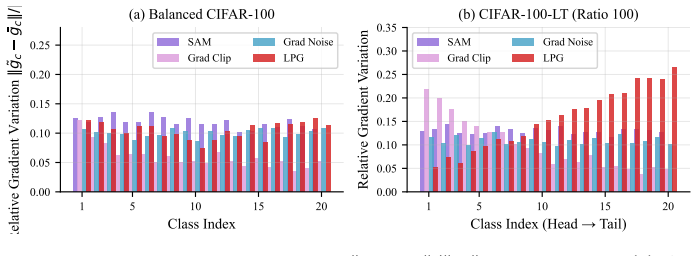
Deep neural network training involves both forward propagation (from features through logits to loss) and backward propagation (from loss through gradients to parameter updates). While perturbations along the forward chain, including feature perturbation, logit perturbation, and label perturbation, have been extensively studied, the backward chain's gradient perturbation has received little systematic investigation. In this paper, we establish a unified framework for gradient perturbation, revealing that existing methods such as Sharpness-Aware Minimization (SAM), gradient clipping, and gradient noise injection can all be interpreted as imposing specific forms of gradient perturbation. Analogous to the recently proposed Logit Perturbation Learning (LPL), we conjecture that amplifying the gradient norm for a class acts as positive augmentation (enhancing learning), while dampening it acts as negative augmentation (suppressing overfitting). Based on these observations, we propose Learning to Perturb Gradients (LPG), which adaptively perturbs logit-level gradients at the class level to achieve category-aware training. We also establish theoretical connections between gradient perturbation bounds and generalization guarantees via PAC-Bayesian analysis. Experiments on balanced classification, long-tail classification, and noisy label learning demonstrate that LPG consistently outperforms existing methods and can be combined with them as a plug-in module.
Figures


Figures from the paper (3 more)


Reference graph
Works this paper leans on
-
[1]
Simplified pac-bayesian margin bounds
David A McAllester. Simplified pac-bayesian margin bounds. InLearning Theory and Kernel Machines: 16th Annual Conference on Learning Theory and 7th Kernel Workshop, COLT/Kernel 2003, Washington, DC, USA, August 24-27,
2003
-
[2]
Adding Gradient Noise Improves Learning for Very Deep Networks
URLhttps: //openreview.net/forum?id=37nvvqkCo5. Arvind Neelakantan, Luke Vilnis, Quoc V Le, Ilya Sutskever, Lukasz Kaiser, Karol Kurach, and James Martens. Adding gradient noise improves learning for very deep networks.arXiv preprint arXiv:1511.06807,
-
[3]
Large Batch Training of Convolutional Networks
Yisen Wang, Xingjun Ma, Zaiyi Chen, Yuan Luo, Jinfeng Yi, and James Bailey. Symmetric cross entropy for robust learning with noisy labels. InProceedings of the IEEE/CVF International Conference on Computer Vision, pages 322–330, October 2019a. Yulin Wang, Xuran Pan, Shiji Song, Hong Zhang, Gao Huang, and Cheng Wu. Implicit semantic data augmentation for d...
Reviewed June 29, 2026 · model on record in the stance chip above.
Discussion (0). Sign in to comment.