Performance Analysis of Underwater Quantum Key Distribution Protocols: BB84, SARG04, and BBM92
Pith reviewed 2026-06-29 07:22 UTC · model grok-4.3
The pith
The BBM92 protocol admits an analytical QBER expression derived from Kraus operators that model attenuation and depolarization in underwater channels.
A machine-rendered reading of the paper's core claim, the machinery that carries it, and where it could break.
Core claim
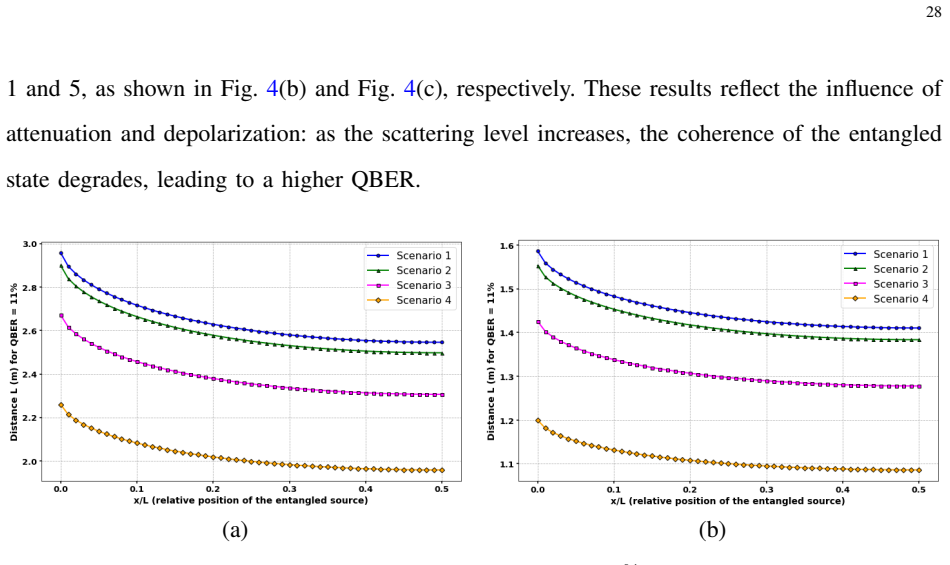
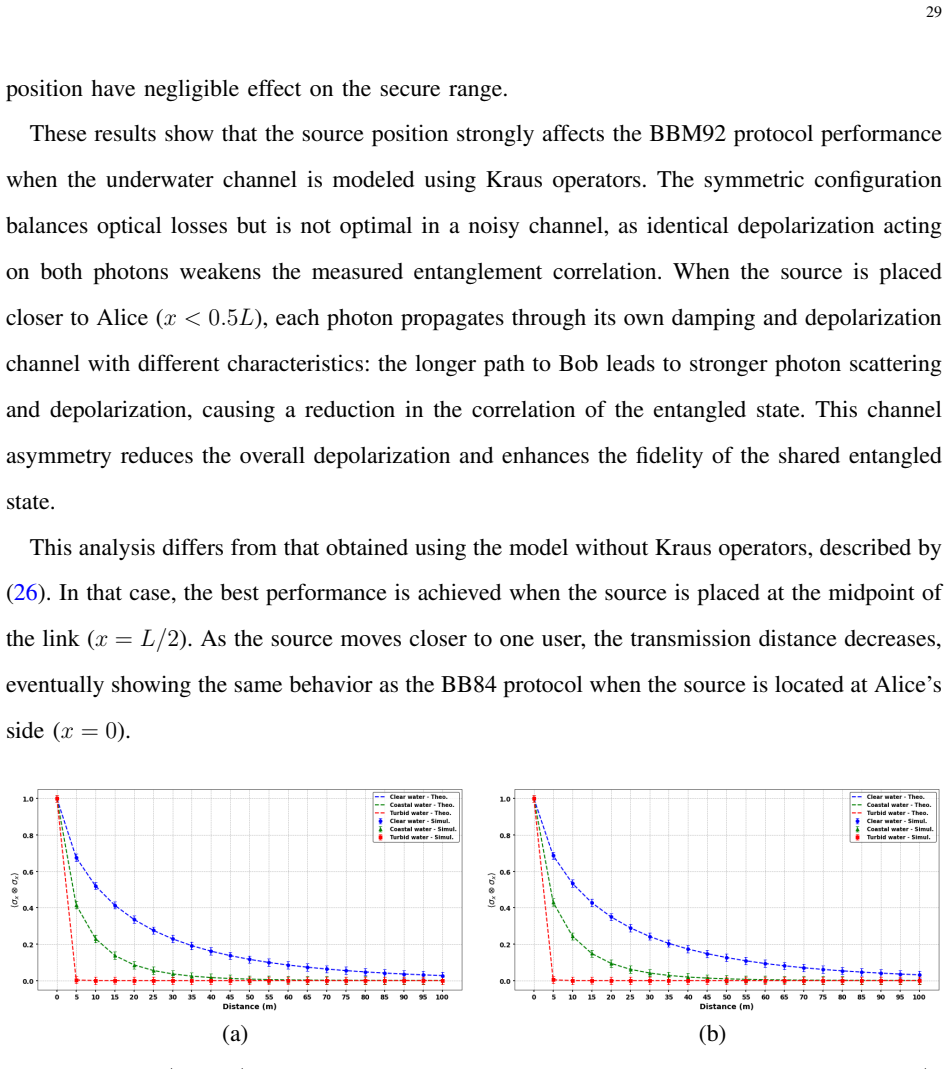
For the BBM92 protocol, the quantum channel is modeled using Kraus operators, which characterize the combined effects of attenuation and depolarization on maximally-entangled photons, allowing the derivation of an analytical expression of the QBER, based on the correlation losses between measurements. Monte Carlo simulation results validate the analytical expression of the QBER for all the studied protocols, under various water types, atmospheric conditions, and system parameters.
What carries the argument
Kraus operators for modeling combined attenuation and depolarization effects on maximally-entangled photons in the underwater quantum channel.
Load-bearing premise
The effects of the underwater channel are fully captured by attenuation and depolarization alone in non-turbulent seawater.
What would settle it
A measurement showing that the observed QBER in an underwater quantum channel deviates substantially from the value predicted by the analytical expression based on Kraus operators.
Figures
read the original abstract
Underwater quantum key distribution (UQKD) ensures unconditional communication security based on the fundamental principles of quantum mechanics. This study examines the performance of the BB84, SARG04, and the entanglement-based BBM92 protocols under the impact of both system optical parameters and the physical effects of the underwater channel. The main performance criteria considered are the quantum bit error rate (QBER) and the quantum correlation between the communicating parties as functions of the propagation distance in three types of non-turbulent seawater: clear, coastal, and turbid. For the BBM92 protocol, the quantum channel is modeled using Kraus operators, which characterize the combined effects of attenuation and depolarization on maximally-entangled photons, allowing the derivation of our analytical expression of the QBER, based on the correlation losses between measurements. Monte Carlo simulation results validate the analytical expression of the QBER for all the studied protocols, under various water types, atmospheric conditions, and system parameters. The results determine the conditions under which QKD protocols achieve optimal performance for secure and efficient underwater quantum communications.
Editorial analysis
A structured set of objections, weighed in public.
Referee Report
Summary. The paper examines the performance of BB84, SARG04, and BBM92 quantum key distribution protocols in underwater channels, focusing on QBER and quantum correlation versus propagation distance in clear, coastal, and turbid non-turbulent seawater. For BBM92, it models the channel with Kraus operators combining attenuation and depolarization to derive an analytical QBER expression based on correlation losses, validated by Monte Carlo simulations under various conditions.
Significance. Should the channel model prove adequate, the analytical QBER derivation and simulation results would offer practical guidance for optimizing UQKD systems, particularly in identifying viable distances for secure key distribution in different water types.
major comments (1)
- [Abstract] Abstract: The analytical QBER for BBM92 is derived from Kraus operators modeling only attenuation and depolarization. This may not fully capture the effects of multiple scattering in non-turbulent seawater, which can cause polarization-dependent losses and additional decoherence not included in a simple depolarization channel. Since the Monte Carlo validation employs the identical model, it verifies algebraic consistency rather than physical accuracy.
minor comments (1)
- The abstract refers to 'system optical parameters' and 'atmospheric conditions' without defining them or indicating how they enter the QBER expressions or simulations.
Simulated Author's Rebuttal
We thank the referee for the detailed review and constructive comment. We address the major point below and will incorporate clarifications in a revised manuscript.
read point-by-point responses
-
Referee: [Abstract] Abstract: The analytical QBER for BBM92 is derived from Kraus operators modeling only attenuation and depolarization. This may not fully capture the effects of multiple scattering in non-turbulent seawater, which can cause polarization-dependent losses and additional decoherence not included in a simple depolarization channel. Since the Monte Carlo validation employs the identical model, it verifies algebraic consistency rather than physical accuracy.
Authors: We agree that the Kraus-operator model (attenuation plus depolarization) is an approximation. It is adopted because it permits a closed-form QBER derivation for BBM92 while remaining consistent with standard treatments of non-turbulent scattering channels in the QKD literature. Depolarization is intended to capture the net polarization scrambling induced by multiple scattering events; however, we acknowledge that it does not explicitly include polarization-dependent loss or higher-order decoherence mechanisms. Consequently, the Monte Carlo runs confirm algebraic correctness of the derivation rather than independent physical validation. In the revised manuscript we will (i) state this modeling limitation explicitly in the abstract and channel-model section, (ii) add a short paragraph discussing the scope of the approximation, and (iii) cite representative works that employ more detailed scattering models. No change to the numerical results or analytical expressions is required. revision: partial
Circularity Check
QBER derivation is a direct mathematical consequence of the input Kraus model with no reduction to fitted quantities or self-citations
full rationale
The paper states that the BBM92 QBER expression is obtained by applying Kraus operators (modeling attenuation plus depolarization) to the maximally entangled state and extracting correlation losses. Monte Carlo simulation is then run on the identical operator set to confirm algebraic consistency. This is a standard forward derivation from stated channel assumptions to an observable; the result is not obtained by fitting parameters to data and then relabeling the output as a prediction, nor does any load-bearing step rely on a self-citation whose content is itself unverified. No self-definitional, fitted-input, or ansatz-smuggling patterns appear. The derivation chain is therefore self-contained against the paper's own premises.
Axiom & Free-Parameter Ledger
Reference graph
Works this paper leans on
-
[1]
Underwater communication technologies: A review,
T. Theocharidis and E. Kavallieratou, “Underwater communication technologies: A review,”Telecommunication Systems, vol. 88, no. 2, p. 54, 2025, http://doi.org/10.1007/s11235-025-01279-x
-
[2]
Underwater optical wireless communication,
H. Kaushal and G. Kaddoum, “Underwater optical wireless communication,”IEEE access, vol. 4, pp. 1518–1547, 2016, http://doi.org/10.1109/ACCESS.2016.2552538
-
[3]
M. O. Lanzagorta,Underwater communications. Morgan & Claypool Publishers, 2012, http://doi.org/10.1007/978-3-031- 01678-3
-
[4]
Underwater turbulence, its effects on optical wireless communication and imaging: A review,
Y . Baykal, Y . Ata, and M. G ¨okc ¸e, “Underwater turbulence, its effects on optical wireless communication and imaging: A review,”Optics & Laser Technology, vol. 156, p. 108624, 2022, http://doi.org/10.1016/j.optlastec.2022.108624
-
[5]
Heisenberg’s uncertainty principle,
P. Busch, T. Heinonen, and P. Lahti, “Heisenberg’s uncertainty principle,”Physics reports, vol. 452, no. 6, pp. 155–176, 2007, http://doi.org/10.1016/j.physrep.2007.05.006
-
[6]
A single quantum cannot be cloned,
W. K. Wootters and W. H. Zurek, “A single quantum cannot be cloned,”Nature, vol. 299, no. 5886, pp. 802–803, 1982, http://doi.org/10.1038/299802a0
-
[7]
Experimental quantum cryptography,
C. H. Bennett, F. Bessette, G. Brassard, L. Salvail, and J. Smolin, “Experimental quantum cryptography,”Journal of cryptology, vol. 5, no. 1, pp. 3–28, 1992, http://doi.org/10.1007/BF00191318. 35
-
[8]
10-GHz clock differential phase shift quantum key distribution experiment,
H. Takesue, E. Diamanti, C. Langrock, M. M. Fejer, and Y . Yamamoto, “10-GHz clock differential phase shift quantum key distribution experiment,”Optics Express, vol. 14, no. 20, pp. 9522–9530, 2006, http://doi.org/10.1364/oe.14.009522
-
[9]
Quantum key distribution over a 40-dB channel loss using superconducting single-photon detectors,
H. Takesue, S. Nam, Q. Zhang, R. Hadfield, T. Honjo, K. Tamaki, and Y . Yamamoto, “Quantum key distribution over a 40-dB channel loss using superconducting single-photon detectors,”Nature photonics, vol. 1, no. 6, pp. 343–348, 2007, http://doi.org/10.1038/nphoton.2007.75
-
[10]
2 GHz clock quantum key distribution over 260 km of standard telecom fiber,
S. Wang, W. Chen, J. F. Guo, Z. Q. Yin, H. W. Li, Z. Zhou, G. C. Guo, and Z. F. Han, “2 GHz clock quantum key distribution over 260 km of standard telecom fiber,”Optics Letters, vol. 37, no. 6, pp. 1008–1010, 2012, http://doi.org/10.1364/OL.37.001008
-
[11]
Practical free-space quantum key distribution over 1 km,
W. Buttler, R. Hughes, P. Kwiat, S. Lamoreaux, G. Luther, G. Morgan, J. Nordholt, C. Peterson, and C. Simmons, “Practical free-space quantum key distribution over 1 km,”Physical review letters, vol. 81, no. 15, p. 3283, 1998, http://doi.org/10.1103/PhysRevLett.81.3283
-
[12]
Controlled bidirectional remote state preparation in noisy environment: a generalized view,
V . Sharma, C. Shukla, S. Banerjee, and A. Pathak, “Controlled bidirectional remote state preparation in noisy environment: a generalized view,”Quantum Information Processing, vol. 14, no. 9, pp. 3441–3464, 2015, http://doi.org/10.1007/s11128- 015-1038-5
-
[13]
Advances in space quantum communications,
J. Sidhu, S. Joshi, M. G ¨undo˘gan, T. Brougham, D. Lowndes, L. Mazzarella, M. Krutzik, S. Mohapatra, D. Dequal, G. Vallone, and al., “Advances in space quantum communications,”IET Quantum Communication, vol. 2, no. 4, pp. 182– 217, 2021, http://doi.org/10.1049/qtc2.12015
-
[14]
Strategies for achieving high key rates in satellite-based QKD,
S. Ecker, B. Liu, J. Handsteiner, M. Fink, D. Rauch, F. Steinlechner, T. Scheidl, A. Zeilinger, and R. Ursin, “Strategies for achieving high key rates in satellite-based QKD,”npj Quantum Information, vol. 7, no. 1, p. 5, 2021, http://doi.org/10.1038/s41534-020-00335-5
-
[15]
Analysis of satellite- to-ground quantum key distribution with adaptive optics,
V . Acosta, D. Dequal, M. Schiavon, A. Montmerle-Bonnefois, C. Lim, J. Conan, and E. Diamanti, “Analysis of satellite- to-ground quantum key distribution with adaptive optics,”New Journal of Physics, vol. 26, no. 2, p. 023039, 2024, http://doi.org/10.1088/1367-2630/ad231c
-
[16]
Towards quantum communications in free-space seawater,
L. Ji, J. Gao, A. Yang, Z. Feng, X. Lin, Z. Li, and X. Jin, “Towards quantum communications in free-space seawater,” Optics Express, vol. 25, no. 17, pp. 19 795–19 806, 2017, http://doi.org/10.1364/OE.25.019795
-
[17]
Performance of underwater quantum key distribution with polarization encoding in ocean water,
S. Zhao, X. Han, Y . Xiao, Y . Shen, Y . Gu, and W. Li, “Performance of underwater quantum key distribution with polarization encoding in ocean water,”Journal of the Optical Society of America A, vol. 36, no. 5, pp. 883–892, 2019, http://doi.org/10.1364/JOSAA.36.000883
-
[18]
Quantum cryptography: Public key distribution and coin tossing,
C. H. Bennett and G. Brassard, “Quantum cryptography: Public key distribution and coin tossing,” inInternational conference on computers, systems and signal processing, 1984, pp. 175–179, http://doi.org/10.1016/j.tcs.2014.05.025
-
[19]
Simple proof of security of the BB84 quantum key distribution protocol,
P. W. Shor and J. Preskill, “Simple proof of security of the BB84 quantum key distribution protocol,”Physical review letters, vol. 85, no. 20, p. 441, 2000, http://doi.org/10.1103/PhysRevLett.85.441
-
[20]
Performance Analysis of Satellite-Based QKD Protocols
Muskan, R. Meena, and S. Banerjee, “Performance analysis of satellite-based QKD protocols using the circular beam model,”arXiv, 2023, https://arxiv.org/abs/2308.01036
work page internal anchor Pith review Pith/arXiv arXiv 2023
-
[21]
Y . Ata and K. Kiasaleh, “Impact of natural turbulent waters on quantum key distribution: Temperature and salinity considerations,”IEEE Journal of Oceanic Engineering, vol. 50, no. 3, pp. 2381–2393, 2025, http://doi.org/10.1109/JOE.2025.3551076. 36
-
[22]
A primer on underwater quantum key distribution,
P. Paglierani, A. H. F. Raouf, K. Pelekanakis, R. Petroccia, J. Alves, and M. Uysal, “A primer on underwater quantum key distribution,”Quantum Engineering, vol. 2023, no. 1, p. 7185329, 2023, http://doi.org/10.1155/2023/7185329
-
[23]
Beating the photon-number-splitting attack in practical quantum cryptography,
X. B. Wang, “Beating the photon-number-splitting attack in practical quantum cryptography,”Physical review letters, vol. 94, no. 23, p. 230503, 2005, http://doi.org/10.1103/PhysRevLett.94.230503
-
[24]
State-of-the-art survey of quantum cryptography,
A. Kumar and S. Garhwal, “State-of-the-art survey of quantum cryptography,”Archives of Computational Methods in Engineering, vol. 29, no. 4, pp. 2291–2313, 2021, http://doi.org/10.1007/s11831-021-09561-2
-
[25]
V . Scarani, H. Bechmann-Pasquinucci, N. J. Cerf, M. Duˇsek, N. L¨utkenhaus, and M. Peev, “Quantum cryptography protocols robust against photon number splitting attacks for weak laser pulse implementations,”Physical review letters, vol. 92, no. 5, p. 057901, 2004, http://doi.org/10.1103/PhysRevLett.92.057901
-
[26]
Performances des protocoles QKD, BB84 et SARG04 pour les communications quantiques sous-marines,
N. Rizk, A. Dr ´emeau, and A. Coatanhay, “Performances des protocoles QKD, BB84 et SARG04 pour les communications quantiques sous-marines,” inProc. of GRETSI, Strasbourg, France, 2025
2025
-
[27]
Quantum cryptography without bell’s theorem,
C. H. Bennett, G. Brassard, and N. D. Mermin, “Quantum cryptography without bell’s theorem,”Physical review letters, vol. 68, no. 5, p. 557, 1992, http://doi.org/10.1103/PhysRevLett.68.557
-
[28]
On the performance of two protocols: SARG04 and BB84
C. Fung, K. Tamaki, and H. Lo, “On the performance of two protocols: SARG04 and BB84,”arXiv [quant-ph], 2005, https://arxiv.org/abs/quant-ph/0510025
work page internal anchor Pith review Pith/arXiv arXiv 2005
-
[29]
Security of two quantum cryptography protocols using the same four qubit states,
C. Branciard, N. Gisin, B. Kraus, and V . Scarani, “Security of two quantum cryptography protocols using the same four qubit states,”Physical Review A, vol. 72, no. 3, p. 032301, 2005, http://doi.org/10.1103/PhysRevA.72.032301
-
[30]
Security of quantum key distribution with entangled photons against individual attacks,
E. Waks, H. Krovi, and Y . Yamamoto, “Security of quantum key distribution with entangled photons against individual attacks,”Physical Review A, vol. 65, no. 5, p. 052310, 2002, http://doi.org/10.1103/PhysRevA.65.052310
-
[31]
Performance of two quantum-key-distribution protocols,
C. Fung, K. Tamaki, and H. Lo, “Performance of two quantum-key-distribution protocols,”Physical Review A, vol. 73, no. 1, p. 012337, 2006, http://doi.org/10.1103/PhysRevA.73.012337
-
[32]
C. D. Mobley,Light and water: radiative transfer in natural waters. Academic press, 1994, iSBN: 978-0-12-502890-7
1994
-
[33]
Performance characterization of underwater visible light communication,
M. Elamassie, F. Miramirkhani, and M. Uysal, “Performance characterization of underwater visible light communication,” IEEE Transactions on Communications, vol. 67, no. 1, pp. 543–552, 2018, http://doi.org/10.1109/TCOMM.2018.2867498
-
[34]
B. Saleh and M. Teich,Fundamentals of Photonics. Wiley, 1991, http://doi.org/10.1002/0471213748
-
[35]
Free-space quantum cryptography in the H-alpha fraunhofer window,
D. Rogers, J. Bienfang, A. Mink, B. Hershman, A. Nakassis, X. Tang, L. Ma, D. Su, C. Williams, and C. Clark, “Free-space quantum cryptography in the H-alpha fraunhofer window,” inFree-Space Laser Communications VI, vol. 6304. SPIE, 2006, pp. 296–305, http://doi.org/10.1117/12.680899
-
[36]
Practical decoy state for quantum key distribution,
X. Ma, B. Qi, Y . Zhao, and H. Lo, “Practical decoy state for quantum key distribution,”Physical Review A, vol. 72, no. 1, p. 012326, 2005, http://doi.org/10.1103/PhysRevA.72.012326
-
[37]
Practical SARG04 quantum key distribution,
S. Ali, S. Mohammed, M. Chowdhury, and A. Hasan, “Practical SARG04 quantum key distribution,”Optical and Quantum Electronics, vol. 44, no. 10, pp. 471–482, 2012, http://doi.org/10.1007/s11082-012-9571-2
-
[38]
A. S. Holevo,Quantum systems, channels, information: a mathematical introduction. Walter de Gruyter GmbH & Co KG, 2013, http://doi.org/10.1515/9783110273403
-
[39]
Wilde,Quantum information theory
M. Wilde,Quantum information theory. Cambridge university press, 2013, http://doi.org/10.1017/CBO9781139525343
-
[40]
Full thermalization of a photonic qubit,
A. de Oliveira, R. Gomes, V . Brasil, N. da Silva, L. C ´eleri, and P. Ribeiro, “Full thermalization of a photonic qubit,” Physics Letters A, vol. 384, no. 36, p. 126933, 2020, http://doi.org/10.1016/j.physleta.2020.126933. 37
-
[41]
B. Wo ´zniak and J. Dera,Light Absorption in Sea Water, ser. Atmospheric and Oceanographic Sciences Library. Springer, 2007, vol. 33, http://doi.org/10.1007/978-0-387-49560-6
-
[42]
Performance analysis of underwater quantum key distribution in oceanic turbulence channels,
A. H. F. Raouf, “Performance analysis of underwater quantum key distribution in oceanic turbulence channels,” 2022, master’s Thesis
2022
-
[43]
Quantum key distribution protocols: a review,
H. Singh, D. Gupta, and A. Singh, “Quantum key distribution protocols: a review,”Journal of Computer Engineering, vol. 16, no. 2, pp. 1–9, 2014, http://doi.org/10.9790/0661-162110109. 38 Nour Rizkreceived the M.Sc. degree in Applied Mathematics and Modeling from the Universit ´e de Rouen Normandie - UFR Sciences et Techniques, Rouen, France, in 2023. Sinc...
-
[44]
Ang´elique Dr ´emeaugraduated from the IMT Atlantique (ex-ENSTB), Brest, France, in 2006
Her research focuses on quantum optical systems for underwater communication, quantum key distribution, and quantum information theory. Ang´elique Dr ´emeaugraduated from the IMT Atlantique (ex-ENSTB), Brest, France, in 2006. She received the Ph.D. degree from the University of Rennes, France, in 2010, and the HDR degree from the Universit ´e de Bretagne ...
2006
-
[45]
degree from the University of Le Havre, Le Havre, France, in 2000, and the HDR degree from the Universit´e de Bretagne Occidentale (UBO), Brest, France, in June 2022
He received the Ph.D. degree from the University of Le Havre, Le Havre, France, in 2000, and the HDR degree from the Universit´e de Bretagne Occidentale (UBO), Brest, France, in June 2022. He is currently a Full Professor at the ´Ecole Nationale Sup´erieure de Techniques Avanc´ees (ENSTA, Institut Polytechnique de Paris), Brest. His research interests inc...
2000
discussion (0)
Sign in with ORCID, Apple, or X to comment. Anyone can read and Pith papers without signing in.