HiKEY: Hierarchical Multimodal Retrieval for Open-Domain Document Question Answering
Pith reviewed 2026-06-29 07:37 UTC · model grok-4.3
The pith
HiKEY treats document hierarchy as a first-class retrieval signal to fix routing failures and evidence fragmentation in large-scale document QA.
A machine-rendered reading of the paper's core claim, the machinery that carries it, and where it could break.
Core claim
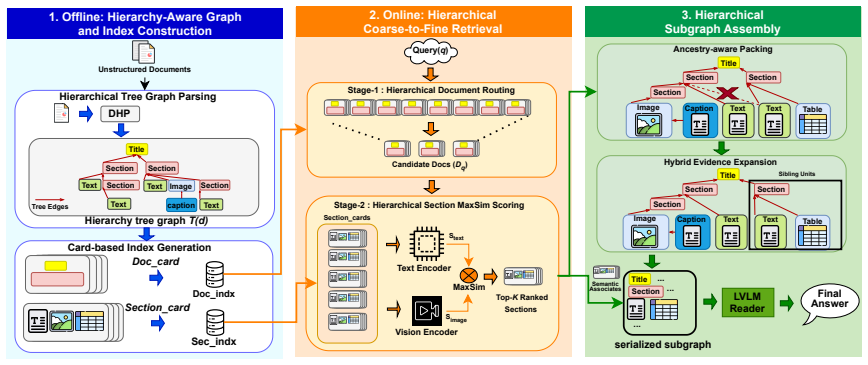
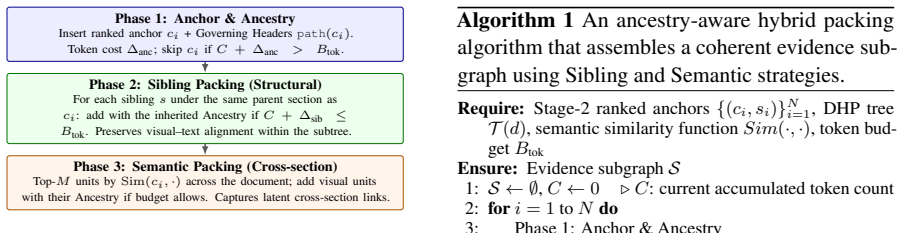
HiKEY reconstructs documents into a logical heterogeneous graph via Document Hierarchical Parsing, performs global routing with hierarchical indexing to prune candidates, applies fine-grained multimodal retrieval to rank sections, and assembles a token-efficient evidence subgraph through hybrid structural-semantic packing, yielding up to 12.9 percent higher retrieval recall and 6.8 percent better QA performance than page- and chunk-based methods.
What carries the argument
Document Hierarchical Parsing (DHP), which builds a tree of parent-child relationships to enable hierarchical coarse-to-fine retrieval and multimodal fusion.
If this is right
- Global routing at the hierarchy level reduces the number of candidates that must be examined in detail.
- Multimodal fusion inside sections allows tables and figures to be scored together with surrounding text.
- Hybrid packing produces shorter evidence sets that still preserve cross-section connections.
- The same tree structure can be reused for both retrieval and later generation steps.
Where Pith is reading between the lines
- The method may generalize to any corpus that already contains explicit section nesting, such as technical manuals or legal filings.
- If parsing errors are common, adding a lightweight human correction step at the tree-construction stage could preserve most of the gains.
- The coarse-to-fine split suggests a natural way to combine fast symbolic indexes with slower neural rerankers.
Load-bearing premise
Document Hierarchical Parsing can reliably recover accurate logical parent-child relationships in varied industrial documents.
What would settle it
Run the system on a corpus of industrial documents whose logical hierarchy has been deliberately scrambled or removed and measure whether the reported recall and QA gains disappear.
Figures
read the original abstract
Retrieval-augmented generation (RAG) for document-based Open-domain Question Answering (ODQA) on large-scale industrial corpora faces two critical bottlenecks: routing failure in locating the correct document and evidence fragmentation in integrating scattered information. Existing approaches relying on flat text chunks or page-level images inherently struggle to (i) precisely pinpoint the target document among thousands of candidates and (ii) organically connect multimodal evidence, such as tables and figures, within a limited token budget. To address these challenges, we propose HiKEY, a hierarchical tree-based multimodal retrieval framework that elevates document hierarchy to a first-class retrieval signal. Instead of simple chunking, HiKEY reconstructs a logical heterogeneous graph via Document Hierarchical Parsing (DHP), explicitly encoding parent-child relationships. Adopting a hierarchical coarse-to-fine strategy, the framework (1) performs global routing to rapidly prune the search space using hierarchical indexing, and (2) conducts fine-grained retrieval to rank sections by employing a multimodal fusion strategy that captures the most discriminative evidence. Finally, HiKEY assembles a token-efficient evidence subgraph via a hybrid structural-semantic packing strategy. Experiments on ODQA benchmarks demonstrate that HiKEY significantly outperforms page- and chunk-based baselines, improving retrieval recall by up to 12.9% and end-to-end QA performance by up to 6.8%.
Editorial analysis
A structured set of objections, weighed in public.
Referee Report
Summary. The paper proposes HiKEY, a hierarchical tree-based multimodal retrieval framework for open-domain document QA. It reconstructs a logical heterogeneous graph via Document Hierarchical Parsing (DHP) to encode parent-child relationships, then applies a coarse-to-fine strategy with global routing to prune search space and fine-grained multimodal fusion for ranking sections, followed by hybrid structural-semantic packing. Experiments on ODQA benchmarks are claimed to show up to 12.9% retrieval recall improvement and 6.8% end-to-end QA gains over page- and chunk-based baselines.
Significance. If the central claims hold, the explicit use of document hierarchy as a first-class signal could meaningfully address routing failures and evidence fragmentation in large industrial corpora, offering a structured alternative to flat chunking. The framework is presented as a new construction evaluated against external benchmarks rather than self-referential fitting, which is a positive aspect.
major comments (2)
- [Abstract] Abstract: The claims of up to 12.9% recall lift and 6.8% QA improvement are stated without any description of datasets, baselines, error bars, or statistical tests. This is load-bearing for the central claim of significant outperformance, as the abstract supplies no experimental details to support verification.
- [Document Hierarchical Parsing (DHP)] Document Hierarchical Parsing (DHP) section: The strongest performance claims rest on DHP reliably reconstructing parent-child hierarchies to enable effective global routing and fine-grained retrieval. No quantitative DHP accuracy metrics, failure-mode analysis on industrial layouts (e.g., tables spanning pages), or ablation removing the hierarchy signal are provided; high parsing error rates would add noise rather than signal and could make reported gains dataset-specific artifacts.
minor comments (1)
- [Abstract] The abstract could include a short statement of the specific ODQA benchmarks used to ground the performance numbers.
Simulated Author's Rebuttal
We thank the referee for the constructive feedback on our manuscript. The comments highlight important aspects of clarity and validation that we will address in revision. We respond point-by-point below.
read point-by-point responses
-
Referee: [Abstract] Abstract: The claims of up to 12.9% recall lift and 6.8% QA improvement are stated without any description of datasets, baselines, error bars, or statistical tests. This is load-bearing for the central claim of significant outperformance, as the abstract supplies no experimental details to support verification.
Authors: We agree that the abstract would benefit from additional context to make the performance claims more verifiable at a glance. In the revised manuscript, we will update the abstract to briefly reference the ODQA benchmarks used, note that comparisons are against page- and chunk-based baselines, and indicate that the gains are supported by experiments that include error bars and statistical tests (with full details provided in the experimental section). This revision will be made while preserving abstract length constraints. revision: yes
-
Referee: [Document Hierarchical Parsing (DHP)] Document Hierarchical Parsing (DHP) section: The strongest performance claims rest on DHP reliably reconstructing parent-child hierarchies to enable effective global routing and fine-grained retrieval. No quantitative DHP accuracy metrics, failure-mode analysis on industrial layouts (e.g., tables spanning pages), or ablation removing the hierarchy signal are provided; high parsing error rates would add noise rather than signal and could make reported gains dataset-specific artifacts.
Authors: We acknowledge that direct validation of the DHP step strengthens the claims. We will add an ablation study comparing HiKEY against a non-hierarchical variant to isolate the contribution of the parent-child signal. For quantitative DHP accuracy metrics and failure-mode analysis on layouts such as spanning tables, we will incorporate a discussion of parsing reliability (drawing on available annotations where present) and potential error propagation; if comprehensive per-layout metrics require new annotations beyond the current scope, we will explicitly note this as a limitation while emphasizing the end-to-end gains. revision: partial
Circularity Check
No circularity; new framework evaluated on external benchmarks
full rationale
The paper introduces HiKEY as a novel hierarchical multimodal retrieval system built around Document Hierarchical Parsing (DHP) to create a heterogeneous graph, followed by coarse-to-fine routing and multimodal fusion. All performance claims (recall +12.9%, QA +6.8%) are presented as empirical outcomes measured against page- and chunk-based baselines on ODQA benchmarks. No equations, fitted parameters renamed as predictions, self-citations used as load-bearing uniqueness theorems, or ansatzes smuggled via prior work appear in the provided text. The derivation chain consists of explicit construction steps whose outputs are independently tested rather than reducing to the inputs by definition.
Axiom & Free-Parameter Ledger
invented entities (1)
-
Document Hierarchical Parsing (DHP)
no independent evidence
Reference graph
Works this paper leans on
-
[1]
LLaVA-OneVision-1.5: Fully Open Framework for Democratized Multimodal Training
Llava-onevision-1.5: Fully open framework for democratized multimodal training.Preprint, arXiv:2509.23661. Satanjeev Banerjee and Alon Lavie. 2005. Meteor: An automatic metric for mt evaluation with improved correlation with human judgments. InProceedings of the ACL workshop on intrinsic and extrinsic evalu- ation measures for machine translation and/or s...
work page internal anchor Pith review Pith/arXiv arXiv 2005
-
[2]
Development of a liver disease-specific large language model chat interface using retrieval aug- mented generation.medRxiv. Hongyu Gong, Yelong Shen, Dian Yu, Jianshu Chen, and Dong Yu. 2020. Recurrent chunking mechanisms for long-text machine reading comprehension. pages 6751–6761. Xiaoxin He, Yijun Tian, Yifei Sun, Nitesh V . Chawla, Thomas Laurent, Yan...
-
[3]
RAPTOR: Recursive Abstractive Processing for Tree-Organized Retrieval
Raptor: Recursive abstractive processing for tree-organized retrieval.Preprint, arXiv:2401.18059. Mohammad Shoeybi Sheng-Chieh Lin, Chankyu Lee
work page internal anchor Pith review Pith/arXiv arXiv
-
[4]
Mm-embed: Universal multimodal retrieval with multimodal llms.arXiv preprint arXiv:2411.02571, 2024
Mm-embed: Universal multimodal retrieval with multimodal llms.Preprint, arXiv:2411.02571. Joongmin Shin, Chanjun Park, Jeongbae Park, Jaehyung Seo, and Heuiseok Lim. 2025. MultiDocFusion : Hierarchical and multimodal chunking pipeline for enhanced RAG on long industrial documents. InProceedings of the 2025 Conference on Empir- ical Methods in Natural Lang...
-
[5]
under which section does X fall?
MoC: Mixtures of text chunking learners for retrieval-augmented generation system. InProceed- ings of the 63rd Annual Meeting of the Association for Computational Linguistics (Volume 1: Long Pa- pers), pages 5172–5189, Vienna, Austria. Associa- tion for Computational Linguistics. Xu Zhong, Elaheh ShafieiBavani, and Antonio Ji- meno Yepes. 2020. Image-base...
2020
discussion (0)
Sign in with ORCID, Apple, or X to comment. Anyone can read and Pith papers without signing in.